Picture this: A surrealist oil painting in which an AI-powered sailboat whose sails are made of money is at the crest of an enormous wave. The boat is about to surf down the front of this wave, and in doing so will cross the starting line of a race that will finish in 2026.
That’s the prompt I typed into Dall-E 3, and the resulting image it generated after a few iterations. Why on earth did I ask a generative AI tool to conjure this image? Coming out of re:Invent you can’t help but think about AI in 2024, and this image sums up my high-level thoughts on the topic. Read on for my thoughts on the intersection of sailboat racing, Gartner’s Hype Cycle for Artificial Intelligence, and Dr. Werner Vogels’ AWS re:Invent keynote focus on cloud cost.
[AI-Generated] Behold the surreal depiction of an AI-driven sailboat, its sails adorned with currency motifs, ready to ride the wave towards the starting line of a transformative race set to culminate in 2026.
What the Gartner Hype Cycle says about generative AI: The crest of the wave
Anyone with an internet connection in 2023 has been hit with an onslaught of chatter about artificial intelligence, especially generative AI. So it’s fitting that Gartner placed genAI on their 2023 Hype Cycle at the very top of the “Peak of Inflated Expectations,” estimating it will reach the “Plateau of Productivity” in 5-10 years. What that means for the next year or two is a precipitous drop into the “Trough of Disillusionment.” (Isn’t that where Atreyu lost Artax in The Neverending Story?)
In plainer language, the market is currently as excited about generative AI as it’s likely to ever be. It’s literally all downhill from here, but that’s not entirely bad news. While companies focused on genAI will start experiencing greater skepticism, on the other end of the cycle will be true market acceptance. The companies that make it through the wild ride will reap the rewards. So how can companies developing generative AI products set themselves up for future success today?
Why it’s important to architect with scale and cost in mind: The sailboat
Dr. Werner Vogels’ AWS re:Invent keynote speech focused on the importance of building cost-conscious, scaleable architures, especially as companies evolve and markets mature. He drew parallels between cost and sustainability, and while little evidence was provided related to the implied environmental sustainability, cost optimization is an obvious element of business sustainability.
For companies developing generative AI applications, business sustainability is going to be an important focus on the downward slope into (and eventually back up and out of) disillusionment. The market has seen genAI’s potential, but is also starting to see the limitations of early iterations. The companies that make it through the upcoming era of skepticism will need to show their value in multiple ways.
Customers will need to see products that work as advertised, proving their worth with minimal hallucinations, maximal authenticity and real utility. Getting there will require better models and a constant stream of high volume, high quality data. At the same time, investors will need to see a sustainable business that includes sound financials with a clear path to profitability that includes controlled, predictable costs. This means architecting for scale and cost efficiency should be builders’ top priority.
Experts have suggested that over time, models will become somewhat commoditized, and the greatest competitive advantage will come from datasets. This expectation underscores the criticality of data and relatedly, maintaining its availability, security and resilience. But at the speed and scale required for generative AI, these datasets will be inundated with API calls, making resilience efforts that much more challenging.
Position early for long-term success: The starting line
The start of a sailing race is chaotic. Unlike other forms of racing in which you start from a standstill, sailboats cross the starting line already moving at full speed. The race really begins before the official start, with boats vying for an optimal starting position. They come within inches of one another, aiming to cross the starting line just as the gun is fired and in position to take maximum advantage of the wind. Cross the line at the right time, in the right position, with the right sails and you’re golden. Too early or late, with the wrong sails or in the wrong spot, and your race is pretty much over just as it’s begun.
Right now, generative AI builders are moving at full speed, about to cross that starting line, and not all of them will make it to the finish, the “Plateau of Productivity.” The race before the race has been chaotic (Bard getting a little too emo) and exciting (ChatGPT’s ubiquity). While some differentiation is already apparent, we’re far from declaring winners and losers. A lot can happen in the upcoming years.
Companies that have already built promising products while architecting for cost and scalability will get the best starts, but it’s still possible for others to make strategic moves that will be beneficial in the long run. Those changes would include setting up reliable pipelines of high-quality data, infrastructure that will scale in a cost-effective manner along with that data, and tools for data governance to ensure ongoing efficiency.
Protect your competitive advantage by protecting your data: Preparing for the race ahead
As companies position themselves across the starting line, there’s a third important aspect of business sustainability that is particularly important to generative AI companies; the protection and preservation of critical data.
AI relies on vast amounts of data for model building, training and inference, and that data is generally housed in a data lake, which is often stored in Amazon S3. The criticality of that data necessitates backing it up, a task that gets more challenging as data volume grows and API calls increase.
Backup strategies that were workable in early days can quickly become expensive and failure-prone as data scales beyond the solution’s capabilities. Worse yet, backup solutions that don’t adjust to optimize API pressure can bring the whole application down. The right sail can become the wrong sail as conditions change, and in the worst case can become an anchor.
Scalable, automated data resilience: The sail that’s always right
The easier way is to start the race with a sail that automatically adjusts to conditions. In data terms, one with automated, infinite scalability even in high-change environments. Clumio backs up data lakes as small as a few hundred objects and single terabytes, as large as 40 billion objects, hundreds of petabytes, and all sizes in between, maintaining low RPO point-in-time recovery at up to 20 million changes per hour. It helps customers keep cloud costs in control by finding orphan snapshots and other unnecessary data copies, and aligns with cost-conscious architecting by offering affordable, consumption-based pricing.
The race is on. Generative AI companies need to build better products while focusing on business sustainability through scalability and cost consciousness.
Start your race ahead of the competition:
More related posts
Meet Clumio Chat: An AI Assistant to Help Evaluate Cloud-Native Data Protection
How do you take an hour’s worth of viewpoints from a panel of leading experts and condense it into a 5-minute read designed to help you prepare for 2024? That’s the challenge I posed to myself as I prepared to write this blog, so let me know if I delivered. You can also listen to the full panel discussion here.
The panel: Nathan McAfee, Senior Economic Analyst at Enterprise Strategy Group (ESG); Jaimie Fox, Azure Strategist at Microsoft; Vidya Shankaran, Field CTO at Commvault.
Their goal: Leverage the findings of the recent ESG Study on Commvault Cloud to create actionable intelligence you can use to improve your security posture.
Customer viewpoint #1: “We had no idea the risk we were incurring.”
The sooner you evaluate the risk created by having multiple cyber resilience solutions deployed to protect your data, the sooner you can reduce your potential data loss. Before making the move to Commvault Cloud, the study uncovered that most companies had more than 15 solutions deployed for data protection. These solutions were all replaced by Commvault Cloud, reducing unrecoverable data to less than 1%, with Nathan sharing that all interviewed customers reported zero instances of unrecoverable data, while also reducing their storage footprint by 31%.
The ability to provide proof points of recoverability and audited reporting can lead to lower cyber insurance costs. Nathan shared that interviewed customers who deployed Commvault Cloud lowered their cyber insurance costs, offsetting the investment in Commvault Cloud. This is a result of having validated proof of recoverability and comprehensive, auditable reporting that satisfies auditors, boards of directors, and CISOs.
Customer viewpoint #3: “Commvault Cloud Security Scorecard is the best defense.”
Perhaps the most impactful story Nathan shared focused on the value customers gain from Commvault Cloud’s Security Scorecard, highlighting one customer’s comments: “We could hire 40 security experts to try and hack our systems and it still wouldn’t be as effective as what Commvault Cloud’s Security Scorecard does, continually monitoring and letting us know what more we can do to harden our security posture even more.”
The essential ingredient missing from most cyber resilience plans
The panel closed the session with advice on an essential ingredient missing from many cyber resilience plans: the ability to recover to a clean environment. Both Vidya and Jaimie provided insight into how Cleanroom Recovery, recently launched as a joint solution by Commvault and Microsoft, solves the challenge of having an immediately available, isolated, and “clean, infection-free” environment ready to restore your data. They shared that by adopting Cleanroom Recovery, organizations can confidently test their cyber-recovery plans, identify, and remediate vulnerabilities, and ensure business continuity in the face of cyberattacks.
Prepare to be more Cyber Resilient in 2024 with Commvault Cloud
Commvault Cloud brings to market capabilities that have never existed but that are quickly becoming imperatives. With features like Cleanroom Recovery, Cloud Burst Recovery, and Arlie (Commvault Cloud’s AI co-pilot) it defends against cyber threats, safeguarding your sensitive information, bringing your business back at the right place at the right time. When the next cyberattack hits, we’re ready to help. You can access the comprehensive results of the ESG study, “Analyzing the Economic Benefits of Cyber Resilience with Commvault Cloud” here.
More related posts
Meet Clumio Chat: An AI Assistant to Help Evaluate Cloud-Native Data Protection
We’re excited to announce our latest platform release, which includes the availability of key features revealed at our Commvault Cloud launch . Experience true cloud cyber resilience – download the latest release of Commvault Cloud today and elevate your data protection strategy to new heights.
In the ever-changing digital landscape, cyber resilience has become paramount for businesses seeking to safeguard their critical data and maintain operational continuity. Experience true cloud cyber resilience – download the latest release of Commvault Cloud today and elevate your data protection strategy to new heights.
Commvault Cloud offers a multi-layered approach to enabling cyber resilience , safeguarding businesses from a wide spectrum of threats, including ransomware, malware, and natural disasters. With Commvault Cloud, businesses can rest assured that their data is safe, secure, and recoverable, empowering them to navigate the digital landscape with confidence.
Commvault Cloud’s advanced capabilities extend beyond traditional data protection, enabling businesses to recover their data quickly and easily in the event of a cyberattack. This rapid recovery ensures minimal disruption to operations, allowing businesses to maintain productivity and customer satisfaction even in the face of adversity.
Cleanroom Recovery
As we enter the new year, we are thrilled to introduce our latest innovation: Cleanroom Recovery. This cutting-edge solution is designed to revolutionize the way organizations recover their data after a cyberattack.
Cleanroom Recovery offers a secure and isolated environment in the cloud, specifically built for data recovery purposes. It provides a safe haven where you can restore your data quickly and efficiently, minimizing downtime and getting your operations back on track.
One of the key advantages of Cleanroom Recovery is its ability to ensure that your recovered data is clean and free from any potential malware. We understand the importance of data integrity, especially in the aftermath of a cyberattack. With Cleanroom Recovery, you can have peace of mind knowing that your recovered data is safe and reliable.
But Cleanroom Recovery isn’t just for post-attack scenarios. It also serves as a valuable tool for routine incident response testing. By regularly testing your recovery processes in the cleanroom environment, you can proactively assess and strengthen your systems’ ability to handle such incidents. This proactive approach enhances your overall cyber resilience, ensuring that you are well-prepared to face any challenges that may come your way.
Artificial Intelligence and Machine Learning (AI/ML) have been part of Commvault’s platform for years, working behind the scenes to help inform our users for troubleshooting, optimization, and more. Our latest innovations harness the power of AI to enhance cyber resilience and empower our customers to take proactive action by allowing users to directly interact with our AI capabilities. Introducing Arlie, our AI-powered virtual assistant, available 24/7 throughout the Commvault Cloud platform. Arlie leverages a generative AI model to deliver personalized and actionable responses, all in plain language.
With Arlie’s new AI-enabled capabilities, customers can now access a range of powerful features via an easily accessible search bar. Here’s how Arlie can revolutionize your experience with Commvault Cloud:
Real-time threat analysis and concise reports: Arlie provides you with real-time insights and succinct reports on the latest cyber resiliency health. No more sifting through data to prioritize crucial information. Arlie does the heavy lifting for you.
Simplified integrations and code actions: Building integrations or coding actions is now a breeze. Just describe what you want to do, and Commvault Cloud generates the necessary code on the spot. No more struggling with complex coding processes. Arlie streamlines the entire process for you.
Context-sensitive guided walk-throughs: Setting up, customizing, and fine-tuning Commvault Cloud to meet your specific needs has never been easier. Simply ask Arlie “how to” questions, and you’ll receive step-by-step documentation complete with annotated screenshots. Arlie provides context-sensitive guided walk-throughs, ensuring you have all the information you need at your fingertips.
Generative AI-powered performance monitoring: Keep a close eye on Commvault Cloud’s performance with the help of generative AI. Arlie identifies issues, provides fixes, and offers real-time optimization recommendations for enhanced cyber resilience. Stay ahead of potential problems and optimize your system effortlessly.
Commvault’s AI-driven innovations, led by Arlie, empower you to navigate the complexities of cyber resilience with ease. Take advantage of these cutting-edge features and unlock the full potential of Commvault Cloud. Experience a new level of efficiency, accuracy, and control in safeguarding your data.
https://play.vidyard.com/eEq4ACirHDh6D7RCZLPhMa
Cloudburst™ Recovery
Commvault Cloud’s unique architecture is different by design. By leveraging infrastructure-as-code, we have automated the setup of rapid and reliable recovery infrastructure. This means that you can enjoy a frictionless and scalable recovery process for all your data, regardless of its location. Our storage agnostic approach to safeguarding your data allows you to recover from any location to any location, even across different platforms.
Unlike traditional appliance-based tools that rely on a limited scale-out architecture that require always on conpute resources, Cloudburst™ Recovery takes advantage of the virtually unlimited scale of cloud resources with just-in-time delivery for recoveries. This allows for near real-time scaling up and out, making the recovery process more efficient and less complex. With Cloudburst™ Recovery, since the infrastructure is ephemiral, you only pay for compute resources while recovering, which drama tically reduces costs for recovery and provides better TCO.
Embrace the power of any-to-any portability and experience the ease and convenience of cloud-scale recovery. Our innovative Cloudburst™ Recovery feature ensures that your data is protected and accessible, no matter where it resides.
https://play.vidyard.com/8sRj8Gmn9brR5HF4sD8L7E
Platinum Resilience
We are also introducing Platinum Resilience, a game-changing, fully managed service that offers a wide range of cutting-edge features to ensure comprehensive hybrid data protection and resilience. As part of an exclusive early access preview program, select customers can now experience the power of Platinum Resilience firsthand.
This all-in-one solution goes above and beyond traditional data protection services. With Platinum Resilience, you gain access to advanced automation, cyber deception , recovery testing, and security audits, all seamlessly integrated into a single, streamlined platform. This holistic approach ensures that your data remains secure, resilient, and protected from any potential threats.
One of the standout features of Platinum Resilience is the inclusion of a dedicated ransomware readiness and response team, available 24×7. This team of experts is ready to assist you, providing invaluable support and guidance in the event of a ransomware attack. Their expertise and swift response can help minimize the impact of an attack and ensure a quick recovery.
Unified Management
One of the key features of our latest release is the ability to globally manage your cyber resilience estate across software and SaaS from a single pane of glass. This delivers consolidated monitoring, on-demand visibility, and centralized management, all in one convenient location. Say goodbye to the hassle of navigating multiple interfaces and welcome a streamlined approach to data management.
By providing a single view and governance, we not only simplify management but also reduce risk. With Commvault Cloud, you can have peace of mind knowing that your data is secure and recoverable, regardless of its location. We empower you to take control of your data and make informed decisions that drive your organization forward.
Get started with Commvault Cloud today
These are just a few of the amazing features we have in our latest release, with more to follow in the new year. Connect with our product management team and others in our communities for all the latest news and release information.
If you’re ready to experience the true power of cloud cyber resilience, visit our website for the latest updates on Commvault Cloud. You can also contact our sales team to learn more about our solution and how it can benefit your business. We also offer a variety of webinars and events where you can learn more about Commvault Cloud and our other products and services. Follow us on social media to stay up-to-date on the latest news and announcements from Commvault.
More related posts
Meet Clumio Chat: An AI Assistant to Help Evaluate Cloud-Native Data Protection
At Commvault, our culture and success are built on our ability to empower Vaulters to be their best selves each and every day as we mentor and invest in the next generation of leaders. My goal, along with the rest of our leaders, is to build teams that have real influence and impact.
On that note, I’m thrilled to share that Commvault was recently announced as a winner at the 2023 OnCon Icon Awards in the following categories:
Top 50 Corporate Counsel Team Award
Top 50 Corporate Counsel Individual Award
Top 50 Executive Team Award Winner
Receiving even one of these prestigious awards is impressive, but to be recognized in three categories is a tremendous achievement! To be nominated for and win an OnCon Team Award, a team must demonstrate success and a positive impact within their organization, show innovation in their approach, and be true thought leaders. I can proudly say that our Corporate Counsel and Executive Teams embody these values.
Thank you to all the Vaulters around the world for your ongoing support. We’ve accomplished so much in 2023, I’m looking forward to more incredible teamwork and innovation that will lead us to in 2024!
Wishing everyone a happy and healthy holiday season!
More related posts
Meet Clumio Chat: An AI Assistant to Help Evaluate Cloud-Native Data Protection
This year has been quite the ride – from the launch of our new Commvault® Cloud platform, to working alongside some of the most inspiring, innovative leaders in the industry – we’ve set a new standard in cyber resilience and continue to disrupt the industry.
This type of momentum takes not only innovation, but a strong sense of fearlessness – as we push boundaries and continue to deliver groundbreaking solutions for our customers and partners. But creating a culture that drives this type of innovation doesn’t just happen. Empowering our Vaulters to think big, collaborate, and support each other is something Martha Delehanty, our Chief People Officer, focuses on every day.
I recently had the opportunity to join Martha at the Moves Magazine’s annual gala in New York City where she was named a 2023 Moves Power Woman. This is truly an incredible accomplishment and honor. For the past twenty years, Moves Magazine has recognized strong, savvy, exceptional women, leaders from all sectors of business and society who lead by example and move the needle on gender equality. I was thrilled to honor Martha, along with the rest of this year’s nominees, at this year’s event!
Martha’s mantra – be FEARLESS – rings true across everything she does. She continues to advocate for gender equality, both inside and outside the workplace, and she’s helped cultivate a culture of care and belonging at Commvault since the moment she joined. During her time here, she’s led the expansion of our Employee Groups, who are dynamic and passionate about driving lasting and impactful change. She has an unwavering commitment to creating an environment of collaboration, empowerment, and recognition. And she celebrates the diverse perspectives of our global community – knowing that our differences and unique backgrounds are what make us stronger together. She continues to inspire not only those at Commvault, but across her network (which believe me, goes far and wide!) that she’s built throughout her career.
Her passion for people and leading change has been incredible to watch and be a part of. Congratulations to Martha on being a 2023 Moves Power Woman – may we all continue to make moves, make a difference in this world, and celebrate one another.
And as I look to the future and what’s next for not only myself, Martha, and the rest of Commvault, all I can say is, you bet we will be FEARLESS in everything we do!
More related posts
Meet Clumio Chat: An AI Assistant to Help Evaluate Cloud-Native Data Protection
In a world of data management and evolving cyber threats, having a cyber recovery strategy that looks holistically across your entire IT environment, from cloud to on premises, has never been more important. As industry leaders, Commvault and AWS understand these challenges and are ready to help customers address them head on. We took the next step in our collaboration at AWS re: Invent 2023, announcing support for the newly announced Amazon S3 Express One Zone storage class as well as availability of Commvault Cloud SaaS Operational Recovery for Amazon EC2. Commvault offers a seamless transition to cloud services, perfectly complementing the adaptability, agility, and security that AWS offers its users. Together, Commvault and AWS bring customers resilience and data security with the simplicity, agility, and scale that organizations need to innovate quickly in this modern digital landscape.
Announced at AWS re: Invent yesterday, Amazon S3 Express One Zone is a high-performance, single-availability Zone storage class purpose-built to deliver consistent single-digit millisecond data access for your most frequently accessed datasets and latency-sensitive applications. Through our joint innovation with AWS, Commvault now provides cyber protection and recovery for S3 directory buckets, the new bucket type that enables S3 Express One Zone to support hundreds of thousands of requests per second. While you have always been able to choose a specific AWS Region to store your S3 data, with S3 Express One Zone you can now select a specific AWS Availability Zone within an AWS Region to store your data. You can choose to co-locate your storage and compute resources in the same Availability Zone to further optimize performance, which helps lower compute costs and run workloads faster.
By expanding Commvault Cloud Operational Recovery to support this new storage class, shared customers can back up their Amazon S3 directory buckets, store backups on cost-effective S3 storage classes, and restore data to S3 Express One Zone with speed, ease, and efficiency. Commvault’s Operational Recovery provides critical data security capabilities like continuous threat scanning, early warning, and automated remediation that extend across hybrid workloads to go along with industry-leading data protection, all delivered with the lowest TCO.
We are also excited about the release of Commvault Cloud SaaS Operational Recovery for Amazon EC2, a new SaaS offering to protect your compute workloads in AWS. We’ve simplified the experience to enable turnkey protection of Amazon EC2 instances. Customers are just a few clicks away from benefitting from our award-winning protection and recoverability.
On top of all this, earlier this month we announced Platinum Resilience with AWS, a fully managed service that provides protection, engagement, and responsiveness to cybersecurity threats and disaster situations. Select customers will have access to this service as part of an early preview program with full availability planned in early 2024. Customers looking for industry-leading ransomware readiness and cyber recovery protection can improve end-to-end resilience security posture, without the heavy operational burden. Organizations interested in signing up for the Platinum Resilience Early Access Program can learn more and sign up on our website.
If you’re attending re: Invent this week, you can learn more by checking out Commvault’s sessions and presentations. Join us at our speaking session, “Simplifying cost-optimized cyber response and recovery at massive scale,” on November 29 at 1:30 pm PST to dive deeper into how Commvault’s support for Amazon S3 Express One Zone can empower your organization. Discover firsthand how to fortify your data protection strategies and accelerate recovery processes, ultimately bolstering your defense against threats like ransomware using the latest hybrid cloud innovations from Commvault.
You can also swing by Booth #1260 all week to find out more. We look forward to seeing you!
More related posts
Meet Clumio Chat: An AI Assistant to Help Evaluate Cloud-Native Data Protection
As security and cyber resilience continue to grow in importance as the top data challenge for organizations today, Commvault is excited to announce the continuation of its webinar series featuring experts from ESG, Microsoft and Commvault. “Navigating Cyber Resilience in a Hybrid World” is set for December 6, 2023, providing insight from our expert panel and sharing the latest ESG research into how organizations are building cyber resilience. The session will preview highlights from the soon-to be-released ESG study, “A Roadmap to Future-Proof Cyber Resilience with Commvault Cloud,” co-commissioned by Commvault and Microsoft.
Key ingredients for cyber resilience in a hybrid world
The expert panel assembled for this webinar includes Nathan McAfee, Senior Economic Analyst at ESG; Jaimie Fox, Azure Strategy Specialist at Microsoft; and, Vidya Shankaran, Field CTO at Commvault. During this interactive session, the discussion will focus on:
Key elements that need to be part of every holistic cyber resilience plan
What to consider when striving for the lowest total cost of ownership
The role of artificial intelligence (AI) in accelerating your cyber resilience excellence
How sustainability can be leveraged to improve your cyber resilience
New opportunities with sustainability and cyber resilience convergence
As part of this session, we’re delighted to feature Jaimie Fox. In addition to his role as an Azure Strategy Specialist at Microsoft, Jaimie is also a founder of the sustainability organization, Data Company One. Jaimie will share his perspectives on the convergence of sustainability and cyber resilience and discuss how a solid roadmap for cyber resilience also helps organizations achieve their sustainability goals. This is a discussion you won’t want to miss!
Sign up today and get your questions in
If you have tough questions regarding cyber resilience that you’d like this expert panel to tackle, submit your questions to microsoft@commvault.com. You can register for the December 6th webinar here and download the ESG Study, “Analyzing the Economic Benefits of Cyber Resilience with Commvault Cloud” here.
More related posts
Meet Clumio Chat: An AI Assistant to Help Evaluate Cloud-Native Data Protection
In today’s digital landscape, businesses increasingly use hybrid cloud solutions to meet their evolving IT needs. In fact, approximately 87% of companies embrace a hybrid IT approach today.1 Hybrid cloud offers a combination of public and private cloud environments, providing organizations greater flexibility, scalability, and cost-efficiency. Enterprises that want to combine public clouds, private clouds, and on-premises resources to gain the agility they need can be a competitive advantage.
Here are five key building blocks contributing to a hybrid cloud strategy’s success, focusing on lower cost, any-to-any portability, workload management, consolidation, and security.
Lower Cost: One of the primary advantages of adopting a hybrid cloud approach is the potential for cost savings. Organizations can optimize their infrastructure costs by leveraging a mix of public and private cloud resources. Public cloud services offer pay-as-you-go pricing models, allowing businesses to scale resources up or down based on demand, thereby avoiding unnecessary expenses. On the other hand, private clouds provide greater control and security for sensitive data and applications. Businesses can significantly reduce costs by strategically allocating workloads to the most cost-effective cloud environment.
Any-to-Any Portability: Portability is a critical aspect of hybrid cloud success. It refers to seamlessly moving workloads and data between cloud environments, such as on-premises private clouds, public clouds, and edge devices. Any-to-any portability enables organizations to leverage the strengths of each cloud environment while avoiding vendor lock-in. This flexibility allows businesses to adapt to changing requirements, optimize performance, and avoid disruptions.
Workload Management: Efficient workload management is essential for maximizing the benefits of a hybrid cloud strategy. It involves identifying the most suitable cloud environment for each workload based on performance requirements, security needs, and compliance regulations. By effectively managing workloads, organizations can ensure optimal resource utilization, minimize costs, and enhance overall performance. Automation and intelligent workload placement tools can simplify this process, enabling businesses to make data-driven decisions.
Consolidation: Consolidation is crucial in achieving cost savings and operational efficiency in a hybrid cloud environment. Organizations can reduce hardware and maintenance costs by consolidating workloads onto fewer physical servers or virtual machines. Additionally, consolidation simplifies management and improves resource utilization. Through virtualization technologies and containerization, businesses can achieve higher levels of consolidation, leading to lower costs and improved performance.
Security and Compliance: Maintaining robust security and compliance measures is paramount in a hybrid cloud environment. Organizations must ensure that data and applications are protected across all cloud environments. This involves implementing strong access controls, encryption, and monitoring mechanisms that both prevent threats and ensure data is highly available and recoverable from deletion or attack. Compliance with industry regulations and data privacy laws is also critical. Businesses can mitigate risks and maintain regulatory compliance by adopting a comprehensive security strategy and leveraging cloud-native security tools.
A successful hybrid cloud strategy requires careful consideration of various factors, including lower cost, any-to-any portability, workload management, consolidation, and security. Organizations can achieve greater flexibility, scalability, and cost-efficiency by leveraging the right mix of public and private cloud resources. With the right building blocks in place, businesses can unlock the full potential of hybrid cloud and drive innovation in today’s digital era.
No matter what you do or how you do it, Commvault Cloud can help you protect your no matter where it lives with a platform that delivers portability, resiliency, and rapid recovery — all at the lowest TCO. Here are some additional resources to help you master the hybrid cloud.
See how customers like Power Integrations have transformed their hybrid environments while lowering costs.
“With a long retention strategy, our cloud storage costs were accelerating quickly. Commvault Cloud gave us a way to dramatically lower those costs and keep them predictable, while simultaneously providing us with the data resilience needed to keep our business running.” – Jacob Gsoedl, CIO Power Integrations
Learn how you can master the hybrid cloud with these resources:
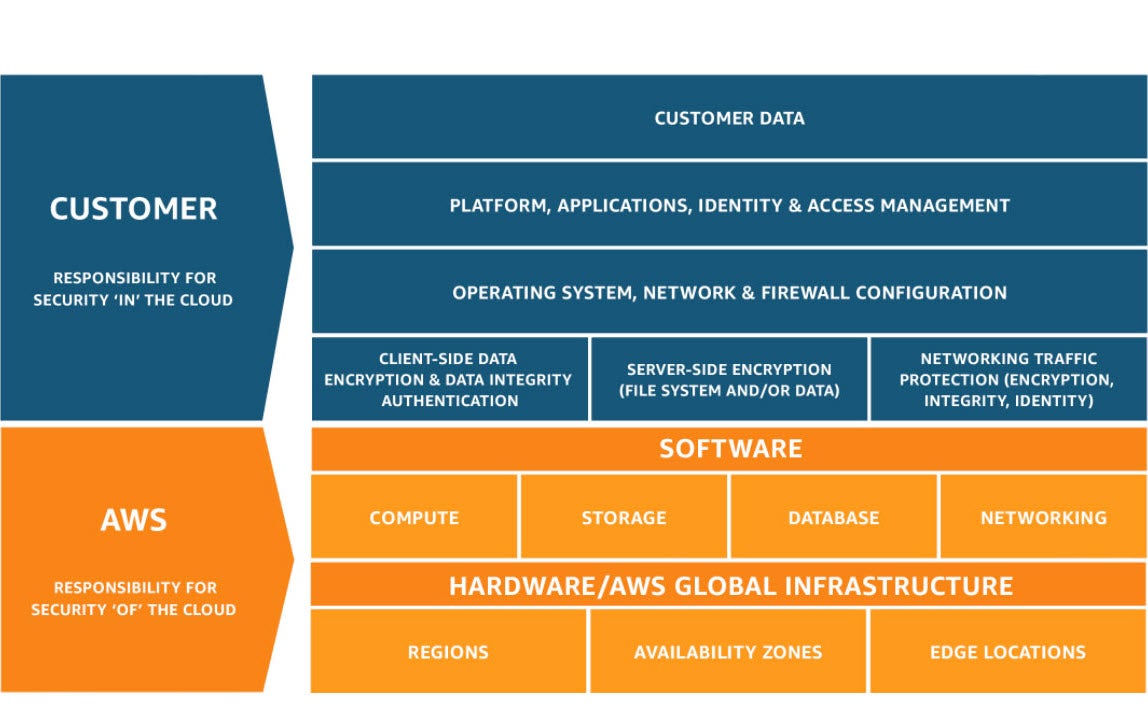
AWS’s Shared Responsibility Model outlines the division of responsibilities between AWS and its customers when it comes to security and compliance in the cloud. AWS manages the security of the cloud, meaning everything from the infrastructure to the physical facilities, while customers are responsible for securing their own data in the cloud and taking appropriate measures to meet specific compliance requirements. This model allows for a flexible approach to security that can be tailored to each customer’s unique needs.
Understanding the AWS Shared Responsibility Model
The AWS Shared Responsibility Model is a framework that outlines how security and compliance responsibilities are shared between AWS and its customers. It is important for businesses to understand this model, as it determines which security controls they are responsible for implementing and which ones are managed by AWS.
Under this model, AWS is responsible for security of the cloud, while customers are responsible for security in the cloud. This means that AWS is responsible for the underlying infrastructure, such as data centers and networks, as well as managing access control to those resources. On the other hand, customers are responsible for securing their own applications and data within their AWS environment.
For example, consider a business that uses Amazon EC2 instances to host their web application. AWS is responsible for ensuring that the physical servers on which these instances run are secure, but the business is responsible for configuring firewalls and security groups to protect their own data.
It is important to note that responsibilities can be shared depending on the specific services used by each customer. The AWS Shared Responsibility Model provides guidelines on which responsibilities should be considered when deploying solutions within an AWS environment.
To further illustrate this point, consider a business that uses both Amazon S3 and Amazon EC2. While AWS manages the physical infrastructure for both services, the responsibility for securing data stored in S3 is mainly on the customer, whereas protecting data on EC2 instances falls under their responsibility.
Some critics argue that there is still confusion around what security risks are being shared. It is important for businesses to take ownership of their end of cloud security risk management so as not to rely solely on providers such as AWS. However, following best practices provided by vendors can go a long way in reducing risk factors in any partnership.
The AWS Shared Responsibility Model outlines how security and compliance responsibilities are shared between AWS and its customers, with AWS being responsible for the security of their physical infrastructure, and customers being responsible for securing their own applications and data within an AWS environment. It is important for businesses to understand this model to determine which security controls they should implement. However, businesses should also take ownership of their end of cloud security risk management and not solely rely on providers like AWS, while following best practices provided by vendors can lower risk factors.
Security of the Cloud vs. Security in the Cloud
One of the key concepts that cloud users must understand is the difference between security of the cloud and security in the cloud. As previously stated, AWS is responsible for managing and securing the underlying infrastructure of their cloud service. This is referred to as security of the cloud, as it involves securing the physical infrastructure.
Security in the cloud refers to data protection within a customer’s applications and servers hosted in the cloud. This responsibility falls on customers rather than AWS. It includes managing user access control, network settings and configurations, as well as encryption of sensitive data.
Think of security of the cloud as a hotel’s safe deposit boxes where physical things one keeps are stored. In contrast, security in the cloud is similar to passwords needed to protect one’s one belongings from intruders while inside their hotel room.
It is important to note that businesses should not ignore their responsibilities under security in the cloud just because AWS is responsible for security of the cloud. With this shared responsibility model, AWS provides best practices and guidelines on how customers can ensure their own security in addition to what AWS already provides.
For example, Amazon EC2 instances protected by a firewall provided by AWS have strict default settings with an option to customize. The customer must configure these firewalls on their end such that they will be able to control who can access their instance environments on top of what AWS has done.
Critics argue that relying solely on best practice documentation can result in inadequate protection against attacks. Cloud users need to be diligent about configuring their own systems according to current standards and proactive measures like automated patching systems that alert system managers on when patches become available.
Implementing the AWS Shared Responsibility Model
The AWS Shared Responsibility Model requires both the customer and AWS to take part in ensuring the security and compliance of their system. AWS manages and controls the physical infrastructure stack, while customers are responsible for securing their applications as well as handling identity access management (IAM). It is therefore crucial that customers implement the model effectively to mitigate any potential threats and maintain security.
One key aspect of implementing the model is identifying and evaluating your organization’s data processing needs. This includes understanding your data, classifying each data type and assigning responsibilities to ensure the secure processing and storage of all data. Any sensitive or regulated data must be stored in controlled environments, with strict access control measures in place.
Another important step is selecting a secure architecture design that incorporates access control, network segmentation, logging, monitoring, encryption services, and vulnerability management practices. Access should only be granted based on individual user roles and responsibilities through IAM best practices. At every stage of implementation, cybersecurity awareness training program must be instituted for all employees to ensure they understand their role in maintaining high levels of security.
For instance, let’s say you’re building an application on AWS using Amazon EC2 instances. As per the shared responsibility model of AWS, while AWS takes care of physical security and availability of hardware resources underlying Amazon EC2 instances as well as networks associated with them; it’s your responsibility to manage guest operating systems (including updates) and firewall configurations applied within these machines.
To further solidify this point about user access control, you can use AWS Identity and Access Management (IAM) tools to grant permissions based on what each user needs to do – for instance only allowing read permissions for logs or database queries. IAM also allows for integration with other services such as databases so that users don’t need remote connections – instead they can connect directly within your private network which minimizes exposure points.
An interesting debate that comes up is whether it’s better to be proactive or reactive when it comes to security. The former argues for planning ahead and anticipating potential threats, while the latter involves arriving at solutions after a security breach has already occurred. As with most debates, there are pros and cons to both approaches; however in terms of implementing the AWS Shared Responsibility Model, being proactive is definitely the way to go. This includes conducting periodic vulnerability scans and penetration tests, reviewing logs regularly to identify anomalous activity, and keeping an up-to-date disaster recovery plan ready in case of emergencies.
According to a 2020 IDC survey, 64% of IT professionals are leveraging security as a shared responsibility under cloud service providers like AWS to maintain a secure cloud environment.
In a 2019 McAfee report, it was found that organizations using AWS experienced more than 2,700 security threats in a month on average, emphasizing the importance of adhering to the shared responsibility model for enhanced protection.
A 2018 Gartner report estimates that by 2025, 99% of cloud security failures will be the customer’s fault, highlighting the importance of understanding and managing customer responsibilities within the shared responsibility model.
User Access Control and Data Management Practices
One area where customers have considerable responsibility under the shared model is that of user access control and data management practices. When dealing with critical data, customer permissions must be audited regularly as part of your IAM best practices. In doing so you can ensure that each user only has access to what they need and nothing more.
Data management best practices require you to enforce strict controls over how data is stored, processed, transmitted, accessed and deleted throughout its lifecycle. Data sensitive environments should be secured by role based access control mechanisms as well as encryption solutions like transport layer security (TLS) which safeguard against eavesdropping and man-in-the-middle attacks.
Suppose you have a team of developers working on critical applications in your infrastructure. By using AWS IAM policies in conjunction with Amazon CloudWatch Logs Insights, you can track user activity to find out who accessed what parts of your system and when. With this data, you can determine whether there are any unusual patterns or errors in their login attempts which could indicate a potential security breach.
Additionally by integrating various AWS services you can create a secure environment where users are prevented from leaking sensitive information outside your organization. An example would be using Amazon Macie along with AWS KMS to manage encryption keys so that valuable data stored on S3 is automatically encrypted when it’s written and decrypted when it’s read. This way, unauthorized access to sensitive information is prevented even if your buckets are accidentally exposed.
When it comes to managing user access controls there’s no one-size-fits-all approach; instead different organizations have different requirements and hence must implement a solution that works best for their use case. However, in order to efficiently implement the AWS Shared Responsibility Model genuine effort needs to be made by customers to maintain an environment which is secure and compliant with industry standards.
Advantages of the AWS Shared Responsibility Model
The AWS Shared Responsibility Model has numerous advantages for companies seeking to secure their IT infrastructure while maintaining flexibility in deployment. One clear advantage is that the model allows organizations to focus on their core competencies, rather than expending time and resources on IT security. By entrusting AWS with responsibility for “Security of the Cloud,” organizations can instead concentrate on managing their data, applications and other critical business functions.
Another advantage is that AWS manages all the physical and network infrastructure, reducing the risks of unauthorized access, data breaches or service disruptions. With its global network of data centers, AWS provides reliable, high-performance hosting services around the clock. This level of support enables businesses to scale up or down easily as required, without having to manage hardware upgrades or network implementations themselves.
Furthermore, both AWS and its customers share control over data management practices, meaning that customers can choose the best tools and technologies to manage their data in a way that aligns with their own compliance requirements. This also means that customers can leverage AWS’s industry-leading security controls and compliance certifications to demonstrate adherence to regulatory frameworks.
For example, a healthcare provider using an electronic health record system could use Amazon RDS to host its database while implementing encryption at rest to meet HIPAA compliance requirements. By leveraging AWS’s expertise in security and compliance controls, the company can avoid many of the challenges of managing its own IT infrastructure while still meeting key regulatory standards.
Another benefit is that companies can take advantage of the scalability and agility offered by cloud computing platforms like AWS. With the ability to provision resources on demand and scale up or down quickly as required, businesses can respond more readily to changing market conditions while avoiding unnecessary costs.
Overall, the shared responsibility model offers a flexible yet robust approach to IT security that is tailored to each organization’s unique needs. By leveraging AWS’s broad range of tools and technologies for security and compliance, companies can implement best practices for data management and application security while focusing on their core competencies.
Enhanced Security and Compliance Flexibility
Security and compliance are critical components of any IT infrastructure, especially for businesses that handle sensitive or regulated data. The AWS Shared Responsibility Model provides enhanced security and compliance flexibility by enabling organizations to utilize a range of tools and technologies to meet their unique requirements.
One key advantage is that AWS offers multiple layers of security controls that can be used in various combinations to meet specific needs. For instance, customers can use Amazon Inspector to assess the security vulnerabilities of their applications while leveraging features like AWS Identity and Access Management (IAM) to control user access.
Additionally, AWS provides enterprise-grade encryption capabilities that enable customers to secure their data both at rest and in transit. This includes support for Secure Sockets Layer (SSL)/Transport Layer Security (TLS) for web traffic, Key Management Service (KMS) for cryptographic key handling, and Hardware Security Modules (HSMs) for enhanced security. By making these technologies available, AWS enables customers to build highly secure architectures within its cloud environment.
Another way that the shared responsibility model supports enhanced security and compliance flexibility is by enabling organizations to maintain control over key aspects of their IT infrastructure. For example, using AWS services like Amazon EC2 Dedicated Hosts allows customers to host instances on hardware dedicated exclusively for their use, thus providing greater control over their computing environment and reducing the risks of unauthorized access or other security issues.
An organization handling classified information may require stricter controls than those provided by default shared tenancy architecture. In such cases, using a dedicated hosting solution through AWS would ensure a more secure computing environment without compromising flexibility or performance.
Finally, AWS offers a range of compliance certifications that can help organizations meet regulatory or industry-specific requirements. Compliance certifications applicable across different industries include ISO 27001, PCI DSS, SOC 1/2/3, and HIPAA, among others. By leveraging these certifications and other security tools in combination with the shared responsibility model, organizations can build secure and compliant IT infrastructures that meet their specific needs.
In the next section, we will explore some of the challenges that organizations may face when implementing the AWS Shared Responsibility Model.
Addressing Potential Challenges in the Shared Model
While the AWS Shared Responsibility Model provides a clear framework for dividing responsibilities between customers and service providers, some challenges can arise. These challenges can include understanding who has responsibility for particular elements of security, managing user access controls, and ensuring that compliance regulations are met. In this section, we’ll explore some common challenges faced by organizations when implementing the Shared Responsibility Model and offer suggestions for addressing them.
One common challenge that organizations face is determining what they are responsible for versus what AWS is responsible for in terms of compliance. Depending on the AWS services used and the IT environment integration, different areas of responsibility may fall on different parties. For example, an organization may be unclear about which regulations are applicable to its use of AWS services or how to configure them properly. A helpful approach here would be to consult AWS documentation or experts in the field to clarify any areas of uncertainty.
Another potential challenge is ensuring that users have appropriate access controls while still maintaining proper security posture. The Shared Responsibility Model requires that customers manage their own identities and access control policies within their own environment using IAM tools provided by AWS. This means that customers must ensure that users are authorized to access only what they need to perform their duties. Additionally, customers must ensure that roles and permissions are assigned appropriately based on job function, seniority level, etc., while also limiting access when not needed. Failing to adequately address these concerns can lead to severe consequences such as lost data or compromised systems.
To address these issues, some organizations choose to implement separate identity management solutions outside of AWS. While this can simplify administration and provide greater control over user access policies, it also introduces additional complexity into already complex environments. Moreover, many third-party vendors lack mature integrations with AWS services or may require custom development efforts.
One potential solution is for organizations to utilize AWS’ Identity and Access Management (IAM) service. IAM offers a range of tools and services that enable organizations to define, manage, and enforce policies for access control across their AWS environment. Additionally, customers can leverage IAM roles to provide temporary credentials to external users or use federated login options to support single sign-on (SSO) capabilities.
Another challenge that may arise within the Shared Responsibility Model is ensuring that sufficient levels of security are maintained at all times. While AWS manages the security of its infrastructure layer and abstracted platform services, customers are responsible for implementing secure guest operating systems, applications, and data configurations. One helpful analogy here is thinking about building a house: Just as contractors must ensure that the foundation is stable before adding additional construction layers, organizations must implement appropriate baseline security protocols before entrusting more data or workloads to AWS.
In conclusion, while the AWS Shared Responsibility Model provides an excellent framework for dividing up responsibilities between providers and customers, challenges can arise when implementing it in practice. These challenges commonly include issues around compliance regulations, user access controls, and implementation of appropriate security policies. By leveraging existing AWS tools like Identity and Access Management (IAM), carefully defining areas of responsibility, and following best practices around security configuration management, organizations can better address these challenges and realize the benefits of this model over time.
Common Questions
What are the customer’s responsibilities in the AWS shared responsibility model?
In the AWS shared responsibility model, customers are responsible for securing their own data and applications up to the operating system. This includes configuring security settings, managing access controls, and conducting regular security assessments.
According to research conducted by Gartner, “through 2025, 99% of cloud security failures will be the customer’s fault” (Gartner, 2018). This highlights the importance of understanding and fulfilling customer responsibilities in the shared responsibility model.
AWS provides a variety of tools and resources to help customers meet their responsibilities. These include security features such as Identity and Access Management (IAM) and Services like AWS Config which enables continuous monitoring and compliance checks.
Ultimately, it is crucial for customers to understand and take ownership of their responsibilities in order to safeguard their data and applications on the AWS platform.
What are the AWS provider’s responsibilities in the shared responsibility model?
In the AWS Shared Responsibility Model, the provider’s responsibilities include the security and management of the underlying infrastructure that supports the cloud. This includes physical security of data centers, network and firewall configuration, and operational security such as monitoring and incident response.
According to a report by Gartner in 2022, “AWS continues to be recognized as a leader in public cloud IaaS due to its comprehensive service offerings and expertise in running infrastructure at scale.” The report also highlights AWS’ strong position in security and compliance.
Additionally, AWS offers numerous security features for customers including identity and access management, encryption options, network security tools, and compliance certifications. These features are designed to help customers meet their own shared responsibility obligations.
However, it’s important to note that while AWS provides a secure infrastructure, customers are still responsible for securing their applications, data, and other assets within the cloud. This includes configuring access controls appropriately, patching operating systems and applications, and monitoring for potential threats or vulnerabilities.
Overall, understanding the shared responsibility model is crucial for any organization using cloud services. By working together with their provider (in this case AWS), customers can ensure their data and assets are properly secured in the cloud.
How does the AWS shared responsibility model differ from other cloud service provider models?
The AWS shared responsibility model sets itself apart from other cloud service providers by clearly defining the security responsibilities of both the customer and AWS. This means that customers have more control over their data and infrastructure while still benefiting from the security measures provided by AWS.
Unlike other cloud service providers, AWS takes responsibility for the physical security of their data centers, as well as the security of their cloud infrastructure. This includes the security of hardware, virtualization layer, storage location, and network infrastructure.
On the other hand, customers are responsible for securing their applications and data within the AWS platform. This includes configuring access controls, managing user identities and permissions, encrypting data in transit and at rest, and ensuring compliance with regulations.
According to a report published by Gartner in 2020, the AWS shared responsibility model played a significant role in helping customers improve their overall security posture. In fact, Gartner stated that “by 2023, 99% of cloud security failures will be the customer’s fault.”
In summary, by clearly outlining the security responsibilities of both parties involved, the AWS shared responsibility model provides customers with greater control over their own security while still benefiting from world-class cloud infrastructure security provided by AWS.
Are there any common misconceptions about the AWS shared responsibility model?
Yes, there are common misconceptions about the AWS shared responsibility model. One of the most widespread is that customers tend to believe that once they move to the cloud, all security responsibilities shift entirely to AWS. However, this is not true, and it is important for businesses to understand how the responsibility is shared when using AWS.
According to a survey conducted by LogicMonitor in 2019, 66% of IT professionals believed that cloud providers were solely responsible for securing their customer data. Furthermore, 70% of those surveyed thought they were less accountable for security in a cloud environment compared to traditional on-premise IT infrastructures. These statistics suggest that there is still a misunderstanding regarding security and responsibility in the cloud.
It’s essential to note that while AWS manages physical security and compliance of its infrastructure, customers are responsible for managing security controls within their own accounts. Customers must ensure proper configuration of their applications and infrastructure and implement safeguards such as firewalls, identity access management (IAM), data encryption, patch management, and more.
To quote a statement from AWS’ Shared Responsibility Model whitepaper:
“Customers retain control of what security they choose to implement to protect their content, platform, applications, systems, and networks, no differently than they would in an on-site data center.”
In conclusion, understanding the AWS shared responsibility model is crucial for businesses who use AWS or plan to migrate to the cloud. It’s essential to recognize that although AWS does provide excellent security measures, customers must take responsibility for security controls in their own infrastructures.
How does the shared responsibility model impact security and compliance in AWS?
The shared responsibility model is a key concept in AWS that dictates the different security responsibilities between the cloud service provider and its customers. This model enables users to have greater control over their data, while also allowing AWS to maintain the necessary security standards.
From a security standpoint, customers are responsible for securing their applications, data and credentials, as well as managing compliance requirements, while AWS is responsible for the security of its infrastructure. Amazon claims that its infrastructure is designed to be highly secure, and that it has implemented extensive controls to maintain this level of security—such as physical and environmental controls, network and perimeter controls, and access controls. Additionally, AWS provides built-in security measures such as encryption, monitoring tools and identity and access management services.
In terms of compliance, AWS adheres to various industry standards such as HIPAA for healthcare organizations and PCI DSS for payment card processing companies. However, customers are ultimately responsible for ensuring they comply with any relevant regulations for their industry or region.
According to a report by McAfee in 2020, misconfigured cloud storage services were the primary cause of 1.5 billion records being exposed during the first half of the year alone. This highlights the importance of understanding one’s responsibilities in an AWS environment. Following best practices such as using multi-factor authentication (MFA) for user access and keeping sensitive data encrypted can greatly reduce the risk of data breaches.
Ultimately, understanding the shared responsibility model is crucial for proper security and compliance in AWS. By leveraging AWS’ infrastructure capabilities while also implementing effective security practices on one’s own end, businesses can ensure a secure cloud environment.
More related posts
Meet Clumio Chat: An AI Assistant to Help Evaluate Cloud-Native Data Protection
Imagine leading security and data protection operations as Chief Information Security Officer (CISO) at a global enterprise when a storm of calls and instant messages erupts your morning routine. A relentless AI-driven attack has taken over devices, systems, and networks – threatening your data.
As the field of artificial intelligence continues to advance, there’s a growing concern about the misuse of AI by cybercriminals to execute advanced attacks. AI-based threats have the potential to be more sophisticated, adaptive, and damaging than traditional attacks. To counteract this evolving risk landscape, businesses must adopt a cyber resilience strategy that embraces innovative approaches. Commvault® Cloud, powered by Metallic ® AI, is the cyber resilience platform for protecting your data and delivering business continuity amidst ever-evolving cyber threats. Combat AI-driven attacks with a platform that is purpose-built to enable true, cloud cyber resilience for the hybrid world, delivering the best security, highest intelligence, and fastest recovery — across cloud, on-prem, and SaaS workloads.
AI-driven Attacks
Cybercriminals leverage AI in various ways and explore further enhancements to increase their attack capabilities. For example:
Advanced phishing and social engineering Generative AI empowers bad actors to automate fraudulent activities, such as crafting of phishing mails, generating fake social media accounts, reviews, and comments, impersonating service and support agents, and carrying out scams. Massive datasets of stolen credentials and personal data can be analyzed in seconds to enhance phishing and social engineering campaigns.
Adaptive malware and botnet generation AI-driven malware and botnets that shapeshift during attack stages expose exponential risk to IT and security teams by evolving in real-time to avoid security measures, identify vulnerabilities in target systems, and coordinate attacks more efficiently than human-generated threats. A growing concern in cybersecurity is related to AI-generated malware capable of bypass traditional signature-based defenses.
Zero-day exploits and supply chain attacks Threat actors are creatively hiding malicious code and zero-day exploits from defenders to widen the attack distribution and extend the blast radius. For example, hiding malicious payload inside an AI model that is built to fulfill legitimate functions such as biometric authentication. In another scenario attackers can manipulate AI to learn algorithms of threat intrusion systems and evade their detection.
Credential stuffing and brute-force attacks By automating the process of gaining unauthorized access to business accounts and systems through stolen credentials and common password combinations AI speeds up the attack itself. Additionally, machine learning algorithms are utilized to evade security detection systems and AI-driven tools accelerate password cracking by analyzing patterns in leaked password databases.
Deepfake attacks Videos and audio generated by AI impersonate familiar voices and faces to manipulate individuals into performing actions that grant access to sensitive data, systems, and funds. The technology behind deepfakes creates convincing audio and images with minimal input gathered via social media or other public platforms.
AI has the power to amplify the impact and the complexity of cyberattacks increasing potential damage and risks to your data estates. Commvault helps you to address uncertainty by combining cutting edge data protection technology with strong cybersecurity measures in alignment with regulatory frameworks to invest in proper cyber resilience and detection mechanisms that keeps your data protected.
Spotting Threats Early
ThreatWise, our cyber deception service integrated in the Commvault Cloud that layer’s defenses along the path to your data, shielding it from AI-driven attacks, and surfacing threat actors that are targeting the most valuable assets in production – your data. This early warning layer enables your organization to adopt a cyber resilience strategy defending your data against tomorrows threat actors:
Limit the blast radius of an incident and divert the threat sooner – before it’s time to recover. ThreatWise alerts key business stakeholders upon first touch while simultaneously luring attackers in and away from actual critical assets, forcing them to waste resources.
Spot the attacker and gather insights about utilized tactics, techniques, and procedures across the complete kill chain. By revealing the original source of the AI-driven attack the symptoms and cause of it can be remediated to stop its aggravation.
Delay attacks by confusing and misleading attackers’ algorithms. ThreatWise feeds AI-driven threats fake tokens leading to deceptive data that is making it harder to automate and execute attacks while wasting threat actors’ time.
ThreatWise detection is highly accurate, because it’s not reliant on signatures to identify malicious activity, spotting zero-day attacks, shape shifting malware, and silent threats across workloads and data estates.
Maximize your response time by automating the alteration of key stakeholders across the business and ease coordination of your recovery to limit impact.
Keeping pace with evolving threats
For more information about how Commvault helps you unleash the power of AI without skyrocketing costs read this blog.
More related posts
Meet Clumio Chat: An AI Assistant to Help Evaluate Cloud-Native Data Protection
As security and cyber resilience continue to grow in importance as the number one data challenge for organizations today, Commvault is excited to be an inaugural member of the Microsoft Security Copilot Partner Ecosystem. With the launch of Commvault Cloud, the biggest advancement in Commvault’s history, enhanced application of AI and deep integration into Microsoft’s security portfolio are essential elements of Commvault’s continued innovation.
Working together to enhance the value of and interoperability with Microsoft Security Copilot
“We are excited about the opportunity to be part of the Microsoft Security Copilot Partner Ecosystem and the advantages this creates for our joint customers,” said David Ngo, Chief Technology Officer, Hyperscalers, Commvault. “Together with Microsoft, we will continue to build on our 27-plus years of co-engineering to ensure that we remain at the forefront of innovative solutions that solve our joint customers most pressing cyber resilience and cyber security issues—and Microsoft Security Copilot will be a focus for us as we look to advance the use of AI and it’s continued application in data security and cyber resilience.”
Commvault participation in the Microsoft Security Copilot Partner Private Preview
Announced this week at Microsoft Ignite, Commvault is participating in the Microsoft Security Copilot Partner Private Preview. Commvault was selected for the program based on its proven experience with Microsoft security technologies and the valued feedback it can provide to Microsoft. As part of the program, Commvault is working with Microsoft product teams to help shape Microsoft Security Copilot product development and future releases.
Commvault Cloud Brings “Arlie” the New AI Copilot to Life
In parallel to the joint focus on AI with Microsoft, Commvault is also introducing “Arlie,” short for “Autonomous Resilience”—a new AI copilot that will respond to inquiries from Commvault customers in plain, simple language. Behind the scenes, Arlie will interface with generative AI models and provide personalized actionable responses.
Learn more – see the joint solution in action
At Commvault, we’re excited to continue our pursuit of excellence in cyber resiliency and cyber security with Microsoft. For organizations interested in seeing exactly how Commvault is at the forefront of the use of AI in cyber security, be sure to visit https://www.commvault.com/platform.
For anyone interested in learning more about the joint Commvault/Microsoft solution, email us at microsoft@commvault.com.
More related posts
Meet Clumio Chat: An AI Assistant to Help Evaluate Cloud-Native Data Protection
Every day across the globe, organizations use Microsoft 365 to communicate, create, and store the content that drives their businesses. This means Microsoft 365 often houses petabytes of valuable data for many customers—data that is critical to business continuity.
Ensuring the resilience and recoverability of Microsoft 365 data
So, how do organizations ensure the safety of Microsoft 365 data, protecting it from unintentional or malicious deletion or large-scale ransomware attacks? In addition to ensuring the availability of applications and infrastructure, Microsoft is adding tools with better performance and trust to enable customers with backup.
Commvault and Microsoft engineers have collaborated to deliver a new solution that protects customers from the most devastating ransomware attacks, using the power of the Microsoft 365 platform itself, with frequent recovery points to which customers can rapidly recover files or emails that might be encrypted or destroyed. This new solution combines the best of Commvault and Microsoft technology with new capabilities for mass data recovery with very high-performance levels, backed by recovery trust from Microsoft.
Building on 27+ years of co-development
“Our product teams have been meeting regularly to ensure that Commvault and Microsoft deliver the best-combined solution to our joint customers,” said David Ngo, Chief Technology Officer, Hyperscalers, Commvault.“Together with Commvault’s current capabilities for flexible, granular recovery and air-gapped infrastructure, the integration with Microsoft 365 Backup Storage enables customers to rapidly respond to malicious attacks and get back to business with minimal disruption. We’re excited to give customers more options to protect their data from malicious attacks.”
“We are pleased to work with Commvault and eager to have customers use their enhanced solutions built on our Microsoft 365 Backup Storage to provide outstanding backup experiences for business stability and confidence,” said Jeff Teper, President, Collaboration Apps and Platforms, Microsoft.
Learn more – see the joint solution in action
At Commvault, we’re excited to pursue data protection excellence with Microsoft. For organizations interested in seeing exactly how Microsoft 365 Backup Storage will function in a Commvault environment, click here for a walk-through demo. In the coming weeks, we will publish additional information regarding pricing, public preview, and general availability. For anyone interested in learning more about the integrated Commvault/Microsoft solution, email us at microsoft@commvault.com.
More related posts
Meet Clumio Chat: An AI Assistant to Help Evaluate Cloud-Native Data Protection
At Commvault, we understand that Active Directory sits at the core of your identity and access management infrastructure and is a primary attack vector for bad actors. On December 1, 2023, we are taking the first of several steps towards providing expanded protection for this essential asset in the form of enhanced object and attribute level recovery for both Active Directory and Azure AD (now Microsoft Entra ID).
The key new features released on December 1 will make it easier for you to identify the scope of a disaster and recover or roll back from it as quickly as possible. The enhanced protection includes:
Accelerated recovery of deleted and changed objects by comparing all objects and attributes between backups.
Recovery of Group Policy Objects, including their security, links, and settings.
Recovery of Entra ID conditional access policies and roles.
Rollback of overwritten or corrupted attributes across many objects at once.
More frequent backups of AD, ensuring it is always possible to restore a recent copy.
To ensure the highest level of AD protection, we will also transition Commvault® Cloud Backup & Recovery for Active Directory from a free subscription to a paid offering starting December 1, 2023.
If you are presently protecting your Active Directory or Entra ID environment with Backup & Recovery for Active Directory, you will automatically gain access to the enhanced capabilities described above at no additional cost until June 1, 2024. No action is required on your part, and your scheduled backups will not be disrupted in any way. Starting on December 1, you will have complete access to the expanded functionality in appreciation of your ongoing business.
If you are not currently protecting Active Directory, you can configure the backup of one Active Directory domain or Entra ID tenant before December 1, 2023, and you will automatically gain free access to these enhanced capabilities until June 1, 2024, with no strings attached. To begin the protection of Active Directory today and gain access to the enhanced protection capabilities through June, open the Commvault portal and click Configure under the Active Directory tile in the Service Catalog.
After June 1, 2024, it will be necessary to purchase a subscription to ensure continued access to the Active Directory service.
Interactive, domain-wide AD comparisons
To make an informed decision as to what objects to restore or roll back, you need a complete report of all changes that have recently occurred in AD. Our new comparisons do just this – they compare all objects and attributes from a backup of your choosing to the current state of AD or another selected backup – and itemize any objects that were deleted or whose attributes have changed. Rather than doing the investigative work yourself, our comparisons will tell you exactly what happened in AD and allow you to interact with the report to search and filter to narrow the results to the objects that require recovery. Most importantly, you can restore the objects directly from the report, eliminating the need to switch between different views and workflows and minimizing downtime or disruption.
Comparisons can automatically scan for all changes in AD between two points in time or focus on particular areas in AD to speed up results. The results for every comparison are saved so you and your colleagues can review them anytime.
Organizations of all shapes and sizes face unprecedented volumes of cyber threats that can disrupt business operations and tarnish brand reputations. It’s chaotic to say the least. As this threat landscape continues to evolve, it’s crucial for businesses like yours to stay ahead of the bad actors and escalate your cyber defenses.
To help address the chaos, Commvault has partnered with industry leaders in cybersecurity, artificial intelligence (AI), and cloud technologies to help bolster your cyber resilience. These strategic integrations provide customers with advanced security measures, data intelligence, and threat detection capabilities. Combining the strengths of Commvault® Cloud with these innovative partners provides you with enhanced data insights, protection, and mitigation strategies.
The Current Cyber Threat Landscape: When not If
According to a recent IDC study commissioned by Commvault, 61% of respondents believe that data loss within the next 12 months due to increasingly sophisticated access is “likely” to “very likely.” This alarming statistic highlights the urgent need for robust cyber resilience measures. Organizations must be prepared to detect, thwart, and recover from ransomware attacks swiftly. It’s a matter of when and how often.
This is why we have forged partnerships across the security tool chain, including security information and event management (SIEM), security orchestration, automation, and response (SOAR), network detection and response, vulnerability risk threat detection, and data governance and privacy.
Integrating with Leading Security and AI Partners
Commvault’s integration with a diverse range of security and AI partners through the Commvault Cloud platform offers customers a comprehensive approach to cyber resilience. Among them:
Avira: Provides advanced AI-driven threat protection, enabling customers to rapidly identify potential nefarious activity and enhance protection against emerging threats.
CyberArk: We live in a zero-trust world when it comes to cybersecurity. Commvault’s integration with CyberArk’s Identity Security Platform helps customers follow strong Zero Trust architecture practices, reducing the risk of credential theft and exploitation in the face of double and triple extortion attacks.
Darktrace: When “when” happens, quick response is key. Combining Darktrace’s innovative HEAL platform and Commvault’s AI-powered data insights, joint customers can proactively defend against potential cyber threats and swiftly respond to incidents.
Databricks: The more data you amass, the more difficult it can be to maintain governance. The integration between Databricks and Commvault enables customers to leverage AI-driven search capabilities, making it easier to identify sensitive data and improve data governance.
Entrust: Get advanced cyber resiliency to protect critical data from current and future threats with Entrust’s post-quantum cryptography and data encryption solutions, integrated with Commvault Cloud.
Netskope: Netskope’s global SASE cybersecurity platform, combined with Commvault Cloud, helps organizations apply zero trust principles to protect data, ensuring ultra-sensitive data awareness and threat protection.
These build on our already announced integrations with Microsoft Sentinel for intelligent SIEM and Palo Alto Networks’ Cortex XSOAR to accelerate response time.
Battling the threats of today and tomorrow
This is just the tip of the iceberg as there are more integrations with Commvault Cloud in the works to strengthen your cyber resilience against bad actors, malicious threats, and ransomware.
Together, Commvault and our partners help you navigate the evolving threat landscape and safeguard your data, applications, and production workloads across hybrid and multi-cloud environments. To learn more about how these integrations can help power the Commvault Cloud, visit www.commvault.com/platform/integrations.
More related posts
Meet Clumio Chat: An AI Assistant to Help Evaluate Cloud-Native Data Protection
Under a constant threat of ransomware attacks and malicious cyber activities, cyber resilience is a paramount concern for organizations of all sizes, in all industries. These existential threats make it imperative for businesses to adopt a comprehensive and proactive approach to protect their data and ensure business resilience. That’s why I am thrilled to share our new platform, Commvault® Cloud, powered by Metallic® AI – a transformative platform that revolutionizes cyber resilience in the hybrid enterprise.
With its unified data protection, security, intelligence, threat detection, and recovery capabilities, Commvault Cloud empowers IT and security teams to stay one step ahead of ransomware and other cyber threats. We’re doing this by bringing our on-premises software and Metallic.io SaaS offering together into a single platform with enhancements to the features you already know and love and new capabilities you’re going to love.
Meet your new cyber resiliency partner, Arlie
There’s obviously a lot of hype around AI and how it’s changing the way we work and interact with software and systems. We’re putting AI to use help you act quickly and efficiently.
Users of Commvault Cloud will soon have access to Arlie—short for “Autonomous Resilience” and much easier to say—a new AI co-pilot that’s at the ready 24 hours a day, responding to inquiries in plain, simple language. We’re using Generative AI models to consolidate information and reports plus provide users with personalized actionable responses. You can use Arlie to verify or validate clean point of recovery for critical systems or generate requested code in mere seconds.
I’m excited about the possibilities this creates. It’s fueled by an integration with Azure OpenAI to enable amazing human-like interaction within Commvault Cloud to:
Give you real-time threat analysis and report summaries showing the latest information about their cyber resiliency health, removing the need to sift through filters and reports to prioritize the most pressing information. Imagine the time savings.
Offer a simplified way to build an integration or code an action: you simply type a description of what you want to do, and the code assistant will generate the code on the spot. No more missing semi-colon fouling up the works.
Provide context-sensitive, guided product walk-throughs that make it easy for you to set-up, customize, and tune Commvault Cloud to your specifications. Simply ask “how to” questions and get step-by-step documentation complete with annotated screenshots.
Constantly monitors the performance of Commvault Cloud using generative AI to find issues, provide fixes, and offer real-time recommendations on how to optimize cyber resilience.
That’s just the start. We’ll have more generative AI model integrations following fast.
Cloudburst™ Recovery
You know and love us for our ability to recover from ransomware or other critical situations quickly. We’re making it faster and more efficient.
The new Cloudburst™ Recovery capability can help you improve business continuity by using infrastructure-as-code and cloud-scaling to automate rapid and frictionless recovery of data to any location. This enables mass recovery from cloud storage at scale with the highest speed possible. You don’t have to run an expensive cluster in the cloud to be able to do this, saving you money and headache.
Cleanroom Recovery
We also have what we call Cleanroom Recovery, one of the standout features of Commvault Cloud. It’s a cutting-edge service that ensures rapid, frictionless, and reliable recoveries after a cyberattack.
When a cyberattack occurs, having a clean backup is crucial. But it’s equally important to have a clean location for recovery. That’s where Cleanroom Recovery comes in. With Commvault Cloud, you can recover your data to a secure, isolated environment in the cloud that is specifically designed for recovery purposes. This cleanroom environment is “at the ready,” meaning it’s always available to you and prepared to facilitate the recovery process.
Cleanroom Recovery offers several benefits, including:
Providing a secure and isolated space for recovery, ensuring that your data is protected from any lingering threats or vulnerabilities. This gives you peace of mind knowing that your recovered data is clean and free from any potential malware or malicious elements.
Enabling rapid recoveries. Time is of the essence when it comes to recovering from a cyberattack, and Cleanroom Recovery ensures that the process is as quick and efficient as possible. Using the power of the cloud, Commvault Cloud enables fast and seamless data recovery, minimizing downtime and allowing you to get back up and running in no time.
Cleanroom Recovery is not just for post-attack recovery; it’s also a valuable tool for conducting routine incident response testing. By regularly testing your recovery processes in the cleanroom environment, you can ensure that your systems are prepared and optimized to handle any potential cyber threats. This proactive approach to testing and validation helps to strengthen your overall cyber resilience.
AI-driven threat prediction
Attackers are using AI to make ransomware even quieter and harder to detect. One of the emerging attacks uses AI to change the shape of the malware. Security experts call these shapeshifting or poly-morphic attacks. Whatever you call it, they are extremely hard to see and go undetected by traditional anomaly detection techniques. In Commvault Cloud we’re using AI to fight AI. This helps you find AI-driven zero-day threats that have already impacted backup content so you can quarantine and recover data cleanly while avoiding reinfection during recovery.
Managing cyber resilience for you
As part of the Commvault Cloud release, we’re adding Platinum Resilience, a fully managed service that provides unmatched protection, engagement, and responsiveness to cybersecurity threats and disaster situations. This service, which is being introduced to select customers as part of an early access preview program with full availability planned in early 2024, provides the following:
Foundational backup and recovery, advanced AI driven automation, cyber deception, recovery testing and readiness checks, advanced reporting, security audits, custom telemetry, and more.
Powerful and comprehensive hybrid data protection and resilience, with the ease of use of the cloud using a dedicated, isolated control plane.
A ransomware readiness and response team dedicated to everything from setup to ongoing testing and validation to recovery upon a cyber event.
We’re confident that Platinum Resilience offers the best in end-to-end cyber resilience and we’re backing that up with a new Commvault Protection Warranty to give everyone from IT managers to board members peace of mind that recovery from an attack is guaranteed.
Commvault Cloud for Cyber Resilience
This is the boldest product launch in my 26-year history here at Commvault. I’m confident that your organization’s approach to cyber resilience will be revolutionized by Commvault Cloud, powered by Metallic AI. With its unified platform, advanced AI capabilities, and unique architecture, Commvault Cloud offers a comprehensive solution for data protection, security, intelligence, and recovery. By leveraging the power of AI, you can benefit from enhanced visibility, simplified processes, and optimized cyber resilience.
With Commvault Cloud, you can have peace of mind knowing that your data is safe, your operations are protected, and your business can continue to thrive in the face of evolving cyber threats. It’s the ultimate solution for achieving cyber resilience in your hybrid enterprise.
More related posts
Meet Clumio Chat: An AI Assistant to Help Evaluate Cloud-Native Data Protection
Four short years ago, Commvault introduced Metallic, and the promise of data protection for businesses of every size. Our focus was simple – to artfully blend the best of enterprise-grade performance, with a light-touch, cloud-centric consumption model. Harnessing 20+ years of proven Commvault technologies, Metallic was born.
Now, you didn’t have to sacrifice. Whether across clouds, data centers, or SaaS apps, our customers could uniformly safeguard their data (wherever it lived) while enjoying the durability, simplicity, and scale of the cloud. With constant innovation at the forefront of our vision, Metallic rapidly evolved, supporting the broadest set of hybrid cloud workloads, while pioneering next-generation security, resiliency, and recovery capabilities.
Thousands of customers later, we are excited to announce the next phase in our journey as Metallic becomes part of the Commvault Cloud.
So, what exactly is the Commvault Cloud? We’re glad you asked!
Commvault Cloud, a unified data resilience platform
A common misconception is that Commvault bought or acquired our award-winning Metallic SaaS technology. Well, we did neither… we built it from the ground up. Metallic was purposefully crafted to join Commvault’s existing portfolio of data protection offerings, as a light-touch, cloud-centric alternative.
Commvault Cloud, our newly introduced cyber resiliency and recovery platform, unifies our cloud, software, and appliance-based services into a single place. This not only provides our customers with a consistent and streamlined experience to consume our technologies, but also creates new synergies and capabilities that advance how our customers protect their data. Commvault Cloud stands as the industry’s first platform for true cloud data security. Simpler, smarter and more scalable than ever before for trusted cyber resilience to secure and recover data in today’s hybrid world.
Benefits for Metallic customers
By melding Metallic and Commvault technologies together into one platform, customers get even faster innovation, automation, and performance. While Metallic users will still enjoy the same SaaS-based backup they’ve come to know and love, the Commvault Cloud will pave the way for even more cloud-delivered advancements in disaster recovery, data security, artificial intelligence, and more. It means the best of all worlds: Simple SaaS protection, next generation cyber recovery innovations, and more flexibility of choice.
Advanced automation and intelligence with Metallic AI
While our SaaS-delivered backup and recovery offerings will be consolidated into our new Commvault Cloud platform, the spirit of Metallic lives on in our AI layer: Metallic AI. Metallic AI serves as our artificial intelligence layer that powers our new platform. From automation and machine learning to AI, Metallic AI brings greater performance and efficiency to every aspect of the Commvault Cloud. Metallic AI will also operate as a powerful integration layer for ecosystem partners, enabling developers to create robust, innovative new services that continuously optimize Commvault Cloud, and deliver greater value for those who use it.
We are excited for this next phase in our journey, how the Commvault Cloud is redefining cyber resiliency and recovery as we know it, and continuing to support our customers with award-winning SaaS-based data protection.
Here at Commvault, our values – we connect, we inspire, we care, we deliver – are foundational to everything we do.
This week, we hosted our quarterly internal Global Town Hall meeting and presented our CEO Living Our Values Awards. This awards program helps us to globally recognize and celebrate our Vaulters for their incredible work as they live our values every day.
I’m so proud to announce our FY24 Q2 CEO Living Our Values Award winners:
Metallic Customer Success Team
Shrey Ahuja
Reine Ayoub
Pronoy Banerjee
Scott Bauer
Ryan Carr
Francesco Coppola
Elizabeth Crinejo
Gemma Dean
Arijit Dey
Jerienne Esguerra
Steve Garrett
Melina Guzman
Srishma H S
Joel Hinchliffe
Salman Karim
Patrick Kelly
Andy Kirby
Richard Klauser
Kanishka Kohli
Brigitte Krause
Sanjeev Kumar
Tom LaFemina
Sally Lavis
Yaakov Lidgi
Mohana Lingaiah
Mark Penny
Varad Phatak
James Powell
Abhinab Pramanik
Syed Qadri
Sapna Rai
Kirk Rose
Alessandra Russo
Christopher Selph
Jayashree Sinha
Marta Slusarczyk
Nate Sprague
Eric Struski
David Stupar
Vimi Joseph Thengungal
Aissa Torres
Kent Willshire
Tayyeba Zamir
Antonio Silva
Inbar Schuchman
Stephanie Long
Fort Lauderdale Office Opening Team
Sam Hernandez
Stephanie Joyce
Tim Karaban
Tracy Skinner
David Surdukowski
Dee Venello
All these winners set an inspiring example and embody what it truly means to be a Vaulter!
To learn more about what it’s like to work at Commvault, check out our careers site.
More related posts
Meet Clumio Chat: An AI Assistant to Help Evaluate Cloud-Native Data Protection
In today’s fast-paced and ever-evolving business landscape, organizations are constantly seeking ways to stay agile and adaptable. This is driving organizations to seek increased flexibility in their software solutions. Traditional on-premises software often falls short in meeting these demands, leading to the rise of Software-as-a-Service (SaaS) solutions. In this blog, we will explore the power of SaaS-delivered flexibility and how it can revolutionize the way businesses operate.
SaaS-delivered flexibility provide organizations with the freedom and adaptability they need from their software solutions. Unlike traditional on-premises software, SaaS solutions are built on cloud infrastructure, allowing businesses to easily scale up or down based on their needs. In fact, 89% of enterprises have a multicloud strategy.1 This scalability enables organizations to quickly adjust to changing market demands, add new users, expand into new markets, or accommodate seasonal fluctuations.
SaaS Considerations
To achieve SaaS-delivered flexibility, there are five key factors to consider:
It’s important to choose a SaaS provider that offers a highly scalable and reliable cloud infrastructure. A significant advantage of SaaS is its inherent scalability. This ensures that the software can handle increased workloads and provide uninterrupted access to users.
Organizations should look for SaaS solutions that offer anytime, anywhere access. Gone are the days of being tied to a specific physical location to access critical business applications. As of last year, 41.4% of cloud leaders say they are increasing their use of cloud-based services due to the macroeconomic climate.2 This means that employees can access the software and data from any location, as long as they have an internet connection. This flexibility empowers remote work, collaboration across geographies, and increases productivity.
Rapid deployment and updates are crucial for achieving SaaS-delivered flexibility. SaaS solutions can be deployed quickly, often within hours or days, allowing organizations to start using the software and reaping its benefits sooner, driving efficiency and productivity. Additionally, SaaS providers handle updates and maintenance, ensuring that businesses always have access to the latest features and security enhancements without any disruption or costly overhead of maintaining on-premises systems.
Customization without complexity is another important aspect to consider. Flexibility in software often goes hand in hand with customization, so organizations should look for SaaS solutions that offer the ability to tailor the software to their specific business requirements without the need for complex and costly customization. Again, we see a need for this level of customization as 72% of IT Pros are taking a hybrid approach by combining public and private clouds.3 With this model, businesses can configure the software to align with their unique processes and workflows, empowering them to work the way they want to, without compromising on functionality.
Integration and collaboration capabilities are essential for achieving SaaS-delivered flexibility. SaaS solutions should offer APIs and connectors that enable seamless integration and data exchange with other systems. This allows businesses to create a unified ecosystem of software tools, streamlining processes and enhancing productivity.
In conclusion, SaaS-delivered flexibility empowers organizations to adapt quickly to changing business needs. By choosing a SaaS solution that offers scalability, anytime access, rapid deployment and updates, customization options, and integration capabilities, businesses can achieve the flexibility they need to thrive in today’s dynamic business environment. Embracing SaaS is not just a technological shift; it is a strategic move towards future-proofing your business and unlocking its full potential.
For more information on SaaS delivered flexibility, please view our Solution Brief, and watch our recent October 3 webinar on demand.
References
1. Flexera State of the Cloud report, 2023 – 2. Google Cloud Brand Pulse Survey, 2022 – 3. Google Cloud Brand Pulse Survey, 2022
More related posts
Meet Clumio Chat: An AI Assistant to Help Evaluate Cloud-Native Data Protection