Commvault is pleased to announce the closing of its acquisition of Satori, a leading provider of data security and AI governance solutions. This marks a significant milestone in our journey to deliver a comprehensive data and AI security platform built for the needs of modern enterprises.
Combining Commvault’s cyber resilience and data protection capabilities with Satori’s advanced data security and AI governance features allows us to offer a unified platform that provides end-to-end protection – from data discovery and classification to backup and cyber recovery.
The acquisition is particularly timely as data growth is outpacing traditional defenses, making visibility and access control non-negotiable. At the same time, AI is reshaping the security landscape – both enabling defenders and accelerating the speed, scale, and automation of attacks. Looking ahead, fragmentation in data and security tooling will not suffice; we need a fundamentally different approach that unifies discovery, classification, access management, DLP, data protection, and AI into a single, intelligent and highly automated platform.
This convergence is essential for building true security and resilience at scale – and it’s exactly the future we are building with Satori. Satori’s technology helps address these needs by providing ongoing discovery and classification of sensitive data across structured, semi-structured, and unstructured sources; granular data access control; and real-time monitoring.
With Satori, Commvault now offers a modern, cloud-native data and AI security platform that addresses the needs of enterprises adopting AI and managing sensitive data across multiple cloud environments. The platform enables organizations to discover and classify sensitive data, govern access, and enforce policies without altering user workflows. It also assesses AI data risk and monitors model usage to support compliant and secure AI innovation.
The acquisition helps address several key customer pain points, including:
Complexity of cyber resilience across multiple cloud environments
Cybersecurity threats and data breaches
AI and data governance challenges
Compliance requirements across global regulations like GDPR, HIPAA, and AI Act
Manual processes and vendor lock-in
By providing a unified platform that combines data and AI security with cyber recovery, Commvault is empowering security, privacy, and data teams to act decisively. The integration of Satori into Commvault’s portfolio is expected to roll out over the next year.
More related posts
Meet Clumio Chat: An AI Assistant to Help Evaluate Cloud-Native Data Protection
As data volumes grow exponentially and cyberattacks continue to grow and evolve, enterprise IT leaders face an uncomfortable reality: Traditional backup solutions weren’t built for today’s threats or tomorrow’s workloads. Legacy systems struggle with scale, leave security gaps, and force costly upfront investments in unused capacity.
The stakes couldn’t be higher. A single ransomware attack can cost enterprises millions in downtime, recovery efforts, and regulatory penalties. Meanwhile, AI and machine learning initiatives demand high-performance data protection that can keep pace with compute-intensive workloads without becoming a bottleneck.
Commvault’s on-prem family delivers a fundamentally different approach – one that transforms data protection from a necessary cost center into a strategic enabler of business resilience and innovation.
Business Outcomes That Matter
Eliminate Ransomware Vulnerability Windows
Traditional backup systems create dangerous exposure gaps during lengthy backup windows. Commvault on-prem solutions provide cyber resilience with built-in immutability across multiple layers – from the file system to the hardened Linux OS. Organizations gain confidence that their data remains recoverable even during active attacks, with zero-trust architecture blocking unauthorized admin access.
Real impact: Eliminate the business-disrupting fear of unrecoverable data loss while maintaining continuous business during security incidents.
Accelerate AI and Data-Intensive Workloads
AI training, machine learning pipelines, and modern analytics generate expansive datasets that traditional backup systems can’t handle efficiently. Commvault on-prem solutions deliver the high-performance protection these workloads demand, enabling your innovation initiatives to avoid the constraints of data protection bottlenecks.
Real impact: Enable faster model training, reduce development cycles, and support data science teams with protection that matches their performance requirements.
Right-Size Infrastructure Investment
Stop paying for unused capacity upfront. Commvault on-prem offerings’ flexible architectures let you start with what you need today and expand as requirements grow – whether that’s adding nodes to a storage pool or scaling compute and storage independently.
Real impact: Improve ROI on data protection investments while maintaining flexibility for future growth and changing business needs.
Simplify Multi-Site Operations
For organizations with distributed locations – retail chains, manufacturing facilities, branch offices – Commvault Edge brings enterprise-grade protection to every site without requiring local IT expertise. Centralized management through Command Center enables consistent policies and simplified operations.
Real impact: Reduce operational overhead, enable consistent protection across all locations, and eliminate the complexity of managing diverse backup solutions.
The Right Solution for Every Scale
Commvault Edge: Enterprise Protection for Distributed Environments
Ideal for: Remote offices, retail locations, manufacturing sites, and primary locations with up to 200TB of data.
Transform how you protect distributed environments. Commvault Edge delivers enterprise-grade security and recovery capabilities in a single-node configuration that’s simple to deploy and maintain. Built-in ransomware protection with intelligent monitoring detects anomalies and alerts administrators, while the hardened Linux OS provides multiple layers of immutability.
Key capabilities:
Fixed-capacity storage pools from 15TB to 200TB
Single-node deployment with minimal operational overhead
Built-in ransomware protection and zero-trust security
Reference architecture flexibility with validated hardware options
Centralized management through Commvault Command Center
Commvault Grid: Integrated Scale-Out for Growing Enterprises
Ideal for: Midsize to large enterprises with 100TB to 2.5PB of data requiring scalable, integrated protection.
Bridge the gap between edge simplicity and enterprise scale. Commvault Grid combines the ease of appliance deployment with the flexibility of scale-out architecture. Start with a 3-node configuration and add nodes as capacity needs grow, with automatic load balancing and the resilient Commvault File System (CVFS) optimizing performance across the cluster.
Key Capabilities:
Scale-out architecture with up to 12 nodes per storage pool
Integrated Commvault File System for optimal data distribution
Available as appliance or reference architecture
Automatic load balancing and enhanced performance
Pay-as-you-grow capacity expansion
Commvault Flex: Disaggregated Performance for Data-Intensive Workloads
Ideal for: Large enterprises and data-centric organizations with external storage requirements for performance-critical applications.
Achieve cloud-like elasticity in your data center. Commvault Flex separates compute from storage, enabling independent scaling of each component. Built for accelerated data growth and demanding performance requirements, it supports petabyte-scale deployments with external all-flash storage from leading vendors like Pure Storage, VAST Data, and in the near future, HPE.
Key Capabilities:
Disaggregated architecture scaling from 1PB to multi-PB
External storage solutions from industry partners
Independent compute and storage scaling
2-node resiliency with built-in redundancy
Suited for data intensive workloads
Built to Protect Against Ransomware Threats
Every Commvault on-prem solution shares Commvault’s commitment to cyber resilience:
Hardened by design: Optimized Linux OS with automated patching and built-in firewall protection.
Multi-layer immutability: Protection across software, OS, and file system levels.
Zero-trust architecture: Block unauthorized access and maintain data integrity.
Intelligent threat detection: Monitor for anomalies and alert on potential ransomware activity.
The Path Forward
The question isn’t whether your organization will face a cyberattack or need to scale data protection – it’s whether you’ll be ready. Legacy backup solutions leave you vulnerable and constrained. Commvault on-prem solutions position you to thrive.
Whether you’re protecting distributed retail locations with Commvault Edge, scaling enterprise operations with Commvault Grid, or powering next-generation AI workloads with Commvault Flex, you gain more than data protection – you gain business resilience, operational efficiency, and the foundation for innovation.
Don’t let yesterday’s backup solutions limit tomorrow’s possibilities. With Commvault on-prem solutions, your data protection becomes a competitive advantage. Ready to transform your data protection strategy? Learn more about our on-prem offerings here.
More related posts
Meet Clumio Chat: An AI Assistant to Help Evaluate Cloud-Native Data Protection
In Episode 3 of our Continuous Compliance podcast series, The Ethics of Paying Up: Compliance vs. Consequences, Commvault’s Field CTO for EMEA, Darren Thompson, and Associate General Counsel for EMEA, Jakub Lewandowski, delve into the critical issue of ransomware with Chief Trust Officer Danielle Sheer.
An interesting discussion on the ethical, legal, and practical issues around ransomware payments and the importance of a strong cyber-resilience strategy; read on for a recap of their discussion.
The Oracle Ransomware Breach: A Wake-Up Call
Danielle brought up the Oracle ransomware breach from earlier this year. While still in flux as to how much data was compromised, as of the podcast recording, Oracle had not agreed to pay a ransom.
When Danielle asked about that decision, and Darren said, “The advice I give people is, is that you should have a good enough plan in place, [so] you never need to consider paying ransom.”
A strong cyber recovery plan can provide the confidence needed to restore operations without succumbing to the demands of cybercriminals. It certainly would be an easier decision if you had a well-prepared and tested cyber resilience plan.
Ethical Considerations of Paying Ransomware
Paying a ransom is a contentious issue, and the podcast explored the ethical implications of this decision. While it might seem like a quick fix, paying a ransom often doesn’t guarantee the recovery of data and can fuel further attacks.
Jakub pointed out that paying a ransom doesn’t fulfill regulatory obligations and can lead to additional legal and reputational risks. The speakers stressed that organizations should focus on building and testing recovery plans to quickly restore their operations and protect their data.
Multidisciplinary Approach to Ransomware
Ransomware attacks require a multidisciplinary approach to address them effectively. Our speakers discussed a few considerations when faced with a ransom:
Technical: Organizations must have robust cyber resilience capabilities, including the ability to restore data and recover from attacks.
Legal: Decision-making processes should be well-documented to serve as evidence for regulators and potential litigation. Compliance with laws such as anti-money laundering, sanction regimes, and export compliance is crucial.
Economic: The financial impact of paying a ransom vs. the costs of business continuity and recovery must be evaluated.
Reputational: The potential damage to an organization’s reputation and the impact on customer trust, especially if sensitive data is threatened, are significant concerns.
U.K. Government’s Proposal to Ban Ransomware Payments
The podcast also addressed the UK government’s proposal to expand its ban on ransomware payments to the entire public sector and operators of critical national infrastructure. This proposal is seen as a world-leading approach to deter ransomware attacks by cutting off the flow of payments to criminals.
However, our speakers highlighted some potential unintended consequences of such a ban, including the optics of punishing victims and the lack of robust cyber resilience plans in the public sector. If the ban is implemented, organizations must rely on their incident response plans and cyber resilience capabilities to recover, rather than paying the ransom.
Recent research by Censuswide, commissioned by Commvault, showed that 94% of respondents support a public sector ban and 99% support a private sector ban. However, 75% admitted they would still pay a ransom if it meant saving their company.
Building a Comprehensive Cyber Resilience Strategy
To avoid the need to pay ransoms, we keep coming back to the same idea: Be prepared with a comprehensive cyber resilience strategy. Here are a few tips from our speakers:
Understand your data: Know what data is critical to your business and how to protect it.
Define minimum viability: Establish and understand the data and systems essential for business continuity.
Test recovery plans: Test and audit recovery plans regularly, so you’re confident they work effectively in a real-world situation.
Data encryption: Implement strong data encryption to improve security.
Clear incident response procedures: Define and document clear procedures for responding to ransomware attacks.
To pay, or not to pay, that is the question. Ransomware attacks are a significant and growing threat, and the decision to pay a ransom is fraught with ethical, legal, and practical challenges.
While we hope you never find yourself in a position to consider paying a ransom, if you do, this podcast will help you better understand the factors to consider. Watch today to hear our experts discuss the latest trends and take the first step toward securing your organization’s future.
More related posts
Meet Clumio Chat: An AI Assistant to Help Evaluate Cloud-Native Data Protection
The financial services industry operates in a unique cybersecurity landscape – one where the stakes couldn’t be higher, yet the outcomes are surprisingly strong. A new Enterprise Strategy Group study commissioned by Commvault reveals a fascinating paradox: While FinServ organizations face more complex cyber recovery challenges than any other sector, they’re also achieving superior results when cyberattacks strike.
The High-Pressure Reality of Financial Services
Financial institutions handle massive volumes of money and sensitive data through increasingly complex IT infrastructures that change at breakneck speed. Under constant regulatory scrutiny, these organizations must maintain extreme diligence to comply with policies while operating with a higher bar than other industries.
The result? More advanced preparation requirements, more rigorous testing protocols, and more aggressive service-level agreements.
The numbers tell a striking story: FinServ organizations are 13% less confident in their skills, technology, and experience to recover from successful cyberattacks compared to other sectors. They consistently report that cyber recovery processes are more complex, time-consuming, and challenging to test than traditional disaster recovery.
The Surprising Success Story
Despite these elevated challenges, the research reveals that FinServ organizations actually outperform their peers when it comes to cyber recovery outcomes:
63% of FinServ organizations reported minimal or no disruption from data loss due to cyberattacks (compared to 53% in other sectors).
63% also experienced minimal downtime disruption (vs. 49% for other industries).
41% described their recent cyber recoveries as “turnkey and smooth” (compared to just 23% across all other industries).
FinServ organizations are more than twice as likely to have cyber recovery plans protecting all apps and data needed to remain operational (36% vs. 17%).
The Secret to Success: Five Key Strategies
How do financial services organizations achieve these superior outcomes despite facing greater complexity? The research identified five critical strategies that separate leaders from laggards:
Set aspirational SLAs. FinServ organizations don’t just aim high – they aim for near-perfection. Fifty-five percent target recovery point objectives of seconds or minutes (vs. 33% in other sectors), while 45% maintain recovery time objectives of less than one day (compared to 26% elsewhere).
Test attack readiness frequently. While 75% of FinServ organizations conduct quarterly or more frequent cyber recovery tests, only 66% of other industries maintain this cadence. This rigorous testing culture helps identify gaps before they become crisis points.
Empower the CISO to set the strategy. FinServ CISOs take more ownership of cyber recovery planning than their counterparts in other industries, particularly in risk assessments (29% vs. 17%), investment decisions (34% vs. 21%), and test plan creation (24% vs. 14%).
Identify key areas of investment. FinServ organizations are significantly more likely to increase investments in parallel/high-availability systems (41% vs. 26%), recognizing that even minutes of downtime can be extremely expensive.
Leverage AI as a force multiplier. FinServ organizations are leading the charge in AI-/ML-powered security technologies, with 43% reporting extensive adoption compared to 29% across other industries.
The Broader Implications
This research offers valuable insights for organizations across all sectors. The FinServ industry’s approach – driven by regulatory requirements, customer trust imperatives, and the high cost of downtime – provides a blueprint for cyber resilience excellence.
The key takeaway? Success in cyber recovery isn’t just about having the right technology – it’s about creating a culture of operational discipline, investing in the right areas, and maintaining the vigilance to test and refine your approach continuously.
Ready to Dive Deeper?
The full Enterprise Strategy Group report contains detailed analysis, methodology, and actionable insights that can help your organization build more effective cyber recovery capabilities.
Organizations that learn from the financial services playbook—combining ambitious goals with rigorous testing, strategic leadership, and smart investments—will be best positioned to not just survive cyberattacks, but to recover stronger than before.
Across businesses in every sector, data volumes are expanding exponentially. Organizations are collecting, processing, and acting on larger and more diverse data sets than ever before. With this relentless data growth, there emerges a new challenge: How can existing data infrastructure keep up, not just in size, but in flexibility and intelligence?
Commvault recognizes that growth demands change.
Initially, Commvault was built for the world of on-premises data center protection. Our products were designed to scale vertically but not horizontally, which we realized posed an issue for our customers.
Our foundational services operated on single machines, which we learned created a bottleneck that limited both flexibility and resilience. More memory and faster processors were able to extend capacity; however, this only proved to be a temporary solution.
As we built our cloud products, we had to evolve and embarked on a massive architectural shift that embraced horizontal scaling, microservices, and a platform foundation built for today’s data workloads.
Recognizing Our Limits: The Inflection Point
System limitations and monolithic architecture created a negative user experience for some of our customers. So, we started making changes.
One core functionality that we started scaling up first was MediaAgents, which are software components that act as data transmission managers, handling data movement and storage management across multiple machines. With those being some of the most data-intensive components, they struggled to keep up as data loads increased.
The solution was to scale-out horizontally, allowing users to bring in more machines to distribute the load. This change marked the beginning of horizontal scaling across the platform. By letting users add machines rather than upgrade the same one, we introduced flexibility. MediaAgent proved that a horizontally scalable approach worked and the rest of the platform should follow suit.
Laying the Groundwork for Scale: Introducing the Entity Lookup Service
As we worked to improve our data movement layer, we also decided to focus on another critical dimension of scale: performance of the Command Center.
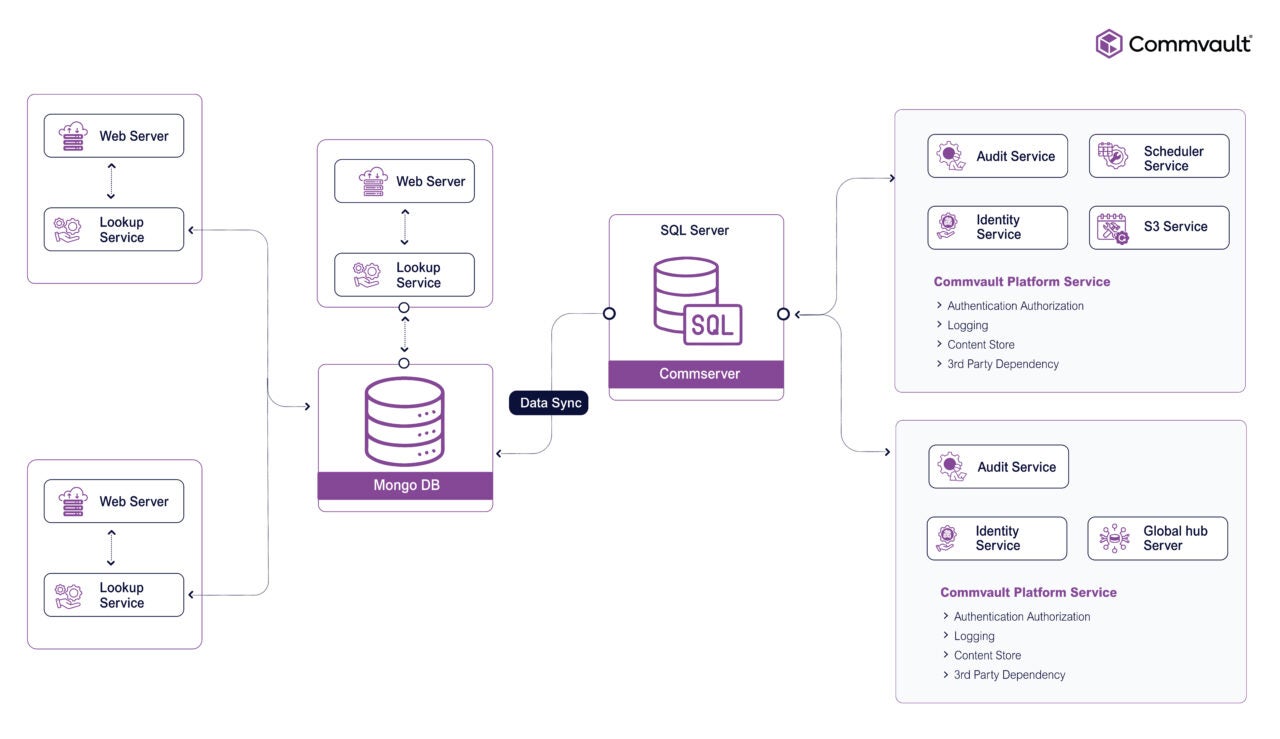
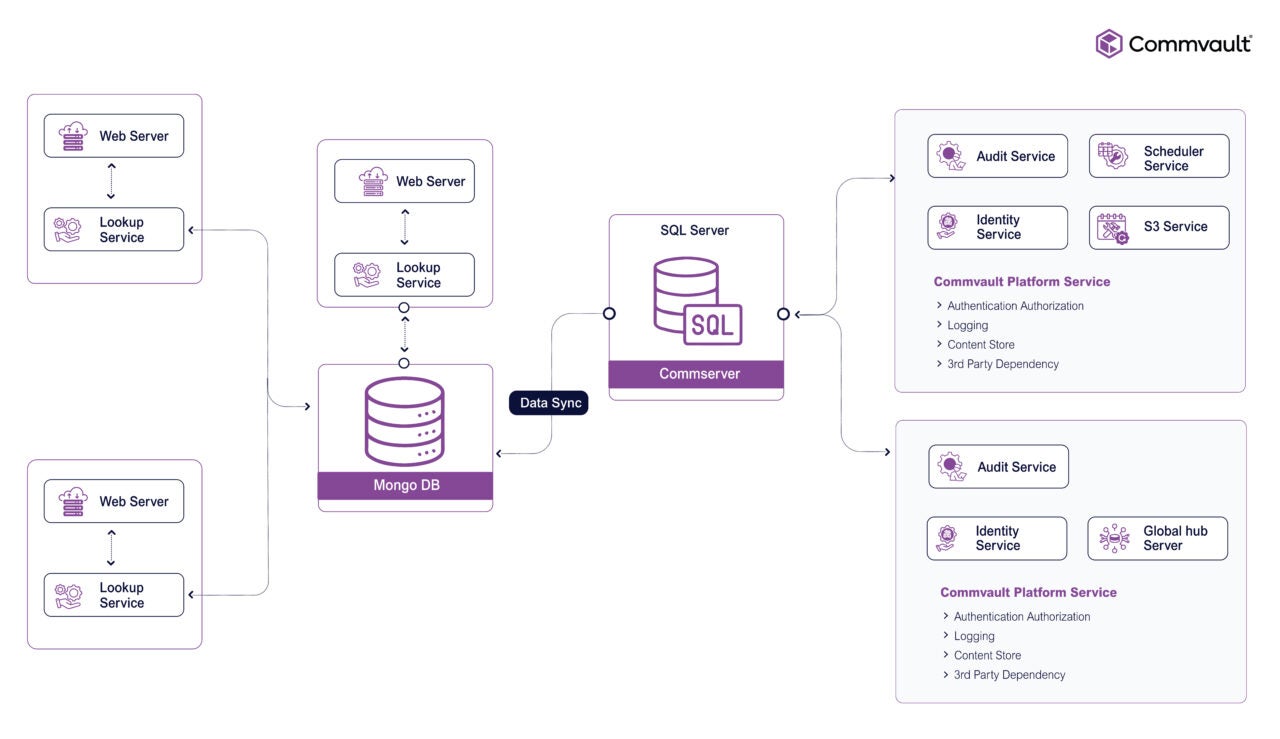
Commvault’s platform is inherently write-heavy, continuously ingesting data for discovery, job tracking, auditing, and more. While this model worked well with relational databases that offered strong consistency and transactional guarantees, read performance could not keep up in large environments.
We introduced the Entity Lookup Service to improve the user experience in the Command Center, where some API calls were taking 30 seconds or more to respond.
This lightweight, read-optimized service maintains a denormalized copy of key relational data in a document-based store such as MongoDB, which allows us to achieve our core performance goal: keeping all read-heavy API responses under 3 seconds, regardless of scale.
This architectural shift not only dramatically improved user experience but also laid the groundwork for further platform optimizations, some of which we detail below.
Rebuilding Our Capabilities: The Role of the CVDotnetContainer
With the successful evolution of MediaAgents, we recognized that our other core components also could be expanded. Our base platform services, such as the Job Manager and CommServe server, still utilized a single machine. This created architectural rigidity and created limitations on our ability to effectively manage growing workloads, regional requirements, and/or customer preferences.
To meet these demands, we decided to shift toward a microservices-based architecture to break large services into smaller, purpose-built components that could be developed, deployed, and scaled independently. This approach provided greater flexibility and more efficient use of infrastructure.
However, it also introduced new challenges. We needed a way to deploy multiple services without consuming excessive resources, concurrently support the coexistence of diverse services on a single machine, and give administrators the flexibility to choose where each service would run. This called for a system capable of hosting modular components while managing shared platform responsibilities.
The solve for this challenge became the CVDotnetContainer.
Making Microservices Practical at Scale
Built from scratch, the CVDotnetContainer acts as an effective hosting layer that supports multiple microservices on a single instance. It provides the flexibility to deploy services independently, based on the needs of each CommCell. Once the base layer was prepared, key services such as S3 Integration, App Manager Lite, and Audit Service quickly adopted the container to run on any machine, with minimal effort and full flexibility.
Beyond its hosting capabilities, the container takes care of common operational requirements. It handles authentication, request and response lifecycles, error management, logging, registry access, and file system interactions. Developers no longer need to rebuild these foundational layers for every new service. Instead, they can focus entirely on the application or business logic.
The CVDotnetContainer brought modularity to Commvault’s platform, streamlined deployments, and allowed services to scale independently. As a result, our overall architecture became more maintainable and better aligned with the demands of ever-evolving modern workloads.
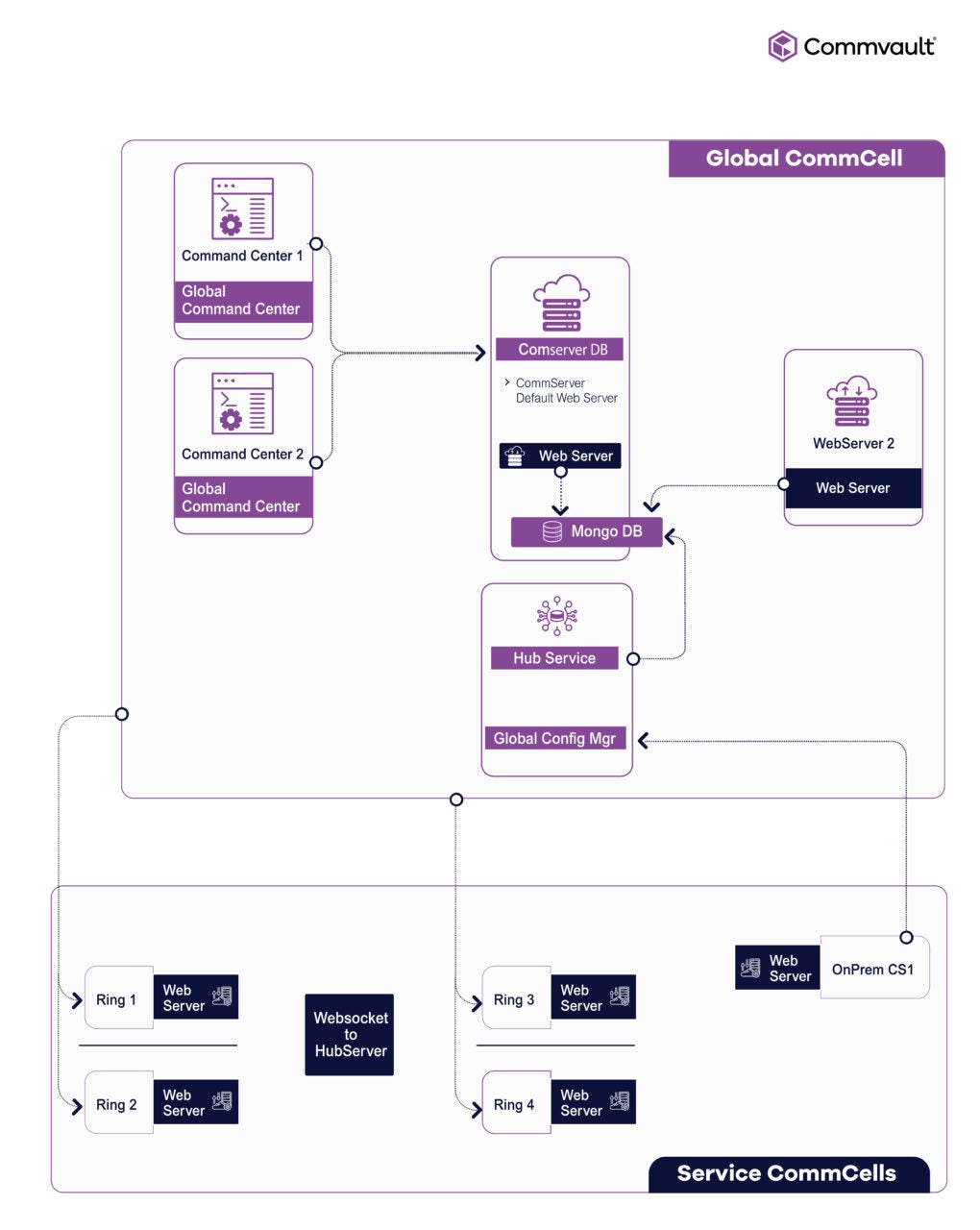
Simplifying CommCell Management: The Global Command Center
As enterprises started reaching global audiences and more data started flooding in, a single CommCell environment proved to be inadequate, given it only has a single instance of a CommServe server. These organizations began setting up multiple CommCells across different regions to meet regulatory, operational, and performance requirements. These instances operated independently, which meant managing them became a fragmented experience.
As we embraced horizontal scaling to enhance user experience, the management of these distributed environments presented Commvault with a new challenge. In response, one of the most significant advancements was made to the Commvault architecture, enablement of a simplified management of multiple environments in a single control plane with the introduction of the Global Command Center, which allows customer to manage all of their CommCells.
The Global Command Center is a control plane that serves as the “single pane of glass,” allowing customers to manage multiple CommCells through a single administrative interface. It created a consolidated view of operations, even when infrastructure was spread across continents. Customers could deploy instances in the United States, Europe, Asia, or any other location, and still monitor and control them from one place.
This unified view eliminated the need to log into each console separately. Instead of requiring multiple administrators to maintain CommCell environments, this single global platform enables customers to monitor jobs, track updates, and oversee the entire enterprise’s health. It helps simplify oversight, reduce operational burden, and allow teams to manage global ecosystems with the clarity of a centralized system.
What Lies Ahead: Designed to Help Create a Future-Ready Enterprise
Commvault’s evolution into a microservices-based, horizontally scalable architecture has fundamentally changed the way we serve our customers for the better. By embracing modularity, providing flexibility, and introducing centralized management through the Global Command Center, Commvault has designed a platform ready for the requirements of today and to help meet the demands of tomorrow. No matter how complex modern workloads become or how large data volumes expand to, Commvault is designed to provide exceptional user experiences.
More related posts
Meet Clumio Chat: An AI Assistant to Help Evaluate Cloud-Native Data Protection
Amazon DynamoDB is the backbone of countless cloud-native applications, celebrated for its immense scalability and performance. As organizations build increasingly mission-critical systems on this NoSQL database, the conversation naturally shifts to the shared responsibility model and the critical need for robust data protection.
Initially, enterprises relied on two primary native options for protecting their DynamoDB data: DynamoDB Point-in-Time Recovery (PITR) and AWS Backup. While functional, both came with limitations that created gaps in security and cost-efficiency.
Analyzing the Limitations of Native Backup Tools
A deeper analysis of the native tools reveals the foundational problems that needed to be solved:
DynamoDB PITR: A Trade-Off Between Precision and Risk Traditional PITR offers recovery precision, allowing restores to any point in time. However, it possessed a critical architectural limitation: Backups are inextricably tied to the source table. If the original table is deleted, whether accidentally or maliciously, the PITR backup is also permanently lost. This dependency creates a single point of failure for data restoration. PITR also doesn’t support cross-account restores, which limits options in the event of an account compromise.
AWS Backup: Convenience at a Cost AWS Backup offers the convenience of managed backups and keeps copies logically separate from the source table. However, the trade-offs are increased cost and security exposure. AWS Backup relies on repeated full backups, driving up the total cost of ownership (TCO) as data volumes grow. Furthermore, these backups are typically stored within the same enterprise security sphere as the primary data, making them vulnerable during wider security events.
A New Foundation: Solving the Core Problem with Clumio SecureVault for DynamoDB
Addressing these gaps required a new approach. In 2022, Clumio launched SecureVault for DynamoDB, a solution engineered to solve these specific problems. It introduced a new foundation for DynamoDB data protection by delivering:
True air-gapped, immutable protection: SecureVault stores backups in a separate secure platform fully isolated from the primary AWS environment. This eliminates the risk of backup loss if the source table is compromised or deleted.
“Incremental Forever” cost efficiency: To combat the high TCO of repeated full backups, SecureVault introduced a forever incremental model. After an initial backup, it only saves unique data changes on an ongoing basis.
The impact was immediate and tangible. One prominent customer in the online learning space slashed DynamoDB backup spending by over 70% by switching to Clumio, while also improving its security posture. SecureVault effectively solved the foundational data protection problem.
The Next Frontier: The Pain of Partition-Level Recovery
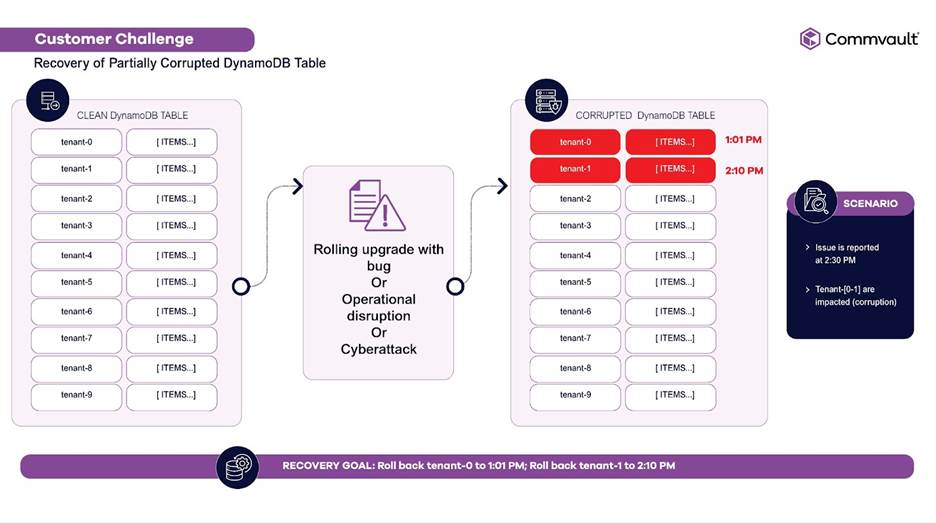
While SecureVault solved the table-level issue, evolving architectural best practices exposed a new, more painful challenge. Modern SaaS applications often rely on a single, massive DynamoDB table that serves thousands of tenants, with each tenant’s data isolated by a set of partition keys.
Now, imagine this nightmare scenario: A minor code change in a rolling software update introduces a bug. The bug doesn’t corrupt the entire table. It affects only two or three tenant partitions within a massive 100-terabyte table that holds billions of records.
Recovering from this with traditional methods creates a significant operational burden:
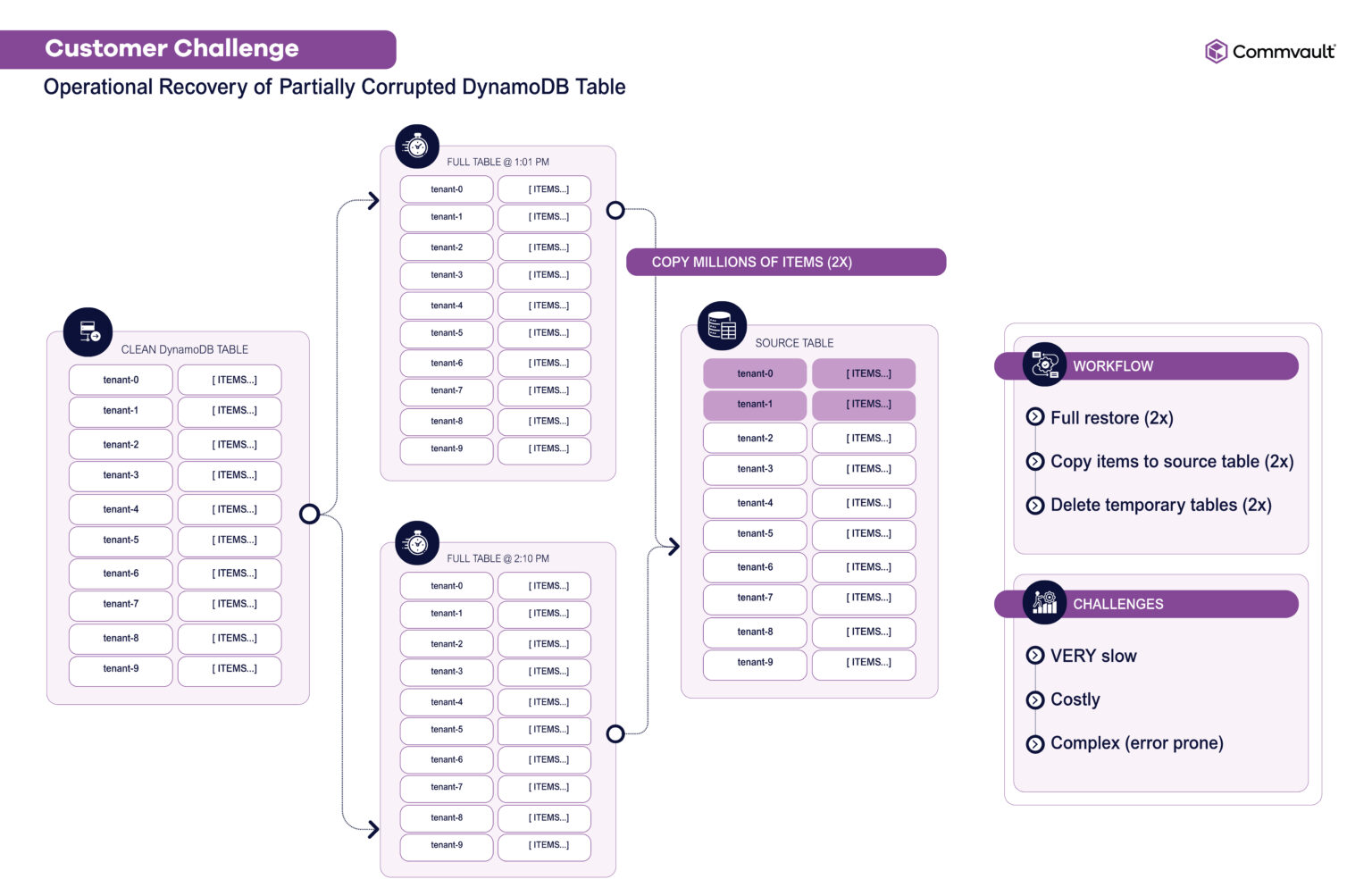
Step 1: The expensive full table restore. The process begins by restoring the entire table to a new, temporary one. This means provisioning and paying for another 100 TB of storage and waiting hours – or even days – for the data to be copied, just to recover a few gigabytes of corrupted data. The recovery time objective is immediately compromised.
Step 2: The agonizing manual sift. With the temporary table online, engineers must now write and run complex ETL scripts to scan through billions of items. Their mission is to extract data from just the affected partitions, a process that is both incredibly time-consuming and dangerously error-prone. One mistake in the script could lead to further data loss.
Step 3: The redundant repeat. If different partitions were corrupted at different times, the entire process of restoring and sifting must be repeated for each unique timestamp, compounding the cost and engineering toil.
Step 4: The high-risk cleanup . Once the data is copied back to the production table, engineers must remember to manually delete the temporary 100 TB tables. Overlooking this step can lead to catastrophic storage costs.
This recovery method is not just inefficient; it’s a high-risk, high-cost engineering project that burns developer hours and puts the business at risk.
Introducing Clumio Backtrack: From Agony to Simplicity
Clumio Backtrack for DynamoDB builds on the SecureVault foundation to eliminate this recovery complexity. It transforms what used to be a multi-day engineering crisis into a simple, minutes-long operational task by delivering three key capabilities:
Recovery granularity: Restore only what you need. Backtrack allows engineers to target only the specific partition keys that were affected. Instead of restoring hundreds of terabytes, it isolates the few gigabytes of data required. This completely eliminates the cost, time, and overhead of restoring a full table, providing an almost-instantaneous start to the recovery.
Recovery precision: Go back to the exact moment. For each targeted partition, Backtrack enables a restore to any point in time, precise to the second. This lets teams restore to the exact state before the corruption without losing any data, preserving integrity without the manual guesswork.
In-place recovery: Restoration simplified. This is the most critical innovation. Backtrack restores the corrected data directly into the live production table. There are no temporary tables to create, no custom scripts to write, and no cleanup to manage. The multi-day, high-risk data migration project is replaced by a few clicks in an intuitive UI.
The foundational cost efficiency and security of SecureVault laid the groundwork. With Backtrack adding surgical precision and in-place recovery, the combined solution reaches far beyond the limits of any native tools.
Clumio SecureVault addresses the initial need for air-gapped security and cost-efficient backups. However, as recovery requirements became more granular, the operational complexity of table-level restores became untenable.
Building on the foundational protection of SecureVault, Clumio Backtrack provides surgical, in-place recovery that allows organizations to move beyond the limitations of native tools. Together, they form a comprehensive solution that helps modern businesses implement a truly modern, simple, and resilient data protection strategy for their most critical DynamoDB workloads. Get a free trial today.
More related posts
Meet Clumio Chat: An AI Assistant to Help Evaluate Cloud-Native Data Protection
Today, the vast majority of organizations operate in hybrid identity environments, where Microsoft Active Directory (AD) and Entra ID work together to manage user identities and secure access across different environments.
AD, the industry standard for on-premises identity management for over 25 years, supports countless integrated applications and serves as the authoritative source of identities and resources. To meet the growing demand for cloud access and external collaboration, many organizations have extended identity management to Entra ID, which provides secure access to cloud applications like Microsoft 365.
In most cases, AD remains the authoritative source for employee identities, with accounts and attributes synchronized one-way to Entra ID. This hybrid approach allows organizations to leverage AD’s robust, established capabilities while enjoying the flexibility of cloud-based identity management. However, this flexibility introduces complexity and new risks.
Why Hybrid Identity Protection Matters
9 Out of 10 Attacks Target Your Identity Infrastructure
From workstation logins to physical building access, AD and Entra ID are essential for the operation of an organization, making them highly attractive targets for cybercriminals. Because identity data flows between AD and Entra ID, any disruption in one system can quickly affect the other.
When authentication is unavailable due to a failure in AD or Entra ID, users are locked out of critical systems and applications. Productivity grinds to a halt, access to cloud and on-premises resources is disrupted, and even incident response efforts can be paralyzed.
Without authentication, the entire organization is effectively frozen. This underscores the need for rapid, reliable recovery of identity services to restore access and resume operations.
You’re Responsible for Entra ID Protection
Microsoft’s shared responsibility model makes it clear: Microsoft is responsible for the uptime of the platform. You protect your identities, configurations, and data.
This includes:
User objects and group memberships.
Conditional Access and MFA policies.
Enterprise application configurations.
Role-based access controls.
While Entra ID offers some native tools for object recovery via the recycle bin, its functionality is limited and only useful in specific scenarios. This leaves organizations with significant gaps in their protection strategy, making a third-party solution for protection essential.
Why Separate Protection Isn’t Enough
Fragmented Tools = Fragmented Security
Organizations often rely on separate tools for protecting AD and Entra ID, if at all. This creates:
Visibility gaps across hybrid environments.
Inconsistent recovery strategies and slower response times.
Gaps that attackers can exploit.
A unified backup and recovery solution recognizes the interdependency between AD and Entra ID and treats hybrid identity as a single, cohesive system that needs comprehensive protection.
Unified Protection = Stronger Identity Resilience
Protecting both AD and Entra ID with a single, unified solution can enhance your security posture, simplify management, and enable faster recovery when it matters most. Here’s what a unified approach delivers:
Consistent backup and recovery: Enable uniform protection and recovery across both AD and Entra ID environments.
Granular restore capabilities: Recover specific user, group, policy, and configuration attributes quickly and accurately.
Central visibility: Monitor and manage hybrid identity environments from a single, unified interface.
Identity is Too Critical to Leave Unprotected or Under Protected
Why accept the risk of incomplete or manual protection for your most critical identity systems? With a unified hybrid identity protection strategy, you can:
Recover faster from cyberattacks or operational mistakes.
Eliminate blind spots in your identity infrastructure.
Fulfill your part in the shared responsibility model for Entra ID.
Enable secure access to applications and data.
How Commvault Delivers Unified Hybrid Identity Resilience
In the face of deletion, corruption, or cyberattacks, Commvault® Cloud Backup & Recovery for Active Directory delivers fast recovery and enables continuous business across the enterprise. With Commvault Cloud, you can protect AD and Entra ID in hybrid environments with a single enterprise solution that also protects your on-premises and cloud workloads and applications like Microsoft 365, Dynamics 356, Salesforce, and more.
Automated, frequent backups – Protect against lost domain information with regular, automated backups of objects and attributes.
Comprehensive coverage – Safeguard critical AD objects, including Group Policy Objects, users, groups, and all their relationships, as well as Entra ID enterprise applications, roles, conditional access policies, and more.
Fast, granular recovery – Restore only the missing, damaged, or misconfigured object attributes to get business systems or users back online quickly without the need for a full environment recovery.
Automated forest recovery of AD – Reduce the time to recover AD after a cyberattack with automated, orchestrated recovery of an entire AD forest, featuring custom runbook generation and point-and-click simplicity.
Interactive domain and tenant-wide comparisons – Identify all changes to the AD domain or Entra ID tenant and quickly recover mistakenly or maliciously deleted objects or roll back overwritten attributes across the entire directory.
Centralized management – View and manage hybrid identity protection alongside all your workloads through a single, unified interface.
Do you have gaps in your identity protection strategy? Explore our Backup & Recovery for Active Directory solution or chat with a Commvault representative today. Get started.
Learn More
Check out these other blogs in our Active Directory series:
Watch our on-demand webinar “The Naked Truth” to see experts simulate a real-world Active Directory outage and demonstrate rapid restoration techniques.
More related posts
Meet Clumio Chat: An AI Assistant to Help Evaluate Cloud-Native Data Protection
When Microsoft Active Directory (AD) is damaged or taken completely offline, the critical applications and services it supports become inaccessible, bringing business to a halt. But the true cost of an AD outage isn’t just inconvenience. It’s lost revenue, reputational damage, recovery expenses, and more.
Mitigate Business Disruption with Resilient AD Recovery
Fast and secure recovery of AD is foundational to maintaining continuous business. Whether recovering from accidental deletions, corruption, or malicious attacks, a solid AD recovery strategy is key to minimizing the impact of an outage. With the right solution, organizations can:
Recover AD quickly at the object, domain, or forest level.
Avoid costly downtime across critical systems.
Resume operations in hours, not days or weeks.
Real-World Impacts: What Happens When AD Goes Offline
Business Operations Come to a Halt
AD provides secure authentication and access control for mission-critical systems and applications. When AD is damaged or taken completely offline:
Employees are locked out and cannot do their jobs.
Line-of-business applications become inaccessible.
Hybrid identity systems like Entra ID breakdown.
For a large organization, this can equate to hundreds of thousands of dollars in lost productivity within hours.
Downtime Costs Add Up Fast
The financial burden of cyber incidents is overwhelming. AD outages can result in financial losses of up to $730,000 per hour. Every minute of downtime costs organizations in:
Lost revenue
Recovery expenses
Lost productivity
Reputational damage
When faced with disaster, time is money, and the longer it takes to restore AD components back to a good working state, the greater the disruption to the business.
Mitigate the Risk: What to Look for in an AD Recovery Solution
A comprehensive AD recovery strategy and the right tools can help minimize downtime and damage to the business. Look for these capabilities:
Granular object-level recovery: Restore users, groups, and policies, without the need to recover the entire AD environment.
Full forest recovery: Quickly restore your entire AD infrastructure to a pre-attack state.
Automation and orchestration: Cut down recovery time with built-in runbooks and guided workflows.
AD recovery testing: Deliver confidence that recoveries can be successful and allow security and IT teams to practice during good times to prepare for the bad times.
Support for hybrid identity environments: Protect and recover across AD and Entra ID for hybrid continuity.
The Bottom Line: AD Downtime is a Business Risk
The consequences of AD outages can be devastating, impacting everything from daily operations to an organization’s financial health and reputation. The risk of substantial revenue loss, coupled with the expenses of recovery and the erosion of trust, highlights the urgent need for a strong and resilient AD recovery strategy.
An automated recovery solution, paired with a well-documented and frequently tested recovery plan, is critical for quickly restoring AD and getting the business back fast. Discover how Commvault Cloud can help you minimize downtime and maintain continuous business operations with automated AD recovery in minutes.
Learn More
Check out these other blogs in our Active Directory series:
Watch our on-demand webinar “The Naked Truth” to see experts simulate a real-world Active Directory outage and demonstrate rapid restoration techniques.
More related posts
Meet Clumio Chat: An AI Assistant to Help Evaluate Cloud-Native Data Protection
Microsoft Active Directory (AD) is the core identity and access infrastructure for most enterprises, providing secure authentication and authorization services for business-critical applications and resources. In the event of a complete forest-level failure, whether from ransomware, corruption, or administrative error, the ability to quickly and accurately recover AD is essential for maintaining continuous business.
Recovery Time Matters: The High Stakes of AD Downtime
In a crisis, every hour AD remains offline increases organizational risk and cost. The longer it takes to restore AD back to a good working state, the greater the disruption to the business. The impact is multifaceted:
Productivity loss: Employees cannot access the necessary resources to perform their jobs, leading to a halt in productivity.
Revenue impact: Business operations are disrupted, potentially leading to lost revenue and opportunities.
Reputation damage: Prolonged downtime can damage an organization’s reputation among customers and partners.
Recovering AD traditionally has been very difficult, requiring intricate, time-consuming manual processes. This blog post explores the limitations of manual methods for AD forest recovery and discusses how automated solutions can facilitate swift and reliable recovery.
Understanding the Complexity of AD Forest Recovery
Recovering AD is not like regular backups and restores. AD is a geographically distributed identity system with a multi-master design, which means that every domain controller (DC) holds a copy of the AD database, allowing changes to be made on any DC and then propagated throughout the network.
While AD’s design enables high availability and resiliency, it introduces complexity that makes rebuilding AD from a disaster or cyberattack, like ransomware, complex and time-consuming. Incorrect recovery strategies can lead to prolonged downtime, security vulnerabilities, and data corruption.
The Intricacies of AD Forest Recovery
Microsoft’s Active Directory Forest Recovery Guide provides prescriptive guidance on rebuilding an AD forest after a catastrophic disaster. While comprehensive, this process assumes a high degree of technical skill and coordination.
Due to AD’s complex nature, the elements involved in a full forest recovery are rigid, prescriptive, time-consuming, and highly susceptible to human error. Depending on the complexity of your AD architecture, there can easily be 50 to 100 or more individual tasks involved in restoring AD back to a previous good state.
The Challenges and Risks Associated with Manual Recovery Methods
Manual recovery is:
Highly error-prone due to the complexity of steps involved. Errors can lead to failed recoveries, inconsistencies, or even reinfection after a cyberattack.
Time-consuming, especially when DCs are recovered one at a time. This can lead to days or weeks of downtime, significantly impacting business operations.
Requires deep and very specific AD expertise. Without experienced professionals, recovery attempts can stall,[DC2] fail, or result in an improperly restored environment, leaving the system vulnerable.
Lacks built-in validation or automation, making it difficult to verify the recovery process is executed correctly. This can result in unpredictable recovery outcomes and a higher risk of restoration failure.
Difficult to rehearse regularly, which is crucial for maintaining recovery readiness. Unvalidated plans introduce significant risk and erode confidence in the ability to recover successfully.
The Need for Automated Solutions
Relying on a manual disaster or cyber recovery plan, along with out-of-the-box Microsoft tools, could mean it takes days or weeks to restore an entire AD forest. A purpose-built solution like Commvault® Cloud Backup & Recovery for Active Directory can help speed AD recovery by automating the intricate steps involved in forest restoration.
How Commvault Simplifies and Accelerates AD Forest Recovery
CommvaultCloud Backup & Recovery for Active Directory is designed to deliver a purpose-built, orchestrated recovery platform that can simplify forest recovery into a guided, automated process, resulting in faster, more secure, and predictable recoveries. It can handle the critical sequencing, validation, and recovery tasks needed to bring AD back online safely, even under the pressure of a real disaster. With Commvault Cloud, you can:
Reduce the time to recover AD and restore access fast.
Simplify AD recovery planning withinteractive, visual topology views of the AD forest that display domains, domain controllers, and their roles, enabling informed, strategic recovery decisions.
Streamline the forest recovery process with customizable runbooks that provide a guided, repeatable recovery workflow, support isolated, test-mode restores for validation, and parallel domain controller rebuilds to reduce recovery time.
Enhance cyber readiness with support forAD recovery testing. Gain confidence that recoveries can be successful, and allow security and IT teams to practice during good times to prepare for the bad times.
Learn More
Check out these other blogs in our Active Directory series:
Watch our on-demand webinar “The Naked Truth” to see experts simulate a real-world Active Directory outage and demonstrate rapid restoration techniques. For a deeper understanding of AD forest recovery and to plan your recovery strategy, explore our whitepaper.
Microsoft Active Directory (AD) is the backbone of enterprise identity and access management. From workstation logins to physical building access, AD enables the routine operation of the organization. When it is damaged or taken completely offline, the critical applications and services it supports become inaccessible. Without AD, the business cannot continue.
Despite its importance, many organizations still rely on outdated, manual backup and recovery approaches that leave gaps in protection and delay recovery efforts, leaving them exposed when disaster strikes.
Here are five critical capabilities that are essential for rapid, reliable recovery of identity services.
1. Forest-Level Recovery of AD
In the event of a complete forest-level failure, the ability to quickly and accurately recover AD is essential for business continuity. Relying on a manual recovery plan and out-of-box tools could mean it takes days to restore an entire AD forest, extending business disruption.
Automated forest-level recovery capabilities enable you to restore the AD forest to a previous healthy state and resume business operations in a fraction of the time. This automation drastically reduces recovery time and minimizes the risk of human error during critical moments.
2. Granular Object and Attribute Recovery
When important data within AD is accidentally or maliciously deleted, changed, or corrupted, you need to be able to quickly identify changes and restore the individual objects and attributes.
Fast, granular recovery capabilities enable you to restore just the missing, damaged, or misconfigured object attribute. This granularity can quickly get business systems or users back online without needing to restore the entire AD environment.
3. Frequent, Automated Backups
AD environments are dynamic. Users are added, permissions are updated, and configurations evolve constantly. Relying on manual backups leaves gaps in coverage.
Frequent, automated backups consistently capture changes across the environment and minimize the risk of data loss.
4. Immutable, Air-Gapped Backups
Backups stored within the same network or domain they are protecting are vulnerable to compromise in an attack. Immutable, air-gapped backups help prevent tampering and keep backups clean, accessible, and reliable when you need them most.
5. Unified Protection for Hybrid Identity Environments
As businesses extend their directories to the cloud with Microsoft Entra ID, the challenge of protecting the hybrid AD environment has only grown. Many organizations backup up AD and Entra ID in silos, if at all.
Unified protection of hybrid identity systems simplifies operations and reduces tool sprawl, enabling consistent security across environments.
Find Your Gaps Before Attackers Do
AD is too important to leave unprotected or underprioritized. By addressing these critical gaps in AD backup and recovery, you can enhance protection, reduce risk, and enable fast, secure recovery in the event of an attack.
Watch our on-demand webinar “The Naked Truth” to see experts simulate a real-world Active Directory outage and demonstrate rapid restoration techniques.
More related posts
Meet Clumio Chat: An AI Assistant to Help Evaluate Cloud-Native Data Protection
When Microsoft Active Directory (AD) goes down, business operations grind to a halt. Users are locked out, and critical systems become inaccessible. The impact of such downtime can be severe, leading to lost productivity, revenue, and even reputational damage.
This is why having a robust AD recovery plan is crucial. But how can you be confident that your plan will work when it matters most?
The answer is simple: frequent testing.
Why AD Recovery Testing Matters
AD is the core identity and access infrastructure for most enterprises. In the event of an AD outage – whether from ransomware, corruption, or administrative error – the ability to quickly and accurately recover AD is essential for business continuity.
Regularly testing your AD recovery plan delivers confidence that recoveries can be successful and allows security and IT teams to practice during good times to prepare for the bad times.
What’s at Risk Without Testing?
Failing to test your AD recovery plan regularly puts your organization at risk:
Extended downtime: Recovery takes far longer than expected, prolonging disruption.
Security exposure: Rushed, incomplete recoveries may introduce vulnerabilities or open the door to repeat attacks.
Data loss: Critical data may be irretrievably lost if the recovery process is flawed.
Core Components of a Reliable AD Recovery Test
1. Simulate Various Disaster Scenarios
Test recovery under the same pressure and constraints you’d face in a real incident. That means simulating scenarios such as schema corruption and ransomware encryption. Only through carrying out a holistic AD recovery will you identify gaps in your recovery plan.[DC1]
2. Test in an Isolated Environment
Recovering to an isolated, non-production environment will provide valuable insight into the completeness of the recovery plan and allow you to vet your own recovery procedures.
3. Test and Update Recovery Plans Regularly
Regular recovery testing is not a one-time task but an ongoing process. Consider testing your AD recovery plan every 3–6 months. Use these tests as an opportunity to both validate your plan and update the recovery guidance based on any recent changes to the AD architecture or topology. Keep your documentation up-to-date and make sure that all team members are trained on the latest procedures.
Common Pitfalls to Avoid
Assuming backups are enough.
Only testing partial recovery scenarios.
Lacking visibility into backup health and scope.
Not aligning recovery priorities with business impact
Determine your minimum viable AD required to support the organization and plan accordingly.
Confidence Comes from Testing
Prioritizing regular, automated, and comprehensive recovery testing is critical for gaining confidence that your AD recovery plan is effective. Don’t wait for a real disaster to find out your plan doesn’t work.
Ready to Test with Confidence? Learn how Commvault helps organizations validate their recovery plans and get back online faster, with confidence. Explore AD recovery solutions.
Learn More
Check out these other blogs in our Active Directory series:
Watch our on-demand webinar “The Naked Truth” to see experts simulate a real-world Active Directory outage and demonstrate rapid restoration techniques.
More related posts
Meet Clumio Chat: An AI Assistant to Help Evaluate Cloud-Native Data Protection
It’s back-to-school season in the U.S., and educational institutions from K–12 to college are facing more cybersecurity challenges, this time from AI.
From intelligent tutoring systems that personalize learning paths to predictive analytics that can help boost student retention, AI is revolutionizing how educational institutions operate and teach.
But as schools and universities race to adopt these transformative tools, they find themselves facing a profound paradox. The very technology that offers so much promise is also being weaponized by adversaries, creating a more sophisticated and dangerous threat landscape than ever before.
This is the double-edged sword of AI in educational cybersecurity. It is simultaneously a powerful new shield for defenders and a formidable new weapon for attackers.
For IT and security leaders in education, navigating this duality is key to unlocking innovation without sacrificing security. It requires moving beyond traditional cybersecurity and embracing a strategy of true cyber resilience.
The Offensive Edge: AI as the Attacker’s New Weapon
Threat actors are early adopters, and they are already leveraging AI to enhance their attacks with terrifying efficiency. Yesterday’s red flags are disappearing, making human vigilance alone an insufficient defense.
Hyper-realistic phishing: Gone are the days of easily spotted phishing emails with glaring grammatical errors. Adversaries now use generative AI to craft flawless, highly personalized spearphishing messages that can convincingly mimic the tone and context of a school principal or department head. These attacks exploit the high-trust environment of schools, turning an employee’s instinct to be helpful into a critical vulnerability.
Automated and adaptive attacks: AI can automate the process of scanning networks for vulnerabilities, helping attackers find and exploit weaknesses faster than overstretched IT teams can patch them. Furthermore, AI can be used to create adaptive malware that changes its behavior to evade traditional, signature-based detection tools.
Deepfakes and chatbot manipulation: The threat goes beyond email. Attackers can use AI to create deepfake audio or video to impersonate trusted leaders in social engineering schemes or manipulate public-facing campus chatbots to distribute malware or harvest data from unsuspecting students and parents.
The Defensive Shield: Fighting AI with AI
To combat threats that operate at machine speed, defenders must adopt defenses that do the same. AI has become a necessity for the modern Security Operations Center.
AI-enabled security solutions can analyze massive volumes of network traffic and user behavior data in real time, identifying subtle anomalies that might be invisible to a human analyst. This allows for:
Proactive threat detection: By learning the normal rhythm of the institution’s digital ecosystem, AI can instantly flag unusual activity – like a login from an odd location or an attempt to access sensitive files at 2 a.m. – as a potential breach.
Automated incident response: When a threat is detected, AI can help trigger an automated response in seconds, such as isolating a compromised device from the network to help stop an attack from spreading.
Predictive analysis: By analyzing historical data, AI can even help identify potential vulnerabilities before they are exploited, allowing teams to proactively strengthen defenses.
The Defender’s Dilemma: Securing the AI You Deploy
Herein lies the new, more complex challenge. The battle isn’t just about defending against external AI-enabled attacks. Educational institutions must now secure the AI systems they are eagerly deploying for their own core mission.
As schools build AI models on vast datasets of sensitive student information, these systems become high-value targets themselves. This introduces a new class of risks that must be managed:
Data poisoning: An adversary could intentionally feed an AI model bad data to corrupt its logic, causing it to miss real threats or make dangerously flawed academic predictions.
Model theft: The AI models themselves, especially those developed in university research settings, represent valuable intellectual property that is at risk of being stolen.
Privacy catastrophe: An AI system trained on student data creates a centralized treasure trove of personally identifiable information. A breach of this system could lead to a privacy disaster on an unprecedented scale.
Charting a Course for AI-Ready Cyber Resilience
Navigating this double-edged sword requires a strategic shift. It’s not enough to simply buy new AI security tools. Institutions need a holistic framework for cyber resilience that prepares them to withstand and recover from attacks in this new era.
Embrace AI-enabled defense: The first step is acknowledging the reality of the arms race. To defend against AI-driven threats, you must leverage AI-enabled security tools. It is a primary way to keep pace with the volume, speed, and sophistication of modern attacks.
Make data protection the foundation: As you adopt AI, the data that fuels it becomes your most critical and vulnerable asset. This makes robust data protection the absolute bedrock of your AI security strategy.
Your AI is only as secure as the data it’s built on. This means going beyond prevention and focusing on your ability to recover. If a sophisticated ransomware attack bypasses your defenses or a data poisoning attack corrupts your models, the ability to restore your data to a clean, immutable, and trusted state is your ultimate safety net. This is the core of true cyber resilience.
Adopt a zero-trust architecture: The line between internal and external threats is blurring. With AI systems themselves becoming targets, you can no longer implicitly trust any user or device. A zero-trust strategy – which requires verification for every access request, regardless of origin – is essential for securing a modern, AI-integrated campus.
The age of AI in education is here, bringing both incredible opportunity and complex risk. By viewing the challenge through the lens of cyber resilience – and placing a strategic emphasis on comprehensive data protection – educational leaders can confidently innovate, harnessing the power of AI to help build the secure and effective learning environments of the future.
Learn more about how to build cyber resiliency at your organization here.
More related posts
Meet Clumio Chat: An AI Assistant to Help Evaluate Cloud-Native Data Protection
Here at Commvault, our values – we connect, we inspire, we care, and we deliver – are foundational to everything we do and why it matters.
This week, we hosted our quarterly Global Town Hall meeting and presented our FY26 Q1 CEO Living Our Values Awards. This award program globally recognizes and celebrates our Vaulters for their incredible work over this past quarter and for living our values each day.
I’m so proud to announce our FY26 Q1 CEO Living Our Values Award winners and our employee-nominated Vaulters’ Choice Award winner below:
CEO Award Winners
Michael Fasulo
Matt Barham
Michael Capon
Manoj Hirway
Toby Anderson
Kelvin Gonzalez
Vaulters’ Choice Award Winner
Kailash Reddy Yerramreddy
These Vaulters set an inspiring example of what it truly means to be a part of Commvault.
To learn more about what it is like to work at Commvault, check out our careers site.
More related posts
Meet Clumio Chat: An AI Assistant to Help Evaluate Cloud-Native Data Protection
In a recent episode of the Continuous Compliance podcast, Dr. Emily Watters, a bariatric and general surgeon from Baltimore, Maryland, sat down with Danielle Sheer, Chief Trust Officer at Commvault, to discuss the profound impact of cybersecurity incidents on healthcare operations.
When ransomware strikes a healthcare facility, the consequences are immediate and severe. Dr. Watters vividly described how these attacks can “completely shut down operations” for hospitals that have become entirely dependent on electronic systems. The repercussions are far-reaching and include:
Canceled surgeries: Procedures that require rescheduling weeks or even months later, causing significant delays in patient care.
Inaccessible patient histories and diagnostic images: Surgeons and anesthesiologists are unable to access critical information needed to safely perform operations.
Handwritten documentation: A forced return to manual processes, which can be inefficient and error-prone.
Compromised quality of care: The inability to access essential data can lead to suboptimal treatment decisions.
Disrupted communication: Communication between healthcare providers and patients is hindered, leading to confusion and anxiety.
Dr. Watters emphasized the extent to which modern healthcare professionals rely on digital systems: “I don’t even know how to find a prescription pad to write a prescription for patients these days. It’s literally everything is electronic.” This dependency underscores the critical need for robust cybersecurity measures to prevent such disruptions.
Critical Patient Information Goes Dark
One of the most alarming aspects of ransomware attacks is the loss of access to vital patient records. Before any surgery, patients undergo comprehensive evaluations, including heart and lung checks, with results stored electronically. Without this information, healthcare providers can’t safely proceed with procedures.
The interconnected nature of medical systems exacerbates the problem. Dr. Watters noted that Maryland’s healthcare facilities have excellent interoperability, allowing records from one hospital to be viewed at another. When these systems go down, critical information sharing is lost.
From Ransomware Recovery to Robotics
The podcast also delved into the growing role of surgical robotics in healthcare. Dr. Watters, as the chair of her hospital’s robotics committee, shared her insights on this advanced technology. She described surgical robotics as “just a tool” similar to “using a push mower vs. using a riding lawn mower,” highlighting that skilled surgeons remain indispensable despite technological advancements.
This comparison draws an interesting parallel to cybersecurity concerns. As healthcare becomes more technologically dependent, the vulnerability to disruption increases. The discussion touched on how robotics collects data on surgical procedures, raising important questions about data ownership and the future of surgical practice.
The integration of robotics into healthcare not only enhances precision and efficiency but also introduces new layers of complexity in data management and security.
Building Healthcare Resilience
The conversation underscored the urgent need for comprehensive cyber resilience strategies in healthcare. As digital transformation accelerates in the medical field, maintaining alternative capabilities becomes crucial.
Dr. Watters and Danielle agreed that continued training in traditional surgical methods remains essential, regardless of technological advancements. This means healthcare providers can still deliver high-quality care even when digital systems are compromised.
For healthcare organizations, this episode serves as a powerful reminder that robust cybersecurity isn’t just about protecting data – it’s about maintaining uninterrupted patient care even during worst-case scenarios. The ability to switch to manual processes and rely on traditional methods can be a lifeline in the event of a cyberattack.
Key Takeaways
Comprehensive cyber resilience: Healthcare facilities must develop and implement comprehensive cyber resilience strategies to protect against ransomware and other cyber threats.
Dependency on digital systems: Modern healthcare professionals are heavily reliant on electronic systems, making it crucial to have backup plans and traditional training in place.
Interoperability and data access: The interconnected nature of medical systems means that a cyberattack can have far-reaching effects, disrupting critical information sharing.
Role of surgical robotics: While surgical robotics offer significant benefits, they also introduce new cybersecurity challenges that need to be addressed.
Training and preparedness: Continuous training in both traditional and advanced surgical methods is essential so that healthcare providers can adapt to any situation.
Cyber Resilience Is Critical
The insights shared in this episode highlight the critical importance of cybersecurity in healthcare. As the healthcare industry continues to embrace digital transformation and advanced technologies like surgical robotics, the need for robust and resilient cybersecurity measures becomes even more pressing.
By preparing for the worst and maintaining a balance between traditional and modern practices, healthcare organizations allow patient care to remain uninterrupted, even in the face of cyber threats. Whether you’re a healthcare professional, a technology enthusiast, or simply someone interested in the future of medicine, this episode offers valuable lessons on the intersection of cybersecurity and patient care.
More related posts
Meet Clumio Chat: An AI Assistant to Help Evaluate Cloud-Native Data Protection
At Commvault, the experience of our Vaulters and the work we do truly matters – for our customers, our partners, and most importantly, for our teams. We believe our values of Connect, Inspire, Care, and Deliver set us apart from our competitors and guide our efforts every day.
So, what better way to celebrate our culture than by partnering with Great Place to Work ®, a globally recognized authority on workplace culture.
For years, our India Center of Excellence has proudly held Great Place to Work certification. This year, we’re thrilled to share that our U.S. community also has been recognized as a Great Place to Work® Certified™ organization.
This recognition is more than a badge of honor – it’s a reflection of our commitment to creating a culture where people feel supported, valued, and empowered. From flexible work options to wellness programs and continuous learning opportunities, we are boldly building a workplace where everyone can thrive – personally and professionally.
Being certified as a Great Place to Work helps us in several powerful ways:
Attracting top talent: In a competitive market, this certification strengthens our employer brand and signals to candidates that Commvault is a place where they can grow and succeed.
Retaining our best people: Great workplaces retain talent up to three times more than average organizations. This recognition supports our efforts to keep our amazing team engaged and inspired.
Empowering our culture: The certification process includes a confidential survey that highlights what we’re doing well and where we can improve. It’s a tool for reflection and growth, helping us stay aligned with our values and our people’s needs.
As we celebrate this achievement, we remain focused on the future. We’ll continue to listen, learn, and evolve across our global Vaulter community – ensuring our workplace remains inclusive, innovative, and inspiring.
Whether you’re a current Vaulter or considering joining us, know that at Commvault, we care deeply about our people and our purpose. Want to learn more? Check out our careers page.
More related posts
Meet Clumio Chat: An AI Assistant to Help Evaluate Cloud-Native Data Protection
The promise of cloud-native applications was supposed to make our lives easier. Instead, many organizations are discovering a painful reality: When these modern applications fail, the cost of getting back up and running is far more expensive than anyone anticipated.
The Staggering Reality: 40.6 Person-Days Per Rebuild
Here’s the number that should keep every CTO awake at night: 40.6 person-days. That’s how long it takes the average organization to restore core functionality during a complete cloud application rebuild.
But it gets worse. The ESG research found that 42% of modern cloud application outages can’t be resolved with a simple backup restore – they require a complete rebuild from scratch. With organizations experiencing roughly nine complete rebuilds annually, we’re talking about serious operational disruption.
Let’s put this in perspective:
66% of organizations need at least a week to restore core functionality.
78% require more than a month for complete environment restoration.
At an average daily rate of $577 per specialist, these rebuilds cost approximately $210,836 annually in labor costs alone.
That’s over $200,000 per year just in recovery labor costs – money that could be invested in innovation instead of firefighting.
The Strategic Initiative Tax: When Recovery Kills Innovation
It isn’t just dollars and cents, don’t forget about the “innovation tax” – every hour spent rebuilding applications is an hour not spent on digital transformation, new features, or competitive advantages. Forty-one percent of organizations report that rebuild incidents disrupt strategic initiatives.
The research reveals additional business impacts that extend far beyond IT:
49% report increased staff stress during rebuild periods.
36% experience direct revenue loss.
35% face customer churn.
34% see decreased customer satisfaction.
When you’re dedicating 4–5 specialized personnel at 50%–74% capacity for weeks at a time, the ripple effects touch every part of the business.
Why Cloud-Native Applications Are Breaking Traditional Recovery
The data shows a stark reality: 49% of organizations find backup and recovery easier for legacy applications, compared to just 26% for cloud-native applications. This isn’t surprising when you understand what’s happening under the hood.
Cloud-native applications are built on microservices architectures – loosely connected components that can be owned by different teams, use different tech stacks, and follow different release cycles. While this enables the agility that makes cloud-native attractive, it creates a recovery nightmare:
82% of organizations report problematic levels of configuration drift.
69% acknowledge that configuration drift actively undermines their digital resilience.
47% of all new application development is now cloud-native, creating a hybrid environment that’s increasingly complex to protect.
The Multi-Cloud Multiplication Effect
The complexity compounds when you consider that 90% of surveyed organizations use two or more cloud providers. While 87% want consistent resilience tools across cloud platforms, the reality is sobering: Nearly 90% struggle with substantial variability in their current protection tools.
This fragmentation creates:
Operational inefficiencies across teams.
Specialized skill requirements for each platform.
Potential resilience gaps between environments.
The Automatic Rebuild Imperative
The data makes one thing crystal clear: The manual approach to cloud application rebuilds is unsustainable. Organizations need to fundamentally rethink their approach from reactive recovery to proactive resilience.
This is where automatic rebuilds become not just helpful, but essential:
Speed that saves money: Compressing weeks-long rebuild processes into hours or minutes doesn’t just reduce downtime – it preserves the strategic initiatives that drive business growth.
Consistency at scale: Automated processes eliminate the configuration drift and human error that plague manual rebuilds, allowing reliable recovery every time.
Resource liberation: When IT teams aren’t constantly managing rebuild crises, they can focus on the innovation work that actually moves the business forward.
The Commvault Solution: From Research to Reality
At Commvault, we’ve built our cloud-native data protection platform specifically to address the challenges highlighted in this ESG research. Our approach delivers the automatic rebuild capabilities that modern organizations need to master cloud complexity while maintaining business continuity.
With solutions like Cloud Rewind, we’re helping organizations transform what was once a cost center into a competitive advantage – so that when disruption occurs, recovery is measured in minutes, not weeks.
The Bottom Line
Manual rebuild processes are a drag on innovation, a drain on resources, and a risk to business continuity. As cloud-native adoption accelerates – with 47% of new applications now built on cloud-native principles – the organizations that survive and thrive will be those that embrace automation as a fundamental requirement, not a nice-to-have feature.
The question isn’t whether your organization can afford to invest in automatic rebuild capabilities. It’s whether you can afford the $200,000+ annual tax of manual processes, the disruption to strategic initiatives, and the competitive disadvantage that comes with weeks-long recovery times.
Ready to break free from the rebuild burden? Download the complete ESG research report to dive deeper into the data and discover how leading organizations are already transforming their approach to cloud resilience. Your future self – and your bottom line – will thank you.
As organizations modernize their IT environments – exploring hybrid cloud, scaling for AI, and managing increasingly complex workloads – virtualization remains a foundational pillar. Recent industry shifts have prompted many to reassess their virtualization strategy, with flexibility, simplicity, and cost control top of mind.
To support this evolving need, HPE has launched HPE Morpheus VM Essentials Software – a new hypervisor that gives customers more choice and control. Designed to reduce complexity and avoid lock-in, it provides a unified, intuitive interface for managing both Kernel-based Virtual Machines (KVMs) and VMware-based virtual machines (VMs) – helping teams adapt quickly without disruption.
Why HPE VM Essentials?
VM Essentials offers a streamlined, cost-effective approach to virtualization by providing a unified management of both VMware-based VMs and KVM. You can manage your existing VMware & VM Essentials workloads, re-platform to HPE’s KVM-based hypervisor, and enjoy a simpler VM-vending experience – all without vendor lock-in.
Exploring alternatives to VMware? VM Essentials is an ideal fit.
However, due to the shared nature of underlying hardware, VMs can be the target for attackers to access critical data or propagate malware across a network. Therefore, helping to maintain resilient, secure, and scalable data protection becomes more important than ever – and that’s where Commvault shines.
Built for VME: Data Protection Without the Complexity
Commvault now includes the capability to protect VMs in VM Essentials using image-based, agentless backup – delivering faster recovery, simplified operations, and greater flexibility. Agentless backups capture the entire VM, including the OS, applications, settings, and data.
Here’s how this powerful combination helps businesses stay ahead:
Granular recovery for precision and speed: Restore exactly what you need – whether it’s a single file, a specific database, or a full VM. This flexibility accelerates recovery times and minimizes disruption, helping to keep your business running smoothly.
Simple, scalable, and resilient: Together, HPE and Commvault deliver enterprise-grade protection tailored for virtual environments, with resiliency, automation, and scalability that grows with your growing business needs.
Whether you’re starting fresh with virtualization or evolving your current stack, VM Essentials + Commvault helps you modernize with confidence – without compromising on performance, security, or simplicity.
Modernize with peace of mind. Protect with purpose. Move forward with Commvault and HPE.
More related posts
Meet Clumio Chat: An AI Assistant to Help Evaluate Cloud-Native Data Protection
In the fast-paced and high-stakes world of healthcare, IT professionals are on the front lines of a constant battle against cyber threats. When a cyberattack strikes, every second of downtime counts. Patient care, sensitive data, and the very reputation of your organization hang in the balance.
While most healthcare organizations have some form of disaster recovery plan, a recent GigaOm report, “Minimum Viable Recovery: Closing the Recovery Gap,” reveals a startling statistic: 54% of organizations lack confidence in their own recovery plans. This “recovery gap” between desired outcomes and actual capabilities is a serious concern, especially in a sector where the consequences of failure are measured in more than just dollars and cents.
The report, commissioned by Commvault, introduces a new approach to cyber resilience: minimum viable recovery (MVR). This business-led strategy is designed to close the recovery gap by prioritizing what matters most, enabling a faster, more efficient, and more reliable recovery when disaster strikes.
The Recovery Gap in Healthcare: When Downtime is a Flatline
In healthcare, downtime isn’t just an inconvenience; it can be a life-or-death situation. Imagine a ransomware attack that cripples your electronic health record (EHR) system. Suddenly, clinicians can’t access patient histories, medication records, or treatment plans. Surgeries are postponed, appointments are canceled, and the entire continuum of care is disrupted.
Traditional, technology-led recovery plans often fail to account for these critical business-level priorities. They can be slow and cumbersome, and may have limited availability for a clean recovery. This is where the concept of minimum viability becomes a game-changer for healthcare.
Minimum Viable Recovery: A Smarter, Faster Path to Resilience
The report shows that MVR is a strategic, business-first approach that focuses on restoring essential services and functions in a prioritized manner. Instead of trying to bring everything back online at once, MVR identifies the bare essentials needed to keep the organization running and delivering patient care.
The GigaOm report outlines three pillars of a successful MVR implementation:
Commvault: Your Partner in Minimum Viable Recovery
At Commvault, we understand the unique challenges facing healthcare IT. Our solutions are designed to help you implement an effective minimum viability strategy and close the recovery gap.
Don’t wait for a crisis to expose the weaknesses in your recovery plan. Embrace an MVR strategy and build a more resilient future for your organization and your patients.
Read the full report today, and reach out to a Commvault representative when you’re ready to talk minimum viability.
More related posts
Meet Clumio Chat: An AI Assistant to Help Evaluate Cloud-Native Data Protection