Skip to content

In today’s fast-paced and ever-evolving business landscape, organizations are constantly seeking ways to stay agile and adaptable. This is driving organizations to seek increased flexibility in their software solutions. Traditional on-premises software often falls short in meeting these demands, leading to the rise of Software-as-a-Service (SaaS) solutions. In this blog, we will explore the power of SaaS-delivered flexibility and how it can revolutionize the way businesses operate.

SaaS-delivered flexibility provide organizations with the freedom and adaptability they need from their software solutions. Unlike traditional on-premises software, SaaS solutions are built on cloud infrastructure, allowing businesses to easily scale up or down based on their needs. In fact, 89% of enterprises have a multicloud strategy.1 This scalability enables organizations to quickly adjust to changing market demands, add new users, expand into new markets, or accommodate seasonal fluctuations.

SaaS Considerations

To achieve SaaS-delivered flexibility, there are five key factors to consider:

  1.  It’s important to choose a SaaS provider that offers a highly scalable and reliable cloud infrastructure. A significant advantage of SaaS is its inherent scalability. This ensures that the software can handle increased workloads and provide uninterrupted access to users.
  2. Organizations should look for SaaS solutions that offer anytime, anywhere access. Gone are the days of being tied to a specific physical location to access critical business applications. As of last year, 41.4% of cloud leaders say they are increasing their use of cloud-based services due to the macroeconomic climate.2 This means that employees can access the software and data from any location, as long as they have an internet connection. This flexibility empowers remote work, collaboration across geographies, and increases productivity.
  3. Rapid deployment and updates are crucial for achieving SaaS-delivered flexibility. SaaS solutions can be deployed quickly, often within hours or days, allowing organizations to start using the software and reaping its benefits sooner, driving efficiency and productivity. Additionally, SaaS providers handle updates and maintenance, ensuring that businesses always have access to the latest features and security enhancements without any disruption or costly overhead of maintaining on-premises systems.
  4. Customization without complexity is another important aspect to consider. Flexibility in software often goes hand in hand with customization, so organizations should look for SaaS solutions that offer the ability to tailor the software to their specific business requirements without the need for complex and costly customization. Again, we see a need for this level of customization as 72% of IT Pros are taking a hybrid approach by combining public and private clouds.3 With this model, businesses can configure the software to align with their unique processes and workflows, empowering them to work the way they want to, without compromising on functionality.
  5. Integration and collaboration capabilities are essential for achieving SaaS-delivered flexibility. SaaS solutions should offer APIs and connectors that enable seamless integration and data exchange with other systems. This allows businesses to create a unified ecosystem of software tools, streamlining processes and enhancing productivity.

In conclusion, SaaS-delivered flexibility empowers organizations to adapt quickly to changing business needs. By choosing a SaaS solution that offers scalability, anytime access, rapid deployment and updates, customization options, and integration capabilities, businesses can achieve the flexibility they need to thrive in today’s dynamic business environment. Embracing SaaS is not just a technological shift; it is a strategic move towards future-proofing your business and unlocking its full potential.

For more information on SaaS delivered flexibility, please view our Solution Brief, and watch our recent October 3 webinar on demand.

References

1. Flexera State of the Cloud report, 2023 – 2. Google Cloud Brand Pulse Survey, 2022 – 3. Google Cloud Brand Pulse Survey, 2022

More related posts


Thumbnail_Blog-Clumio-Chat-2026

Meet Clumio Chat: An AI Assistant to Help Evaluate Cloud-Native Data Protection

Read more about Meet Clumio Chat: An AI Assistant to Help Evaluate Cloud-Native Data Protection
Thumbnail_Blog-Clumio-Fedramp-2026

Clumio Advances Cloud-Native Cyber Resilience with FedRAMP® Milestone

Read more about Clumio Advances Cloud-Native Cyber Resilience with FedRAMP® Milestone
Thumbnail_Blog-Lateral-Access-2026

Private Cloud Data Security Technical Guide

Read more about Private Cloud Data Security Technical Guide

Why Should You Lower Your RTO?

With a low RTO, you can ensure minimal perceivable disruption of business operations for your internal operations and customers — or no disruptions at all. Revenue is also at stake. Each second that passes while your systems are down and waiting to recover is lost revenue. RTO has a direct correlation to less revenue loss.

Here are two distinct ways you can use cloud backup-as-a-service to effectively bolster your RTO and ensure business continuity during any type of disruption.

1. Granular Recovery

In the event of lost or compromised data, the speed at which you can restore the data is the centerpiece of your RTO. Although full backup image restore is an option for data recovery, this can result in long delays and extended downtime as you wait for each file to be restored, regardless of its mission-critical importance.

Granular file recovery is the superior alternative to full backup image restore because it allows you to perform both file and image-based level recovery from a single pass backup operation. This type of recovery allows the user to identify and prioritize certain mission-critical data and workloads to speed up recovery time and ensure business continuity, instead of waiting for the entire instance to be restored — drastically improving RTO.

2. Flexible Recovery

Flexible recovery is somewhat related to granular recovery. With flexible recovery, you can recover to any account in any region. This means that if one account or region is down, you can recover to another account or region that has not been compromised and quickly resume operating, which can certainly help in optimizing RTO.

Optimize Recovery Time Objective with the Industry’s Best Cloud Backup

Disaster recovery planning is essential for enterprises looking to ensure business continuity during malicious attacks and unplanned disruptions to internal infrastructure. Creating an optimized (i.e. lowered) RTO is a vital component to protecting your enterprise and end users.

Built natively in the cloud, Clumio’s industry-leading rapid recovery capabilities leverage granular recovery, incremental forever backup, and flexible recovery to equip today’s enterprises with fast and efficient data restores that can refine RTO and maintain business continuity during any type of disaster event.

More related posts


Thumbnail_Blog-Clumio-Chat-2026

Meet Clumio Chat: An AI Assistant to Help Evaluate Cloud-Native Data Protection

Read more about Meet Clumio Chat: An AI Assistant to Help Evaluate Cloud-Native Data Protection
Thumbnail_Blog-Clumio-Fedramp-2026

Clumio Advances Cloud-Native Cyber Resilience with FedRAMP® Milestone

Read more about Clumio Advances Cloud-Native Cyber Resilience with FedRAMP® Milestone
Thumbnail_Blog-Lateral-Access-2026

Private Cloud Data Security Technical Guide

Read more about Private Cloud Data Security Technical Guide

Although AWS backup services certainly provides plenty of its own benefits in terms of versatility, it also has certain shortcomings that prevent it from being a comprehensive solution—not to mention offering only marginal control over cloud costs.

Here are five of the primary challenges AWS backup presents when used on its own.

Five Common Challenges of Using AWS Backup

No Ransomware Protection

Ransomware has become a prevailing threat to enterprises of all types and sizes, with costs forecasted to reach $10.5 trillion annually by 2025. Security experts estimate that one ransomware attack occurs every 11 seconds. How can you effectively protect your data and ideally avoid a ransomware scenario altogether? Or even ensure that you can recover quickly from an attack?

When enterprises use AWS Backup to protect data sources such as S3, EC2, EBS, and RDS, snapshots are automatically created and kept in the same account as the primary data, leaving no separation between the primary data and snapshots.

This means that if a hacker gains access to the primary account, they can easily compromise the snapshots before moving onto the primary data.

Once the primary data has been compromised, there are no longer any backups to restore from—the enterprise’s data has been completely locked. They are now at the mercy of the hackers, who may still keep or destroy the data even after receiving the ransom payment.

Long Recovery Times

Backup is not the only aspect of the data protection equation; data recovery is equally important. If an enterprise’s primary data gets corrupted—be it from bad actors or data failure—it has to have a way to recover the data as fast as possible to avoid significant disruptions to business continuity and its end users.

The lack of visibility into snapshots can lead to costly delays in recovery. Without a precise form of granular recovery, restoring data from an AWS backup can require a substantial amount of time due to the complex process of identifying which data needs to be restored and in what order.

Limited Visibility

The lack of visibility into snapshots within AWS doesn’t just affect recovery time, it can also complicate proving backup compliance with auditors and insurers. Furthermore, maintaining consistent policies across all applications and accounts is difficult and time-consuming when there is limited visibility into snapshots.

Additional Complexity

The basic out-of-the-box capabilities of AWS backup can lead to ongoing complexities that require constant attention from IT teams and their resources. For example, IT teams have to routinely write complex scripts to add any missing functionalities into their data protection solution.

Such scenarios work against the goal of cloud computing in the first place, which is to leverage the speed and agility of the cloud. If you constantly have to devote extra resources just to keep AWS cloud backup running smoothly, you’re not being efficient.

Unpredictable Costs

Aside from ensuring a reliable, secure data backup and recovery system, enterprises also turn to cloud backup to gain cost-efficiencies. At first glance, the TCO with AWS backup can seem reasonable, but expenses can begin to pile up—sometimes exponentially over time.

This is due to the standard snapshot replication and storage process within AWS backup. Snapshots are replicated for long-term retention across accounts, resulting in higher backup costs.

Additional egress charges for any cross-account transfers can further increase these costs, all of which will snowball over time, catching many enterprises off guard.

Why Clumio is the Solution to AWS Backup Challenges

Clumio was specifically designed to meet the various challenges enterprises can encounter when using AWS backup. The cloud-native platform provides AWS backup and recovery through an intuitive interface that requires no additional hardware or software to run.

With Clumio, enterprises receive:

  • Best-in-Class Security that provides air-gapped and immutable backups that are end-to-end encrypted—to provide protection against threats like ransomware and bad actors
  • Rapid Recovery via a granular approach that quickly locates and restores backup files and can cut restore time from several hours to just minutes
  • Better Visibility into your data protection plans and compliance status to ensure you’re meeting business requirements
  • Simpler Backup Management with features like global policies and protection groups that automate long-term data retention as well as data classification
  • Lower TCO thanks to no longer needing to install additional resources, pay egress charges, devote additional IT resources to manage the process, or make mirror copies of snapshots— reducing backup costs by up to 50%

More related posts


Thumbnail_Blog-Clumio-Chat-2026

Meet Clumio Chat: An AI Assistant to Help Evaluate Cloud-Native Data Protection

Read more about Meet Clumio Chat: An AI Assistant to Help Evaluate Cloud-Native Data Protection
Thumbnail_Blog-Clumio-Fedramp-2026

Clumio Advances Cloud-Native Cyber Resilience with FedRAMP® Milestone

Read more about Clumio Advances Cloud-Native Cyber Resilience with FedRAMP® Milestone
Thumbnail_Blog-Lateral-Access-2026

Private Cloud Data Security Technical Guide

Read more about Private Cloud Data Security Technical Guide

EC2-Other is a cost category in AWS billing that includes multiple service related usage types such as data transfer, EBS volumes and snapshots, elastic IP addresses, and NAT gateways. Customers can use it to calculate the total cost of running EC2 instances, excluding fixed hourly instance running costs. Understanding EC2-Other is crucial to isolate individual cost categories within it so that you can optimize your usage of EC2 instances efficiently and reduce unnecessary costs.

Understanding EC2-Other

When it comes to cloud computing, Amazon Elastic Compute Cloud (EC2) is one of the most popular options available on the market. EC2 offers a wide range of benefits, including cost savings, flexibility, and accessibility, but to get the most out of your instance, it’s important to understand the different types of EC2 instances as well as the billing and cost categories associated with them.

First, let’s take a closer look at EC2-Other. This cost category is created by Amazon and is often the second largest cost category on an AWS bill for heavy EC2 users. It includes multiple service-related usage types like data transfer, elastic IP addresses, EBS volumes and snapshots, NAT gateways and more. Essentially, EC2-Other encompasses all costs associated with running your EC2 instances except for fixed hourly instance running costs.

To provide an analogy: think of the EC2 hourly instance running costs as similar to renting an apartment with fixed rent each month. In comparison, EC2-Other would include all other monthly expenses like utilities (electricity, water, gas), cable or internet connection fees, as well as any additional maintenance fees.

Understanding how AWS reports total EC2 costs can be daunting as different reporting tools display costs in varying ways. However, it’s crucial for tracking your usage and monitoring your spending so you can isolate individual cost categories within EC2-Other. Two categories that customers can use to get the total cost of running their EC2 instances include EC2-Instances and EC2-Other.

Now that we have a basic understanding of what EC2-Other means in terms of an AWS bill let’s delve further into the different types of EC2 instances available.

Types of EC2 Instances

Amazon provides several different types of instances to fit individual user needs. Within these categories are varying instance sizes and pricing options.

For instance, the General Purpose burstable instances, as the name suggests, offer a balance between compute memory, CPU, and network bandwidth capabilities. The T3 and M6g instance families are part of this category. If you have workloads with inconsistent usage patterns then these instances could be a great fit.

In contrast, high-performance computing workloads might prefer compute-optimized instances, which come in C6g and C5n family groups. These instances feature custom processors and large memory footprints.

Memory-optimized instances are ideal for workloads that require large scale data manipulation And fast processing power. They incorporate the R5a and R6g. Users can leverage up to 768 GB to support any of their big data applications.

Next up is storage optimized instances (I3en), perfect for data intensive tasks at petabyte scale.

Last but not least, GPU based instances combine the CPU capabilities of the EC2 alongside GPUs purpose built to enable ML training or rendering.

Of course, one might argue: why bother with all these varying types? Though it may seem overwhelming, understanding your precise use case will help you save cost while ensuring optimal performance. For example, running batch jobs are much less expensive with the Standard or above options instead of starting multiple on-demand instances to get the same computation done at a higher price point.

Understanding which type of EC2 instance is right for a specific workload has become increasingly important in recent years as companies lean towards virtualized environments. In the next section we’ll take a closer look at how each instance type differs in terms of performance and features so you can make an informed decision on what works best for your particular business needs.

  • Amazon offers a range of EC2 instances for users to choose from based on their specific workload requirements. Each instance type has its own unique set of features and capabilities designed to optimize performance while minimizing costs. It is important for companies to understand their precise use cases in order to select the best EC2 instance type that aligns with their business needs. By doing so, they can ensure optimal performance while mitigating unnecessary expenses.

AWS Billing and Cost Categories

Amazon Elastic Compute Cloud (EC2) is one of the most widely used cloud computing services in the world. With EC2, users have access to a wide range of virtual machines, or “instances,” which they can use to run software applications, store data, and perform other computing tasks in the cloud. However, as with any cloud service, understanding the costs associated with using EC2 is critical to managing expenses and optimizing usage.

AWS Billing and Cost Categories are a key aspect of using EC2 effectively. Amazon has designed specific cost categories to provide users with a clear understanding of how much they are spending on different types of EC2 instances and related services. By breaking down the costs in this way, users can gain valuable insights into their usage patterns, identify ways to save money, and optimize their overall experience using EC2.

There are two primary cost categories for EC2 – EC2 Instances and EC2-Other. EC2 Instances include the hourly charge for running an instance as well as any additional costs for data transfer or storage associated with that instance. The pricing model for these instances varies depending on factors such as location, operating system, instance type, and usage pattern.

EC2-Other is a separate cost category created by Amazon which could be the second largest cost category on your AWS Bill if you are a heavy EC2 user. It includes a range of service-related usage types such as data transfer, EBS volumes and snapshots, elastic IP addresses, NAT gateways and more. Understanding what costs fall under this category is crucial to unpacking where your expenses lie within that grouping.

AWS reporting tools display total EC2 costs in different ways because several methodologies exist for calculating total EC2 costs based on the tool used. One calculated metric from Cost explorer is called EC2-Other expenditure that calculates the total cost of running your EC2 instances while excluding fixed hourly instance running costs. This can help AWS users determine the expenses associated with different activities without getting bogged down in the details of individual usage operations.

Benefits of Using EC2-Other

EC2-Other has several benefits that make it a crucial part of any cloud computing strategy. One of the key benefits is cost savings and flexibility. By understanding how to isolate individual cost categories within EC2-Other, users can save money by optimizing their usage of EC2 instances in the cloud. For example, if a user identifies an unused NAT gateway or elastic IP address, they can remove these services and save costs accordingly.

In addition to cost savings, EC2-Other provides enhanced security and accessibility features for users. Accessible storage volumes and snapshots offer more flexible backup solutions, while Elastic IPs provide robust means of failover and disaster recovery. This level of redundancy is excellent protection against costly shutdowns or failures that could create inconsistent results, productivity losses or even potential data loss.

Another critical benefit of using EC2-Other is the ability to analyze usage data further. Usage type groups break down each type into its purpose thereby providing clear visibility on how much they are spending in every aspect. It enables pinpoint accuracy when optimizing the overall system by moving between the totality of your EC2 footprint and dive into some of the supplemental usage aspects requiring attention.

By leveraging tools such as Purchase Options grouping, users who have already purchased AWS Reserved Instances can further optimize their usage patterns and reduce overall expenses by adjusting reserved instance coverage based on actual utilization levels instead of predicted ones.

  • In 2023, it was reported that EC2 services accounted for approximately 55% of the total AWS revenue, making it critical to gain insights into its associated costs.
  • The cost of Amazon EC2-Other typically makes up around 10%-20% of the total EC2-related expenses on an average user’s AWS bill.
  • A recent study estimated that analyzing and optimizing EC2-Other costs could potentially yield an average savings of 15%-30% for high-volume Amazon EC2 users who adopt efficient management strategies.

Cost Savings and Flexibility

When it comes to cloud computing, one of the biggest benefits is cost savings. Amazon EC2-Other offers a numerous cost-saving opportunities that can help you optimize your AWS spending and ultimately reduce your AWS billing.

For example, with EC2-Other, you only pay for what you use. Instead of purchasing hardware and infrastructure upfront, which can be expensive, you can simply rent only the resources you need to run your applications. This gives you the flexibility to scale up or down based on your needs without breaking the bank.

Another way EC2-Other offers cost savings is through Reserved Instances or Spot Instances. Reserved instances offer discounts on usage while providing flexibility in terms of instance types, operating systems, and tenancy options. Spot instances provide even greater discounts but are recommended for non-critical applications that have flexible start and end times.

While offering big cost savings, being able to scale up and down with ease also provides a great deal of flexibility. You can quickly increase capacity when there’s a sudden surge in demand or scale your compute environment down during periods of reduced activity.

Say you’re running an e-commerce website and anticipate a high spike in traffic for an upcoming sale event. With EC2-Other, instead of worrying about having enough resources available for the coming week, you can simply spin up additional instances as needed during the peak period and then spin them down afterward. This ensures that you have just enough resources when needed without paying for unnecessary instances during non-peak periods.

All these features make Amazon EC2-Other a popular choice among cloud users looking to save costs while increasing their infrastructure’s flexibility.

Security and Accessibility

AWS has consistently followed industry-standard security practices to ensure safe access to its services over time. Amazon EC2-Other reinforces these best practices by providing safe, isolated network connections, auto-scaling features that protect against system failures, and more.

EC2-Other also provides fine-grained control over access to instances and other resources. For example, you can use security groups to define inbound and outbound traffic rules for your instances, configure network access lists to allow access or deny permissions to specific IP addresses or CIDR blocks, and use Amazon VPCs (Virtual Private Clouds) to create isolated networks for your instances.

At the same time, EC2-Other is highly accessible from anywhere in the world. For instance, you can start up an instance on a cloud server located in Singapore and run its applications from New York with ease. You can also access your instances using the AWS Management Console, a web interface that gives you full control of your instances’ settings, performance metrics, storage usage, and more.

Just like how a bank’s vault provides both security and accessibility—locks keep valuables secure while tellers allow authorized individuals access to their accounts—the EC2-Other’s balance between security and accessibility protects users’ data assets while enabling their teams’ concurrent workflows.

Moreover, EC2-Other assures security by encrypting data both at rest and in transit. You can encrypt Elastic Block Store (EBS) volumes or snapshots with either AWS-KMS (Key Management Service) Managed Keys or Customer Master Keys. This adds an extra layer of protection to confidential data during transfer to different parties through external protocols like HTTPS or SSH.

Analyzing EC2-Other Costs

Analyzing EC2-Other costs is essential to understand the total EC2 cost, which includes all running costs of an EC2 instance except for the fixed hourly instance running costs. EC2-Other includes a range of usage types such as data transfer, EBS volumes and snapshots, elastic IP addresses, and NAT gateways. However, identifying individual cost categories within EC2-Other can be challenging due to the different ways AWS reporting tools display total EC2 costs.

To isolate individual cost categories within EC2-Other, it’s crucial to understand the three logical categories of EC2 costs: existence costs, utilization costs, and subresource costs. Existence costs are those that accumulate when an EC2 instance runs regardless of how much it is utilized. Utilization costs are those that accumulate when an instance is used beyond its fixed hourly cost. Finally, subresource-related charges arise because of additional services linked to an instance.

For example, consider a situation where a company has a 24×7 running web server on an m5.large instance in the US East Region. In this case, the existence cost will be the hourly rate charged by Amazon for keeping this instance online for 730 hours per month (24×30 days). The utilization cost for this situation can be assessed by looking at incoming traffic source regions. During high traffic periods, say from Russia or China instead of their target audience in the US East region, excess traffic could result in excessive utilization charges.

AWS’ cost allocation report shows usage costs separately for each usage type within each service category. In contrast, Cost Explorer aggregates these charges into broader categories such as Data Transfer or Elastic IP addresses while ignoring specific utilization-related charges like VPCPeering-In and Out or PublicIP-In and Out.

Understanding the individual classes of costs goes a long way in helping companies understand the breakdown of their EC2 billing charges, enabling them to identify unnecessary costs and optimize their usage.

Utilization, Existence, and Subresource Costs

Before reducing your costs with EC2-Other, it’s important first to understand how Amazon bills you for its services.

As discussed earlier, AWS separates costs into various categories depending on what service they pertain to. One such category is “EC2-Other.” By looking at individual cost categories within EC2-Other, you can get a sense of which services are costing you the most and where you can make cost-saving optimizations.

In the next section, we’ll dive into these individual categories with a focus on how to identify and isolate them for cost optimization.

Identifying the Right EC2-Other for Your Needs

Optimizing EC2-Other Usage

Utilization cost is one of the individual categories under EC2-Other. Amazon calculates this based on network usage and data consumption from instances that exceed their fixed hourly instance running cost. In contrast, existence cost includes costs incurred by the instance when it is not being used actively but stays online waiting for requests. Finally, subresource-related charges are those that arise as additional utilization-related services linked to an instance.

To isolate utilization costs by operation from other types of costs like existence or subresource-related charges, analyze the values in lineItem/Operation of your AWS Cost Explorer report. Some values denote existence cost like RunningHours:C5 on demand while others indicate Utilization costs like VPCPeering-In and Out or PublicIP-In and Out.

Some companies may argue that isolating individual categories within EC2-Other does not help much since these categories interact with each other. A high amount of data transfer to an EC2 instance like sending large files or backing up databases will result in higher elastic IP and NAT gateway usage charges, leading to unexpected bills. Therefore greater optimization can come from analyzing total cost rather than attempting to break down individual categories within it.

Analyzing EC2-Other costs is similar to a puzzle where pieces need to be put together accurately for a full picture. Ultimately, understanding the individual pieces allows companies first to understand how much each problem area contributes towards the end state’s solution before formulating solutions across all these areas.

AWS offers several tools that customers can use to track their costs effectively and optimize their EC2-Other usage. By examining comprehensive data sets such as utilization, existence and subresource-related charges, you can begin to truly optimize your EC2-Other usage while reducing costs.

Identifying the Right EC2-Other for Your Needs

Utilizing EC2-Other to its fullest potential requires a deep understanding of the different types of instances as well as the cost breakdowns associated with each. Determining which instance type best suits your needs and then optimizing its usage through continuous monitoring can help in achieving significant cost savings.

Amazon offers numerous different instance types for EC2-Other, ranging from general-purpose instances for computing and memory-intensive applications to storage-optimized instances for companies with vast amounts of data. Adopting an instance type that doesn’t fit your workload can lead to unnecessary spending or sub-optimal performance. Therefore, it’s vital first to identify specific patterns within your usage across individual instances to identify the areas that require modifications.

Utilization costs vary significantly by application workload and operational requirements, making it essential to monitor your EC2 usage regularly to ensure optimal resource allocation. It is often found that keeping a balance between instances with spiky workloads and steady-state demand enables organizations to realize significant cost savings while maximizing performance.

Organizations that have dynamic workload demands should leverage spot pricing where possible. These pricing rates are much lower than the standard pay-as-you-consume model, as they represent the available capacity in a given availability zone. However, spot pricing is only feasible when working with non-critical workloads since the rate could fluctuate depending on demand dynamics. Therefore, organizations need to carefully evaluate their workload needs before deciding whether spot pricing is right for them.

Optimizing EC2 instance usage is similar to driving a car more efficiently by monitoring speed, gear selection, and fuel economy metrics in real-time. The more information you have about how your car is performing, the better equipped you are at optimising your fuel usage and prolonging your car’s durability.

Frequently Asked Questions

How much does it cost to use EC2-Other compared to other instances?

The cost of using EC2-Other instances can vary depending on a few factors such as the region, type of instance, and usage duration. However, in general, EC2-Other instances are priced competitively compared to other instances offered by Amazon Web Services (AWS).

For example, according to AWS’s pricing calculator, the cost for an m5.xlarge instance (one of the most popular Instance types) in the US East (N. Virginia) region is $0.192/hour. On the other hand, the cost for an x1e.xlarge instance (an EC2-Other instance optimized for high-performance computing workloads) in the same region is $0.759/hour. Although this may seem more expensive at first glance, it’s essential to note that EC2-Other instances are designed for specific tasks and require specialized hardware to achieve optimal performance.

Additionally, AWS offers different pricing models that can further reduce costs when using EC2-Other instances. One such model is Spot Instances, which allows users to get spare computing capacity at a discounted price when there’s excess capacity available in AWS data centers. This model can provide significant discounts of up to 90% off on-demand prices.

In conclusion, while EC2-Other instances’ costs may appear higher than other instances initially when you factor in the specialized nature of these instances and their unique capabilities, they offer great value for money and can be priced competitively with other similar services in the market.

What specific services or features fall under the category of EC2-Other?

EC2-Other refers to the various services and features that are available as part of Amazon’s Elastic Compute Cloud (EC2) platform, beyond its standard instances. These services and features offer tremendous benefits for businesses that require more robust computing power or that need to run specialized applications.

Some specific examples of EC2-Other services and features include:

1. Dedicated Hosts: With dedicated hosts, businesses can have an entire physical server dedicated to their use, providing greater control over resources and security.

2. Spot Instances: Spot instances allow companies to bid on unused EC2 capacity, potentially saving up to 90% on costs while still getting access to high-performance computing power.

3. GPU Instances: For businesses that require high-performance graphics processing units (GPUs) for advanced applications like machine learning or scientific research, Amazon offers powerful GPU instances with up to 8 NVIDIA Tesla V100 GPUs per instance.

4. Fargate: Fargate is a serverless computing service that allows businesses to deploy containerized applications directly onto EC2 without having to manage servers themselves.

5. Batch: Batch is a fully-managed service for running batch computing workloads at scale.

These are just a few examples of the many services and features offered under the EC2-Other category. According to recent studies, EC2 instances (both standard and other) are in high demand globally, with nearly half of all cloud workloads running on AWS as of 2020 (Source: Synergy Research Group). As such, utilizing EC2-Other can offer significant advantages in terms of scalability, performance, and cost savings for businesses looking to take advantage of cloud computing technology.

Can EC2-Other be used for specific types of applications or workloads?

Yes, EC2-Other can be used for specific types of applications or workloads. In fact, it offers a wide variety of instance types to cater to different computing needs, ranging from general purpose instances to memory optimized and GPU instances. These instances have varying CPU, memory, storage, and networking capabilities to meet the specific requirements of different workloads.

For example, if you’re running compute-intensive workloads such as scientific simulations or video encoding, you could choose an instance type that has more CPU cores and higher clock speeds. On the other hand, if you’re running memory-intensive workloads such as large-scale relational databases or in-memory caching systems, you could go for an instance type that has more RAM.

In addition to the variety of instance types, EC2-Other also provides flexible pricing options that allow you to optimize your costs based on your usage patterns and capacity needs. You can choose between On-Demand Instances that offer pay-as-you-go pricing with no upfront costs or reservations, Reserved Instances that provide significant discounts but require upfront payment for a specified term, or Spot Instances that let you bid on unused capacity at a lower price.

According to a report by Synergy Research Group, Amazon Web Services (AWS), including EC2-Other, had a 33% share of the global cloud infrastructure market in Q3 2022. This indicates the popularity and trustworthiness of AWS services among users worldwide.

In conclusion, EC2-Other is a versatile and scalable compute service that can be used for various types of applications and workloads. It provides a range of instance types with different configurations and competitive pricing options to suit diverse business needs. With its proven track record and solid customer base, it’s definitely worth considering as your cloud computing solution.

How does EC2-Other differ from other EC2 instances?

EC2-Other differs from other EC2 instances in that it provides users with unique configurations to meet specific computing requirements. Unlike other EC2 instances, EC2-Other does not fall into any pre-defined categories and allows users to fully customize their virtual machines by selecting different combinations of CPU, memory, storage, and networking options.

This level of customization makes EC2-Other an excellent choice for running specialized workloads such as machine learning, high-performance computing, big data analytics, and other complex applications that require tailor-made configurations. According to a recent report by Synergy Research Group, Amazon Web Services (AWS), the parent company behind EC2-Other, holds a significant lead in the cloud infrastructure services market with over 30% share.

One of the key advantages of using EC2-Other is that it provides scalability and flexibility without any long-term commitments or upfront costs. Users only pay for what they use, and can easily modify their instance types or numbers with just a few clicks. Furthermore, EC2-Other comes equipped with a wide range of security features such as network firewalls, encryption at rest and in transit, identity and access management (IAM), and compliance certifications that ensure secure operations.

In conclusion, EC2-Other is a game-changing feature within the AWS ecosystem as it gives users complete control over their computing environments. It lets businesses optimize their resource allocation to reduce costs while achieving optimal performance levels for their unique use cases.

Are there any limitations or performance considerations to keep in mind when using EC2-Other?

Yes, there are certain limitations and performance considerations to keep in mind when using EC2-Other for cloud computing. Here is a rundown of some of the most significant ones:

1. Limited Availability Zones: EC2-Other is only available in limited Availability Zones, meaning your options for deploying in different regions may be limited. This can cause issues if you require better geographical coverage across different regions.

2. Lower Network Performance: Compared to other EC2 instance types, EC2-Other instances have lower network performance due to the use of software-defined networking (SDN) technology instead of dedicated hardware resources. This can impact bandwidth and latency requirements for certain workloads.

3. Inflexibility: EC2-Other instances are not as flexible as other instances, which may create some challenges when scaling or adjusting your infrastructure requirements.

Despite these limitations, it’s important to note that EC2-Other still has many benefits for cloud computing workloads. For example, it can provide more economical options for certain applications with low resource utilization requirements.

According to a recent study by Synergy Research Group, AWS continues to lead the public cloud market with a 33% share (as of Q4 2022). Therefore, given the adoption rate and demand for AWS services worldwide, we believe that any limitations on using EC2-Other are outweighed by its clear advantages over traditional on-premises IT infrastructure when it comes to cost-effectiveness and scalability for companies.
More related posts


Thumbnail_Blog-Clumio-Chat-2026

Meet Clumio Chat: An AI Assistant to Help Evaluate Cloud-Native Data Protection

Read more about Meet Clumio Chat: An AI Assistant to Help Evaluate Cloud-Native Data Protection
Thumbnail_Blog-Clumio-Fedramp-2026

Clumio Advances Cloud-Native Cyber Resilience with FedRAMP® Milestone

Read more about Clumio Advances Cloud-Native Cyber Resilience with FedRAMP® Milestone
Thumbnail_Blog-Lateral-Access-2026

Private Cloud Data Security Technical Guide

Read more about Private Cloud Data Security Technical Guide

In today’s digital landscape, hybrid environments are the norm rather than the exception for organizations of all sizes. As companies juggle a multitude of workloads, adopt SaaS solutions, and migrate applications to the cloud, they are also faced with the challenge of repatriating data on-premises. This ongoing data sprawl, combined with the ever-evolving threat landscape featuring advanced, AI-fueled attacks, underscores the critical importance of robust data protection strategies to drive cyber resiliency.

To ensure data security and compliance across their entire environment, organizations must integrate data protection measures right from the outset. This proactive approach minimizes risks and potential vulnerabilities, providing comprehensive cyber resiliency.

However, the journey towards cloud adoption is not a one-size-fits-all approach. It’s granular and app-specific, with some applications being rehosted while others are refactored to leverage cloud-native PaaS and Kubernetes services. To navigate this complexity, organizations need a clear blueprint for cloud data protection and resilience that extends to the edge of their environment.

This blueprint must encompass cloud data protection that provides security and resiliency across the entire hybrid infrastructure. This includes all cloud workloads, applications, and services, regardless of their location. Moreover, it should enable seamless data movement between clouds and back on-premises, all while offering a unified view of your entire environment.

To bolster cyber resiliency a comprehensive cloud data protection blueprint should address the following crucial aspects:

  1. Cost-Optimization: Commvault’s unique range of offerings, spanning SaaS, software, and on-premises solutions, can significantly reduce infrastructure management overhead.
  1. Fast Recovery: Thanks to flexible, performance-optimized storage and the ability to create air-gapped copies for ransomware protection, companies can minimize costly downtime.
  1. Air-Gapped Security: Hybrid cloud architecture enables air-gapped protection, complementing ransomware strategies.
  1. Broad Coverage: Commvault provides the broadest coverage for on-premises, SaaS, and hybrid cloud workloads.
  1. Simple Management: Commvault offers a single-pane-of-glass management interface, combined with the agility of a service.
  1. Reliability for Peace of Mind:  Leveraging industry-leading trusted solutions rather than unproven point products provides peace of mind in an environment where cyber resiliency and data protection are paramount.

The Gateway to Hybrid Cloud Adoption

Data protection isn’t just a necessity; it can also be the gateway to effective hybrid cloud adoption for many organizations. The right data protection solution supports cloud maturity by enabling data protection across workloads, regardless of their location on the cloud journey. This provides a solid foundation for a hybrid enterprise, offering the flexibility to protect data where it resides today and where it will be in the future.

Commvault stands out as the unified data protection platform designed for cyber resiliency in the modern, hybrid cloud world. With a coverage breadth that surpasses competing solutions, manageable through a single pane of glass, Commvault instills confidence in managing ongoing changes without the need for multiple point solutions as workloads evolve and grow.

In a hybrid cloud environment where data is scattered across various platforms, Commvault ensures that your organization’s most valuable asset—your data—is protected, compliant, and ready to drive your business forward, regardless of where it resides. Embrace the future of cyber resiliency with Commvault, your trusted partner in safeguarding your data in the hybrid world.

To learn more about how customers have utilized Commvault to create their blueprint for the cloud, click here or join our upcoming webinar on October 3rd, Five Critical Building Blocks for Hybrid Cloud Success.

More related posts


Thumbnail_Blog-Clumio-Chat-2026

Meet Clumio Chat: An AI Assistant to Help Evaluate Cloud-Native Data Protection

Read more about Meet Clumio Chat: An AI Assistant to Help Evaluate Cloud-Native Data Protection
Thumbnail_Blog-Clumio-Fedramp-2026

Clumio Advances Cloud-Native Cyber Resilience with FedRAMP® Milestone

Read more about Clumio Advances Cloud-Native Cyber Resilience with FedRAMP® Milestone
Thumbnail_Blog-Lateral-Access-2026

Private Cloud Data Security Technical Guide

Read more about Private Cloud Data Security Technical Guide

In today’s hybrid multi-cloud world, enterprises are running applications and supporting workloads in on-premises, Edge, Cloud or SaaS. As new applications and locations emerge, ensuring consistent strategy around data protection and recoverability wherever data lives is critical – especially in the face of rapidly proliferating, and increasingly autonomous threats.

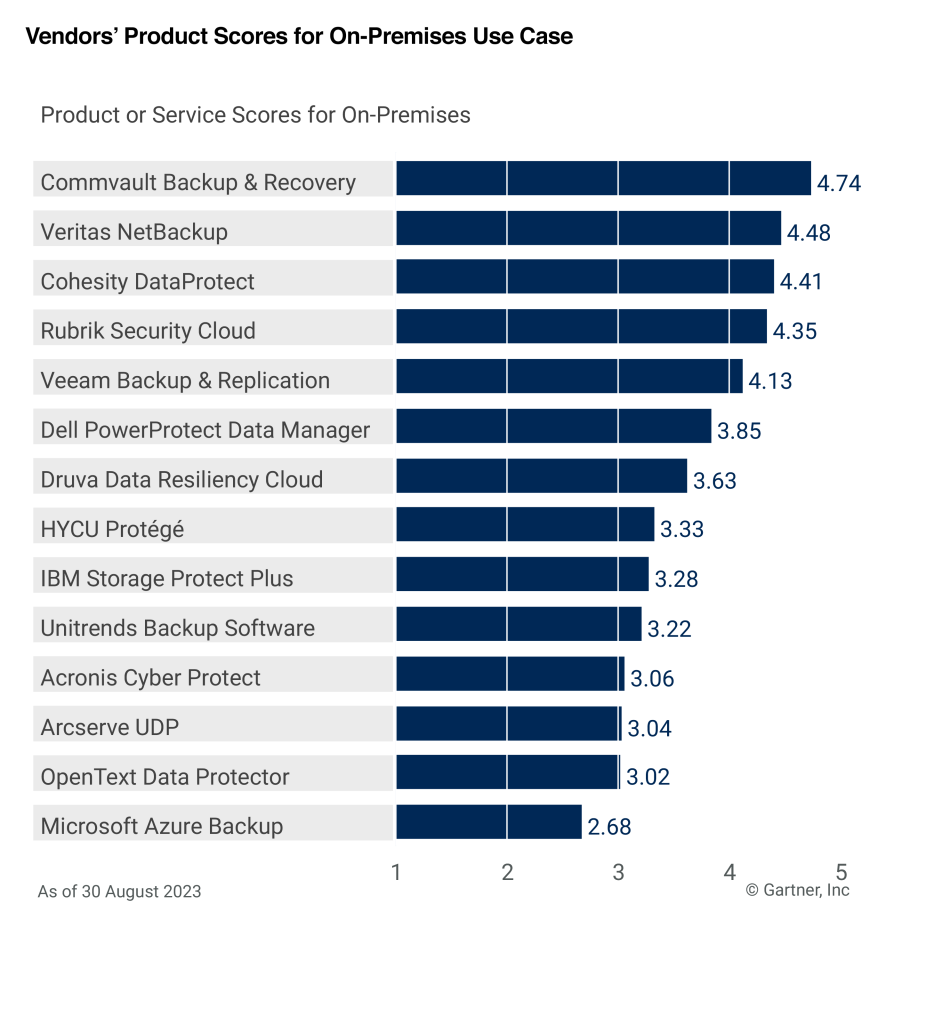
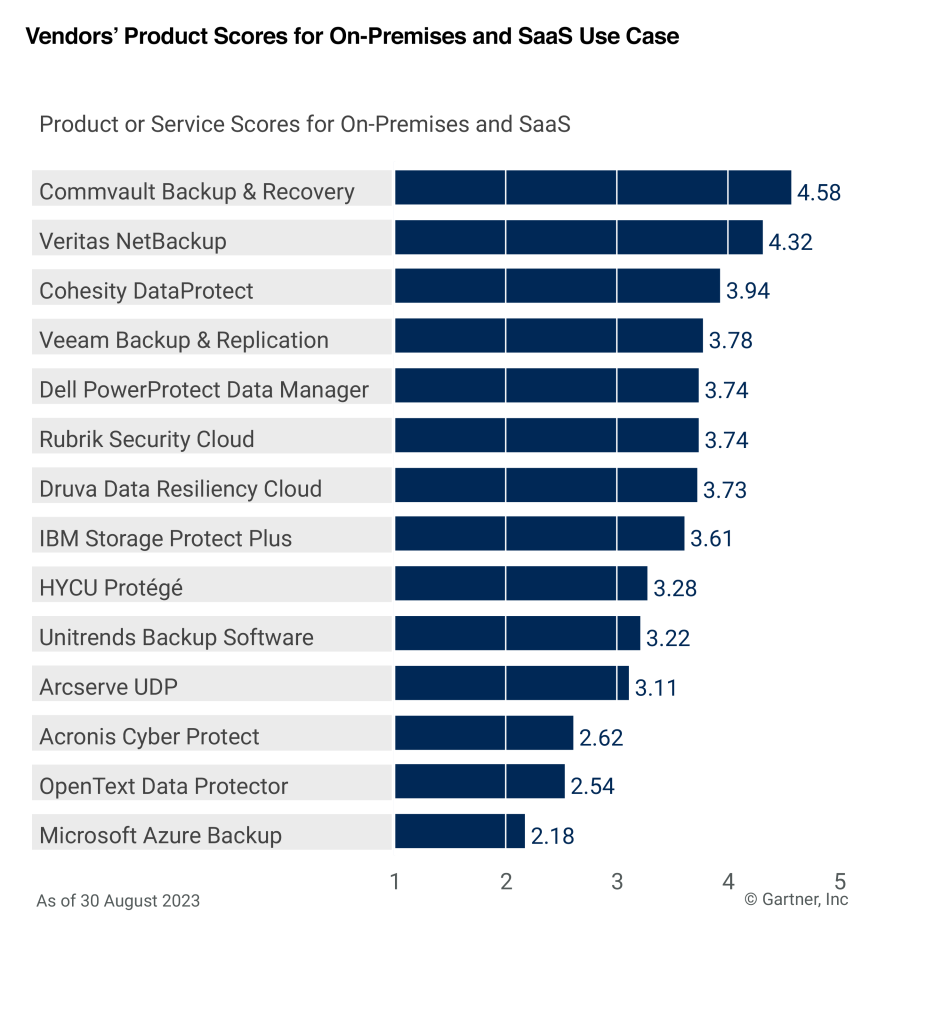
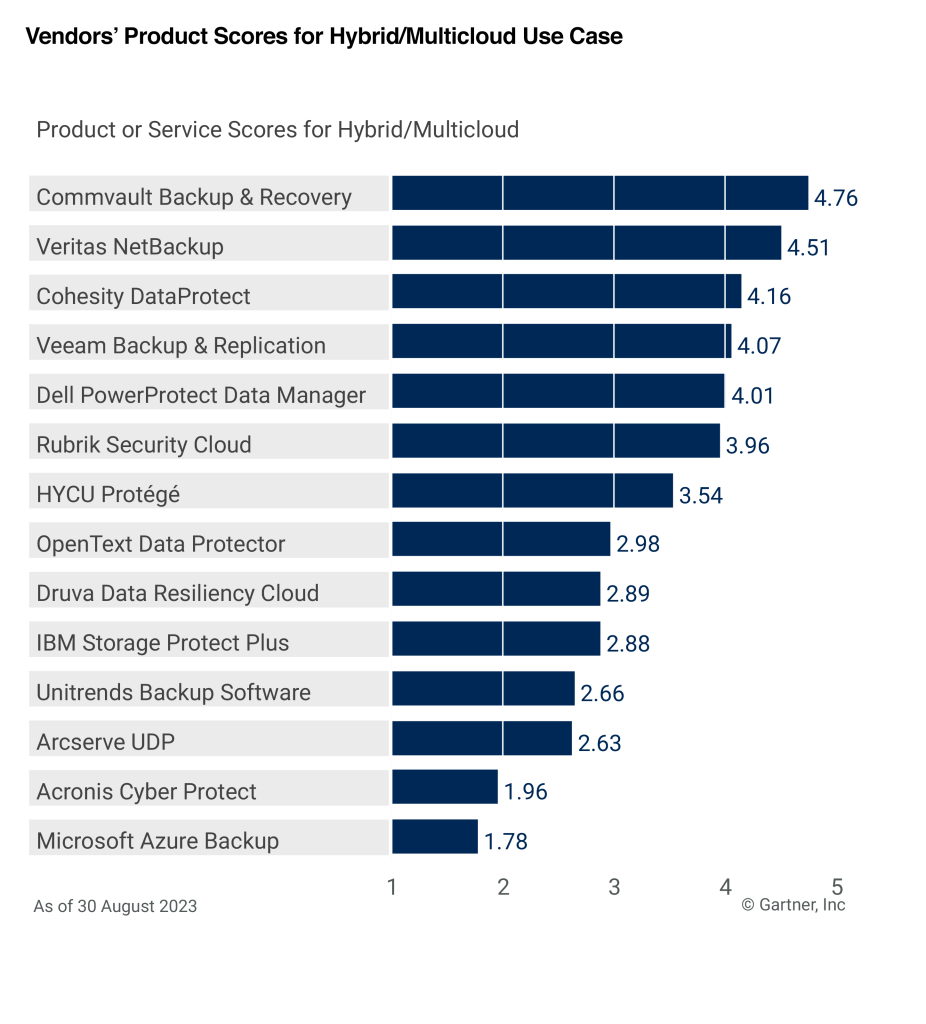
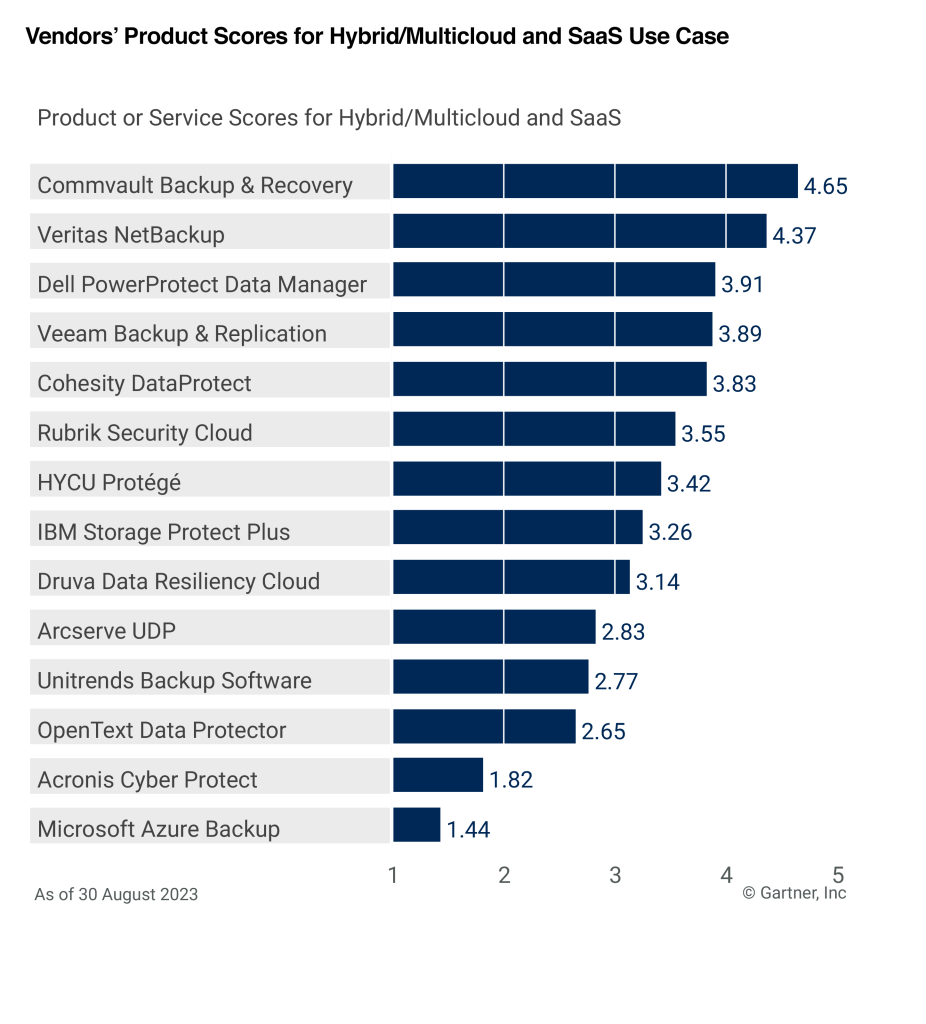
Gartner Critical Capabilities report, which is released as an essential companion to the Gartner Magic Quadrant, assesses vendors based on 15 key capabilities including Data Center Integration, Platform Security, Ransomware, and Management and more, across seven Use Cases.

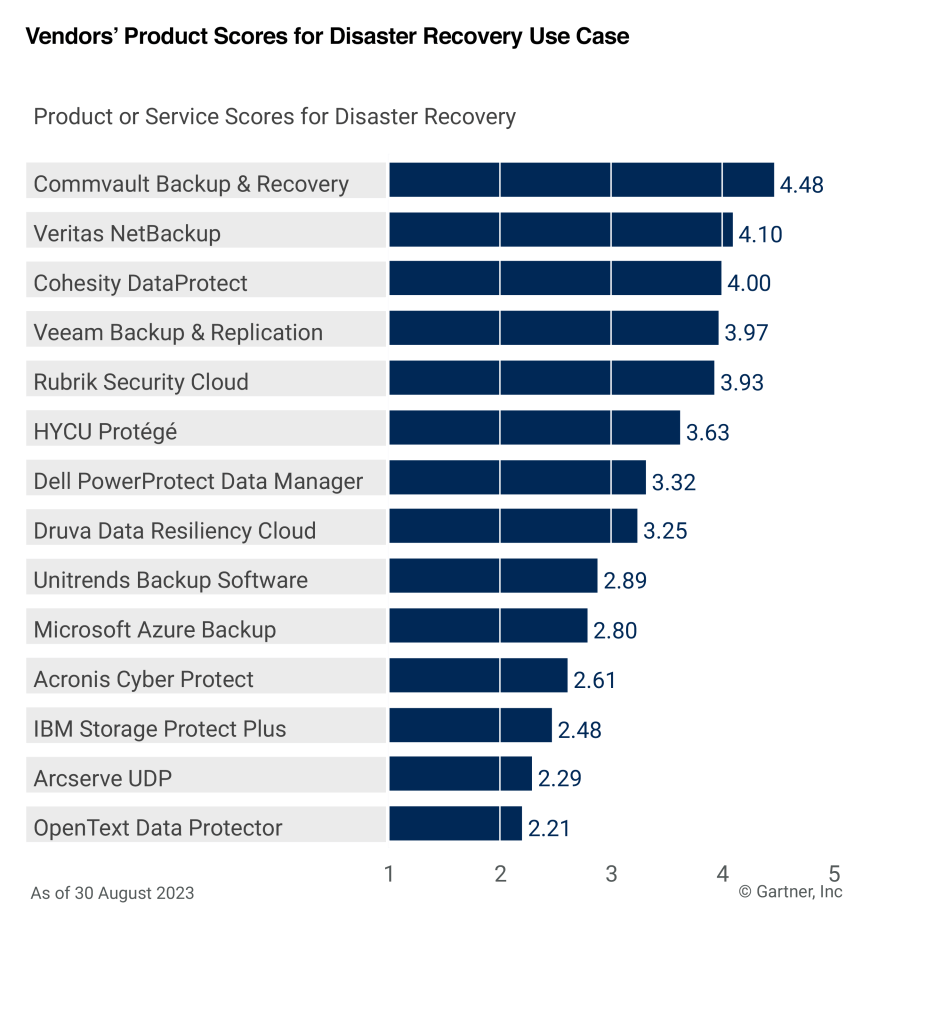
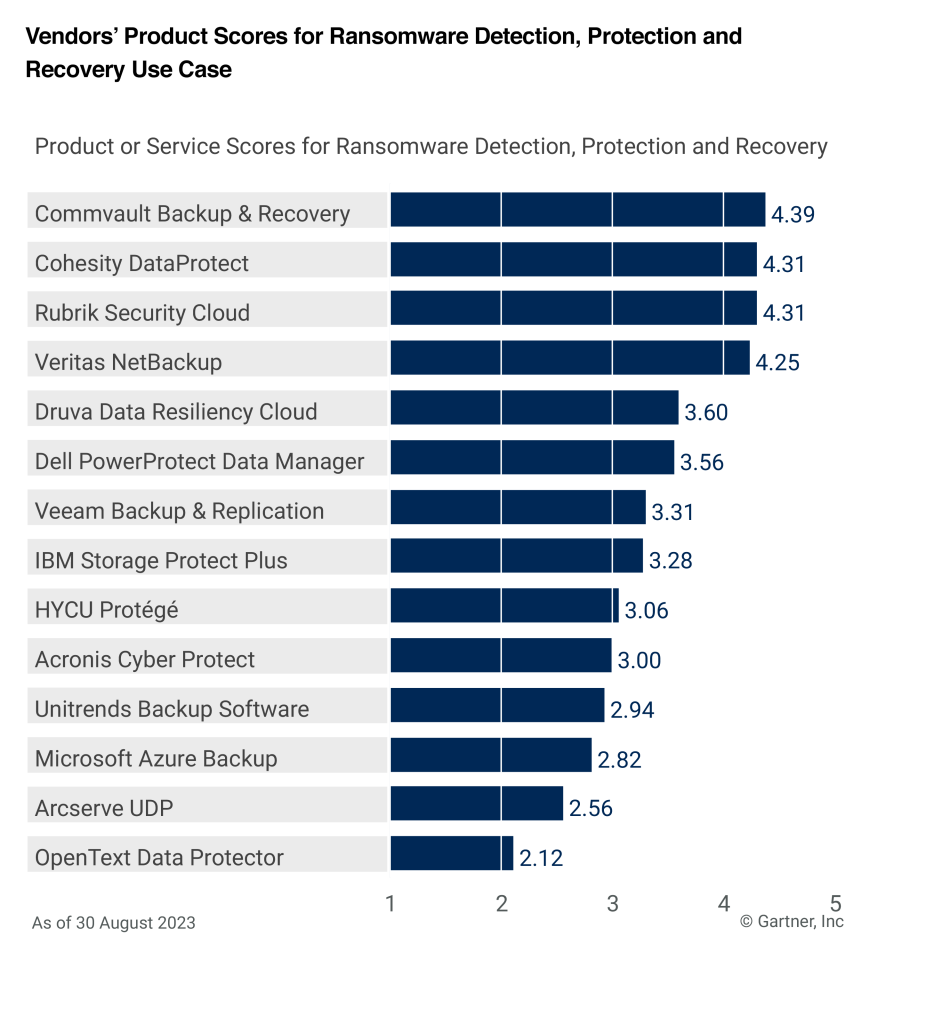
We are thrilled and honored that Commvault Backup & Recovery has scored the highest in six of the seven Use Cases in the Gartner Critical Capabilities for Enterprise Backup and Recovery Software Solutions: On-premises (4.74/5), On-premises and SaaS (4.58/5), Hybrid/Multicloud (4.76/5), Hybrid/Multicloud and SaaS (4.65/5), Disaster Recovery (4.48/5), and Ransomware Detection, Protection and Recovery (4.39/5)! Commvault ranked   second highest (4.36/5) for the Data Services Use Case.1

On-premises (4.74/5)

On-premises and SaaS (4.58/5)

Hybrid/Multicloud (4.76/5)

Hybrid/Multicloud and SaaS (4.65/5)

Disaster Recovery (4.48/5)

Ransomware Detection, Protection and Recovery (4.39/5)

We believe/think/feel that the release of this year’s report is indicative of the industry as a whole; data continues to require stronger protection, cyber threat detection and recovery across more environments. At Commvault, this is our sweet spot – delivering secure data protection for the hybrid world. We are honored to be recognized in this year’s Critical Capabilities report and ranked highest in six of out the seven Use Cases. We provide the right mix of detection, security, and recoverability capabilities to help customers meet cyber threats head-on.

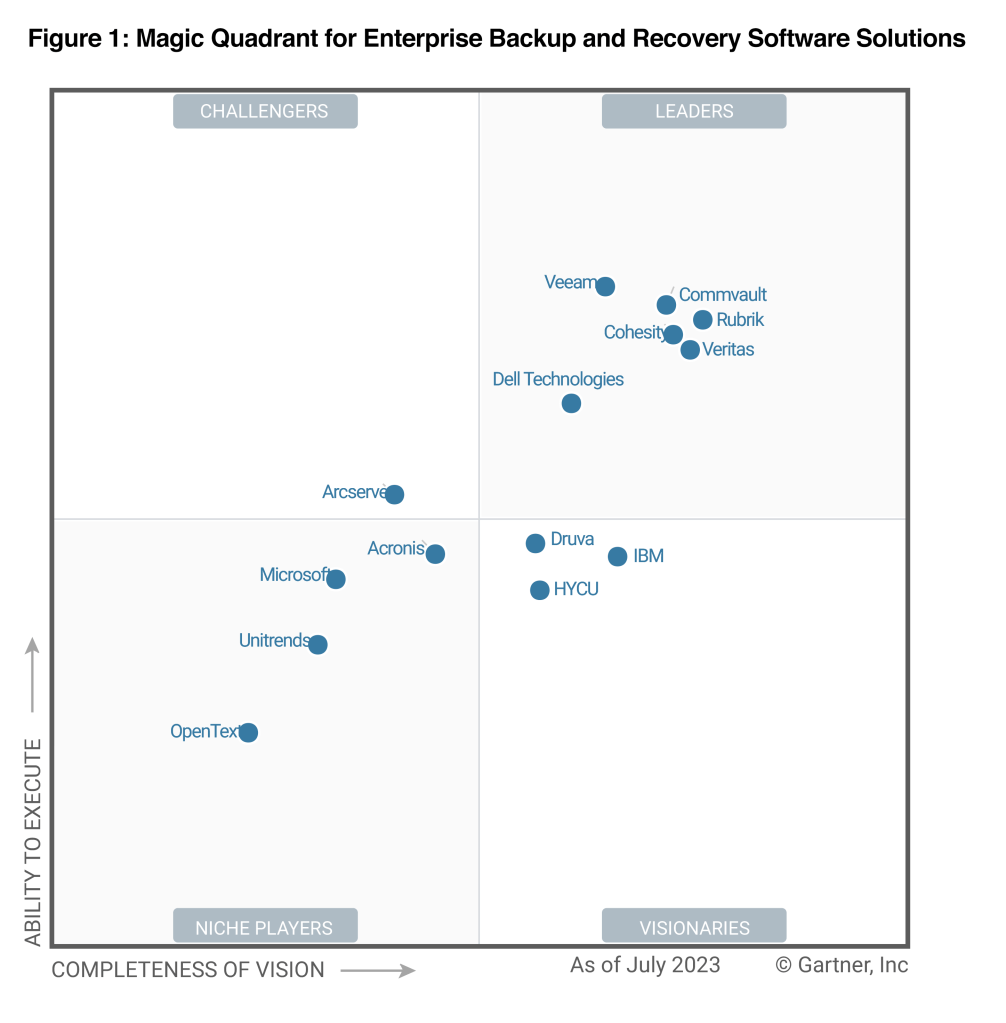
We are a twelve-time Leader in the Gartner Magic Quadrant and being recognized again in the Gartner Critical Capabilities report. We [AG3] are grateful to our customers for partnering with us in this journey of continuous customer-first innovation and to our partners in building a data ecosystem with no boundaries.

Get your copy of the 2023 Gartner Critical Capabilities for Enterprise Backup and Recovery Solutions!


Gartner, Magic Quadrant for Enterprise Backup and Recovery Software Solutions, Michael Hoeck, Nik Simpson, Jerry Rozeman, Jason Donham, 7 August 2023. This Magic Quadrant report was previously published as Magic Quadrant for Data Center Backup and Recovery Solutions (2016-2017; 2019-2020); Magic Quadrant for Enterprise Backup Software and Integrated Appliances (2014-2015); Magic Quadrant for Enterprise Backup/Recovery Software (2012-2013); and Magic Quadrant for Enterprise Disk-Based Backup/Recovery (2011).

GARTNER is a registered trademark and service mark of Gartner, Inc. and/or its affiliates in the U.S. and internationally, and MAGIC QUADRANT is a registered trademark of Gartner, Inc. and/or its affiliates and are used herein with permission. All rights reserved.

This graphic was published by Gartner, Inc. as part of a larger research document and should be evaluated in the context of the entire document. The Gartner document is available upon request from Commvault.

1. Gartner, “2023 Gartner® Critical Capabilities for Enterprise Backup and Recovery Software Solutions,” Jason Donham, Jerry Rozeman, Michael Hoeck, Nik Simpson, 18 September 2023.

Gartner disclaimer

Gartner does not endorse any vendor, product or service depicted in our research publications, and does not advise technology users to select only those vendors with the highest ratings or other designation. Gartner research publications consist of the opinions of Gartner’s research organization and should not be construed as statements of fact. Gartner disclaims all warranties, expressed or implied, with respect to this research, including any warranties of merchantability or fitness for a particular purpose.

More related posts


Thumbnail_Blog-Clumio-Chat-2026

Meet Clumio Chat: An AI Assistant to Help Evaluate Cloud-Native Data Protection

Read more about Meet Clumio Chat: An AI Assistant to Help Evaluate Cloud-Native Data Protection
Thumbnail_Blog-Clumio-Fedramp-2026

Clumio Advances Cloud-Native Cyber Resilience with FedRAMP® Milestone

Read more about Clumio Advances Cloud-Native Cyber Resilience with FedRAMP® Milestone
Thumbnail_Blog-Lateral-Access-2026

Private Cloud Data Security Technical Guide

Read more about Private Cloud Data Security Technical Guide

Fall is upon us! Which means it’s pumpkin spiced latte season and Cybersecurity Awareness Month is just around the corner. It’s a good time to check in on your incident response playbook, particularly the recovery phase. Remember, your cloud provider is responsible for the durability and uptime of their service, but your data—its resilience, integrity, and security—is your responsibility.

Backups—your final defense in the cloud

Risk profiles for cloud data encompass a range of scenarios, including unintentional data deletion due to human error, erroneous software deletes, malicious wipeouts, insider threats from disgruntled or departing employees, and targeted ransomware campaigns. A robust backup and recovery strategy, fortified with features such as data versioning, encryption, and air gaps, serves to enhance organizational data resilience. This multi-layered approach aims to minimize the impact of adverse data incidents by providing fast and secure data restoration, thus mitigating operational downtime and financial losses.

Air-gapped backups can save your company

Snapshots, often stored in production accounts, share the same risk as production data. Cross-account snapshots are also not enough, as they still fall under the organization’s primary security domain. For example, if an actor gains access to the right workload or the right administrator credentials, all data can often be manipulated. A more secure approach involves creating a virtual air gap between the primary account and the backup storage, offering an out of band layer of defense against ransomware and other cyberattacks.

Benefits of air-gapped backups

  • Ransomware resilience: Air-gapped backups ensure data recoverability, even when primary datasets are compromised.
  • Data integrity: Unauthorized access and data tampering are mitigated, particularly with immutable backups.
  • Regulatory compliance: Cybersecurity insurance and specific industry regulations often mandate air-gapped backups, ensuring both data protection and policy adherence.
  • Rapid recovery: Air-gapped backups facilitate quick data restoration, reducing downtime and mitigating adverse impacts.
  • Assurance: Secure backups offer peace of mind and enable IT resources to focus on other mission-critical operations.

Adding protection without adding cost or complexity

Stronger data protection through air-gapped, immutable backups is just one of the reasons that customers turn to Clumio. As organizations grow their cloud presence, controlling costs becomes another challenge to tackle. IT teams are tasked with reducing cloud costs, but often lack visibility into where they can cut their AWS bill without limiting business innovation.

Analyst firm ESG found that Clumio helps customers reduce costs by 30% on average through a uniquely architected solution that optimizes backup and recovery processes. Consumption reports further assist IT teams by identifying where organizations are spending the most for their AWS backups so they can better manage their storage spend. Clumio customers are typically able to reduce their backup costs while increasing their data security.

Clumio at Gartner IT Symposium, October 16-19, 2023

Join us at the Gartner IT Symposium in Orlando, Florida, at Booth #147. Stop by to chat with me or our Field CTO about how Clumio fits into your AWS data protection strategy while meeting your budget constraints.

More related posts


Thumbnail_Blog-Clumio-Chat-2026

Meet Clumio Chat: An AI Assistant to Help Evaluate Cloud-Native Data Protection

Read more about Meet Clumio Chat: An AI Assistant to Help Evaluate Cloud-Native Data Protection
Thumbnail_Blog-Clumio-Fedramp-2026

Clumio Advances Cloud-Native Cyber Resilience with FedRAMP® Milestone

Read more about Clumio Advances Cloud-Native Cyber Resilience with FedRAMP® Milestone
Thumbnail_Blog-Lateral-Access-2026

Private Cloud Data Security Technical Guide

Read more about Private Cloud Data Security Technical Guide

Data protection and cloud migration and recovery planning, oh my! Experience it all with Commvault at Oracle CloudWorld, Booth #23, running September 19-21 in Las Vegas.

We’re only a few weeks away from the show and boy do we have a packed agenda for customers, partners, and show attendees!

First up, our speaking sessions and tutorials. Get these on your calendar before it’s too late!

  • Tues, Sept 19 at 5:00 pm PDT – OCI Data Protection: Building Cyber Response Strategies to Lower Risk—and TCO
    • Decrease Risks and Costs! Learn how Commvault and Oracle are redefining modern data protection for Oracle Cloud Infrastructure (OCI).
  • Wed, Sept 20 at 1:00 pm PDT – Your VMware Estate Migration: Maintain Control and Maximize Security
    • It’s as easy as 1-2-3! Follow this step-by-step tutorial to seamlessly deploy and migrate VMware workloads to OCVS (Oracle Cloud VMware Solution), using Commvault data protection.
  • Wed, Sept 20 at 3:55 pm PDT – Partners: The Ransomware Playbook – why Firewalls and Backups are not Enough
    • Attention partners, now’s the time to walk away a hero and help your customers defeat their biggest threat – ransomware.
  • Thurs, Sept 21 at 8:30 am PDT – OCI and Commvault Partner to Secure, Protect, Recover Your Hybrid Environment
    • Want to know the secret when it comes to cost savings? Simplifying management, optimizing cloud strategies, reducing security risks, and improving business continuity with Commvault.
  • Thurs, Sept 21 at 1:05 pm PDT – How Commvault Helps Redefine Data Protection for Oracle Partners and Customers
    • Partners, this one’s for you! Discover ways to exceed your customers’ expectations while helping them secure, defend, and recover their most precious resource, their data.

Next, be sure to stop by the Commvault booth (Booth #23) where you’ll experience the best in data protection for the widest breadth of workloads, first-hand. We’re here to help accelerate your OCI journey by delivering superior price-performance, built-in enhanced security, and simplified recovery and management.

  • Are you a planner? No need to rush around during the show. Schedule a meeting in advance and we’ll hold your spot.
  • Do you prefer a more spontaneous approach? We’ll be hosting brief 10-minute sessions throughout the show days. This is your opportunity to quickly learn the ins and outs of simplifying your backup strategy….and you may walk away with some pretty cool prizes.
  • How about testing the technology for yourself? We’ve got you covered with demos showcasing fast backup and recovery of cloud and on-premises workloads, and Metallic Recovery Reserve on OCI for air-gapped protection. 

Are you convinced yet that Commvault Booth #23 is the place to be? We’ll see you in Las Vegas!

More related posts


Thumbnail_Blog-Clumio-Chat-2026

Meet Clumio Chat: An AI Assistant to Help Evaluate Cloud-Native Data Protection

Read more about Meet Clumio Chat: An AI Assistant to Help Evaluate Cloud-Native Data Protection
Thumbnail_Blog-Clumio-Fedramp-2026

Clumio Advances Cloud-Native Cyber Resilience with FedRAMP® Milestone

Read more about Clumio Advances Cloud-Native Cyber Resilience with FedRAMP® Milestone
Thumbnail_Blog-Lateral-Access-2026

Private Cloud Data Security Technical Guide

Read more about Private Cloud Data Security Technical Guide

Monday, September 11th is Patriot Day and a National Day of Service and Remembrance in the United States as we commemorate the 22nd anniversary of the September 11th (9/11) terrorist attacks.  

September 11, 2001 was a loss felt worldwide. Today, we remember those who lost their lives on that day, thank the brave first responders who put their lives on the line and honor the sacrifices made to protect our freedom.  

As I reflect on that day, how our communities came together always stands out to me. We put aside our divisions and united in caring for one another, supporting one another, and projecting hope; I tend to describe this as compassion. Those efforts resonate with me today and each time I step out of my front door into the daily complexities surrounding us all. Each interaction where we can inject more compassion into the community helps. 

As a U.S. Navy veteran, I am proud to be the executive sponsor of our VALOR (Veterans) Employee Resource Group (ERG) here at Commvault. To honor the anniversary of 9/11, our VALOR ERG held our annual Commvault Climbs challenge, where Vaulters around the world are challenged to climb as many as 104 flights of stairs to honor the brave firefighters and first responders who climbed the stairs of the Twin Towers of the World Trade Center to save the lives of those who were trapped. Each year, I’m reminded of the incredible support across our company as we live our value of caring.   

Let’s take the time today to remember those who lost their lives on 9/11, reflect on the bravery of the first responders in those moments, and honor those who volunteered to serve their country in response to the tragedy. 

More related posts


Thumbnail_Blog-Clumio-Chat-2026

Meet Clumio Chat: An AI Assistant to Help Evaluate Cloud-Native Data Protection

Read more about Meet Clumio Chat: An AI Assistant to Help Evaluate Cloud-Native Data Protection
Thumbnail_Blog-Clumio-Fedramp-2026

Clumio Advances Cloud-Native Cyber Resilience with FedRAMP® Milestone

Read more about Clumio Advances Cloud-Native Cyber Resilience with FedRAMP® Milestone
Thumbnail_Blog-Lateral-Access-2026

Private Cloud Data Security Technical Guide

Read more about Private Cloud Data Security Technical Guide

Cyber threats continue to evolve and become more persistent. Worldwide spending on security solutions and services is expected to reach nearly $300 billion in 20261 – a 37% increase from current spending, indicating the increasing threat level. Surprisingly, despite greater awareness and investment, 83% of organizations have experienced more than one data breach in their lifetime2. These numbers highlight the crucial need for recovery readiness, with data security a top concern as cloud storage becomes the popular option for offsite backups.

The need for immutability

Immutability is defined as “the ability of any data to be maintained in a non-fungible state for a specific duration of time”. Data immutability can be attained via various methods working in conjunction with each other.  An immutable architecture, then, is a model in which no updates, security patches, or configuration changes happen “in-place” on production systems. If any change is needed, a new version of the architecture is built and deployed into production.  Immutability protects within, as well as outside of the backup solution.

Organizations need an immutable architecture to ensure their data is safe and secure and, more importantly, ready whenever they need to restore it. Immutability is a proven technique used to reduce cyber-attacks on backup data and ensure that backup copies aren’t changed in any way.

The best indicator that you have a reliable backup solution is your ability to recover data quickly. This comes partly from proper planning and architecting your backup and recovery solution. However, this can be a difficult challenge when your data is up against so much opposition. In the past, hardware failures, natural disasters, and human error were likely “top of mind” outage threats. Today, ransomware and insider threats have taken over as top concerns. It’s apparent that planning and architecture design is not enough; today’s backup and recovery solution must be immutable, so you have peace of mind that your data is safe.

Mutable vs. Immutable

There is an essential distinction between mutable and immutable infrastructure when protecting valuable data. Traditional mutable infrastructure is more flexible and allows for updates and integrations to be made quickly, but this can also make it easier for cybercriminals to access and manipulate data.

These bad actors often target businesses through data breaches, which can have severe consequences such as reputational damage, loss of revenue, and legal problems. This is where an immutable architecture comes in, offering a more secure and tamper-proof solution to protect data from internal and external threats.

Immutability for regulatory compliance

Immutable storage is essential for any organization to protect its business-critical or private data. This is especially important for industries like healthcare, finance, and law, which have strict legal and regulatory requirements to safeguard sensitive data from unauthorized access or tampering. Immutable storage helps organizations comply with requirements like those put forth by the SEC, CFTC, and FINRA related to the recording, storage and retention of electronic records and facilitates easy recovery in case of data loss or corruption.

Commvault Cloud is immutable by default

With every environment having its own mix of infrastructure, securing backup data against random unauthorized changes can seem challenging. Therefore, Commvault has taken an agnostic approach to immutability. Leveraging a hardened, multi-layered approach to data protection, we provide robust controls that prevent various types of threats to backup data and ensure copies are highly recoverable from accidental deletion or malicious attack. Natively, all backup data is protected at the storage level. Backup copies and operations live in a virtually air-gapped location, in an isolated security domain, decoupled from source environments. Retention locks can also be applied to prevent unwarranted modifications to data retention policies.

With Commvault Cloud, you do not need special hardware or cloud storage accounts to lock backup data against ransomware threats. If you happen to have Write-Once, Read Many (WORM), object lock, or snapshot supported hardware (which Commvault fully supports), you can still use Commvault’s built-in locking capabilities to complement and layer on top of existing security controls. Having the ability to layer security controls across different infrastructure types is what places Commvault’s immutable solution ahead of the competition.

Multi-factor authentication, AES 256 bit at-rest encryption, firewalls, and other zero-trust access controls block internal and external movement of data by unauthorized parties. All security protocols employed adhere to security best practices and are based upon NIST 800-53, SOC2 type II, and ISO27001:2013 guidelines and compliance requirements.

With built-in zero-trust security protocols, Commvault Cloud meets the most stringent confidentiality, integrity, and availability standards for government agencies and business, alike.

Commvault Cloud’s immutable infrastructure architecture

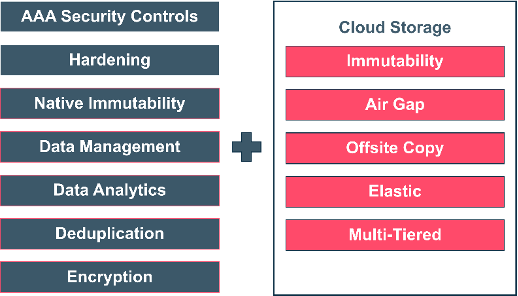
Commvault’s machine learning platform extends immutable protection capabilities by providing a proactive platform for detecting and responding to threats accordingly. We employ a multi-layered approach to protect against various threat vectors and ensure data is safe and include storage locking to combat ransomware and Zero trust AAA controls up and down the backup and recovery stack to provide comprehensive protection. Isolation and air gapping utilizes TLS encrypted network topologies and infrastructure is hardened to reduce the attack surface.

At a high level, the Commvault platform includes these seven layers combined with immutable cloud storage:

Cloud storage provides enhanced options for defending, securing, and restoring your data. Immutable by default, it all adds up to the most flexible data protection you can deploy anywhere and at scale for any workload.

Your Protection, Your Way: Immutability for Software and SaaS

Commvault Grid makes implementing an immutable architecture as an integrated appliance or reference design for an all-in-one solution easier. It delivers comprehensive data management for all workloads from a single, extensible platform. Commvault Cloud employs a multi-layered approach to protect against various threat vectors and ensure data is safe. Commvault’s immutable architecture consists of:

  • Software (Compliance Lock)
    • Attempt: Backup admin tries to reduce retention, delete backup job, policy, or library accidentally
    • Action: Denied by Compliance Lock
  • Operating System (Access controls)
    • Attempt: Authorized user tries to encrypt, move, or delete files or reformat a disk
    • Action: OS blocks users and/or ransomware attacks through access controls
  • File System (Immutability at the storage layer)
    • Attempt: Authorized or malicious user tries to modify or encrypt protected backup data
    • Action: Immutable file system prevents backup data from being modified/encrypted

Commvault AirGap is a fully managed cloud storage target for the Commvault SaaS hybrid cloud portfolio, as well as Backup and Recovery and Commvault Grid. Cloud adoption is accelerated with optimized storage options and air gapped copies of data to ensure ransomware recovery.

Commvault AirGap is optimized cloud data protection, offering:

  • Short or long-term cloud storage, from one vendor, managed in one interface
  • Controlled costs via optimized storage
  • Unified naming for all cloud storage

With Commvault AirGap, you can have both primary and secondary backup copies for all your workloads in the following storage tiers:

  • Azure Hot
  • Azure Cool
  • OCI Standard (Commvault Cloud SaaS only)
  • OCI Infrequent Access (Commvault Cloud SaaS only)

And while all the above solutions can elevate your cyber resilience strategy, it also provides significant cost savings. Commvault Cloud’s air-gapping, immutability, and more importantly, ability to effectively restore an environment can have a $1.06 million ransomware benefit over the 3-year analysis.3

Conclusion

Data threats are becoming increasingly sophisticated, and there’s no getting around the fact that backup and recovery platforms today must offer greater protection against cyber threats. Commvault solves this problem with an immutable architecture that provides complete data security and fast recovery of any workload, no matter where it lives. Our layered approach reduces risk while helping organizations meet compliance requirements without sacrificing performance.

Now is the time to ask the tough questions regarding your data security provider so you can be fully confident that your data is safe, secure, and compliant. Start exploring our immutable architecture today and discover how staying ahead of potential threats with the right solution has never been easier or more secure.


References

1. IDC Worldwide Security Spending Guide – 2. IBM Cost of a Data Breach Report 2022 – 3. Analyzing the Economic Benefits of Data Protection with Commvault on Microsoft Azure

More related posts


Thumbnail_Blog-Clumio-Chat-2026

Meet Clumio Chat: An AI Assistant to Help Evaluate Cloud-Native Data Protection

Read more about Meet Clumio Chat: An AI Assistant to Help Evaluate Cloud-Native Data Protection
Thumbnail_Blog-Clumio-Fedramp-2026

Clumio Advances Cloud-Native Cyber Resilience with FedRAMP® Milestone

Read more about Clumio Advances Cloud-Native Cyber Resilience with FedRAMP® Milestone
Thumbnail_Blog-Lateral-Access-2026

Private Cloud Data Security Technical Guide

Read more about Private Cloud Data Security Technical Guide

In an organization’s ongoing battle against ransomware threats, safeguarding Personally Identifiable Information (PII) – the data encompassing sensitive personal information whose compromise can lead to severe legal, financial, and reputational consequences – is a critical imperative.  As ransomware attacks continue to evolve in sophistication, safeguarding PII data has become paramount for effective defense strategies.

  • Mitigating Legal and Financial Risks: After a ransomware attack, the unveiling of PII data can expose organizations to significant legal and financial risks. Data breaches may result in hefty fines, regulatory penalties, and class-action lawsuits. To reduce vulnerability to such liabilities, organizations must proactively discover and secure PII data, demonstrating their commitment to data protection and privacy.
  • Thwarting Data Exfiltration: Ransomware attackers frequently threaten to publish or sell stolen data to coerce victims into paying ransoms. Identifying and securing PII data is required to pinpoint critical assets that attackers might target for exfiltration. Robust access controls, encryption measures, and data loss prevention protocols act as strong deterrents against unauthorized extraction.
  • Tailored Protection by Prioritizing PII Data: Recognizing that not all data is of equal value, organizations should adopt a strategic approach to protection. PII data, given its high susceptibility to identity theft and fraud, demands special attention. Through meticulous discovery and categorization, organizations can allocate resources to fortify their most sensitive and valuable data, thereby enhancing the efficacy of overall cybersecurity measures.

Recognizing the need for strong protection of PII data is part one. Identifying a solution to accomplish this task is the second piece of the puzzle.

Commvault Risk Analysis: AI to the Rescue

Commvault Risk Analysis is a comprehensive solution aiding organizations in discovering, evaluating, overseeing, and implementing measures to minimize data-related risks. By gaining visibility into these, organizations can easily identify and categorize sensitive data to help mitigate potential data breaches and foster efficient cross-functional collaboration. Commvault Risk Analysis forms the backbone of smart, proactive data management strategies designed to reduce risks and costs.

Sensitive data detection relies heavily on AI methods that can process vast amounts of data quickly and accurately, and Commvault Risk Analysis is modernized with such capabilities. These AI-driven techniques significantly enhance the accuracy and efficiency of identifying sensitive information within large and diverse datasets.

  • Comprehensive PII Management: Risk Analysis Entity Manager equips organizations with a versatile toolset for managing various PII types identified through content analysis. This feature includes predefined PII entities and the flexibility to create custom entities to finetune the model for specific datasets and datatypes. These entities encompass specific PII categories, allowing for sensitivity level adjustments and associated keywords. This system enables configuration for default and customized entity types, forming the foundation for effective PII management.
  • AI-Powered Contextual Learning for Data Classification: Leveraging AI-driven contextual learning, Commvault Risk Analysis can achieve precise data classification. Unlike traditional methods, AI-driven approaches use machine learning algorithms to understand the context and adapt to evolving data patterns. This reduces false positives and false negatives by considering surrounding text, metadata, and contextual cues. These systems efficiently identify sensitive data and automate classification, bolstering data security, compliance, and governance.
  • Empowering Data Classification Through Training Models: Training classification models with custom datasets is essential for accurate identification of document types. This involves uploading representative files that mirror desired categories, allowing the model to build a strong foundation. Continuous refinement is possible by adding additional documents that finetune the classification model, leading to more accurate sensitive data detection.
  • Azure Cognitive Services for Data Classification Insights: Integrating Azure Cognitive Services with Commvault Risk Analysis further enhances the recognition of diverse data types within sensitive datasets. AI-driven algorithms can identify intricate patterns defining various data categories and business domains. Deep learning and text analytics capabilities of Azure Cognitive Services boost data classification accuracy, efficiency, and compliance even in complex unstructured data. The synergy between Azure’s Cognitive Services and sensitive data governance capabilities of Risk Analysis offers a cohesive and integrated experience, that not only facilitates more accurate data governance but also a modern AI-enabled deep learning approach that continuously adapts as datasets evolve.

In today’s digital landscape fraught with ransomware dangers, safeguarding PII data is not merely a necessity but a responsibility. By embracing AI-driven intelligent technologies, and a commitment to a robust data protection wrapper around sensitive data, organizations can fortify their defenses against ransomware attacks and ensure the security and privacy of the sensitive data they store.

More related posts


Thumbnail_Blog-Clumio-Chat-2026

Meet Clumio Chat: An AI Assistant to Help Evaluate Cloud-Native Data Protection

Read more about Meet Clumio Chat: An AI Assistant to Help Evaluate Cloud-Native Data Protection
Thumbnail_Blog-Clumio-Fedramp-2026

Clumio Advances Cloud-Native Cyber Resilience with FedRAMP® Milestone

Read more about Clumio Advances Cloud-Native Cyber Resilience with FedRAMP® Milestone
Thumbnail_Blog-Lateral-Access-2026

Private Cloud Data Security Technical Guide

Read more about Private Cloud Data Security Technical Guide

Fans of science fiction know Artificial Intelligence (AI) is a recurring theme – and has been for quite some time. Movies, books and even video games embrace it as an advanced technology that powers robots, cyborgs, spaceships – you name it. And core to the mythos of AI is that it thinks in a manner indistinguishable from that of a human, while operating with the speed and intelligence of a computer.

We’re not there yet; as much as I’d like my own version of Tony Stark’s Mark V armor, I’ll have to settle for being able to ask Alexa facts about Chuck Norris. But we are making swift progress – I recently learned a popular online tech publication had been using AI to generate articles for months – and was none the wiser, thanks to ChatGPT and other Large Language Models (LLMs).  

LLMs promise to revolutionize how we interact personally and professionally. We’re seeing incredible interest and funding being poured into their development – and it’s just beginning. In today’s business world, AI is being viewed as the key to unlock technological advancement, competitive advantage, and in turn, profitability.

It’s why tech giants like Microsoft, Meta, and Google each referenced AI almost 50 times in their recent earnings calls. As a result, you may be asking yourself “What if AI could help my business…”

  • Make better decisions?
  • Operate more efficiently?
  • Save costs?
  • Enhance customer relationships?

The good news is that it can absolutely do all the above.

The bad news? AI isn’t free. Quite the opposite, in fact.

The Cost of AI

AI, like anything in its infancy, requires learning. So how does one go about teaching ChatGPT and other LLMs how to work? Simply put, money. Tony Stark kind of money.

It’s been reported that ChatGPT utilized over 10,000 GPUs (Graphic Processing Units) to train it. (Now we know where all the graphics cards went for the last two years.) And the most powerful GPU on the planet will run you $30,000. Which means ChatGPT had an awfully expensive childhood. But that’s not all. It’s estimated that ChatGPT costs upwards of $700,000 per day to operate. Why? Well…

AI Requires Cloud Infrastructure

If generating AI were as simple as harnessing the pixel pushing power of Nvidia or AMD, we would see it proliferate at an even higher rate than it currently is. But to deliver AI, you need additional hardware and infrastructure. That means servers – many, many servers. And not coincidentally, today’s enterprises need the same to fulfill their data protection needs. And where do they turn to do that? The cloud.

That’s right – the same infrastructure that defends, protects, and secures your data is now being used to make AI available to the masses. It drives LLMs, machine learning, and automation, just to name a few. Those use cases are going to exponentially increase because AI makes great use of raw computing power and scalability. And because the more things change, the more they stay the same – in this instance, we’re talking about reducing the cost of AI to ensure a healthy bottom line for your business.

Extra ROI from Your Data Protection Platform

The natural progression of innovation and technical economics involves experimenting to find a way to optimize a use case in hardware (silicon processors)  and then shift it into software (ChatGPT)  so that everyone can benefit from it. Using that logic, you’re probably already in the cloud. More likely, multiple clouds. To take advantage of this paradigm, you need to implement cost-effective solutions that ensure the integrity of your dataset.

One way to do so is by using Data Protection as a Service (DPaaS) to reduce your operational spend on cloud Infrastructure to help pay for those growing AI bills. You’re already optimizing your business in myriad ways; this methodology is a natural fit. It’s a virtuous cycle: grow your business by utilizing existing resources to reduce costs, which are then invested back into the business.

Driving Down Today’s TCO is Just the Start

Where DPaaS is concerned, enterprises are rightfully focused on security first, with TCO (Total Cost of Ownership) being a close second. TCO is quantitative in nature, so it can be difficult to know how to evaluate vendor claims. At the end of the day, these are the current table stakes:

  • Deduplication and data tiering: Maximize storage efficiencies and control cloud costs.
  • Cloud-native storage: Storage costs should always decrease when utilizing a DPaaS vendor alongside your cloud provider.
  • Proactive Ransomware Monitoring and Alerting: This also includes end to end data encryption and data immutability.
  • Multi-Cloud Data Protection: Companies should use the right cloud technology that suits their business needs. And vendors should offer DPaaS solutions that support all of them.
  •  Broad Spectrum of Workloads: Companies use a mix of SaaS, IaaS, and on-premises resources – your DPaaS solution needs to support all of it.
  • Robust reporting: Includes compliance analytics to stay current and proactively address future requests on demand.

If you can check all of the above boxes, you’re well on your way to driving down the cost of your data protection investment. Now it’s time to start thinking about what’s next and where to reinvest those savings.

The Future of Data Protection

AI-enhanced data protection will offer continuous innovation, based on machine learning and other advancements that are driven by the needs of modern organizations. And because we are at the intersection of data protection not only in the cloud, but also on-premises, we need a unique perspective on what that could look like. What if you could:

  • Automate tasks to drive better efficiencies?
  • Continuously analyze data and find root cause for problems instantly?
  • Be more efficient with less resources?
  • Utilize your data to make better decisions?
  • Receive high-fidelity security alerts?
  • Use data-driven insights to automatically understand customer or employee needs, and generate the right result, at the right time?

Soon, these will be the new table stakes. Your data protection, whether you know it or not, is a direct on-ramp for your ability to harness AI, affordably.

It’s YOUR data. What will you do with it?

More related posts


Thumbnail_Blog-Clumio-Chat-2026

Meet Clumio Chat: An AI Assistant to Help Evaluate Cloud-Native Data Protection

Read more about Meet Clumio Chat: An AI Assistant to Help Evaluate Cloud-Native Data Protection
Thumbnail_Blog-Clumio-Fedramp-2026

Clumio Advances Cloud-Native Cyber Resilience with FedRAMP® Milestone

Read more about Clumio Advances Cloud-Native Cyber Resilience with FedRAMP® Milestone
Thumbnail_Blog-Lateral-Access-2026

Private Cloud Data Security Technical Guide

Read more about Private Cloud Data Security Technical Guide

At Commvault, we believe that investing in our people begins with the next generation of leaders.

Our U.S. summer internship program recently concluded, and I’m so incredibly proud of the work done by our intern class these past few months! Our intern program provides students with meaningful work experiences as we empower these aspiring professionals to grow and learn with us at Commvault. And our hybrid work environment allows our remote-first work to spread through into our development of the next generation of talent.

https://play.vidyard.com/Qkt2ixrpHZMpyKoaC6R2mb

We prioritize collaboration with leadership, mentorship, and networking opportunities, providing training and direct experience that enables our interns to expand their professional network and technical skillset are all core to this program. These are the minds that will help shape the future for us all!

The internship program concludes with a project contest, which is an exciting opportunity for our interns to present a product idea, process improvement, or survey results tied to their field of study to a panel of our cross-functional leaders. And let me tell you, the innovation we see each year through these projects is exceptional! This year’s projects ranged from built applications, sizing tools, and more!

Each year, I’m reminded of the importance of having mentors to provide insight into new workplace innovations and perspectives. Our continuous culture of learning allows us to embrace and celebrate the ideas of everyone within our global Vaulter community!

We continue to always inspire our next generation of leaders and give them an exceptional experience during their time here. I want to extend a huge thank you to our 2023 U.S. summer intern class for all their amazing contributions to Commvault. Congratulations all!

More related posts


Thumbnail_Blog-Clumio-Chat-2026

Meet Clumio Chat: An AI Assistant to Help Evaluate Cloud-Native Data Protection

Read more about Meet Clumio Chat: An AI Assistant to Help Evaluate Cloud-Native Data Protection
Thumbnail_Blog-Clumio-Fedramp-2026

Clumio Advances Cloud-Native Cyber Resilience with FedRAMP® Milestone

Read more about Clumio Advances Cloud-Native Cyber Resilience with FedRAMP® Milestone
Thumbnail_Blog-Lateral-Access-2026

Private Cloud Data Security Technical Guide

Read more about Private Cloud Data Security Technical Guide

Recently, the fifth annual AWS Storage Day was held – a virtual event streamed on Twitch during which Amazon Web Services (AWS) shares the latest news and innovations around their storage portfolio. The event is a celebration of customer-focused innovation, something we at Commvault pride ourselves in, which is why we are honored to have been invited by AWS to participate in this year’s festivities.

Listening to the sessions, it was no surprise to us (given our leadership position in the data protection space – 12 times in a row, in fact) that data was at the heart of every discussion. The newest features and capabilities announced during Storage Day provide new options to customers and application developers to innovate without limits by leveraging the elasticity and scale of AWS storage while still maintaining that all-important cost-efficiency along the way. It is clear that these new enhancements and the 17+ years of innovation leading up to them – across Amazon S3, Amazon EBS, and many more – will power the next generation of Generative AI apps under development right now.

Some of the announcements we thought were especially exciting included:

Then there’s the one most near and dear to our hearts – customers are now able to recover up to 85% faster from Amazon S3 Glacier, further maximizing the value of their archived assets. We might be a little biased, though, as our own Michael Fasulo presented on this very topic alongside Nitish Pandey, a product leader on the Amazon S3 team, in a session during Storage Day (that you can rewatch here).

We were so excited to share the latest example of the great collaboration and innovation that Commvault and AWS are bringing to our joint customers — allowing them to recover their data significantly faster, at no additional cost, from the ultra-low cost, long-term, secure, and durable Amazon S3 Glacier Flexible Retrieval storage class. At its simplest, it’s all about helping our customers protect their data and be able to recover it when their business needs it most. And having partners like AWS who are aligned in that vision and share that customer obsession enables us to do some remarkable things together.  You can read more about this joint solution and why we’re so excited about it on the AWS Storage Blog: Reduce recovery time and optimize storage costs with faster restores from Amazon S3 Glacier storage classes and Commvault.

Now, Storage Day wasn’t all new announcements. There were also some great Amazon S3 primers that helped give us all the confidence that securityremains the top priority for AWS and their customers’ data while also staying relentlessly focused on data durability in everything they do with customer storage. These themes resonate with us, as well, as we are intently focused on securing, defending, and recovering our customers’ data across AWS and their entire data estate. And if you’re looking to find out more about how we are working together to strengthen our customers’ security posture and improve their resiliency, you’re in luck.  

We teased it during the stream of our session, but you can now register for our Technology Touchdowns event on September 6th where we’ll go deep into our playbook and show you what Game-Winning Data Protection with Commvault and AWS looks like. We’ll even be joined by Peyton Manning –2x Super Bowl-Winning Champion, 5x NFL MVP & Member of the Pro Football Hall of Fame – for a candid discussion about teamwork, leadership, and experiences from his successful career.  We’re looking forward to continuing the momentum from this Storage Day event and diving deeper into what makes our partnership with AWS so exciting for customers. 

Quick Links:

More related posts


Thumbnail_Blog-Clumio-Chat-2026

Meet Clumio Chat: An AI Assistant to Help Evaluate Cloud-Native Data Protection

Read more about Meet Clumio Chat: An AI Assistant to Help Evaluate Cloud-Native Data Protection
Thumbnail_Blog-Clumio-Fedramp-2026

Clumio Advances Cloud-Native Cyber Resilience with FedRAMP® Milestone

Read more about Clumio Advances Cloud-Native Cyber Resilience with FedRAMP® Milestone
Thumbnail_Blog-Lateral-Access-2026

Private Cloud Data Security Technical Guide

Read more about Private Cloud Data Security Technical Guide

As part of our promise to not only help our customers deliver, but create a more sustainable world, I’m pleased to share the launch of our Carbon Reduction Calculator. Now available on our Command Center Dashboard, we are offering an overview of carbon footprint savings that our customers can potentially achieve with Commvault’s deduplication and compression.

Data centers are large consumers of energy, and as such, they can contribute significantly to the global carbon dioxide emissions. Therefore, implementing energy efficiency measures, such as upgrading to more efficient hardware, improving cooling systems, and optimizing server utilization, and using technologies such as deduplication and compression that help reduce their overall Data Center storage requirements among other things, can significantly reduce a data center’s carbon footprint.

As consumers become increasingly aware of the environmental impact of their purchasing decisions, carbon footprint savings can be an important selling point for companies that prioritize sustainability. Adopting sustainable practices and technologies and reducing carbon footprint can not only contribute to a healthier planet but also lead to cost savings and enhance brand reputation. 

A carbon footprint savings calculator in a data center context can help organizations assess their environmental impact and make informed decisions about implementing sustainable practices and technologies that can aid in reducing their overall carbon footprint. For calculating carbon footprint savings in a data center, our customers typically consider factors such as the data center’s location, size, energy usage, and electricity source. And all these factors are based on industry-established measured metrics.

Our Carbon Reduction Calculator measures the amount of disk storage and energy consumption required before and after deduplication and compression, as delivered by Commvault, and presents this information in terms of more relatable equivalent values, such as the number of barrels of oil consumed, number of smartphones charged, number of passenger vehicles that it could have powered, etc.

At Commvault, part of our commitment to environmental, social, and governance (ESG) is helping our customers and partners manage their data more sustainably. 

With our Carbon Reduction Calculator, we’re not only helping our customers manage and protect their data, but we’re helping them do good for the environment with more sustainably friendly business practices.  

More related posts


Thumbnail_Blog-Clumio-Chat-2026

Meet Clumio Chat: An AI Assistant to Help Evaluate Cloud-Native Data Protection

Read more about Meet Clumio Chat: An AI Assistant to Help Evaluate Cloud-Native Data Protection
Thumbnail_Blog-Clumio-Fedramp-2026

Clumio Advances Cloud-Native Cyber Resilience with FedRAMP® Milestone

Read more about Clumio Advances Cloud-Native Cyber Resilience with FedRAMP® Milestone
Thumbnail_Blog-Lateral-Access-2026

Private Cloud Data Security Technical Guide

Read more about Private Cloud Data Security Technical Guide

At Commvault, we’re revolutionizing how businesses tackle risk, safeguard valuable data, and drive better business outcomes. On June 6th, we unveiled our game-changing innovations that empower businesses of all sizes to take a proactive approach with layered protection.

But our commitment to data security doesn’t end there. We’re excited to announce the launch of Commvault Platform Release 2023E – our latest release introducing additional enhancements for managing and safeguarding your entire data estate.

Global Data Management across Metallic and Commvault Deployment

Commvault PR 2023E introduces https://www.commvault.com/platform/products/cloud-command our new Saas-based platform that provides real-time insights, unified dashboards, and consolidated views of your data across all deployment forms. All in one convenient location!

 Enhancing Commvault Command Center’s capabilities, our new solution streamlines processes and eliminates manual checks and multiple dashboard reviews. Easily track and analyze data trends, prepare for future risks, and quickly identify vulnerabilities across all delivery options using comprehensive security metrics. Enjoy enhanced visibility and actionable insights to streamline your data management.

Reduce guesswork. Automate dormant threat detection and clean file recovery.

Commvault PR 2023E includes our new Threat Scan product’s general availability (GA), which ensures IT admins can be confident that their backup data is clean, safe, and recoverable.

Ransomware threats are something we’ve all heard of, and we know how devastating they can be for organizations. Starting with the initial access, usually through phishing, stolen credentials, or an exploit. The threat then moves laterally, before the big impact – data destruction, encryption, and exfiltration.

On average, a threats dwell time in an environment is around 20-52 days1, depending on how advanced the organization’s defenses are. But here’s the catch: backups happen all the time, and threats can lurk within them before they’re even discovered. This means that infected backups put data recovery at risk. Not only does it take longer to get clean data back, but there’s also the risk of re-infection.

That’s where Commvault Threat Scan comes in; IT admins can take control and defend their backup data by proactively identifying malware threats to avoid reinfection during recovery. Threat Scan automatically analyzes backup data to find encrypted or corrupted files, allowing users to recover trusted versions of their data quickly. Suspected threats can be isolated and quarantined, enabling further analysis by forensic teams in a secure environment.

Unify Data Protection and Security

Building on Commvault’s existing SIEM connector, PR2023E introduces bidirectional integration support for Microsoft Sentinel and Palo Alto XSOAR to improve collaboration and reduce incident response time with automated orchestration and combined insights.

SecOps teams face the constant challenge of handling a high volume of security events, requiring them to adopt automation to effectively respond to and minimize cyber threats. While specific tools are used to gather security events, logs, and alerts, there is a significant gap as these tools fail to collect important information from data protection platforms. This lack of visibility leaves SecOps teams with a blind spot in their overall defense.

Our latest integration brings together the power and visibility of data protection and security platforms, enhancing internal collaboration and overall security posture. Our runbooks make it easy to automate actions out of the box through a secure connection. No more working in silos! SecOps and ITOps can now join forces to tackle security incidents and automate actions like revoking access, disabling data aging, or other data policies.

Better protect data with new integrations for Dell PowerProtect Data Domain

Customers using PowerProtect Data Domain can now easily manage their data through the same native compression, deduplication, and replication processes. This exciting update brings tighter integration with Commvault and PowerProtect Data Domain, which our customers have eagerly asked for.

With the newest capabilities, customers can now leverage the Data Domain Boost Client for native integration with PowerProtect Data Domain. Whether you’re already using our native SDK support with Commvault compression and deduplication, or just starting to protect and utilize PowerProtect Data Domain as a target, you have the flexibility to choose. Access enhanced capabilities through the PowerProtect dashboards and enjoy features like native replication.

Commvault utilizes secure APIs to communicate with PowerProtect Data Domain, and our data plane integration ensures seamless accessibility for all workloads.

These are just a few of the amazing features we have in Platform Release 2023E. You can learn about more of the latest features on our What’s New page for Platform Releases. Connect with our product management team and others in our communities for all the latest news and release information. 

References

1. Sophos Active Adversary Playbook 2022

More related posts


Thumbnail_Blog-Clumio-Chat-2026

Meet Clumio Chat: An AI Assistant to Help Evaluate Cloud-Native Data Protection

Read more about Meet Clumio Chat: An AI Assistant to Help Evaluate Cloud-Native Data Protection
Thumbnail_Blog-Clumio-Fedramp-2026

Clumio Advances Cloud-Native Cyber Resilience with FedRAMP® Milestone

Read more about Clumio Advances Cloud-Native Cyber Resilience with FedRAMP® Milestone
Thumbnail_Blog-Lateral-Access-2026

Private Cloud Data Security Technical Guide

Read more about Private Cloud Data Security Technical Guide

Ransomware protection and recovery is a never-ending challenge. Organizations invest in improving their cyber security, and cybercriminals leverage new hacks and tactics to discover and exploit network and system vulnerabilities. It is a continuous game of cyber leapfrog that every organization faces. As these cyberthreats continue to evolve, companies need the right tools to protect their data and ensure that it can be reliably recovered in the event of an attack or system failure. You need a modern data protection solution with built-in security, defense, and rapid recovery to protect against the most advanced threats.

Data Protection Redefined

In today’s digital landscape, cyberthreats have become increasingly sophisticated, and organizations must adopt a proactive approach to data protection. These solutions often only come into play post-impact, after bad actors have compromised data and damage is done. To combat this, organizations must look beyond conventional security tools and take steps to ensure data resiliency. Commvault delivers the right breadth of detection, security, and recovery capabilities to actively secure, defend, and recover data broadly across production and backup environments.

Three Pillars of Data Protection

Commvault’s A-to-Z data protection delivers layered protection across cloud, on-prem, and SaaS workloads. We provide this through our three pillars of data protection: Secure, Defend, and Recover. Securing data with hardened, zero trust, immutable architecture with built-in security protocols to prevent unwanted access and drive compliance in the face of evolving cyberthreats. Defending data with next-generation early warning and in-depth monitoring to surface and neutralize zero-day and insider threats before they cause harm. Recovering data with proactive and reliable recoverability across the industry’s broadest workload coverage, proven to reduce downtime, thwart data loss, and accelerate response times for unrivaled business continuity.

A-to-Z data protection

Creating a secure environment is essential for any organization and having a well-defined plan to protect data is more critical than ever. Commvault provides a wide array of data protection capabilities that safeguard data from internal and external threats. These capabilities provide various benefits to organizations in terms of security, data integrity, and reliability. Improved security measures mean confidential information is kept safe from unauthorized access or malicious attacks. Enhanced data integrity ensures that customer records remain accurate and up to date. Additionally, increased reliability helps organizations maintain compliance with industry regulations. Hardened, secure-by-design protocols include air-gapped backup copies by layering cloud security with restrictive account access and data isolation. Ensure your backup data is immutable with security controls to prevent data from being tampered with, deleted, modified, or altered. In the event of a cyber-attack, if your corporate network becomes infected, air-gapped backup copies will remain isolated, untouched, and available for restoration.

A fast and clean recovery is essential for business continuity. All of your data protection solutions need to follow a multilayered security model and Zero Trust architecture framework to help reduce your attack surface and eliminate any security gaps within your infrastructure.

By using these technologies and taking steps towards creating a secure environment, organizations can stay ahead of the curve when defending against emerging threats and ensure that their systems are always protected against cyberthreats.

From air gap to Zero Trust principles, Commvault has you covered from A-to-Z with the core capabilities of Data secured; Data defended; and Data recovered. With Commvault, you’re ready to protect and recover from ransomware, read our A-to-Z solutions brief and A-to-Z Infographic.

More related posts


Thumbnail_Blog-Clumio-Chat-2026

Meet Clumio Chat: An AI Assistant to Help Evaluate Cloud-Native Data Protection

Read more about Meet Clumio Chat: An AI Assistant to Help Evaluate Cloud-Native Data Protection
Thumbnail_Blog-Clumio-Fedramp-2026

Clumio Advances Cloud-Native Cyber Resilience with FedRAMP® Milestone

Read more about Clumio Advances Cloud-Native Cyber Resilience with FedRAMP® Milestone
Thumbnail_Blog-Lateral-Access-2026

Private Cloud Data Security Technical Guide

Read more about Private Cloud Data Security Technical Guide

We’re honored to be recognized as a Leader in the 2023 Gartner® Magic Quadrant™ for Enterprise Backup and Recovery Software Solutions for the 12th consecutive year. And, as Commvault’s Chief Marketing and Chief Product Officers, we have to say it never gets old.

From our perspective, recognition like this further validates that Commvault continues to innovate and deliver the resilient data protection and support CIOs, CISOs, and their teams depend on today.

In its latest report, Gartner recognized Commvault as a Leader for our Ability to Execute and Completeness of Vision with our software and SaaS offerings being evaluated. Read the report to learn more about the identified Strengths and Cautions of each recognized vendor in the market.

But what about the future?  In recent conversations with customers and partners, we’ve consistently heard one thing: the complexity and expense of protecting data in a hybrid world is overwhelming security and IT teams everywhere.

Why? Much of it has to do with the modern threats coming from the new wave of pervasive, rapidly proliferating, and increasingly autonomous threats we’re seeing every day. The attacks may be new, but the approach most are taking to stop them is not. They require a more modern approach that spans protection and cyber resilience and brings together the power of AI with the flexibility and ease of SaaS. For instance, our latest capabilities for Metallic ThreatWise provide customers cyber deception tactics in addition to traditional protection, helping to uncover unknown threats, contain and limit exposure windows, and flag ransomware activity before it takes hold.

Not only is this the only way to ensure that today’s hybrid business has uniform protection across all its data and workloads, wherever they live, it sharply reduces infrastructure costs and complexity. Having one data protection platform with software and SaaS enables you to manage your entire experience across your environment. And the automation and machine learning we’ve built into our offerings makes it easier for customers to recover their data in the event of an issue.

It’s a new vision of what data protection should and must become as the modern threatscape continues to evolve. A vision backed by a major investment in innovations that we’ll be revealing through some exciting new capabilities in the coming months. Stay tuned.


Gartner, Magic Quadrant for Enterprise Backup and Recovery Software Solutions, Michael Hoeck, Nik Simpson, Jerry Rozeman, Jason Donham, 7 August 2023. This Magic Quadrant report was previously published as Magic Quadrant for Data Center Backup and Recovery Solutions (2016-2017; 2019-2020); Magic Quadrant for Enterprise Backup Software and Integrated Appliances (2014-2015); Magic Quadrant for Enterprise Backup/Recovery Software (2012-2013); and Magic Quadrant for Enterprise Disk-Based Backup/Recovery (2011).

GARTNER is a registered trademark and service mark of Gartner, Inc. and/or its affiliates in the U.S. and internationally, and MAGIC QUADRANT is a registered trademark of Gartner, Inc. and/or its affiliates and are used herein with permission. All rights reserved.

Gartner does not endorse any vendor, product or service depicted in its research publications, and does not advise technology users to select only those vendors with the highest ratings or other designation. Gartner research publications consist of the opinions of Gartner’s research organization and should not be construed as statements of fact. Gartner disclaims all warranties, expressed or implied, with respect to this research, including any warranties of merchantability or fitness for a particular purpose.

This graphic was published by Gartner, Inc. as part of a larger research document and should be evaluated in the context of the entire document. The Gartner document is available upon request from Commvault.

More related posts


Thumbnail_Blog-Clumio-Chat-2026

Meet Clumio Chat: An AI Assistant to Help Evaluate Cloud-Native Data Protection

Read more about Meet Clumio Chat: An AI Assistant to Help Evaluate Cloud-Native Data Protection
Thumbnail_Blog-Clumio-Fedramp-2026

Clumio Advances Cloud-Native Cyber Resilience with FedRAMP® Milestone

Read more about Clumio Advances Cloud-Native Cyber Resilience with FedRAMP® Milestone
Thumbnail_Blog-Lateral-Access-2026

Private Cloud Data Security Technical Guide

Read more about Private Cloud Data Security Technical Guide