Technical blog
Private Cloud Data Security: A Technical Guide for Modern Enterprises
Private cloud can offer greater control, but teams should still have visibility, governance, protection, and recovery for sensitive data across workloads, users, AI systems, and backups.
Key Takeaways
Private cloud data security depends on coordinated controls across encryption, identity, data access, backup, recovery, and AI data use.
- Encryption should cover data at rest, data in transit, backup copies, and key management processes. In private cloud environments, the practical question is not whether encryption exists, but whether teams can prove how keys are controlled, rotated, separated, and used during recovery.
- Access governance should extend beyond human users. Modern private cloud estates increasingly include service accounts, automation, APIs, data pipelines, and AI systems that need policy-based access to sensitive data without creating unnecessary exposure.
- Protected backup copies are part of the data security architecture. Immutable and indelible copies, isolated recovery environments, malware scanning, and clean recovery validation help teams recover trusted data when production systems or administrative control planes are compromised.
- Data discovery and classification help make private cloud controls more precise. Commvault Data & AI Security capabilities help teams identify sensitive data, classify it, assess risk, and apply access policies based on identity, role, and data sensitivity.
You are reviewing a private cloud environment after a merger, audit request, ransomware simulation, or application modernization project. The infrastructure team can show where workloads run. The security team can point to encryption standards, network controls, and identity policies. The backup team can demonstrate recovery points and retention schedules.
But none of those answers prove whether sensitive data can be found, classified, governed, protected, and recovered cleanly across the full environment.
That gap becomes more serious when analytics pipelines, service accounts, privileged automation, third-party integrations, and AI systems begin using the same data stores. The core issue is not whether the private cloud was designed with control in mind, but whether that control remains visible, enforceable, auditable, and recoverable when the environment is under pressure and teams need evidence instead of assumptions.
Private cloud data security is a layered architecture that helps protect sensitive data across storage, access, backup, and recovery workflows. Commvault Cloud and Commvault Data & AI Security capabilities help enterprises discover and classify sensitive data, govern access by humans and AI systems, protect cloud workloads, and recover trusted data through clean recovery and cyber resilience capabilities.
in average breach costs for multi-environment incidents shows how private cloud visibility, governance, and recovery gaps can quickly escalate business risk.1
Where Private Cloud Data Security Architecture Breaks Down
Private cloud data security architecture is the set of controls that protects sensitive data across private cloud infrastructure, workloads, backups, administrative access, and recovery paths. It should connect data discovery, encryption, access governance, backup protection, and clean recovery into one operating model.
Rather than treating private cloud as a trusted zone, modern architecture typically assumes that credentials can be misused, workloads can be compromised, and recovery systems can be targeted.
Data security controls should therefore be mapped to where sensitive data lives, who or what can access it, how it is protected, and how it can be restored to a trusted state. This requires coordination between infrastructure, security, data, and recovery teams.
Data discovery: Identify where sensitive data lives across structured, semi-structured, and unstructured environments. Discovery gives security and data teams the visibility needed to classify data before applying controls.
Data classification: Classify data such as personally identifiable information, protected health information, payment data, intellectual property, and secrets such as API keys. Classification helps teams prioritize controls based on sensitivity rather than applying the same policy everywhere.
Encryption and key control: Apply encryption for data at rest, data in transit, and protected backup copies. Key management should help define ownership, rotation, access separation, and recovery procedures so encrypted data remains recoverable during an incident.
Access governance: Control access based on identity, role, data sensitivity, and policy. This should include human users, privileged administrators, service accounts, automation, and AI systems.
Recovery validation: Test whether protected copies can be restored into an isolated environment without reintroducing compromised files or configurations. Validation helps turn backup posture into recoverability evidence.
Why Encryption Key Management Shapes Recovery Readiness
Encryption and key management help protect private cloud data by making stored and transmitted data unreadable without authorized cryptographic keys. Effective private cloud encryption should include clear key ownership, separation of duties, and recoverability planning.
Encryption should operate at multiple layers: storage, database, application, network, backup, and replication. Rather than relying on platform defaults alone, private cloud teams should define which keys protect which data, who can administer those keys, and how key access is audited.
The recovery plan must also account for key availability; encrypted backups are useful only if the organization can recover the keys and validate access during a crisis.
At-rest encryption: Protect stored data across volumes, databases, object stores, and backup repositories. This control helps reduce exposure if storage media, snapshots, or repositories are accessed outside approved channels.
In-transit encryption: Protect data as it moves between applications, services, APIs, backup targets, and replication destinations. This is especially important when private cloud workloads connect to public cloud services, SaaS applications, or AI data pipelines.
Customer-controlled keys: Define whether key management uses platform-managed, bring-your-own-key, or hold-your-own-key patterns. The right model depends on regulatory requirements, operational capacity, and recovery design.
Key separation: Separate backup administration, production administration, and key administration where possible. Separation helps reduce the risk that a single compromised account can access production data, protected copies, and recovery keys.
Recovery-aware key operations: Include key restoration, vault access, and emergency authorization paths in recovery testing. A private cloud recovery plan that cannot retrieve required keys is incomplete.
How Commvault Data & AI Security Governs Access
Commvault Data & AI Security capabilities help enterprises discover and classify sensitive data, assess data risk, and govern access by humans and AI systems. It helps connect data visibility with access policies so teams can control how sensitive data is used.
Private cloud environments often contain sensitive data that has moved through application modernization, analytics, development, and AI workflows.
Commvault Data & AI Security capabilities help teams identify that data, classify it, understand access patterns, and apply policies based on identity, role, and data sensitivity. Instead of relying only on perimeter controls, the architecture uses data context to guide access decisions and remediation priorities.
Sensitive data discovery: Scan structured, semi-structured, and unstructured data sources to identify sensitive data such as PII, PHI, PCI data, intellectual property, and secrets. This helps teams find data that may not be visible through application inventories alone.
Classification metadata: Apply classification metadata that can support downstream policy decisions and reporting. Consistent labels help data, security, compliance, and recovery teams work from the same view of sensitivity.
Data risk assessment: Identify areas with high volumes of sensitive data, overly broad access, or redundant, obsolete, and trivial data. Risk assessment helps prioritize remediation based on exposure and business impact.
Data & AI access governance: See who and what has access to sensitive data, including AI systems and automated workflows. This is increasingly important as private cloud data feeds retrieval-augmented generation, analytics, model training, and agentic workflows.
Privacy controls: Validate prompts and responses for sensitive or unpermitted data and apply privacy controls such as masking and redaction. These controls help minimize data risk without blocking legitimate use.
Backup Protection for Cleaner Private Cloud Recovery
Backup protection and clean recovery help private cloud teams restore trusted data after deletion, corruption, ransomware, or administrative compromise. The goal is not simply to restore systems, but to recover data that can be trusted.
Attackers often target backup systems because recovery capability determines business leverage during an incident.
Private cloud data security should therefore include protected backup copies, isolation, malware scanning, recovery point validation, and controlled recovery workflows. Rather than assuming the most recent backup is the right backup, teams should identify recovery points that are clean, usable, and aligned to business priorities
Immutable and indelible copies: Maintain backup copies designed to resist deletion or alteration. This helps preserve recovery options if production systems or administrative accounts are compromised.
Air-gapped protection: Use logical or physical separation to help reduce the risk that an attacker can reach both production data and protected backup copies. Air-gapped designs should be reviewed against operational access patterns, not just storage location.
Cleanpoint identification: Identify recovery points that are more likely to be usable after malware, encryption, or suspicious activity is detected. Cleanpoint validation helps teams avoid restoring compromised data into production.
Commvault Cleanroom™: Use isolated recovery environments for testing, forensic investigation, and recovery staging. Cleanroom workflows helps teams validate applications and data before returning workloads to production.
Recovery runbooks: Document and automate recovery steps for critical workloads and dependencies. Runbooks help teams execute under pressure and reduce ambiguity during incident response.
How AI Data Controls Can Help Reduce Sensitive Data Exposure
AI data security in private cloud environments helps control how sensitive enterprise data is discovered, classified, accessed, and used by AI models, agents, and data pipelines. It helps teams support AI initiatives without losing visibility into data risk.
Private cloud data is often used for analytics, internal AI applications, retrieval systems, and model training. That creates new pathways for sensitive data exposure through prompts, outputs, embeddings, logs, and development environments. Data security controls should therefore be applied before data enters AI workflows and monitored while those workflows run.
AI data classification: Classify data before it is used for model training, retrieval, analytics, or inference. Classification helps determine which datasets require masking, redaction, restricted access, or exclusion.
Prompt and response validation: Inspect prompts and outputs for sensitive or unpermitted data. This helps reduce the risk that private cloud data is exposed through AI interactions.
Role-based AI access: Apply access policies based on identity, role, and data sensitivity. AI systems should not inherit broad access simply because they support business productivity or automation.
Data Rooms: Use governed environments to activate trusted backup data for analytics and AI use cases. Data Rooms can help separate controlled data use from ad hoc copying and unmanaged extraction.
Audit evidence: Maintain evidence of who accessed sensitive data, which policies applied, and how AI-related data use was governed. This helps support internal risk reviews, audits, and incident investigations.
-

Amazon Web Services (cloud): Cloud and workload protection across AWS environments – supports consistent private cloud and hybrid data resilience patterns.
-

Microsoft Azure (cloud): Cloud workload protection across Azure environments – helps extend governance and recovery workflows across hybrid architectures.
-
Google Cloud (cloud): Cloud data protection for Google Cloud environments – helps reduce visibility and recovery gaps across multi-cloud estates.
-

Amazon S3 (cloud storage): Object storage integration for scanning and classifying data stored in S3 buckets across AWS environments.
-
Snowflake (data platform): Agentless access governance via Satori – applies classification-based controls to Snowflake structured data without platform-side agents.
-
Databricks (data platform): Extends classification-based policy enforcement to Databricks workspaces — critical for AI/machine learning training data governance.
-
ServiceNow (ITSM): Incident, job, and service level agreement reporting integration – connects data protection operations with service management workflows.
-

Active Directory (identity): Identity recovery support for directory services — helps restore access control dependencies during cyber recovery.
-

Microsoft Entra ID (identity): Identity protection and recovery support – helps maintain recoverability for cloud-based identity dependencies.
-

Okta (identity): Identity provider protection and recovery support – helps preserve access control continuity across cloud and SaaS environments.
How Private Cloud Data Security Works

Commvault Data & AI Security (via Data Posture 360) discovers and classifies sensitive data across private cloud, hybrid, and cloud environments → Teams gain a working inventory of where regulated, confidential, and high-risk data lives.

Access governance (via Data Access Manager) applies policies based on identity, role, data sensitivity, and usage context → Human users, service accounts, and AI workflows can be governed with more consistent controls across data platforms.

Commvault Cloud protects critical workloads and validates recovery through protected copies, threat-aware recovery workflows, and isolated Cleanroom recovery → Teams can recover trusted data with evidence instead of relying on untested assumptions.
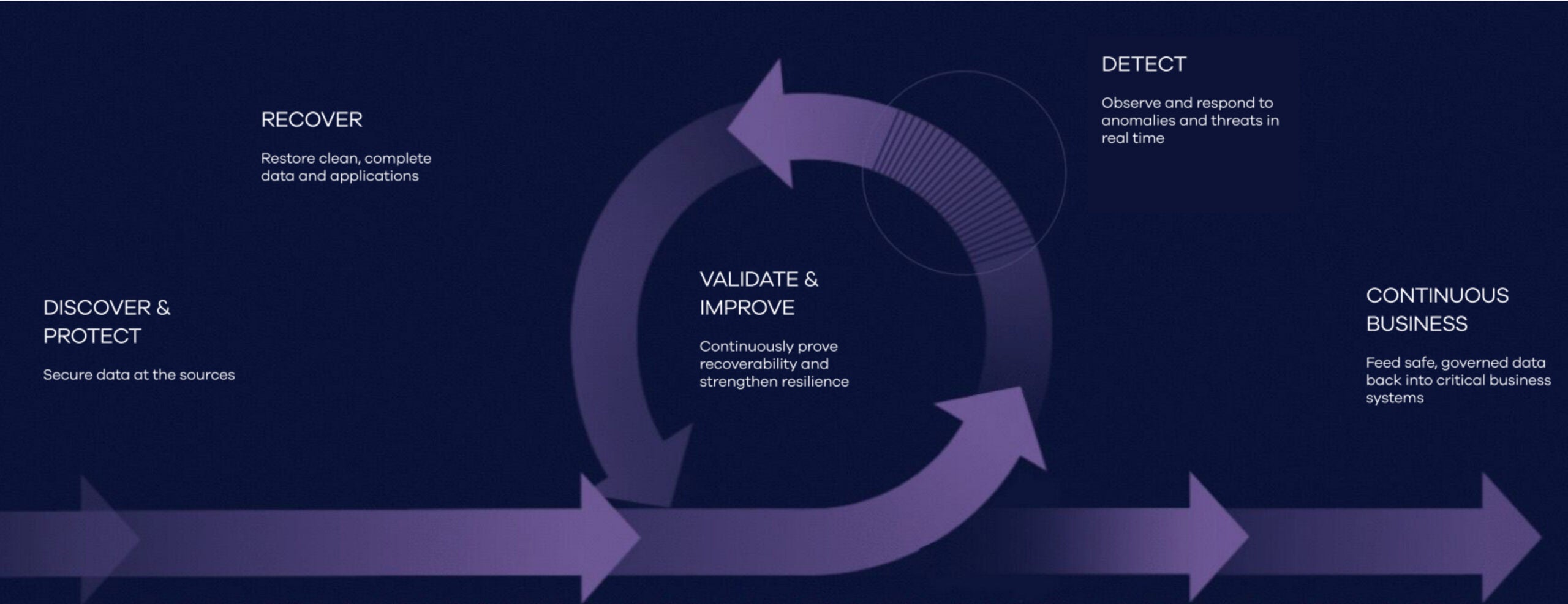
Private cloud data security works when teams can move from assumptions to evidence. That starts with knowing where sensitive data lives and how it is being used, then applying controls that follow the data across workloads, users, AI systems, and protected copies. Commvault Cloud and Commvault Data & AI Security capabilities help connect those activities into a more practical operating model, so teams can govern access, protect recoverable data, and validate clean recovery before an incident forces the issue.
Frequently Asked Questions
How does Commvault support private cloud data security?
Commvault Cloud and Commvault Data & AI Security capabilities help connect discovery, classification, access governance, data protection, and cyber recovery workflows. Teams can identify sensitive data, understand who and what has access to it, apply access policies, protect backup copies, and validate recovery in isolated environments.
This is useful in private cloud architectures where data security depends on coordinated controls across production workloads, administrative systems, and recovery paths.
Why is classification important in private cloud?
Classification helps give teams the data context needed to apply the right controls to the right information. Commvault Data & AI Security can help classify sensitive data such as PII, PHI, PCI data, intellectual property, and secrets like API keys.
Those classifications help guide access policies, remediation priorities, AI data use decisions, and recovery planning instead of forcing teams to rely on broad, generic rules.
How should encryption fit into recovery planning?
Encryption should be planned as part of the recovery architecture, not only as a storage or transport control. Teams need documented procedures for key ownership, key recovery, separation of duties, access auditing, and emergency authorization.
Encrypted backups are only useful if the organization can recover the required keys, validate access to restored data, and avoid creating a single administrative path that exposes production data and protected copies.
How is clean recovery different from backup?
Clean recovery focuses on restoring trusted data, while backup focuses on preserving copies. A recent backup may still contain corrupted, encrypted, or compromised data.
Commvault capabilities such as Cleanpoint identification, Threat Scan, Synthetic Recovery, and Cleanroom help teams evaluate recovery points, inspect data, and stage recovery in isolation before returning workloads to production. That matters when attackers have had time to reach production and backup environments.
Can Commvault govern AI access to data?
Cleanroom is useful when teams need to test, investigate, or stage recovery outside production. It can support ransomware exercises, forensic review, workload validation, and clean recovery planning.
In a private cloud context, an isolated recovery environment helps teams determine whether data, applications, dependencies, and identity services are ready for restoration before production systems are reconnected or reopened to users.
Strengthen Private Cloud Data Security
See how Commvault helps classify sensitive data, control access, and recover trusted data across cloud environments.
Related resources

Securing AI with Unified Data Access Governance

Cloud Native Data Protection