ON-DEMAND SESSION
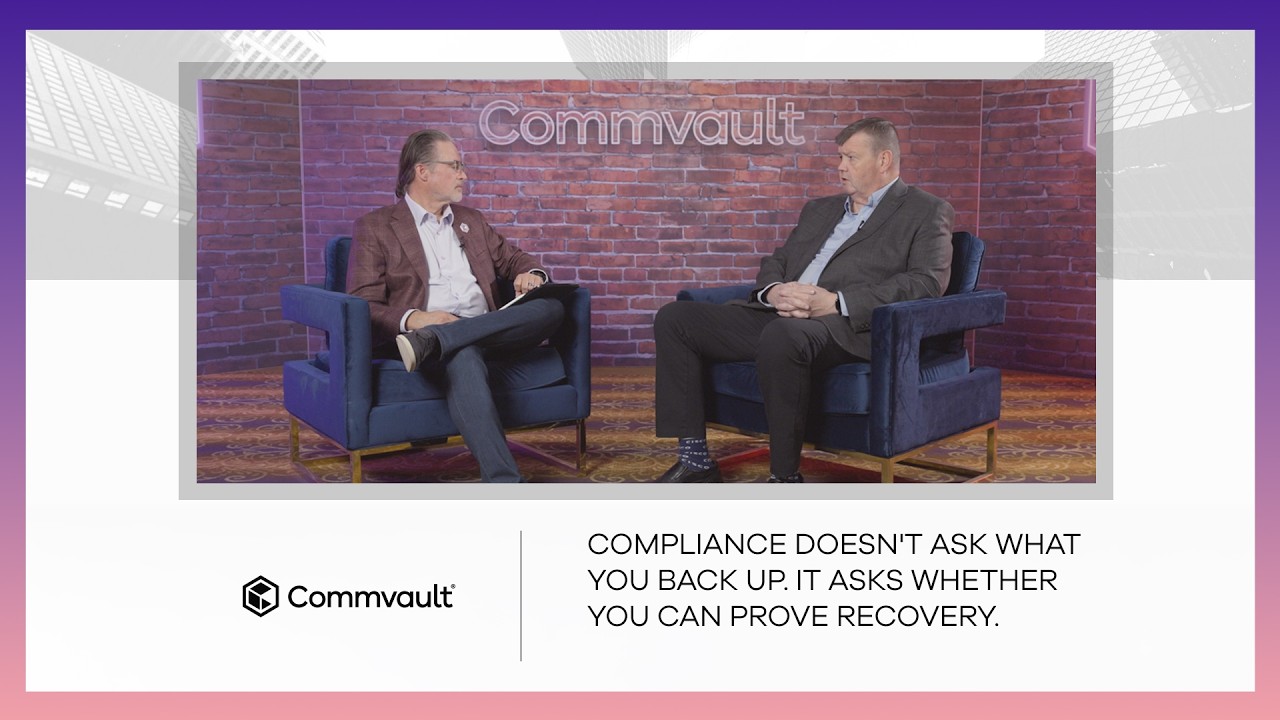
Compliance Doesn't Ask What You Back Up
Learn how a healthcare organization proves end-to-end resilience by focusing on working clinical systems, continuous validation, and shared accountability.
Key Takeaways
Prove the System Works
Measure whether complete clinical and corporate systems return and work for their users.
Build Resilience Into Operations
Make resilience a standing agenda item instead of a periodic audit exercise.
Connect Technology and Care
Align IT, security, clinical operations, data, and analytics around patient outcomes.
Validate End to End
Test interconnected applications, infrastructure, devices, data, and access together.
Start With Team Gaps
Ask technical and clinical teams where recovery weaknesses exist and use their expertise.
Focus on Fewer Actions
Choose one or two practical improvements and build support from the bottom up.
About this session
Compliance evidence should show that critical services recover and work, not simply that backup jobs completed successfully. In this SHIFT customer podcast, Health Shared Services Alberta explains its move from backup status reporting toward end-to-end resilience. The discussion covers shared responsibility, healthcare regulation, clinical technology, continuous proof, limited resources, and the communication needed to keep patient care at the center.
Beyond Green Checkmarks
A successful backup does not prove that a clinical or corporate system is usable. Recovery validation must include the full service, its dependencies, access, data, infrastructure, connected devices, and the people who rely on it.
The meaningful outcome is whether clinicians and other users can return to work effectively after disruption. Healthcare resilience requires close coordination among IT, security, clinical operations, the chief medical information function, and data and analytics teams. Shared leadership helps teams balance technical priorities with care delivery.
Make Resilience Routine
Public-sector teams may not have extra funding or staff for separate audit exercises. Making resilience a standing item in regular meetings creates a repeatable cadence for identifying gaps, assigning work, and tracking proof.
Create Shared Ownership. Security retains an independent view, but every team has a role in protecting and recovering data. A patient-centered mission can help break down silos and keep decisions focused on organizational outcomes.
Improve Through Communication
Ask teams where gaps exist, select one or two achievable changes, and let subject-matter experts shape the solution. Bottom-up participation makes operational change more practical and sustainable.
Related resources
Cyber Recovery Readiness
Build an end-to-end approach for testing and proving operational recovery.
Cleanroom Recovery
Learn how isolated validation supports clean, repeatable, and documented recovery.
Test Recovery Outcomes
Explore why realistic recovery testing matters beyond successful backup jobs.
Frequently Asked Questions
Why are successful backups not enough for compliance?
A successful backup confirms that data was copied. It does not prove that a complete clinical or corporate system can be restored, accessed, and used effectively by the people who need it.
What does end-to-end recovery validation include?
Validation should cover applications, databases, infrastructure, identity, connected devices, integrations, data access, and operational workflows. The test should confirm that the entire service works as designed.
How can resilience become part of regular operations?
Add resilience as a standing agenda item in team meetings. Review gaps, recovery evidence, ownership, resource needs, and system changes continuously rather than waiting for periodic audits.
Who is responsible for healthcare data resilience?
IT and security have important roles, but resilience requires shared responsibility across clinical operations, data and analytics, system owners, leadership, and the teams that deliver patient care.
How should organizations begin improving resilience?
Ask teams where the most important gaps are, select one or two achievable improvements, and involve subject-matter experts in shaping the work. Focused progress is more sustainable than launching many changes at once.
Transcript
View full transcript
Welcome to this SHIFT customer podcast. I’m your host, Chris Mierzwa, and I am joined by Hugh Gray from Health Shared Services from Alberta, Canada.
And now we’re going to talk to you today about their journey to recovery resilience and more importantly, in a highly regulated environment, how they prove that. And I think that’s been a theme for us here, of course, all week here at SHIFT. And it’s a theme that of course continues throughout the year.
So, Hugh, thank you for being here.
Thank you for the invite.
Yeah. You’re welcome. So maybe if it’s okay, spend a few minutes just talking a little bit about yourself and how you got to where you are as the acting CIO. Congratulations. And what you all do?
Sure. Yeah. So I’m acting CIO for Health Shared Services up in Alberta. We provide the infrastructure, the end user devices, you know, all the real technology. For the bulk of the health services in Alberta, you know, primary care is a key component. Acute care, the hospitals, mental health and addictions and, you know, continuing care or assisted living, there are four other pillars, that have been spun up as part of a, you know, the health refocus journey that the government announced a couple of years ago.
So we’re an underlying shared services organization. And we actually provide that continuing, you know, and shared infrastructure, which means that everyone can use, you know, common devices, common standards. No issues with getting email from, you know, one body to another type of thing. Right. Access to those, etc.. So I’m also the Chief Technology Officer.
That’s my day job. I’ve been in this acting role for about 11 months. So, you know, I have knowledge of the technology, but, you know, it’s the CIO. You’ve got to look at it, you know, from a more, you know, call it strategic and business oriented approach.
Of course. Well, wait, what’s better than one job? Two jobs, right. And also, because this is always a unique question where security reports into the organization, can you spend a second there so everybody understands where does that fit and who it peers with.
Yeah. So security reports into IT. Okay. The CISO reports to me. Okay. You know, our CISO is part of our IT executive team in IT. You know, which is a group of the senior leaders within IT. But, you know, even though the reporting function is IT, they’ve got some independence in terms of, you know, what they do because they sometimes have to do things that you might say are unpleasant.
Yeah. The other watchdog of the organization. Sure. And they maybe sometimes after, you know, look at things from an independent lens. It’s not about what’s best for IT. It’s what’s best for the organization.
For the overall organization.
For the, you know, the patient as well. Because, you know, I always say to my team, we are here not to just do IT. We’re here to do IT so that our clinical colleagues and other colleagues can use it effectively for patient care. It’s all about the patient in there.
You know, you want it to be frictionless as much as possible. Right. And speed to care of course. In your world is everything. Right. There’s already probably enough. How should we say tape? Red tape in certain places. You don’t want to layer any on in IT. So given that, and especially given the regulatory sort of envelope that you have to operate in, how have you approached resilience and recovery?
Maybe if you want to use the Wayback Machine a little, right, since you’ve been there a good number of years to give a feel for where it was and where you’re guiding it to.
Yeah, we mainly operate under the Health Information Act, and that’s recently undergone a few changes. Okay. You know, with the change in health refocus, these new organizations have been spun up. They are now, you know, also, you know, responsible for the data. So we’ve had to sort of change our approach in terms of, you know, who has data ownership, who owns the data, who’s responsible for securing the data.
I mean, that really hasn’t changed much, but because, as we say, everyone’s got a responsibility in ensuring the data is secure, making sure that it remains within our domain. But I think, you know, what’s changed is that we’ve moved away and are continuing to move away from, you know, just seeing that, yes, we have backups. We have a green light, you know, a dashboard that shows all our jobs worked.
It’s proving that, you know, that resilience is about whether a clinical system or a corporate system comes back and is used effectively by the people that need to use it? That’s resilience. It’s really all about that end to end process and all the systems that go into it. So it’s not just about one technology component.
And I think that’s probably a shift that has happened in the last few years. People realize it’s not about an individual server. An individual database is more about the whole system.
I mean, plus you have a layer of complexity that not everybody has, right? You have, of course, the regulation that you’re talking about, you have a substantial number of IoT based devices that are out of band from regular backup recovery resiliency plans, but they have to be resilient, nonetheless. And I’m assuming those require, you know, nursing staff, doctors to understand the uniqueness of those, right.
Because they all have to integrate with the tech, the clinical side. And how does the CMO fit into that or the CMIO? And maybe curiously there, how does your organization interact with the CMO and vice versa? How does that telemetry move back and forth?
So yeah, we have a CMIO, who’s got, you know, their own team. But they report into the same structure that we do. So we report into an executive lead. We call it a digital health group, you know, and that includes our data and analytics people. Okay. You know, and it includes our clinical operations people.
So I think it’s a good structure that we’re all reporting into the same executive lead. Day to day, we deal with each other, you know, all the time. Those, I’d say those are, you know, a good deal of understanding of what’s important. Both groups. Yeah. There’s probably not a day that goes by where, you know, what’s important to us is not necessarily important to them and vice versa.
But I think the aim of it is, you know, we all have to work together because, you know, we’re there to help them. You know, again, you know, I keep saying it’s all about the—
The patients at the center. Yeah. You know, to help the clinicians, so they can do their job effectively.
I think that’s interesting. It’s a good point to kind of reinforce and hammer home. You know, one of the things we talk a lot about workshops and tabletops and interacting is communication. And just listening to you here in the first few minutes. There’s communication. And I think if there’s a takeaway from this and what we’ve been talking about here at SHIFT is that it is such a fundamental building block that is not always omnipresent in a lot of enterprises, health care or otherwise.
Right. And if you don’t have the communication piece, it is very tough. If you don’t have that bedrock to build off of. And I don’t know if this is a fair statement, almost the fact that the patient is at the center. And I think everybody understands that emotionally. Right. You know, right. Because they have loved ones that have been in situations and they understand why the patient is at the center, let alone the layer of regulation.
It probably almost forces that communication at a different level than it does in other enterprises. Right.
It does, you know, it helps to break down the silos because I think everyone realizes, you know, we’re all there for one purpose, right? You know, I always try to say, this is not about ego. Leave your ego at the door. Yeah. Think about who you’re doing it for. As you mentioned.
You know, the people who benefit from this are families and friends, not colleagues. So it’s not as if we’re creating a product which is sold in some other countries.
We’re doing something that benefits the community. Benefits that people are better.
That makes sense. So a little bit ago, you mentioned proof. So of course you have the regulatory requirement to prove. But that’s the end point. You have to do a lot of things internally to get to that point where it is written down.
But more importantly, if you were asked questions about it, you could walk back the proof of resilience all the way to how you got there. So I know we can’t go through all of that, but could you give a feel for how iterative that continues to be? You know, before we were even chatting, we talked a little bit about that where you’re like this is a process that’s always ongoing.
So how do you tackle that and how do you define a cadence, so you don’t overwhelm your organization with it, but yet keep up on all the regulatory pieces.
Yeah. You know, that is the difficult part being, you know, in the public sector. We were not flush with the money and we’re not flush with people. Yeah. So you like to say you’ve got to build it into the regular operations. Traditionally, audit used to be, you know, once every three months, once every six months.
And you’d get that, you know, two, three, four weeks notice that the auditor would be appearing the documentation.
So I think, you know, to answer the point, resilience needs to be part of the conversation in every team meeting. It needs to be a standing agenda item. You know, because if it isn’t, then it gets pushed on the back burner. Yeah. So I’d say that’s one of the approaches that we’re trying to take and we need to take, you know, in order to actually be able to determine how much resource is required.
You know, have we got the appropriate resources? You know, if not, how can we use technology like, you know, AI to help us get to where we need to be?
Sure, you know, you are providing a clinic here on something that we introduced a year ago, and we’re trying to make sure it’s a community driven commitment. But this, you know, resilience operations, ResOps, that, you know, hopefully folks have heard about. But you are the definition of that, everything you’re saying and it is hard to do.
You’re building it in at the base layer. And clearly you have some forcing functions like we talked about that are making you do that. But you can’t just make people do that. It has to be part of an ongoing culture, right? Which, you know, you’ve clearly built. So I’m just curious if you could share one example.
So you say you build it in every meeting. How long did that take? Because I mean, you just don’t flip the switch and folks go, oh yeah, I’m going to line up all the interconnection points here and the communication points. So how did you get to where you are?
You know, I would say it’s actually a work in progress. Okay. I would never say work. Well, we want to be I, you know, it’s like I said, you know, cybersecurity. You’re never there. Yeah. It’s always more to do. So. Yeah, it’s, I’m not even going to claim, you know, that project management, you’ll claim 25, 50, 75% complete.
Yeah, I would say, you know, it’s ongoing. You know, and a lot of the ideas have come from SHIFT. You know, they’re the ones that, you know, are we able to take back and say, you know, does this work for us? Yeah. You know, what I did caution people against in an earlier discussion was don’t come back from a conference with ten ideas and think that you’re going to implement all ten of them.
You know, maybe focus on 1 or 2 and actually discuss some with the team and make them think it’s their idea. Yeah. Because that’s how you get success. I think more when it comes from the bottom up and the team drives it and the team comes up with ideas. Yeah. You know, especially, you know, from a technology front because they are the technology experts.
That’s interesting. I very much appreciate that you’re saying, hey, you know, bottom up, we don’t hear that enough. That doesn’t mean it doesn’t get checked and balanced. And some ideas may have to be tabled or refined. But what a better groundswell that creates than trying to just stuff it down, you know, from the top. Right.
I mean, you know, in IT what used to change. We like change. We like to see the technology change. Sure. But as human beings we don’t like change forced on us.
If you can make people think the change is our idea, that we want to do this, you’re more likely to see the change succeed.
Yeah. And the second thing you brought up, this is so key, is used in reference to a conference. Like here, like at SHIFT. But you cannot bring back ten things. You can’t bring back probably five things. Because when you do and you come back and roll the list out like the scrolls, it’s overwhelming.
And people shut down before they even get cracking. Right. You know, if you start with a couple of key ones that everybody may decide on together, which is an opportunity for a meeting in and of itself, just kind of filter it down. Now you can actually get your arms around that. Right. And really work hard in 1 or 2 things that you take back.
So this is the clinic here. This is a clinic in both virtual terms and real terms that you’re doing. So anything sort of in closing, I mean, these are a lot of pieces of wisdom. And I know not everybody will be able to just go back and flip the switch. But to your point, you just made, if there were 1 or 2 things that you wanted folks to take back and say, hey, these are reasonably generic, but yet very critical for you to focus on, what would those be for folks?
I would say it’s really about looking at things as a whole system rather than individual technology components. In terms of, you know, proving resilience, it’s whether the system comes back and works as designed, as needed by people. And I would also, you know, say, one of the first things to do is, you know, ask people, ask your team, where are the gaps?
Yeah. Ask for their input. And a lot of you know, it’s basically about communication, talking to your people, getting the ideas, having a consultative approach. It is key, I think, especially as you know, in an area such as, you know, moving from just backup to organizational resilience.
It’s really about that communication and bringing everyone on the journey with you.
Yeah. He’s done it. He has it. Not everybody’s been on my journey for the whole week. But if I’ve used the word communication once I’ve used it a million times. It’s fundamental. It’s something. While it’s clearly existed since time began. But it is the one thing. Thank you for saying to you that we can stress it is the building block.
If you can nail that, all of these layers you’re talking about. Right. Building in the, you know, the teams working together and working as they should. You can’t do it without that at the base. I thank you for really just breaking it down. I mean, clearly you’re very humble, and you all are doing an amazing job at the shared services in Alberta.
Thank you for having a much better accent than mine. We’ll hopefully replace mine with yours in post. And this is a fantastic message for everybody to take back. I hope everybody really listens to this a couple of times, because this really breaks it down and gives the resolution that, you know, we’d like to see with most enterprises and people should strive for.
So thank you.
Thank you for the invite.
You’re welcome.