ON-DEMAND SESSION
From Inspiration to Execution: How to Launch Your ResOps Journey
Learn how to turn cyber resilience goals into a sustainable Resilience Operations discipline built on visibility, control, evidence, and continuous improvement.
Key Takeaways
Make Resilience Operational
Turn cyber resilience from a one-time project into an ongoing, cross-functional operating discipline.
Focus on Three Questions
Ask whether critical services can recover now, within tolerance, with proof.
Build Visibility First
Define critical services, business tolerances, owners, dependencies, governance, and funding before selecting tools.
Engineer Clean Recovery
Coordinate containment, protected recovery points, isolated testing, and decision authority before a crisis.
Prove Recovery Readiness
Use realistic exercises and evidence to validate recovery outcomes and expose gaps.
Start Small, Then Scale
Prove recovery for one critical service, learn, improve, and expand the program.
About This Session
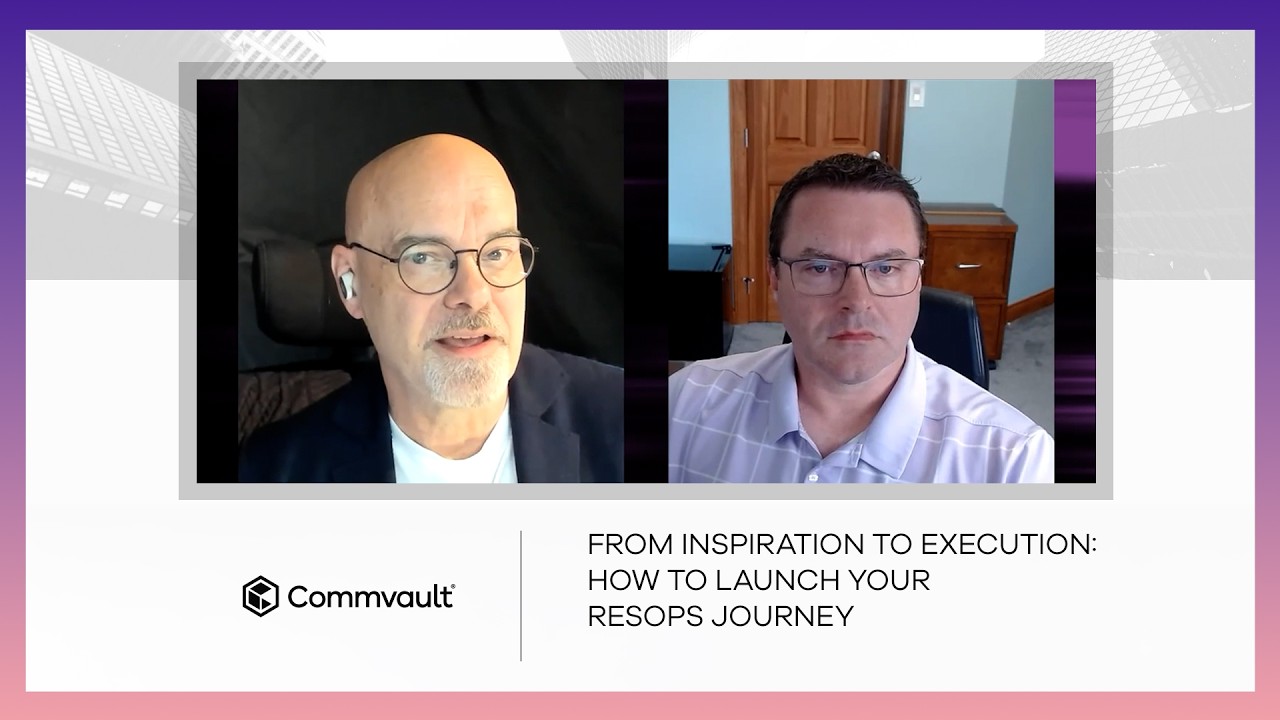
Resilience Operations turns cyber resilience into a repeatable discipline that connects security, IT operations, infrastructure, and business leaders. In this session, Michael Thelander and Jason Cray explain how organizations can move beyond isolated resilience activities. They present a shared operating model focused on discovering what matters, protecting it, detecting threats, recovering safely, and restoring services through continuous improvement.
Answer Three Critical Questions
A Resilience Operations program should show whether critical services can recover cleanly, whether recovery can happen now within the business tolerance, and whether the organization has credible evidence to prove those outcomes rather than relying on assumptions.
The framework organizes resilience work into three connected phases: visibility, control, and confidence, supported by eight practical steps. Visibility defines priorities and dependencies. Control prepares containment, assured recovery, and crisis decisions. Confidence uses realistic exercises and evidence to verify results.
Coordinate Teams Before Crisis
Resilience Operations is cross-functional. Executive sponsors, program owners, business owners, security, IT operations, legal, compliance, and recovery teams should agree on priorities, authority, tolerances, and evidence requirements before an incident occurs.
Recovery success means restoring clean, usable services within business tolerance, not simply bringing systems back online quickly. Protected recovery points, isolated environments, integrity checks, dependency validation, and preassigned decision authority help reduce the risk of reinfection or incomplete recovery.
Build Momentum in 90 Days
Start with one critical service. Establish sponsorship and ownership, map dependencies and recovery measures, then run a realistic exercise, document gaps, report evidence, and repeat.
Related Resources
ResOps Guide
Transform resilience from a bunch of assumptions into something you can prove.
2025 IDC MarketScape: Worldwide Cyber-Recovery
IDC names Commvault a Leader in cyber recovery.
Gartner Magic Quadrant for Backup and Data Protection Platforms
Named a Leader for the 15th consecutive time and ranked highest in five of six use cases, including ransomware protection, detection, and recovery.
Frequently Asked Questions
What is Resilience Operations?
Resilience Operations is an ongoing, cross-functional discipline that aligns security, IT operations, infrastructure, and business teams around shared recovery priorities, processes, evidence, and continuous improvement.
What are the three Resilience Operations phases?
The three phases are visibility, control, and confidence. They help organizations define what matters, prepare coordinated recovery actions, and prove recovery readiness through realistic exercises and evidence.
How does an organization prove recovery readiness?
Run realistic recovery exercises, measure results against business tolerances, verify data integrity and dependencies, document evidence, report gaps, and feed lessons into a prioritized resilience backlog.
Who should participate in Resilience Operations?
Executive sponsors, program owners, business service owners, security, IT operations, infrastructure, recovery, legal, compliance, risk, and business continuity teams should participate with clearly defined authority and responsibilities.
How can a Resilience Operations program start?
Begin with one or two critical services. Establish ownership, define business tolerances, map dependencies, identify recovery measures, run a realistic test, document findings, and expand based on evidence.
Transcript
View full transcript
Welcome to Inspiration to Execution. If you’ve been to many of the sessions here at SHIFT, you’ve seen us talking about ResOps and the discipline that we call resilience operations, but we really haven’t unpacked it a great deal.
We haven’t really talked about how you create a raise ops program, and in fact, that’s sort of a commonplace event. We hear a lot about cyber resilience out in the world today. You can just look at sort of the last year of releases and reports that come out of Gartner, and they’ve talked about cyber resilience any number of times.
They have talked about coolest vendor innovations in cyber resilience, how you can align with your BCM programs. They’ve talked about adapting cyber security strategies to drive enterprise-wide cyber resilience. And they’ve even sort of taken the contrarian view and looked at the other side of it that says, hey, cyber resilience is really the latest excuse for the industry not to fix itself, which is sort of an interesting take, very rarely do we actually get down into like, how do you build a sustainable, ongoing program around resilience operations?
Well, that’s one of the things that I’m going to share with you today. I’m Michael Thelander, Director of Product Marketing at Commvault. I spend a lot of time in sort of educational and outreach roles.
I’m relying heavily today on Jason Cray, our Head of Product Experience at Commvault. How are you today, Jason? Excellent. Thanks very much.
Well, thanks for the intro.
I said I’m Jason Cray. I run the Product Experience team here at Commvault. But what that really means is I’m spending most of my time between the engineers who have to build the recovery and the leaders who have to explain that recovery to the poor. And that gap right there is actually what we’re going to spend a lot of time today talking about.
So let’s look at what results in action means. If we really want cyber resilience to be more than a buzzword. It has to show up as something that people actually do every week. Every day. If this is what we mean by resilience operations, it is an operating discipline that puts operations, security and infrastructure on one shared language, one shared process.
Instead of having separate teams that only meet during the time of a crisis,
it’s not a project that you just run once. There is no go live date. There is no moment where you declare victory and move on. ResOps is your ongoing heartbeat for resilience within your organization. Now let’s take a look real quickly at how that runs across the five different functions.
We have discover. Discover is we actually look at what’s in your environment to figure out what’s critical. Where your sensitive data is, who has access to that thing. Then we look at protect. Protect is the actual action of taking your critical data that we just discovered, and ensuring that you can bring it back during a crisis. Then we lean into detect.
Detect is the process where we look and discover all of the anomalies and threats in the organization. This is real time as well as in that data that we just protected. Then we have recover. Recover is the process by which we start to bring that data back in a safe, isolated environment to make certain that it is clean.
And finally, we have restore. That is the process by which we take all the data that we just recovered and move it back into operations for the organization. So those are the five high function or the functions of results. But I want to lean and on one key part. Detection for all of this is an accelerant. We cannot make it a gate that the plan depends on.
Because if we have a plan that depends on detection, finding all of the threats before we start to recover, we don’t have a recovery plan.
Now let’s look at results in action in your environment. We have discover, protect, detect, recover, and restore. All the functions we just talked about. But those are in a continuous motion and a continuous loop that doesn’t have a beginning. It doesn’t have an end. Maybe you found out during recover that you missed some dependencies during your discover phase, or during protect.
You found out that your plans don’t work the way you had anticipated, and that’s all okay. That can feed back in to improve. We’re not looking for a pass fail. We’re looking for continuous improvement. And that’s the difference between a resilience project and a resilience discipline. The project just ends with the findings. The discipline takes those findings, fit it back in and makes the process better every single time you run it.
Now Michael is going to take you through the rest of what we have planned for today.
Thanks, Jason.
So our agenda is pretty straightforward, and it’s largely based on a book that we released just earlier this year. ResOps: An Executive Guide book was co-written by Jason and myself with our partner Ben Herzberg. The book breaks down a number of these three different phases that we’re going to talk about in the eight critical steps, and also the five sort of actions that Jason was just referring to as part of the actual ResOps activity that’s happening.
We’re going to talk about sort of the three questions that are always top of mind for ResOps, and then we’re going to break this into those three major phases visibility, control and confidence. We’ll close with some discussion about how do you get organizational buy in in your organization, and then what can you do when you actually get back from an event.
Or you see, you know, you come back from watching a webinar like this, how do you actually start taking action throughout the discussion that we’re going to have today? There’s three fundamental questions that underlying everything about raise up. So if you forget everything else and remember that we anchor on these three questions. You’re well on your way to really understanding the rest.
Ops discipline. The first question is for our critical services, those things that organization relies the most on, can we recover them? And sort of a follow on question, can we do it with confidence in the cleanliness of that data, that it’s not corrupted, that it doesn’t have any unseen payloads? And the second main question is, can we do that recovery right now?
And if we do it right now, how long is it going to take? Have we actually tested that? The third key question that will come back to you again. Again, probably the most important question of anything related to raise ops is can we actually prove it? We’ll talk a lot about what evidence provides, and we’ll talk about how the framework really relies on evidence.
And Jason is going to jump into that. Now, you heard the three questions that Michael asked.
They seem like actually really simple questions at face value. But I have to tell you that most organizations cannot answer those questions with true confidence.
So here’s how you can build towards that. It’s the framework of results. It’s the three phases, the eight steps with that one goal in mind, proving that you can recover.
Most organizations find that goal very easy to date. They think they do tests all the time, but in practice, when it comes down to really confidently answering that, they find it very hard to do. And ResOps was designed to close that gap. So you can answer the three questions Michael just asked with confidence and proof instead of hope.
Now let’s take a look at the results program on the slide here. The whole program is built on three phases. We have visibility. Visibility is like we kind of talked about where it’s knowing what you have and what to protect. Now we have control. Control starts to outline. What do we do when something breaks. What happens in the event of a crisis and then confidence.
Confidence is that last question. Can we prove that we can come back. That that is a critical key to all of this. But now let’s look at each one of these in depth with visibility. It starts with governance.
One strategy we have to figure out who’s going to help run this and keep this going. So it doesn’t just fade away over time.
It needs to be that continuous motion and that needs someone to oversee and care for it. But we also need to define what our critical services are. Define what that minimum viable company or that minimum viable operations is, so that you understand what needs to come back and in what order. Now, when we look at control, we have the three steps of control you need to protect and isolate when when something happens, we gotta limit that down quickly.
But we also need to leverage that into understanding what our blast radius is. Understand what comes back. And that feeds right into the assured recovery, where we need to understand what it is we bring back and how do we bring it back. Verified and clean, not just fact. And then finally, that ties into crisis management. We need someone to organize all of this, that that incident commander who is the cool head throughout all of it, guiding people throughout the process.
So there isn’t a question. And then finally, we have confidence that all important proving what you say you can do. It brings up those realistic tests. And so you know, you just ran through this last month and yes, it met all of your requirements. But that also feeds back into the program. So anything that we missed we improve on and we we make it better the next time.
But the one thing I want you to take away from all of this is at the very top of this slide. ResOps is a cross-functional discipline. No single team owns it. Security can’t run this on their own. It can’t run this on their own. They need each other. But even more so, we need the business. The business has to outline what is important.
What are our tolerances? What’s critical for us to operate? All three of those together have to play together for this to be a real resilience program.
Now let’s dive in to how we start this. Before we do anything, there are a few steps that we must do. First, and it has nothing to do with it or technology. The first thing is we need an executive sponsor. We need that person who is going to own resilience for the entire organization. That’s starting to be the CISO in what we’re seeing.
In fact, if you look at what Gartner is saying, Gartner is predicting that the CISO, our own resilience for the entire organization in the very near future. Now, that’s not to say that the CIO can’t perform this. Absolutely. The CIO can. It’s all dependent upon your organization. But really those two need to work together. Because regardless, the CIO also has to bring the environment back in and actually recover.
Second, we have the resource owner. That’s the person who sets priority, helps coordinate, not just set meetings. They can set priority and they can help when security. And it may not align at the first stage. Then we have the business owner. This is critical. The business owner is the one who sets what makes up the business service. Because remember, we’re not talking about a single application.
We’re talking about the business service. They are the ones that determine what the dependencies are and help determine the impact tolerance. Without them, we can’t determine what resilience and what recovery actually looks like for us. And then finally on the fourth step, we have a recurring form. This is somewhere where all of the findings can be discussed. The important thing is any gap that we uncover, they get addressed in this form.
They don’t get ignored. Either we decide to fix it, or we excite, or we decide to accept the risk. But either way, a decision is made. It’s not ignored. Those four things together keep this from becoming an initiative that just fades into the background and moves it into an initiative that is the heartbeat of the organization.
Now Michael is going to take you into visibility.
We all talk about visibility. We’ve been in cyber security for any amount of time. We talk about the importance of visibility.
But this is where an area where as Jason was talking about the Ops owner, the person that really understands the vision, the goal, the charter, not just the outcomes of the ops program, but really takes ownership of it.
They help us understand that it’s not observability kind of visibility that we’re seeking here. It’s making things visible for the organization. It’s actually taking a much, much more active role in the things that we decide are going to be visible, the things that we’re going to manage and the things that we’re going to change over the course of time.
So with each one of these phases, we’ll talk about what the key questions are. In this phase. We’re talking about what is our goal? What are we trying to achieve in this continuous program. What must we protect. We talk again and again about minimum viable company or minimum viable organization, or even minimum viable mission. In many cases, that determines what we have to protect.
What are those things that we really can’t do without and make a good, clear case for why those things need our constant vigilance? And then what must we tolerate? In other words, what are the changes? What are the conditions? What’s the time lag? If a system goes down before it comes back up that the business can actually tolerate, and that we can really use as a that yardstick for measuring our progress going forward.
So within that phase of visibility, there’s two primary steps. The first of those is to actually set the charter. Set the charter to determine the charter. That ops owner is probably the best person to list out. What is the charter for this, this overall effort? What does the initiative look like? Where do we get the money for it from to run this initiative?
I want to point out that it raise ops initiative in and of itself, is really not an expensive charter to actually fund and get going in the organization. It’s more a question of asking where do is other spending that’s happening, whether that’s around governance and reporting, or whether that’s around your cyber security program, where those things can sort of be leveraged to better execute on your ops program.
The second thing comes down to defining those minimum that minimum viable service, and not just the minimum viable service, but actually mapping all of those critical dependencies within your organization. The things that are sort of hidden within the dependency change between those as we look at these, as they sort of unfold for each of these will give you an outline of what happens, who’s at the table and what the stakes are.
So what happens in setting the charter is that names leader who has the authority to set priorities, who has sort of been blessed with the charter to go make the program happen, make it execute and then look at the results, builds the program out and defines the priorities. You build a government through them. What are the review cycles going to look like then?
A funding policy on how we’re going to tire investment together, and then put all that together into the overall charter. That explains like what success is going to look like. Who’s there? This ties back to really what Jason was already saying. You’re probably going to have the CISO may very well be that resource owner, or they may appoint somebody in their organization, the CIO, the business unit leaders, the finance and CFO, and the funding policy.
Those business unit leaders are really your key partners in determining what that minimum viable business looks like. Getting agreement across the board on what we consider to be the minimum viable business. Then with the charter there, every gap has an owner. There’s a timeline for the entire effort and everything that we’re going to do with it. And there’s business consequences if we actually fail, if we don’t meet those goals and those end states for each of these in this define minimum viable service area mapping dependencies.
We’re now looking at pulling these teams together and understanding how a critical service actually gets defined. The named owner of that service, how the business defined impact tolerance. In other words, if we don’t have this service, how long can it last? How long can we go before we need to get this service back online to fit within our stated tolerances and dependencies?
We focus on what is tier zero, the things that are really critical to get back up to speed, like within hours, and then tier one or tier date. Tier two dependency mapping is that underlying thread that ties all those things together. And this is where there’s a lot of effort that needs to happen. There’s a lot of in our sort of complex, interdependent world, there’s a lot of hidden dependencies.
Identity is one of those. We may be looking at a system, the relationship between, for instance, Active Directory and your DNS servers is critical. If you don’t have one of those, you may not be able to instantiate your Active Directory service. Which means even though you’re, say, your DNS is not it, it’s not connectable in a time of crisis.
I still can’t get my AD actually running, so it’s really understanding full dependencies across this, across the spectrum of all of the business operations. Who’s at the table there? You’ve got the business owners defining those tolerances. You’ve got all your technology leaders, and of course you’ve got legal and compliance sort of along for the ride to make sure that we’re meeting our regulatory, obligations.
And then what we discover and these exercises can be used to also handle our regulatory requirements.
Now we’re going to talk about the next phase of this. Jason is going to take us into the control aspects of it.
Yeah. So we just heard how visibility tells you what matters to your organization.
Now let’s look at control and what happens when something actually breaks. And whether you can get about clean.
We have the three main areas that control answers.
First is can we contain the damage that is that blast radius discussion?
It is. Can we keep the attacker or the outage contained to a specific area? That’s critical for a couple reasons. One, we don’t want to take down the whole business. We don’t want to allow them to get any further than they are. But the other thing is understanding what needs to come back. That’s that blast radius that has to feedback into recovery to understand.
These are the services that were affected and what we have to bring back. Now to now that we’ve determined what needs to be brought back, we have to make certain that it’s can we bring the service back clean? And that’s the next step. We have to engineer recovery. So it’s a sure not just fast because as we talked about, we also have to think about what happens when detection didn’t detect any threat to begin with.
How can we assure that our recovery is going to be clean? How can we bring that back so we don’t reinfect the environment more? And then finally, who has the authority to do all this? We have to integrate into the crisis operations. We have to know who makes a decision on what the blast radius is. Who makes the decisions on.
Was it clean? Is it ready to be brought back into operations? But the one thing for all of these we need to really look at is this needs to be decided in advance. We cannot be making these decisions. Unfortunately, most of us are. But we cannot be making these decisions in a time of a crisis. At 2 a.m., with only half the information, let’s get ahead of it and do it in a time where it’s calm.
Now let’s dive into more of containing the blast radius. When something breaks, the window to act is actually measured in minutes. You can’t work out who’s going to be pulling the plug, what the procedures are while the clock’s running. Every time you do that is a minute more. You’re giving the attacker. So we have to think about isolating the systems, cutting the integrations before damage spreads.
And everybody needs to understand what that is because there’s a couple things that can happen. When we bring a system down, what are the dependencies on that system? What other systems in the environment are going to be affected by that? That may not necessarily have been affected by the initial attack. Also, what happens due to a recovery? Are we eliminating our path back to a clean recovery?
And here’s the part that people miss is that clean recovery. If we are if we isolate a system, we may be wiping out the very logs and recovery points needed to perform forensics or have any sort of audit capability. So that blast radius decision and recovery plan needs to be made together by the same group ahead of time.
Security operations runs the containment infrastructure, actually documents the isolation actions and how it impacts. And then legal and forensics need a seat at the table also because they have to determine what evidence they need. When the when an event happens. So all of these have to be coordinated together. But the very bottom line here is says it all containment that erases your clean recovery path solves one problem, but creates a lot larger problem for you on the back end.
Now, engineered assured Recovery. That’s the next step. What this means is we have to think about how do we bring things back in the event that detection fails? Most recovery plans are written for that ideal condition where it’s scripted. We found everything. But you know what real incidents look nothing like those plans. Information is always incomplete. People are working on systems they may not fully understand, and nobody has the time to really think through what needs to happen.
So you have to design this ahead of time instead of during that attack. This means a named owner for every critical service, just like we were talking about with the business owner, which they then run to create the procedures to test by the people actually running it. So that business owner helps determine what test for that business application, not the person who wrote the runbook three years ago.
The actual person running and using that application the day. It means protected recovery points. Putting in it, put it put into an isolated recovery environment and checking the data integrity before anything goes back into production. Even though we may have had detection, we still have to go through and do our own forensics before it goes back into production.
But then it also means changing the definition of success. We normally think about success as the systems are back online. Everything’s great, but success really needs to look like. Is it clean? Have we verified that the applications running along with all of us dependencies, and then we get it back within the proper color for the business? Speed without integrity isn’t recovery.
If you restore fast from a compromised point, all you’ve done is introduce a bigger problem downstream, and you may have even let the attacker back in. Now, the last step for control crisis operations and is the decision authority. This is all about coordination. Take a look at your plans. If your team today has a plan that says stop and ask for permission before they can act, you don’t have a recovery plan.
We have to wait for that person to be contacted. That needs to be decided ahead of time, and a backup person and a backup decision needs to be clearly stated, not at the time of crisis beforehand. Now, once an incident crosses a certain line, which that line could only be terminated by the business or organization themselves, business as usual has to stop.
The line has been decided. Now you bring in the incident commander. So the command structure is clear and everyone is looking at the same picture. We must also cross-train our teams so that no one individual is the bottleneck. Because the plan that the plans on one person falls apart, that person is on a plane or crews. These actions must all be practiced every day.
All of these recovery plans must be proven in a real stress tested crisis scenario, again and again to prove that they work. If your team has never practiced that shift into crisis mode, they’ll improvise in the worst possible conditions because all of us under stress never operate on our peak time.
Which brings us to the final step. Confidence.
When we talk about confidence, if visibility is understanding what our priorities need to be, gaining visibility across the organization of what’s important, what matters, what our critical services are, and if, then control is all about exerting control in a crisis or understanding the passive control in a crisis, that confidence is really all about demonstrating it.
It’s showing the rest of the organization what we’ve done, how we’ve done it, and how we can prove again and again that we can recover from this situation.
There’s three questions that we’ll answer in this phase. Each one of these relates to a step. Can we prove it works? How do we validate it through realistic exercises, tabletop exercises, tactical simulations, clean room restores, failover. These are sort of the litany of tasks that we need to schedule, need to plan for, and figure out how we’re going to run those on a routine and regular basis.
For each of those, are we within tolerance of the on the current evidence, based on the evidence that we’ve revealed that we’ve uncovered through this exercise, are we within tolerance, within tolerance for our sensitivity of the data, within tolerance for the time it takes to restore within tolerance for the time that it or within tolerance for the people that it took to engage in that program?
And then are we getting better over time? So this is an ongoing discipline. That’s a never ending program. How can we take the lessons that we’re learning with each exercise, with each actual real life failure or crisis that we face and feed them back into the system, understand how we can drive improvement. When we break these down, we look at what happens in those realistic exercises.
Jason sort of mentioned this, but really an untested recovery plan. It’s just a hypothesis. This is what we think is going to happen in this world of sort of more frequent attacks, more frequent crisis crises, more complex systems. We can’t live on that hypothesis. We need to actually ensure how we’re going to recover from that situation and then turn it into evidence that we can look at and rely on continuous and scope calibrated to program maturity.
In other words, what you start with your raise Ops program, that discipline is not necessarily going to be your end state. Your first starting point might be that you minimally define that minimum viable company to literally just that tier zero systems, and that’s all that we’re focused on. But as you advance in maturity, you have a much more involved program and not one high risk annual event, but sort of continuous mapping of those portfolio basically means all of the things, the things that we mentioned that you can leverage to run your exercises and to collect your data, and that every exercise actually produces updated SREs service reliability indicators and findings for your resilience backlog.
Who’s involved in this? Well, again, the service owners, the people that we’re relying on, whether that’s identity teams, application teams, cloud teams, these are the people that we’re relying on. These are the ones that are actually leading an exercise. You don’t step in and execute these for them. Bring everybody along with you on these exercises as we map them out.
I.T Operations and security who are doing the execution of it, the business continuity people who are actually designing all of the scenarios. The goal is to have results, testings. That’s safe, that’s continuous, that scoped to what the organization actually needs. And it’s not a high stakes annual fire drill. It’s not like the old days of doing the SoC analysis that everything compressed down to this, you know, once or twice a year survey assessment, it’s an ongoing state of continuous improvement.
Let’s talk about SREs and the Brazilians Posture Score and SRE fundamentally answers for questions for a service. Is the system actually recoverable? Is this service that we’re relying on whether again it’s identity or application service? Is it recovered in a realistic exercise and within the tolerance we set for it? Do we have integrity of the data? Was it restored with high confidence that the data is actually clean again, is not carrying any, any, embedded threats or compromises within that data.
And then this whole program, did we recover it within the confidence, within the tolerance range that we needed? How current and credible is the evidence that we’ve collected in this? And so when we say that we can recover within a certain amount of time, do we have high confidence across the board? You can’t really overlook the impact of fragility map, not mapping those dependencies.
And what most people will find is they do this. So the first couple of times that they’re working through their program is you will find dependencies that are unmapped that we didn’t rely on. But that’s a learning exercise. That’s a point of getting new information and understanding. Now, do we have all of our dependencies that are known mapped?
Are they constantly monitor? And do we have a solid cadence for collecting, for running the exercise and collecting that data? Data? An S3 dashboard should basically tell you just a few key points. It should say this is what we consider a tier zero or a tier one service could be payments in your IAM system. And the result of this is if there’s a failure of the payment system.
We need to know that we set a tolerance of saying, you could be down for four hours, and we recovered that within 3.2 hours. Identity and access might say that we did not achieve any recovery on that, given the time that we had, or your customer CRM might have a different set of requirements for it, but your dashboard will always show you for the latest exercises that we’ve done.
This is what we anticipated. This is what we said our tolerance would be, and this is what we actually delivered. Ultimately, we’re trying to enable a board level conversation. It’s the ability for the CISO or whoever represents your ops program across the enterprise to say, hey, last quarter, we restored payments in 3.2 hours against a planned for our tolerance for it.
That system is in line, but having the same frank, data driven conversation about all of your other critical services as well feed the lessons back. So continuous improvement. One of the key things that I think that Redis ops sort of has borrowed from the DevOps practice over years is continuous improvement, not just having a continuous loop that can protect things and discover content, or discover data and then protect it and then detect when something goes wrong.
And then, restore the data and recover it. But really having continuous improvement of the overall process, the thing that we’re using to manage this program, we understand the gaps. We’ve found the gaps through testing. We prioritize the business impact and not just relying on technical severity of something. Monthly council reviews are all surfacing. We’re actually having conversations in a cross-functional way about our investment decisions, and that’s really having those reliable, continual monthly meetings that everybody depends on in the business is what makes Ops this continuous, ongoing discipline.
So who’s there? Well, obviously the ops owner who’s running the backlog discussion but really risk. And to you’re there again tying it back to the risk register and the other requirements that the organization has and that executive sponsor the takeaway lesson really for this this this step of the program is resilience is not something that you achieve. It’s something that you’re going to continuously improve on.
But how do you get organizational buy in across your organization? Jason’s going to take us into that a little bit.
Yes. Everything we’ve covered up so far depends on something that isn’t isn’t technical at all.
It is. It’s getting that organizational buy in across the board.
So let’s look at who owns what.
We are kind of stated ResOps isn’t a single pillar. But the one thing we haven’t talked about, ResOps doesn’t replace anyone’s job.
It doesn’t replace any other disciplines that you have in place today. It expands what each team is currently responsible for and helps those teams work better together. This idea is very important because when people hear a new program, a new discipline, they always think create one more thing layered on top. So someone else is going to tell me what to do.
And that’s not the design of what ResOps is. So let’s start with cybersecurity. Cybersecurity currently measures today on detecting threats, containing threats, keeping the bad actors out. Now with ResOps, the job extends to containing the threat, understanding the blast radius, and ensuring that we recover clean data. Now, when we look at it, operations previously IT operations usually.
And what we found runs on tribal knowledge a lot of manual runbooks. But ResOps, those become documented playbooks that have been tested continuously under pressure. Now we have business continuity and GRC today. These typically are involved heavily with creating plans policies the risk register for an organization. Now with ResOps, those same organizations are responsible to produce resilience indicators backed by the real evidence given to them by the testing being performed.
And then finally, we have business leadership. This moves from reading those technical reports to governing the with shrines and your resilience postures for all based on impact tolerances, so that they can clearly understand and fund the needs of the business. Every team keeps its current mandate. It just gets measured on the outcomes instead of just activities. So there are typically two barriers that stall most resource programs.
Whenever we talk to clients. And the first one starts off with ownership without an owner. Press ops typically fails right off the bat. You need that single owner who’s going to be cross-functional, who’s going to help drive this across the board. And then it’s funding. The other thing that we hear all the time is great. You mean you’re going to need more money from my budget?
Who’s already allocated? And I already have projects in place. But now I want to dig into the funding a little bit. That’s not what we’re saying at all. What I want people to understand is most enterprises are already paying for this work. They already have these things in place in pieces, in their different silo. They already have security, backup infrastructure, cloud, business continuity, even cyber insurance.
These already exist. All we’re saying is rez ops doesn’t add that silo. It coordinates the money. You’re already allocating around one shared standard of evidence, the resilience backlog that then turns that coordination into an investment. That is very logical for a CFO to act on. So the order matters. First we got to do the owner. Then the funding will follow the evidence.
It’s Monday morning. You’ve been to shift to a live event where you’ve got and been inspired by Rise Ops and what it can clearly do for you and your organization, and how it can take these isolated activities and turn them into a ongoing, continuous, sustainable operating discipline.
But what are the things you actually have to do? We’re going to break this into two things understanding sort of the common pitfalls, the things that will get into your way, and then your first sort of 30/90 day plan.
So the pitfalls to get out of the way first, as you start bringing back, hopefully you will bring back the book that we provided. You’ll bring back your own notes, but really get people to not think first about just tools. There’s a tool first sort of mentality that we have in cybersecurity. I’ve got a tool for that.
I’ve got a resource for that, or I’ve been using, you know, my investment in these systems allows me to tap into those and start getting, some insight and some visibility right away. Not a bad idea, but really evaluating the platforms that we’re going to use before we define our critical services or the accountability paths or that organizational information that Jason was talking about is really one of the things that gets in people’s way.
Also, having a compliance mindset, mind you, we brought GRC with us along the entire way. They’re there with us understanding how they can use this program for their own compliance mandates. However, we want to make this not just a binder of policies and not just periodic testing. This is a way for the organization to improve and grow. Jason touched on this lack of ownership.
That’s probably the single biggest pitfall that we see in organizations. And then I’d warn people about scope creep again, declare you and define your minimum required, minimum viable service for your organization. Start there. Don’t try to lump in 50 critical services all at once. Start with two, one, two services that you know are critical, and look at the process that you can enable.
And then you can sort of execute across getting those into a resilient state. And finally, don’t declare victory too early. Raise ops the resilience, the operational discipline that is ResOps is really not a one and done practice at all. It’s really the long game. You have to play the long game. How do we establish this practice, get the funding for it, get the sort of the organizational discipline to run it on a regular basis, and then how do we use it to measure our improvements going forward?
Those are the pitfalls you need to keep in mind as you start sort of unpacking what runs ops is going to mean for your organization.
Now let’s take a look at how we can quickly get started with a ResOps in your organization.
Most people, when they talk to me, they like the idea, but they look at the whole picture and get very daunted by trying to do this across the organization all at once. And that’s a huge thing to do.
So instead, what I recommend for everybody what we have found to be the best method.
Take one service, prove that recovery and then roll it out to others. So let’s look at these one two through 30. When you get back find that champion. Find the governance within your own organization. Find the executive sponsor who help drive you up. Drive your message up the chain. Find those application owners to help you start defining what it is that you need to protect, and what it looks like to get it back in a time that’s meaningful for the business.
Then look at these 31 through 60. Figuring out what all the dependencies are. Identify what your service resilience indicators are for those work for those critical applications. Identify any blockers that you may have in place. So this is where you’re really leaning into the visibility portion of it. Understanding what it is you need to recover. Now the 61 through 90.
Let’s go to the let’s build some confidence. Let’s prove that we can recover. Let’s take that one service. Bring it back. In a real life scenario. Now, I mean, the real chaotic type scenario you would face in real life. Not a scripted test. Learn from it. Decide what your meantime to clean recovery is. Produce that dashboard. Then report those findings back and then keep repeating this.
This is how we get the program started. Now, I do want to caution you though, when you first attempt this and you first use those tests that are real world, they’re going to be challenging. They’re going to be painful. But you know what? That’s the good thing. If you aren’t finding challenges, you’re not testing hard enough. We need to struggle.
We need to find where our gaps are and improve upon them. That is a continuous cycle for us. Ops. Now, if you’re an executive listening to us right now, I want you to go back and ask your teams one thing for your 1 or 2 critical tier or zero services, can you recover cleanly in the end? Today, within the business tolerance?
And what’s your proof that you can do it? That may be a difficult question. Some of that they may be able to answer. Some of it may be followed up with maybes. And we believe. And that’s when you lean in and you support your team to help them build that proof that you can then take to the board to make the board comfortable, that you’re doing the things necessary to bring the business back in a crisis.
If you’re not an executive, start looking for systems, find those application owners and start doing those tests and showing them to the executives to show them, hey, we’ve proved that we can recover this, but we have some gaps over here.
Now, all of this, Michael, Ben and I go into much more detail in the book than executive, which is available through O’Reilly.
It covers all of this and in much more detail than we could get in today, but we hope you found this helpful and we thank you for your time today.