Skip to content

Here’s a sobering statistic that should concern every business leader: Despite spending millions on resilience and recovery infrastructure, 54% of enterprises lack confidence in their ability to recover from a major disruption or cyberattack.

Our latest research collaboration with GigaOm, “Minimum Viable Recovery: Closing the Recovery Gap,” reveals why traditional recovery approaches are failing – and introduces a game-changing methodology that’s earning support from 96% of organizations surveyed.

The Recovery Confidence Crisis

The numbers tell a stark story. While most organizations have experienced business-critical incidents within the last 18 months, less than half (46%) feel very confident they could recover to full business operations after a major disruption. This “recovery gap” between aspiration and reality represents one of the most significant blind spots in enterprise risk management today.

What’s driving this crisis of confidence? The research identifies three fundamental problems:

  1. The complexity trap: System and application complexity tops the list of recovery challenges. As organizations embrace digital transformation, their technology stacks become increasingly interconnected and interdependent, making comprehensive recovery planning exponentially more difficult.
  2. The business-technology disconnect: While 56% of organizations say they prioritize restoring core business capabilities first, the reality is starkly different. In practice, actual recovery priorities focus on technical metrics – security systems (56%) and operations (45%) – while revenue impact ranks much lower (31%).
  3. The change velocity problem: Recovery plans struggle to keep pace with rapidly changing business environments and technological evolution. What worked six months ago may be completely irrelevant after a major system upgrade or business pivot.

Why Current Recovery Strategies Are Failing

The research reveals a fundamental flaw in how organizations approach recovery planning. Currently, enterprises split between two main strategies:

  • 44% use comprehensive approaches (trying to recover everything at once).
  • 56% use staged or tiered approaches (recovering systems in predetermined sequences).

Both approaches share a critical weakness: They’re technology-led rather than business-driven. When recovery teams lack resources for comprehensive planning, they inevitably focus on front-of-mind technical issues rather than business priorities.

The result? Technical metrics like system downtime (50%) and time to resolution (49%) dominate recovery planning, while customer and revenue impact receive significantly less attention.

Enter Minimum Viable Recovery: A Business-First Approach

The solution isn’t more technology or bigger budgets – it’s a fundamental shift in methodology. This research introduces the concept of Minimum Viable Recovery (MVR), a business-led approach that can achieve the same risk mitigation as comprehensive recovery, but faster and at lower cost.

The response has been overwhelming: Ninety-six percent of surveyed organizations endorsed this approach, recognizing its potential to bridge the recovery gap that has plagued traditional methods.

The Three Pillars of MVP

Based on extensive research findings, we’ve identified three core pillars that make MVR successful:

  • Pillar 1: Business-critical prioritization: Instead of treating all systems equally, MVR starts by identifying the minimal set of business functions essential for operation. This means quantifying the value of these functions and mapping them to supporting systems, services, and interdependencies.
  • Pillar 2: Measurable technical response: MVR creates automatable recovery workflows focused on positive business impact rather than technical completeness. This allows for recovery efforts to directly support business continuity goals.
  • Pillar 3: Organizational recovery readiness: Success requires more than technology. The research shows that 51% of organizations identify clear processes and roles as the highest priority, followed by improving skill sets and expertise (46%).

The Business Case: Effectiveness at a Lower Cost

Perhaps the most compelling finding is that MVR delivers comparable results to comprehensive approaches while requiring significantly less investment. The research shows that 92% of comprehensive approach adopters can recover to minimum viability in under a week – the same timeframe achieved by strong MVR advocates.

Organizations with comprehensive recovery approaches are particularly interested in MVR, recognizing that even well-funded programs benefit from business-first prioritization.

Why This Matters Now More Than Ever

The threat landscape makes MVR not just attractive, but essential. Cybersecurity threats lead the list of business disruption causes, followed closely by insider attacks (both malicious and inadvertent). With ransomware attacks almost inevitable, organizations can’t afford to rely on hope as a strategy.

MVR transforms recovery from a reactive technical exercise into a proactive business capability. By putting business outcomes first, organizations can:

  • Reduce recovery costs and complexity.
  • Increase confidence across all stakeholders.
  • Turn resilience into a competitive advantage.
  • Enable decisive action rather than uncertain reaction.

The Path Forward

The data is unambiguous: Traditional recovery approaches are insufficient for today’s threat landscape and business requirements. Organizations that embrace business-led recovery planning will be better prepared, more resilient, and more competitive.

Ready to close your recovery gap? Download the complete research report to explore the full methodology and discover how leading organizations are transforming their approach to business resilience. Your stakeholders – and your business continuity – depend on it.
More related posts


Thumbnail_Blog-Clumio-Chat-2026

Meet Clumio Chat: An AI Assistant to Help Evaluate Cloud-Native Data Protection

Read more about Meet Clumio Chat: An AI Assistant to Help Evaluate Cloud-Native Data Protection
Thumbnail_Blog-Clumio-Fedramp-2026

Clumio Advances Cloud-Native Cyber Resilience with FedRAMP® Milestone

Read more about Clumio Advances Cloud-Native Cyber Resilience with FedRAMP® Milestone
Thumbnail_Blog_Agentic-Ransomware-Attack

Cyber Resiliency for AI and Ransomware Recovery

Read more about Cyber Resiliency for AI and Ransomware Recovery

In an era of complex global challenges, resilience has become a foundational principle for long-term business success.


Commvault’s FY25 Sustainability Report provides a compelling blueprint for how sustainability can stabilize and reinforce operational continuity and stakeholder trust across businesses. Sustainability is traditionally viewed as a risk management framework, but Commvault’s approach creates a lever for opportunity.


Our materiality assessment is not a once-a-year checklist or a static list of priorities, but evolves in response to real-time stakeholder input, regulatory development, and environmental events. It’s a responsive model that doesn’t just insulate against disruption but also positions us to lead through it.


Commvault’s emphasis on environmental efficiency is tightly linked to continuous business. Our LEED-certified office and data center in New Jersey are optimized for energy and water efficiency, two practical steps in reducing dependency on volatile resource markets. And our free-cooling systems, electronic waste recycling, and emissions-conscious supplier policies are strategic decisions that reduce long-term cost volatility and risk in future unpredictability.


Moreover, climate strategy is not confined to internal operations. Commvault’s product design supports customer sustainability by limiting data proliferation, minimizing energy-heavy data transfers, and integrating AI-enabled analytics to streamline resource allocation. Sustainability becomes a competitive advantage for the company and its customers.


Resilience today must include digital resilience. Cybersecurity, often siloed from environmental or social governance, is reimagined in Commvault’s report as a sustainability pillar.


We have established a Cyber Resilience Council – comprising leaders from government, academia, and private enterprise – to inform the company’s multilayered preparedness. By fusing external intelligence with internal discipline, Commvault has built a nimble defense system to mitigate and respond to threats.


Workforce continuity is another key element of resilience. Commvault’s zero-injury record, robust health and benefits portfolio, and leadership development programs all contribute to a workplace that is both safe and high-performing. Our approach to compensation, upskilling, and flexible work arrangements supports retention and engagement in an industry where skilled talent is key.


Sustainability is the foundation for long-term continuity. Commvault’s FY25 Sustainability Report demonstrates how thoughtful, metrics-driven sustainability can fortify a business against disruption, whether climatic, technological, or economic.


In today’s uncertain world, that is not just responsible governance – it’s good business.


Learn more about what Commvault does for customers, and explore our careers page.

More related posts


Thumbnail_Blog-Clumio-Chat-2026

Meet Clumio Chat: An AI Assistant to Help Evaluate Cloud-Native Data Protection

Read more about Meet Clumio Chat: An AI Assistant to Help Evaluate Cloud-Native Data Protection
Thumbnail_Blog-Clumio-Fedramp-2026

Clumio Advances Cloud-Native Cyber Resilience with FedRAMP® Milestone

Read more about Clumio Advances Cloud-Native Cyber Resilience with FedRAMP® Milestone
Thumbnail_Blog_Agentic-Ransomware-Attack

Cyber Resiliency for AI and Ransomware Recovery

Read more about Cyber Resiliency for AI and Ransomware Recovery

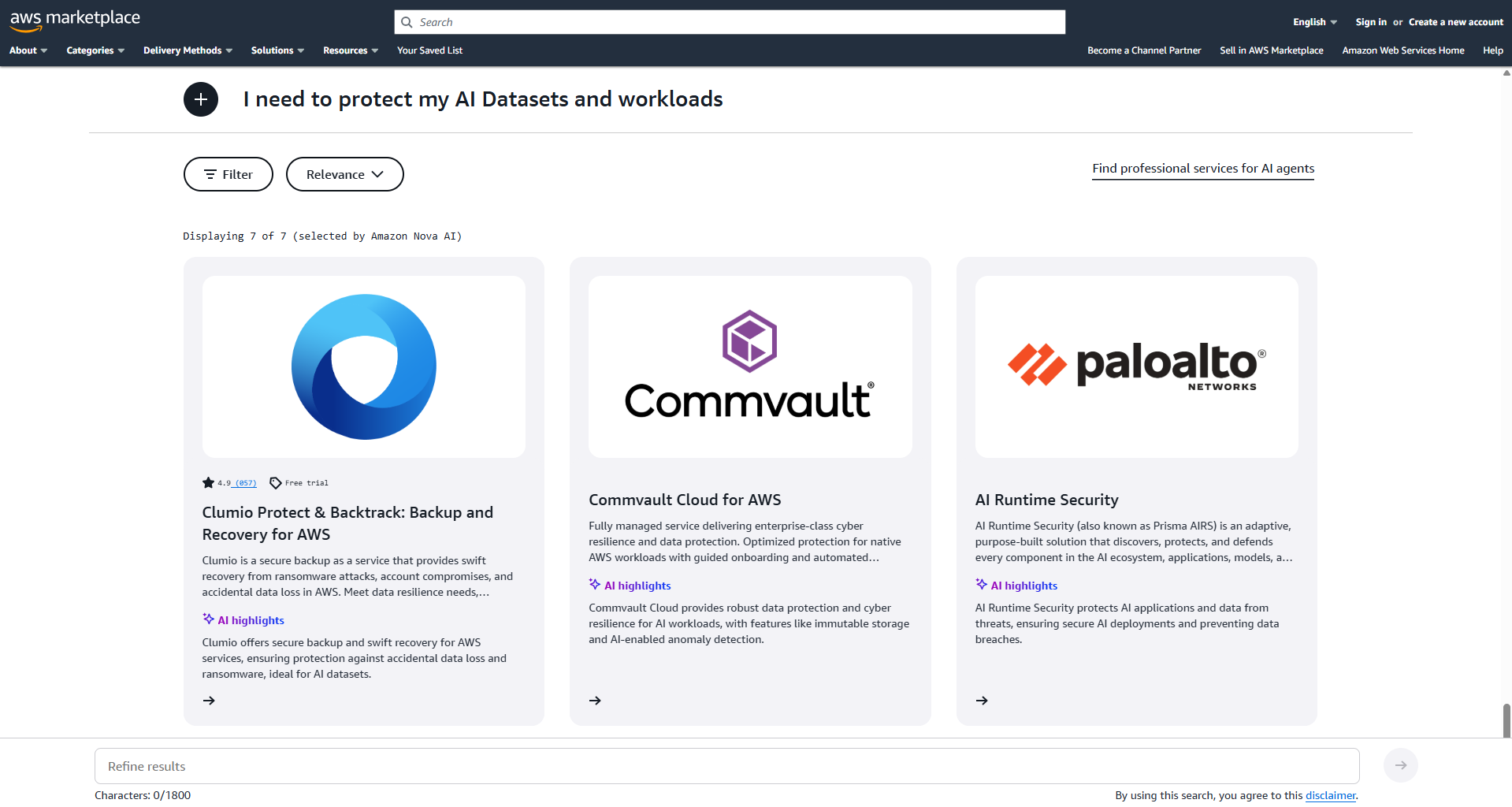
Following today’s unveiling of the AI Agent Solution space in AWS Marketplace at the AWS Summit in New York City, we are excited to highlight that Commvault has two solutions listed as AI Agent Solutions at launch, Commvault Cloud and Clumio.

These listings serve as a testament not only to the strength of our 15+ year partnership and the depth of our integration with AWS, but also to our longstanding commitment to protecting, securing, and driving cyber resilience across our customers’ workloads of today and tomorrow.

With AI Agent Solutions in AWS Marketplace, customers have a centralized destination purpose-built to connect AWS builders and AI architects to technologies that accelerate the adoption and incorporation of artificial intelligence by addressing key challenges across the AI lifecycle – from data preparation and model training to deployment, monitoring, security, and resilience.

By bringing together best-in-class tools, this new AI Agent Solution space helps organizations move faster, innovate smarter, and build with AI responsibly and at scale.

As AI adoption explodes across industries, so does the complexity of managing and safeguarding the vast amounts of data fueling it. From training datasets to inference data, from databases to large-scale structured and unstructured information, the effectiveness of AI is directly tied to the underlying data – and that data needs to be reliable, clean, and available.

That’s where our solutions come in.

How Cyber Resilience and Data Protection Fit in the AI Conversation

AI use cases and workloads are rapidly evolving both in scale and sophistication. But with all that growth, business leaders are being challenged by their board members and executive leadership to answer important questions. Questions like:

“How do you make sure that the data that powers all of these AI models is secure, resilient, and recoverable?  How will it affect the business if they’re not?”

Whether proprietary training data, inference inputs, or application data stored in databases providing Retrieval-Augmented Generation for high-value interactive customer experience in real time, securing and protecting all that data is no longer an afterthought – it’s a board-level imperative.

The Impact of Lost or Compromised Data for AI Workloads

Put yourself in the shoes of a business leader responsible for implementing AI solutions that promise to completely revolutionize how your organization does business. Now imagine the fallout if your proprietary AI training data were to be corrupted, encrypted in a ransomware attack, or accidentally deleted.

The consequences could be catastrophic – lost intellectual property, broken models, biased decisions, breaches of privacy, and months (or years) of work lost. These concerns aren’t worst-case scenarios – they’re a growing reality as AI becomes an attractive target for cybercriminals and internal threats alike.

That’s why AI innovation must go hand-in-hand with a solid data protection and cyber resilience strategy – not just for compliance, but for businesses to survive.

As part of the AI Agent Solutions in AWS Marketplace, Commvault empowers organizations to protect what matters most: the data behind the intelligence.

Commvault is proud to contribute two of our industry-leading cyber resilience and data protection solutions to the marketplace:

The Future of AI Needs a Secure Foundation

As more enterprises integrate AI into their operations, it’s clear that protecting AI data is protecting the future of the business.

We’re honored to be included in the AI Agent Solutions in AWS Marketplace alongside other innovators and leaders. And we’re proud to offer the tools and technology needed for your AI data to be secure, protected, and available for the applications that your customers and employees depend on.

Explore Commvault Cloud and Clumio in AWS Marketplace, and discover how we’re helping organizations secure and protect their most valuable AI assets from Day One.

More related posts


Thumbnail_Blog-Clumio-Chat-2026

Meet Clumio Chat: An AI Assistant to Help Evaluate Cloud-Native Data Protection

Read more about Meet Clumio Chat: An AI Assistant to Help Evaluate Cloud-Native Data Protection
Thumbnail_Blog-Clumio-Fedramp-2026

Clumio Advances Cloud-Native Cyber Resilience with FedRAMP® Milestone

Read more about Clumio Advances Cloud-Native Cyber Resilience with FedRAMP® Milestone
Thumbnail_Blog_Agentic-Ransomware-Attack

Cyber Resiliency for AI and Ransomware Recovery

Read more about Cyber Resiliency for AI and Ransomware Recovery

Amazon Simple Storage Service (S3) is a highly secure, scalable, and durable storage service built for the cloud. The unstructured nature of storage makes it a perfect choice for a wide variety of workloads. However, while powerful, it does present some challenges when it comes to data protection, especially at scale and with different types of data stored across many S3 buckets. This blog post will explore these challenges and how Clumio’s cloud-native solution uniquely addresses them, helping to keep your data secure, recoverable, and available.

Key Challenges of Protecting Data in Amazon S3

Protecting Amazon S3 data comes with several challenges:

Clumio’s Solution: Cloud-Native, Scalable Data Protection

Clumio is a cloud-native cyber resilience solution built on AWS, designed for rapid backup and recovery of Amazon S3 data. It allows quick rollbacks to specific versions of S3 buckets. Clumio’s backups are immutable and air-gapped, providing extra protection against data loss. By leveraging serverless scaling and parallel rehydration, Clumio can provide critical access to billions of objects in minutes, not days.

Clumio’s lightweight architecture, powered by serverless AWS Lambda functions, processes events, fetches objects, applies data reduction techniques, and stores data in an immutable backup repository. Metadata, inventory, and backup data are encrypted and stored in Clumio’s isolated AWS account. The event-driven and parallelized design captures changes to buckets on an ongoing basis without disrupting your production workloads.

Key Features That Differentiate Clumio S3 Protection

Scale

Clumio allows customers to scale far beyond traditional Amazon S3 backup limits. In production environments, Clumio has protected over 80 billion objects and 30 petabytes of data from a single S3 bucket – more than 10x the scale typically supported by AWS Backup (~7.5 billion objects/6 PB)1. The platform is continuously improving to handle larger environments, so customers can confidently expand protection as their data grows. This allows you to protect more critical data, retain more restore points, and reduce risk across your environment.

Backup Performance

Initial backups of billion object, petabyte scale buckets can often take weeks with traditional backup solutions. Subsequent backups of large buckets, too, require superior performance in order to complete the backups within the given RPO.

Clumio can significantly scale backup capacity very quickly with its serverless architecture. It all works under the covers using AWS technology to automatically scale up and down as needed for an organization’s specific data backup needs. Powered by this serverless architecture, Clumio offers near continuous backups with RPO as low as 15 minutes, regardless of the object and capacity scale of your S3 buckets.

Restore Performance and RTO

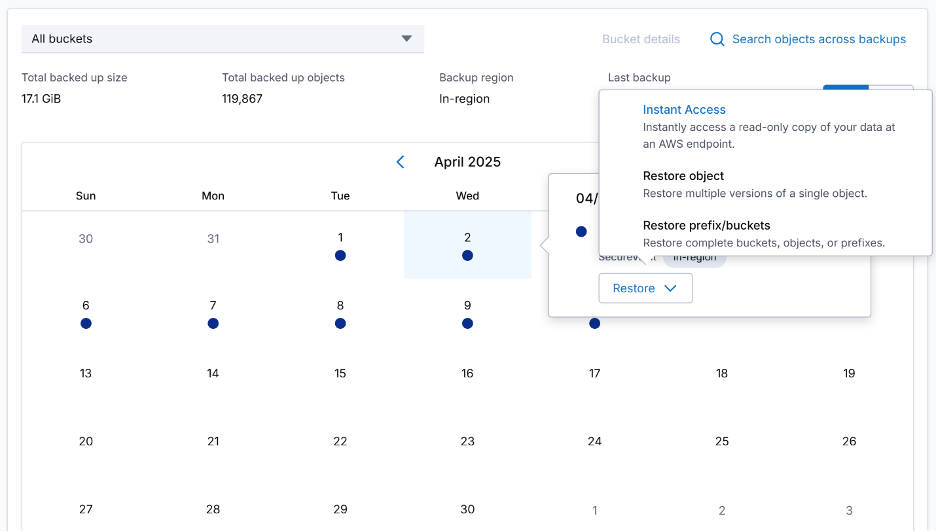
Clumio offers industry-leading RTOs with its Instant Access feature, which uses Amazon S3 Object Lambda Access Points for read-only backup access. This allows for rapid access to your S3 objects without having to kick off any full restores. The result of this unique feature is that RTO can be reduced to mere minutes, and DR testing becomes a breeze. Crucial data can be accessed rapidly for emergency access in critical situations. This is particularly useful in scenarios such as compliance audits where recovery needs to be proven and a full restore can be cost (and time) prohibitive.

Protection Groups

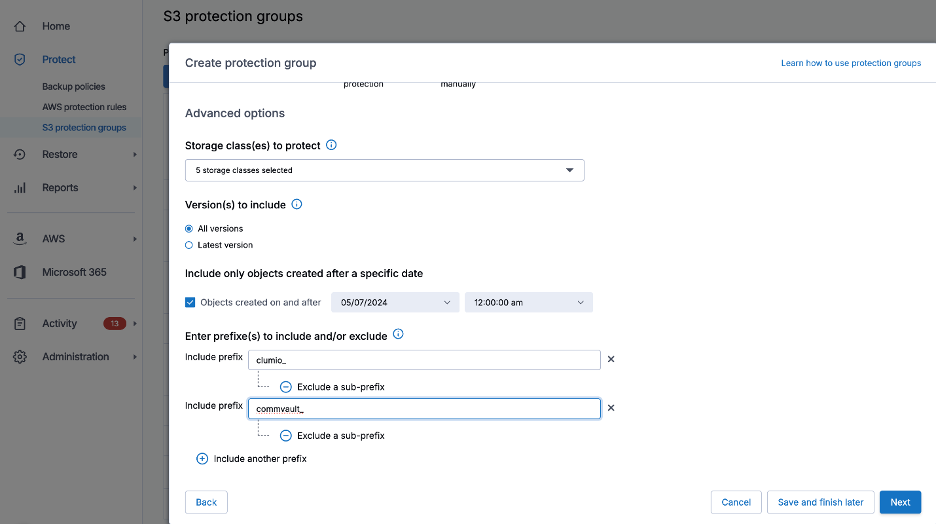
Clumio allows fine-grained control of data with protection groups. These are logical filters to define what data to back up based on factors like criticality and business requirements. Once protected, the objects in an S3 bucket can be restored at an individual or bulk level, or you can choose to restore whole buckets or prefixes, to any given point in time.

And for slices of your buckets that don’t need to be backed up, Clumio Backtrack offers a versioning-based point in time recovery feature that can restore your buckets to any given point in time using just object metadata information.

Immutable, Air-Gapped Protection

Clumio achieves superior data protection with air-gapped copies of customer data. The data is stored in a separate Clumio-maintained AWS account that is secured via role-based access control. Backup data is stored in an immutable vault outside of the enterprise security sphere, using composite keys to encrypt data in-flight and at-rest. If your primary or secondary data locations are compromised, Clumio has an air-gapped protected copy of your critical data ready to be restored and accessed.

TCO Savings

Clumio has purpose built a highly optimized storage layer to store your backups under the hood. Organizations save 30% or more on backup costs using Clumio vs. traditional AWS backup methods. Not only can organizations leverage the faster backup and restore capabilities of Clumio, but it comes at a lower cost as well!

Serverless Architecture

Clumio is built on a serverless architecture that’s both scalable and performant. The architecture provides the ability to scale up and down based on the backup needs. This architecture, built with AWS Lambda, is perfectly suitable for protecting S3 that’s inherently built for huge scale. Clumio’s S3 offering meticulously tracks, protects, and restores objects with RPO as low as 15 minutes and or very fast RTO expectations, even at a billion object/petabyte scale.

Conclusion

Amazon S3’s unmatched scalability and flexibility make it the foundation of modern cloud storage – but protecting data at that scale presents serious challenges. From environments spanning petabytes and billions of objects to the need for air-gapped protection and rapid recovery, neither traditional backup tools nor native capabilities can keep up. Clumio closes this gap with a cloud-native, serverless architecture purpose-built to meet the speed, scale, and security needs of today’s enterprises.

Interested in learning more about how to keep your S3 data secure, recoverable, and available for innovation? Schedule a demo and experience simple, logically air-gapped, and default-immutable backups for AWS workloads. You can also get a 14-day free trial of Clumio in the AWS Marketplace.


1. https://docs.aws.amazon.com/aws-backup/latest/devguide/s3-backups.html#s3-completion-windows

More related posts


Thumbnail_Blog-Clumio-Chat-2026

Meet Clumio Chat: An AI Assistant to Help Evaluate Cloud-Native Data Protection

Read more about Meet Clumio Chat: An AI Assistant to Help Evaluate Cloud-Native Data Protection
Thumbnail_Blog-Clumio-Fedramp-2026

Clumio Advances Cloud-Native Cyber Resilience with FedRAMP® Milestone

Read more about Clumio Advances Cloud-Native Cyber Resilience with FedRAMP® Milestone
Thumbnail_Blog_Agentic-Ransomware-Attack

Cyber Resiliency for AI and Ransomware Recovery

Read more about Cyber Resiliency for AI and Ransomware Recovery

Organizations are accelerating their move to the cloud. Microsoft Azure Elastic SAN offers a powerful solution for scalable, high-performance storage, purpose-built for mission-critical workloads such as large databases and analytics applications. Elastic SAN helps enable centralized volume management, cross-subscription support, and cloud-native agility.

Enterprises are empowered to confidently deploy and protect performance-intensive workloads in Azure now that Commvault integrates backup and recovery support for Azure Elastic SAN volumes.

Made possible through close collaboration between Commvault and Microsoft, we help ensure Elastic SAN volumes are protected within Commvault’s platform. We extend our thanks to the Microsoft team for their partnership and commitment to building robust, enterprise-ready cloud solutions.

Designed for Scalable, Resilient Cloud Environments

With Commvault’s integration, organizations can protect Azure Elastic SAN volumes attached to Azure virtual machines (VMs) using the same trusted platform they rely on for comprehensive data protection.

Key capabilities include:
  • Snapshot-based protection: IntelliSnap support enables rapid, low-impact backups that minimize performance impact on production systems.
  • Flexible recovery options: Full-VM and attach-disk restores are supported, including cross-region scenarios. In cross-region restores, Elastic SAN volumes are automatically restored as managed disks.
  • Broad platform compatibility: Both Windows- and Linux-based VMs are supported. Elastic SAN volume discovery requires PowerShell on Windows or Python 3 on Linux.

Deployment and Configuration Considerations

For optimal performance and streamlined protection workflows, enterprises should consider the following implementation guidance:
  • VM group strategy: For improved detection and operational control, group Elastic SAN-attached VMs into dedicated VM groups. During the initial release of this feature, the following key must be enabled at the VM group level: bAzureEnableElasticSanSnapBackupSupport
  • Runtime requirements: The Azure VM Agent must be installed, and VMs must remain powered on for successful volume discovery. Volume detection takes approximately 30 seconds per VM, regardless of volume attachment status.
  • Restore behavior: Snap restores create new volumes using the naming format . These are not automatically reattached to the VM and require a follow-up script or manual operation. In some cases, VMs may retain their connection to the original Elastic SAN volume unless explicitly detached.
  • Considerations: Restore points for Elastic SAN volumes are not currently supported. Attach-disk restores will result in managed disks regardless of source (primary or secondary copy).

Governance and Access Control

To support successful protection and recovery operations, appropriate Azure role-based access control permissions must be in place. These include permissions for Elastic SANs, volume groups, volumes, and snapshots. A full list of required permissions is documented in Commvault’s Azure documentation.

Be sure to review and integrate these permissions into your infrastructure-as-code templates or deployment scripts for smooth operation at scale.

Accelerate Cloud Confidence with Commvault

Azure Elastic SAN represents a significant advancement in cloud storage architecture. With Commvault’s integrated protection, enterprises can deploy this powerful capability to help make sure their data remains secure, recoverable, and compliant.

To learn more about protecting Azure workloads – including Elastic SAN – contact your Commvault account team or visit our Azure protection documentation.

More related posts


Thumbnail_Blog-Clumio-Chat-2026

Meet Clumio Chat: An AI Assistant to Help Evaluate Cloud-Native Data Protection

Read more about Meet Clumio Chat: An AI Assistant to Help Evaluate Cloud-Native Data Protection
Thumbnail_Blog-Clumio-Fedramp-2026

Clumio Advances Cloud-Native Cyber Resilience with FedRAMP® Milestone

Read more about Clumio Advances Cloud-Native Cyber Resilience with FedRAMP® Milestone
Thumbnail_Blog_Agentic-Ransomware-Attack

Cyber Resiliency for AI and Ransomware Recovery

Read more about Cyber Resiliency for AI and Ransomware Recovery

The digital world has brought undeniable benefits but also has increased cybersecurity risks. Cyberattacks now target essential systems and data, like customer information, financial records, and operational systems.

To combat this, organizations need a comprehensive cyber recovery plan that not only addresses how to respond and recover from attacks but also enables a swift return to normal operations with minimal impact. This includes mitigation strategies, data resiliency, employee training, and well-defined incident response and cyber recovery plans. Is your organization prepared for the next cyberattack?

Understanding the essentials of cyber recovery, planning for the future, and recognizing why readiness testing is the cornerstone of resilience is essential. A proactive cyber recovery strategy must integrate with existing IT operations and address both the technical and operational challenges of a cyber incident. Organizations need to adopt a proactive approach – not just react to events – to effectively manage cyber recovery.

Looking Ahead: Building a Cyber Recovery Roadmap 

Cyber recovery requires a forward-looking approach that evolves with the threat landscape. Here’s how organizations can stay ahead:

  1. Robust cyber security framework
    Use firewalls (local/enterprise), intrusion detection systems, endpoint protection, zero-trust architectures, and access controls.
  2. Multi-layered protection
    Beyond backups, encryption in flight and at rest, multifactor authentication, patching vulnerabilities, isolated identity domain for backup infrastructure. In addition, Commvault AirGap Protect creates immutable copies on separate infrastructure for data isolation and security.
  3. Integration of advanced threat detection
    Leverage security information and event management (SIEM) integration with advanced anomaly and threat scanning to identify and neutralize threats in real time, reducing the impact on critical systems.
  4. Incident detection and response
    Develop and practice a clear, actionable plan for responding to breaches, including steps for containment and eradication, which is defined in an incident response plan (IRP). Detailed recovery efforts should be outlined in a cyber recovery plan that can be a subcomponent or standalone plan from your IRP.
  5. Continuous training
    Equip teams with knowledge of evolving cyber threats, enabling them to recognize and respond swiftly to potential vulnerabilities.
  6. Cyber recovery readiness testing
    Readiness testing is the linchpin of any cyber recovery roadmap. Frequent simulations and stress tests help organizations identify gaps, enabling their recovery protocols to be robust and actionable. With Commvault Cleanroom Recovery, you can perform full-scale cyber recovery and resilience testing to assess and validate preparedness for cyber incidents without costly dedicated infrastructure.
  7. Continuous improvement
    Perform post-incident analysis to strengthen defenses after each breach or simulated breach, turning breaches into micro incidents. Leverage testing, metrics, and KPIs to continuously improve cyber resilience.

Readiness Testing: Bridging Plans and Reality

Strive toward a resilience-first culture with readiness testing programs to validate your organization’s ability to recover from an attack while identifying areas that need improvement.

Key Components of Readiness Testing

  • Tabletop exercises are essential for gathering key personnel to discuss and strategize their responses to various cyberattack scenarios. These exercises help identify weaknesses in planning and response.
  • Cyber recovery tests go beyond tabletop exercises by executing recovery procedures in a simulated environment, offering risk-free testing, identifying weaknesses, improving response times, training, and validating recovery strategies.
  • Scenario-based drills simulate real-world attacks like ransomware to evaluate team response times and procedural effectiveness.
  • Gap analysis pinpoints vulnerabilities in recovery protocols and lets you update processes accordingly, enabling better preparedness for future incidents.
  • Cross-functional collaboration can be tested through simulation exercises and tabletop drills, involving all relevant departments to practice roles and responsibilities, test communication protocols, and refine processes.
  • Regulatory compliance review allows you to align recovery actions with legal and industry standards.
  • Documentation of all tests, including findings, observations, and recommendations for improvement.

By taking a proactive and continuous approach to readiness testing, you can continually strengthen your organization’s defenses against evolving cyber threats.

Why Cyber Recovery Readiness Is Non-Negotiable

In an era where a single ransomware attack can cost a business millions of dollars in downtime, readiness is not an option but a necessity. Recovery tests act as both a shield and a blueprint, allowing organizations to maintain operational integrity when an attack strikes. By integrating these tests into broader recovery strategies, organizations can validate their plans work in practice – not just on paper. This proactive stance protects data, helps maintain customer trust, and positions businesses for long-term success.

Final Thoughts: Resilience Is a Journey

Resilience is not just a buzzword; it must become an integral part of your company’s DNA. Cyber recovery isn’t simply about bouncing back – it’s about safeguarding your organization’s future in an increasingly hostile digital landscape. Forget the myth of perfect security. The future belongs to those who treat every breach as a learning opportunity, emerging stronger and more innovative with each challenge.

Without a robust cyber recovery plan, businesses risk catastrophic financial losses, irreparable damage to their reputation, and the erosion of hard-earned customer trust. By combining forward-thinking strategies with rigorous readiness testing, organizations can cultivate a culture of resilience is prepared to withstand even the most determined adversaries.

Don’t wait for a crisis to expose your vulnerabilities. Act now to fortify your defenses, protect your critical assets, and emerge stronger, more resilient, and ready to thrive in the face of any challenge. For more insights on building and testing your cyber recovery plan, explore resources from Commvault on readiness planningcyber recovery assessment, and responding to ransomware attacks.

By prioritizing preparation today, you safeguard the foundation of your organization’s tomorrow. Start by conducting a thorough cyber recovery assessment and developing a comprehensive plan that includes regular readiness testing.

Learn More

Watch our webinar “Cracking the Code: Recover 99% Faster from Cyber Attacks” to learn how you can improve your cyber recovery plan and minimize downtime.

And check out these other blogs in our series on cyber resilience and minimum viability:

More related posts


Thumbnail_Blog-Clumio-Chat-2026

Meet Clumio Chat: An AI Assistant to Help Evaluate Cloud-Native Data Protection

Read more about Meet Clumio Chat: An AI Assistant to Help Evaluate Cloud-Native Data Protection
Thumbnail_Blog-Clumio-Fedramp-2026

Clumio Advances Cloud-Native Cyber Resilience with FedRAMP® Milestone

Read more about Clumio Advances Cloud-Native Cyber Resilience with FedRAMP® Milestone
Thumbnail_Blog_Agentic-Ransomware-Attack

Cyber Resiliency for AI and Ransomware Recovery

Read more about Cyber Resiliency for AI and Ransomware Recovery

What’s the difference between disaster recovery and cyber recovery? While they might seem similar at first, a deeper dive reveals significant differences.

We partnered with ESG to explore these distinctions, surveying 500 IT and security leaders worldwide. Our findings, detailed in the report “Preparedness Gap: Why Cyber-recovery Demands a Different Approach From Disaster Recovery,” highlight the greater complexity and reach of cyber recovery (CR).

This free report is packed with data that could change your approach to CR.

6 Key Findings

1. Confidence is not high

Only 26% of respondents are confident in their ability to protect all mission-critical applications and data. And only 20% are confident they’re protecting all apps and data needed to remain operational.

2. Complexity and differentiation

CR is significantly more complicated than traditional disaster recovery (DR). Among our respondents, 70% say CR is either more complex, takes longer, or both. While both aim to restore operations, CR involves additional steps for successful recovery.

3. Greater challenges with cyber recovery

Nearly all respondents (91%) say the complexity with CR begins with spending significant time and effort on forensic analysis to determine the full scope of the incident. And 85% say recovery without establishing a cleanroom environment creates significant risk of reinfection. A similar number of respondents (83%) fear that rushing to recover from a cyber incident could destroy valuable evidence.

4. Specialized processes and technologies

It’s not just the extra steps needed that makes CR more complicated. Effective CR requires specialized processes and technologies as well. Sixty-four percent of respondents say the technologies for CR are more complex than traditional DR. And people skills are a problem. Fifty-nine percent of respondents report finding and retaining staff with the right skills is harder for CR, than DR.

5. Attacks are targeting more than data

Ransomware payments are typically motivated by RTO needs, so attackers know that taking out the backup infrastructure will exacerbate the situation for the victim. Among our respondents, 92% say they’ve suffered from attacks that explicitly target backups, and 71% say those kinds of attacks account for half or more of all attacks. The good news is nearly all (96%) report that they’re taking extra measures to protect at least some or all of their backup copies.

6. Alignment with disaster recovery

It’s not all black and white when it comes to DR vs CR. Despite the differences, many organizations integrate CR planning into their broader DR programs. Over 52% of organizations include CR as part of their DR strategy, and even when managed separately, there is a high degree of alignment in processes and protocols.

Why a Different Emphasis on Cyber Recovery Matters

Let’s be honest, ransomware attacks are downright nasty. Aside from the obvious data loss and downtime:

  • 44% of respondents report reputational damage and customer loss.
  • 42% report theft of sensitive data from employees/customers/partners.
  • 40% report compliance violations.
  • 32% say such attacks resulted in third-party liability/legal action.

On the financial side, nearly a quarter of respondents (23%) report having paid a ransom last year, with the average largest payment reportedly being nearly $3 million. Given those high stakes, it’s vital to learn all you can to prepare your organization to tackle the complexities of CR.

Take a look at the full report here. If you’re looking to bolster your CR capabilities, I invite you to check out Beyond Disaster Recovery: Why You Need a Different Strategy When Ransomware Strikes.

Learn More

Watch our webinar “Cracking the Code: Recover 99% Faster from Cyber Attacks” to learn how you can improve your cyber recovery plan and minimize downtime.

And check out these other blogs in our series on cyber resilience and minimum viability:

More related posts


Thumbnail_Blog-Clumio-Chat-2026

Meet Clumio Chat: An AI Assistant to Help Evaluate Cloud-Native Data Protection

Read more about Meet Clumio Chat: An AI Assistant to Help Evaluate Cloud-Native Data Protection
Thumbnail_Blog-Clumio-Fedramp-2026

Clumio Advances Cloud-Native Cyber Resilience with FedRAMP® Milestone

Read more about Clumio Advances Cloud-Native Cyber Resilience with FedRAMP® Milestone
Thumbnail_Blog_Agentic-Ransomware-Attack

Cyber Resiliency for AI and Ransomware Recovery

Read more about Cyber Resiliency for AI and Ransomware Recovery

When ransomware strikes or systems fail, the effectiveness of your recovery doesn’t just depend on technology – it hinges on people working together across organizational boundaries. Despite the critical importance of alignment, significant gaps persist between cybersecurity teams and business leadership, undermining organizational resilience when it matters most.

This article explores how to build the organizational alignment necessary for effective cyber resilience, connecting technical teams with business leadership to create a unified approach to recovery.

The Organizational Challenge in Cyber Resilience

The most critical barrier to effective cyber resilience isn’t technological – it’s organizational. Research reveals alarming disconnects between cybersecurity leaders and the executives who control resources and strategic direction:

Board-Level Misalignment and Understanding Gaps

Harvard Business Review research from 2025 found that “many boards overestimate their company’s cybersecurity readiness while underestimating the strategic importance of their own role in shaping it.” The research reveals “a gap between perceived cyber investment and true board-level understanding, reflecting a broader misalignment: too many directors see themselves as growth strategists rather than stewards of long-term resilience.”

Communication and Credibility Gaps

Operational communication barriers persist between cybersecurity teams and business stakeholders. McKinsey research shows that while cybersecurity spending has increased dramatically – with organizations spending approximately $200 billion in 2024 compared to $140 billion in 2020 – many organizations still struggle with basic alignment between security teams and business units. This spending increase hasn’t necessarily translated to better organizational coordination.

CISO Role Evolution and Authority Gaps

The State of the CISO, 2023–2024, Report from IANS Research and Artico Search reveals a key challenge CISOs face: “Despite the role expectations being elevated to C-Level, CISOs struggle to be viewed as such, and the CISO role is frequently not part of the senior leadership team.”

However, the research found that “CISO satisfaction positively correlated with access and influence at the board level,” with CISOs who have strong board relationships feeling “more valued and generally report they are ‘heard,’ even when there are disagreements on budgeting.”

Limited Executive Access and Influence

Despite the strategic importance of cybersecurity, many CISOs lack meaningful access to senior leadership. The State of the CISO report cited above also revealed that only 20% of CISOs are positioned at the C-level in their organizational hierarchy, with 63% holding vice president- or director-level positions.More telling, 90% of CISOs are at least two organizational levels removed from the CEO.

Even among large organizations, access remains limited. Among companies with annual revenues exceeding $10 billion, only 60% of CISOs meet regularly with boards.

The Three Pillars of Organizational Alignment

With the challenges outlined above, it’s no surprise that there is thrash and uncertainty when it comes to how to actually build operational resilience into the business and ultimately respond to and recover from cybersecurity incidents. So where can teams start?

Building effective alignment for cyber resilience requires addressing three core areas:

1. Governance and Decision Rights

Resilience requires clear governance structures that define who makes which decisions:

Executive sponsorship:

Decision frameworks:

Cross-functional oversight

2. Roles and Responsibilities

Clearly defined roles eliminate confusion during high-stress incidents:

Incident response roles:

Recovery-specific responsibilities:

RACI Matrix Development

3. Communication and Collaboration

Effective communication bridges the gap between technical and business stakeholders:

Common language development:

Communication protocols:

Collaboration mechanisms

Building a Cross-Functional Resilience Culture

Beyond structures and processes, effective resilience requires a supportive organizational culture. Every level of the organization needs to know that they play a part in making sure the organization can withstand operational and cyber incidents. To help prepare company leadership for its role in building this culture, you should think about these components:

Executive Engagement Strategies

Success starts at the top with leadership that understands and prioritizes resilience:

Education approaches:

Metrics that matter to leadership:

Board-level reporting:

Middle Management Alignment

Middle managers often serve as critical connectors between technical teams and leadership and must be brought into the fold early in order to be prepared for any eventuality. Here are some good places that your leadership team can focus to help make middle management a driver of your resilience:

Resilience champions program:

Business unit integration:

Performance integration:

Technical Team Empowerment

Technical teams need both authority and guidance to execute effectively:

Decision authority frameworks:

Skill development programs:

Recognition and incentives:

Practical Alignment Methods

Building alignment requires concrete actions. Here are practical methods organizations can implement:

1. Joint business impact analysis (BIA)

One of the most effective alignment tools is a collaborative BIA:

Cross-functional BIA workshops:

Outcome documentation:

2. Tabletop exercises

Scenario-based exercises build shared understanding across organizational boundaries:

Cross-functional exercise design:

Exercise facilitation:

Post-exercise action planning

  1.  

3. Recovery plan translation

Effective plans bridge the gap between technical and business languages:

Business-focused plan elements:

Technical-business translation components:

Integrated documentation:

Measuring Alignment Effectiveness

To ensure alignment efforts are working, organizations should track specific metrics:

Process metrics:

Perception metrics:

Outcome metrics:

Regular measurement of these metrics provides insight into alignment effectiveness and highlights areas for improvement.

Implementation Roadmap

For organizations looking to improve stakeholder alignment, consider this phased approach:

Phase 1: Assessment (1–2 months)

Phase 2: Foundation Building (2–4 months)

Phase 3: Capability Development (4–8 months)

Phase 4: Optimization (8+ months)

Alignment as Competitive Advantage

As cyber threats continue to evolve, the ability to coordinate effectively across organizational boundaries will likely become an even more critical differentiator between organizations that maintain continuous business and those that suffer extended disruption.

By implementing structured approaches to governance, roles, and communication, organizations can significantly enhance their resilience posture and build the human foundation necessary for effective recovery.

Learn More

Watch our webinar “Cracking the Code: Recover 99% Faster from Cyber Attacks” to learn how you can improve your cyber recovery plan and minimize downtime.

And check out these other blogs in our series on cyber resilience and minimum viability:

More related posts


Thumbnail_Blog-Clumio-Chat-2026

Meet Clumio Chat: An AI Assistant to Help Evaluate Cloud-Native Data Protection

Read more about Meet Clumio Chat: An AI Assistant to Help Evaluate Cloud-Native Data Protection
Thumbnail_Blog-Clumio-Fedramp-2026

Clumio Advances Cloud-Native Cyber Resilience with FedRAMP® Milestone

Read more about Clumio Advances Cloud-Native Cyber Resilience with FedRAMP® Milestone
Thumbnail_Blog_Agentic-Ransomware-Attack

Cyber Resiliency for AI and Ransomware Recovery

Read more about Cyber Resiliency for AI and Ransomware Recovery

Recovering everything after a cyber incident isn’t just challenging – it’s often impossible to do quickly. This is where the concept of minimum viable recovery (MVR) becomes essential: identifying and prioritizing the critical subset of business functions absolutely necessary to maintain operations during a crisis.

Why Traditional Recovery Approaches Fall Short

When organizations face cyberattacks, they often discover a disconnect between their technical recovery capabilities and actual business needs. According to Minimum Viable Recovery: Closing the Recovery Gap, a joint report from GigaOm and Commvault, 54% of enterprises lack confidence in their ability to recover from disruption or cyber attack despite significant investment in resilience infrastructure. This “recovery gap” exists largely because recovery planning is typically technology-led rather than business-driven.

Traditional recovery approaches often attempt to recover everything, which can lead to:

Identifying Your Minimum Viable Business Functions

The first step in implementing an MVR approach is identifying the subset of business functions that are truly essential. This requires direct engagement with business leaders across the organization to determine:

According to the GigaOm report, organizations that take a business-led MVR approach can achieve the same level of risk mitigation as those pursuing comprehensive recovery – but faster and at lower cost. The key is proactive business engagement at a strategic level before an incident occurs.

Quantifying Business Impact: Beyond Technical Metrics

To effectively implement MVR, organizations need to move beyond purely technical metrics (like system downtime or recovery point objectives) to business-focused measurements:

Creating a Business-Driven MVR Framework

Building an effective MVR approach requires a structured methodology:

1. Business function mapping

Work with business stakeholders to document and map critical business processes, including:

2. Impact quantification

Assign business value and impact metrics to each function:

3. System and data dependency mapping

Create technical dependency maps that connect business functions to underlying infrastructure:

4. Recovery sequence design

Develop a tiered recovery sequence based on business priority:

5. Validation and testing

Create a testing methodology that validates business function restoration:

Implementation Roadmap

To implement MVR in your organization, consider this phased approach:

1. Discovery (Weeks 1–4)

2. Design (Weeks 5–8)

3. Implementation (Weeks 9–16)

4. Validation (Continuous)

Key Takeaways

MVR represents a fundamental shift in how organizations approach cyber resilience:

By focusing on what truly matters to your business, you can achieve more effective resilience with fewer resources, lower cost, and greater confidence in your ability to weather cyber disruptions.

Learn More

Watch our webinar “Cracking the Code: Recover 99% Faster from Cyber Attacks” to learn how you can improve your cyber recovery plan and minimize downtime.

And check out these other blogs in our series on cyber resilience and minimum viability:


More related posts


Thumbnail_Blog-Clumio-Chat-2026

Meet Clumio Chat: An AI Assistant to Help Evaluate Cloud-Native Data Protection

Read more about Meet Clumio Chat: An AI Assistant to Help Evaluate Cloud-Native Data Protection
Thumbnail_Blog-Clumio-Fedramp-2026

Clumio Advances Cloud-Native Cyber Resilience with FedRAMP® Milestone

Read more about Clumio Advances Cloud-Native Cyber Resilience with FedRAMP® Milestone
Thumbnail_Blog_Agentic-Ransomware-Attack

Cyber Resiliency for AI and Ransomware Recovery

Read more about Cyber Resiliency for AI and Ransomware Recovery

Organizations invest heavily in security technologies and recovery capabilities – yet when a crisis hits, many still struggle to recover effectively. Why? Recent research points to a critical missing element: regular, thorough recovery testing.

According to the 2024 Cyber Recovery Readiness Report, a joint effort of Commvault and GigaOm, organizations that regularly test their recovery capabilities recover significantly faster from cyber incidents and show greater confidence in their resilience posture. Despite this clear advantage, many organizations still overlook this critical component of cyber resilience.

The Testing Gap in Cyber Resilience

The Cyber Recovery Readiness Report reveals a striking pattern: Organizations that test their recovery plans quarterly are significantly more resilient than those that test less frequently. The data shows that 70% of cyber-mature organizations test their recovery plans quarterly, compared to only 43% of less mature organizations.

This testing gap directly impacts recovery outcomes:

Despite these benefits, the report revealed that only 13% of organizations have implemented mature testing practices. This represents both a challenge and an opportunity for organizations looking to improve their resilience posture, as organizations with incident response teams and regular testing reduce breach costs by 58% compared to those without tested plans.

Why Recovery Testing Often Falls Short

Several common barriers prevent organizations from implementing effective recovery testing programs:

Resource Constraints

Many organizations cite resource limitations as the primary barrier to regular testing:

Complexity Challenges

Testing recovery capabilities is inherently complex:

Organizational Barriers

Organizational factors often impede testing initiatives:

Risk Concerns

Ironically, concern about testing risks can prevent testing:

Building a Practical, Sustainable Testing Program

Despite these challenges, organizations can implement effective testing programs without disrupting operations or breaking the budget. Here’s a framework for developing a practical testing approach:

1. Define Testing Objectives and Scope

Start by clearly defining what you’re trying to achieve with testing:

Types of Testing Objectives:

Scoping Considerations:

2. Design a Progressive Testing Methodology

Effective testing programs use a progressive approach that builds capabilities over time:

Level 1: Tabletop Exercises

Level 2: Technical Validation Testing

Level 3: Functional Recovery Testing

Level 4: Simulation Exercises

Organizations should start with lower-level testing and progressively advance to more complex scenarios as capabilities mature.

3. Implement Testing Without Dedicated Infrastructure

One of the biggest barriers to testing is infrastructure requirements. Modern approaches offer alternatives:

Cloud-Based Testing Environments

Cleanroom Recovery Technology

Hybrid Testing Approaches

4. Create Effective Testing Scenarios

The quality of testing scenarios directly impacts their effectiveness:

Realistic Attack Scenarios

Business Process Impacts

Recovery Complications

Documentation Testing

5. Establish Measurable Outcomes

Effective testing requires clear metrics to track progress:

Recovery Time Measurement

Recovery Quality Assessment

Process Effectiveness Metrics

Continuous Improvement Tracking

Real-World Testing Methodologies

Organizations with mature testing practices typically implement a combination of approaches:

Quarterly Testing Cadence

As the Cyber Readiness Report revealed, the most mature organizations test their recovery plans quarterly. A typical quarterly cycle includes:

Quarter 1: Tabletop Exercise

Quarter 2: Technical Validation

Quarter 3: Functional Recovery Test

Quarter 4: Comprehensive Simulation

This progressive approach builds capabilities throughout the year while managing resource requirements.

Recovery Testing to a Cleanroom

A particularly effective approach is recovery testing in a cleanroom, which provides:

With Commvault® Cloud Cleanroom™ Recovery, organizations can conduct frequent, comprehensive tests without significant production risk or dedicated infrastructure costs.

Read more about how to bolster your cyber resilience in ESG’s technical report on Cleanroom Recovery.

Implementation Roadmap

For organizations looking to enhance their testing programs, consider this phased approach:

Phase 1: Foundation (1­–3 months)

Phase 2: Process Development (3–6 months)

Phase 3: Capability Building (6–12 months)

Phase 4: Optimization (12+ months)

Testing as a Competitive Advantage

In the face of increasing cyber threats, recovery testing has evolved from a compliance exercise to a strategic advantage. Organizations that implement robust testing programs demonstrate:

As cyber threats continue to evolve, recovery testing will likely become an even more critical differentiator between organizations that can maintain continuous business and those that suffer extended disruption. By implementing a progressive, sustainable testing program, organizations can significantly enhance their resilience posture without overwhelming resources.

Learn More

Watch our webinar “Cracking the Code: Recover 99% Faster from Cyber Attacks” to learn how you can improve your cyber recovery plan and minimize downtime.

And check out these other blogs in our series on cyber resilience and minimum viability:

More related posts


Thumbnail_Blog-Clumio-Chat-2026

Meet Clumio Chat: An AI Assistant to Help Evaluate Cloud-Native Data Protection

Read more about Meet Clumio Chat: An AI Assistant to Help Evaluate Cloud-Native Data Protection
Thumbnail_Blog-Clumio-Fedramp-2026

Clumio Advances Cloud-Native Cyber Resilience with FedRAMP® Milestone

Read more about Clumio Advances Cloud-Native Cyber Resilience with FedRAMP® Milestone
Thumbnail_Blog_Agentic-Ransomware-Attack

Cyber Resiliency for AI and Ransomware Recovery

Read more about Cyber Resiliency for AI and Ransomware Recovery

Multi-cloud fragmentation has become an existential vulnerability for modern enterprises. As organizations distribute critical workloads across AWS, Azure, Google Cloud, and specialized SaaS platforms, they’ve inadvertently created security blind spots, recovery gaps, and operational complexity that attackers exploit ruthlessly.

Traditional protection approaches – designed for centralized environments – simply collapse under the weight of siloed cloud architectures.

Commvault’s cyber resilience platform helps eliminate these vulnerabilities through unparalleled cloud integration that unifies protection across the entire digital estate. By delivering native, deep integration with hyperscale clouds, specialized platforms, and critical SaaS applications, Commvault enables organizations to implement enterprise-grade resilience without sacrificing the flexibility that drove their cloud adoption in the first place.

The following cases demonstrate how organizations have leveraged Commvault’s multi-cloud capabilities to transform security challenges into operational advantages that drive business value and competitive differentiation.

Customer Success Stories

University of Canberra: Transforming Disaster Recovery with Cloud Integration

The University of Canberra faced challenges with its legacy tape-based backup systems, which limited its disaster recovery capabilities and imposed significant overhead costs for maintaining physical infrastructure. It needed a solution that could support its long-term data retention requirements while enhancing data protection.

By implementing Commvault® Cloud Backup & Recovery with native integration to Amazon S3 and Amazon Glacier, the university transformed its disaster recovery approach. This integration reduced its overhead costs for tape libraries and physical storage by A$149,000 over six years while enabling daily off-site disaster recovery backups instead of the previous quarterly schedule.

The university’s associate director, vendor and operations, noted that Commvault’s native integration with AWS provided the agility needed to support its long-term retention requirements and enhance student services, while giving its confidence that its data was always readily available.

Global Entertainment Powerhouse: Achieving Cloud Resilience at Scale

A global leader in live entertainment faced critical challenges in maintaining cloud resilience across its rapidly expanding digital infrastructure. As its business grew globally, its needed a solution that could provide comprehensive protection for its increasing number of cloud resources while enabling business continuity for its entertainment services, used by millions worldwide.

The company turned to Commvault Cloud Rewind to address its critical need for cloud resiliency at scale. This solution enabled it to implement comprehensive backup and recovery capabilities for its entire cloud environment, including all resources, services, and dependencies. The native cloud integration allowed it to maintain the agility required for its fast-paced business while providing robust protection against outages and cyber threats.

With Cloud Rewind, the company successfully established a scalable resilience framework that can grow as its business expands. The solution’s ability to rewind and rebuild dynamic cloud applications enabled the company to maintain service availability for its global audience, even during major events that drive significant traffic spikes.

This implementation provided the entertainment company with the confidence to continue adding protection for more resources as it expands its business globally, enabling its platform to remain resilient and available to millions of users around the clock.

Enabling Multi-Cloud Agility

These success stories demonstrate how Commvault’s unparalleled cloud supportability and native integration capabilities enable organizations to achieve true multi-cloud agility.

By providing a unified cyber resilience platform for managing data protection across diverse cloud environments, Commvault helps businesses optimize their cloud investments, enhance data security, and maintain business continuity.

Whether scaling to accommodate exponential data growth, transforming disaster recovery approaches, or expanding integration possibilities with public cloud platforms, Commvault’s multi-cloud capabilities provide the foundation for successful cloud initiatives.

As organizations continue to adopt multi-cloud strategies, Commvault’s deep native cloud integration remains a critical enabler of their digital transformation journeys.

More related posts


Thumbnail_Blog-Clumio-Chat-2026

Meet Clumio Chat: An AI Assistant to Help Evaluate Cloud-Native Data Protection

Read more about Meet Clumio Chat: An AI Assistant to Help Evaluate Cloud-Native Data Protection
Thumbnail_Blog-Clumio-Fedramp-2026

Clumio Advances Cloud-Native Cyber Resilience with FedRAMP® Milestone

Read more about Clumio Advances Cloud-Native Cyber Resilience with FedRAMP® Milestone
Thumbnail_Blog_Agentic-Ransomware-Attack

Cyber Resiliency for AI and Ransomware Recovery

Read more about Cyber Resiliency for AI and Ransomware Recovery

The hybrid infrastructure explosion has shattered traditional protection boundaries. Today’s enterprises deploy workloads across a kaleidoscope of environments – from legacy on-premises systems to edge computing to multiple cloud platforms – creating protection gaps that sophisticated attackers ruthlessly exploit.

Each workload type, with its unique architecture and data structures, demands specialized protection approaches that most solutions simply cannot deliver.

Commvault’s cyber resilience platform overcomes these limitations through industry-leading workload supportability that spans the entire enterprise technology landscape. By delivering comprehensive protection for critical workloads – from containerized applications to specialized databases to virtual infrastructure – Commvault establishes a unified security and recovery fabric to help eliminate vulnerability gaps while dramatically simplifying management complexity.

The following organizations have leveraged Commvault’s extensive workload capabilities to transform fragmented protection landscapes into unified security advantages, even across the most heterogeneous environments.

Customer Success Stories

Scottish Fire and Rescue Service (SFRS): Cyber Resilience for Hybrid Multi-Cloud

The Scottish Fire and Rescue Service faced the challenge of maintaining cyber resilience across a complex hybrid, multi-cloud infrastructure. With critical emergency services data distributed across diverse environments, it needed a comprehensive solution that could provide consistent protection and recovery capabilities.

Commvault’s solution provides SFRS with comprehensive protection across its varied workload types, including virtualized environments, containerized applications, databases, and specialized emergency response systems. The platform’s unified management interface enables the SFRS IT team to implement consistent protection policies despite the diversity of its infrastructure.

By implementing Commvault’s cyber resilience platform, SFRS gained the ability to protect its hybrid, multi-cloud infrastructure effectively. This approach enables SFRS to keep critical data secure and recoverable, regardless of where it resides, supporting its mission-critical emergency response capabilities.

Financial Services Giant: Automated Cloud Application Recovery

A leading financial services organization that operates in both traditional data center and cloud environments deployed Commvault Cloud Rewind to address critical recovery challenges across its hybrid infrastructure. With complex applications spanning multiple environments, the company struggled with lengthy recovery times and high costs associated with their previous protection approach.

Its hybrid environment included thousands of virtual machines, containerized applications running on Kubernetes clusters, and specialized database workloads including SQL, Oracle, and MongoDB. The company required a solution that could consistently protect and rapidly recover these diverse workloads while maintaining the complex dependencies between components.

Commvault’s solution delivered automated rebuild capabilities for the company’s entire application environment, dramatically reducing recovery time and operational costs. The platform’s ability to protect and recover diverse workload types – from traditional virtualized systems to modern cloud-native applications – enabled a unified approach to cyber resilience across its heterogeneous infrastructure.

The implementation reduced the company’s cloud application resilience costs by 85% while enabling it to recover complex application environments in minutes. This remarkable improvement demonstrates Commvault’s capability to support diverse workload types within sophisticated hybrid environments, delivering both operational efficiency and enhanced protection.

SMSA Express: Defending Against Cyberattacks Across Distributed Systems

SMSA Express, a leading express delivery and logistics service provider, implemented Commvault Cloud to address significant protection challenges across its geographically dispersed hybrid infrastructure. With operations dependent on continuous availability of tracking systems, customer databases, and logistics applications, SMSA required a solution that could provide consistent protection across diverse workload types.

The company’s infrastructure included on-premises data centers housing traditional applications, virtual environments based on VMware, Microsoft SQL databases, and cloud-based logistics platforms. This mixture of legacy and modern systems presented significant challenges for maintaining consistent protection policies and enabling rapid recovery capabilities.

Commvault’s solution provided SMSA Express with comprehensive protection across its entire workload portfolio, enabling it to implement consistent policies despite the diversity of its infrastructure. The platform’s ability to protect everything from virtual machines to container-based applications to specialized databases meant that no critical components were left vulnerable.

By leveraging Commvault’s extensive workload supportability, SMSA Express successfully established a unified protection fabric that spans its hybrid environment. This implementation has significantly enhanced its cyber resilience posture, enabling it to defend against sophisticated attacks and recover rapidly from incidents, maintaining continuous logistics operations despite the complex nature of its distributed systems.

Prepared for Hybrid Complexity

These customer success stories demonstrate the power of Commvault’s industry-leading workload supportability in addressing the challenges of complex hybrid environments. By providing comprehensive protection for diverse workloads across heterogeneous infrastructures, Commvault enables organizations to implement unified data management strategies that help enhance operational efficiency, reduce risk, and support business growth.

Whether facilitating infrastructure migrations, simplifying management of heterogeneous environments, or delivering cyber resilience across hybrid multi-cloud infrastructures, Commvault’s extensive workload supportability provides the foundation for effective data protection in complex IT landscapes.

As organizations continue to expand and diversify their infrastructures, Commvault’s ability to protect critical data assets wherever they reside will remain a crucial enabler of digital transformation initiatives.

More related posts


Thumbnail_Blog-Clumio-Chat-2026

Meet Clumio Chat: An AI Assistant to Help Evaluate Cloud-Native Data Protection

Read more about Meet Clumio Chat: An AI Assistant to Help Evaluate Cloud-Native Data Protection
Thumbnail_Blog-Clumio-Fedramp-2026

Clumio Advances Cloud-Native Cyber Resilience with FedRAMP® Milestone

Read more about Clumio Advances Cloud-Native Cyber Resilience with FedRAMP® Milestone
Thumbnail_Blog_Agentic-Ransomware-Attack

Cyber Resiliency for AI and Ransomware Recovery

Read more about Cyber Resiliency for AI and Ransomware Recovery

For today’s businesses, disaster no longer wears the face of fire or flood; it strikes silently, in the form of a cyberattack. And with cyberattacks per organization increasing by a staggering 47% in Q1 2025 alone, the question is no longer if you’ll be targeted, but when.

Similarly, as ransomware becomes more frequent, recovery has evolved into an exercise of trust. Trust in your security capabilities. Trust in your ability to recover. Trust that you’re not welcoming back compromised data when you restore. But how can you be sure your backup isn’t already infected? How can you objectively build “trust”? 

In an era where threats hide seamlessly in plain sight, blind trust is a risk no business can afford. This is the harsh reality of modern cyber resilience: Speed matters, but cleanliness is critical.

This is where Commvault® Cloud Threat Scan and Cleanroom™ Recovery emerge as a powerful pairing. Together, they enable organizations to recover with speed AND confidence. With clean recovery becoming the new golden standard, this duo makes one thing clear: Fast is good, but clean is non-negotiable.

A Closer Look at the Numbers: The Dangers of Downtime

Downtime doesn’t just stall operations; it breaks down trust, shakes confidence, and stops your business in its tracks. Whether it’s ransomware, data corruption, or insider threats, the aftermath often comes with a hefty price tag. 

The numbers don’t lie. According to IBM, the average global cost of a data breach is $4.88 million. Extended outages cause even further issues. Enterprise Management Associates recently reported that the average cost of downtime is roughly $14,056 per minute, rising to $23,750 for large organizations of more than 10,000 employees.

But that’s not all. With the immense pressure that downtime brings, many businesses may rush to restore systems using backups that look clean but are silently infected. Recovering infected backups can lead to reinfection, cascading failures, and a costly second wave of compromise. This ultimately extends the initial downtime caused by the incident.

In short, without visibility and control, clean recovery becomes less of a certainty and more of a gamble.

Becoming a Continuous Business: Cleanroom Recovery

In this high-stakes landscape where clean data is integral, Cleanroom Recovery is a secure, on-demand, isolated environment purpose-built for confident recovery after a cyber event.

Cleanroom Recovery enables teams to:

  • Spin up a clean, air-gapped space to perform detailed forensics.
  • Test cyber recovery plans and workflows through simulations with real data.
  • Keep up with the latest compliance regulations.
  • Execute production-grade recovery only after full verification.

Since a newly spun-up instance cannot contain hidden threats, this isolated environment allows businesses to operate with confidence. It also serves as the ideal space for security teams to run their own analyses, test system behavior, and rehearse responses. With these capabilities, Cleanroom is more than a mere environment; it’s the very foundation of a continuous business.

A New Era of Confidence: Threat Scan Integration with Cleanroom Recovery

As cybersecurity grows in complexity to counter ever-evolving ransomware, solutions that bolster cyber resilience need to be smart, inherently secure, and work in synergy with the broader security stack. This is precisely why integrating Threat Scan with Cleanroom Recovery makes perfect sense. 

Commvault’s intelligent threat detection engine, Threat Scan, analyzes backups for indicators of compromise before recovery. By surfacing malware, identifying encryptions, and flagging suspicious changes, Threat Scan enables you to identify the last known good version of data estates. Ultimately, this helps you to speed up recoveries while avoiding reinfecting recovered infrastructure in production.  

Here’s how Threat Scan provides comprehensive coverage to:

  • Anomaly and encryption detection: Threat Scan monitors for suspicious patterns in backup behavior like off-hour jobs or sudden spikes in file volume, which are often the first signs of compromise. Powered by AI-enhanced behavioral and statistical models, it also analyzes file metadata and randomness patterns to identify signs of malicious encryption.

  • Root-cause tracing and malware scanning: Integrated with leading antivirus engines, Threat Scan identifies and traces malware back to patient zero, revealing the full scope of infection and helping teams stop it at the source.

  • AI vs. AI with Threat Scan Predict: Ransomware learns, adapts, and hides behind ever-shifting patterns. Threat Scan Predict counters this with AI trained to detect emerging, evasive behaviors. It spots what traditional tools miss, helping you stay ahead of threats designed to outsmart human and machine defenses alike.

  • Third-party security integrations: Tight integration with platforms like CrowdStrike, Cisco, Netskope, and Darktrace enriches Threat Scan with external threat intelligence. This creates a complete feedback loop between detection and recovery.
  • Restore point classification: Backups are automatically labeled with correlating levels of risk as they are created, giving IT teams a real-time timeline of safe recovery points.

Together, Threat Scan and Cleanroom Recovery turn recovery into an intelligence-driven process and not a blind leap of faith. It’s the difference between crossing your fingers and making a fully informed decision. And for many businesses, it’s the difference between long-term success and organizational failure.

A Cyber Recovery Flow That Works

When integrated, Threat Scan and Cleanroom Recovery deliver a clear, repeatable recovery process designed to minimize downtime and help eliminate doubt.

Here’s a glimpse of how you can leverage these solutions to create a foolproof recovery plan:

  • Preparation is key: Build and test a comprehensive recovery plan.
  • Immediate action: Detect, isolate, and assess threats quickly.
  • Data integrity: Confirm backups are clean and secure.
  • Gradual reintegration: Reconnect systems cautiously, and monitor for threats.
  • Continuous improvement: Learn from each incident to enhance your security posture.

Looking Ahead: Clean Recovery Is the New Must-Have

As threats continually evolve and pose significant challenges, recovery has become a strategic imperative for success. When the stakes are this high, there’s no room for guesswork or second chances. The way you recover from cyberattacks determines the course of your entire business. 

In this landscape, Cleanroom Recovery and Threat Scan shift recovery from reactive to proactive, from hopeful to provable. Together, they empower organizations to recover not only faster but also smarter. 

Learn more about how we can help your organization with clean recovery here.

More related posts


Thumbnail_Blog-Clumio-Chat-2026

Meet Clumio Chat: An AI Assistant to Help Evaluate Cloud-Native Data Protection

Read more about Meet Clumio Chat: An AI Assistant to Help Evaluate Cloud-Native Data Protection
Thumbnail_Blog-Clumio-Fedramp-2026

Clumio Advances Cloud-Native Cyber Resilience with FedRAMP® Milestone

Read more about Clumio Advances Cloud-Native Cyber Resilience with FedRAMP® Milestone
Thumbnail_Blog_Agentic-Ransomware-Attack

Cyber Resiliency for AI and Ransomware Recovery

Read more about Cyber Resiliency for AI and Ransomware Recovery

You’re a cybersecurity leader in your company. It’s 6:30 pm on a Friday before a long weekend. Just as you are about to board a plane for vacation with your family, your phone rings – it’s your SecOps team. Your IT systems around the world are starting to go unresponsive, and there are indications that you’re under a ransomware attack.

In that moment, the difference between chaos and control comes down to these key factors: how fast you respond and how cleanly you recover. A swift reaction might contain the damage. But if your recovery reintroduces infected data, you’re right back where you started.

Traditional backup and recovery strategies no longer work when staring down today’s threats. Organizations need a plan that pairs real-time threat detection with clean, validated recovery. This is the foundation of true cyber resilience. The equation is simple but powerful: Commvault® Cloud Threat Scan + Cleanroom™ Recovery = Cyber Confidence.

Ransomware actors are becoming more sophisticated while organizations struggle to keep up. According to research from 2024, the fastest detection-to-impact time was 27 minutes. That means it’s possible your organization will have less than half an hour‌ ‌from the first warning to potential system-wide paralysis. 

In this high-stakes scenario, every minute matters. Each delay increases the risks for data loss, extended downtime, regulatory nightmares, and erosion of customer trust. In this playbook, we’ll show how Commvault helps you move from reactive recovery to confident, orchestrated response.

What Happens After the Alarm?

When a cyberattack strikes, detection is just the beginning. The real test lies in what comes next: recovery. In theory, backups should be your safety net. But in practice, they can become silent carriers of infection. Since most bad actors target your data, restoring backups blindly carries inherent risks such as reintroducing malware into your environment. 

That’s why modern recovery spots clean points for restore. It needs Threat Scan.

Threat Scan: Your Clean Data Recovery Wingman

Commvault Cloud Threat Scan helps you to recover and restore clean data quickly, expertly avoiding threats and allowing you to automatically quarantine potentially malicious data. But what exactly is “malicious data”? And how can we tell if data is clean?

Rather than treating every backup as trustworthy, Threat Scan continuously analyzes data backups to surface hidden threats. It uses anomaly detection, malware scanning, encryption analysis, and third-party signals to classify recovery points with a high degree of confidence.

Here are the core features of Threat Scan:

  • Anomaly detection: Customers generally backup their data periodically. Some may do it daily, whereas some might do it every other week. Threat Scan monitors for unusual patterns in backup activity‌ – ‌such as unexpected spikes in data volume, off-hour backup jobs, or sudden changes in data types. These anomalies often serve as early indicators of compromise.
  • Encryption detection: A core pillar of Threat Scan is its advanced capability to detect data encrypted by ransomware. The system analyzes file metadata and randomness patterns to identify signs of malicious encryption.

    Unlike traditional methods that rely solely on entropy, Threat Scan uses deeper file composition analysis to distinguish between legitimate encryption and ransomware activity. Trained on diverse datasets and encryption behaviors, it delivers fast detection with reduced false positives – even for emerging, zero-day threats.
  • Root-cause tracing and integrated malware scanning: Threat Scan doesn’t stop at detection – it traces infected files back to their source, helping teams isolate patient zero and understand the scope of the attack. This infecting file, also known as the source of encryption, is detected with the help of integrated industry-leading antivirus solutions. 
  • Third-party security ecosystem integration: Integrations with partners like CrowdStrike, Darktrace, Cisco, and Netskope allow Commvault to capture incidents from external security platforms and flag associated devices or data as being vulnerable. These captured events are then shown on the Commvault platform against the assets or resources where the incident was generated. This tightens the feedback loop between detection and recovery.
  • Restore classification while backing up: As backups are created, data is automatically labeled as clean or compromised, forming a real-time recovery timeline. This helps enable teams to confidently select the right point to restore from‌.

Integration with SIEM & SOAR for Full Automation

In a true rapid-response scenario, speed and precision are integral to the safety of an organization’s invaluable data. Similarly, each event on the recovery journey from anomaly detection to infection identification is essential from a security standpoint.

Hence, Commvault provides the capability to share these critical security events with the security operations (SecOps) teams through SIEM (Security Information and Event Management) integrations and perform actions with SOAR (Security Orchestration, Automation, and Response) integrations. 

First, as Threat Scan detects anomalies‌ – ‌malware, encryption events, or suspicious backup behaviors‌ – ‌it immediately sends security events to these platforms via dedicated connectors (SIEM and webhooks).

Next, through integrations with powerful SOAR platforms such as Splunk, Microsoft Sentinel, and Palo Alto Networks XSOAR, Commvault allows SecOps to gain actionable intelligence and automate response workflows using preconfigured playbooks (co-developed with Commvault) to take action‌ – ‌quarantining infected data, preserving backup versions, or triggering recovery workflows‌.

Cleanroom Recovery

Cleanroom Recovery is an on-demand secure and isolated environment for organizations to prepare, validate, and execute cyber recovery – delivering continuous business. With Cleanroom Recovery, organizations can confidently test cyber recovery plans, conduct secure forensic analysis, and deliver production recovery to help achieve continuous business following an attack.

When it comes to restoring data, especially in production environments, even “clean” isn’t clean enough. Despite already being marked as clean or compromised, customers still will want their own security teams to analyze the data and run the desired forensics.

With the latest integration, Threat Scan in Cleanroom Recovery now delivers post-recovery threat detection, analysis, and clean recovery. This will help boost the confidence of security and IT teams that they can recover after a cyber incident.

Think of it as two-factor verification in data recovery. Cleanroom Recovery gives your team a chance to validate the data again post-recovery. Only when the team is confident in the cleanliness of their data does the data move forward into production‌ – helping deliver not just a fast recovery, but a clean one.

Orchestrating a Fast and Confident Recovery

When each second matters and the future of your organization is at stake, confidence is everything. Commvault’s recovery orchestration doesn’t just restore data; it does it intelligently and safely. With AI-enabled scans of metadata and file entropy, the platform automatically quarantines suspicious files and pinpoints the last known good copy. This means teams don’t waste precious hours guessing‌ – ‌they restore what’s clean, fast.

What’s more, the business impact is undeniable. Commvault’s sophisticated solution helps reduce downtime, improving confidence in recoveries and preventing the reinfection of their environments. 

This is what modern cyber resilience looks like: fast threat detection, isolated environments for testing and staging recoveries, and automations to help your teams quickly recover following attacks.

More related posts


Thumbnail_Blog-Clumio-Chat-2026

Meet Clumio Chat: An AI Assistant to Help Evaluate Cloud-Native Data Protection

Read more about Meet Clumio Chat: An AI Assistant to Help Evaluate Cloud-Native Data Protection
Thumbnail_Blog-Clumio-Fedramp-2026

Clumio Advances Cloud-Native Cyber Resilience with FedRAMP® Milestone

Read more about Clumio Advances Cloud-Native Cyber Resilience with FedRAMP® Milestone
Thumbnail_Blog_Agentic-Ransomware-Attack

Cyber Resiliency for AI and Ransomware Recovery

Read more about Cyber Resiliency for AI and Ransomware Recovery

Up and to the right: We believe that’s the march of progress and innovation. One that Commvault has been recognized in since its beginning in 2011.

You would expect that there would be setbacks and downturns along the way. But not with this company and this team. For us, this isn’t a one-off or a recent recognition, but an unbroken 14-time track record of finding better, smarter, faster ways to help customers be continuous businesses. 

If you’re a Gartner client, you can see for yourself our long run as a Leader using its interactive tool.

Commvault delivers consistently, setting the benchmark for excellence in data management and protection.

We believe that our recognition is not only about our product, we think it reflects all the achievements over the past year, including:

Consistent progress calls. There is no rest. Only better. That’s the promise we’ve made to our customers. We’re already hard at work on new innovations that we’ll be showing at SHIFT in November. Watch this space for the future of cyber resilience and continuous business.

To learn more about Commvault’s recognition from Gartner and to read the 2025 Gartner® Magic Quadrant™ for Backup and Data Protection Platforms report, visit: www.commvault.com/gc/itleaders.


Gartner, Magic Quadrant for Backup and Data Protection Platforms; Michael Hoeck, Jason Donham, Rene Rodriguez, Rizvan Hussain, Sankalp Rastogi; June 2025.

Gartner does not endorse any vendor, product or service depicted in its research publications and does not advise technology users to select only those vendors with the highest ratings or other designation. Gartner research publications consist of the opinions of Gartner’s Research & Advisory organization and should not be construed as statements of fact. Gartner disclaims all warranties, expressed or implied, with respect to this research, including any warranties of merchantability or fitness for a particular purpose.

GARTNER is a registered trademark and service mark of Gartner, Inc. and/or its affiliates in the U.S. and internationally, Magic Quadrant is a registered trademark of Gartner, Inc. and/or its affiliates and is used herein with permission. All rights reserved.

More related posts


Thumbnail_Blog-Clumio-Chat-2026

Meet Clumio Chat: An AI Assistant to Help Evaluate Cloud-Native Data Protection

Read more about Meet Clumio Chat: An AI Assistant to Help Evaluate Cloud-Native Data Protection
Thumbnail_Blog-Clumio-Fedramp-2026

Clumio Advances Cloud-Native Cyber Resilience with FedRAMP® Milestone

Read more about Clumio Advances Cloud-Native Cyber Resilience with FedRAMP® Milestone
Thumbnail_Blog_Agentic-Ransomware-Attack

Cyber Resiliency for AI and Ransomware Recovery

Read more about Cyber Resiliency for AI and Ransomware Recovery

At Commvault, we’ve never set out to build an “employer brand” in the conventional sense. What we have built is a space where people are trusted with responsibility, equipped with clarity, and given room to grow.

Recognition as Employer Brand of the Year at the YourStory GCC Summit 2025 is a meaningful moment ­– not just because it affirms what we’ve done, but because it sharpens our vision for what we do next.

India’s global capability centers are no longer just extensions of global operations – they are shaping strategy, building IP, and influencing product roadmaps. At Commvault’s COE, we see this as a responsibility. Our focus isn’t on being popular – it’s on being purposeful. That means creating a talent ecosystem that’s resilient, future-ready, and aligned with where the industry is headed, not just where it stands today.

Here’s what we believe makes a truly future-forward workplace:

  • Programs that empower movement – across functions, geographies, and growth stages.
  • Leadership that prioritizes transparency over control.
  • Teams that challenge with context and collaborate with intent.
  • Culture that adapts without losing its core.

And as we step into the “Era of the Customer,” we’re not rebooting – we’re fine-tuning, as our Chief Customer Officer, Sarv Saravanan, would say. Our focus continues to be on making deliberate, continuous improvements; embedding customer obsession into everything we do; simplifying our offerings, accelerating onboarding and upgrades, and delivering consistent outcomes; and collaborating deeply across teams to create smooth, end-to-end experiences.

We’re grateful for the recognition – but we’re more invested in the road ahead. India is at the center of the global tech shift, and we’re committed to building talent, trust, and customer-centricity at scale.

Learn more about working at Commvault and view our open roles here.

More related posts


Thumbnail_Blog-Clumio-Chat-2026

Meet Clumio Chat: An AI Assistant to Help Evaluate Cloud-Native Data Protection

Read more about Meet Clumio Chat: An AI Assistant to Help Evaluate Cloud-Native Data Protection
Thumbnail_Blog-Clumio-Fedramp-2026

Clumio Advances Cloud-Native Cyber Resilience with FedRAMP® Milestone

Read more about Clumio Advances Cloud-Native Cyber Resilience with FedRAMP® Milestone
Thumbnail_Blog_Agentic-Ransomware-Attack

Cyber Resiliency for AI and Ransomware Recovery

Read more about Cyber Resiliency for AI and Ransomware Recovery

The financial services industry stands at the forefront of a relentless battle against cyber threats. As financial institutions increasingly rely on technology to protect, access, and restore vast amounts of sensitive data, the stakes have never been higher. A single breach can lead to catastrophic financial losses, reputational damage, and legal ramifications.

Let’s talk about how important cybersecurity is in finance; investigate the changing threat landscape, including advanced ransomware attacks and AI-driven threats; explore the regulatory requirements that financial organizations must adhere to; and identify the key pillars of cyber resilience that are essential for safeguarding against cyber risks.

Why Cybersecurity Is Critical for Finance

Sensitive information such as personal financial data, transaction details, and proprietary trading algorithms are prime targets for cybercriminals. A breach can lead to significant financial losses, legal repercussions, and reputational damage, making robust cybersecurity a non-negotiable priority. What makes the stakes so high in this sector, specifically?

  • Regulatory compliance pressure: Financial institutions are subject to strict regulatory requirements to protect customer data, such as those from DORA, Payment Card Industry Data Security Standard (PCI DSS) and Network and Information Systems Directive 2 (NIS2). Noncompliance can result in hefty fines and legal action.  
  • Trust and customer confidence: Customer trust is the lifeblood of financial services. Any breach, no matter how small, can erode this trust and cause customers to flee. Strong cybersecurity measures are essential to maintaining confidence that clients feel their assets and personal information are safe within the organization.
  • Evolving threat landscape: Cyber threats are constantly evolving, with new tactics and technologies emerging. Financial institutions must stay ahead of these threats by implementing advanced security solutions and maintaining a proactive approach. This includes regular updates to security protocols and continuous monitoring of networks and systems.
  • Economic impact of breaches: The economic impact of a cyber breach can be devastating. The cost of a data breach in the financial services sector averaged $6.08 million in 2024, marking a 3% increase from the previous year. Beyond the immediate financial loss, there are long-term costs such as legal fees, customer loss, and operational disruptions. Investing in cybersecurity is a cost-effective strategy that can help reduce these losses and protect the institution’s bottom line.
  • Reputation and brand integrity: A cyberattack can severely damage a financial institution’s reputation. In an industry where trust is paramount, the fallout from a breach can be long-lasting. An effective cybers resilience strategy not only protects data but also safeguards the brand’s integrity and the institution’s standing in the competitive market.

The Evolving Threat Landscape: Ransomware and AI-Driven Attacks

Ransomware attacks have surged in the financial sector, targeting critical data and disrupting operations. In 2024, 65% of financial organizations were hit by ransomware attacks. These attacks encrypt valuable information, demanding a ransom for its release.

Financial institutions must stay vigilant, as the sophistication and frequency of these threats continue to rise, posing significant risks to both data integrity and business continuity. Here are some important topics to monitor:

  1. Advanced AI-driven tactics: AI-driven malware can learn and adapt, evading traditional security measures with ease. These attacks are becoming more personalized and harder to detect, making them a formidable challenge. AI can analyze vast amounts of data to identify vulnerabilities and launch targeted strikes.
  2. The role of Machine Learning: Cybercriminals are using ML algorithms to automate and refine their attack methods. These algorithms can predict patterns and behaviors, enabling attackers to bypass security protocols more effectively. Financial institutions need to fight this by using advanced AI and ML to help them find and respond to threats better.
  3. Evolving defense mechanisms: To combat these advanced threats, financial institutions must adopt multilayered security approaches and continuous update their systems. Regular security audits and employee training are also crucial.
  4. Compliance and regulation: Financialinstitutions must comply with stringent regulations to avoid penalties and provide customer protection. This means making strong security rules, checking risks often, and talking openly with regulators and customers.

Regulatory Drivers: DORA, PCI DSS, and NIS2

Regulatory bodies are increasingly focusing on cybersecurity, especially in the financial sector. Here are just a few that the sector needs to abide by:

  • The Digital Operational Resilience Act (DORA): A comprehensive framework in the European Union aimed at strengthening the cyber resilience of financial institutions. It requires stringent security measures and regular assessments so that institutions can withstand and recover from cyberattacks.
  • The Payment Card Industry Data Security Standard (PCI DSS): A set of security standards designed for the safe handling of credit card information. It aims to help reduce data breaches and protect customer financial data.
  • The Network and Information Systems Directive (NIS2): Expands the scope of cybersecurity regulations, covering a wider range of sectors, including financial services. It requires institutions to implement robust security measures and report significant cyber incidents quickly. NIS2 aims to improve the overall security posture and foster a more resilient digital environment.

To align with DORA, PCI DSS, and NIS2, financial institutions must integrate these frameworks into their security policies. This involves continuous monitoring, proactive threat hunting, and regular updates to security protocols. By doing so, institutions can make progress on their compliance journey and protect their data from evolving cyber threats.

Key Pillars of Cyber Resilience

Maintaining a strong security posture relies on vigilance across these pillars of cyber resilience:

  • Data integrity is crucial. It enables data to remain accurate and unaltered throughout its lifecycle. By using strong data validation and monitoring tools, financial organizations can find and stop illegal changes, keeping their customers and stakeholders’ trust.
  • Rapid recovery is essential in the event of a cyberattack. Financial institutions should have well-defined cyber recovery plans and regularly test them. This includes identifying your minimum viability – those critical systems and data that can be restored quickly and allow you to resume operations, helping minimize downtime and financial losses. Read more in our Guide to Cyber Recovery Preparedness for the Financial Services Industry.
  • Compliance with cybersecurity regulations is non-negotiable. Financial institutions must stay informed about evolving standards like DORA, PCI DSS, and NIS2. Regular training and audits allow all employees to be aware of and adhere to these regulations, reducing the risk of noncompliance penalties.
  • Proactive monitoring is key to identifying and mitigating threats before they escalate. Advanced security information and event management systems can detect unusual activities and alert security teams in real time.

How Commvault® Cloud Enables Resilience

Threat Detection: First Line of Defense

Commvault Cloud offers advanced threat detection capabilities, leveraging AI and ML to identify and respond to cyber threats. By continuously monitoring data and network activities, it can detect unusual patterns and potential breaches, allowing financial institutions to take action and help reduce data loss.

Immutable Backups: Safeguarding Data

Commvault Cloud provides immutable backups, so that critical data remains protected. These backups are indelible, providing a reliable recovery point in the event of a ransomware attack. This feature is vital for maintaining data integrity and business continuity.

Compliance Search: Meeting Regulatory Standards

Commvault Cloud includes a robust compliance search function, enabling financial institutions to locate and review data to assist with regulatory requirements. This feature helps in conducting thorough audits and reducing the risk of noncompliance with standards.

Secure Data Management: End-to-End Protection

With Commvault Cloud, financial institutions can manage their data securely from end to end. It offers comprehensive data protection solutions, including encryption, access controls, and secure data storage. These features help protect sensitive information, improving the overall security posture and customer trust.

Practical Steps for Implementation

Start by assessing your current security measures. Identify any gaps or vulnerabilities in your system. This foundational step will help you understand where you need to strengthen your defenses and allocate resources effectively.

  • Develop a comprehensive security strategy that aligns with regulatory requirements and industry best practices. It should include multilayered security, regular updates, employee training, and clearly defined roles and responsibilities.
  • Implement advanced security solutions like AI and ML into your defense strategy to help detect and respond to threats. Commvault Cloud has robust threat detection and immutable backups, which provide an additional layer of protection.
  • Conduct regular security audits to maintain compliance with regulations, help identify new risks, and verify that your security measures are up to date.
  • Educate employees about the importance of cybersecurity so they can recognize and respond to threats. Encourage a culture of security awareness, where employees are proactive in reporting suspicious activities and following security protocols.
  • Test cyber recovery plans regularly to make sure they’re effective. Updates should be made based on the results of these tests and any new threats that emerge.

Financial institutions must remain vigilant and proactive. The stakes are high, and the threats are sophisticated, but with the right strategies and tools, organizations can protect their data, maintain customer trust, and comply with regulatory requirements.

Commvault Cloud offers a robust suite of solutions that can significantly enhance an institution’s cyber resilience. By integrating these solutions and following the practical steps outlined, financial organizations can build a strong defense against cyber threats. Learn more about Commvault Cloud for financial services.


More related posts


Thumbnail_Blog-Clumio-Chat-2026

Meet Clumio Chat: An AI Assistant to Help Evaluate Cloud-Native Data Protection

Read more about Meet Clumio Chat: An AI Assistant to Help Evaluate Cloud-Native Data Protection
Thumbnail_Blog-Clumio-Fedramp-2026

Clumio Advances Cloud-Native Cyber Resilience with FedRAMP® Milestone

Read more about Clumio Advances Cloud-Native Cyber Resilience with FedRAMP® Milestone
Thumbnail_Blog_Agentic-Ransomware-Attack

Cyber Resiliency for AI and Ransomware Recovery

Read more about Cyber Resiliency for AI and Ransomware Recovery

As organizations increasingly rely on DevOps platforms like Azure DevOps, GitHub, and GitLab for software development, the security and recoverability of repositories, metadata, and CI/CD pipelines is critical.

That’s why we are excited to announce the general availability of Commvault® Cloud Backup & Recovery for DevOps. This solution provides enterprise-grade protection and fast recovery to help safeguard valuable source code, intellectual property, and configurations from accidental deletion, corruption, or malicious attacks.

Why Back Up DevOps Data?

DevOps platforms are critical to modern software development, facilitating collaboration, streamlining workflows, and enabling teams to deploy software and applications quickly and efficiently.

These platforms store a wealth of business-critical intellectual property, including source code repositories, CI/CD pipelines, wikis, issues, configurations, and metadata. But what if:

  • A developer accidentally deletes a repository?
  • A compromised credential leads to the malicious deletion of source code?
  • A misconfiguration in your CI/CD pipeline wipes out essential deployment artifacts?

These scenarios are not hypothetical. Accidental deletions, insider threats, and cyberattacks all can halt development, cause project delays, and severely impact productivity as teams struggle to reconstruct lost work.

Without a robust backup and recovery strategy, you could face:

  • Permanent data loss: Important files and code may be irretrievably lost, forcing teams to start from scratch.
  • Extended downtime: Development processes can come to a standstill, leading to project delays and reduced productivity.
  • Compliance failures: Industries such as finance, healthcare, and government require proof of data recoverability during audits. Non-compliance can result in severe legal and financial penalties.

While some DevOps platforms offer built-in backup tools, they often fall short in providing comprehensive coverage and granular recovery options, leaving critical data exposed to potential threats. Custom scripts might seem like a viable workaround, but they are technically challenging to set up and maintain, often leading to gaps in protection and increased risk of errors.

Keep DevOps Data Safe and Recoverable with the help of Commvault Cloud

Commvault Cloud Backup & Recovery for DevOps delivers enterprise-grade protection for Azure DevOps, GitHub, and GitLab to help safeguard valuable intellectual property, source code, and configurations from accidental deletion, corruption, or malicious attacks. Commvault Cloud offers:

  • Comprehensive coverage: Protect your repositories, metadata, and configurations across Azure DevOps, GitHub, and GitLab – all from a single, unified solution.
  • Automated, policy-based backups: Enable consistent and reliable protection with automated backups that follow your policies.
  • Fast, granular recovery: Restore what you need, from a single project or repository to individual artifacts and pipelines, with flexible in-place and out-of-place recovery options, including cross-platform migration.
  • Immutable, air-gapped backups: Help minimize the risk of ransomware with indelible backups, providing an additional layer of security.
  • Compliance readiness: Help stay ahead of audits with detailed audit logs and comprehensive reporting.
  • Enterprise-scale performance: High-speed, API-efficient backups that intelligently circumvent rate limits to handle massive DevOps environments without bottlenecks.

Get Started Today

Don’t let data loss or disruption derail your development efforts. With the help of Commvault Cloud Backup & Recovery for DevOps, you can be confident that your critical DevOps data is protected and readily available.

To learn more about how Commvault can enhance your DevOps resilience, visit Commvault.com/platform/devops. If you’re ready to take the next step, sign up for a 30-day free trial today and experience the peace of mind that comes with enterprise-grade backup and recovery.

More related posts


Thumbnail_Blog-Clumio-Chat-2026

Meet Clumio Chat: An AI Assistant to Help Evaluate Cloud-Native Data Protection

Read more about Meet Clumio Chat: An AI Assistant to Help Evaluate Cloud-Native Data Protection
Thumbnail_Blog-Clumio-Fedramp-2026

Clumio Advances Cloud-Native Cyber Resilience with FedRAMP® Milestone

Read more about Clumio Advances Cloud-Native Cyber Resilience with FedRAMP® Milestone
Thumbnail_Blog_Agentic-Ransomware-Attack

Cyber Resiliency for AI and Ransomware Recovery

Read more about Cyber Resiliency for AI and Ransomware Recovery