ON-DEMAND SESSION
The Readiness Discipline
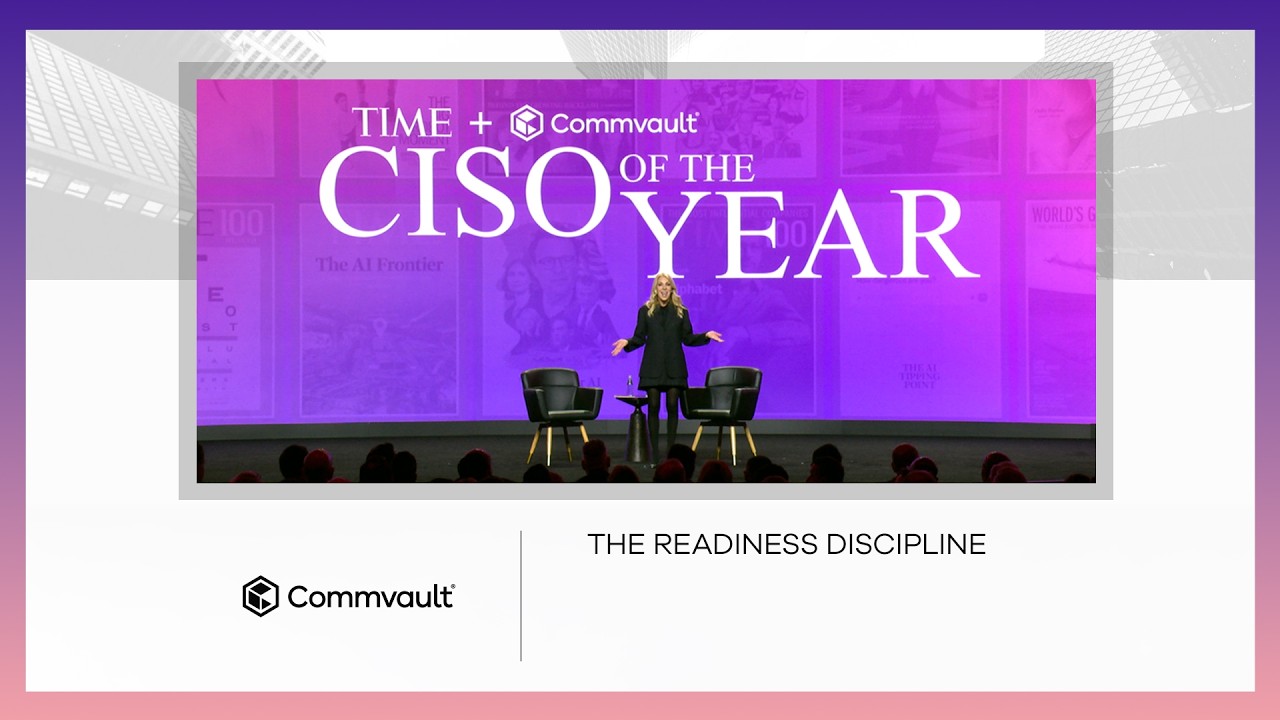
Alex Levy, CISO at BNSF Railway, explains why AI-era resilience depends on continuous readiness, trusted recovery, and security that enables the business.
Key Takeaways
Resilience Starts Before Crisis
Prepare continuously so recovery is practiced, measurable, and ready before disruption begins.
AI Changes Attack Speed
Defenders must use AI to counter faster, commoditized threats.
Fight Fire With Fire
Pair capable AI agents with human judgment, governance, and clearly defined guardrails.
Security Should Enable Business
Build protections that reduce friction while helping teams innovate and operate confidently.
Observability Proves Readiness
Detect abnormal conditions before unavailable systems or customers reveal the incident.
Recover Clean and Fast
Restore trusted environments in minutes or hours, not days.
About This Session
The modern CISO is not only a security leader, but an architect of continuity, recovery, and trust. In this conversation, TIME CISO of the Year Alex Levy shares lessons from protecting BNSF Railway and its 33,000-mile network while preparing for incidents that can unfold at machine speed.
AI Raises the Stakes
AI gives attackers speed, scale, and access to sophisticated techniques. Levy argues that defenders must respond with equally capable tools, while preserving the human judgment needed for ambiguous, high-impact decisions.
Readiness becomes real when teams practice recovery, expose hidden dependencies, and build muscle memory before an actual incident. Tabletop exercises, simulations, and controlled disruption help leaders reveal gaps that documentation alone cannot show.
Security Without Friction
Levy frames the CISO as a business enabler. The goal is to design guardrails that protect systems and data without blocking innovation, productivity, or responsible adoption of frontier technologies.
Observability is the first executive test of readiness: teams should detect trouble before customers report that services are unavailable.Recovery confidence also depends on restoring clean, usable systems at the speed the business now requires.
From Plans to Discipline
The session closes with a practical challenge: treat readiness as an operating discipline, continuously tested and improved as technology, threats, and business priorities change.
Related Resources
Cyber Resilience
See end-to-end discovery, identity recovery, and cleanroom restoration in minutes.
Clean Recovery
Learn how to validate trusted data before restoring production operations.
Readiness Planning
Build a recovery plan that is practiced, proven, and business-aligned.
Frequently Asked Questions
What does readiness mean in the AI era?
Readiness means continuously testing the organization’s ability to detect disruption, make sound decisions, and restore clean, trusted operations at the speed AI-enabled incidents can unfold.
Why must defenders use AI?
AI has commoditized sophisticated attack techniques and accelerated execution. Defenders need AI-enabled capabilities to detect, analyze, and respond at comparable speed, with people governing consequential decisions.
How can leaders test cyber recovery?
Use tabletop exercises, simulations, and controlled disruption to practice real recovery steps. These tests expose dependencies, clarify decision rights, and build the muscle memory teams need during an incident.
What should CEOs ask their CISOs?
Ask how the organization knows something has gone wrong. Strong observability should surface abnormal behavior early, before systems fail or customers become the first source of incident detection.
What recovery assumption should leaders challenge?
Challenge the belief that recovery can take days. Modern attacks can dismantle environments in minutes, so organizations must restore clean, usable systems in minutes or, at worst, hours.
Transcript
View full transcript
For more than a century. TIME has covered the people and ideas who are shaping our world. From person of the year to the TIME 100. We recognize achievement and spotlight the leaders who are driving impact. This year, TIME extended that focus to our very first executives of the year: Tech and Data list.
We recognize 50 leaders whose work in technology, AI, cybersecurity, and digital innovation is changing how organizations operate, and actually how they grow. Today, I don’t have to tell all of you this, but the Chief Information Security Officer has become one of the most consequential leaders in any organization. Their responsibility extends far beyond security to continuity, recovery, and also trust.
They have become architects of resilience, and that’s the work that we’re here to explore with Alex Levy of BNSF Railway, our inaugural TIME and Commvault CISO of the Year.
Alex has spent 30 years in cybersecurity, and today he’s responsible for protecting a network spanning 33,000 miles of rail while preparing for attacks that can unfold in just seconds. So, before we begin, let’s take a look at Alex as our CISO of the Year.
It’s such an incredibly humbling experience to be named the TIME and Commvault CISO of the Year. I’ve been working in this industry now for 30 years, and I never expected this to mature the way it has. There’s one thing that moves companies forward, even with the advent of AI, it’s change. So, you need a CISO who understands that change is the only constant.
And I think in his persona as an inventor, Alex gets this intrinsically. I’ve always felt like a protector. It’s natural for me to want to look at a scenario and try to understand how we can design a system in a way where it’s safe for everybody. AI and some of the frontier technologies that we deal with can certainly assist us, but nothing is going to replace good judgment.
Please welcome, for the first time ever, TIME and Commvault CISO of the Year, Alex Levy.
Hello. Alex. Hello, Jessica. And congratulations on being named the first ever TIME and Commvault CISO of the year. Thank you so much.
All right, let’s just start. What has this recognition meant and done for you?
Well, it’s been incredibly humbling, right? For 30 years, I’ve been working on protecting US critical infrastructure in some capacity or another. But I think the most important piece of this is the recognition of the profession. Cybersecurity people generally are the folks that stay behind the scenes and unfortunately only get recognized when bad things occur. So, for TIME and Commvault to recognize our profession is something that I think is great for everybody who has to deal with what we deal with daily.
Well, my very own CISO said to me, it’s not a matter of if, but it’s when. What does that mean and how do we prepare and be ready for that?
So, this entire conference is around the notion of resiliency and the ability to recover quickly. With AI and all of the new agentic models that are out there performing actions at a speed that humans just can’t keep up with, we have no choice but to think differently than we did fifteen, ten, five years ago. So, if you think about vulnerabilities and vulnerability management, you think about the amount, the sheer volume of the threats that we have to deal with now, it is just fundamentally impossible to keep up with all of them.
So, the way in which we handle that is we look at how we can be resilient, how we can plan for blast radius mitigation, and how we can recover quickly in the event of an issue. Your CISO is. correct. It’s not a factor of if, but when.
Tell me a little bit about your career and your work. This is not new for you. What does this journey look like and how do you lead differently now than you did when you started this work and in your career?
Cybersecurity has matured. I started in 1996 and cybersecurity was not its own discipline back then. It was just a function that was baked into various verticals within technology. It started to mature into its own area maybe about 20 years ago, and it’s really blossomed into a board level discussion that we all have to take extraordinarily seriously. It’s the core of a lot of businesses, the data that we protect every day and the people by proxy that we protect every day are what keep the country running.
How do you balance disruption, but also just organizations that just keep going in the face of any disruption? How does that come together. And you mentioned boardroom I think that’s really important. This is now in the boardroom in the C-suite,real time conversations.
Yeah, I mean cyber security risk. Well, technology risk in general is something that every business leader should be cognizant of. Right. We spend a lot of time talking about cyber risk and the threat that that creates for our business partners. But in reality, it’s the totality of technology risk.
AI is not necessarily going to be used for nefarious activity. However, it can be used inadvertently and create some pretty poor outcomes. So, my organization is not just cybersecurity. That’s a facet of what we do. But I own the technology risk function, which includes business continuity, disaster recovery, governance, risk and compliance. These are the things that really play into what the modern world really needs to focus on.
Tell me about that friction? Does that friction exist in obviously leaning into AI, making sure that you’re an AI-proficient organization, but you’re also using it responsibly? Explain to me and explain to the audience how does that work? How do you continue to operate with that friction and how do you hold people accountable?
Yeah, it’s a great question. I think it’s one that probably everybody in this room is dealing with right now. How do you move fast, safely? How do you deliver business value, especially at AI speed while still keeping the environment safe? The answer is going to be different per environment, but there is a healthy amount of friction.
There is an amount of friction that allows users, let’s say, to stub their toe without creating an untenable risk for a business. You have to try and balance the risk that gets created by moving fast or by citizen developers, which I’m sure a lot of us are dealing with right now. Versus just being the org of no.
Traditional cybersecurity orgs usually got that moniker, the org of absolutely not or no. We can’t be that way anymore. AI is here. It’s going to push its way through whether we want it that way or not. So, we need to be able to work with our business partners to figure out the best, most secure path forward.
So, two questions. Let’s get really specific here if you can. First is how do you build that discipline? Like how are you doing that now? Give us some actual guidance and advice. Maybe a few high-level examples. And then when disruption happens, because it does and it will continue to, what’s the first thing you do?
I think there’s a there’s a couple of different ways. The first thing is culture is one of the most important things that you can do. Within a company, you want to have a culture of acceptance of mistake. There’s going to be a time where people are going to do things within the confines of an LLM, and maybe it wasn’t appropriate. You want to create an environment where they’re comfortable to come forward and say, I made a mistake.
You want to find out about it quickly in a way where it hasn’t caused any type of harm. So, make sure that your employees understand it’s okay to make a mistake. Just don’t make the same mistake twice. Secondarily, you want to have a thought exercise. So, I’ll give you an example. I’m sure there are a lot of people here whose organizations are very heavily into vibe-coding.
Probably been doing so for three, six months. So much so that it’s now making up a large portion of their development. If you were to go and say, shut those LLMS off for a day, what would your productivity go to? Would it drop to zero? Would it drop to 5%? We spend a lot of time talking about the intrinsic risk of AI from a technical perspective. But you also have to look at the human aspect of it.
If your developers who’ve been developing for 20 years suddenly lose their ability to code because the tool they’ve gotten so accustomed to is not available for one reason or another. That’s a huge business risk problem that I think everyone should be cognizant of.
I really appreciate that you say it’s okay if you make a mistake, come forward. How do you how do you create that culture? How does that exist where any employee can come forward? And then you spread that or socialize that in a positive or productive way. And then what if disruption happens and you don’t know the cause?
So, I think to the first part of that question, and I know this may sound weird, but celebrate the error when somebody makes a mistake, don’t villianize it, don’t demonize it. Say, you know, they brought it forward. Let people know. Thank you. This was great. And do so in a public way. Give people the comfort to come forward and say, I made a mistake. I made a problem, occur. And you’re going to find that you’re going to identify more issues in your environment that maybe your observability didn’t catch.
It’s hard to predict human behavior. Previously, the humans were always the chaos in the equation, and the systems were always the predictive area where you’d configure a system or a server or an operating system in a specific way, and you knew exactly how it was going to react. Now you have chaos on both sides of the equation. The system is no longer deterministic. AI has changed that entirely. So, you need to make sure that any time a human actually makes a mistake, they bring it to you as quickly as possible.
So, in your role you’re protecting the organization. You’re protecting the technology. You’re also protecting physical things. You’re protecting infrastructure. How has that changed and how do you weigh all of that in your role as CISO? Because it’s not just inside the company. It’s again 33,000 of railway.
For any of you that have OT operational technology in your environment, you’ll know that the age of those items is measured in years, sometimes decades. And one thing that we all have to realize is what’s old is new again. A lot of the risk that we’ve carried, especially those who have OT, the age of those systems was actually a benefit because they had aged out so much that the people who were focusing on them had aged out with them and attackers weren’t looking at, you know, 15-year-old controllers, 20 year old wayside switches.
But AI has changed all of that. Nobody actually needs to have the skill set to look at those environments. Mainframe is a great example of that. I’m sure there’s plenty of mainframe in this room. And we all know that the skill set for that is very specified. But AI has now given mainframe capabilities to people who have never touched them before. So, it’s created a new threat vector we all need to be cognizant of.
Okay. So, show of hands in our audience. Raise your hand if you use AI professionally or personally. Okay. Now raise your hand if you have an agent doing work for you. Well, at TIME we actually have more agents than employees working for our company.
We have more agents coming to TIME.com than humans. So, we are on the front lines of navigating all of this. You talk about AI. The way that we look at agents is they’re workers, but they’re human-enabled. They’re doing things for people, looking up information, making decisions, and now buying things. That’s really valuable for us. We’re looking at that as a very valuable audience.
But we have two websites. We have two TIME.coms. One is for all of you incredible humans. You want it to be fast, load, have beautiful ads that aren’t intrusive, HTML, video, audio, photo, all of that. Agents want something completely different. Machine readable structured data looks like black and white code. So, we want the agents to come to TIME.com.
We want to show up when all of your hands have gone up and you’re asking for information. Not just what we’re reporting on writing today, but our 103 years of our archives. So now let’s ask you, as the CISO of the Year, named by Commvault and TIME, how are you navigating this new these new workers?
I think the answer is back to the basics. So, when we think about security, one of the core tenets of security is proper identity management, which I can tell you nobody does well. There’s not an organization on the planet that has both authorization and authentication down perfectly. Which creates a challenge because non-human identity has been something that we’ve all struggled with for decades. Now it’s compounded because now you have a non-human performing actions on behalf of a human that needs access to various different things in your environment that can be potentially disruptive and very destructive.
So, some of the basics that we’ve been trying to work on for years and years have come full circle and are now the foundational bedrock for how we’re going to protect some of these agents from performing dastardly output. So, where we want to invest and where everybody should invest is looking in your environment for just core, basic functionality that over time has dwindled.
So, there’s firewalls that look like Swiss cheese. There’s identity with users that are significantly over provisioned from what they should have from an access perspective. All of that needs to be the focus of where you start. The only way you’re going to be able to ring fence these agents is by having a good handle on what they can do, and when. They’re going to do whatever, it is they want.
Their goal is to please. So even if you give them an instruction, they’re not necessarily going to follow it to a tee. So, they’re going to act like a child almost and go and do what they want to do. So, you have to protect yourself, you have to baby proof your environment.
I have a 25-year-old son who has a girlfriend who’s 27, and I think between the two of them, they have an army of agents who are working for them personally. And I found out that they’ve given these agents their passcodes and information that I was like, this isn’t going to go well. Again, I think this exemplifies the younger generation. I believe you’re way more experts in the room than I am you. You wrote and I read your article, what you would tell your family, your friends, your children. Talk about that. Give me some advice. As a mom of two adult children and also obviously also the CEO of TIME.
Just remember that anything you put out on the internet is there forever. There is really is no notion of privacy on the internet. No matter how much you try to protect what you put out there. The reality is the folks that many of us fight against are working very hard to expose all of it.
Kids don’t necessarily understand that. I have a four of my own, and they are they are quite happy to try and find every loophole they can to get around the controls that I’ve put in my house. Yeah. You parents understand. But they don’t understand the dangers that are out there. We do.
And, you know, when I kind of put that article together, I wanted for it to be consumable by all. I wanted people who are not technologists to understand the kind of baseline list of items that they can do in their own life that’ll just keep themselves protected. Number one, don’t share passwords across sites, across devices. Use a password manager. These are things that you know as technologists we’re used to doing. But for the non-technologists out there, the risk is extraordinary.
Let’s focus on one last topic. And then I have a couple of quick lightning round questions. For those organizations that don’t have, they’re not part of large corporations. They don’t have the resources. How do you prepare for readiness in that instance?
So, I think if you have an organization where there’s maybe a small IT staff for or maybe no IT staff and all of that work is outsourced. It really does come down to culture and awareness. There are plenty of training courses out there for non-technical people that can teach them some of the the dangers that we deal with every day. And I certainly don’t want to be doom and gloom, but it is kind of the reality of what we deal with.
Is that an HR led initiative, a technology led initiative, both?
It’s a little bit of both. It’s a little bit of both because many organizations dictate that you that you need training every year. It’s just another one that gets kind of added to the mix. But there should be an emphasis on it because it really does impact the bottom line. Should you get compromised or breached, the results of that could be catastrophic to any business.
Okay. One question every CEO should ask their CISO about readiness.
First thing is what is your observability? How do you know that something has gone awry in your environment? It shouldn’t be that systems are unavailable. That’s worst-case scenario. If your customers are calling telling you that there’s a problem before you’ve found it, you’ve failed.
Okay, one assumption about recovery that leaders should definitely challenge.
That would be speed of recovery and the ability to recover. So, resiliency is one of the most important things that we can do today. With the way that AI is moving environments can be torn down in minutes. Something that would have taken a human doing something nefarious hours or days to do environments, disappear pretty much in the blink of an eye.
So you need to be able to not only have an environment where you can recover, but you need to be able to trust what you’re recovering is clean and is available for business use right away. There used to be the whole notion of an RTO and a mean time to recovery. Reality is that that used to be days. It needs to be minutes. And at worst case scenario, hours now to be able to keep your business up and running.
Okay, last and final question. More of a personal one. What are you most excited and optimistic about?
I think the models are getting better. The guardrails are getting better. It’s hard to balance the optimism with what we see today. But for me, I’m hoping that sometime in the very near future, we’ve gotten to a point where all of the code that’s being generated by all of these agentic models are flaw- free. And those of us that are dealing with the 300,000 new vulnerabilities a month can take a breather.
Well, Alex, thank you. This is a great conversation. Congratulations again on all your work. Thank you Commvault and TIME CISO of the Year.