Você já jogou Jenga?
It starts with a small wobble – a backup job running slower than usual, a security flag dismissed, a compliance box left unchecked. Each shift, seemingly insignificant, feels minor on its own. But over time, the structure weakens. Then, with one wrong move, everything tilts. Maybe you catch it in time. Maybe you don’t.
Gerenciar a infraestrutura de TI pode parecer, às vezes, um jogo de Jenga. Pequenas rachaduras se formam sob camadas de complexidade, muitas vezes passando despercebidas até se transformarem em falhas graves. Mas e se o seu sistema pudesse detectar essas mudanças antes que se tornassem um problema? E se, em vez de correr para consertar as rachaduras, o seu sistema de TI se mantivesse estável?
That’s precisely where Commvault’s Arlie comes in. Short for “Autonomous Resilience,” Arlie is designed to deliver actionable insights, helping you save time, resolve threats, and tackle complexities. With your 24/7 AI-powered assistant, you can keep everything stable, secure, and running smoothly before issues escalate.
Como a Commvault usa a IA para aprimorar a experiência do usuário
AI has promised to revolutionize IT: faster troubleshooting, smarter automation, stronger defenses. But in reality, AI solutions can often hallucinate, be difficult to scale, cause data security concerns, and fail to adapt. What IT teams need isn’t more AI; they need AI that fits their world – accurate, scalable, secure, and smart enough to evolve.
Arlie isn’t a mere bolt-on chatbot or a pilot tool. It is designed to think, adapt, and automate IT operations with enterprise-grade precision. Arlie is natively embedded in Commvault Cloud, secure by design, and available where teams already work – through the console, chatbot, or API workflows. It scales across cloud, on-prem, hybrid, and air-gapped environments without disrupting existing architecture. That means real-time insights, smarter workflows, and fewer errors.
What’s more, being ubiquitous, Arlie provides system-wide visibility, giving you answers to your most critical questions. For example, it can help with tasks such as creating reports and providing a real-time daily digest of the things that matter most. If you’re having issues with your critical virtual machines, Arlie can provide reports showing failed backups on critical VMs along with specific reasons, explanations, and possible solutions.
Not only is Arlie your new favorite colleague, capable of executing tedious organizational tasks effortlessly, but it’s also simple to understand and easy to use. It’s readily available to Commvault Cloud software customers at the com um clique.
Como Arlie pensa: o cérebro por trás do assistente
Behind every smooth interaction with Arlie is a carefully built architecture – one designed to be accurate, secure, and reliable in the high-stakes world of IT.
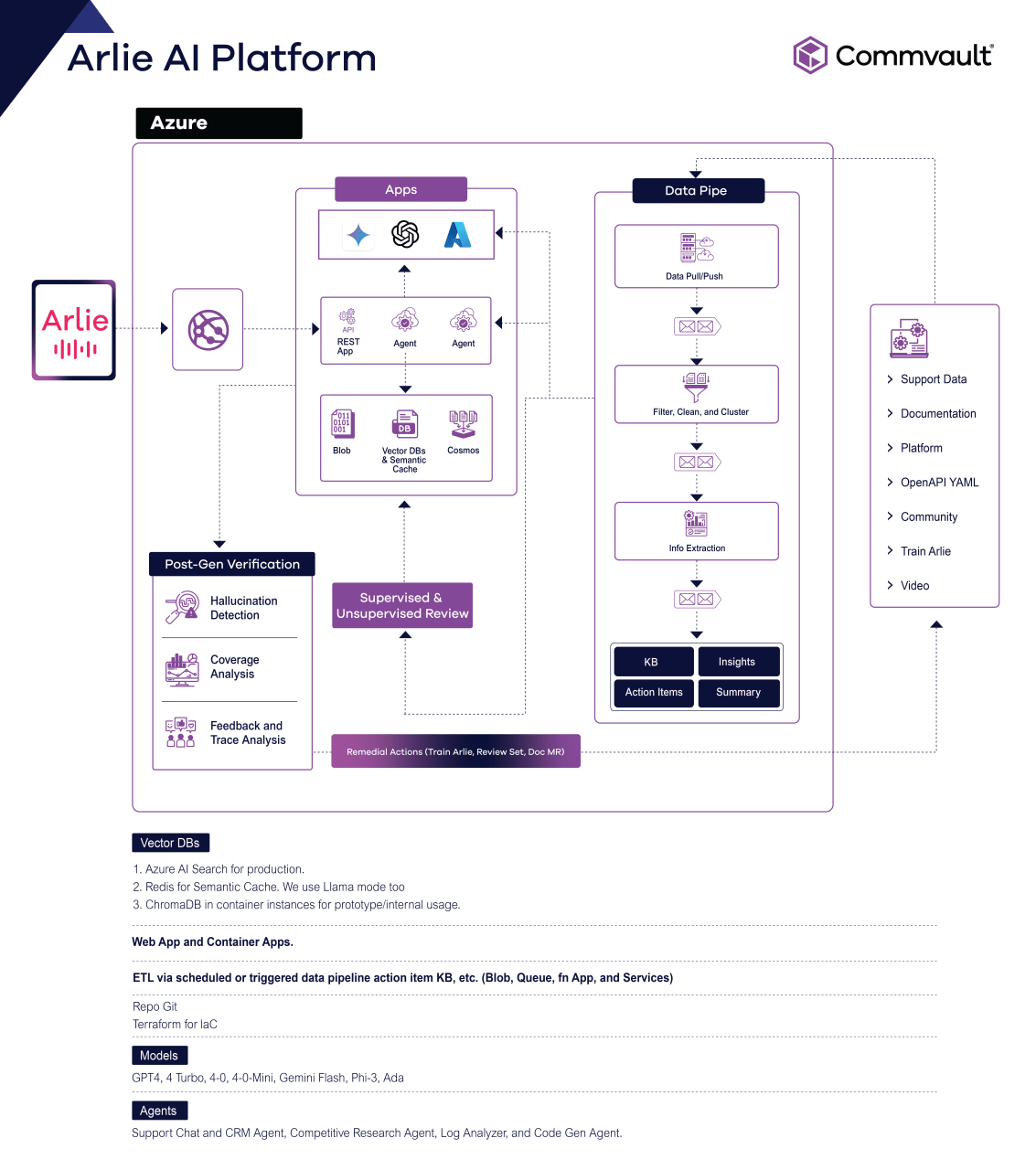
Let’s take a closer look at how Arlie tackles AI challenges that other tools can’t.
IA que se adapta facilmente às necessidades das empresas
AI solutions often promise efficiency, but they struggle with enterprise-scale workloads. Here’s why:
- Exigentes em termos de computação, lentos e onerosos. Muitos modelos de IA exigem recursos enormes, o que os torna impraticáveis para grandes ambientes de TI.
- O desempenho diminui sob cargas reais. Ferramentas de IA que funcionam bem em demonstrações muitas vezes falham quando implantadas em milhares de sistemas.
- Rigid architectures. AI solutions with fixed infrastructure can’t adapt to fluctuating IT demands, leading to bottlenecks.
O Arlie é capaz de lidar com grandes volumes de trabalho de forma eficiente, sem comprometer o desempenho nem os orçamentos. Ele possui:
- Lightweight AI processing . Arlie optimizes compute usage, running AI models efficiently without excessive power consumption.
- Equilíbrio adaptativo da carga de trabalho. A IA aumenta ou reduz dinamicamente a capacidade com base na demanda em tempo real, evitando lentidão.
- Implantação em diversos ambientes. O Arlie pode ser executado na nuvem, no local ou em ambientes isolados, o que o torna adaptável a qualquer infraestrutura de TI.
- Integração com prioridade na API. Integra-se perfeitamente aos fluxos de trabalho existentes, permitindo que as empresas expandam o uso da IA por milhares de sistemas sem a necessidade de reengenharia.
- BYO language model and vector index. Whether you’re using OpenAI, Gemini, Llama, or bringing your own LLM and vector store, Arlie adapts. Bring your own vector DB (Qdrant, Azure AI Search, or Cosmos DB).
IA que minimiza as alucinações
Uma das maiores barreiras à confiança na IA é a “alucinação”, que ocorre quando os modelos geram, com convicção, respostas imprecisas ou enganosas. Entre os problemas estão:
- Chatbots guess instead of knowing. Without verified context, AI tools often “fill in the blanks,” creating risk instead of clarity.
- Static LLM outputs lack accountability. There’s no built-in way to cross-check if an answer is right.
- A desinformação atrasa o trabalho das equipes de TI. Em vez de resolver problemas, as equipes perdem tempo verificando a precisão dos resultados gerados pela IA.
Arlie is built on a retrieval-augmented generation framework – meaning it retrieves answers from trusted, enterprise-verified sources before responding. The benefits of this approach include:
- Contextual retrieval over generation. Arlie pulls from known documentation, logs, and past incident records – not just an LLM’s language prediction.
- Semantic vector search. It understands user intent and maps it to relevant data – not just keywords.
- Rastreamento de alucinações em tempo real. Se o nível de confiança for baixo ou forem detectadas lacunas na cobertura, a resposta é sinalizada, reavaliada ou retida.
- Validação contínua. Os engenheiros analisam as respostas sinalizadas e incorporam um feedback estruturado ao modelo para seu aprimoramento contínuo.
IA que minimiza os riscos relacionados aos dados desde a concepção
AI models aren’t always built with security in mind. In fact, they may even treat enterprise data like test data – with little regard for compliance, isolation, or access controls. Some issues include:
- LLMs treinados com dados confidenciais. Algumas ferramentas de IA retêm ou reutilizam inadvertidamente informações fornecidas pelos clientes, criando enormes riscos à segurança.
- Opaque data flows. Enterprises can’t always tell where their data is going or how it’s being processed.
- Poor fit for regulated industries. Most AI assistants aren’t equipped for air-gapped environments, compliance audits, or strict data governance.
Arlie is engineered for security, with controls that match the needs of the most regulated industries – from finance to government. Arlie has:
- Dados dos clientes protegidos. Customer data is never used to train AI models. Only metadata and structured query logs are analyzed – never content.
- Ambientes de IA em sandbox. O Arlie é executado em uma estrutura isolada e segura que ajuda a reduzir o vazamento de dados entre locatários.
- Multi-environment deployment. Supports cloud, on-prem, and air-gapped installations, so that AI capabilities don’t compromise control.
- Automação alinhada às políticas. O Arlie detecta padrões de acesso não autorizado e ajuda a aplicar políticas de segurança e conformidade automaticamente.
IA que aprende e evolui
AI isn’t static. Your systems evolve, your threats change, your workflows shift. But most AI tools don’t. Once deployed, they plateau. That approach has drawbacks, such as:
- No learning from real-world use. Many assistants don’t refine outputs over time, repeating the same inaccuracies.
- Blind to feedback. If a user flags an error, it doesn’t necessarily feed back into the system for improvement.
- Can’t adjust to changing infrastructure. AI that isn’t tuned continuously becomes outdated fast – especially in dynamic enterprise environments.
O Arlie foi desenvolvido com ciclos contínuos de aprendizado, o que lhe permite aprimorar-se a cada interação. As vantagens dessa abordagem são:
- Aprendizado supervisionado e não supervisionado. As respostas sinalizadas são revisadas manualmente por engenheiros, enquanto os modelos de detecção de anomalias monitoram os resultados com baixo nível de confiança.
- Ajuste adaptativo. O Arlie ajusta as ponderações da busca semântica, os limites de pontuação e os algoritmos de classificação com base no que funciona na prática.
- Aperfeiçoamento por meio do uso. Cada registro que ele analisa e cada fluxo de trabalho que ele suporta ajudam a tornar os resultados futuros mais inteligentes e mais rápidos.
- Evita que falhas se repitam. O Arlie identifica padrões recorrentes de erros e ajusta suas recomendações para resolvê-los mais rapidamente na próxima vez.
Não é só IA. É IA que funciona.
AI in IT can’t afford to be experimental. It needs to be scalable, secure, accurate, and adaptive – ready to perform under pressure and evolve with complexity. That’s exactly what Arlie delivers.
Instead of guessing, it verifies. Instead of overloading systems, it optimizes them. Instead of creating noise, it cuts through it. Deeply embedded across your IT environment – from workloads to workflows – Arlie is more than an assistant. It’s part of your infrastructure.