¿Alguna vez has jugado al Jenga?
It starts with a small wobble – a backup job running slower than usual, a security flag dismissed, a compliance box left unchecked. Each shift, seemingly insignificant, feels minor on its own. But over time, the structure weakens. Then, with one wrong move, everything tilts. Maybe you catch it in time. Maybe you don’t.
A veces, gestionar la infraestructura informática puede parecer un juego de Jenga. Se forman pequeñas grietas bajo las capas de complejidad, que a menudo pasan desapercibidas hasta que se convierten en fallos graves. Pero, ¿y si tu sistema pudiera detectar esos cambios antes de que se convirtieran en un problema? ¿Y si, en lugar de tener que apresurarte a reparar las grietas, tu sistema informático se mantuviera estable por sí mismo?
That’s precisely where Commvault’s Arlie comes in. Short for “Autonomous Resilience,” Arlie is designed to deliver actionable insights, helping you save time, resolve threats, and tackle complexities. With your 24/7 AI-powered assistant, you can keep everything stable, secure, and running smoothly before issues escalate.
Cómo utiliza Commvault la inteligencia artificial para mejorar la experiencia del usuario
AI has promised to revolutionize IT: faster troubleshooting, smarter automation, stronger defenses. But in reality, AI solutions can often hallucinate, be difficult to scale, cause data security concerns, and fail to adapt. What IT teams need isn’t more AI; they need AI that fits their world – accurate, scalable, secure, and smart enough to evolve.
Arlie isn’t a mere bolt-on chatbot or a pilot tool. It is designed to think, adapt, and automate IT operations with enterprise-grade precision. Arlie is natively embedded in Commvault Cloud, secure by design, and available where teams already work – through the console, chatbot, or API workflows. It scales across cloud, on-prem, hybrid, and air-gapped environments without disrupting existing architecture. That means real-time insights, smarter workflows, and fewer errors.
What’s more, being ubiquitous, Arlie provides system-wide visibility, giving you answers to your most critical questions. For example, it can help with tasks such as creating reports and providing a real-time daily digest of the things that matter most. If you’re having issues with your critical virtual machines, Arlie can provide reports showing failed backups on critical VMs along with specific reasons, explanations, and possible solutions.
Not only is Arlie your new favorite colleague, capable of executing tedious organizational tasks effortlessly, but it’s also simple to understand and easy to use. It’s readily available to Commvault Cloud software customers at the click of a button.
Cómo piensa Arlie: el cerebro que hay detrás del asistente
Behind every smooth interaction with Arlie is a carefully built architecture – one designed to be accurate, secure, and reliable in the high-stakes world of IT.
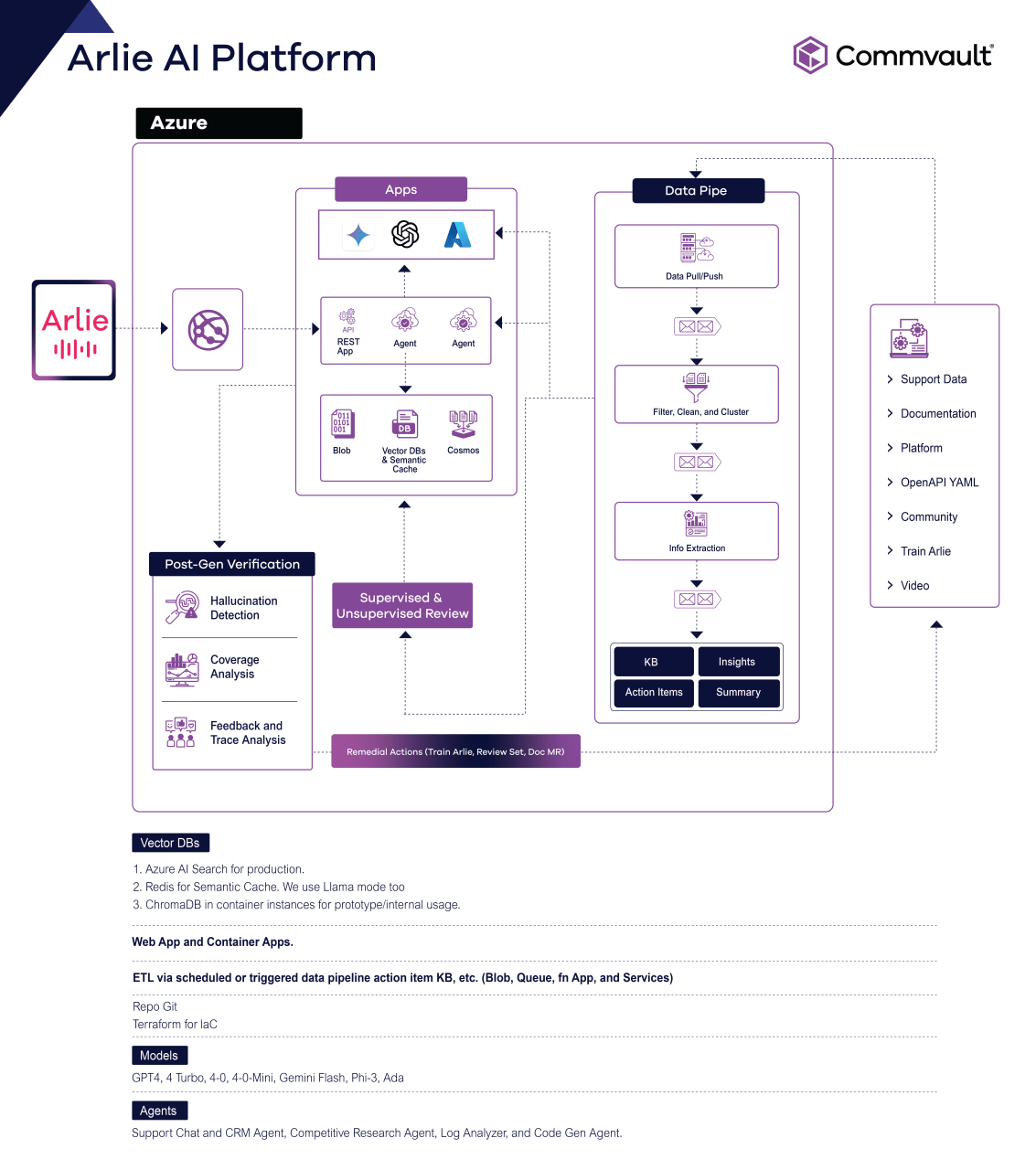
Let’s take a closer look at how Arlie tackles AI challenges that other tools can’t.
Una IA que se adapta sin esfuerzo a las necesidades de las empresas
AI solutions often promise efficiency, but they struggle with enterprise-scale workloads. Here’s why:
- Compute-heavy, slow, and costly. Many AI models require massive resources, making them impractical for large IT environments.
- Performance degrades under real-world loads. AI tools that work well in demos often fail when scaled across thousands of systems.
- Rigid architectures. AI solutions with fixed infrastructure can’t adapt to fluctuating IT demands, leading to bottlenecks.
Arlie es capaz de gestionar de forma eficiente grandes volúmenes de trabajo sin que ello afecte al rendimiento ni a los presupuestos. Cuenta con:
- Lightweight AI processing . Arlie optimizes compute usage, running AI models efficiently without excessive power consumption.
- Adaptive workload balancing. AI dynamically scales up or down based on real-time demand, preventing slowdowns.
- Multi-environment deployment. Arlie runs in the cloud, on-prem, or in air-gapped environments, making it adaptable for any IT infrastructure.
- API-first integration. Seamlessly embeds into existing workflows, allowing enterprises to scale AI across thousands of systems without re-engineering.
- BYO language model and vector index. Whether you’re using OpenAI, Gemini, Llama, or bringing your own LLM and vector store, Arlie adapts. Bring your own vector DB (Qdrant, Azure AI Search, or Cosmos DB).
IA que minimiza las alucinaciones
Una de las mayores barreras para la confianza en la IA es la «alucinación», que se produce cuando los modelos generan con total seguridad respuestas inexactas o engañosas. Entre los problemas se incluyen:
- Chatbots guess instead of knowing. Without verified context, AI tools often “fill in the blanks,” creating risk instead of clarity.
- Static LLM outputs lack accountability. There’s no built-in way to cross-check if an answer is right.
- Misinformation slows down IT teams. Instead of solving problems, teams waste time validating AI output.
Arlie is built on a retrieval-augmented generation framework – meaning it retrieves answers from trusted, enterprise-verified sources before responding. The benefits of this approach include:
- Contextual retrieval over generation. Arlie pulls from known documentation, logs, and past incident records – not just an LLM’s language prediction.
- Semantic vector search. It understands user intent and maps it to relevant data – not just keywords.
- Real-time hallucination tracking. If confidence is low or coverage gaps are found, the response is flagged, re-evaluated, or withheld.
- Continuous validation. Engineers review flagged responses, feeding structured feedback back into the model for ongoing refinement.
IA que minimiza el riesgo relacionado con los datos desde su diseño
AI models aren’t always built with security in mind. In fact, they may even treat enterprise data like test data – with little regard for compliance, isolation, or access controls. Some issues include:
- LLMs trained on sensitive data. Some AI tools inadvertently retain or reuse customer inputs, creating massive security liabilities.
- Opaque data flows. Enterprises can’t always tell where their data is going or how it’s being processed.
- Poor fit for regulated industries. Most AI assistants aren’t equipped for air-gapped environments, compliance audits, or strict data governance.
Arlie is engineered for security, with controls that match the needs of the most regulated industries – from finance to government. Arlie has:
- Customer data safeguarded. Customer data is never used to train AI models. Only metadata and structured query logs are analyzed – never content.
- Sandboxed AI environments. Arlie runs in an isolated, secure framework that helps reduce data spillage across tenants.
- Multi-environment deployment. Supports cloud, on-prem, and air-gapped installations, so that AI capabilities don’t compromise control.
- Policy-aligned automation. Arlie, detects unauthorized access patterns, and helps enforce security and compliance policies automatically.
IA que aprende y evoluciona
AI isn’t static. Your systems evolve, your threats change, your workflows shift. But most AI tools don’t. Once deployed, they plateau. That approach has drawbacks, such as:
- No learning from real-world use. Many assistants don’t refine outputs over time, repeating the same inaccuracies.
- Blind to feedback. If a user flags an error, it doesn’t necessarily feed back into the system for improvement.
- Can’t adjust to changing infrastructure. AI that isn’t tuned continuously becomes outdated fast – especially in dynamic enterprise environments.
Arlie está diseñado con ciclos de aprendizaje continuos, lo que le permite mejorar con cada interacción. Las ventajas de este enfoque son:
- Supervised and unsupervised learning. Flagged responses are manually reviewed by engineers while anomaly detection models track low-confidence outputs.
- Adaptive tuning. Arlie adjusts semantic search weightings, threshold scores, and ranking algorithms based on what works in the field.
- Refinement through usage. Every log it analyzes and every workflow it supports helps make future outputs smarter and faster.
- Prevents repeat failures. Arlie identifies recurring error patterns and tunes its recommendations to resolve them earlier next time.
No es solo IA. Es IA que funciona.
AI in IT can’t afford to be experimental. It needs to be scalable, secure, accurate, and adaptive – ready to perform under pressure and evolve with complexity. That’s exactly what Arlie delivers.
Instead of guessing, it verifies. Instead of overloading systems, it optimizes them. Instead of creating noise, it cuts through it. Deeply embedded across your IT environment – from workloads to workflows – Arlie is more than an assistant. It’s part of your infrastructure.