With ransomware and other cyber threats being headline news around the globe, Commvault Feature Release 11.26 includes numerous security enhancements to our best-in-class Intelligent Data Management Platform that help to harden infrastructure against attack and enhance recoverability. And since multi-cloud is the name of the game, we’ve made it easier to take full advantage of the major cloud providers for the utmost in flexibility and cost-efficiency. Generally available on Feb 15, 2022, here’s a partial list of new features that that make good on our ongoing commitment to providing a future-proof platform for protecting, managing, and recovering your data and workloads.
Data Protection is all about protecting your data and workloads and helping to ensure rapid recoverability… whether it’s on-prem, in hybrid environments, in the cloud, and even across multiple clouds. Enhancements include:
- Die umfassende Nutzung von Cloud-nativen APIs wie „Direct Write“ von Amazon Elastic Block Store (EBS) und inkrementellen Snapshots mit „Changed Block Tracking“ (CBT) von Azure Stack trägt dazu bei, die Leistung zu steigern und die Abhängigkeit von Cloud-Zugriffsknoten zu verringern.
- Extending Commvault® Disaster Recovery orchestration to include Object Storage and Big Data File Systems like Hadoop
- Schutz und Erhalt der Metadaten-Tagging-Informationen von Workloads in der Cloud, um die Konvertierung und Migration zwischen Microsoft Azure und Amazon Web Services (AWS) zu vereinfachen
Bei der Datensicherheit geht es darum, Ihre Abwehrmaßnahmen zu stärken, um Ransomware-Angriffe und andere Datenverletzungen zu erkennen, zu verhindern und die Folgen zu beheben. Zu den Verbesserungen gehören:
- Der Einsatz hardwarebasierter Sicherheitstoken, wie sie beispielsweise von YubiKey und dem US-Verteidigungsministerium angeboten werden, in Verbindung mit der Unterstützung von Common-Access-Karten trägt dazu bei, Ihre Sicherheitslage zu stärken.
- Nutzung hochsicherer Cloud-Authentifizierungsmethoden, darunter das AWS Key Management System (KMS) und Azure Key Vault
Data Compliance & Governance is all about providing new tools manage data access and enable compliance with a continually-evolving regulatory landscape. Enhancements include:
- Ermöglichung der Nutzung externer Klassifikatoren wie Azure Form Recognizer zur Vereinfachung der Datenverwaltung
- Driving operational efficiency by migrating and leveraging existing indexes across Data Governance and eDiscovery solutions
Die Datentransformation ermöglicht die nahtlose Übertragung von Daten zwischen unterschiedlichen Umgebungen im Rahmen der Anwendungsmodernisierung sowie die Einführung neuer Workloads und Prozesse. Zu den Verbesserungen gehören:
- Beschleunigung der regionenübergreifenden Disaster Recovery in der AWS-Cloud durch den Einsatz der Amazon EBS-Direktschreib-APIs
- Allowing Service Providers to easily deliver Commvault® Disaster Recovery as a Service (DRaaS) to their clients
Data Insights nutzt künstliche Intelligenz (KI) und maschinelles Lernen (ML) für Ihre Daten, um Kosteneinsparungen und betriebliche Effizienzsteigerungen zu erzielen. Zu den Verbesserungen gehören:
- An upgraded entity extraction engine reduces memory requirements and increases performance of eDiscovery and compliance operations
- Nutzung von ML-gestützten Datenerkenntnissen im Rahmen der Daten-Governance zur Berechnung von Risikobewertungen für sensible Daten und zur Identifizierung von Anomalien im Nutzerverhalten
Here’s a deeper drill-down on some additional features of note:
Datenschutz
- Disaster Recovery for Amazon EC2 Using EBS Direct APIs. Commvault® Disaster Recovery now leverages Amazon Elastic Block Store (EBS) direct APIs when performing Amazon EC2 instance replications. This eliminates the need to create and attach volumes to a cloud access node in the destination region. Periodic replication powered by EBS direct APIs allows for full-instance Amazon EC2 restores and Attach Volume restores both within the same region and across multiple regions, optimizing throughput speeds for greater efficiency.
- MetroCluster Solution and Replication for the Dell EMC TimeFinder SnapVX (SYMCLI) Snapshot Engine. Dell EMC’s SnapVX provides the ability to manage consistent point-in-time copies for Storage Groups with a single operation. You can now create TimeFinder SnapVX snapshots on PowerMax/VMAX3/VMAX arrays in standalone, metro cluster, and replication configurations using the TimeFinder SnapVX (SYMCLI) engine.
- Neustart von NDMP-Multi-Stream-Sicherungen auf Isilon-Dateiservern. Wenn Multi-Stream-Sicherungen auf Dell EMC Isilon/PowerScale OneFS-Dateiservern fehlschlagen, kann die Commvault-Software diese Multi-Stream-Sicherungen zügig abschließen. Während des ersten Sicherungsauftrags erstellt die OneFS-Software Checkpoints, die Commvault nutzt, um die fehlgeschlagene Sicherung automatisch neu zu starten.
Data Security
- Utilizing a Security Key for Two-Factor Passwordless Authentication. Users can now use FIDO2-compliant (Fast Identity Online 2-factor authentication protocol) hardware security keys (such as Yubico’s YubiKey) as a multifactor authentication method for logging on to local networks and to Active Directory. Fast Identity Online 2-Factor (FIDO2) Authentication enables a user to log-on without having to enter a password. Once two-factor authentication has been enabled in Commvault, users can use the PIN-generation tool or they can set-up their hardware security key as their primary multifactor authentication method. If Security Assertion Markup Language (SAML) has been configured through the authentication provider, you can also use YubiKey for SAML-based logons.
- Common Access Card (CAC) Authentication. CAC authentication is now supported for logging onto both the Commvault Command Center™ and the Java Console. CAC authentication complies with U.S. Department of Defense security guidance, and users can now use their card for a passwordless authentication experience.
Data Transformation
- Die Katalogisierung von Snapshots auf einem NetApp-Speicherarray erfolgt mithilfe von SnapDiff v3. Bei NetApp-Speicherarrays mit der ONTAP-Enterprise-Datenverwaltungssoftware (ab Version 9.8) wird SnapDiff v3 zur Katalogisierung von Snapshots verwendet. SnapDiff ist eine interne ONTAP-Engine, die schnell die Unterschiede bei Dateien und Verzeichnissen zwischen zwei Snapshot-Kopien ermittelt, um die Snapshot-Verwaltung zu optimieren.
- Deploying a VMware Access Node or FREL for Linux. You can now deploy a VMware Linux Access Node or a VMware File Recovery Enabler (FREL) directly from within the Commvault Command Center™. You can add a VMware Linux Access Node to a hypervisor and use it for both backup and restore operations. When you initiate the deployment of a FREL, the Commvault software uses its Open Virtual Appliance (OVA) template to create a VM that contains the FREL. You can then use the FREL to browse Virtual Machine (VM) data from a backup of a source Linux VM. This simplifies backup and restore operations.
- Using Oracle Linux as a VMware Access Node or FREL for Linux. You can now use an Oracle Linux 8 machine to create a VMware Access Node or FREL directly from within the Commvault Command Center™. This simplifies backup and restore operations.
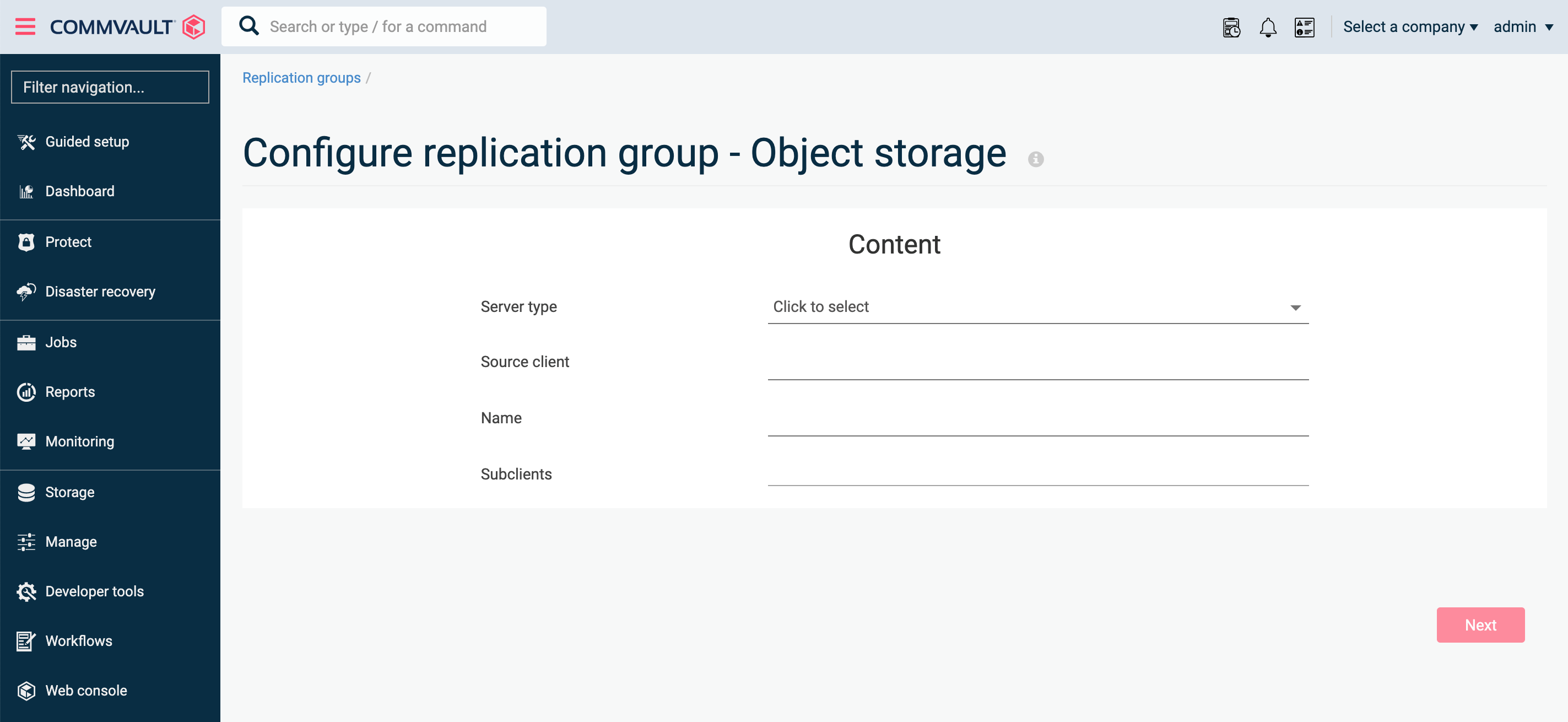
- Neues Konfigurationstool für Objektspeicher und Big-Data-Replikation. Sie können nun die Replikation für Objektspeicher und Big-Data-Zielstandorte mithilfe eines Tools konfigurieren, das den gesamten Prozess vereinfacht und optimiert. Das Konfigurationstool führt Sie durch die Einrichtung von Quell- und Zielstandorten für die Notfallwiederherstellung (DR) und unterstützt Sie bei der Verwaltung von Speicher, Netzwerkeinstellungen, Datentransport und sekundären Kopien.
Dateneinblicke
- Adding Data Sources in Bulk for File Storage Optimization. You can now add file server data sources in bulk for data analysis using File Storage Optimization. You can specify and add data sources individually from within the Commvault Command Center™, or by specifying and adding data sources in bulk via a CSV file.
- Verbessertes Ressourcenmanagement bei der Analyse sensibler Daten in Microsoft Exchange. Sie können nun denselben Indexserver verwenden, wenn Sie Exchange-Datenquellen sowohl im Rahmen von „Sensitive Data Governance“ als auch während eines Sicherungsvorgangs indizieren. Die Wiederverwendung des Indexservers senkt die Hardwarekosten und steigert die betriebliche Effizienz.
As Commvault celebrates more than 25 years of data management success and innovation in helping businesses of all size protect and manage their data, our regular cadence of Feature Releases demonstrates our commitment to innovation. This innovation is what enables our customers to meet their ever-changing data protection and recovery needs through the continuous evolution of our Intelligent Data Management Platform – a suite of tools that help organizations manage enterprise data and accelerate business growth. These ongoing enhancements provide a powerful incentive for customers to keep their Commvault deployments up-to-date.