Capturing and monitoring events into logs helps you in several ways, including but not limited to:
Detecting breaches: Just like your security camera helps capture any unknown person entering your home, audit logs help detect login events that seem suspicious. If your administrator is logging in at 3am from Russia, you know something is off.
Demonstrating compliance: Sometimes, even if the instructions say to not allow your kids to watch TV, your nanny still allows them to do so! Your security cameras help to validate whether your nanny is compliant with the instructions or not. Similarly, if your business requires your assets to be backed up at a certain frequency, audit logs keep a record of it so if audited, you can demonstrate compliance.
Integrating with SIEM (Security Incident and Event Management) solutions: In today’s IoT (Internet of Things) world, mutual interaction happens between security cameras, smart lock, motion sensors, smart lights etc. All of these coordinate amongst themselves using Apple HomeKit or Google Assistant. Similarly, you also want audit logs to flow into a centralized SIEM solution. This helps organizations get all the necessary logs in one place and build workflows from it.
Valuable insights: Footage from your security cameras tells you which neighbor knocks your garbage bins down or when birds come to drink water from your fountain. Similarly analyzing audit logs can provide insight into which assets behave nicely and which assets have challenges while being backed up.
After talking to many customers, we realized that the majority of issues they face stems from hardware centric solutions such as backup servers and appliances that have limited resources in terms of CPU, memory, and disk. Also, the user experience is not optimized for today’s cloud centric world and customers are forced to build and run complex scripts. To address these issues, we went back to the drawing board to build the right architecture. We wanted to ensure that we have:
Always On logging: Since some hardware/software vendors, by definition, have limited resources, they do not enable logs by default. Customers have to choose whether to enable logging. This is like having a security camera that is not turned on because the vendor wants to save your energy bill. Clumio, being an authentic SaaS solution, has access to nearly infinite resources and turns on audit logs for all of its customers at no additional costs.
Capture in-depth information: Even if your backup vendor offers logging, sometimes the logs which do not capture all the important details. When these logs are analyzed by someone in your SOC (Security Operations Center) team, they require as much detail as possible. The Clumio SaaS, by default, logs all the relevant information to ensure that security investigations don’t get stalled due to lack of detail. With Clumio, you always get 4K UHD, whereas your backup vendor may recommend you choose a lower resolution to accommodate their shortcomings.
Do not miss events: With hardware/software based solutions, resources like memory and disk are limited. When an appliance is performing some operation (like a backup) and concurrently wants to write to an audit log in a low memory situation, guess what operation it’ll perform and what it’ll drop? This challenge is not present in Clumio’s world due to our capability to consume resources on-demand. We also architected our service correctly to ensure that logs are captured before and after any events happen. Clumio can record every single day for 24x7x365 independent of weather conditions, but competitors may not have video for days with snowfall.
Scale elastically: Some customers have had to make a difficult decision of extracting logs every week because of the limited capacity of the appliance. When they expand their data protection coverage to include a new asset, suddenly they find they only have capacity to hold the logs for 4 days. These challenges are common in the appliance world but in Clumio’s SaaS world, there are no resource constraints. We can tap into our infinite disk resources to capture as many audit events that our customers can generate. The issue of limited storage is also very common with security cameras but with Clumio, you get the equivalent of unlimited video storage in the cloud, and you can access it at any place or time.
Help find that needle in a haystack: Clumio supports granular filtering capabilities so customers can find the exact information they seek. This is similar to finding the exact frame in the security camera footage that has the thief’s face clearly captured.
Clumio has been investing in its audit logging capabilities by architecting an audit log solution to meet and exceed customer expectations. With increased adoption of cloud and SaaS services, many customers are moving towards SIEM in the cloud. Logs can stream directly from Clumio to your cloud. In this world, even if your network gets compromised, attackers will still not have access to your logs.
More related posts
Architect for Tomorrow: Unified Data Protection as the Foundation for Resilience
Some say that the best things in life are free, but when it comes to data protection in the cloud, free might only get you part of what you need and cost more in the long run. At the end of the day, it is good to have options and review the pros and cons of any data protection solution in the public cloud to ensure you are getting what you need at the lowest cost.
I am sure that many people thought to themselves, “what is Clumio doing providing free snapshot management capabilities since snapshots are not backups?” You are correct, snapshots are not backups, but they do have their place in the public cloud.
Snapshots are an awesome operational recovery mechanism for applications that need point-in-time recovery in AWS.Operational recovery might be the only requirement if you are an early cloud adopter, or for most, it can be part of a broader holistic data protection solution that requires backup of data with longer than 14 – 30 days of retention for compliance requirements.
We are providing this snapshot management capability for free to our customers, versus charging for it like many of our friends in the industry. It is only part of a complete data protection solution in the cloud. Although I think they should rename it to AWS Operational Recovery instead. 🙂
What are the pros and cons of snapshots in AWS and why are they not backups?
One of the major pros with snapshots is the ability to quickly restore from mistakes, accidental deletions, or data corruptions. On-premises snapshots are typically stored on the same array or application infrastructure as the core application to enable quick recovery. In AWS, snapshots are stored in the same AWS account as the production data. No matter where these snapshots reside, they are typically kept for relatively short-term durations as their value diminishes over time for operational recovery.
Beyond snapshots, backups are required to be held outside the production environment to ensure you have access to your data, even when the production infrastructure goes down or has major issues. Backups are also stellar at fine-grain recovery as they are indexed and cataloged for quick granular retrieval outside of production. Compliance backup goes even further, as it needs to be kept for legal or compliance needs, which need to be protected even when an entire site or account is compromised.
One of the major cons of snapshots is they fail miserably in both functionality and cost when used for backup and long-term compliance. For example, let’s say you have a new application you developed or moved from on-premises that has a requirement for 30 daily backups and 12 monthly backups for long-term retention. Snapshots are stored on the same account as the production data, so if you fat-finger a script, delete the wrong thing, or a bad actor gets access to your account, you lose the backup and potentially the data. This is obviously bad.
To avoid this vulnerability, you could always replicate these snapshots to another AWS account for safekeeping, but then you get hit with transfer costs, twice the snapshot bill, and if you are using PaaS services such as RDS you will be required to keep full copies versus chains of snapshots. Since none of the data is indexed or cataloged, now you have to restore the entire thing and find the data yourself. Getting the data back is painful as well, but the costs alone in this scenario makes snapshots unusable.
Why use Clumio’s Free Tier for Operational Recovery instead of AWS Backup or snapshot managers?
Clumio’s backup as a service for native AWS services provides a holistic data protection solution well beyond snapshot management. As you proceed along your cloud journey, Clumio can provide a single data protection service to help with your enterprise needs. Maybe today you use snapshots for operational recovery in a testing and development environment. When the application goes into production, the requirements change and you need more protection, yet you don’t want and probably didn’t plan for massive costs with snapshots.
With Clumio, you can leverage our unique air gap protection, full indexing and catalog, and granular restores of files for EBS or granular record retrieval for RDS via direct query access to our data lake. The experience is stellar and can be turned on for any application requiring these features beyond snapshots. The best part is all of this may be delivered at up to 50% less cost compared to AWS snapshots.
What is the Clumio experience for snapshot management?
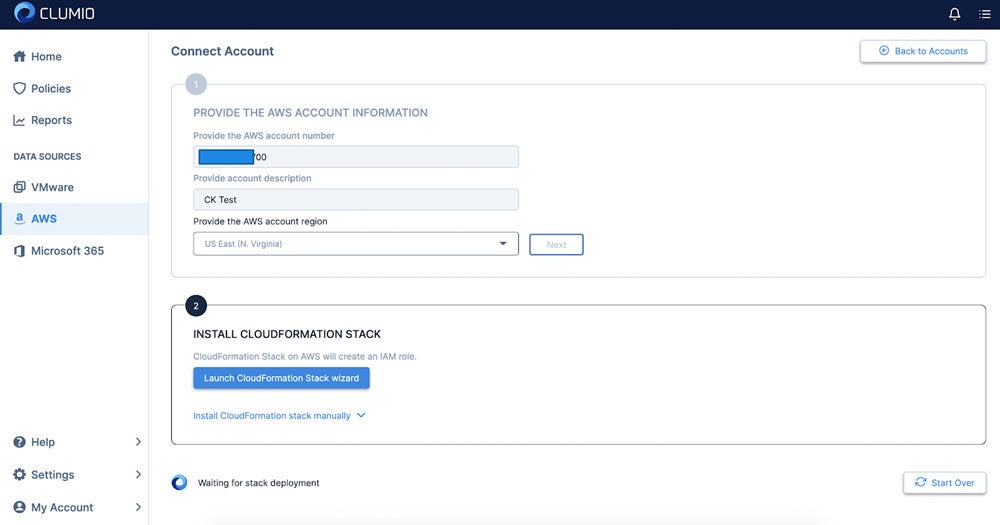
As with everything at Clumio, the experience is simple and getting up and running takes as few as 15 minutes. The first step is to create your login, which is as simple as inputting an email and password. Afterward, you input your AWS account information including AWS account number, account description (so you can remember), AWS region, and click next, then launch CloudFormation Stack wizard:
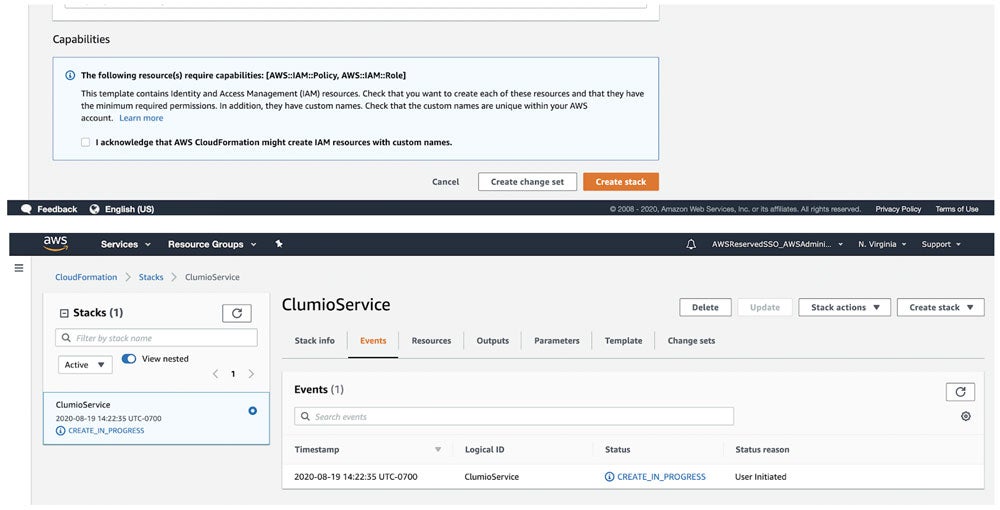
This will kick you over to AWS to create the stack. Click Create stack and wait about 3 – 5 minutes to complete.
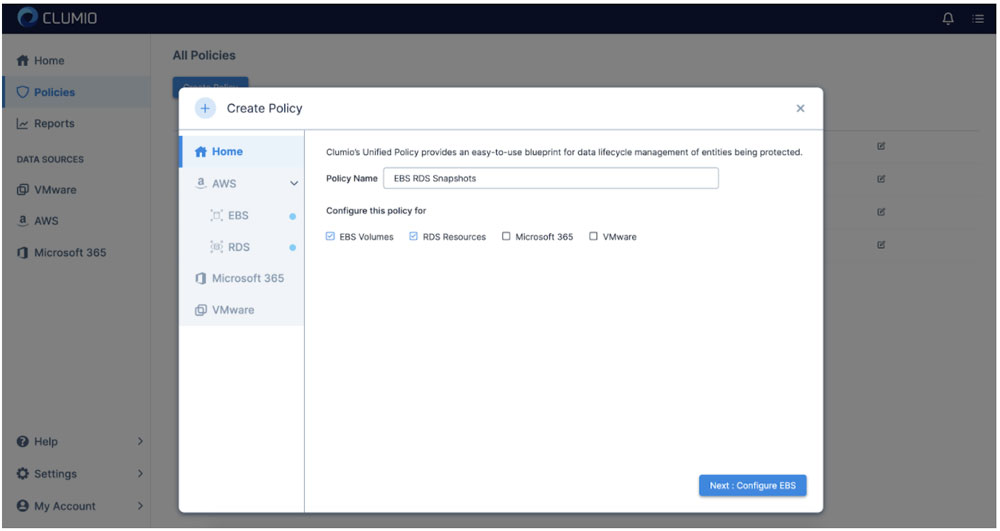
Once completed, your account will run through inventory services. You can run the same process on all our other accounts you want to protect as well. Once you are done, the next step is to create a unified policy across EBS and/or RDS.
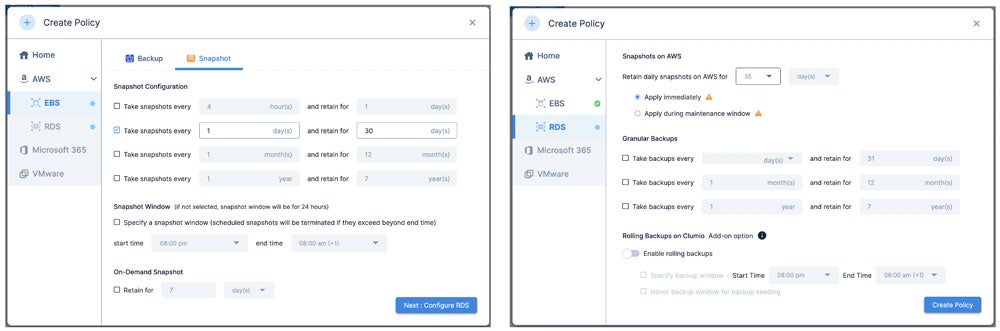
Define the policies for up to 30 days for EBS or up to 35 days for RDS:
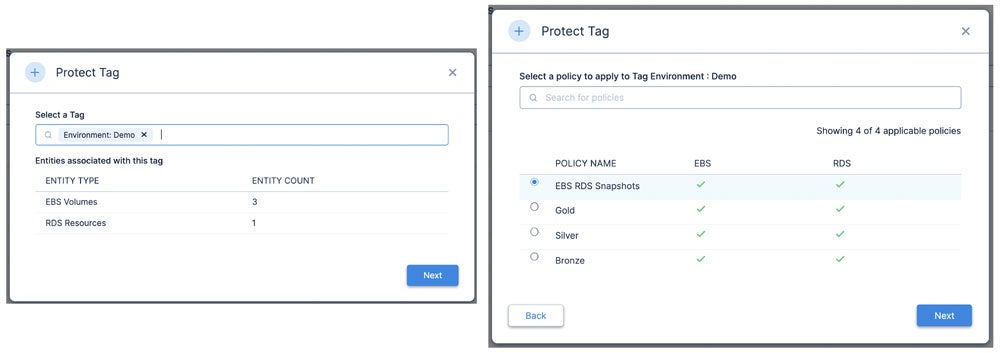
Clumio leverages existing tags for aligning policies, so the next step is to determine the tags you would like to protect with your new policy you just created. This allows you to tag specific resources to protect with this policy.
That is it! Now you are up and running with Clumio’s free tier for operational recovery for both EBS and RDS.
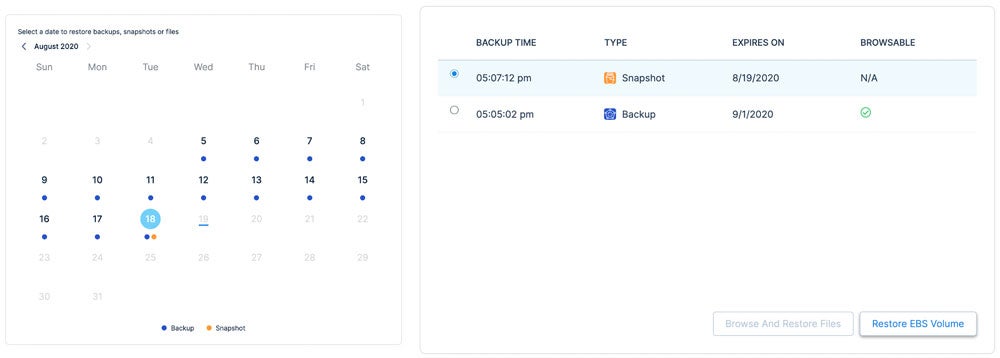
Now that we have operational recovery available for EBS and RDS, let’s review the restoration process for EBS. First, you pick the EBS volume you want to restore, then define the point in time you want to restore. In this case, I have backups (shown in blue dots) and snapshots (shown in orange dots). When you click on the date it will give you options for both.
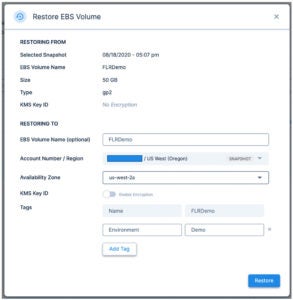
You can then restore the volume to any AZ available.
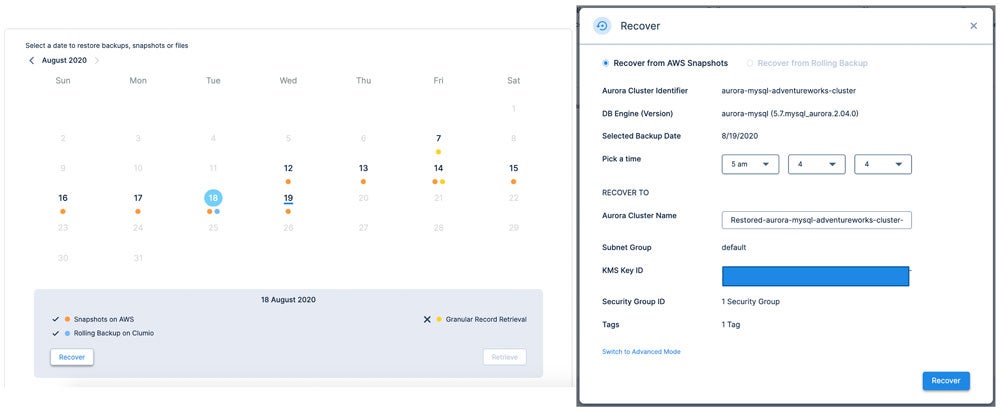
RDS is a similar experience, but slightly different as there are multiple options for the protection of RDS available including rolling backup (time-lagged RDS instance in Clumio) and granular record retrieval (long-term backup).
First you pick a restore date where there is a snapshot available (orange dot), click recover, then pick the point in time of which you want to recover the database, down to the second. In this case I am restoring to 5:04:04 AM.
As you can see in this quick overview, protecting AWS resources for operational recovery is incredibly easy! No matter if you are developing net-new applications, lifting and shifting legacy applications from your on-premises data center, or a cloud-optimized veteran with 100% of your applications running on the cloud, Clumio has a solution to help. For more information, check out our backup as a service for AWS.
Until next time, stay SaaSy my friends.
More related posts
Architect for Tomorrow: Unified Data Protection as the Foundation for Resilience
In 2007, ten years after the company was founded, Netflix was slinging rentals of Weekend at Bernie’s in red envelopes by mail. Anyone remember the last Netflix DVD that they failed to return? Not saying mine was Weekend at Bernie’s, but it very well could have been. In 2007, Netflix pivoted to streaming services. As early as 2011, they realized that their digital content suppliers would ultimately be their competitors and they shifted from a reliance on third-party content to becoming a producer of original content. In July of this year, Netflix broke HBO’s record for the most Emmy nominations.
Netflix started not with the end game of disrupting Blockbuster but with the full intention of streaming when network bandwidth and digital content was readily available. After all, their name from the get-go was Netflix, not DVDsDirect.com. In the early innings, they executed on short term goals and remained customer, not competition, focused. They also had the good fortune of a massive market category and a few tired, old competitors they could disrupt early on. Here at Clumio, there is a lot of neat stuff we aim to deliver. There is also a vast amount of low hanging fruit out there to harvest as well.
For those who have spent time in the data protection space and don’t know Clumio:
We’re relentlessly focused on simplifying data protection with a secure, air-gapped backup and recovery service for a world where customer data is increasingly distributed across clouds, SaaS and on-premises realms. We’re also here for a world where the bitcoin-seeking boogie man is just as much of a threat as a natural disaster.
We’re a company focused on customer delight. We belive in simplfying data protection. Clumio can be turned on in as few as 10 minutes and our customers can go focus on more important things to drive their businesses forward.
We’re a platform company with our eyes to the horizon. We seek to deliver value creation opportunities as a by-product of our data protection offering. Think analytics and ETL. Think multi-cloud data management and cloud arbitrage. Our follow-on acts are why this author joined and why smart people with backgrounds in search, security, analytics and cloud are steering the company, on our board or have voted for us with their wallets.
For the analysts and my friends and family members who might not know much about Clumio:
Clumio for VMware Protection = Weekend at Bernie’s mailed in a Red Netflix Envelope. Protecting on-premises assets is our “DVD in a red envelope” use case. It’s our “right now” interest simplifying and disrupting the private cloud data protection market, and it’s a massive market that’s ripe for disruption.
Clumio for Cloud Native Services and SaaS Protection = Streaming The Office on Netflix. This is an emerging market as organizations move to public cloud and SaaS and find that the native data protection services offered by traditional providers are purpose-built for the data center, short on functionality and super costly.
Clumio Data Platform = Netflix Studios. I’m going to venture a guess that Ozark helps drive far more consumers to the Netflix service than Weekend at Bernie’s. Over time you will see us evolve from being solely focused on data protection to opening up the platform to afford customers and their partners the opportunity to derive greater value than just operational recovery. The proof points and hints are already there if you look for them.
Thanks for putting up with this author’s incessant desire to trot out analogies. It’s just that signing up for and deploying a protection strategy with Clumio is about as uninvolved as signing up for Netflix. And just like the Netflix service, new content and goodness arrives while you sleep.
More related posts
Architect for Tomorrow: Unified Data Protection as the Foundation for Resilience
Downtime costs businesses thousands per minute, and traditional backup alone is not enough.This guide covers what cloud recovery is, why it matters, and how to build a strategy that keeps your data safe.
Cloud recovery is a fast-evolving discipline. Here are the most important points you should take away from this guide:
Cloud recovery combines data protection with rapid recovery to help reduce downtime and data loss.
Data breaches now cost organizations millions of dollars on average, making a cloud disaster recovery strategy more critical than ever.
Backup and disaster recovery serve different purposes – backup preserves copies of data, while disaster recovery focuses on restoring operations after a failure.
Best practices include defining recovery time objective (RTO) and recovery point objective (RPO) targets, following the 3-2-1 backup rule, tiering workloads by criticality, and testing recovery plans regularly.
Clumio by Commvault provides air-gapped, cloud-native backup and recovery for AWS workloads including Amazon S3, DynamoDB, and more.
Cloud recovery is the practice of replicating data to a cloud environment so your organization can restore operations quickly after a disruption. Whether you are dealing with a ransomware attack, a misconfigured deployment, or a region-wide outage, a strong cloud recovery strategy helps give you the ability to recover critical data and resume business operations without relying on legacy infrastructure.
The stakes are high. Cyberattacks are growing in frequency and sophistication. Hardware failures happen without warning. Human error – from accidental deletions to bad code pushes – remains one of the leading causes of data loss. And for organizations running production workloads in the cloud, the blast radius of any of these events can extend across applications, databases, and entire regions.
A cloud disaster recovery approach helps address these risks by storing backup copies of your data in isolated, off-site cloud environments and providing the tools to help restore that data rapidly. Unlike traditional on-premises backup, cloud-based solutions scale with your infrastructure and can be tested and validated without disrupting production systems.
In this guide, we break down what cloud recovery is, how it differs from traditional backup, and what best practices you should follow to help protect your organization.
What Is Cloud Recovery?
Cloud backup and disaster recovery are two related but distinct disciplines that work together to help protect your organization’s data and operations.
Cloud backup is the process of copying data – files, databases, application configurations, and system images – to a remote cloud environment. These copies serve as point-in-time snapshots that you can use to help restore data if the original is lost, corrupted, or compromised. Cloud backup removes the need for physical media like tape or on-site storage arrays and helps give you the flexibility to store data across multiple regions and accounts.
Disaster recoverygoes further. Disaster recovery is a strategy for restoring not just data, but the applications, infrastructure, and workflows your business depends on. A disaster recovery plan defines how quickly you need to be back online (your RTO) and how much data loss you can tolerate (your RPO).
When you combine cloud backup with disaster recovery, you get a cloud-based disaster recovery strategy – one that helps store protected copies of your data off-site and provide the automation and tooling needed to recover workloads at scale.
Why Cloud Recovery Matters
The cost of failing to protect your data has never been higher. Data breaches now cost organizations millions of dollars on average.
But breach costs are only part of the picture. Unplanned downtime disrupts revenue, erodes customer trust, and triggers regulatory scrutiny. For organizations in regulated industries like financial services, healthcare, and legal, the failure to recover data within defined timeframes can result in fines, litigation, and loss of operating licenses.
Ransomware has changed the calculus further. Attackers increasingly target backup infrastructure itself, encrypting or destroying recovery data before launching their primary attack. Without a cloud recovery strategy that includes isolated, immutable copies of your data, you risk losing both your production environment and your ability to recover from it.
Disaster recovery as a service (DRaaS) has emerged as one response to this challenge, helping give organizations the ability to replicate and fail over workloads to a cloud-hosted environment without managing their own disaster recovery infrastructure.
A well-designed cloud recovery plan helps reduce both the financial and operational impact of unplanned outages – and increasingly, it is a baseline expectation from auditors, regulators, and cyber insurance providers.
The bottom line:Ransomware recovery readiness is no longer optional. It is a business requirement.
Cloud Backup vs. Disaster Recovery:What’sthe Difference?
Many organizations confuse backup with disaster recovery, but a backup without a recovery plan leaves critical gaps in your response strategy. Understanding the distinction is essential for building a complete backup and disaster recovery plan. Let’s compare them.
Cloud Backup
Disaster Recovery
Purpose
Preserve copies of data at specific points in time.
Restore full operations – applications, infrastructure, and data – after a failure.
Restore individual files or datasets; speed varies by volume.
Designed to meet defined RTO targets – minutes to hours.
Key metric
RPO – how frequently data is backed up.
RTO – how quickly operations resume.
Cost model
Pay for storage and transfer.
Pay for replication, failover infrastructure, and orchestration.
Backup answers the question: “Can I make copies of my data?” Disaster recovery answers: “Can I get my business running again?” You need both.
A backup strategy without a disaster recovery plan means you may have your data but no way to restore the applications and infrastructure that depend on it. A disaster recovery plan without reliable backups means you may be able to fail over, but the data you recover could be incomplete, stale, or corrupted.
The strongest protection comes from combining cloud backup with a structured disaster recovery plan that defines RTO and RPO targets per workload and tests recovery procedures regularly.
Best Practices for Cloud Recovery
Building an effective cloud recovery strategy requires more than selecting a tool. It demands a structured approach to planning, architecture, and testing. The following best practices help you design a cloud disaster recovery solution that holds up under real-world conditions.
Follow the 3-2-1 backup rule. Maintain at least three copies of your data, stored on two different media types, with one copy off-site in the cloud. This foundational rule helps reduce the risk of a single point of failure wiping out all your recovery options.
Define RTO and RPO targets per workload. Not every workload has the same criticality. Your customer-facing production database may require a five-minute RPO and a 15-minute RTO, while a development environment may tolerate hours of downtime. Tier your workloads accordingly and allocate cloud backup solutions for business continuity based on these tiers.
Use air-gapped, immutable storage. Air-gapped vaults and immutable backups help prevent ransomware from encrypting or deleting your recovery data.
Test your recovery plan regularly.A backup you have never restored is a backup you cannot trust. Scheduleoperational recovery drills at least quarterly, validate that your RTO and RPO targets are achievable, and document the results.
Automate where possible.Manual backup and recovery processes introduce human error and delay. Cloud-native solutions can automate backup schedules, retention policies, and recovery workflows to help reduce the exposure window.
How Clumio by Commvault Helps Protect Your Cloud Data
Clumio by Commvault is built for organizations that run production workloads across AWS and Google Cloud and need cloud disaster recovery that delivers speed, reliability, and security at scale.
Clumio takes a cloud-native, serverless approach to backup and recovery. There is no infrastructure to deploy or manage—you connect your cloud environments, define your protection policies, and Clumio handles the rest. Backup data is stored in an immutable, air-gapped vault isolated from production, helping protect recovery data even if the primary environment is compromised.
Clumio supports cloud-native workloads including Amazon S3, DynamoDB, RDS and Aurora, EC2 and EBS, Apache Iceberg on AWS, Amazon Neptune, Amazon DocumentDB, and Google Cloud Storage. Recovery is granular, enabling restores at the object, prefix, bucket, partition, table, or workload level depending on the service. Clumio Backtrack enables in-place rollback for Amazon S3 and DynamoDB, while Instant Access lets you query S3 backup data without full rehydration.
For ransomware recovery, Clumio helps organizations restore clean recovery points with granular recovery workflows. Clumio also supports cross-account, cross-region, and cross-project recovery, providing flexibility to restore data into clean cloud environments when needed.
Common Use Cases for Cloud DR Solutions
A cloud disaster recovery solution is not a one-size-fits-all tool. The right approach depends on the failure scenarios you need to plan for and the workloads you need to protect. Here are the most common use cases for cloud disaster recovery.
Ransomware attack recovery. Ransomware attacks increasingly target backup infrastructure itself, making air-gapped cloud disaster recovery solutions a critical layer of defense. Having immutable, air-gapped backups stored outside your primary cloud account can help you restore clean data without paying a ransom.
Accidental data deletion. A single misapplied script or manual error can wipe out an entire S3 bucket or DynamoDB table. Granular cloud backup lets you recover specific objects, prefixes, or partitions without restoring an entire environment – getting your team back to work in minutes, not days.
Infrastructure or region failure. Cloud outages are rare but not impossible. Cross-region backup and recovery give you the ability to restore workloads in a different region if your primary region goes down, helping maintain business continuity.
Compliance and audit requirements. Regulatory frameworks in financial services, healthcare, and other industries require documented backup and recovery capabilities. Disaster recovery as a service can help satisfy audit requirements by providing automated, policy-driven backup with full reporting and retention controls.
Multi-region and hybrid cloud environments.Organizations operating across multiple regions or in hybrid cloud configurations need a unified cloud disaster recovery strategy that spans environments without creating management complexity.
Cloud backup is no longer a nice-to-have – it is a foundational requirement for any organization running workloads in the cloud. The threats are real, the costs of failure are measured in millions, and the regulatory bar continues to rise.
The good news is that modern cloud-native solutions help make it possible to protect your data, meet your recovery objectives, and stay resilient – without the complexity and overhead of legacy approaches. Whether you are defending against ransomware, recovering from human error, or satisfying an auditor, a well-designed cloud recovery strategy helps put you in control.
Frequently Asked Questions
What is cloud recovery?
Cloud recovery is a strategy that combines copying data to a remote cloud environment with the tools and processes needed to restore operations after a disruption.It helps protect against data loss from ransomware, hardware failure, accidental deletion, and other threats.
How do backup and disaster recovery differ?
Backup preserves copies of data at specific points in time.Disaster recovery is a broader strategy focused on restoring applications, infrastructure, and business operations. A complete backup and disaster recovery plan includes both disciplines working together.
What is DRaaS?
What are RTO and RPO?
RTO (recovery timeobjective) is the maximum acceptable downtime after a failure. RPO (recovery pointobjective) is the maximum acceptable data loss measured in time. Both should be defined per workload based on business criticality.
What are cloud backup best practices?
Follow the 3-2-1 rule, define RTO and RPO targets per workload, use air-gappedandimmutable storage, tier workloads by criticality, and test your recovery plan at least quarterly. These practices help build a resilient clouddisaster recoverysolution.
How does Clumio protect cloud data?
Clumioprovides cloud-native, air-gapped backup and recovery for AWSand Google Cloudworkloads.It helps reduce recovery time with granular restores and helps protect against ransomware with isolated vault architecture and AI-enhanced threat detection.
While the first few months of this
year brought unprecedented global change from the way we think to the way we
work, at Commvault we rallied together to adjust to the “new normal.” We remained
steadfast in our top priorities: keep our employees and communities safe,
continue to be there for our customers and remain unwavering in our innovation.
And while the way we engage with
our customers has changed, business did not stop. We brought many new users
into the Commvault family and expanded existing relationships, with use cases
spanning cloud,
cloud-native, multi-cloud and SaaS workloads. In the spirit of sharing some good
news, I’d like to take the opportunity to celebrate some of the new and
expanded customer use cases in our fiscal Q4.
Blue Cross and Blue Shield of Minnesota; NASA (see below); mobile service provider MTS; Shaanxi Coal Industry; CPA Global; Ministry of Finance of Poland; and cloud services provider, Chmury Krajowej, all embraced Commvault for their critical needs in Q4.
Kira Blackwell, Program Executive at NASA HQ within the Space Technology Mission Directorate Office, explains the value of data, well-managed data and the value of using Commvault.
Additionally, McDonald’s Corporation turned to
Commvault to address the growing trend of moving infrastructure to the cloud.
Here is what they had to say about how Commvault is helping them tackle that
initiative.
McDonald’s Corporation moves to the cloud
With an already-robust Commvault deployment in place, we’re now leveraging Commvault’s cloud capabilities to shed ownership of our technology infrastructure; instead, we’re investing heavily in the cloud to keep our IT operations running. The software solution from Commvault fills gaps in native cloud tools and has cut across every use case McDonald’s Cloud Services team requires, providing optimized and effective backups across databases. Commvault’s solution tunes performance across AWS and Microsoft Azure cloud servers and drives cost savings through deduplication and compression.
– Douglas Leonard, Director – Cloud Services, McDonald’s Corporation
I’d also like to highlight
customers who have shared their stories this quarter. These customers span
industries and use cases, leveraging Commvault to protect critical data both
on-premises and in the cloud, while ensuring compliance for document retention,
medical record privacy and more.
Parsons uses Commvault intelligent data management for workloads across AWS S3 Standard-IA and AWS S3 Glacier cloud storage locations, VMware and Hyper-V virtual machines, plus physical servers.
Cloud environments typically don’t have robust built-in data protection capabilities – and they can also be hard to protect without the right tools in place. Parsons Corporation manages its total on-premises recovery environment and AWS data protection with Commvault.
“We’ve moved off of tape backups to AWS, and now we have an initiative to move the whole environment to the cloud. Moving into the cloud has been really simple. With the Commvault solution, it’s just having the Command Center. Everything is simplistic.” –Benjamin Roper, Enterprise Backup and Recovery Specialist, Parsons Corporation
Delaware Department of Correction becomes data ready
“Data helps provide a story,” says Phil Winder, Director of Information Technology for the Delaware Department of Correction.
When every data point shapes a person’s life, the public
sector needs to be data ready. Streamlined data management is critical, from
disaster recovery with no data loss to quickly accessing data that affects a
person’s freedom.
“We went through a disaster recovery exercise and, in fact, we thought we had lost some data. We don’t have time to have data loss. With a quick call to Commvault support, the problem was identified. The organization was back up and operational within the hour — with no data loss.” – Phil Winder, Delaware Department of Correction
As someone who thrives on meeting with customers, I miss the in-person engagement we’ve had to put on hold in this current environment, but we’ve been getting creative in how we interact with our customers to keep the personal touch. It was great to see and hear from a few of our customers in recent videos. I encourage you to take a look at how customers like Cochlear, Penn State Health and Mitchell International (see videos below) are using Commvault to solve their most critical data challenges.
Consistency, reliability, daily VMware virtual machine backups and a worry-free environment? By consolidating backup products, Cochlear was able to streamline secure healthcare data protection and gain that worry-free environment.
Replacing IBM TSM with Commvault data protection gave Penn State Health more ability to manage large volumes of data, improved customer support and the reassurance that data could be easily recovered.
For Mitchell International, a technology provider for the auto and casualty insurance industry, Commvault software covers data protection for a growing IT environment and helps provide better customer service.
Commvault is the toast of the town
On top of customer victories, we’ve also been winning industry accolades! Check out our recent awards from CRN, Gartner, Storage Magazine and others:
Although this is a time when the industry – and the world – is definitely not conducting business as usual, we’re proud to be there for our customers. We’re customer centric all the time, and these customer use cases speak for themselves.
More related posts
Architect for Tomorrow: Unified Data Protection as the Foundation for Resilience
Cloud Data Compliance: What It Is and Why It Matters
Cloud data compliance enables your cloud-stored data to meet all applicable laws, regulations, and industry standards. Learn which frameworks apply and how to build a compliant cloud environment.
Cloud data compliance spans regulations, shared responsibility, and continuous monitoring. Here are the essential points.
Cloud data compliance is the practice of aligning your cloud operations with regulatory requirements, industry standards, and internal data governance policies.
Major frameworks including GDPR, HIPAA, PCI DSS, SOC 2, and FedRAMP each impose distinct obligations depending on your industry, geography, and data types.
The shared responsibility model means your cloud provider helps secure the infrastructure, but you are accountable for how you configure, access, and protect your data.
Best practices include data classification, least-privilege access, encryption, automated compliance monitoring, and regular risk assessments.
Continuous compliance requires automated tooling, defined audit cadences, and incident response plans that evolve alongside regulatory changes.
What Is Cloud Data Compliance?
Cloud data compliance is the discipline ofenablingdata stored, processed, and transmitted in cloud environmentsto meetall applicable laws, regulations, industry standards, and internal governance policies.It spans everything from how you collect and classify information to how you encrypt it in transit and at rest, control access, and respond to breaches. Why does cloud data compliance demand your attention right now? Because the cost of getting it wrong keeps climbing. Data breaches now carry multimillion-dollar price tags when you factor in technical remediation, regulatory fines, legal fees, and lasting reputational damage. If your organization handles customer data, financial records, health information, or government workloads in the cloud, data compliance is not optional. Regulations like GDPR and HIPAA carry enforcement teeth, and customers increasingly expect proof that you protect their information. Cloud compliance is also a competitive differentiator: organizations thatdemonstratestrong data governance win trust, close deals faster, and avoid the operational chaos of post-breach firefighting. Whether you are migrating your first workloads or managing a mature multi-cloud environment, understanding cloud data compliance is the foundation for building resilient, trustworthy cloud operations.
Key Compliance Frameworks and Standards
Navigating cloud data compliance standards starts with understanding which frameworks apply to your organization. Here are the five most critical: GDPR (General Data Protection Regulation):Applies to any organization that processes personal data of EU residents, regardless of where you are headquartered. Key requirements include data subject rights,breachnotification within72 hours, and data protection by design. Violations carry fines of up to 20 million euros or 4% of annual global turnover, whichever is higher. For a deeper look at the regulatory landscape, see our guide todata privacy regulations. HIPAA (Health Insurance Portability and Accountability Act):Governs protected health information (PHI) in the United States. If you are a healthcare provider, health plan, or business associate handling PHI in the cloud, HIPAA compliance demands encryption, access controls, and audit logging. PCI DSS (Payment Card Industry Data Security Standard):Applies to any entity that stores, processes, or transmits cardholder data. PCI DSS compliance requires network segmentation, vulnerability management, and regular penetration testing. SOC 2 (Service Organization Control 2):A trust-based cloud compliance framework built on five criteria: security, availability, processing integrity, confidentiality, and privacy. SOC 2 compliance is often a prerequisitefor enterprise SaaS vendors. FedRAMP and NIST:FedRAMPstandardizes the securityassessment and authorization processforcloud products used by U.S. federal agencies. The underlyingNIST Cybersecurity Framework, updated to version 2.0 in February 2024, now includes governance as a sixth core function, reflecting the growing importance of cloud compliance frameworks at the organizational level.
TheShared Responsibility Model
Theshared responsibility modelis the foundational concept behind cloud data compliance and cloud security compliance, andmisunderstanding itis the leading cause of cloud compliance failures. In simple terms, your cloud provideris responsible forhelpingsecurethe infrastructure, and youare responsible forsecuring everything you put on it. For Infrastructure as a Service (IaaS), the providersupportsphysical hardware, hypervisors, and network fabric. You own the operating system, middleware, applications, data classification, identity and access management, and encryption. As youmove upthe stack to Platform as a Service (PaaS), the provider absorbs more responsibility for the runtime and operating system, but you still control application logic and data access. With Software as a Service (SaaS), the provider managesnearly everything, yet youremainaccountable for user access, data sharing, and configuration settings. Thefinancial impactof getting this wrong is severe. Many of those incidents trace back to misconfigured storage buckets, overly permissive access policies, or unmonitored third-party integrations, all squarely within the customer’s side of the shared responsibility model.
Cloud Compliance Best Practices
Buildinga strongcloud data compliance and cloud data security posture requires a systematic approach. Here are eight practices that form the backbone of effective cloud compliance:
Classify your sensitive data.You cannot protect what you do not understand. Map every data asset to its regulatory category, whether it is personal data under GDPR, PHI under HIPAA, or cardholder data under PCI DSS.
Implement least-privilege access and multi-factor authentication (MFA).Grant users only the permissions theyneed, andenforce MFA across all cloud accounts. This reduces your blast radius if credentials are compromised.
Encrypt data at rest and in transit.Use strong encryption standards such as AES-256 for stored data and TLS 1.2 or higher for data in motion.
Automate compliance monitoring.Manual audits cannot keep pace with the speed of cloud deployments.Deploy tools that continuously assess configurations against your compliance baselines.
Conduct regular risk assessments.Quarterly assessments help youidentifyemerging gaps before auditors do.
Build a cloud governance program.Establish policies, assign ownership, and create accountability structures that connect technical teams tocomplianceleadership.
Address shadow IT.Unauthorized cloud services create blind spots in your compliance posture. Implement discovery tools and clear procurement policies.
Develop a disaster recovery plan.Compliance frameworks increasingly requiredemonstratedrecovery capabilities. Document your recovery timeobjectivesand test your plans regularly. For guidance on building one, see our post on creating abackup plan for compliance.
How to Stay Compliant Over Time
Data compliance is not a destination.It is a continuous practice that evolves as regulations change, your cloud footprint grows,and new threatsemerge.Here is how to build lasting cloud data compliance discipline. Invest in automated monitoring tools.Manual checks fail at cloud scale.Automated platforms continuously scan your environment for configurationdrift, policy violations,and access anomalies, then alert your team in real time. Define a clear audit cadence.Conduct internal compliance reviews quarterlyand comprehensive external audits annually.Document everyfinding,andtrack remediation to completion. Maintain a tested incident response plan.Regulations like GDPR requirebreachnotification within72 hours.You cannot meet that deadline with an untested plan.Run tabletop exercises at least twice a yearand update your playbook after each real incident. Audit third-party vendors. Your cloud compliance posture extends to every vendor that touches your data.Require SOC 2 reports, conduct annual vendor reviews,and include compliance obligations in your contracts. Track regulatory changes proactively.Assign ownership formonitoringregulatory updates in everyjurisdictionwhere youoperate.Subscribe to regulatory feeds, join industry groups,and build regulatory change into your governance calendar.
Clumio provides cloud-native data protection with air-gapped backups, granular recovery,and continuous compliance monitoringpurpose-built forcloud workloads.
Request a demoto see howClumiohelpskeepyour cloud data compliantand recoverable.
Frequently Asked Questions
What Is Cloud Data Compliance?
Cloud data compliance is the practice of enabling data in cloud environments to meet all applicable legal, regulatory, and organizational requirements. It involves aligning your cloud configurations, access policies, and data handling practices with frameworks such as GDPR, HIPAA, and PCI DSS.
Which Regulations Apply to Cloud Data?
The regulations that apply depend on your industry, geography, and data types. Common frameworks include GDPR for EU personal data, HIPAA for healthcare information in the U.S., PCI DSS for payment card data, SOC 2 for service organizations, and FedRAMP for U.S. federal cloud services. Many organizations must comply with multiple frameworks simultaneously.
What Does the Shared Responsibility Model Mean?
The shared responsibility model divides cloud security obligations between the cloud provider and the customer. The provider secures the underlying infrastructure, while you are responsible for configuring your environment, managing access, protecting your data, and meeting compliance requirements specific to your workloads.
What Are Common Cloud Compliance Challenges?
The most common challenges include managing compliance across multi-cloud environments, keeping pace with rapidly evolving regulations, and addressing shadow IT where unauthorized cloud services create blind spots. Lack of skilled personnel and inadequate automation also contribute to compliance gaps.
How Can Organizations Maintain Compliance?
Organizations maintain compliance through regular internal audits, automated monitoring tools that detect configuration drift, ongoing employee training, and clearly defined governance structures. Partnering with cloud-native compliance platforms helps reduce manual effort and enables continuous audit readiness.
What Are the Consequences of Non-Compliance?
Non-compliance can result in substantial financial penalties.GDPR violationscarry fines up to 20 million euros or 4% of global annual turnover. Beyond fines, theaverage data breach costs $4.44 million, and organizations face reputational damage, customer churn, and potential legal action.
Let us say you have a SQL Server Availability Group (AG) in your virtualized data center. This SQL Server AG is hosting many databases serving mission critical applications. There is a total of half a terabyte of mission critical data today but it is growing rapidly. You are worried about this SQL Server’s availability, and that is why you had configured it as an AlwaysOn Availability Group in the first place. And, you are well aware that AG does not protect against software glitches, corruptions and security vulnerabilities so you want to backup that half a terabyte somewhere else, preferably air-gapped away from the production site. In the unfortunate event of data loss, what is the best recovery time objective (RTO) that your backup vendor can offer?
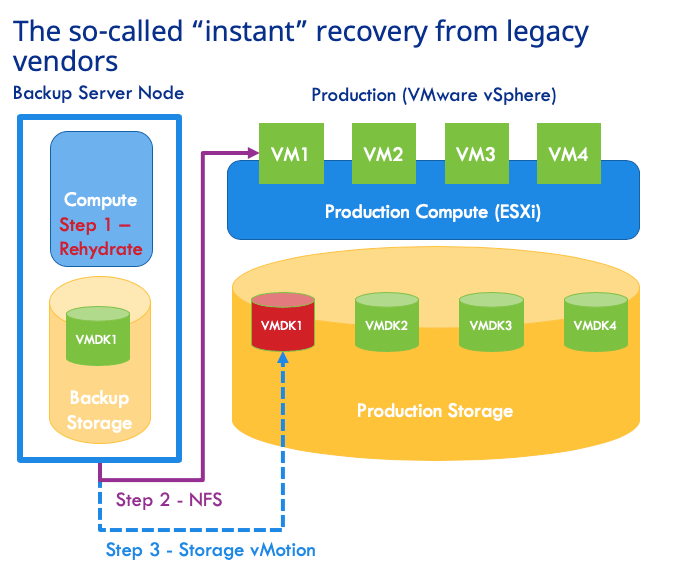
You are likely to hear bricks and blocks backup vendors for on-premises touting the value of “instant recovery” for virtual machines. The RTO being promised is seconds to minutes. But when it comes to recovering a virtual machine (VM) to its production operational level, there is nothing ‘instant’ about the so-called instant recovery.
The so-called instant recovery is to serve the VM disk files from backup system via NFS and let VMware vSphere run the VM from those disk files. It is true that the process to boot up a VM from backup this way will only take a few minutes. It is true that the flash storage on backup systems can act as a caching mechanism for write-I/O. However, in order to make the VM operationally on-par for production use, the VM administrator must carefully plan and execute storage vMotion when the time is right. This process will migrate the VM disks from backup storage onto production storage while the VM is live. This process is often throttled down by vSphere so as not to hinder the live VM. It takes several hours to even a full day before a large VM can be migrated and becomes operationally ready for production level performance. So much for the “instant” in instant recovery!
Thus, for the SQL Server AG example above, the nodes must be served by a single backup storage system which goes against why you have AG. The AG is supposed to be set up with dedicated storage systems at each node for availability. Then, the AG cluster would have a hard time coming up as the synchronization will be extremely slow because I/O-reads are occurring from backup storage. Note that AG is unavailable during this time period and hence there is no ‘instant recovery’ really. To add insult to injury, the AG would limp along while the required storage vMotion needs to occur from overloaded backup storage onto production storage.
The problem for this instant recovery does not end there. The backup is still co-located with production and hence is prone to site loss and security vulnerabilities. You cannot use cloud storage as a viable backup destination for operational recovery from these solutions. And, instant recovery is useless once you plan to migrate workloads to VMware Cloud on AWS because there is no support for third party NFS storage.
Clumio Rapid Recovery – Superior Operational RTO
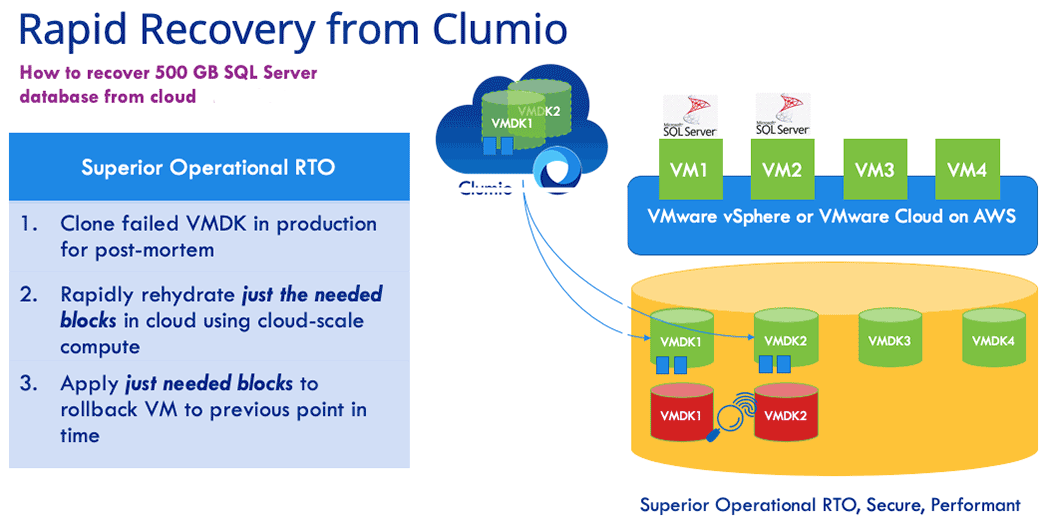
Help to deliver secure backup and recovery for your data – wherever it needs to be. Rapid Recovery is a set of innovations from Clumio that enables fast operational restores from cloud storage even when you are protecting on-premises workloads. Thanks to Rapid Recovery with Clumio SaaS, it took just 5 minutes to recover an active SQL Server AG environment with 500GB of data given in the above example This is the time taken for end-to-end recovery and data restored to a fully operationally state. How did we do this? There are two innovations in Rapid Recovery playing key roles here.
Scale-out Rehydration:
Clumio’s scale-out rehydration eliminates the rehydration penalty of traditional bricks and blocks systems altogether. Rehydration is done by Clumio using serverless compute and it takes advantage of the unlimited compute capacity of the cloud while running parallel I/O operations across all blocks of interest for a given request. The result: restore throughput from the Clumio backup service beats that of a traditional deduplication system co-located in the data center.
Reverse Changed Block Tracking:
When you are recovering a VM in production from backup, you are essentially trying to roll back the clock so as to get to a last known good condition. Clumio’s reverse changed block tracking helps you do exactly that without the need to go through a full restore. The Clumio backup service retrieves the changed blocks (regenerated via scale-out rehydration described earlier) and applies them directly into production storage to rollback the VM to the previous point in time. The result: the time it takes to recover a VM from the Clumio backup service to a production operational level is faster than that of recovering from local storage!
These two Rapid Recovery capabilities from Clumio eliminate ALL of the limitations of instant recovery from legacy vendors.
Let’s summarize the key customer benefits of Rapid Recovery from Clumio:
No human intervention required: The backup admin or VM admin does not need to do anything during backup or recovery to take advantage of Rapid Recovery. Clumio SaaS automatically detects if the requested restore point in time meets rollback criteria and initiates it automatically during recovery.
RTO is superior to that of instant recovery: You are bringing just the data required to roll back the VM and your recovery is complete. The time it takes to do this is better than the overall time it takes to perform instant recovery followed by storage vMotion.
Protect against data loss and ransomware: Unlike co-located bricks and blocks based backup solutions needed for instant recovery, Clumio backups are air-gapped from your production datacenter. Clumio helps protect you against site loss and site-level vulnerabilities.
Gets you ready for VMware Cloud on AWS: Instant recovery does not work in VMware Cloud on AWS environments because of its dependency on NFS. Rapid Recovery has you covered when you are migrating to VMware Cloud on AWS.
Want to try Rapid Recovery? Contact us.
More related posts
Architect for Tomorrow: Unified Data Protection as the Foundation for Resilience
After spending the last 20 years helping my customers properly evaluate and right-size storage architectures for these peaks, it was never lost on me that they generally occurred less than 20% of the total run time of the sized environment. In the era of on-prem infrastructure, this equated to a lot of dormant resources waiting in reserve.
At Clumio, as I now shift into the sphere of helping customers right-size a data protection solution for the public cloud, the first thing that became apparent is that, if done correctly, the dynamic scalability of the public cloud allows for much more precise utilization of resources at all points in time. In fact, this is an optimization that must occur to seriously advance any idea into a fully formed, developed solution because, in public cloud, every second a resource is reserved or “in use” costs money. This is exactly why solutions designed to address an on-prem problem cannot simply be lifted and shifted to the public cloud. We often hear customers talk about the need to ‘refactor’ an application. This is a time-consuming effort, but the value in wasting less resources, in the end, is worth the time spent redesigning a solution.
For a SaaS application to manage peak workloads at scale, resource utilization is even more important – not just for resources that get presented in the customer’s environment, but especially for the backend services that support not just one customer, but thousands of customers. Only by building an application end-to-end with an intelligent resource utilization model will true scalability occur while minimizing cost for the consumers of the service.
By bringing to bear a cloud-native approach using microservices, Clumio has already designed our secure, enterprise backup service to help our customers get the benefit of cloud efficiency instead of having to ‘refactor’ their existing backup applications. This is best exemplified by the way Clumio inserts zero fixed-compute resources in the data path and, instead, incorporates the parallelism of AWS S3 combined with the dynamic scalability of AWS Lambda functions and AWS DynamoDB resources to help provide that seamless, fluid experience that customers expect when using SaaS. This also creates a much simpler methodology for right-sizing a customer environment – Clumio will provide the requested resources on-demand.
Clumio has helped remove the need for the arduous task to size for peak workloads. I find that I now spend most of my time educating customers on the importance of a truly optimized architecture and the value that brings to the consumer. Of course, the best way to discover the value of Clumio is by experiencing it first-hand….I encourage you to give it a test run.
More related posts
Architect for Tomorrow: Unified Data Protection as the Foundation for Resilience
Commvault is “in the zone” – a mindset and special place often reserved for athletes on a scoring streak.
While no one here will argue that customer success is one of the most important validations of our business, it’s hard not to be impressed with Commvault’s recent string of industry accolades for its products, services and people under Sanjay Mirchandani’s leadership. The recent wave of recognition and company momentum across all areas of the business speaks for itself.
Just this month, Commvault received word that its Commvault Complete Backup and Recovery solution had been named a finalist forTechTarget’s product storage awards in the category for backup and disaster recovery hardware, software and services. Judged by an impartial panel of analysts, consultants and users, TechTarget’s product of the year award program helps buyers identify the best products amid a crowded field. It’s kind of a big deal. While the winners in each category will be announced in February on SearchStorage.com, we feel we’ve already won.
Commvault was also
included in Solutions Review’sBackup and Disaster Recovery and Data Management Software buyer’s
guides while Hedvig – a company we recently acquired if you haven’t heard – was
included in the Enterprise Data Storage guide.
Solutions Review releases these guides to assist organizations
during the research and discovery phase of buying business
software. Editors compile each Buyer’s Guide using research, analyst
reports, industry experts and product demos. These guides are scientific and
well-respected. While it’s great to see Commvault recognized in two guides,
it’s also noteworthy that competitors such as Rubrik, Veeam and Veritas were
only recognized in one.
Last but certainly not least, taking center stage in our proverbial trophy room, just a few months ago Forrester named Commvault a Leader in Data Resiliency Solutions, whileGartner recognized Commvault as a Leader in its Magic Quadrant for Data Center Backup and Recovery Solutions. Forrester ranked Commvault the highest in its Current Offering category, while Gartner positioned Commvault furthest for completeness of vision in its Leaders quadrant and highest for ability to execute in its entire Magic Quadrant for the 8th consecutive year.
More related posts
Architect for Tomorrow: Unified Data Protection as the Foundation for Resilience
Being a true, cloud-native backup solution allows us to provide our customers with a level of support previously unseen with legacy enterprise backup products.
Users see the difference as noted in this message from a Clumio customer after being proactively notified of an issue by our support team:
“Thank you for taking care of this issue. We appreciate having a second set of eyes on our backups and how easy this whole thing has been for us” – Midwestern US Healthcare Provider
Proactive Customer Support
Being Authentic SaaS means that we’ve architected our solution to remove the complexities of managing enterprise backup for our customers. This is reflected in our model of service delivery – from proactive support to transparent over-the-air software upgrades.
Our customers enjoy real-time monitoring of their Clumio service delivered via software, processes, and people. As of November 2019, 72% of our customer cases have been proactively opened and triaged by our support team without any action from the customer.
Clumio Automated Proactive Support
Unlike the ineffective “call home” alerting provided by legacy hardware vendors, Clumio support capabilities are built in the cloud and provide:
Continuous 24/7 monitoring of task and environmental failures
Triggers for the creation of proactive support tickets
Ongoing improvement of the Clumio service by the automated detection of product defects
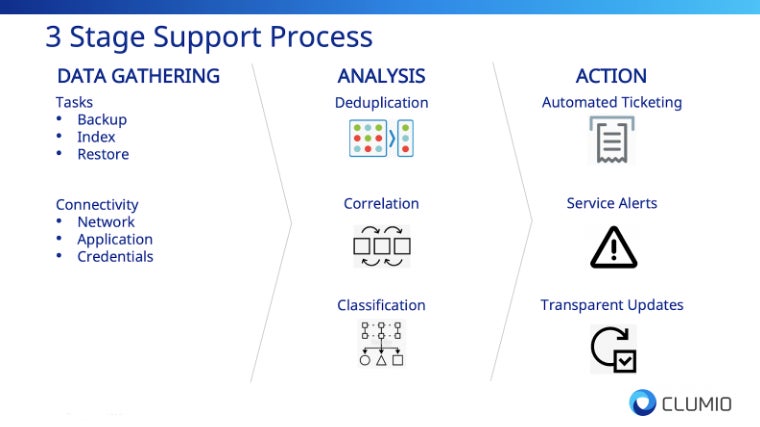
Our framework for delivering the most innovating support in the industry consists of three stages:
Stage 1 – Data Gathering
As an authentic SaaS solution, we have complete access to critical failure information that legacy hardware and software vendors do not have, whether generated in the cloud or from the customer’s on-prem environment. The data sources include:
Task Status – Backup, restore, file-level indexing, or file-level restore failures.
Connectivity Status – On-prem network or application failures.
Stage 2 – Analysis
To make sense of the data gathered, the analysis stage performs 1) deduplication, 2) correlation, and 3) classification of the failure data.
The analysis stage is critical help minimize to ensure that we minimize the amount of unwanted noise and distill the information down to succinct actionable steps to improve the customer experience.
Stage 3 – Action!
The failure data that emerges after the analysis stage then triggers one of three remediation workflows:
Automated Ticketing – Proactive support ticket is opened for triage
Service Alert – Customers are notified via product alerts of failures
Transparent Updates – Product defects are tracked by our support team and resolved via over-the-air upgrades
The result of the action stage is a customer experience that breaks away from the traditional, reactive nature of support delivered by legacy hardware and software vendors.
Over-the-Air Upgrade Model
In addition, customers need not worry about the complexities traditionally associated with upgrading legacy backup products: planned downtime, on-call administrators, validation testing, or service downtime. Clumio patches, upgrades, and fixes are all delivered seamlessly over-the-air with no complicated upgrade planning required.
This has manifested itself in an unprecedented enterprise backup experience. As of November 2019, 100% of Clumio product defects have been resolved without requiring any customer action.
Innovative Customer Experience is a Journey
As an innovative enterprise backup vendor, should also provide an innovative enterprise customer support most innovative enterprise backup vendor should also provide the most innovative enterprise customer support. This is why customer experience and leveraging cloud and automation technology are at the heart of our customer success strategy.
Our team consists of highly trained engineers with expertise in cloud, security, storage, automation and more, all committed to the success of our customers.
As we continue on our journey of innovation, customer experience will always be a top priority, and we look forward to partnering with you.
More related posts
Architect for Tomorrow: Unified Data Protection as the Foundation for Resilience
The public cloud has delivered tremendous value to the enterprise, but a new mindset is required. Without a new mindset, you are bound to replay the same challenges you had before as they follow all with you on your new journey.
Over the last ten years, the journey to the cloud has provided 3 big lessons that have shaped the way enterprises approach the cloud in the current era. Shadow IT showcased the value of agility and scale, but also alerted us to the fact that a security-first mindset is required as data becomes dispersed across clouds. The cloud-first era reminded us that the cloud is costly if you leverage the same on-premises methodologies in the public cloud. The goal of today’s era, I like to call the cloud smart era, is to accelerate to the cloud intelligently by taking advantage of public cloud innovation, scale, and economics.
One core business function that did not evolve along this journey is data protection. If you look at the data center today, the data protection methodologies are robust including replication between storage arrays, snapshots, backups, replicated backups, and tape backups for offsite storage. But in the public cloud, data protection solutions are minimal, especially for backup. Today’s options include a virtualized version (or cloud retrofit) of the same legacy backup product you use in your data center today or volume level snapshots you have to orchestrate in the public cloud. Let’s take a look at the challenges of each of these options.
Legacy Backup Product – “Cloud Retrofit”
Traditional backup products have been in the data center for years. Most of these solutions are 10, if not 30 years old. As we saw in the cloud-first era, lifting and shifting existing products as a virtualized appliance, even with a “cloud-like consumption” model, results in complexity, higher costs, a software bill, a cloud bill, and a lack of scale and agility. Without re-architecting or rebuilding these backup products from the cloud up, the result is the same on-premises challenges enterprises are running away from in the first place.
Native Cloud Snapshot Management
Most enterprises have seen the complexity and false claims of the traditional backup products and decided to roll their own snapshot managers or orchestrate the creation of those snapshots. Snapshots are suitable for a quick recovery of a volume to a point in time, but cannot deliver long-term cost-effectiveness, file searching capabilities, or single file restores with any ease. Imagine if you accidentally deleted a few files across multiple volumes, need to go back in time for ediscovery, or require data to compare from 5 years ago. Having snapshots as your only tool makes life very painful. Another area of concern is putting your primary data and snapshots in the same account, which brings the additional risk for ransomware or bad actors who could compromise the data and the “backup.” To alleviate this issue, many users copy their snapshots to other accounts to keep them separate, which incurs additional egress costs. If this was not challenging enough, most enterprises have 10s, if not 1000s of accounts in the public cloud, so the challenge grows exponentially.
What enterprises demand is a secure, simple, and predictable SaaS data protection solution that follows along as they accelerate their journey to the cloud. At Clumio, we have the luxury of building products in a cloud-first world, building services natively from the cloud up, without any legacy products or services in our platform to change or evolve. We develop products that give our customers a competitive advantage by removing the complexity of legacy backup solutions and protecting data as enterprises accelerate their journey to the public cloud. We believe that backup should be a service provided to the enterprise with a setup that can take as few as 10 minutes., the quick discovery of all data assets, global search, single file, volume, or application recovery, with a security-first mindset. And this is just the beginning. In my next blog post, we will dig deep into how Clumio solves the multi-cloud data protection challenge.
Take care and stay “authentic” SaaSy my friends.
More related posts
Architect for Tomorrow: Unified Data Protection as the Foundation for Resilience
Imagine your business has just been hit by a disastrous event – be it a natural disaster, cyber-attack, or even human error, and all your company’s critical data is either lost or inaccessible. The clock is ticking, and each second of downtime spells potential financial losses and irreparable damage to your organization’s reputation. This nightmarish scenario is precisely why understanding Recovery Time Objective (RTO) and accurately calculating it is crucial for businesses of all sizes. In this post, we’ll demystify RTO, guide you on determining the optimal target for your business, and share how to calculate it effectively to limit the impact of data loss, avoid catastrophe, and give you peace of mind.
A Recovery Time Objective (RTO) is the maximum amount of time that an organization can tolerate for restoring its critical systems, applications, and data after a disruption or outage. It is a key metric used in disaster recovery planning and helps organizations determine how quickly their business operations need to be resumed after a major incident. RTO can be calculated by performing a business impact analysis (BIA) and determining the recovery time needed for each application, service, system, or data component based on its criticality and loss tolerance.
Understanding Recovery Time Objective (RTO)
When an unexpected disaster like a cyber attack or natural calamity occurs, IT systems in an organization may go down. The recovery process for bringing these IT systems back up and running will have to be done within a specific time frame. This is where the concept of the Recovery Time Objective (RTO) comes into play. RTO is defined as the maximum duration of time acceptable before an organization can resume normal business operations after a significant disruption.
To understand RTO better, consider the analogy of a hospital’s emergency room. In case of any life-threatening injury, it is essential to provide medical attention to the patient within a certain time frame. This time frame or duration is known as the ‘Golden Hour.’ If doctors and staff fail to provide medical aid within this hour, there are chances that the injury turns fatal, causing long-term damage. In the same way, for an organization, if critical applications and systems are not resumed within the RTO period, there could be financial and reputational damage that will hurt the business’s interests.
In today’s world, businesses rely heavily on technology systems to conduct their day-to-day activities. Any downtime or delay in resuming those critical services can lead to severe losses, including revenue, missed opportunities, unplanned expenses, decreased customer satisfaction and loss of market share. Therefore, having proper RTO planning in place is essential for swift disaster recovery. Sometimes organizations prioritize cost over quick service restoration in case of failure or disaster. However, downtime could prove much more expensive than investing in proper RTO planning options from the beginning.
Now let’s delve deeper into why RTO is important and how it can benefit your organization.
According to a report by the Aberdeen Group, 93% of businesses that experienced data center downtime for more than ten days filed for bankruptcy within a year.
A study conducted by Gartner revealed that the average cost of IT downtime is $5,600 per minute, emphasizing the importance of having a well-defined Recovery Time Objective (RTO).
In a survey by the Disaster Recovery Preparedness Council, nearly three-quarters (73%) of businesses reported not having an adequate RTO in place, highlighting the need for organizations to prioritize disaster recovery planning.
Importance of RTO in Disaster Recovery Plans
RTO plays a crucial role in ensuring that your organization can resume normal operations as quickly as possible in case of any disruption. The following are some ways RTO is essential in disaster recovery plans:
Firstly, RTO helps to reduce loss of revenue, reputation damage, and other impacts caused by lengthy downtime. Downtime has immediate tangible costs like revenue loss and intangible costs such as loss of customer trust.
Secondly, let’s consider a scenario where an accounting application is down for several days. This application is vital to the business’ operations since it takes care of all accounting activities. In this situation, failure to restore the application within the RTO duration will lead to late payments and incorrect balances that could result in loss of significant amounts of money or gradual fallbacks. To understand how important RTO is to organizations, imagine being without your mobile phone for one day during an important project; inevitably, you’ll lose valuable time and work behind schedule on delivery deadlines.
Thirdly, defining RTO helps an enterprise to identify critical IT systems that have the potential to cause the most severe impact on the business if they fail. With clear identification of these systems and their associated RTO values makes prioritization easier for IT teams while system restoration since it determines which services must be brought back first to maintain steady operations. Lastly, ignoring or mismanaging RTO planning may lead you in the wrong direction when determining which Disaster Recovery technologies would be suitable for restoring vital data and applications. Understanding how crucial RTO Planners are in disaster recovery planning should prompt us to consider how we can calculate them.
RTO vs. Recovery Point Objective (RPO)
Recovery time objective (RTO) and recovery point objective (RPO) are often considered together as the two most important parameters of a data protection or disaster recovery plan. While both concepts are related to data recovery in the event of a disaster, they differ in their focus.
RTO is concerned with how quickly an organization can resume normal business operations after a major incident has occurred that has caused a disruption. RPO, on the other hand, focuses on the maximum amount of data that can be lost during this time before it becomes unacceptable.
To illustrate the difference between RTO and RPO, imagine a company that conducts its operations through various critical applications and databases. These applications process orders from customers, manage inventory levels, and handle financial transactions. If one of these applications goes down due to hardware failure or natural disaster, how long can the company afford to have the application unavailable? This duration would be the RTO for that application.
Now consider what happens if there is a backup system in place but it is not able to recover all of the latest transaction data since its last backup was taken 24 hours ago. The entire day’s worth of work would be lost, leading to significant financial losses and other negative consequences. The acceptable limit for such data loss would be defined by the RPO.
Calculating RTO for Your Organization
The first step in calculating your organization’s RTO is to conduct a business impact analysis (BIA). This helps you identify critical systems and applications that require the highest level of availability and assess how much downtime each system can tolerate before operational disruptions negatively impact your business.
For instance, imagine an insurance company whose claims processing application goes down. The company may be able to survive if the application is offline for a few hours during off-peak times but may suffer significant financial losses and damage to its reputation if it is unavailable during peak hours. Therefore, peak hours could be defined as the period during which the RTO must be met. Another analogy to consider is similar to how hospitals prepare for natural disasters. They have a plan in place that outlines what they will do if there is an influx of patients due to an earthquake or hurricane. Within this plan, they define the maximum time it should take for them to get back up and running in case something disruptive happens. A hospital with critical surgeries scheduled that day would have different RTO timelines than one without any scheduled procedures.
Once you have identified critical systems and applications, you need to determine how quickly they need to be restored after a disaster has occurred. When calculating RTO, it’s essential to consider factors such as backup frequency, location, transport mechanism, security measures, staff capabilities, and end-user requirements.
Conducting a Business Impact Analysis (BIA)
Before calculating RTO for your organization, it is important to conduct a business impact analysis (BIA). The BIA involves evaluating the potential effects of a disaster or system failure on critical business functions. It is important to note that BIA is separate from the disaster recovery planning process as it instead focuses on understanding the potential impact of disruptions on key business functions. For example, in mid-2020, many organizations were caught off guard by the rapid shift to remote work due to COVID-19. Companies that had previously relied on on-premise solutions struggled to adapt their systems to accommodate a remote workforce. To prevent such issues in the future and better understand the risks associated with this kind of disruption, businesses should consider conducting a BIA. To begin the analysis process, organizations should identify key stakeholders from across departments and functional areas. This team should gather information about every critical business function and determine how long each can be disrupted before causing significant harm to operations.
It is also important for organizations to consider both direct and indirect impacts of disruption. Direct impacts might include halted production, while indirect effects could include lost sales due to supply chain problems. Accounting for these different types of effects can help create a comprehensive understanding of potential impacts.
Comparing a business to a building with multiple levels can help visualize this process. Each level represents different aspects of business functions and processes, such as finance or supply chain management. You must diligently map every floor’s contents within your business context and determine what happens if you remove specific parts partially or completely. Once you’ve completed your BIA and identified all critical business functions, you’re ready to move on to the next step: identifying critical systems and applications.
Identifying Critical Systems and Applications
Identifying critical systems and applications is critical in creating a disaster recovery plan. The identification process should involve thinking through which IT systems and applications are essential to supporting the business functions identified in the BIA.
For example, a manufacturer would likely identify production systems as a critically vital application, while a financial institution might focus on their trading or core banking applications. In all cases, however, any application that is vital to supporting critical operations must be documented and analyzed.
Once you’ve identified your critical applications, it’s also essential to examine dependencies between them. This includes examining the infrastructure and hardware components required for each application’s proper functioning.
It is recommended to consider dependency tracking even beyond primary layers since a change at the second level of dependencies still may have secondary effects that can cascade to critical applications.
To investigate these dependencies further, system analysts often used flowcharts to detail the expected workflow or data movements between applications. By visualizing the interconnectivity between different systems, it becomes easier to prioritize recovery procedures and implement more comprehensive resiliency measures. After carefully analyzing your organization’s critical systems and dependencies between them, you’ll be well-prepared to select suitable disaster recovery technologies in our next section.
Implementing and Improving RTO Strategies
Once you have calculated your organization’s Recovery Time Objective (RTO), it is crucial to implement and improve strategies that will help you achieve the desired recovery time. One of the key components of implementing an efficient RTO strategy is ensuring that all stakeholders understand their respective roles during a disaster or crisis. It is essential to undertake continuous training and education for both employees and IT staff on disaster recovery procedures and plans. Simulations can be conducted periodically to ensure that everyone understands the procedures, as well as to test the efficacy of systems, technologies, and personnel.
Additionally, regularly reviewing the effectiveness of RTO strategies can reveal areas requiring improvement. It is essential always to seek ways to improve and make available more effective backup solutions. This could involve a shift in the existing technology, updating software or conducting regular hardware upgrades. One company based in New York City learned this lesson after storms caused severe flooding of data centers within their region. Power outages resulted in catastrophic data loss, including losing our clients’ vital information stored in storage devices.
In response, we scaled up our cloud-based infrastructure services, ensuring our clients could continuously access data backups remotely should anything go wrong. With strict privacy policies and compliance requirements for storage regulations adhered to by our team of experts, we gave our clients peace of mind knowing that their critical business operations were secure. Evaluating backup data can also give insight into additional improvements required on top of existing strategies. If specific applications are taking too long to back up regularly, upgrading them using modern infrastructure with higher capacity might be necessary.
Another way to enhance your RTO strategy would be by implementing automation tools which allow IT teams quickly and efficiently respond to emergencies without interrupting regular productivity. In addition, automating repetitive or predictable tasks can free up time for IT professionals to focus on more complicated aspects such as monitoring software performance and conducting regular drills.
Selecting Suitable Disaster Recovery Technologies
Selecting the best disaster recovery technologies for your unique business needs is vital. Business-critical applications require a recovery time objective that favors speedy applications, while other non-critical applications might have a higher RTO.
When looking for the perfect disaster recovery technology, you’ll need to consider aspects such as security, costs, scalability, and your organization’s technological capabilities. Cloud-based services are increasingly popular due to their accessibility, scalability, and low capital investment costs. Amazon Web Services (AWS) is one cloud provider used by several major companies such as Airbnb and Netflix. With AWS, organizations can deploy recovery plans in multiple zones and regions to ensure redundancy in case of disasters or data outages.
Another available technology option is synchronous replication between sites. This requires having replicate data centers combine with failover settings that minimize disruptions during a societal breakdown. Both software-defined WANs (Wide Area Networking) and Fiber connections are viable options to synchronizing replicated data centers to ensure near-zero RTO periods. An important debate revolves around whether to opt for hot or cold standby sites against an essential application failover in case of a disaster. A hot site refers to a ready-to-go backup center that mirrors both data operations and infrastructure; it allows for instant resumption of normal operations but might incur higher costs. A cold site on the other hand requires more preparation before switches can happen however with less expense attached.
By identifying crucial applications coupled with careful zone and region selection across diverse data centers, selecting suitable disaster recovery technologies will overall be beneficial regardless of which solution is chosen.
Selecting the best disaster recovery technologies for your unique business needs is crucial, and there are several options available to meet different recovery time objectives. Cloud-based services, such as AWS, offer accessibility, scalability, and low capital investment costs. Synchronous replication between sites can minimize disruptions during a societal breakdown, while software-defined WANs and fiber connections can ensure near-zero RTO periods. Choosing between hot or cold standby sites depends on the level of preparedness and cost considerations. Overall, identifying critical applications and carefully selecting suitable disaster recovery technologies across diverse data centers can significantly benefit any organization.
Monitoring and Adjusting RTO Over Time
Once you have calculated your Recovery Time Objective (RTO) and implemented strategies to achieve it, your work is not yet over. Monitoring and adjusting your RTO will ensure that it remains relevant and effective in mitigating the effects of unexpected disasters or failures.
Let’s say that a few months after calculating your RTO and implementing recovery strategies, you experience a major data breach that takes down your critical systems for several hours. This incident could reveal weaknesses in your RTO plan and requirements, leading to necessary adjustments for future readiness. By analyzing the data from the incident, you can determine if the RTO needs to be adjusted based on factors like the severity of the disaster or failure or if new technologies would better facilitate data restoration. As technology constantly evolves, so do the tools available for recovering critical data. Hence, IT departments need to remain up-to-date on newer alternatives or enhanced version of existing technologies that may address the potential gaps in their current RTO plan. An excellent way to monitor advancements in this industry is by attending technology conferences or webinars that explain emerging trends and give organizations an opportunity to network with industry experts.
On the other hand, some organizations might argue that monitoring RTOs is not necessary as long as their initial calculations are robust enough to cater for all eventualities. However, this argument overlooks the fluid nature of technological systems where things could change as quickly as an overnight software update or hack tool emerging in criminal circles.
Monitoring and adjusting your RTO is similar to driving a car. Once you set out on the road, you don’t just settle down and forget about caution altogether because you believe everything went well at the start. A vigilant driver continuously monitors their environment by regularly checking mirrors and avoiding hazards as they appear along their path. Any sudden changes on the road like a blown tire or engine trouble will require quick thinking and new strategies, much like how IT organizations must adapt quickly to emerging security threats or IT failures.
So there you have it, monitoring and adjusting RTO over time is crucial for all organizations’ disaster recovery plans. By being vigilant in paying attention to potential threats and keeping track of technological advancements, you can ensure that your system remains robust and effective in the long run. Remember, recovery does not end after the implementation phase, for an efficient plan should account for any dynamic changes that might occur in an ever-evolving technological landscape.
What role does technology and infrastructure play in achieving desired RTOs?
Technology and infrastructure are crucial aspects in achieving desired RTOs. The right technology and infrastructure can help businesses recover faster from potential downtime, lessening the negative impact on their operations, customers, and bottom line.
For instance, implementing a robust backup and recovery system that leverages cloud computing technologies can enable organizations to restore important data or applications in a matter of minutes. Additionally, having a resilient IT infrastructure with redundant systems, automated failover processes, and disaster recovery plans can significantly reduce RTOs.
According to a recent study by Veeam Software, 84% of companies reported that they experienced downtime events in the past year. Of those that experienced such events, 33% lost access to their critical systems for an hour or more. Furthermore, research suggests that unplanned downtimes can cost businesses up to $5600 per minute.
In conclusion, technology and infrastructure play an essential role in not only achieving desired RTOs but also minimizing business risks associated with downtime events. By investing in the right technological tools and infrastructure solutions, businesses can drastically improve their operational resiliency and minimize the potential financial losses caused by unplanned outages.
How does RTO differ from Recovery Point Objective (RPO)?
Recovery Time Objective (RTO) and Recovery Point Objective (RPO) are two critical metrics that organizations must take into account when designing their disaster recovery plans. While some people may use these terms interchangeably, they are not the same thing.
In short, RTO defines the length of time an organization can afford to be without a particular system or application before it starts to suffer significant financial losses or other negative consequences. On the other hand, RPO specifies the maximum amount of data that an organization can afford to lose as a result of a disruption before it begins to experience significant damage. For example, if a company has an RTO of two hours, it means that it can only tolerate up to two hours of downtime before suffering severe consequences such as losing customers or revenue. On the other hand, if an organization has an RPO of one hour, it implies that it can only afford to lose up to one hour’s worth of data before experiencing significant damage. To put things into perspective; according to a study conducted by IBM, every minute of unplanned downtime costs enterprises around $8,851 on average. Furthermore, research from IDC suggests that the average cost of downtime for critical applications is approximately $100,000 per hour.
Therefore, setting realistic RTOs and RPOs for your organization is crucial in minimizing downtime and avoiding financial losses. However, keep in mind that these metrics should also align with your business goals and needs since overly aggressive objectives could be difficult to achieve and maintain without overburdening your resources.
What factors determine an appropriate RTO for a business or organization?
Determining an appropriate Recovery Time Objective (RTO) for a business or organization involves considering several factors. The RTO should be determined based on the potential impact of system downtime and how rapidly the organization needs to resume operations. Some of the factors that determine an appropriate RTO include:
Business Impact Analysis (BIA) – A BIA helps identify critical systems, data, and applications that are essential for business continuity. By prioritizing these aspects, organizations can develop recovery plans with specific RTOs that align with their importance.
Industry Standards – Certain industries such as healthcare or financial services have stricter regulatory requirements that dictate specific RTOs for protecting sensitive data and ensuring uninterrupted operation.
Financial Implications – According to a study by the Ponemon Institute, the average cost of data center downtime has risen to $9,000 per minute in 2021. Therefore, an organization’s financial situation plays a significant role in determining an appropriate RTO as it impacts both short-term revenue loss and long-term reputation damage.
Technology Infrastructure – The RTO should be based on the organization’s technological capabilities, including hardware, software, and network infrastructure. This includes assessing redundancy levels of IT systems and ensuring backup solutions are available to minimize recovery time.
In summary, determining an appropriate RTO requires understanding the potential impact of system downtime on your business operations, analyzing your critical systems and data, and balancing financial implications with technology infrastructure capabilities. By taking a proactive approach towards disaster recovery planning, businesses can minimize downtime while ensuring seamless business continuity during unexpected failures or disruptions.
What are some common mistakes businesses make when establishing RTOs, and how can they be avoided?
Establishing a recovery time objective (RTO) is crucial for businesses to plan and prepare for disasters, cyberattacks, and other potential disruptions. However, there are some common mistakes that businesses make when determining their RTOs.
One of the most significant mistakes is setting an unrealistic RTO. According to a survey by IDG, 28% of IT professionals admit to setting unachievable RTOs. Setting an RTO without considering the resources available or testing the plan can lead to downtime, loss of revenue and damage to reputation. Another common mistake is not reviewing or updating the RTO regularly. As businesses grow and technology changes, so do the potential risks and required solutions. The Disaster Recovery Preparedness Council reports that 60% of organizations have not updated their disaster recovery plans in over a year, leading to out-of-date and ineffective plans.
To avoid these mistakes, businesses need to conduct risk assessments, test their disaster recovery plans regularly and consult with experts in business continuity planning. It’s essential to establish an achievable RTO based on the needs and capabilities of your organization. A realistic plan will allow you to recover quickly while minimizing costs.
In summary, avoiding the common mistakes of setting unrealistic RTOs or failing to update them regularly requires ongoing preparation, planning, and consultation with disaster recovery experts within organizations.
How can businesses minimize their RTO in the event of a disaster or downtime?
Businesses can minimize their Recovery Time Objective (RTO) by implementing the following strategies:
Establish a comprehensive disaster recovery plan: A well-documented plan reduces confusion and helps to restore systems quickly. According to a study by Gartner, only 35% of small and medium-sized businesses have a disaster recovery plan in place.
Invest in resilient infrastructure: Robust IT infrastructure with multiple redundancies, backup generators, and power sources ensures business continuity even in the event of an outage.
Practice regular backups: Regular backups mean that data is always up-to-date and available when needed. 60% of small businesses close down within six months of experiencing significant data loss without proper backup solutions
Adopt cloud-based solutions: Cloud-based solutions offer flexibility and scalability that traditional on-premises solutions lack, providing faster recovery times according to 95% of surveyed IT professionals.
By implementing these measures along with others tailored to their specific industry and business needs, companies can ensure minimal RTOs during disasters or downtimes, minimizing potential losses to revenue and reputation alike.
Meet or Exceed Your RTOs with Clumio
Disaster recovery planning is essential for enterprises of all sizes looking to ensure business continuity during malicious attacks, downtime, and disruptions to infrastructure. Good data backups and a well-defined recovery process are critical elements of this planning.
Having a viable RTO—and the ability to meet or exceed the RTO—is a vital component to protecting both your business and its customers. As a cloud-native data protection backup-as-a-service platform, Clumio’s industry-leading rapid recovery capabilities provide enterprises with quick and reliable data restores to help ensure business continuity in the face of downtime to critical infrastructure.
By providing a seamless way to restore an entire instance as well as granularly recovering individual files, records, or mailboxes, Clumio optimizes data recovery to easily meet or beat your existing RTOs.
Related Topics:
Data Protection Essentials: RTO vs. RPO Learn the data protection essentials: the difference between RTO (Recovery Time Objective) and RPO (Recovery Point Objective) for effective backup and recovery.
What is RPO? The Importance of Recovery Point Objective in Your Business Continuity Plan Learn why Recovery Point Objective is vital to an enterprise’s business continuity plan in today’s risk-filled environment where threats like malware and ransomware are now commonplace. Implementing effective data backups and setting recovery objectives will help secure your business’s future.
Exploring Cloud Backup Options: A List of Considerations Examine your available options for cloud backup and learn why a cloud-native solution specifically designed for the cloud is the best choice for everything from ransomware protection to faster data recovery and easier compliance. This is particularly important for businesses and organizations with complex network environments and specific requirements.
The Role of Disaster Recovery in a Business Continuity Plan for Businesses and Organizations Read about the key role disaster recovery plays in a business continuity plan and learn why your choice of cloud backup can affect the speed of recovery.
How the Right Cloud Backup Solution Enables Faster Disaster Recovery across Diverse Network Environments When a disaster event (such as a ransomware attack) strikes, disaster recovery planning is paramount for businesses and organizations operating in various network environments. Learn about the key capabilities a cloud backup solution should provide to enable faster disaster recovery.
What Is a Data Retention Policy? Learn the basics about data retention policy and discover how the right cloud backup can simplify your compliance while securing backup data, catering to the distinct needs of businesses and organizations in different industries.
More related posts
Architect for Tomorrow: Unified Data Protection as the Foundation for Resilience
It may be tempting to try porting over an on-premises backup system to the cloud, mainly due to your organization’s familiarity with the hardware and system. But this would defeat the purpose of moving to the cloud altogether. Backup solutions designed for on-premises backup don’t leverage cloud services to their full potential because these solutions were specifically made to run on a rigid physical infrastructure, which is less flexible and requires more pre-planning as user requirements change.
Porting over backup solutions from a data center to the cloud will result in two key problems:
Inefficient Architecture: Even if you were to take a “lift and shift” approach and emulate the physical hardware with Infrastructure as a Service (IaaS) components like AWS’ EC2 virtual machines and EBS volumes for virtual hard drives, you will not achieve any independent scaling of compute and storage. Instead, you’d have to size the backup data precisely and continually tweak AWS resources manually to accommodate the changing backup requirements. This would create an unnecessarily complex backup system with unpredictable costs—all while completely failing to leverage the agility of the cloud.
Compute Scale limitations: In the data center, compute is constantly running and has a fixed cost, but the cloud is just the opposite. Cloud compute is consumed on-demand, and you pay for each compute cycle. Backup solutions designed for on-premises use do not make full use of the cloud’s scaling abilities, causing unnecessary delays due to lack of bandwidth.
2. Using off-the-shelf cloud-native tools (such as snapshots) or DIY script-based solutions
There are some backup solutions whose approach is based on building a wrapper around the standard snapshot API that is native on that particular cloud platform. While this solution will work, and typically comes with an intuitive UI, it doesn’t provide a comprehensive data protection solution.
First, it’s difficult to automate global policy-based backups. It can also be time-consuming to locate the right snapshot to restore. This approach is also more vulnerable, mainly because snapshots are generally stored locally and close to the primary application.
Although some may choose to develop complex scripts to mitigate some of these deficiencies, there still remains a risk of human errors and corrupt scripts, not to mention the need to continually devote valuable IT resources to the creation and upkeep of these scripts.
3. A cloud-native solution specifically designed for the cloud
Pairing a cloud-native backup solution with the cloud itself means that it can take full advantage of the scalability and agility of the cloud—two of the main reasons for migrating to the cloud in the first place.
With this approach, there is no need to install additional software, manage cloud resources, or install agents in the customer’s account. There is no upfront complex planning required as the solution elastically scales to meet the data protection needs of the applications. A well-designed solution also ensures that the backup copies are stored outside the security sphere of the primary data.
This creates an air gap between the primary data and the backups to ensure a successful recovery when the primary data is compromised. Additionally, an ideal cloud-native backup solution should also enable users to quickly search through backups to locate and retrieve data, as well as provide helpful tools such as dashboards and reporting to be on top of your compliance needs.
Although a cloud-native backup makes the most sense in terms of performance, data protection, and visibility into data, not all cloud-native solutions are created equal and users need to carefully select a solution that delivers on the key functionalities mentioned above.
The Industry’s Best AWS Cloud Backup Solution
Built natively in AWS, Clumio’s backup solution provides superior scalability, performance, cost efficiencies, data protection, and faster access to innovation made possible by the cloud, all while solving issues common in other cloud backup solutions.
Protection From Ransomware
Clumio provides comprehensive data protection against growing threats like ransomware and bad actors via air-gapped and immutable backups that are stored outside of the customer’s security sphere. Both data at rest and data in transit are end-to-end encrypted.
Hands-Off Compliance
Compliance has become increasingly complicated as more jurisdictions implement their own versions of data retention laws. Clumio mitigates complexity and exposure to compliance violations with a simple interface. Clumio provides a single, cohesive view of all AWS assets and automatically indexes any resources that require compliance protection with uniform policies, along with simplified reporting for compliance audits. And that’s just the start.
Rapid Recovery with Global Search
Clumio’s interface utilizes a granular approach that can quickly locate and restore backup files, effectively reducing restore time from several hours to just minutes. This helps to ensure optimal business continuity in the event of downtime from a security event.
No More Data Bottlenecks
Clumio utilizes AWS serverless Lambda functions and the unlimited scalability of the cloud to sidestep process tiers and transport data directly into highly scalable and durable object storage. This enables Clumio to scale as needed to meet application demands quickly.
Cost Controls
Clumio’s advanced analytics and simulations include several cost control features that can provide clear, actionable insights into possible ways to reduce TCO. For example, by analyzing aspects like snapshots created per asset and their retention periods, Clumio can identify opportunities to cut back on certain snapshots and reduce AWS backup costs.
Related Topics:
AWS Backup Services AWS backup is the practice of creating a protected and space-efficient copy of data being used or generated by AWS services.
Solving the Challenges of AWS Backup Amazon Web Services (AWS) has become the primary cloud backup choice for many businesses, but it comes with certain challenges that users must be aware of before diving in. Learn how to solve the common problems with AWS backup while maintaining full control over cloud costs.
Adding Ransomware Protection to Your Amazon Cloud Backup Ransomware is a growing threat that shows no signs of slowing down—and your Amazon cloud backup could be at risk of exposure. Read about the vulnerabilities of Amazon Cloud Backup and learn what you can do to safeguard your data and backups from an attack.
How to Choose Between Cloud Backup Solutions Choosing the right cloud backup solution can seem like an overwhelming task. Where do you even start? Discover five of the most important things you need to examine when searching for your cloud backup provider.
Controlling Costs of Cloud Backup Services Are you wondering why your cloud backup costs are so high? Learn about the biggest culprits behind excessive and fluctuating cloud backup costs and find out how you can gain control over them, permanently.
Three Reasons You Need Cloud Backup for Business Curious about the actual benefits that cloud backup can provide for your business? Read about three of the biggest benefits your business can gain by utilizing a dependable cloud backup solution.
More related posts
Architect for Tomorrow: Unified Data Protection as the Foundation for Resilience
What is Included in a Business Continuity Plan Template?
When a disaster event such as a server outage or cyber attack threatens to disrupt operations, a business continuity plan empowers an organization to continue functioning while navigating through the recovery from the incident. But, as one might imagine, the plan itself can be quite complicated, as it involves many moving parts. Generally, the components of a business continuity plan can range from the fundamental, such as planning communications between employees during a disaster event or restoring function to utilities, to the nuanced, like creating social media posts, press relations, etc.
One of the vital parts of a business continuity plan template involves planning for the recovery and restoration of mission-critical data and applications. In years past, this would have been mostly relegated to restoring data from physical backups and on-premises servers, but things have significantly changed as organizations have migrated most or all operations to the cloud. Products, services, and indeed the running of the business, have become more reliant on data and cloud-native applications and workloads.
If the template you’re using to create a business continuity plan doesn’t outline a way to back up and restore these applications and workloads in the cloud, the template is not only unsuitable for your organization, it would make your finalized plan vulnerable to significant repercussions from a potential disaster event.
Why Cloud Backup is the Foundation of a Modern Business Continuity Plan Template
An organization cannot recover and restore its data unless it has first been backed up. If you’ve migrated to the cloud, a cloud backup solution will protect an organization’s data and facilitate the disaster recovery process when the need arises.
The process is simple in theory: Enterprise data is routinely backed up by the cloud backup solution, stored securely, and automatically updated according to the set schedule. If an incident results in lost or compromised data, the cloud backup solution can initiate data recovery from the most recent backup, allowing the business to continue operations.
While this seems simple in practice, recovering and restoring vast amounts of data all at once can require a significant amount of time. And as with any business, not all data is mission-critical for operations to continue. If your cloud backup solution only restores data instances in a broad manner, you may risk downtime occurring while waiting for the entire instance to restore.
Secure Cloud Backup with Rapid Restore is the Key to Ensuring Business Continuity
The speed of data recovery during a disaster incident is the difference between downtime occurring and ensuring core operations continue. Using an inferior cloud backup solution that lacks rapid restore features can put your business continuity at risk—no matter how failsafe your template may seem.
Built natively in the cloud, Clumio’s industry-leading cloud backup-as-a-service platform is equipped with several rapid recovery capabilities that provide fast data restores and ensure business continuity when data has been lost or compromised during a disaster event. With Clumio, organizations can automatically back up data in an encrypted, air-gapped environment. When data has been lost or compromised, users can restore an entire instance or use granular and flexible recovery features to identify and restore mission-critical data and applications needed to maintain business continuity.
A successful business continuity plan template depends not just on proper planning—the tools matter just as much. Learn why Clumio is the industry’s leading innovator for cloud backup and rapid recovery by scheduling a demo today.
More related posts
Architect for Tomorrow: Unified Data Protection as the Foundation for Resilience