Skip to content

Here at Commvault, our values – we connect, we inspire, we care, and we deliver – are foundational to everything we do and why it matters.

Nesta semana, realizamos nossa reunião trimestral interna do Global Town Hall e apresentamos o prêmio FY25 Q3 CEO Living Our Values Awards. Esse programa de prêmios reconhece e celebra globalmente nossos Vaulters por seu incrível trabalho no último trimestre e por viverem nossos valores todos os dias.

I’m so proud to announce our FY25 Q3 CEO Living Our Values Award winners and our employee-nominated Vaulters’ Choice Award winner below:

Vencedores do Prêmio CEO

Nithya Suresh

Nithya Suresh

Michael Lawson

Michael Lawson

Dominique Leblond

Dominique Leblond

Equipe de Mídias Sociais
Jason Meserve

Jason Meserve

Riya Borkotoky

Riya Borkotoky

Vaulter’s Choice Award Winner

Joseph Nazaro

Joseph Nazaro

Esses Vaulters são um exemplo inspirador do que realmente significa fazer parte da Commvault.

Para saber mais sobre como é trabalhar na Commvault, consulte nossosite de carreiras.

More related posts


Thumbnail_Blog-Dangerous-Silos-IDC-Resops-2026 (1)

The Importance of Recovery Point Objective (RPO) in Your Business Continuity Plan

Read more about The Importance of Recovery Point Objective (RPO) in Your Business Continuity Plan
Thumbnail_Blog-IDC-Resops-2026

Business Continuity Planning for the Cloud-Native Era

Read more about Business Continuity Planning for the Cloud-Native Era
Thumbnail_Blog-Bringing-Trust-to-CVE-2026

Demystifying SOC 2 Data Protection Requirements

Read more about Demystifying SOC 2 Data Protection Requirements

A Lei de Resiliência Operacional Digital (DORA) entrou em vigor em 17 de janeiro, trazendo diretrizes abrangentes e um marco regulatório detalhado sobre como todas as entidades de serviços financeiros que operam na União Europeia devem garantir a resiliência dos dados contra interrupções imprevistas.

A DORA também reconhece uma realidade amplamente aceita pelos profissionais de segurança cibernética: não se trata mais de saber se ocorrerá um ataque cibernético, mas sim quando. Essa legislação crucial traz um novo nível de rigor e responsabilidade ao setor de serviços financeiros, que continuará a evoluir para salvaguardar a estabilidade da UE e do ecossistema financeiro global.

Muitos setores do setor de serviços financeiros, além dos bancos tradicionais e das instituições de crédito, estão agora sujeitos à DORA, incluindo provedores de pagamentos, corretoras de valores, plataformas de negociação, seguradoras e prestadores terceirizados de serviços de tecnologia da informação e comunicação (TIC).

Those that are new to this level of regulation may struggle to comply, as indicated by European financial regulators’ DORA “Dry Run Exercise.”1 They also likely will face additional scrutiny by interconnected customers, partners and other stakeholders as a new operational risk. Non-compliance no longer means just the potential for a very large fine but also reputational damage and liability for a company, its directors, and its partners.


While it remains to be seen how quickly financial regulators act, DORA represents a shift from guidelines for data readiness and cyber resilience to enforcement of it. Given the expansive nature of DORA, which significantly broadens the EU’s financial regulation of IT, regulators, lacking unlimited expertise and resources, may face challenges enforcing all aspects of DORA immediately. As a result, regulators are likely to adopt a targeted approach, focusing on the most critical and visible areas of noncompliance. 

O que as instituições financeiras estão priorizando

A top priority for DORA compliance is the submission of accurate and technically compliant registers of information. Financial regulators have emphasized that registers will be a primary focus of enforcement, and they expect organizations to submit them early in 2025. Submitting an accurate register that details the organization’s most significant IT providers may be more beneficial than submitting incomplete information about all of its IT providers.2

For data protection leaders and CIOs, DORA is a call to action to examine legacy systems and consider whether they are capable of withstanding today’s cyberthreats and can deliver the performance required for efficient, rapid service recovery. 

Além de identificar e mapear os principais sistemas, aplicativos e cargas de trabalho junto aos respectivos provedores de TIC, as organizações devem considerar cuidadosamente os recursos essenciais que protegem, defendem e recuperam esses sistemas. Os recursos críticos incluem:

  • Data protection and cyber recovery
    cibernética. Os recursos de recuperação rápida são essenciais no âmbito da DORA para minimizar o impacto operacional de um ataque. A única maneira de atingir o RTO mais rigoroso e ultracurto exigido para sistemas críticos é realizar a recuperação por meio de instantâneos imutáveis baseados em armazenamento. Esses instantâneos devem ser armazenados com segurança em um repositório isolado (ou virtualmente isolado do mundo externo).
  • Early-warning threat detection
    Identifying and remediating potential cyberthreats earlier is an important aspect of data protection and readiness. The capability to continuously scan data to detect anomalies and identify threats like ransomware and malware in real time and automate remediation is essential for faster containment of an attack. 
  • Isolated recovery environments (IRE) or cleanrooms for resilience testing
    Establishing a completely self-contained IRE, where data can be restored for forensic and application analysis and validated as clean before returning to production, speeds recovery. IREs also allow organizations to continuously test and improve cyber recovery practices for organizational readiness.
  • Scalability and performance

Businesses will continue to evolve their services, face new regulatory requirements, and deal with emerging cyberthreats. It’s important to consider a solution’s ability to scale as data requirements change across distributed, hybrid environments while maintaining high-performance speeds for data protection and recovery.

Conformidade com confiança

Organizations that delay establishing robust capabilities to meet DORA and other evolving resilience regulations – such as PSD2, NIS2, APRA CPS 230, and the European Cyber Resilience Act coming into effect in 2026 – may find themselves with mounting challenges to overcome. They also may find themselves at competitive disadvantage to firms that can demonstrate their ability to remain resilient in the face of disruptions in the global financial ecosystem.

Working with partners that understand the regulation’s resilience requirements and deploying robust solutions can help enable organizations to be compliant and better prepared to meet new regulatory challenges and defend their data environment against emerging threats.

Pure Storage and Commvault have come together to build a joint solution, modular in design, that helps financial institutions enhance their cyber resilience practices and address key pillars of DORA for incident response and resilience testing. The solution is built by integrating the leading cyber resilience capabilities of Commvault® Cloud with the highly secure, high-performance Pure Storage platform.  Learn more about the solution and our commitment to cyber resilience Saiba mais no SHIFT 2025.

Você está preparado para a Readiness cibernética?

Readiness reflects mature cyber resilience, where technology, people, and processes work seamlessly to enable continuous business in the face of any cyber challenge. Evaluate your organization’s cyber resilience with Commvault’s a Avaliação de Maturidade Cibernética.  


1 Principais conclusões do exercício de simulação das ESAs de 2024, Autoridade Bancária Europeia, 17 de dezembro de 2024.

2 Countdown to DORA – Four Takeaway Points from Regulators’ December Statements, Skadden, Arps, Slate, Meagher & Flom, LLP, Jan. 3, 2025


More related posts


Thumbnail_Blog-Dangerous-Silos-IDC-Resops-2026 (1)

The Importance of Recovery Point Objective (RPO) in Your Business Continuity Plan

Read more about The Importance of Recovery Point Objective (RPO) in Your Business Continuity Plan
Thumbnail_Blog-IDC-Resops-2026

Business Continuity Planning for the Cloud-Native Era

Read more about Business Continuity Planning for the Cloud-Native Era
Thumbnail_Blog-Bringing-Trust-to-CVE-2026

Demystifying SOC 2 Data Protection Requirements

Read more about Demystifying SOC 2 Data Protection Requirements

Welcome to the final installment of our three-part series on Active Directory. In ourprevious blog post, we explored small-scale disruptions that could impact AD, such as the accidental deletion of an object, and why fast, granular recovery is so critical.

Mas o que acontece quando ocorre um desastre em escala maior? E quanto a desastres em grande escala no Active Directory, como ataques de ransomware ou corrupção de esquema? Nesses cenários, o processo de recuperação pode exigir uma recuperação completa da floresta do Active Directory. Isso envolve restaurar o serviço de diretório, incluindo todos os domínios, controladores de domínio e dados associados, para um estado anterior ao ataque.

A ameaça iminente do ransomware

Imagine this scenario: A ransomware attack strikes your organization, locking down the server that hosts AD. Suddenly, all the files on the server are encrypted, and AD goes offline. Now, all the business-critical applications that depend on AD for user authentication are inaccessible. Employees can’t log in, critical services come to a halt, and business is at a standstill.

O impacto de um ataque ao Active Directory (AD) que desativa controladores de domínio é real e pode ser devastador. Em 2017, a gigante global do transporte marítimo Maersk foi vítima do ciberataque NotPetya, que criptografou os sistemas de arquivos de 45.000 computadores, 4.000 servidores e todos, exceto um, de seus 150 controladores de domínio do AD. Com o AD completamente fora do ar, as operações foram interrompidas instantaneamente, fechando 17 portos marítimos em todo o mundo e deixando centenas de navios porta-contêineres encalhados por 10 dias. No total,o ataque custou à empresa pelo menos US$ 300 milhões.

A Gartner informa que, a partir deste ano, 75% das organizações terão passado por pelo menos um incidente cibernético, como um ataque de ransomware. With such threats looming, having a well-documented and frequently tested recovery plan to restore and rebuild your entire AD environment to a pre-attack state is not just a good idea – it’s critical and the key to getting your business back fast.

A recuperação da DA exige um plano e um processo específicos

Quando ocorre um desastre, a recuperação do AD é fundamental, mas, tradicionalmente, tem sido muito difícil de realizar, exigindo processos manuais complexos e demorados.

Como o AD é um sistema multimestre e geograficamente distribuído, sua restauração exige uma coordenação meticulosa durante o processo de Recovery. Cada controlador de domínio deve ser sincronizado e restaurado de maneira coordenada para evitar inconsistências nos dados e possíveis danos no diretório recuperado.

Microsoft’s Active Directory Forest Recovery Guide provides a detailed, step-by-step method for this, which can involve anywhere from 50 to 100, or even more, individual steps, depending on the size of your organization. This complexity can significantly prolong the process if done manually, often taking days to weeks to complete. All the while, business operations cease to function, and users cannot access important applications.

O desafio vai além da simples Recovery do AD. Durante um ataque cibernético, a Recovery do AD é apenas uma parte do quadro. Sua equipe também precisará recuperar dados, aplicativos, terminais de usuários, máquinas virtuais e muito mais. Sem uma abordagem holística, essas complexidades podem prolongar ainda mais as interrupções e o tempo de inatividade.

Apresentando: Commvault® Cloud Backup & Recovery for Active Directory Enterprise Edition

Last week, we announced how we are solving the challenges associated with recovering and rebuilding AD with Backup & Recovery for Active Directory Enterprise Edition. It brings a new level of resilience to AD by enabling automated, rapid recovery of the AD forest. This new offering eliminates slow and error-prone manual processes often associated with AD forest recoveries. With Backup & Recovery for AD Enterprise Edition, you will be able to:

  • Make AD recovery a snap via automated runbooks: Automated forest recovery runbooks streamline the multi-step process required for AD forest recovery, including the complex hygiene tasks essential for a clean recovery. These runbooks also can be used for regular testing in non-production environments to enhance cyber readiness.
  • Enable fast recovery of the most important AD infrastructure: Visual topology views of your AD environment enable simple and rapid identification of which domain controllers to restore first and how they should be recovered to accelerate the availability of AD services.
  • Accelerate recovery times and advance resilience: Manually recovering an AD forest can take days or even weeks to complete, but with Commvault, you can recover it in a fraction of the time. The Commvault Cloud platform integrates AD forest recovery with granular recovery of both AD and Entra ID, providing comprehensive protection. 

Para saber mais e experimentar a solução, acesse aActive Directory solution page.

Caso você não tenha visto, leia o comunicado de imprensa completoherepara obter mais detalhes.

More related posts


Thumbnail_Blog-Dangerous-Silos-IDC-Resops-2026 (1)

The Importance of Recovery Point Objective (RPO) in Your Business Continuity Plan

Read more about The Importance of Recovery Point Objective (RPO) in Your Business Continuity Plan
Thumbnail_Blog-IDC-Resops-2026

Business Continuity Planning for the Cloud-Native Era

Read more about Business Continuity Planning for the Cloud-Native Era
Thumbnail_Blog-Bringing-Trust-to-CVE-2026

Demystifying SOC 2 Data Protection Requirements

Read more about Demystifying SOC 2 Data Protection Requirements

We’re thrilled to announce that Commvault COE has earned the Great Place to Work® certification for the eighth year in a row. This recognition reflects our enduring commitment to creating a workplace where employees feel valued, connected, and motivated to grow.

At Commvault, our three core principles – We Care, We Inspire, and We Deliver – shape our culture and define our success. We prioritize holistic wellbeing, diversity, equity, and inclusion, creating an environment where every individual feels supported and empowered.

We also believe that to deliver for our customers and partners, we must first deliver for ourselves – by caring for ourselves. From flexible work arrangements to programs that support mental and physical health, we aim to ensure that every Vaulter can achieve their full potential.

Nossa cultura se baseia na comunicação aberta, no cuidado genuíno e em canais regulares de feedback, como o Vaulter Voices, que permitem que os funcionários compartilhem suas opiniões e ideias. Também damos grande ênfase ao crescimento profissional por meio de programas sólidos de aprendizagem e desenvolvimento, oportunidades de mentoria e workshops de aprimoramento de habilidades, ao mesmo tempo em que garantimos que o equilíbrio entre vida profissional e pessoal e o bem-estar individual sejam parte integrante do sucesso.

Being recognized as a Great Place to Work fills us with immense pride and motivates us to create a lasting impact together – not just for the organization but for each other. Looking ahead, we are committed to investing in our people through advanced collaboration tools, wellness programs, and initiatives that strengthen community engagement.

À medida que navegamos pelo cenário de trabalho em constante evolução, nosso foco continuará sendo colocar as pessoas em primeiro lugar, impulsionar a inovação e oferecer consistentemente um valor excepcional aos nossos clientes e parceiros. Parabéns, Equipe Índia!

More related posts


Thumbnail_Blog-Dangerous-Silos-IDC-Resops-2026 (1)

The Importance of Recovery Point Objective (RPO) in Your Business Continuity Plan

Read more about The Importance of Recovery Point Objective (RPO) in Your Business Continuity Plan
Thumbnail_Blog-IDC-Resops-2026

Business Continuity Planning for the Cloud-Native Era

Read more about Business Continuity Planning for the Cloud-Native Era
Thumbnail_Blog-Bringing-Trust-to-CVE-2026

Demystifying SOC 2 Data Protection Requirements

Read more about Demystifying SOC 2 Data Protection Requirements

Imagine conducting a full-scale disaster recovery test while sipping on your latté during a coffee break. Sounds too good to be true, doesn’t it? But with Commvault Cloud Rewind’s specialized cloud resilience platform, this scenario becomes your reality. In a digital age where high-availability cloud services are non-negotiable, robust recovery strategies for cloud infrastructure are more critical than ever.

A importância da resiliência e da Recovery na nuvem

Os serviços em nuvem se tornaram a força vital das empresas modernas. Consequentemente, qualquer interrupção nesses serviços pode resultar não apenas em perdas financeiras e de reputação significativas, mas também em um desperdício considerável de tempo e recursos essenciais da equipe de engenharia.

This is why cloud resilience is not just a buzzword but an essential component of any modern cloud operations strategy. Without reliable cloud-based DR systems, you’re exposing your organization to considerable risks.

Os desafios da recuperação de desastres (DR) tradicional na computação em nuvem

Muitas vezes, a realização de um teste de recuperação de desastres (DR) em escala real é demorada e complexa, exigindo um planejamento e uma coordenação minuciosos. Essa complexidade e o investimento de tempo podem dissuadir as organizações de realizar testes regulares, deixando-as vulneráveis a falhas no sistema e à perda de dados.

Revolucione seus testes de recuperação de desastres na nuvem

Cloud Rewind offers a game-changing approach that makes this critical function not only effective but also incredibly efficient and very cost-effective. Imagine being able to run a full DR test over a coffee break. Yes, it’s that fast and simple.

One of our recent users from a multibillion organization in the insurance industry shared his experience: “I am very impressed with how simple the interface is to navigate and perform various tasks,” he said. “I ran a few recoveries earlier today, and it worked 100%.”

Por que o modelo “Cloud Rewind Rebuild” é a escolha certa para testes de recuperação de desastres na nuvem

What makes Cloud Rewind unique is its laser focus on hyperscale cloud environments and our platform’s ability to rebuild isolated on-demand environments quickly. Unlike other platforms that spread their capabilities thin by trying to cover on-premises or hybrid cloud setups, Cloud Rewind is exclusively focused on cloud-based applications. This expertise results in a product that is not just effective but also highly specialized for cloud-based DR.

Principais vantagens de escolher o Cloud Rewind

Speed: Execute a full-scale DR test in minutes. No more prolonged downtime or exhaustive preparations or 10-member teams over a weekend.

User-friendliness: Designed with ease of use in mind, Cloud Rewind doesn’t require you to be an expert in DR in cloud computing. Navigate its simple interface and perform various tasks effortlessly.

Cost-effectiveness: The speed and efficiency of Cloud Rewind reduces the costs related to downtime and lost data, offering a highly cost-effective solution for cloud resilience.

Ao se concentrar exclusivamente em ambientes de aplicativos baseados em nuvem, o Retrocesso Cloud oferece conhecimento especializado e funcionalidades incomparáveis em resiliência e Recovery na nuvem. Saiba mais sobreRetrocesso Cloude como ele pode ajudá-lo a realizar testes de Recovery de desastres em questão de minutos.

More related posts


Thumbnail_Blog-Dangerous-Silos-IDC-Resops-2026 (1)

The Importance of Recovery Point Objective (RPO) in Your Business Continuity Plan

Read more about The Importance of Recovery Point Objective (RPO) in Your Business Continuity Plan
Thumbnail_Blog-IDC-Resops-2026

Business Continuity Planning for the Cloud-Native Era

Read more about Business Continuity Planning for the Cloud-Native Era
Thumbnail_Blog-Bringing-Trust-to-CVE-2026

Demystifying SOC 2 Data Protection Requirements

Read more about Demystifying SOC 2 Data Protection Requirements

Acho apropriado que, logo após celebrarmos o início de um novo ano, dediquemos um dia para celebrar e refletir sobre o legado do Dr. Martin Luther King Jr.

Today, Commvault’s U.S. offices are closed to observe Martin Luther King Jr. Day. However, as a global Vaulter community, it’s a time for us to pause and reflect on the profound impact Dr. King had not just in the U.S., but around the world.

Dr. King’s unwavering commitment to equality, justice, and community has inspired generations, and his famous “I Have a Dream” speech continues to resonate today. And while we have made significant progress in the years since his famous speech, there is always more work to be done to create a just and equitable world.

As we have just wrapped up our Commvault Cares Quarter of Caring, Dr. King’s commitment to service is top of mind for me. Our Quarter of Caring is an annual initiative here at Commvault dedicated to giving back to our communities and raising awareness of causes close to our hearts. And while many see MLK Day as a day off of work or school, I see it as a day “on” for our global communities! So today, I encourage you to get involved – whether that be by volunteering, donating, or supporting a local nonprofit.

Let’s all honor Dr. King’s legacy with simple acts of kindness, understanding, and service. Together, we can build a brighter future for all.

Learn more about Commvault’s culture of caring Saiba mais no SHIFT 2025.

More related posts


Thumbnail_Blog-Dangerous-Silos-IDC-Resops-2026 (1)

The Importance of Recovery Point Objective (RPO) in Your Business Continuity Plan

Read more about The Importance of Recovery Point Objective (RPO) in Your Business Continuity Plan
Thumbnail_Blog-IDC-Resops-2026

Business Continuity Planning for the Cloud-Native Era

Read more about Business Continuity Planning for the Cloud-Native Era
Thumbnail_Blog-Bringing-Trust-to-CVE-2026

Demystifying SOC 2 Data Protection Requirements

Read more about Demystifying SOC 2 Data Protection Requirements

The partnership between Commvault and HPE is redefining the world of data protection and management. HPE’s high-performance infrastructure powers an entire ecosystem of scalable, sustainable solutions, while Commvault orchestrates and protects data across that ecosystem. Together, we are empowering data-driven enterprises to securely manage, protect, and recover their data across today’s complex hybrid cloud environments.

HPE’s infrastructure solutions are purpose-built to support the most demanding workloads, delivering unmatched performance and scalability across hybrid, multi-cloud, and on-premises environments. At HPE Discover Las Vegas 2024, the company reaffirmed its commitment to leading the enterprise adoption of AI, further positioning HPE as a cornerstone for modern IT. Partnering with HPE allows Commvault to harness this infrastructure, providing our customers with cyber-resilient solutions that enhance the reliability and efficiency of data protection.

Maior resiliência com integração ativa de persistência entre pares

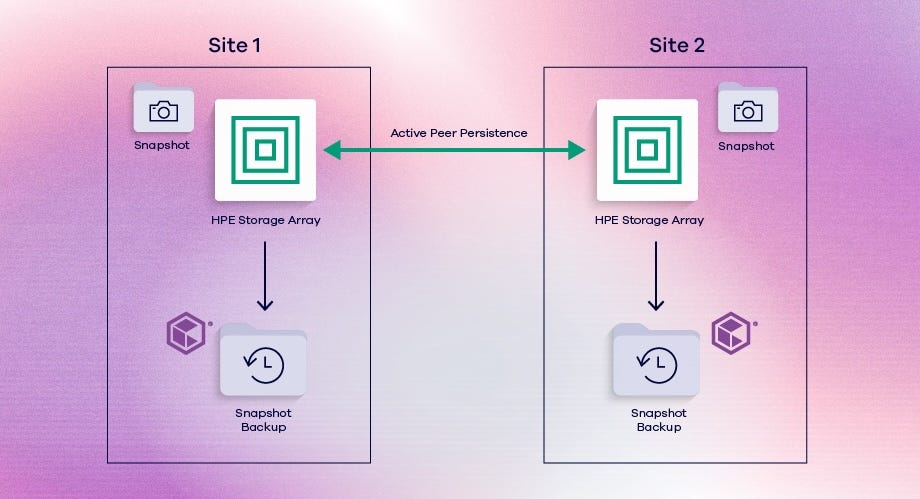
Commvault’s deep integration with HPE storage platforms includes advanced snapshot management capabilities that streamline the protection of large databases, medical imagery, and other data-intensive workloads. Building on this, our recent milestone is Commvault’s new integration with HPE’s Active Peer Persistence technology.

Currently available in HPE Alletra 9000 and HPE Alletra Storage MP B10000, HPE’s Active Peer Persistence enables synchronous replication across two geographically separated storage arrays, automatically failing over from one site to another during an outage without any disruption. This continuous availability is crucial for mission-critical applications that require minimal downtime.

With our new integration, Commvault detects when two HPE storage arrays are in an Active Peer Persistence configuration and snaps both arrays simultaneously, backing up each locally. Commvault’s robust data management tools then allow businesses to send extra copies of data to tape (HPE StoreEver), cloud, or other storage options, supporting compliance and adding another layer of data security.

Benefícios da integração para empresas orientadas por dados

Essa integração traz benefícios significativos para os clientes que buscam maximizar a resiliência, reduzir o tempo de inatividade e otimizar os processos de Backup and Recovery em ambientes distribuídos.

  • Continuous availability: Mission-critical applications benefit from uninterrupted access to data, even in the event of planned or unplanned outages.
  • Network efficiency: By allowing data recovery directly from either primary or secondary arrays, the integration reduces the requirement for additional copies, reducing the overall load on network resources.
  • Enhanced compliance: Commvault’s flexible data management enables additional copies of data to meet various regulatory and compliance needs.

A parceria entre a Commvault e a HPE exemplifica nosso compromisso comum em oferecer soluções de proteção de dados modernas, escaláveis e sustentáveis.

“Partnering with HPE to support Active Peer Persistence underscores our dedication to delivering solutions that drive business continuity and operational efficiency,” said Jeff Carlat, Director – WW Alliances at Commvault. “Together, we are equipping our customers with the tools they need to navigate complex data environments with confidence.”

Learn more at hpe.com/storage.

More related posts


Thumbnail_Blog-Dangerous-Silos-IDC-Resops-2026 (1)

The Importance of Recovery Point Objective (RPO) in Your Business Continuity Plan

Read more about The Importance of Recovery Point Objective (RPO) in Your Business Continuity Plan
Thumbnail_Blog-IDC-Resops-2026

Business Continuity Planning for the Cloud-Native Era

Read more about Business Continuity Planning for the Cloud-Native Era
Thumbnail_Blog-Bringing-Trust-to-CVE-2026

Demystifying SOC 2 Data Protection Requirements

Read more about Demystifying SOC 2 Data Protection Requirements

O Readiverse é um recurso abrangente, desenvolvido para ajudar pessoas e organizações a se manterem preparadas no campo em constante evolução da resiliência cibernética. É o destino definitivo para conhecer as melhores práticas e adquirir conhecimento prático sobre resiliência cibernética.

No Readiverse, você pode participar de diversos formatos de aprendizagem que atendem a diferentes necessidades e horários. Seja o desafio de exercícios simulados como o “Minutes to Meltdown”, a profundidade das certificações e oficinas, a conveniência dos vídeos tutoriais ou o espírito colaborativo do aprendizado em comunidade, o Readiverse tem de tudo.

Nossa plataforma vai além dos métodos tradicionais de aprendizagem, oferecendo conteúdo interativo e dinâmico para que você esteja bem preparado para lidar com as mais recentes ameaças cibernéticas.

Junte-se aoReadiversehoje mesmo para aprimorar suas defesas cibernéticas e fazer parte de uma comunidade proativa dedicada à excelência em segurança cibernética.

What’s new in the Readiverse?

O Readiverse agora oferece uma certificação online gratuita e autodirigida em resiliência cibernética.

Essa nova certificação proporciona aos profissionais de TI e segurança o conhecimento e as habilidades necessárias para construir uma defesa robusta contra ameaças cibernéticas em apenas 4 horas.

This course focuses on the fundamental principles of cyber resilience, covering topics such as early warning systems, threat detection, and advanced recovery techniques.  

Os participantes adquirem experiência prática na configuração e integração das soluções da Commvault, incluindo o domínio da técnica deCleanroom to minimize downtime and data loss. 

Through a blend of self-paced e-learning modules and hands-on lab sessions, participants gain the practical skills and knowledge to protect their organizations’ assets. And with a certification in hand, they’ll have the confidence and peace of mind that they have the latest skills and knowledge in cyber resilience.

Os clientes podem acessar os cursos do Readiverse usando suas credenciais da CommvaultSaiba mais no SHIFT 2025, enquanto os parceiros podem acessar os cursos por meio doPortal de Parceiros da Commvault.

More related posts


Thumbnail_Blog-Dangerous-Silos-IDC-Resops-2026 (1)

The Importance of Recovery Point Objective (RPO) in Your Business Continuity Plan

Read more about The Importance of Recovery Point Objective (RPO) in Your Business Continuity Plan
Thumbnail_Blog-IDC-Resops-2026

Business Continuity Planning for the Cloud-Native Era

Read more about Business Continuity Planning for the Cloud-Native Era
Thumbnail_Blog-Bringing-Trust-to-CVE-2026

Demystifying SOC 2 Data Protection Requirements

Read more about Demystifying SOC 2 Data Protection Requirements

À medida que as organizações passam a depender cada vez mais de plataformas de Software como Serviço (SaaS), como o Microsoft 365 e o Salesforce, para operações essenciais aos negócios, a proteção abrangente desses ambientes tornou-se essencial.

While many organizations assume that SaaS providers offer complete data protection, most operate under a shared responsibility model where customers remain responsible for data backup, recovery, and security. Commvault’s SaaS protection capabilities deliver comprehensive security for these critical environments.

A Importância da Proteção do SaaS

A adoção cada vez mais rápida de plataformas SaaS criou desafios críticos de proteção:

  • A maioria dos provedores de SaaS opera sob um modelo de responsabilidade compartilhada.
  • As organizações são responsáveis por proteger seus dados de SaaS contra perda, corrupção e acesso não autorizado.
  • As ferramentas nativas de proteção de SaaS costumam apresentar limitações significativas em termos de retenção, granularidade e segurança.
  • SaaS environments increasingly contain an organization’s most sensitive operational data.

Esses fatores tornam a proteção de SaaS de terceiros essencial para uma segurança e conformidade abrangentes.

Recursos de proteção do Microsoft 365

Commvault® Cloud Backup & Recovery for Microsoft 365 delivers SaaS resilience and recovery capabilities specifically designed to provide protection from deletion, corruption, and attack. This includes:

Proteção do Exchange Online:
  • Proteção para os aplicativos do Microsoft 365.
  • Oferece opções de Recovery detalhadas para caixas de correio, e-mails, anexos e outros componentes do Exchange Online.
Proteção do SharePoint Online e do OneDrive:
  • Preserva as permissões dos documentos, o histórico de versões e os metadados.
  • Permite a recuperação granular de documentos individuais, bibliotecas ou sites inteiros.
Proteção das equipes:
  • Armazena as conversas, os arquivos, os canais e as configurações das equipes.
  • Permite a Recovery tanto granular quanto completa do Teams.

Recursos de proteção do Salesforce

A Commvault amplia sua proteção SaaS para ambientes do Salesforce, incluindo:

  • Abrangendo tanto objetos padrão quanto objetos personalizados no Salesforce.
  • Preservação das relações entre objetos para uma Recovery completa.
  • Preenchimento, mascaramento e reidratação de ambientes sandbox para testes acelerados.
  • Armazenamento ilimitado, retenção ilimitada e protocolos avançados (como o FedRAMP High) incorporados.

Essa proteção abrangente do Salesforce garante que os dados críticos de clientes e vendas permaneçam seguros e possam ser recuperados.

Features avançadas de segurança para SaaS

Além do Backup and Recovery básico, a Commvault oferece recursos de segurança de nível empresarial para ambientes SaaS.

Maior segurança dos dados

A Commvault implementa uma segurança abrangente para dados de SaaS:

  • A plataforma oferece recursos de segurança incorporados ao projeto, com imutabilidade, isolamento físico e acesso de confiança zero integrados.
  • A solução oferece o Commvault AirGap como um destino de armazenamento em nuvem integrado, o que facilita a adoção, por parte das equipes de TI, do armazenamento em nuvem com isolamento físico (air gap) para reduzir riscos.
  • Essas features de segurança protegem os dados do SaaS tanto contra ameaças externas quanto contra riscos internos.

Conformidade e Governança

A Commvault oferece recursos de conformidade para dados de SaaS:

  • A plataforma oferece suporte à retenção, às políticas e à capacidade de recuperação padronizadas em cargas de trabalho híbridas diversas, incluindo aplicativos SaaS.
  • A solução ajuda as organizações a implementar uma governança consistente em todos os ambientes SaaS.
  • Esses recursos ajudam a atender aos requisitos regulatórios relativos à proteção e retenção de dados.

Gerenciamento Unificado de Proteção SaaS

A Commvault oferece gerenciamento consistente em toda a proteção de SaaS:

  • A plataforma elimina a complexidade associada ao uso de vários consoles por meio de um gerenciamento unificado.
  • A solução oferece suporte à retenção, às políticas e à capacidade de recuperação padronizadas em cargas de trabalho híbridas diversas, incluindo aplicativos SaaS como o M365, o Dynamics 365, o Salesforce e o Google Workspace.
  • Essa abordagem unificada simplifica o gerenciamento da proteção em várias plataformas SaaS.

O impacto nos negócios de uma proteção abrangente para SaaS

For organizations, Commvault’s SaaS protection capabilities deliver several significant business advantages:

Continuidade de negócios aprimorada

A proteção abrangente do SaaS garante a continuidade das operações críticas:

  • The solution provides fast and automated backup, flexible and granular restore, and   scalable and unlimited storage.
  • A plataforma oferece proteção contra exclusão, corrupção e ataques, com recursos de Backup and Recovery para ambientes do Microsoft 365 e do Salesforce.
  • Esses recursos ajudam a minimizar os transtornos causados pela perda ou corrupção de dados em ambientes SaaS.

Preparação Simplificada para a Conformidade

Commvault’s SaaS protection helps streamline efforts to comply with various industry regulations:

  • A plataforma oferece suporte a políticas padronizadas de retenção e recuperabilidade para ajudar a atender aos requisitos de conformidade.
  • Os recursos de proteção, backup e restauração permitem a preservação de dados para fins de conformidade.
  • Essas features simplificam a auditoria e a elaboração de relatórios para atender aos requisitos regulatórios.

Risk de segurança reduzido

Features avançadas de segurança minimizam os riscos aos dados do SaaS, já que a solução inclui imutabilidade, isolamento físico (air gapping) e acesso zero-trust integrados.

Proteção de SaaS para ambientes críticos

As organizations increasingly depend on SaaS platforms for mission-critical operations, comprehensive protection has become essential for business continuity, security, and compliance. Commvault’s superior capabilities for Microsoft 365 and Salesforce protection deliver significant advantages:

  • Comprehensive coverage: Protection for all aspects of SaaS environments, not just the most common elements.
  • Granular recovery: Precise restoration options that minimize disruption and data loss.
  • Enhanced security: Integrated protection against modern threats targeting SaaS data.
  • Simplified compliance readiness: Comprehensive capabilities for helping organizations meet regulatory requirements.

Para organizações que levam a sério a proteção de seus ambientes SaaS essenciais à missão, a Commvault representa uma solução abrangente para proteger empresas, que elimina lacunas e oferece Recovery completo quando necessário.


Referências e notas de validação

Referências principais:
1. Documentação da Commvault sobre proteção de SaaS para o Microsoft 365 (Documento 3)
2. Recursos de proteção da Commvault para o Salesforce (Documento 3)
3. Recursos de segurança para proteção de SaaS (Documentos 3, 21)


Requisitos de validação:
1. Verificar os recursos específicos de proteção para cada aplicativo do Microsoft 365 (Exchange, SharePoint, Teams)
2. Confirmar as opções de Recovery granular para o Microsoft 365 e o Salesforce
3. Validar os recursos de segurança disponíveis especificamente para a proteção
de SaaS 4. Verificar os recursos e as limitações de retenção de dados
de SaaS 5. Confirmar quaisquer certificações ou recursos específicos de conformidade para a proteção de SaaS


More related posts


Thumbnail_Blog-Dangerous-Silos-IDC-Resops-2026 (1)

The Importance of Recovery Point Objective (RPO) in Your Business Continuity Plan

Read more about The Importance of Recovery Point Objective (RPO) in Your Business Continuity Plan
Thumbnail_Blog-IDC-Resops-2026

Business Continuity Planning for the Cloud-Native Era

Read more about Business Continuity Planning for the Cloud-Native Era
Thumbnail_Blog-Bringing-Trust-to-CVE-2026

Demystifying SOC 2 Data Protection Requirements

Read more about Demystifying SOC 2 Data Protection Requirements

As we approach the end-of-life for Actifio on-premises solutions, previsto para 30 de junho de 2025, it’s crucial for Managed Service Providers (MSPs) to prepare for the transition. After this date, Actifio will cease to provide updates for security, reliability, and performance, which could significantly impact MSPs relying on this platform for on-premises backup and disaster recovery.

O Desafio

O prazo que se aproxima exige que os MSPs migrem seus clientes para uma alternativa robusta, a fim de manter a proteção e a segurança ininterruptas dos dados. Essa transição requer uma avaliação cuidadosa das possíveis alternativas, um planejamento detalhado da migração e uma execução sem contratempos para manter a confiança dos clientes e a integridade dos dados.

A Oportunidade

Esse período de mudanças representa uma oportunidade perfeita para que os MSPs aprimorem sua oferta de serviços por meio da adoção de uma solução mais avançada e abrangente. A Commvault se destaca como uma opção superior, oferecendo amplos recursos de proteção de dados e Features inovadoras capazes de elevar a qualidade do serviço que os MSPs prestam aos seus clientes.

Por que escolher a Commvault?

Comprehensive data protection: Commvault delivers an extensive range of data protection services, including state-of-the-art backup and recovery, disaster recovery, and proactive data management. It supports a diverse set of workloads and applications, creating a holistic approach to data safety.

Scalability and flexibility: Designed to accommodate any business size, Commvault’s scalable solutions allow MSPs to tailor services to meet specific client needs, adapting effortlessly as those needs evolve.

Advanced features: With features like deduplication, compression, and encryption, Commvault not only optimizes storage but also fortifies data security. Its automation tools further streamline operations, reducing the administrative load on MSPs.

Enhanced cyber resiliency: Commvault offers robust defenses against modern cyber threats, including ransomware. Its comprehensive security measures, such as immutable backups and anomaly detection, provide MSPs and their clients with peace of mind.

MSP-centric programs: Commvault’s dedicated MSP programs offer tailored resources, support, and flexible pricing models, all designed to help MSPs thrive.

Mudança para a Commvault

A Commvault simplifica o processo de migração com ferramentas e orientação especializada para garantir uma transição tranquila do Actifio. Nossa equipe está empenhada em apoiar os MSPs em todas as etapas do processo, desde o planejamento inicial até a execução completa.

Principais benefícios para os MSPs
  • Enhanced service offerings: By leveraging Commvault’s comprehensive solutions, MSPs can expand their range of services, increasing their appeal to current and potential clients.
  • Increased efficiency: Automation and streamlined operations reduce costs and improve service delivery, boosting MSPs’ bottom line.
  • Improved profitability: With MSP-friendly pricing and resource allocation, Commvault helps MSPs enhance their profitability and operational efficiency.

Conclusão: Abraçando o futuro com a Commvault

The end of Actifio’s on-premises offerings marks a critical point for MSPs to reassess their data protection strategies. Commvault stands ready to help MSPs transition smoothly, delivering enhanced service capabilities, operational efficiency, and increased profitability in a post-Actifio landscape.

Don’t delay your preparations. Partner with Commvault today and set the stage for a more resilient, profitable future in managed services.

More related posts


Thumbnail_Blog-Dangerous-Silos-IDC-Resops-2026 (1)

The Importance of Recovery Point Objective (RPO) in Your Business Continuity Plan

Read more about The Importance of Recovery Point Objective (RPO) in Your Business Continuity Plan
Thumbnail_Blog-IDC-Resops-2026

Business Continuity Planning for the Cloud-Native Era

Read more about Business Continuity Planning for the Cloud-Native Era
Thumbnail_Blog-Bringing-Trust-to-CVE-2026

Demystifying SOC 2 Data Protection Requirements

Read more about Demystifying SOC 2 Data Protection Requirements

When evaluating enterprise cyber resilience solutions, organizations face an important architectural choice between appliance-based approaches like Rubrik’s and software-defined platforms like Commvault’s.

Embora ambos os fornecedores ofereçam recursos de proteção de dados, as diferentes abordagens arquitetônicas geram implicações de custo distintas que se tornam evidentes ao longo de todo o ciclo de vida da solução.

Abordagens arquitetônicas: baseada em módulos versus baseada em plataforma

Rubrik’s Appliance-Centric Model

Rubrik’s approach centers on physical or virtual appliances that serve as the primary deployment model:

  • A capacidade de proteção é aumentada em incrementos fixos por meio de Appliances adicionais.
  • O dimensionamento geralmente exige a implantação de novas Appliances quando são atingidos os limites de desempenho ou capacidade.
  • Rubrik’s solution uses an appliance-based architecture where data protection capacity comes in predefined sizing options.
Commvault’s Software-Defined Platform

A Commvault utiliza uma arquitetura modular definida por software:

  • As opções de implantação incluem soluções exclusivamente de software, arquiteturas de referência, sistemas convergentes ou implementações baseadas em nuvem.
  • Os recursos podem ser dimensionados de forma independente e incremental, com base nos requisitos de desempenho ou capacidade.
  • A plataforma Commvault pode ser implantada em uma infraestrutura existente, em Appliances dedicadas ou como um serviço em nuvem.
Implicações financeiras das diferenças arquitetônicas

As diferenças arquitetônicas entre essas soluções geram várias considerações importantes em relação aos custos:

1. Scaling flexibility and efficiency

As abordagens baseadas em Appliances geralmente exigem o provisionamento de capacidade em incrementos pré-determinados, o que pode levar ao provisionamento excessivo quando as necessidades reais se situam entre as opções de tamanho dos Appliances. De acordo com analistas do setor, esse escalonamento em saltos pode resultar em capacidade ociosa ao longo de todo o ciclo de vida da implantação.

O desempenho e a capacidade estão intimamente ligados. Para melhorar o desempenho, é necessário adicionar um nó Rubrik adicional, o que também acarreta o custo de capacidade de armazenamento extra. Da mesma forma, para aumentar a capacidade de armazenamento, os clientes também precisam pagar por recursos adicionais de desempenho (CPU, RAM). Isso resulta em um aumento do TCO.

Commvault’s platform modular approach enables more precise scaling, allowing organizations to spend as per actual requirements. This helps reduce resource wastage and improves cost efficiency.

2. Cloud integration approach

À medida que as organizações adotam serviços em nuvem, a abordagem arquitetônica tem um impacto significativo nos custos de proteção na nuvem:

As soluções de plataforma podem se integrar diretamente a serviços em nuvem por meio de APIs nativas. A Commvault oferece integração direta com serviços em nuvem sem a necessidade de Appliances virtuais, o que pode reduzir os recursos necessários para a proteção em nuvem.

Fatores do custo total de propriedade

Ao avaliar o custo total de propriedade ao longo de um período de três a cinco anos, as organizações devem levar em consideração vários fatores-chave:

Cost Category Appliance Approach Impact Platform Approach Advantage
Custos de infraestrutura Possível provisionamento excessivo Implantação com dimensionamento adequado
Custos de proteção na nuvem Appliances virtuais em cada ambiente Integração direta com serviços em nuvem
Custos de escalonamento Aumentos em saltos Incrementais com base nas necessidades
Atualização tecnológica Ciclos completos de substituição de Appliances Atualizações no nível dos componentes

Além do custo: considerações sobre a capacidade

As diferenças arquitetônicas vão além das implicações de custo e geram distinções em termos de capacidade:

1. Multi-cloud support

As arquiteturas de plataforma geralmente oferecem recursos mais consistentes em ambientes de nuvem, por meio do uso de uma base de código comum com pontos de integração específicos para a nuvem. Isso pode simplificar a proteção em diversas implantações em nuvem.

2. Workload coverage

As plataformas definidas por software costumam oferecer suporte a uma gama mais ampla de cargas de trabalho, incluindo sistemas legados, aplicativos especializados e diversos tipos de infraestrutura. Isso pode eliminar a necessidade de múltiplas soluções de proteção.

3. Security integration

The architectural approach also impacts security capabilities. Commvault’s platform includes integrated security features like threat detection, while appliance-focused solutions may require additional components for comprehensive security. Rubrik’s data security solution is delivery through their SaaS, severely limiting functionality in environments where cloud connectivity is restricted or prohibited, such as dark sites or isolated clusters.

Considerações estratégicas sobre arquitetura

The choice between Rubrik’s appliance-based approach and Commvault’s platform architecture represents a strategic decision with long-term implications.

As organizações devem avaliar essas soluções com base em suas necessidades específicas, levando em conta não apenas os custos iniciais, mas também fatores de longo prazo, como eficiência de escalabilidade, despesas operacionais, integração com a nuvem e questões de segurança. Ao compreender as diferenças arquitetônicas e suas implicações em termos de custo, as organizações podem tomar decisões mais bem fundamentadas sobre seus investimentos em resiliência cibernética.

More related posts


Thumbnail_Blog-Dangerous-Silos-IDC-Resops-2026 (1)

The Importance of Recovery Point Objective (RPO) in Your Business Continuity Plan

Read more about The Importance of Recovery Point Objective (RPO) in Your Business Continuity Plan
Thumbnail_Blog-IDC-Resops-2026

Business Continuity Planning for the Cloud-Native Era

Read more about Business Continuity Planning for the Cloud-Native Era
Thumbnail_Blog-Bringing-Trust-to-CVE-2026

Demystifying SOC 2 Data Protection Requirements

Read more about Demystifying SOC 2 Data Protection Requirements

The shift to cloud computing has become more than a strategic advantage – it’s now a business necessity. According to Gartner, by 2028, cloud computing will shift from being a technology disruptor to becoming a necessary component for maintaining business competitiveness. But with this transformation comes a critical challenge that most organizations haven’t fully addressed: true cyber resilience.

Os 70% de risco ocultos nos ambientes em nuvem

Here’s a startling reality that most cloud and security leaders don’t realize: According to our research, in a typical cloud environment, application data makes up only 20% to 30% of the resources, while 50% to 70% consists of cloud configurations that remain completely unprotected by traditional backup solutions.

Pense no que isso significa durante um incidente cibernético ou uma interrupção no serviço. Sua solução de backup pode restaurar seus bancos de dados e arquivos, mas você também precisa levar em consideração:

  • Equipamentos de balanceamento de carga e grupos de segurança.
  • Configurações de VPC e políticas de rede.
  • Configurações de orquestração de contêineres.
  • Gateways de API e dependências de microsserviços.
  • Configurações de gerenciamento de identidade e acesso.
  • Modelos de Infraestrutura como Código.

This is where traditional backup falls catastrophically short.

Além da proteção de dados: a revolução da Recovery centrada em aplicativos

Commvault® Cloud Rewind represents a fundamental shift from data-centric to application-centric recovery. Rather than simply backing up and restoring data files, Cloud Rewind treats your entire cloud environment as code – discovering through collecting configuration metadata not application data, and rebuilding cloud ecosystems with all their dependencies intact.

A vantagem do Cloud Rewind: Recovery como Código

Cloud Rewind’s patented Recovery-as-Code approach automatically codifies your application’s cloud resources, dependencies, and data for hyperfast rebuild capabilities. This isn’t just backup ­– it’s a complete Cloud Time Machine that can rewind your entire environment to any point in time.

Os principais recursos incluem:
Descoberta e aprendizado contínuos:
  • Aproveite as APIs nativas de backup e instantâneos fornecidas por plataformas de nuvem, como AWS, Azure e GCP.
  • Mapeia dependências complexas de aplicativos em tempo real.
  • Se adapta à medida que seus ambientes com escalonamento automático e balanceamento de carga mudam.
  • Não são necessários agentes, instalação nem manutenção.
Proteção abrangente:
  • Protege as configurações e dependências na nuvem para uma reconstrução rápida.
  • Cópias em um momento específico com backups incrementais contínuos.
  • Gerenciamento de replicação multirregional e entre nuvens.
  • Proteção sem agente para aplicativos com escalonamento automático.
Orquestração inteligente da recuperação:
  • Recovery com um clique de ambientes completos com várias pilhas e suas dependências.
  • Recovery entre zonas, entre regiões, entre contas e entre locatários.
  • Simulações e testes automatizados de resiliência.
  • Sequenciamento com consideração de dependências para aplicações complexas.

Por que os concorrentes tradicionais ficam aquém das expectativas

While competitors like Cohesity, Rubrik, and Veritas focus primarily on data protection, they fundamentally miss the application-centric nature of modern cloud environments. Even traditional cloud service providers, while responsible for protecting customer data, do not secure the underlying cloud infrastructure – leaving customers with limited ability to minimize downtime and recover quickly in the event of a cyber incident.

As desvantagens das ferramentas tradicionais de resiliência incluem:
  • Limited scope: They protect data but ignore the 70% of cloud resources that are configurations.
  • Manual resilience testing: Time-consuming, cumbersome, and often not done enough to establish cyber resilience.
  • Fragmented approach: Applications and infrastructure are treated separately, creating recovery gaps.
  • Legacy architecture: Solutions adapted from on-premises thinking rather than cloud-native design.

O Cloud Rewind elimina essas limitações ao tratar os aplicativos e sua infraestrutura subjacente, camadas de dados, rede e segurança como um sistema unificado e baseado em código.

Os três pilares da resiliência cibernética

O Cloud Rewind oferece resiliência cibernética abrangente por meio de três recursos principais:

1. Reduzir o risco:
  • A análise contínua de desvios identifica erros de configuração antes que se transformem em vulnerabilidades.
  • Monitoramento proativo da resiliência em todos os recursos em nuvem.
  • Backups imutáveis impedem a criptografia por ransomware.
2. Aumentar a Readiness.
  • Simulações automatizadas de resiliência testam os procedimentos de Recovery.
  • Não é necessário usar manuais de procedimentos nem scripts.
  • Proteção sempre atualizada, com capacidade para mais de 100.000 recursos na nuvem.
3. Ative a Recovery.
  • “Recovery como Código” ajuda a eliminar os processos manuais de reconstrução.
  • A flexibilidade na Recovery entre nuvens evita a dependência de um único fornecedor.
  • A restauração com um clique garante a continuidade dos negócios e ajuda a reduzir o tempo de inatividade imprevisto.

Perspectivas para o futuro: a era da recuperação contínua

As cloud environments become increasingly complex with microservices, containers, and serverless architectures, the gap between traditional backup and true resilience will only widen. Cloud Rewind’s Recovery-as-Code approach represents the future of continuous business – where applications and their complete ecosystems can be rebuilt near-instantly, automatically, and reliably.

For organizations serious about cyber resilience, the question isn’t whether you need application-centric recovery – it’s whether you can afford to operate without it. In an era where application availability directly impacts business success, Cloud Rewind provides the comprehensive protection that competitive offerings simply cannot match.

The time to act is now. Every day your organization operates without complete application protection is another day of unnecessary risk. Cloud Rewind helps reduce unknown vulnerabilities by continually discovering and mapping your cloud environment, thus helping enable your business to rewind, recover, and rebuild from cyber incidents in minutes, not weeks.

Saiba mais sobre comoRetrocesso Cloudpode ajudar sua organização a reverter e reconstruir aplicativos dinâmicos e distribuídos com extrema rapidez após interrupções de serviço e ataques de ransomware.

More related posts


Thumbnail_Blog-Dangerous-Silos-IDC-Resops-2026 (1)

The Importance of Recovery Point Objective (RPO) in Your Business Continuity Plan

Read more about The Importance of Recovery Point Objective (RPO) in Your Business Continuity Plan
Thumbnail_Blog-IDC-Resops-2026

Business Continuity Planning for the Cloud-Native Era

Read more about Business Continuity Planning for the Cloud-Native Era
Thumbnail_Blog-Bringing-Trust-to-CVE-2026

Demystifying SOC 2 Data Protection Requirements

Read more about Demystifying SOC 2 Data Protection Requirements

Em empresas híbridas, a proteção abrangente em múltiplas nuvens tornou-se essencial para a resiliência cibernética. À medida que as organizações distribuem cargas de trabalho entre data centers locais, várias nuvens públicas e aplicativos SaaS, é fundamental manter uma proteção consistente em todos esses ambientes. O Commvault Cloud oferece vantagens significativas em relação ao Cohesity no que diz respeito à cobertura de cargas de trabalho em ambientes multicloud.

A realidade do multi-cloud

As empresas modernas operam em ambientes de TI complexos que abrangem várias plataformas. De acordo com oFlexera 2025 State of the Cloud Report, 70% of respondents embrace hybrid cloud strategies, using at least one public and one private cloud. This fragmentation creates potential protection gaps, particularly in multi-cloud deployments where native tools may create inconsistent protection and security postures.

Commvault x Cohesity: Comparação da cobertura de cargas de trabalho

Ao avaliar plataformas de proteção multicloud, a cobertura de cargas de trabalho é um diferencial fundamental. A Commvault oferece suporte a cargas de trabalho mais abrangente do que a Cohesity em várias áreas:

Cobertura de cargas de trabalho críticas na nuvem

A Commvault oferece proteção para diversas cargas de trabalho críticas:

  • Oracle Cloud Infrastructure: Commvault provides integration with OCI for protection of applications and databases in Oracle’s cloud environment.
  • Cloud-native databases: Commvault supports a wide range of cloud database services across major cloud providers, including Amazon RDS, Azure SQL, and Google Cloud SQL.
  • S3 object storage: Commvault’s platform includes enterprise-grade protection for large-scale object storage deployments across cloud providers, supporting petabyte-scale environments.

Commvault’s platform provides comprehensive protection across these environments, while Cohesity’s public documentation shows more limited coverage in these specific areas.

Reconhecimento dos analistas

Industry analysts have recognized Commvault’s comprehensive workload coverage. Commvault received recognition in the Forrester Wave™ for Data Resilience Solutions (Q4 2024), with high scores in several criteria, including SaaS platform support and cloud infrastructure protection.

Recursos de integração na nuvem

Além do backup básico, a Commvault oferece integração com diversos serviços nativos da nuvem:

  • Storage tier integration: Support for various cloud storage tiers like Amazon S3 Glacier Deep Archive, Azure Archive Storage, and Google Cloud Storage Archive.
  • Database service integration: Direct integration with managed database services for application-consistent protection with minimal performance impact.
  • Security framework integration: Connections with cloud security services to enable coordinated security responses and improved cyber resilience.

Experiência de gerenciamento unificada

Commvault’s Cloud Command provides a single interface for managing protection across all environments, eliminating the need for multiple management consoles when protecting diverse cloud resources. This unified approach reduces management complexity and improves operational efficiency.

Recursos de mobilidade de dados

A Commvault facilita a movimentação de dados entre ambientes de nuvem para:

  • Recovery de desastres em plataformas de nuvem.
  • Migração de cargas de trabalho entre nuvens.
  • Otimização dos custos de armazenamento por meio de uma estrutura de camadas inteligente.
  • Atender aos requisitos de soberania de dados em implantações globais.

Vantagem de custo

Recovery “a quente” do site:
  • Commvault’s intelligent disaster recovery approach eliminates the financial burden of maintaining duplicate cloud infrastructure for non-critical workloads. Unlike traditional methods that pre-provision expensive “always-on” failover environments, Commvault delays full VM creation until actual disaster scenarios through its meta-data driven replication.
  • Para empresas que gerenciam ambientes multicloud, isso se traduz em milhões de dólares em economia anual por meio da otimização do consumo de nuvem e da eliminação dos custos decorrentes da capacidade ociosa.
  • The solution also enables flexible cross-cloud failover strategies without vendor lock-in – a critical advantage in a hybrid cloud landscape.1
On-demand Cleanroom Recovery for cloud-native environments:
  • Zero infrastructure tax: Unlike legacy solutions requiring dedicated on-premises environments, Commvault provisions isolated recovery spaces in Azure on demand – eliminating 100% of idle infrastructure costs. Organizations pay only for active recovery/testing cycles, converting fixed CapEx into variable OpEx.
  • Continuous resilience validation: Automated weekly recovery testing (vs. costly quarterly manual drills) reduces breach-related downtime costs. Integrated AI identifies “known good” recovery points, accelerating response while minimizing forensic labor expenses.
  • Multi-cloud financial agility: Commvault’s any-to-any recovery architecture prevents vendor lock-in penalties, enabling cost-optimized failovers across AWS/Azure/GCP. Contrast this with rigid single-cloud solutions that incur premium pricing during surge events.2

A integração entre a Cohesity e a Veritas

A fusão entre a Cohesity e a Veritas apresenta possíveis desafios de integração para os clientes. Publicações do setor têm discutido o tempo necessário para integrar essas diferentes plataformas, com a integração completa prevista para levar de 18 a 24 meses. Em contrapartida, a Commvault oferece uma plataforma já integrada, projetada para ambientes híbridos e multicloud.

Proteção completa em múltiplas nuvens

Para organizações que precisam de proteção abrangente em diversos ambientes de nuvem, o Commvault Cloud oferece vantagens significativas em termos de amplitude de cobertura de cargas de trabalho. Com suporte a serviços críticos em nuvem, integração nativa profunda e gerenciamento unificado, a Commvault oferece a proteção completa de que as empresas modernas que utilizam múltiplas nuvens precisam.


1https://documentation.commvault.com/11.38/essential/warm_site_recovery_for_replication_groups.html

2https://documentation.commvault.com/11.38/essential/cleanroom_recovery.html

More related posts


Thumbnail_Blog-Dangerous-Silos-IDC-Resops-2026 (1)

The Importance of Recovery Point Objective (RPO) in Your Business Continuity Plan

Read more about The Importance of Recovery Point Objective (RPO) in Your Business Continuity Plan
Thumbnail_Blog-IDC-Resops-2026

Business Continuity Planning for the Cloud-Native Era

Read more about Business Continuity Planning for the Cloud-Native Era
Thumbnail_Blog-Bringing-Trust-to-CVE-2026

Demystifying SOC 2 Data Protection Requirements

Read more about Demystifying SOC 2 Data Protection Requirements

No episódio 13 do podcast “Resilience Rundown”, Alex Janas, diretor de tecnologia de campo da Commvault, conversa com o apresentador Thomas Bryant, diretor sênior de marketing de produto da Commvault. Os dois abordam a importância da conscientização sobre segurança cibernética, especialmente no contexto do trabalho remoto. A conversa girou em torno de dicas práticas e estratégias para proteger dados pessoais e profissionais em um ambiente de trabalho cada vez mais digital e distribuído.

A filosofia do Zero Trust

Alex emphasized a philosophy of considering everything suspect. Whether you’re an employee using a home network or a business managing remote workers, the principle of zero trust is crucial.

This means treating every network, device, and interaction as potentially hostile. For employees, this translates to using trusted VPNs to tunnel all traffic, including DNS, through secure connections. Even if a network requires a password and authentication, it’s essential to remain vigilant, as you never know who else has accessed it.

Vulnerabilidades da rede doméstica

Um ponto importante destacado por Alex é a vulnerabilidade dos equipamentos de rede doméstica, como os roteadores fornecidos pelos provedores de internet. Esses dispositivos costumam ter recursos de segurança limitados. As margens de lucro desses aparelhos são baixas, o que resulta em uma vida útil curta e na falta de atualizações de segurança contínuas. Isso os torna alvos principais para agentes mal-intencionados, que podem usá-los para roubar informações pessoais, bloquear dados ou até mesmo invadir seu ambiente de trabalho.

Alex recommends investing in more reputable and capable networking devices that offer better security and longer support. While this may require some extra effort in setup and maintenance, it’s a worthwhile investment to protect your data and privacy.

O panorama das ameaças

As ameaças às redes domésticas e aos dispositivos pessoais são multifacetadas. Pessoas mal-intencionadas podem ter você como alvo para roubar informações confidenciais, como dados de contas bancárias, ou usar seu dispositivo como um bot em sua infraestrutura de comando e controle.

Outra tática comum é aproveitar eventos publicados nas redes sociais, como aniversários de trabalho, para criar e-mails de phishing convincentes. Esses e-mails geralmente parecem ter sido enviados pelo RH e solicitam que você clique em links para acessar benefícios ou atualizações, o que pode levar a infecções por malware ou vazamentos de dados.

Cultivando uma paranóia saudável

Alex sugere que um pouco de paranóia saudável pode ser muito útil para se proteger. Ser cauteloso e reservar um momento para verificar as comunicações pode evitar muitas armadilhas comuns de segurança cibernética. Por exemplo, se você receber um e-mail com um link, digite o URL manualmente no navegador, em vez de clicar nele. Se alguém ligar alegando ser de uma empresa, desligue e ligue de volta para a empresa usando um número verificado.

Dicas práticas para a segurança doméstica

  1. Use a trusted VPN: Tunnel all your traffic, including DNS, through a secure connection to protect your data.
  2. Invest in better networking equipment: Consider purchasing a router from a reputable company that offers regular security updates.
  3. Be cautious with links and attachments: Verify URLs and attachments before clicking, especially on mobile devices where it can be harder to inspect links.
  4. Monitor your network: Regularly check your home network for suspicious activity.
  5. Educate yourself: Stay informed about the latest cybersecurity threats and best practices.

Reduza seus riscos com vigilância

In a world where remote work is the norm, cybersecurity awareness is more critical than ever. By adopting a zero-trust mindset, investing in better home networking equipment, and being cautious with online interactions, you can significantly reduce the risk of becoming a victim of cybercrime. For businesses, it’s essential to monitor and protect remote workers’ devices and networks, treating every environment as potentially hostile.

Check out the full episode of the podcast Saiba mais no SHIFT 2025.

More related posts


Thumbnail_Blog-Dangerous-Silos-IDC-Resops-2026 (1)

The Importance of Recovery Point Objective (RPO) in Your Business Continuity Plan

Read more about The Importance of Recovery Point Objective (RPO) in Your Business Continuity Plan
Thumbnail_Blog-IDC-Resops-2026

Business Continuity Planning for the Cloud-Native Era

Read more about Business Continuity Planning for the Cloud-Native Era
Thumbnail_Blog-Bringing-Trust-to-CVE-2026

Demystifying SOC 2 Data Protection Requirements

Read more about Demystifying SOC 2 Data Protection Requirements

We’re thrilled to announce that Commvault® Cloud Backup & Recovery for Google Workspacejá está disponível para o público em geral noGoogle Cloud Marketplace, so you can start safeguarding your critical Google Workspace data today. 

In today’s fast-paced business world, collaboration and efficiency are the lifeblood of success. Google Workspace, a suite of secure, online communication and collaboration tools has become a go-to platform for organizations seeking these advantages. With this cloud-based convenience comes a critical challenge that is often overlooked: data protection.

Uma interface única para todas as suas necessidades de proteção de aplicativos SaaS

SaaS applications are not immune to data loss. Accidental deletions, ransomware attacks, and other unforeseen events can wreak havoc on productivity. According to a recent ESG survey, when asked about the most common causes of SaaS data loss, respondents cited 34% from malicious deletions due to malicious attacks and 33% from accidental deletions.1 Given these risks, protecting the data within the SaaS applications that run your business is not just a good idea – it’s essential.

Google Workspace is a highly resilient platform and goes to great lengths to secure customer data, including built-in threat prevention, zero-trust access, and data protection controls. However, businesses typically adopt multiple SaaS apps to provide their teams with the tools they need to get the work done.

Contar com uma maneira consistente de fazer backup de forma simples, restaurar rapidamente e reter com flexibilidade os dados críticos de aplicativos SaaS significa maior produtividade, redução de riscos e custos mais baixos para sua organização de TI. Com a Commvault, os clientes obtêm uma plataforma comum de proteção de dados que abrange ambientes locais, nuvem e SaaS, oferecendo proteção cibernética resiliente contra ransomware, agentes mal-intencionados internos e exclusão acidental.

Now Available on Google Cloud Marketplace: Commvault Cloud Backup & Recovery for Google Workspace 

Commvault Cloud Backup & Recovery for Google Workspace delivers comprehensive, end-to-end enterprise-grade protection for Gmail, Google Drive, and Shared Drives, helping to keep valuable data safe and recoverable – all with the simplicity of SaaS. Commvault offers bundled Google Cloud Storage for Google Workspace protection while providing the broadest workload protection across SaaS, hybrid, and cloud-native workloads. Some key features and benefits include:

  • Comprehensive coverage across Gmail, Google Drive, and Shared Drive data. Plus, automatic discovery of new users and data for proactive protection.
  • Data isolation for air-gapped protection from malicious insiders and ransomware attacks.
  • Granular recovery with flexible point-in-time, in-/out-of-place, and item-level restore options.
  • Long-term, extended retention of active and deleted users with bundled Google Cloud Storage options to maintain SLA compliance.
  • Single, unified solution to protect data in Google Workspace and other SaaS, hybrid, and cloud-native workloads.
  • Simple cloud delivery with no hardware, maintenance, or upfront capital investments required.

“Bringing the Commvault Cloud Backup & Recovery to Google Cloud Marketplace will help customers quickly deploy, manage, and grow the data protection platform on Google Cloud’s trusted, global infrastructure,” said Dai Vu, Managing Director, Marketplace & ISV GTM Programs at Google Cloud. “Commvault can now securely scale and support customers on their digital transformation journeys.” 

Don’t let data loss disrupt your productivity. Take control with Commvault Cloud Backup & Recovery for Google Workspace. To learn more, visit commvault.com/platform/google-workspace. Pronto para começar?Solicite uma demonstraçãopara ver nossa solução em ação.

1  Tech Target, ““Atenção: há muitas maneiras de perder dados de SaaS,” May 2023

More related posts


Thumbnail_Blog-Dangerous-Silos-IDC-Resops-2026 (1)

The Importance of Recovery Point Objective (RPO) in Your Business Continuity Plan

Read more about The Importance of Recovery Point Objective (RPO) in Your Business Continuity Plan
Thumbnail_Blog-IDC-Resops-2026

Business Continuity Planning for the Cloud-Native Era

Read more about Business Continuity Planning for the Cloud-Native Era
Thumbnail_Blog-Bringing-Trust-to-CVE-2026

Demystifying SOC 2 Data Protection Requirements

Read more about Demystifying SOC 2 Data Protection Requirements

Whether it’s a sudden market shift, a cybersecurity breach, or a regulatory change, the unexpected can strike at any moment. Being prepared is key to navigating these challenges successfully. This is where risk management and the Digital Operational Resilience Act (DORA) – a regulatory framework that takes effect in January to help protect financial institutions from disruptions like cyberattacks – come into play.

DORA applies to a wide range of financial entities in the European Union, including credit institutions, investment firms, payment institutions, and electronic money institutions. It also covers critical third-party service providers. Let’s explore how DORA’s risk management requirements can help you stay ahead of the game and keep your organization resilient in the face of uncertainty.

O que é gestão de riscos?

Risk management is the process of identifying, assessing, and prioritizing risks followed by the application of resources to minimize, monitor, and control the probability or impact of unfortunate events. Effective risk management isn’t just about avoiding disasters; it’s about creating a robust framework that supports your strategic goals and enhances your decision-making.

Risk management helps protect your organization’s assets, including financial resources, physical property, and reputation. By identifying potential threats, you can take proactive steps to mitigate them.

Investidores, clientes e funcionários tendem a confiar e apoiar mais uma organização que demonstre um forte compromisso com a gestão de riscos. Compreender os riscos ajuda a tomar melhores decisões estratégicas. Isso permite alocar recursos de forma mais eficaz e concentrar-se nas áreas que realmente importam.

Como a DORA se alinha à gestão de riscos

DORA and risk management are closely aligned, as both focus on preparing for and mitigating potential disruptions. Here’s how DORA’s components fit into a broader risk management strategy:

  1. Risk management framework: DORA requires financial entities to establish a comprehensive risk management framework. This framework should include policies, procedures, and controls to identify, assess, and manage risks. It’s like having a detailed map of potential hazards, allowing you to navigate them more effectively.
  2. Incident reporting: Timely and accurate incident reporting is crucial for maintaining operational resilience. By reporting incidents, you can quickly address issues and learn from them, reducing the likelihood of similar events in the future.
  3. Testing and exercises: Regular testing and exercises are essential for verifying that your systems and processes can handle disruptions. This might include simulated cyberattacks, system outages, or other scenarios. It’s like practicing fire drills to so that everyone knows what to do in an emergency.
  4. Third-Party Dependencies: Many financial entities rely on third-party service providers for various operations. DORA emphasizes the importance of managing these dependencies so that they do not pose a risk to your operational resilience. This involves conducting due diligence, establishing service-level agreements (SLAs), and monitoring performance.

Melhores práticas para gestão de riscos e conformidade com a DORA

  1. Stay Informed: Keep up to date with the latest regulatory changes and industry best practices. This will help you stay ahead of the curve and confirm your risk management framework remains effective.
  2. Collaborate: Work closely with other departments and stakeholders to create and maintain a holistic approach to risk management. Collaboration can help you identify and address risks that might otherwise go unnoticed.
  3. Continuous improvement: Risk management is an ongoing process. Regularly review and update your risk management approach so that it stays relevant to the current state of your organization.
  4. Technology investment: Invest in the right technology to support your risk management efforts. This might include risk management software, cybersecurity tools, and data analytics platforms.
  5. Cultural shift: Foster a culture of operational resilience within your organization. Encourage employees to report potential risks and participate in risk management activities.

O Futuro da Gestão de Riscos e a DORA

As technology continues to evolve, so too will the risks and challenges faced by financial entities. DORA is a step in the right direction, but it’s just the beginning. Here are some trends to watch:

Artificial Intelligence (AI) can help automate risk management processes, making them more efficient and effective. For example, AI can be used to detect and respond to cyber threats in real-time.

Cloud security will become increasingly important as more organizations move to the cloud. DORA’s requirements will likely evolve to address this growing concern.

Regulatory changes are a constant, as governing bodies update their guidelines to address new risks. Stay informed and be prepared to adapt as needed.

Global standards for operational resilience will likely emerge as more countries adopt similar regulatory frameworks. This will make it easier for organizations to operate across different jurisdictions.

Protect Your Organization with a Proactive Approach

Risk management and DORA are powerful tools for preparing for the unexpected. By establishing a robust risk management framework and maintaining DORA compliance, you can help protect your organization’s assets, maintain stakeholder confidence, and achieve your strategic goals. Remember, the key to success is a proactive and continuous approach. Stay informed, collaborate with stakeholders, and invest in the right technology to build a resilient and thriving organization.

With the right tools and strategies, you can turn potential threats into opportunities for growth and improvement. So, take the first step today and start preparing for the unexpected. Your organization’s future depends on it.

Saiba mais sobre como você pode se preparar para a Lei de Resiliência Operacional Digital em nossa série de blogs Explorando a DORA:

More related posts


Thumbnail_Blog-Dangerous-Silos-IDC-Resops-2026 (1)

The Importance of Recovery Point Objective (RPO) in Your Business Continuity Plan

Read more about The Importance of Recovery Point Objective (RPO) in Your Business Continuity Plan
Thumbnail_Blog-IDC-Resops-2026

Business Continuity Planning for the Cloud-Native Era

Read more about Business Continuity Planning for the Cloud-Native Era
Thumbnail_Blog-Bringing-Trust-to-CVE-2026

Demystifying SOC 2 Data Protection Requirements

Read more about Demystifying SOC 2 Data Protection Requirements

In the ever-evolving landscape of financial technology, regulatory compliance has become a critical aspect of business operations. One of the most significant recent developments in this area is the European Union’s Digital Operational Resilience Act (DORA), which aims to enhance the resilience of the financial sector by setting stringent standards for data management and other operational processes. This blog delves into the importance of data management in complying with DORA and how organizations can navigate these new regulations effectively.

O que é o DORA?

A DORA é um marco regulatório abrangente concebido para lidar com os crescentes riscos digitais enfrentados pelo setor financeiro. Ela abrange uma ampla gama de áreas, incluindo a gestão de riscos relacionados às tecnologias da informação e comunicação (TIC), a notificação de incidentes e a supervisão de prestadores de serviços terceirizados. O principal objetivo da DORA é garantir que as instituições financeiras possam manter suas operações e serviços mesmo diante de interrupções digitais, protegendo assim os consumidores e preservando a estabilidade financeira.

A importância do gerenciamento de dados

Data management is at the heart of DORA’s regulatory requirements. Financial institutions must have robust data management practices to maintain the accuracy, integrity, and availability of data. This is crucial for several reasons:

  1. Risk mitigation: Effective data management helps identify and mitigate potential risks. By maintaining accurate and up-to-date data, institutions quickly can detect anomalies and take corrective actions to prevent operational disruptions.
  2. Compliance reporting: DORA mandates detailed incident reporting and regular assessments of ICT risk management. Accurate data is essential for generating these reports and confirming that they meet regulatory standards.
  3. Operational efficiency: Well-managed data can streamline operations, reduce redundancies, and improve decision-making processes. This not only enhances compliance but also boosts overall business performance.
  4. Customer trust: With data breaches and cyberattacks commonplace, maintaining the security and privacy of customer data is paramount. DORA’s data management requirements help build and maintain customer trust.

Principais requisitos de gerenciamento de dados no âmbito da DORA

Para cumprir a DORA, as instituições financeiras devem respeitar vários requisitos essenciais de gestão de dados:

  1. Data governance: Establish a clear and comprehensive data governance framework. This includes defining roles and responsibilities, setting data policies, and making sure that your data management practices are integrated into your overall risk management strategy.
  2. Data quality: Verify that data is accurate, complete, and consistent. This involves implementing data validation processes, regular data audits, and using advanced analytics to monitor data quality.
  3. Data security: Implement robust security measures to protect data from unauthorized access, breaches, and cyber threats. This includes encryption, access controls, and regular security assessments.
  4. Data availability: Data must be available and accessible when needed. This involves having reliable backup and recovery systems, as well as disaster recovery plans.
  5. Data privacy: Comply with data privacy regulations, such as the General Data Protection Regulation (GDPR). This includes obtaining proper consent, anonymizing data where necessary, and providing transparency to customers about how their data is used.
  6. Data lifecycle management: Manage the entire lifecycle of data, from creation to disposal. This includes data retention policies, data archiving, and secure data deletion practices.

Implementação de práticas de gerenciamento de dados

A implementação de práticas eficazes de gestão de dados para cumprir a DORA envolve várias etapas:

  1. Assessment and planning: Conduct a thorough assessment of your current data management practices to identify gaps and areas for improvement. Develop a comprehensive plan that aligns with DORA’s requirements and your business objectives.
  2. Technology investment: Invest in advanced data management technologies, such as data lakes, data warehouses, and data governance tools. These technologies can help automate data validation, security, and privacy processes, making compliance more manageable.
  3. Training and awareness: Educate your employees on the importance of data management and the specific requirements of DORA. Foster a culture of data responsibility and awareness throughout the organization.
  4. Regular audits and reviews: Conduct regular audits and reviews of your data management practices to maintain ongoing compliance. Use the results of these audits to make continuous improvements.
  5. Third-party oversight: If you rely on third-party service providers for data management, they also must comply with DORA. This includes conducting due diligence, signing service-level agreements (SLAs), and monitoring their performance regularly.

Melhores práticas para o gerenciamento de dados

To better understand how to implement DORA’s data management requirements, let’s look at some best practices:

Best Practice: Data Quality Metrics

Utilize métricas de qualidade de dados para monitorar a precisão, a integridade e a consistência dos seus dados. Essas métricas podem ajudá-lo a identificar e resolver problemas relacionados aos dados de forma proativa. A melhoria na qualidade dos dados leva a uma tomada de decisão mais eficaz e a relatórios de conformidade mais confiáveis.

Best Practice: Automated Data Validation

Implemente processos automatizados de validação de dados para confirmar que os dados estejam precisos e completos antes de serem utilizados. Isso reduz o risco de erro humano e garante que seus dados sejam validados de forma consistente.

Best Practice: Secure Data Access Controls

Utilize controles de acesso baseados em funções e autenticação multifatorial para proteger dados confidenciais contra acesso não autorizado. Medidas de segurança aprimoradas reduzem o risco de violações de dados e garantem que apenas pessoal autorizado possa acessar informações confidenciais.

Desafios e soluções

While implementing DORA’s data management requirements can be challenging, there are solutions to overcome these obstacles:

  1. Data silos: Many organizations struggle with data silos, where data is stored in isolated systems and departments. This can make it difficult to verify data consistency and availability.
    • Solution: Implement a centralized data management system that integrates data from various sources. This can help break down silos and keep data consistent and accessible.
  2. Resource constraints: Smaller financial institutions may lack the resources to invest in advanced data management technologies and training.
    • Solution: Consider outsourcing data management to third-party service providers that specialize in compliance and have the necessary resources and expertise.
  3. Complexity of regulations: DORA is a complex regulatory framework with many requirements. Understanding and implementing these requirements can be overwhelming.
    • Solution: Seek the help of regulatory compliance experts and use compliance management software to simplify the process.

O futuro da gestão de dados na conformidade regulatória

À medida que a tecnologia continua a evoluir, o mesmo ocorrerá com o cenário regulatório. As instituições financeiras devem estar preparadas para adaptar suas práticas de gestão de dados a fim de atender às novas regulamentações e às que estão surgindo. Aqui estão algumas tendências a serem observadas:

  1. Artificial Intelligence and Machine Learning can help automate data management processes, improve data quality, and enhance security. These technologies also can help predict and prevent potential risks.
  2. Cloud computing offers scalable and flexible solutions for data management. It can help financial institutions manage large volumes of data more efficiently and securely.
  3. Blockchain technology can provide a secure and transparent way to manage and share data. It can help maintain data integrity and reduce the risk of fraud.
  4. Regulatory technology solutions are designed to help financial institutions comply with regulations more efficiently. These solutions can automate compliance processes, reduce manual effort, and provide real-time monitoring and reporting.

A gestão de dados é fundamental para a conformidade com a DORA

DORA represents a significant step forward in enhancing the digital operational resilience of the financial sector. Effective data management is crucial for compliance with DORA and for maintaining the trust and confidence of customers and regulators. By implementing robust data governance, maintaining data quality and security, and staying ahead of regulatory trends, financial institutions can not only meet DORA’s requirements but also gain a competitive edge in the digital age.

DORA’s data management requirements are not just a regulatory burden but an opportunity to improve operational efficiency, mitigate risks, and build a more resilient and trustworthy financial institution. Embrace these requirements and use them as a catalyst for positive change in your organization.

Saiba mais sobre como você pode se preparar para a Lei de Resiliência Operacional Digital em nossa série de blogs Explorando a DORA:

More related posts


Thumbnail_Blog-Dangerous-Silos-IDC-Resops-2026 (1)

The Importance of Recovery Point Objective (RPO) in Your Business Continuity Plan

Read more about The Importance of Recovery Point Objective (RPO) in Your Business Continuity Plan
Thumbnail_Blog-IDC-Resops-2026

Business Continuity Planning for the Cloud-Native Era

Read more about Business Continuity Planning for the Cloud-Native Era
Thumbnail_Blog-Bringing-Trust-to-CVE-2026

Demystifying SOC 2 Data Protection Requirements

Read more about Demystifying SOC 2 Data Protection Requirements

Forrester recently published the “Forrester Wave: Data Resilience Solutions Q4 2024,” which illustrated a shakeup from the latest 2022 version to the 2024 version by dropping two of the three former “Leaders” to “Strong Performers,” and elevating two former “Strong Performers” to “Leaders.” 

As a result, Commvault was the only vendor that has maintained a position as a “Leader” in all the publications of the Forrester Wave for Data Resilience since its inception in 2019. 

What enabled Commvault to maintain and elevate the status of a top “Leader” in the Wave from 2022 to 2024? In the words of Forrester: “Commvault’s strategic strengths include a commitment to innovation through R&D and acquisition as well as a well-developed partner ecosystem of channel, technology, go-to-market, and infrastructure partners.”  

Após abrir o capital em 2006, a Commvault tem mantido, de forma contínua e vigorosa, um ritmo de inovação para se manter à frente das últimas tendências no mercado de gerenciamento de dados e resiliência. A Commvault não apenas oferece Backup como Serviço (BaaS) para cargas de trabalho em nuvem híbrida e em contêineres, mas também expandiu, mais recentemente, para serviços modernos de resiliência de aplicativos distribuídos nativos da nuvem por meio das aquisições da Appranix — recentemente renomeada como Cloud Rewind — e da Clumio, voltada para cargas de trabalho nativas da nuvem com grande volume de dados.

À medida que os clientes nativos da nuvem buscam proteção e recuperação em ambientes de hiperescala, a Commvault agora oferece recursos altamente diferenciados de resiliência na nuvem e cibernética, graças à facilidade de integração, à ausência de agentes e ao rápido retorno de investimento do moderno software nativo da nuvem que adquiriu.

Not only did Forrester recognize the distinct differentiation of Commvault’s modern cloud-native software capabilities by rating them with the highest possible score for the “Hyperscale Cloud/IaaS” and “Kubernetes and Containers” criteria, but other reports also ranked and scored Commvault’s cloud-native capabilities as the most advanced in the industry.  

In the 2024 Gartner Critical Capabilities for Enterprise Backup and Recovery Software Solutions, Commvault was ranked as the top vendor for the “Hybrid/Multicloud” and “SaaS” use cases. In addition, Commvault was positioned as the top “Leader” in GigaOm’s 2024 Sonar for Cloud Native Data Protection. With the acquisition of Appranix, Commvault also has pioneered the cloud infrastructure recovery assurance market cloud-native applications.1 

Not only is Commvault generating results in the leading industry analyst reports, but it also has reported double-digit revenue growth, positive cash flow, and profitability five quarters running. 

Indeed, Commvault’s commitment to innovation and customer-driven nature has elevated it to deliver the most advanced software to address that latest cloud resilience requirements of the modern enterprise.  

1 Hype Cycle for Backup and Data Protection Technologies, 2024, Gartner, July 2024 

More related posts


Thumbnail_Blog-Dangerous-Silos-IDC-Resops-2026 (1)

The Importance of Recovery Point Objective (RPO) in Your Business Continuity Plan

Read more about The Importance of Recovery Point Objective (RPO) in Your Business Continuity Plan
Thumbnail_Blog-IDC-Resops-2026

Business Continuity Planning for the Cloud-Native Era

Read more about Business Continuity Planning for the Cloud-Native Era
Thumbnail_Blog-Bringing-Trust-to-CVE-2026

Demystifying SOC 2 Data Protection Requirements

Read more about Demystifying SOC 2 Data Protection Requirements