Skip to content

Here at Commvault, our values – we connect, we inspire, we care, and we deliver – are foundational to everything we do and why it matters.

Questa settimana abbiamo ospitato la nostra riunione trimestrale interna Global Town Hall e abbiamo presentato i nostri premi CEO Living Our Values per il terzo trimestre dell’anno scorso. Questo programma di premiazione riconosce e celebra a livello globale i nostri Vaulter per l’incredibile lavoro svolto nello scorso trimestre e per aver vissuto ogni giorno i nostri valori.

I’m so proud to announce our FY25 Q3 CEO Living Our Values Award winners and our employee-nominated Vaulters’ Choice Award winner below:

Vincitori del premio CEO

Nithya Suresh

Nithya Suresh

Michael Lawson

Michael Lawson

Dominique Leblond

Dominique Leblond

Team Social Media
Jason Meserve

Jason Meserve

Riya Borkotoky

Riya Borkotoky

Vaulter’s Choice Award Winner

Joseph Nazaro

Joseph Nazaro

Questi Vaulter sono un esempio illuminante di cosa significhi veramente far parte di Commvault.

Per saperne di più su cosa significa lavorare in Commvault, visitate il nostrosito dedicato alle carriere.

More related posts


Thumbnail_Blog-Dangerous-Silos-IDC-Resops-2026 (1)

The Importance of Recovery Point Objective (RPO) in Your Business Continuity Plan

Read more about The Importance of Recovery Point Objective (RPO) in Your Business Continuity Plan
Thumbnail_Blog-IDC-Resops-2026

Business Continuity Planning for the Cloud-Native Era

Read more about Business Continuity Planning for the Cloud-Native Era
Thumbnail_Blog-Bringing-Trust-to-CVE-2026

Demystifying SOC 2 Data Protection Requirements

Read more about Demystifying SOC 2 Data Protection Requirements

Il Digital Operational Resilience Act (DORA) è entrato in vigore il 17 gennaio, introducendo linee guida esaustive e un quadro normativo dettagliato sulle modalità con cui tutti gli enti che prestano servizi finanziari nell’Unione europea devono garantire la resilienza dei dati di fronte a interruzioni impreviste.

La DORA riconosce inoltre una realtà ampiamente condivisa dai professionisti della sicurezza informatica, ovvero che non si tratta più di chiedersi se si verificherà un attacco informatico, ma quando. Questa normativa fondamentale introduce un nuovo livello di rigore e responsabilità nel settore dei servizi finanziari, che continuerà a evolversi per salvaguardare la stabilità dell’UE e dell’ecosistema finanziario globale.

Molti settori dell’industria dei servizi finanziari, oltre alle banche tradizionali e agli istituti di credito, rientrano ora nell’ambito di applicazione del DORA, tra cui i fornitori di servizi di pagamento, le società di investimento, le piattaforme di negoziazione, gli assicuratori e i fornitori terzi di servizi nel settore delle tecnologie dell’informazione e della comunicazione (TIC).

Those that are new to this level of regulation may struggle to comply, as indicated by European financial regulators’ DORA “Dry Run Exercise.”1 They also likely will face additional scrutiny by interconnected customers, partners and other stakeholders as a new operational risk. Non-compliance no longer means just the potential for a very large fine but also reputational damage and liability for a company, its directors, and its partners.


While it remains to be seen how quickly financial regulators act, DORA represents a shift from guidelines for data readiness and cyber resilience to enforcement of it. Given the expansive nature of DORA, which significantly broadens the EU’s financial regulation of IT, regulators, lacking unlimited expertise and resources, may face challenges enforcing all aspects of DORA immediately. As a result, regulators are likely to adopt a targeted approach, focusing on the most critical and visible areas of noncompliance. 

Quali sono le priorità delle organizzazioni finanziarie

A top priority for DORA compliance is the submission of accurate and technically compliant registers of information. Financial regulators have emphasized that registers will be a primary focus of enforcement, and they expect organizations to submit them early in 2025. Submitting an accurate register that details the organization’s most significant IT providers may be more beneficial than submitting incomplete information about all of its IT providers.2

For data protection leaders and CIOs, DORA is a call to action to examine legacy systems and consider whether they are capable of withstanding today’s cyberthreats and can deliver the performance required for efficient, rapid service recovery. 

Oltre a identificare e mappare i sistemi, le applicazioni e i carichi di lavoro chiave presso i rispettivi fornitori di servizi ICT, le organizzazioni dovrebbero valutare attentamente le capacità fondamentali che proteggono, difendono e ripristinano tali sistemi. Tra le capacità critiche figurano:

  • Data protection and cyber recovery
    informatico. Ai sensi del DORA, le capacità di Recovery rapido sono fondamentali per ridurre al minimo l’impatto operativo di un attacco. L’unico modo per raggiungere l’RTO più rigoroso e ultracorto richiesto per i sistemi critici è quello di effettuare il Recovery utilizzando snapshot immutabili basati su storage. Questi snapshot devono essere archiviati in modo sicuro in un repository isolato (o virtualmente “air-gapped”).
  • Early-warning threat detection
    Identifying and remediating potential cyberthreats earlier is an important aspect of data protection and readiness. The capability to continuously scan data to detect anomalies and identify threats like ransomware and malware in real time and automate remediation is essential for faster containment of an attack. 
  • Isolated recovery environments (IRE) or cleanrooms for resilience testing
    Establishing a completely self-contained IRE, where data can be restored for forensic and application analysis and validated as clean before returning to production, speeds recovery. IREs also allow organizations to continuously test and improve cyber recovery practices for organizational readiness.
  • Scalability and performance

Businesses will continue to evolve their services, face new regulatory requirements, and deal with emerging cyberthreats. It’s important to consider a solution’s ability to scale as data requirements change across distributed, hybrid environments while maintaining high-performance speeds for data protection and recovery.

Conformità con fiducia

Organizations that delay establishing robust capabilities to meet DORA and other evolving resilience regulations – such as PSD2, NIS2, APRA CPS 230, and the European Cyber Resilience Act coming into effect in 2026 – may find themselves with mounting challenges to overcome. They also may find themselves at competitive disadvantage to firms that can demonstrate their ability to remain resilient in the face of disruptions in the global financial ecosystem.

Working with partners that understand the regulation’s resilience requirements and deploying robust solutions can help enable organizations to be compliant and better prepared to meet new regulatory challenges and defend their data environment against emerging threats.

Pure Storage and Commvault have come together to build a joint solution, modular in design, that helps financial institutions enhance their cyber resilience practices and address key pillars of DORA for incident response and resilience testing. The solution is built by integrating the leading cyber resilience capabilities of Commvault® Cloud with the highly secure, high-performance Pure Storage platform.  Learn more about the solution and our commitment to cyber resilience qui.

Sei pronto per la cibernetica?

Readiness reflects mature cyber resilience, where technology, people, and processes work seamlessly to enable continuous business in the face of any cyber challenge. Evaluate your organization’s cyber resilience with Commvault’s il Cyber Maturity Assessment.  


1 Risultati principali dell’esercitazione di simulazione delle autorità di vigilanza europee (ESA) del 2024, Autorità bancaria europea, 17 dicembre 2024.

2 Countdown to DORA – Four Takeaway Points from Regulators’ December Statements, Skadden, Arps, Slate, Meagher & Flom, LLP, Jan. 3, 2025


More related posts


Thumbnail_Blog-Dangerous-Silos-IDC-Resops-2026 (1)

The Importance of Recovery Point Objective (RPO) in Your Business Continuity Plan

Read more about The Importance of Recovery Point Objective (RPO) in Your Business Continuity Plan
Thumbnail_Blog-IDC-Resops-2026

Business Continuity Planning for the Cloud-Native Era

Read more about Business Continuity Planning for the Cloud-Native Era
Thumbnail_Blog-Bringing-Trust-to-CVE-2026

Demystifying SOC 2 Data Protection Requirements

Read more about Demystifying SOC 2 Data Protection Requirements

Welcome to the final installment of our three-part series on Active Directory. In ourprevious blog post, we explored small-scale disruptions that could impact AD, such as the accidental deletion of an object, and why fast, granular recovery is so critical.

Ma cosa succede quando si verifica un disastro su scala più ampia? Che dire dei disastri su larga scala che coinvolgono Active Directory, come gli attacchi ransomware o il danneggiamento dello schema? In questi scenari, il processo di Recovery potrebbe richiedere un ripristino completo della foresta di Active Directory. Ciò comporta il ripristino del servizio di directory, inclusi tutti i domini, i controller di dominio e i dati associati, allo stato precedente all’attacco.

La minaccia incombente del ransomware

Imagine this scenario: A ransomware attack strikes your organization, locking down the server that hosts AD. Suddenly, all the files on the server are encrypted, and AD goes offline. Now, all the business-critical applications that depend on AD for user authentication are inaccessible. Employees can’t log in, critical services come to a halt, and business is at a standstill.

L’impatto di un attacco AD che mette fuori uso i controller di dominio è reale e può essere devastante. Nel 2017, il colosso mondiale delle spedizioni Maersk è stato vittima dell’attacco informatico NotPetya, che ha crittografato i file system di 45.000 PC, 4.000 server e tutti i suoi 150 controller di dominio AD tranne uno. Con l’AD completamente fuori uso, le operazioni si sono interrotte immediatamente, causando la chiusura di 17 porti marittimi in tutto il mondo e lasciando bloccate centinaia di navi portacontainer per 10 giorni. In totale,l’attacco è costato all’azienda almeno 300 milioni di dollari.

Secondo Gartner, a partire da quest’anno il 75% delle organizzazioni avrà subito almeno un incidente informatico, come ad esempio un attacco ransomware. With such threats looming, having a well-documented and frequently tested recovery plan to restore and rebuild your entire AD environment to a pre-attack state is not just a good idea – it’s critical and the key to getting your business back fast.

Il ripristino di AD richiede un piano e una procedura specifici

Quando si verifica un disastro, il ripristino dell’AD è fondamentale, ma tradizionalmente è sempre stato molto difficile da realizzare, poiché richiedeva procedure manuali complesse e dispendiose in termini di tempo.

Poiché AD è un sistema multi-master distribuito geograficamente, il suo ripristino richiede un coordinamento meticoloso durante la procedura di Recovery. Ogni controller di dominio deve essere sincronizzato e ripristinato in modo coordinato per evitare incongruenze nei dati e potenziali danneggiamenti nella directory ripristinata.

Microsoft’s Active Directory Forest Recovery Guide provides a detailed, step-by-step method for this, which can involve anywhere from 50 to 100, or even more, individual steps, depending on the size of your organization. This complexity can significantly prolong the process if done manually, often taking days to weeks to complete. All the while, business operations cease to function, and users cannot access important applications.

La sfida va ben oltre il semplice Recovery di Active Directory. Durante un attacco informatico, il Recovery di Active Directory rappresenta solo una parte del quadro complessivo. Il vostro team dovrà occuparsi anche del Recovery di dati, applicazioni, endpoint degli utenti, macchine virtuali e altro ancora. Senza un approccio olistico, queste complessità possono prolungare ulteriormente le interruzioni e i tempi di inattività.

Introduzione: Commvault® Cloud Backup & Recovery for Active Directory Enterprise Edition

Last week, we announced how we are solving the challenges associated with recovering and rebuilding AD with Backup & Recovery for Active Directory Enterprise Edition. It brings a new level of resilience to AD by enabling automated, rapid recovery of the AD forest. This new offering eliminates slow and error-prone manual processes often associated with AD forest recoveries. With Backup & Recovery for AD Enterprise Edition, you will be able to:

  • Make AD recovery a snap via automated runbooks: Automated forest recovery runbooks streamline the multi-step process required for AD forest recovery, including the complex hygiene tasks essential for a clean recovery. These runbooks also can be used for regular testing in non-production environments to enhance cyber readiness.
  • Enable fast recovery of the most important AD infrastructure: Visual topology views of your AD environment enable simple and rapid identification of which domain controllers to restore first and how they should be recovered to accelerate the availability of AD services.
  • Accelerate recovery times and advance resilience: Manually recovering an AD forest can take days or even weeks to complete, but with Commvault, you can recover it in a fraction of the time. The Commvault Cloud platform integrates AD forest recovery with granular recovery of both AD and Entra ID, providing comprehensive protection. 

Per saperne di più e provare la soluzione, visita laActive Directory solution page.

Se ve lo siete perso, leggetehereil comunicato stampa completo per maggiori dettagli.

More related posts


Thumbnail_Blog-Dangerous-Silos-IDC-Resops-2026 (1)

The Importance of Recovery Point Objective (RPO) in Your Business Continuity Plan

Read more about The Importance of Recovery Point Objective (RPO) in Your Business Continuity Plan
Thumbnail_Blog-IDC-Resops-2026

Business Continuity Planning for the Cloud-Native Era

Read more about Business Continuity Planning for the Cloud-Native Era
Thumbnail_Blog-Bringing-Trust-to-CVE-2026

Demystifying SOC 2 Data Protection Requirements

Read more about Demystifying SOC 2 Data Protection Requirements

We’re thrilled to announce that Commvault COE has earned the Great Place to Work® certification for the eighth year in a row. This recognition reflects our enduring commitment to creating a workplace where employees feel valued, connected, and motivated to grow.

At Commvault, our three core principles – We Care, We Inspire, and We Deliver – shape our culture and define our success. We prioritize holistic wellbeing, diversity, equity, and inclusion, creating an environment where every individual feels supported and empowered.

We also believe that to deliver for our customers and partners, we must first deliver for ourselves – by caring for ourselves. From flexible work arrangements to programs that support mental and physical health, we aim to ensure that every Vaulter can achieve their full potential.

La nostra cultura si basa su una comunicazione aperta, un’attenzione sincera e canali di feedback regolari come Vaulter Voices, che consentono ai dipendenti di condividere le proprie opinioni e idee. Attribuiamo inoltre grande importanza alla crescita professionale attraverso solidi programmi di formazione e sviluppo, opportunità di mentoring e workshop di perfezionamento delle competenze, garantendo al contempo che l’equilibrio tra vita lavorativa e vita privata e il benessere personale siano parte integrante del successo.

Being recognized as a Great Place to Work fills us with immense pride and motivates us to create a lasting impact together – not just for the organization but for each other. Looking ahead, we are committed to investing in our people through advanced collaboration tools, wellness programs, and initiatives that strengthen community engagement.

Mentre ci muoviamo in un panorama lavorativo in continua evoluzione, il nostro obiettivo rimarrà quello di mettere le persone al primo posto, promuovere l’innovazione e offrire costantemente un valore eccezionale ai nostri clienti e partner. Congratulazioni, Team India!

More related posts


Thumbnail_Blog-Dangerous-Silos-IDC-Resops-2026 (1)

The Importance of Recovery Point Objective (RPO) in Your Business Continuity Plan

Read more about The Importance of Recovery Point Objective (RPO) in Your Business Continuity Plan
Thumbnail_Blog-IDC-Resops-2026

Business Continuity Planning for the Cloud-Native Era

Read more about Business Continuity Planning for the Cloud-Native Era
Thumbnail_Blog-Bringing-Trust-to-CVE-2026

Demystifying SOC 2 Data Protection Requirements

Read more about Demystifying SOC 2 Data Protection Requirements

Imagine conducting a full-scale disaster recovery test while sipping on your latté during a coffee break. Sounds too good to be true, doesn’t it? But with Commvault Cloud Rewind’s specialized cloud resilience platform, this scenario becomes your reality. In a digital age where high-availability cloud services are non-negotiable, robust recovery strategies for cloud infrastructure are more critical than ever.

L’importanza fondamentale della resilienza e della Recovery nel cloud

I servizi cloud sono diventati la linfa vitale delle aziende moderne. Di conseguenza, qualsiasi interruzione di tali servizi può comportare non solo ingenti perdite finanziarie e reputazionali, ma anche un notevole spreco di tempo e risorse ingegneristiche fondamentali.

This is why cloud resilience is not just a buzzword but an essential component of any modern cloud operations strategy. Without reliable cloud-based DR systems, you’re exposing your organization to considerable risks.

Le sfide del DR tradizionale nel cloud computing

Spesso, l’esecuzione di un test di DR su vasta scala richiede molto tempo ed è complessa, poiché comporta una pianificazione e un coordinamento minuziosi. Questa complessità e l’investimento di tempo possono scoraggiare le organizzazioni dal condurre test regolari, rendendole vulnerabili a guasti del sistema e alla perdita di dati.

Rivoluziona i tuoi test di DR nel cloud

Cloud Rewind offers a game-changing approach that makes this critical function not only effective but also incredibly efficient and very cost-effective. Imagine being able to run a full DR test over a coffee break. Yes, it’s that fast and simple.

One of our recent users from a multibillion organization in the insurance industry shared his experience: “I am very impressed with how simple the interface is to navigate and perform various tasks,” he said. “I ran a few recoveries earlier today, and it worked 100%.”

Perché il modello “Cloud Rewind Rebuild” è la scelta giusta per i test di DR nel cloud

What makes Cloud Rewind unique is its laser focus on hyperscale cloud environments and our platform’s ability to rebuild isolated on-demand environments quickly. Unlike other platforms that spread their capabilities thin by trying to cover on-premises or hybrid cloud setups, Cloud Rewind is exclusively focused on cloud-based applications. This expertise results in a product that is not just effective but also highly specialized for cloud-based DR.

I principali vantaggi della scelta di Cloud Rewind

Speed: Execute a full-scale DR test in minutes. No more prolonged downtime or exhaustive preparations or 10-member teams over a weekend.

User-friendliness: Designed with ease of use in mind, Cloud Rewind doesn’t require you to be an expert in DR in cloud computing. Navigate its simple interface and perform various tasks effortlessly.

Cost-effectiveness: The speed and efficiency of Cloud Rewind reduces the costs related to downtime and lost data, offering a highly cost-effective solution for cloud resilience.

Concentrandosi esclusivamente sugli ambienti applicativi basati sul cloud, Cloud Riavvolgimento offre competenze e funzionalità senza pari in materia di resilienza e Recovery nel cloud. Scopri di più suCloud Riavvolgimentoe su come può aiutarti a eseguire test di DR in pochi minuti.

More related posts


Thumbnail_Blog-Dangerous-Silos-IDC-Resops-2026 (1)

The Importance of Recovery Point Objective (RPO) in Your Business Continuity Plan

Read more about The Importance of Recovery Point Objective (RPO) in Your Business Continuity Plan
Thumbnail_Blog-IDC-Resops-2026

Business Continuity Planning for the Cloud-Native Era

Read more about Business Continuity Planning for the Cloud-Native Era
Thumbnail_Blog-Bringing-Trust-to-CVE-2026

Demystifying SOC 2 Data Protection Requirements

Read more about Demystifying SOC 2 Data Protection Requirements

Trovo giusto che, poco dopo aver festeggiato l’inizio di un nuovo anno, dedichiamo una giornata a celebrare e riflettere sull’eredità del dottor Martin Luther King, Jr.

Today, Commvault’s U.S. offices are closed to observe Martin Luther King Jr. Day. However, as a global Vaulter community, it’s a time for us to pause and reflect on the profound impact Dr. King had not just in the U.S., but around the world.

Dr. King’s unwavering commitment to equality, justice, and community has inspired generations, and his famous “I Have a Dream” speech continues to resonate today. And while we have made significant progress in the years since his famous speech, there is always more work to be done to create a just and equitable world.

As we have just wrapped up our Commvault Cares Quarter of Caring, Dr. King’s commitment to service is top of mind for me. Our Quarter of Caring is an annual initiative here at Commvault dedicated to giving back to our communities and raising awareness of causes close to our hearts. And while many see MLK Day as a day off of work or school, I see it as a day “on” for our global communities! So today, I encourage you to get involved – whether that be by volunteering, donating, or supporting a local nonprofit.

Let’s all honor Dr. King’s legacy with simple acts of kindness, understanding, and service. Together, we can build a brighter future for all.

Learn more about Commvault’s culture of caring qui.

More related posts


Thumbnail_Blog-Dangerous-Silos-IDC-Resops-2026 (1)

The Importance of Recovery Point Objective (RPO) in Your Business Continuity Plan

Read more about The Importance of Recovery Point Objective (RPO) in Your Business Continuity Plan
Thumbnail_Blog-IDC-Resops-2026

Business Continuity Planning for the Cloud-Native Era

Read more about Business Continuity Planning for the Cloud-Native Era
Thumbnail_Blog-Bringing-Trust-to-CVE-2026

Demystifying SOC 2 Data Protection Requirements

Read more about Demystifying SOC 2 Data Protection Requirements

The partnership between Commvault and HPE is redefining the world of data protection and management. HPE’s high-performance infrastructure powers an entire ecosystem of scalable, sustainable solutions, while Commvault orchestrates and protects data across that ecosystem. Together, we are empowering data-driven enterprises to securely manage, protect, and recover their data across today’s complex hybrid cloud environments.

HPE’s infrastructure solutions are purpose-built to support the most demanding workloads, delivering unmatched performance and scalability across hybrid, multi-cloud, and on-premises environments. At HPE Discover Las Vegas 2024, the company reaffirmed its commitment to leading the enterprise adoption of AI, further positioning HPE as a cornerstone for modern IT. Partnering with HPE allows Commvault to harness this infrastructure, providing our customers with cyber-resilient solutions that enhance the reliability and efficiency of data protection.

Maggiore resilienza grazie all’integrazione della persistenza attiva tra pari

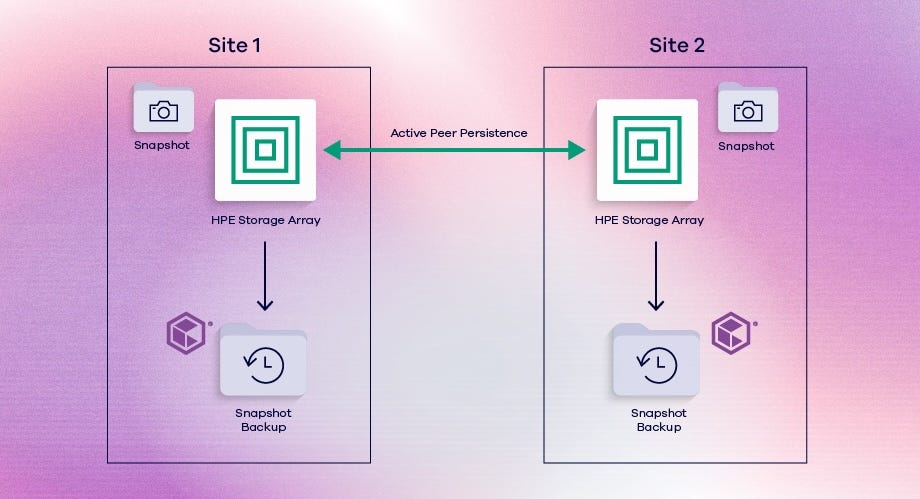
Commvault’s deep integration with HPE storage platforms includes advanced snapshot management capabilities that streamline the protection of large databases, medical imagery, and other data-intensive workloads. Building on this, our recent milestone is Commvault’s new integration with HPE’s Active Peer Persistence technology.

Currently available in HPE Alletra 9000 and HPE Alletra Storage MP B10000, HPE’s Active Peer Persistence enables synchronous replication across two geographically separated storage arrays, automatically failing over from one site to another during an outage without any disruption. This continuous availability is crucial for mission-critical applications that require minimal downtime.

With our new integration, Commvault detects when two HPE storage arrays are in an Active Peer Persistence configuration and snaps both arrays simultaneously, backing up each locally. Commvault’s robust data management tools then allow businesses to send extra copies of data to tape (HPE StoreEver), cloud, or other storage options, supporting compliance and adding another layer of data security.

I vantaggi dell’integrazione per le aziende basate sui dati

Questa integrazione offre notevoli vantaggi ai clienti che desiderano massimizzare la resilienza, ridurre i tempi di inattività e ottimizzare i processi di Backup and Recovery in ambienti distribuiti.

  • Continuous availability: Mission-critical applications benefit from uninterrupted access to data, even in the event of planned or unplanned outages.
  • Network efficiency: By allowing data recovery directly from either primary or secondary arrays, the integration reduces the requirement for additional copies, reducing the overall load on network resources.
  • Enhanced compliance: Commvault’s flexible data management enables additional copies of data to meet various regulatory and compliance needs.

La partnership tra Commvault e HPE è un esempio del nostro impegno comune nel fornire soluzioni di protezione dei dati moderne, scalabili e sostenibili.

“Partnering with HPE to support Active Peer Persistence underscores our dedication to delivering solutions that drive business continuity and operational efficiency,” said Jeff Carlat, Director – WW Alliances at Commvault. “Together, we are equipping our customers with the tools they need to navigate complex data environments with confidence.”

Learn more at hpe.com/storage.

More related posts


Thumbnail_Blog-Dangerous-Silos-IDC-Resops-2026 (1)

The Importance of Recovery Point Objective (RPO) in Your Business Continuity Plan

Read more about The Importance of Recovery Point Objective (RPO) in Your Business Continuity Plan
Thumbnail_Blog-IDC-Resops-2026

Business Continuity Planning for the Cloud-Native Era

Read more about Business Continuity Planning for the Cloud-Native Era
Thumbnail_Blog-Bringing-Trust-to-CVE-2026

Demystifying SOC 2 Data Protection Requirements

Read more about Demystifying SOC 2 Data Protection Requirements

Readiverse è una risorsa completa pensata per aiutare individui e organizzazioni a mantenersi sempre aggiornati nel campo in continua evoluzione della resilienza informatica. È il punto di riferimento per eccellenza per le migliori pratiche e le conoscenze pratiche in materia di resilienza informatica.

Nel Readiverse puoi sperimentare una varietà di modalità di apprendimento adatte a diverse esigenze e ritmi. Che tu preferisca la sfida delle simulazioni da tavolo come “Minutes to Meltdown”, l’approfondimento offerto da certificazioni e workshop, la praticità dei video tutorial o lo spirito collaborativo dell’apprendimento in comunità, il Readiverse ha tutto ciò che fa per te.

La nostra piattaforma va oltre i metodi di apprendimento tradizionali, offrendo contenuti interattivi e dinamici che ti consentiranno di affrontare con sicurezza le più recenti minacce informatiche.

Entra a far parte diReadiverseoggi stesso per potenziare le tue difese informatiche e far parte di una comunità proattiva impegnata a raggiungere l’eccellenza nel campo della sicurezza informatica.

What’s new in the Readiverse?

Readiverse offre ora una certificazione online gratuita e autogestita in materia di resilienza informatica.

Questa nuova certificazione fornisce ai professionisti dell’IT e della sicurezza le conoscenze e le competenze necessarie per mettere in atto una solida difesa contro le minacce informatiche in sole 4 ore.

This course focuses on the fundamental principles of cyber resilience, covering topics such as early warning systems, threat detection, and advanced recovery techniques.  

I partecipanti acquisiscono esperienza pratica nella configurazione e nell’integrazione delle soluzioni Commvault, imparando in particolare a padroneggiare la tecnica delRecupero in Cleanroom to minimize downtime and data loss. 

Through a blend of self-paced e-learning modules and hands-on lab sessions, participants gain the practical skills and knowledge to protect their organizations’ assets. And with a certification in hand, they’ll have the confidence and peace of mind that they have the latest skills and knowledge in cyber resilience.

I clienti possono accedere ai corsi Readiverse utilizzando le proprie credenziali Commvaultqui, mentre i partner possono accedere ai corsi tramite ilPortale Partner Commvault.

More related posts


Thumbnail_Blog-Dangerous-Silos-IDC-Resops-2026 (1)

The Importance of Recovery Point Objective (RPO) in Your Business Continuity Plan

Read more about The Importance of Recovery Point Objective (RPO) in Your Business Continuity Plan
Thumbnail_Blog-IDC-Resops-2026

Business Continuity Planning for the Cloud-Native Era

Read more about Business Continuity Planning for the Cloud-Native Era
Thumbnail_Blog-Bringing-Trust-to-CVE-2026

Demystifying SOC 2 Data Protection Requirements

Read more about Demystifying SOC 2 Data Protection Requirements

Poiché le organizzazioni si affidano sempre più a piattaforme Software-as-a-Service (SaaS) come Microsoft 365 e Salesforce per le operazioni critiche per l’azienda, è diventata essenziale una protezione completa di questi ambienti.

While many organizations assume that SaaS providers offer complete data protection, most operate under a shared responsibility model where customers remain responsible for data backup, recovery, and security. Commvault’s SaaS protection capabilities deliver comprehensive security for these critical environments.

L’importanza fondamentale della protezione nel settore SaaS

La crescente diffusione delle piattaforme SaaS ha posto sfide cruciali in materia di protezione:

  • La maggior parte dei fornitori di servizi SaaS opera secondo un modello di responsabilità condivisa.
  • Le organizzazioni hanno la responsabilità di proteggere i propri dati SaaS da perdita, danneggiamento e accesso non autorizzato.
  • Gli strumenti nativi di protezione SaaS presentano spesso notevoli limitazioni in termini di conservazione dei dati, granularità e sicurezza.
  • SaaS environments increasingly contain an organization’s most sensitive operational data.

Questi fattori rendono indispensabile la protezione dei servizi SaaS di terze parti per garantire una sicurezza e una conformità complete.

Funzionalità di protezione di Microsoft 365

Commvault® Cloud Backup & Recovery for Microsoft 365 delivers SaaS resilience and recovery capabilities specifically designed to provide protection from deletion, corruption, and attack. This includes:

Protezione di Exchange Online:
  • Protezione per le applicazioni Microsoft 365.
  • Offre opzioni di Recovery dettagliate per caselle di posta, messaggi e-mail, allegati e altri componenti di Exchange Online.
Protezione di SharePoint Online e OneDrive:
  • Conserva le autorizzazioni dei documenti, la cronologia delle versioni e i metadati.
  • Consente la Recovery granulare di singoli documenti, librerie o interi siti.
Protezione delle squadre:
  • Salva le conversazioni, i file, i canali e le impostazioni dei team.
  • Consente sia il ripristino parziale che quello completo di Teams.

Funzionalità di protezione di Salesforce

Commvault estende la propria protezione SaaS agli ambienti Salesforce, tra cui:

  • Copre sia gli oggetti standard che quelli personalizzati all’interno di Salesforce.
  • Mantenere le relazioni tra gli oggetti per garantire una Recovery completa.
  • Inizializza, maschera e reidrata gli ambienti sandbox per accelerare le operazioni di test.
  • Spazio di archiviazione illimitato, conservazione illimitata e protocolli avanzati (come FedRAMP High) integrati.

Questa protezione completa di Salesforce garantisce che i dati critici relativi ai clienti e alle vendite rimangano al sicuro e recuperabili.

Funzionalità avanzate di sicurezza SaaS

Oltre alle funzionalità di base di Backup and Recovery, Commvault offre funzionalità di sicurezza di livello aziendale per gli ambienti SaaS.

Maggiore sicurezza dei dati

Commvault garantisce una sicurezza completa per i dati SaaS:

  • La piattaforma offre funzionalità progettate per garantire la sicurezza fin dall’inizio, con caratteristiche integrate quali immutabilità, isolamento fisico e accesso zero-trust.
  • La soluzione offre Commvault AirGap come destinazione di archiviazione cloud integrata, che semplifica alle organizzazioni IT l’adozione dell’archiviazione cloud air gap per ridurre i rischi.
  • Queste funzionalità di sicurezza proteggono i dati SaaS sia dalle minacce esterne che dai rischi interni.

Conformità e governance

Commvault offre funzionalità di conformità per i dati SaaS:

  • La piattaforma supporta criteri standardizzati di conservazione, politiche e recuperabilità per carichi di lavoro ibridi eterogenei, comprese le applicazioni SaaS.
  • La soluzione aiuta le organizzazioni ad attuare una governance coerente in tutti gli ambienti SaaS.
  • Queste funzionalità consentono di soddisfare i requisiti normativi in materia di protezione e conservazione dei dati.

Gestione unificata della protezione SaaS

Commvault garantisce una gestione uniforme in tutto l’ambito della protezione SaaS:

  • La piattaforma elimina la complessità legata alla gestione di più console grazie a un sistema di gestione unificato.
  • La soluzione supporta la conservazione, le politiche e la recuperabilità standardizzate per carichi di lavoro ibridi eterogenei, comprese applicazioni SaaS come M365, Dynamics 365, Salesforce e Google Workspace.
  • Questo approccio unificato semplifica la gestione della protezione su più piattaforme SaaS.

L’impatto aziendale di una protezione completa per le soluzioni SaaS

For organizations, Commvault’s SaaS protection capabilities deliver several significant business advantages:

Maggiore continuità operativa

Una protezione SaaS completa garantisce la continuità delle operazioni critiche:

  • The solution provides fast and automated backup, flexible and granular restore, and   scalable and unlimited storage.
  • La piattaforma garantisce protezione da cancellazione, danneggiamento e attacchi, grazie a funzionalità di Backup and Recovery per gli ambienti Microsoft 365 e Salesforce.
  • Queste funzionalità contribuiscono a ridurre al minimo i disagi causati dalla perdita o dal danneggiamento dei dati negli ambienti SaaS.

Preparazione semplificata alla conformità

Commvault’s SaaS protection helps streamline efforts to comply with various industry regulations:

  • La piattaforma supporta procedure standardizzate di conservazione, politiche e recuperabilità per aiutare a soddisfare i requisiti di conformità.
  • Le funzionalità di protezione, backup e ripristino consentono la conservazione dei dati ai fini della conformità normativa.
  • Queste funzionalità semplificano le attività di audit e la rendicontazione ai fini del rispetto dei requisiti normativi.

Riduzione del rischio per la sicurezza

Le funzionalità di sicurezza avanzate riducono al minimo i rischi per i dati SaaS, poiché la soluzione integra di serie caratteristiche quali l’immutabilità, l’air gap e l’accesso zero-trust.

Protezione SaaS per ambienti critici

As organizations increasingly depend on SaaS platforms for mission-critical operations, comprehensive protection has become essential for business continuity, security, and compliance. Commvault’s superior capabilities for Microsoft 365 and Salesforce protection deliver significant advantages:

  • Comprehensive coverage: Protection for all aspects of SaaS environments, not just the most common elements.
  • Granular recovery: Precise restoration options that minimize disruption and data loss.
  • Enhanced security: Integrated protection against modern threats targeting SaaS data.
  • Simplified compliance readiness: Comprehensive capabilities for helping organizations meet regulatory requirements.

Per le organizzazioni che prendono sul serio la protezione dei propri ambienti SaaS mission-critical, Commvault rappresenta una soluzione completa per la protezione delle imprese, in grado di colmare le lacune e garantire un Recovery completo in caso di necessità.


Riferimenti e note di convalida

Riferimenti principali:
1. Documentazione Commvault sulla protezione SaaS per Microsoft 365 (Documento 3)
2. Funzionalità di protezione Commvault per Salesforce (Documento 3)
3. Funzionalità di sicurezza per la protezione SaaS (Documenti 3, 21)


Requisiti di convalida:
1. Verificare le funzionalità di protezione specifiche per le singole applicazioni di Microsoft 365 (Exchange, SharePoint, Teams)
2. Confermare le opzioni di Recovery granulare per Microsoft 365 e Salesforce
3. Verificare le funzionalità di sicurezza disponibili specificamente per la protezione
SaaS 4. Verificare le funzionalità e i limiti di conservazione dei dati
SaaS 5. Confermare eventuali certificazioni o funzionalità di conformità specifiche per la protezione SaaS


More related posts


Thumbnail_Blog-Dangerous-Silos-IDC-Resops-2026 (1)

The Importance of Recovery Point Objective (RPO) in Your Business Continuity Plan

Read more about The Importance of Recovery Point Objective (RPO) in Your Business Continuity Plan
Thumbnail_Blog-IDC-Resops-2026

Business Continuity Planning for the Cloud-Native Era

Read more about Business Continuity Planning for the Cloud-Native Era
Thumbnail_Blog-Bringing-Trust-to-CVE-2026

Demystifying SOC 2 Data Protection Requirements

Read more about Demystifying SOC 2 Data Protection Requirements

As we approach the end-of-life for Actifio on-premises solutions, prevista per il 30 giugno 2025, it’s crucial for Managed Service Providers (MSPs) to prepare for the transition. After this date, Actifio will cease to provide updates for security, reliability, and performance, which could significantly impact MSPs relying on this platform for on-premises backup and disaster recovery.

La sfida

L’avvicinarsi della scadenza impone agli MSP di migrare i propri clienti verso una soluzione alternativa affidabile, al fine di garantire la protezione e la sicurezza dei dati senza interruzioni. Questa transizione richiede un’attenta valutazione delle potenziali alternative, una pianificazione dettagliata della migrazione e un’esecuzione senza intoppi, al fine di mantenere la fiducia dei clienti e l’integrità dei dati.

L’opportunità

Questo periodo di cambiamento rappresenta un’occasione perfetta per gli MSP per potenziare la propria offerta di servizi adottando una soluzione più avanzata e completa. Commvault si conferma come la scelta migliore, grazie alle sue ampie funzionalità di protezione dei dati e alle Features innovative in grado di migliorare la qualità del servizio che gli MSP offrono ai propri clienti.

Perché scegliere Commvault?

Comprehensive data protection: Commvault delivers an extensive range of data protection services, including state-of-the-art backup and recovery, disaster recovery, and proactive data management. It supports a diverse set of workloads and applications, creating a holistic approach to data safety.

Scalability and flexibility: Designed to accommodate any business size, Commvault’s scalable solutions allow MSPs to tailor services to meet specific client needs, adapting effortlessly as those needs evolve.

Advanced features: With features like deduplication, compression, and encryption, Commvault not only optimizes storage but also fortifies data security. Its automation tools further streamline operations, reducing the administrative load on MSPs.

Enhanced cyber resiliency: Commvault offers robust defenses against modern cyber threats, including ransomware. Its comprehensive security measures, such as immutable backups and anomaly detection, provide MSPs and their clients with peace of mind.

MSP-centric programs: Commvault’s dedicated MSP programs offer tailored resources, support, and flexible pricing models, all designed to help MSPs thrive.

Passare a Commvault

Commvault semplifica il processo di migrazione grazie a strumenti e alla consulenza di esperti, garantendo una transizione senza intoppi da Actifio. Il nostro team si impegna a supportare gli MSP in ogni fase del percorso, dalla pianificazione iniziale alla completa esecuzione.

Vantaggi principali per gli MSP
  • Enhanced service offerings: By leveraging Commvault’s comprehensive solutions, MSPs can expand their range of services, increasing their appeal to current and potential clients.
  • Increased efficiency: Automation and streamlined operations reduce costs and improve service delivery, boosting MSPs’ bottom line.
  • Improved profitability: With MSP-friendly pricing and resource allocation, Commvault helps MSPs enhance their profitability and operational efficiency.

Conclusione: Abbracciamo il futuro con Commvault

The end of Actifio’s on-premises offerings marks a critical point for MSPs to reassess their data protection strategies. Commvault stands ready to help MSPs transition smoothly, delivering enhanced service capabilities, operational efficiency, and increased profitability in a post-Actifio landscape.

Don’t delay your preparations. Partner with Commvault today and set the stage for a more resilient, profitable future in managed services.

More related posts


Thumbnail_Blog-Dangerous-Silos-IDC-Resops-2026 (1)

The Importance of Recovery Point Objective (RPO) in Your Business Continuity Plan

Read more about The Importance of Recovery Point Objective (RPO) in Your Business Continuity Plan
Thumbnail_Blog-IDC-Resops-2026

Business Continuity Planning for the Cloud-Native Era

Read more about Business Continuity Planning for the Cloud-Native Era
Thumbnail_Blog-Bringing-Trust-to-CVE-2026

Demystifying SOC 2 Data Protection Requirements

Read more about Demystifying SOC 2 Data Protection Requirements

When evaluating enterprise cyber resilience solutions, organizations face an important architectural choice between appliance-based approaches like Rubrik’s and software-defined platforms like Commvault’s.

Sebbene entrambi i fornitori offrano funzionalità di protezione dei dati, gli approcci architetturali diversi comportano implicazioni di costo distinte che si manifestano nel corso dell’intero ciclo di vita della soluzione.

Approcci architettonici: basato su box vs. basato su piattaforma

Rubrik’s Appliance-Centric Model

Rubrik’s approach centers on physical or virtual appliances that serve as the primary deployment model:

  • La capacità di protezione viene aumentata a incrementi fissi tramite l’aggiunta di ulteriori Appliances.
  • Il ridimensionamento richiede in genere l’implementazione di nuove Appliances quando si raggiungono i limiti di prestazioni o di capacità.
  • Rubrik’s solution uses an appliance-based architecture where data protection capacity comes in predefined sizing options.
Commvault’s Software-Defined Platform

Commvault adotta un’architettura modulare definita dal software:

  • Le opzioni di implementazione comprendono soluzioni esclusivamente software, architetture di riferimento, sistemi convergenti o implementazioni basate sul cloud.
  • Le risorse possono essere scalate in modo indipendente e incrementale in base ai requisiti di prestazioni o capacità.
  • La piattaforma Commvault può essere implementata su infrastrutture esistenti, su Appliance appositamente progettate o come servizio cloud.
Implicazioni economiche delle differenze architetturali

Le differenze architettoniche tra queste soluzioni comportano diverse considerazioni significative in termini di costi:

1. Scaling flexibility and efficiency

Gli approcci basati su Appliance richiedono spesso l’assegnazione di capacità in incrementi prestabiliti, il che può portare a un sovradimensionamento quando le esigenze effettive si collocano tra le diverse opzioni di dimensione delle Appliance. Secondo gli analisti del settore, questo ridimensionamento a gradini può comportare una capacità inutilizzata durante l’intero ciclo di vita dell’implementazione.

Le prestazioni e la capacità sono strettamente correlate. Per migliorare le prestazioni, è necessario aggiungere un nodo Rubrik supplementare, il che comporta anche il costo di una maggiore capacità di archiviazione. Analogamente, per aumentare la capacità di archiviazione, i clienti devono sostenere anche i costi relativi alle risorse aggiuntive necessarie per le prestazioni (CPU, RAM). Ciò comporta un aumento del TCO.

Commvault’s platform modular approach enables more precise scaling, allowing organizations to spend as per actual requirements. This helps reduce resource wastage and improves cost efficiency.

2. Cloud integration approach

Man mano che le organizzazioni adottano i servizi cloud, l’approccio architetturale incide in modo significativo sui costi di protezione del cloud:

Le soluzioni basate su piattaforma possono integrarsi direttamente con i servizi cloud tramite API native. Commvault offre un’integrazione diretta con i servizi cloud senza richiedere Appliance virtuali, riducendo potenzialmente le risorse necessarie per la protezione dei dati nel cloud.

Fattori relativi al costo totale di proprietà

Nel valutare il costo totale di proprietà su un periodo compreso tra i tre e i cinque anni, le organizzazioni dovrebbero tenere conto di diversi fattori chiave:

Cost Category Appliance Approach Impact Platform Approach Advantage
Costi di infrastruttura Potenziale sovradimensionamento Implementazione su misura
Costi di protezione del cloud Appliances virtuali in ogni ambiente Integrazione diretta dei servizi cloud
Costi di scalabilità Aumenti a scatti Incrementali in base alle esigenze
Aggiornamento tecnologico Cicli di sostituzione completi dell’Appliance Aggiornamenti a livello di componente

Oltre i costi: considerazioni sulle capacità

Le differenze architettoniche vanno oltre le implicazioni in termini di costi e determinano distinzioni a livello di funzionalità:

1. Multi-cloud support

Le architetture di piattaforma offrono in genere funzionalità più uniformi negli ambienti cloud grazie all’utilizzo di un codice di base comune con punti di integrazione specifici per il cloud. Ciò può semplificare la protezione in diverse implementazioni cloud.

2. Workload coverage

Le piattaforme software-defined spesso supportano una gamma più ampia di carichi di lavoro, tra cui sistemi legacy, applicazioni specializzate e diversi tipi di infrastruttura. Ciò può eliminare la necessità di ricorrere a più soluzioni di protezione.

3. Security integration

The architectural approach also impacts security capabilities. Commvault’s platform includes integrated security features like threat detection, while appliance-focused solutions may require additional components for comprehensive security. Rubrik’s data security solution is delivery through their SaaS, severely limiting functionality in environments where cloud connectivity is restricted or prohibited, such as dark sites or isolated clusters.

Considerazioni strategiche di natura architettonica

The choice between Rubrik’s appliance-based approach and Commvault’s platform architecture represents a strategic decision with long-term implications.

Le organizzazioni dovrebbero valutare queste soluzioni in base alle proprie esigenze specifiche, tenendo conto non solo dei costi iniziali, ma anche di fattori a lungo termine quali l’efficienza di scalabilità, i costi operativi, l’integrazione con il cloud e le questioni relative alla sicurezza. Comprendendo le differenze architetturali e le relative implicazioni in termini di costi, le organizzazioni possono prendere decisioni più consapevoli riguardo ai propri investimenti nella resilienza informatica.

More related posts


Thumbnail_Blog-Dangerous-Silos-IDC-Resops-2026 (1)

The Importance of Recovery Point Objective (RPO) in Your Business Continuity Plan

Read more about The Importance of Recovery Point Objective (RPO) in Your Business Continuity Plan
Thumbnail_Blog-IDC-Resops-2026

Business Continuity Planning for the Cloud-Native Era

Read more about Business Continuity Planning for the Cloud-Native Era
Thumbnail_Blog-Bringing-Trust-to-CVE-2026

Demystifying SOC 2 Data Protection Requirements

Read more about Demystifying SOC 2 Data Protection Requirements

The shift to cloud computing has become more than a strategic advantage – it’s now a business necessity. According to Gartner, by 2028, cloud computing will shift from being a technology disruptor to becoming a necessary component for maintaining business competitiveness. But with this transformation comes a critical challenge that most organizations haven’t fully addressed: true cyber resilience.

Il rischio nascosto del 70% negli ambienti cloud

Here’s a startling reality that most cloud and security leaders don’t realize: According to our research, in a typical cloud environment, application data makes up only 20% to 30% of the resources, while 50% to 70% consists of cloud configurations that remain completely unprotected by traditional backup solutions.

Pensate a cosa ciò comporti in caso di incidente informatico o interruzione del servizio. La vostra soluzione di backup potrebbe ripristinare i database e i file, ma dovete anche considerare quanto segue:

  • Bilanciatori di carico e gruppi di sicurezza.
  • Configurazioni VPC e politiche di rete.
  • Impostazioni di orchestrazione dei container.
  • Gateway API e dipendenze dei microservizi.
  • Configurazioni relative alla gestione delle identità e degli accessi.
  • Modelli “Infrastructure-as-Code”.

This is where traditional backup falls catastrophically short.

Oltre la protezione dei dati: la rivoluzione del Recovery incentrato sulle applicazioni

Commvault® Cloud Rewind represents a fundamental shift from data-centric to application-centric recovery. Rather than simply backing up and restoring data files, Cloud Rewind treats your entire cloud environment as code – discovering through collecting configuration metadata not application data, and rebuilding cloud ecosystems with all their dependencies intact.

Il vantaggio di Cloud Rewind: Recovery-as-Code

Cloud Rewind’s patented Recovery-as-Code approach automatically codifies your application’s cloud resources, dependencies, and data for hyperfast rebuild capabilities. This isn’t just backup ­– it’s a complete Cloud Time Machine that can rewind your entire environment to any point in time.

Le capacità principali includono:
Scoperta e apprendimento continui:
  • Sfruttare le API native per il backup e gli snapshot fornite dalle piattaforme cloud quali AWS, Azure e GCP.
  • Mappa le dipendenze complesse delle applicazioni in tempo reale.
  • Si adatta man mano che cambiano i tuoi ambienti con scalabilità automatica e bilanciamento del carico.
  • Non sono necessari né agenti, né installazione, né manutenzione.
Protezione completa:
  • Protegge le configurazioni cloud e le dipendenze per consentire una rapida ricostruzione.
  • Copie puntuali con backup incrementali continui.
  • Gestione della replica multiregionale e tra cloud.
  • Protezione senza agenti per applicazioni con scalabilità automatica.
Orchestrazione intelligente del Recovery:
  • Recovery con un solo clic di interi ambienti multi-stack con dipendenze.
  • Recovery tra zone, regioni, account e tenant.
  • Simulazioni e test automatizzati sulla resilienza.
  • Sequenziamento che tiene conto delle dipendenze per applicazioni complesse.

Perché i concorrenti tradizionali non sono all’altezza

While competitors like Cohesity, Rubrik, and Veritas focus primarily on data protection, they fundamentally miss the application-centric nature of modern cloud environments. Even traditional cloud service providers, while responsible for protecting customer data, do not secure the underlying cloud infrastructure – leaving customers with limited ability to minimize downtime and recover quickly in the event of a cyber incident.

Tra gli svantaggi degli strumenti tradizionali di resilienza figurano:
  • Limited scope: They protect data but ignore the 70% of cloud resources that are configurations.
  • Manual resilience testing: Time-consuming, cumbersome, and often not done enough to establish cyber resilience.
  • Fragmented approach: Applications and infrastructure are treated separately, creating recovery gaps.
  • Legacy architecture: Solutions adapted from on-premises thinking rather than cloud-native design.

Cloud Rewind elimina queste limitazioni trattando le applicazioni e la relativa infrastruttura sottostante, i livelli di dati, la rete e la sicurezza come un sistema unificato basato sul codice.

I tre pilastri della resilienza informatica

Cloud Rewind garantisce una resilienza informatica completa grazie a tre funzionalità fondamentali:

1. Ridurre il rischio:
  • L’analisi continua delle derive individua le configurazioni errate prima che si trasformino in vulnerabilità.
  • Monitoraggio proattivo della resilienza su tutte le risorse cloud.
  • I backup immutabili impediscono la crittografia da parte del ransomware.
2. Migliorare la Readiness operativa.
  • Le simulazioni automatizzate di resilienza mettono alla prova le procedure di Recovery.
  • Non sono necessari runbook né script.
  • Una protezione sempre aggiornata, in grado di adattarsi a oltre 100.000 risorse cloud.
3. Abilitare Recovery.
  • Il “Recovery-as-Code” contribuisce ad eliminare i processi di ricostruzione manuale.
  • La flessibilità della Recovery tra diversi cloud evita la dipendenza da un unico fornitore.
  • Il ripristino con un solo clic garantisce la continuità operativa e contribuisce a ridurre i tempi di inattività imprevisti.

Uno sguardo al futuro: l’era della Recovery continua

As cloud environments become increasingly complex with microservices, containers, and serverless architectures, the gap between traditional backup and true resilience will only widen. Cloud Rewind’s Recovery-as-Code approach represents the future of continuous business – where applications and their complete ecosystems can be rebuilt near-instantly, automatically, and reliably.

For organizations serious about cyber resilience, the question isn’t whether you need application-centric recovery – it’s whether you can afford to operate without it. In an era where application availability directly impacts business success, Cloud Rewind provides the comprehensive protection that competitive offerings simply cannot match.

The time to act is now. Every day your organization operates without complete application protection is another day of unnecessary risk. Cloud Rewind helps reduce unknown vulnerabilities by continually discovering and mapping your cloud environment, thus helping enable your business to rewind, recover, and rebuild from cyber incidents in minutes, not weeks.

Scopri di più su comeCloud Riavvolgimentopossa aiutare la tua organizzazione a ripristinare e ricostruire in modo ultraveloce applicazioni dinamiche e distribuite a seguito di interruzioni di servizio e attacchi ransomware.

More related posts


Thumbnail_Blog-Dangerous-Silos-IDC-Resops-2026 (1)

The Importance of Recovery Point Objective (RPO) in Your Business Continuity Plan

Read more about The Importance of Recovery Point Objective (RPO) in Your Business Continuity Plan
Thumbnail_Blog-IDC-Resops-2026

Business Continuity Planning for the Cloud-Native Era

Read more about Business Continuity Planning for the Cloud-Native Era
Thumbnail_Blog-Bringing-Trust-to-CVE-2026

Demystifying SOC 2 Data Protection Requirements

Read more about Demystifying SOC 2 Data Protection Requirements

Nelle aziende ibride, una protezione multi-cloud completa è diventata essenziale per la resilienza informatica. Poiché le organizzazioni distribuiscono i carichi di lavoro tra data center on-premise, diversi cloud pubblici e applicazioni SaaS, è fondamentale garantire una protezione coerente in tutti questi ambienti. Commvault Cloud offre vantaggi significativi rispetto a Cohesity in termini di copertura dei carichi di lavoro negli ambienti multi-cloud.

La realtà del multi-cloud

Modern enterprises operate in complex IT environments that span multiple platforms. According to theFlexera 2025 State of the Cloud Report, 70% of respondents embrace hybrid cloud strategies, using at least one public and one private cloud. This fragmentation creates potential protection gaps, particularly in multi-cloud deployments where native tools may create inconsistent protection and security postures.

Commvault vs. Cohesity: confronto sulla copertura dei carichi di lavoro

Nella valutazione delle piattaforme di protezione multi-cloud, la copertura dei carichi di lavoro rappresenta un fattore chiave di differenziazione. Commvault offre un supporto più ampio per i carichi di lavoro rispetto a Cohesity in diversi ambiti:

Copertura dei carichi di lavoro critici nel cloud

Commvault garantisce la protezione di diversi carichi di lavoro critici:

  • Oracle Cloud Infrastructure: Commvault provides integration with OCI for protection of applications and databases in Oracle’s cloud environment.
  • Cloud-native databases: Commvault supports a wide range of cloud database services across major cloud providers, including Amazon RDS, Azure SQL, and Google Cloud SQL.
  • S3 object storage: Commvault’s platform includes enterprise-grade protection for large-scale object storage deployments across cloud providers, supporting petabyte-scale environments.

Commvault’s platform provides comprehensive protection across these environments, while Cohesity’s public documentation shows more limited coverage in these specific areas.

Riconoscimenti agli analisti

Industry analysts have recognized Commvault’s comprehensive workload coverage. Commvault received recognition in the Forrester Wave™ for Data Resilience Solutions (Q4 2024), with high scores in several criteria, including SaaS platform support and cloud infrastructure protection.

Capacità di integrazione cloud

Oltre al backup di base, Commvault offre l’integrazione con vari servizi cloud-native:

  • Storage tier integration: Support for various cloud storage tiers like Amazon S3 Glacier Deep Archive, Azure Archive Storage, and Google Cloud Storage Archive.
  • Database service integration: Direct integration with managed database services for application-consistent protection with minimal performance impact.
  • Security framework integration: Connections with cloud security services to enable coordinated security responses and improved cyber resilience.

Esperienza di gestione unificata

Commvault’s Cloud Command provides a single interface for managing protection across all environments, eliminating the need for multiple management consoles when protecting diverse cloud resources. This unified approach reduces management complexity and improves operational efficiency.

Funzionalità di mobilità dei dati

Commvault semplifica il trasferimento dei dati tra ambienti cloud per:

  • Recovery di emergenza su piattaforme cloud.
  • Migrazione del carico di lavoro tra cloud.
  • Ottimizzazione dei costi di archiviazione tramite un sistema di tiering intelligente.
  • Soddisfare i requisiti di sovranità dei dati nelle implementazioni globali.

Vantaggio in termini di costi

Recovery a caldo del sito:
  • Commvault’s intelligent disaster recovery approach eliminates the financial burden of maintaining duplicate cloud infrastructure for non-critical workloads. Unlike traditional methods that pre-provision expensive “always-on” failover environments, Commvault delays full VM creation until actual disaster scenarios through its meta-data driven replication.
  • Per le aziende che gestiscono ambienti multi-cloud, ciò si traduce in un risparmio annuo di milioni di dollari grazie all’ottimizzazione dell’utilizzo del cloud e all’eliminazione dei costi legati alla capacità inutilizzata.
  • The solution also enables flexible cross-cloud failover strategies without vendor lock-in – a critical advantage in a hybrid cloud landscape.1
Cleanroom Recovery on-demand in ambiente cloud-native:
  • Zero infrastructure tax: Unlike legacy solutions requiring dedicated on-premises environments, Commvault provisions isolated recovery spaces in Azure on demand – eliminating 100% of idle infrastructure costs. Organizations pay only for active recovery/testing cycles, converting fixed CapEx into variable OpEx.
  • Continuous resilience validation: Automated weekly recovery testing (vs. costly quarterly manual drills) reduces breach-related downtime costs. Integrated AI identifies “known good” recovery points, accelerating response while minimizing forensic labor expenses.
  • Multi-cloud financial agility: Commvault’s any-to-any recovery architecture prevents vendor lock-in penalties, enabling cost-optimized failovers across AWS/Azure/GCP. Contrast this with rigid single-cloud solutions that incur premium pricing during surge events.2

L’integrazione tra Cohesity e Veritas

La fusione tra Cohesity e Veritas comporta potenziali difficoltà di integrazione per i clienti. Alcune pubblicazioni di settore hanno discusso dei tempi necessari per integrare queste diverse piattaforme; si prevede infatti che l’integrazione completa richieda dai 18 ai 24 mesi. Al contrario, Commvault offre una piattaforma già integrata, progettata per ambienti ibridi e multi-cloud.

Protezione multi-cloud completa

Per le organizzazioni che necessitano di una protezione completa in diversi ambienti cloud, Commvault Cloud offre vantaggi significativi in termini di ampiezza della copertura dei carichi di lavoro. Grazie al supporto per i servizi cloud critici, alla profonda integrazione nativa e alla gestione unificata, Commvault garantisce la protezione completa di cui hanno bisogno le moderne imprese multi-cloud.


1https://documentation.commvault.com/11.38/essential/warm_site_recovery_for_replication_groups.html

2https://documentation.commvault.com/11.38/essential/cleanroom_recovery.html

More related posts


Thumbnail_Blog-Dangerous-Silos-IDC-Resops-2026 (1)

The Importance of Recovery Point Objective (RPO) in Your Business Continuity Plan

Read more about The Importance of Recovery Point Objective (RPO) in Your Business Continuity Plan
Thumbnail_Blog-IDC-Resops-2026

Business Continuity Planning for the Cloud-Native Era

Read more about Business Continuity Planning for the Cloud-Native Era
Thumbnail_Blog-Bringing-Trust-to-CVE-2026

Demystifying SOC 2 Data Protection Requirements

Read more about Demystifying SOC 2 Data Protection Requirements

Nella puntata n. 13 del podcast “Resilience Rundown”, Alex Janas, Field CTO di Commvault, è ospite di Thomas Bryant, Senior Director of Product Marketing presso Commvault. I due approfondiscono l’importanza della sensibilizzazione alla sicurezza informatica, soprattutto nel contesto del lavoro da remoto. La conversazione si è concentrata su consigli pratici e strategie per proteggere i dati personali e professionali in un ambiente di lavoro sempre più digitale e distribuito.

La filosofia dello Zero Trust

Alex emphasized a philosophy of considering everything suspect. Whether you’re an employee using a home network or a business managing remote workers, the principle of zero trust is crucial.

This means treating every network, device, and interaction as potentially hostile. For employees, this translates to using trusted VPNs to tunnel all traffic, including DNS, through secure connections. Even if a network requires a password and authentication, it’s essential to remain vigilant, as you never know who else has accessed it.

Vulnerabilità delle reti domestiche

Un punto chiave sottolineato da Alex è la vulnerabilità delle apparecchiature di rete domestiche, come i router forniti dagli ISP. Questi dispositivi hanno spesso funzionalità di sicurezza limitate. I margini di profitto su questi dispositivi sono ridotti, il che comporta una durata di vita breve e la mancanza di aggiornamenti di sicurezza regolari. Ciò li rende obiettivi privilegiati per i malintenzionati, che potrebbero utilizzarli per rubare informazioni personali, bloccare i dati o persino infiltrarsi nel vostro ambiente di lavoro.

Alex recommends investing in more reputable and capable networking devices that offer better security and longer support. While this may require some extra effort in setup and maintenance, it’s a worthwhile investment to protect your data and privacy.

Il panorama delle minacce

Le minacce alle reti domestiche e ai dispositivi personali sono molteplici. I malintenzionati potrebbero prenderti di mira per rubare informazioni sensibili, come i dati del conto corrente, oppure utilizzare il tuo dispositivo come bot nella loro infrastruttura di comando e controllo.

Un’altra tattica comune consiste nello sfruttare gli eventi pubblicati sui social media, come gli anniversari di servizio, per creare e-mail di phishing convincenti. Queste e-mail sembrano spesso provenire dall’ufficio Risorse Umane e invitano a cliccare su link relativi a benefici o aggiornamenti, il che può portare a infezioni da malware o violazioni dei dati.

Coltivare una sana paranoia

Alex sostiene che un po’ di sana paranoia possa essere molto utile per proteggersi. Essere prudenti e prendersi un momento per verificare le comunicazioni può aiutare a evitare molte delle insidie più comuni nel campo della sicurezza informatica. Ad esempio, se ricevi un’e-mail contenente un link, digita manualmente l’URL nel browser invece di cliccarci sopra. Se qualcuno ti chiama sostenendo di rappresentare un’azienda, riattacca e richiama l’azienda utilizzando un numero verificato.

Consigli pratici per la sicurezza domestica

  1. Use a trusted VPN: Tunnel all your traffic, including DNS, through a secure connection to protect your data.
  2. Invest in better networking equipment: Consider purchasing a router from a reputable company that offers regular security updates.
  3. Be cautious with links and attachments: Verify URLs and attachments before clicking, especially on mobile devices where it can be harder to inspect links.
  4. Monitor your network: Regularly check your home network for suspicious activity.
  5. Educate yourself: Stay informed about the latest cybersecurity threats and best practices.

Riduci i rischi con la vigilanza

In a world where remote work is the norm, cybersecurity awareness is more critical than ever. By adopting a zero-trust mindset, investing in better home networking equipment, and being cautious with online interactions, you can significantly reduce the risk of becoming a victim of cybercrime. For businesses, it’s essential to monitor and protect remote workers’ devices and networks, treating every environment as potentially hostile.

Check out the full episode of the podcast qui.

More related posts


Thumbnail_Blog-Dangerous-Silos-IDC-Resops-2026 (1)

The Importance of Recovery Point Objective (RPO) in Your Business Continuity Plan

Read more about The Importance of Recovery Point Objective (RPO) in Your Business Continuity Plan
Thumbnail_Blog-IDC-Resops-2026

Business Continuity Planning for the Cloud-Native Era

Read more about Business Continuity Planning for the Cloud-Native Era
Thumbnail_Blog-Bringing-Trust-to-CVE-2026

Demystifying SOC 2 Data Protection Requirements

Read more about Demystifying SOC 2 Data Protection Requirements

We’re thrilled to announce that Commvault® Cloud Backup & Recovery for Google Workspaceè ora disponibile al pubblico suGoogle Cloud Marketplace, so you can start safeguarding your critical Google Workspace data today. 

In today’s fast-paced business world, collaboration and efficiency are the lifeblood of success. Google Workspace, a suite of secure, online communication and collaboration tools has become a go-to platform for organizations seeking these advantages. With this cloud-based convenience comes a critical challenge that is often overlooked: data protection.

Un’unica interfaccia per tutte le tue esigenze di protezione delle app SaaS

SaaS applications are not immune to data loss. Accidental deletions, ransomware attacks, and other unforeseen events can wreak havoc on productivity. According to a recent ESG survey, when asked about the most common causes of SaaS data loss, respondents cited 34% from malicious deletions due to malicious attacks and 33% from accidental deletions.1 Given these risks, protecting the data within the SaaS applications that run your business is not just a good idea – it’s essential.

Google Workspace is a highly resilient platform and goes to great lengths to secure customer data, including built-in threat prevention, zero-trust access, and data protection controls. However, businesses typically adopt multiple SaaS apps to provide their teams with the tools they need to get the work done.

Disporre di un metodo coerente per eseguire facilmente il backup, ripristinare rapidamente e conservare in modo flessibile i dati critici delle applicazioni SaaS significa maggiore produttività, riduzione dei rischi e minori costi per la vostra organizzazione IT. Con Commvault, i clienti ottengono una piattaforma comune di protezione dei dati che si estende dall’infrastruttura on-premise al cloud e al SaaS, offrendo una protezione dei dati resiliente agli attacchi informatici contro ransomware, malintenzionati interni e cancellazioni accidentali.

Now Available on Google Cloud Marketplace: Commvault Cloud Backup & Recovery for Google Workspace 

Commvault Cloud Backup & Recovery for Google Workspace delivers comprehensive, end-to-end enterprise-grade protection for Gmail, Google Drive, and Shared Drives, helping to keep valuable data safe and recoverable – all with the simplicity of SaaS. Commvault offers bundled Google Cloud Storage for Google Workspace protection while providing the broadest workload protection across SaaS, hybrid, and cloud-native workloads. Some key features and benefits include:

  • Comprehensive coverage across Gmail, Google Drive, and Shared Drive data. Plus, automatic discovery of new users and data for proactive protection.
  • Data isolation for air-gapped protection from malicious insiders and ransomware attacks.
  • Granular recovery with flexible point-in-time, in-/out-of-place, and item-level restore options.
  • Long-term, extended retention of active and deleted users with bundled Google Cloud Storage options to maintain SLA compliance.
  • Single, unified solution to protect data in Google Workspace and other SaaS, hybrid, and cloud-native workloads.
  • Simple cloud delivery with no hardware, maintenance, or upfront capital investments required.

“Bringing the Commvault Cloud Backup & Recovery to Google Cloud Marketplace will help customers quickly deploy, manage, and grow the data protection platform on Google Cloud’s trusted, global infrastructure,” said Dai Vu, Managing Director, Marketplace & ISV GTM Programs at Google Cloud. “Commvault can now securely scale and support customers on their digital transformation journeys.” 

Don’t let data loss disrupt your productivity. Take control with Commvault Cloud Backup & Recovery for Google Workspace. To learn more, visit commvault.com/platform/google-workspace. Sei pronto per iniziare?Richiedi una demoper vedere la nostra soluzione in azione.

1  Tech Target, ““Attenzione: ci sono molti modi per perdere i dati SaaS,” May 2023

More related posts


Thumbnail_Blog-Dangerous-Silos-IDC-Resops-2026 (1)

The Importance of Recovery Point Objective (RPO) in Your Business Continuity Plan

Read more about The Importance of Recovery Point Objective (RPO) in Your Business Continuity Plan
Thumbnail_Blog-IDC-Resops-2026

Business Continuity Planning for the Cloud-Native Era

Read more about Business Continuity Planning for the Cloud-Native Era
Thumbnail_Blog-Bringing-Trust-to-CVE-2026

Demystifying SOC 2 Data Protection Requirements

Read more about Demystifying SOC 2 Data Protection Requirements

Whether it’s a sudden market shift, a cybersecurity breach, or a regulatory change, the unexpected can strike at any moment. Being prepared is key to navigating these challenges successfully. This is where risk management and the Digital Operational Resilience Act (DORA) – a regulatory framework that takes effect in January to help protect financial institutions from disruptions like cyberattacks – come into play.

DORA applies to a wide range of financial entities in the European Union, including credit institutions, investment firms, payment institutions, and electronic money institutions. It also covers critical third-party service providers. Let’s explore how DORA’s risk management requirements can help you stay ahead of the game and keep your organization resilient in the face of uncertainty.

Che cos’è la gestione del rischio?

Risk management is the process of identifying, assessing, and prioritizing risks followed by the application of resources to minimize, monitor, and control the probability or impact of unfortunate events. Effective risk management isn’t just about avoiding disasters; it’s about creating a robust framework that supports your strategic goals and enhances your decision-making.

Risk management helps protect your organization’s assets, including financial resources, physical property, and reputation. By identifying potential threats, you can take proactive steps to mitigate them.

Gli investitori, i clienti e i dipendenti tendono a fidarsi e a sostenere maggiormente un’organizzazione che dimostri un forte impegno nella gestione dei rischi. Comprendere i rischi aiuta a prendere decisioni strategiche migliori. Consente infatti di allocare le risorse in modo più efficace e di concentrarsi sulle aree che contano davvero.

In che modo DORA si integra con la gestione del rischio

DORA and risk management are closely aligned, as both focus on preparing for and mitigating potential disruptions. Here’s how DORA’s components fit into a broader risk management strategy:

  1. Risk management framework: DORA requires financial entities to establish a comprehensive risk management framework. This framework should include policies, procedures, and controls to identify, assess, and manage risks. It’s like having a detailed map of potential hazards, allowing you to navigate them more effectively.
  2. Incident reporting: Timely and accurate incident reporting is crucial for maintaining operational resilience. By reporting incidents, you can quickly address issues and learn from them, reducing the likelihood of similar events in the future.
  3. Testing and exercises: Regular testing and exercises are essential for verifying that your systems and processes can handle disruptions. This might include simulated cyberattacks, system outages, or other scenarios. It’s like practicing fire drills to so that everyone knows what to do in an emergency.
  4. Third-Party Dependencies: Many financial entities rely on third-party service providers for various operations. DORA emphasizes the importance of managing these dependencies so that they do not pose a risk to your operational resilience. This involves conducting due diligence, establishing service-level agreements (SLAs), and monitoring performance.

Migliori pratiche per la gestione dei rischi e la conformità al DORA

  1. Stay Informed: Keep up to date with the latest regulatory changes and industry best practices. This will help you stay ahead of the curve and confirm your risk management framework remains effective.
  2. Collaborate: Work closely with other departments and stakeholders to create and maintain a holistic approach to risk management. Collaboration can help you identify and address risks that might otherwise go unnoticed.
  3. Continuous improvement: Risk management is an ongoing process. Regularly review and update your risk management approach so that it stays relevant to the current state of your organization.
  4. Technology investment: Invest in the right technology to support your risk management efforts. This might include risk management software, cybersecurity tools, and data analytics platforms.
  5. Cultural shift: Foster a culture of operational resilience within your organization. Encourage employees to report potential risks and participate in risk management activities.

Il futuro della gestione del rischio e DORA

As technology continues to evolve, so too will the risks and challenges faced by financial entities. DORA is a step in the right direction, but it’s just the beginning. Here are some trends to watch:

Artificial Intelligence (AI) can help automate risk management processes, making them more efficient and effective. For example, AI can be used to detect and respond to cyber threats in real-time.

Cloud security will become increasingly important as more organizations move to the cloud. DORA’s requirements will likely evolve to address this growing concern.

Regulatory changes are a constant, as governing bodies update their guidelines to address new risks. Stay informed and be prepared to adapt as needed.

Global standards for operational resilience will likely emerge as more countries adopt similar regulatory frameworks. This will make it easier for organizations to operate across different jurisdictions.

Protect Your Organization with a Proactive Approach

Risk management and DORA are powerful tools for preparing for the unexpected. By establishing a robust risk management framework and maintaining DORA compliance, you can help protect your organization’s assets, maintain stakeholder confidence, and achieve your strategic goals. Remember, the key to success is a proactive and continuous approach. Stay informed, collaborate with stakeholders, and invest in the right technology to build a resilient and thriving organization.

With the right tools and strategies, you can turn potential threats into opportunities for growth and improvement. So, take the first step today and start preparing for the unexpected. Your organization’s future depends on it.

Scopri di più su come prepararti al Digital Operational Resilience Act nella nostra serie di blog Exploring DORA:

More related posts


Thumbnail_Blog-Dangerous-Silos-IDC-Resops-2026 (1)

The Importance of Recovery Point Objective (RPO) in Your Business Continuity Plan

Read more about The Importance of Recovery Point Objective (RPO) in Your Business Continuity Plan
Thumbnail_Blog-IDC-Resops-2026

Business Continuity Planning for the Cloud-Native Era

Read more about Business Continuity Planning for the Cloud-Native Era
Thumbnail_Blog-Bringing-Trust-to-CVE-2026

Demystifying SOC 2 Data Protection Requirements

Read more about Demystifying SOC 2 Data Protection Requirements

In the ever-evolving landscape of financial technology, regulatory compliance has become a critical aspect of business operations. One of the most significant recent developments in this area is the European Union’s Digital Operational Resilience Act (DORA), which aims to enhance the resilience of the financial sector by setting stringent standards for data management and other operational processes. This blog delves into the importance of data management in complying with DORA and how organizations can navigate these new regulations effectively.

Che cos’è DORA?

Il DORA è un quadro normativo completo concepito per affrontare i crescenti rischi digitali cui è esposto il settore finanziario. Esso copre un’ampia gamma di ambiti, tra cui la gestione dei rischi legati alle tecnologie dell’informazione e della comunicazione (TIC), la segnalazione degli incidenti e la vigilanza sui fornitori di servizi terzi. L’obiettivo principale del DORA è verificare che gli istituti finanziari siano in grado di garantire la continuità delle proprie operazioni e dei propri servizi anche in caso di interruzioni digitali, tutelando così i consumatori e preservando la stabilità finanziaria.

L’importanza della gestione dei dati

Data management is at the heart of DORA’s regulatory requirements. Financial institutions must have robust data management practices to maintain the accuracy, integrity, and availability of data. This is crucial for several reasons:

  1. Risk mitigation: Effective data management helps identify and mitigate potential risks. By maintaining accurate and up-to-date data, institutions quickly can detect anomalies and take corrective actions to prevent operational disruptions.
  2. Compliance reporting: DORA mandates detailed incident reporting and regular assessments of ICT risk management. Accurate data is essential for generating these reports and confirming that they meet regulatory standards.
  3. Operational efficiency: Well-managed data can streamline operations, reduce redundancies, and improve decision-making processes. This not only enhances compliance but also boosts overall business performance.
  4. Customer trust: With data breaches and cyberattacks commonplace, maintaining the security and privacy of customer data is paramount. DORA’s data management requirements help build and maintain customer trust.

Requisiti chiave in materia di gestione dei dati ai sensi del DORA

Per conformarsi alla normativa DORA, gli istituti finanziari devono rispettare diversi requisiti fondamentali in materia di gestione dei dati:

  1. Data governance: Establish a clear and comprehensive data governance framework. This includes defining roles and responsibilities, setting data policies, and making sure that your data management practices are integrated into your overall risk management strategy.
  2. Data quality: Verify that data is accurate, complete, and consistent. This involves implementing data validation processes, regular data audits, and using advanced analytics to monitor data quality.
  3. Data security: Implement robust security measures to protect data from unauthorized access, breaches, and cyber threats. This includes encryption, access controls, and regular security assessments.
  4. Data availability: Data must be available and accessible when needed. This involves having reliable backup and recovery systems, as well as disaster recovery plans.
  5. Data privacy: Comply with data privacy regulations, such as the General Data Protection Regulation (GDPR). This includes obtaining proper consent, anonymizing data where necessary, and providing transparency to customers about how their data is used.
  6. Data lifecycle management: Manage the entire lifecycle of data, from creation to disposal. This includes data retention policies, data archiving, and secure data deletion practices.

Attuazione delle pratiche di gestione dei dati

L’adozione di pratiche efficaci di gestione dei dati per conformarsi alla DORA prevede diverse fasi:

  1. Assessment and planning: Conduct a thorough assessment of your current data management practices to identify gaps and areas for improvement. Develop a comprehensive plan that aligns with DORA’s requirements and your business objectives.
  2. Technology investment: Invest in advanced data management technologies, such as data lakes, data warehouses, and data governance tools. These technologies can help automate data validation, security, and privacy processes, making compliance more manageable.
  3. Training and awareness: Educate your employees on the importance of data management and the specific requirements of DORA. Foster a culture of data responsibility and awareness throughout the organization.
  4. Regular audits and reviews: Conduct regular audits and reviews of your data management practices to maintain ongoing compliance. Use the results of these audits to make continuous improvements.
  5. Third-party oversight: If you rely on third-party service providers for data management, they also must comply with DORA. This includes conducting due diligence, signing service-level agreements (SLAs), and monitoring their performance regularly.

Migliori pratiche per la gestione dei dati

To better understand how to implement DORA’s data management requirements, let’s look at some best practices:

Best Practice: Data Quality Metrics

Utilizza gli indicatori di qualità dei dati per monitorarne l’accuratezza, la completezza e la coerenza. Questi indicatori possono aiutarti a identificare e risolvere in modo proattivo eventuali problemi relativi ai dati. Una migliore qualità dei dati si traduce in un processo decisionale più efficace e in report di conformità più affidabili.

Best Practice: Automated Data Validation

Implementa processi automatizzati di convalida dei dati per verificare che questi siano accurati e completi prima di essere utilizzati. Ciò riduce il rischio di errori umani e garantisce che i dati siano sempre convalidati in modo coerente.

Best Practice: Secure Data Access Controls

Utilizzare controlli di accesso basati sui ruoli e l’autenticazione a più fattori per proteggere i dati sensibili da accessi non autorizzati. Misure di sicurezza potenziate riducono il rischio di violazioni dei dati e garantiscono che solo il personale autorizzato possa accedere alle informazioni sensibili.

Sfide e soluzioni

While implementing DORA’s data management requirements can be challenging, there are solutions to overcome these obstacles:

  1. Data silos: Many organizations struggle with data silos, where data is stored in isolated systems and departments. This can make it difficult to verify data consistency and availability.
    • Solution: Implement a centralized data management system that integrates data from various sources. This can help break down silos and keep data consistent and accessible.
  2. Resource constraints: Smaller financial institutions may lack the resources to invest in advanced data management technologies and training.
    • Solution: Consider outsourcing data management to third-party service providers that specialize in compliance and have the necessary resources and expertise.
  3. Complexity of regulations: DORA is a complex regulatory framework with many requirements. Understanding and implementing these requirements can be overwhelming.
    • Solution: Seek the help of regulatory compliance experts and use compliance management software to simplify the process.

Il futuro della gestione dei dati nella conformità normativa

Con la continua evoluzione della tecnologia, anche il quadro normativo subirà dei cambiamenti. Gli istituti finanziari devono essere pronti ad adeguare le proprie pratiche di gestione dei dati per conformarsi alle normative nuove ed emergenti. Ecco alcune tendenze da tenere d’occhio:

  1. Artificial Intelligence and Machine Learning can help automate data management processes, improve data quality, and enhance security. These technologies also can help predict and prevent potential risks.
  2. Cloud computing offers scalable and flexible solutions for data management. It can help financial institutions manage large volumes of data more efficiently and securely.
  3. Blockchain technology can provide a secure and transparent way to manage and share data. It can help maintain data integrity and reduce the risk of fraud.
  4. Regulatory technology solutions are designed to help financial institutions comply with regulations more efficiently. These solutions can automate compliance processes, reduce manual effort, and provide real-time monitoring and reporting.

La gestione dei dati è fondamentale per la conformità alla normativa DORA

DORA represents a significant step forward in enhancing the digital operational resilience of the financial sector. Effective data management is crucial for compliance with DORA and for maintaining the trust and confidence of customers and regulators. By implementing robust data governance, maintaining data quality and security, and staying ahead of regulatory trends, financial institutions can not only meet DORA’s requirements but also gain a competitive edge in the digital age.

DORA’s data management requirements are not just a regulatory burden but an opportunity to improve operational efficiency, mitigate risks, and build a more resilient and trustworthy financial institution. Embrace these requirements and use them as a catalyst for positive change in your organization.

Scopri di più su come prepararti al Digital Operational Resilience Act nella nostra serie di blog Exploring DORA:

More related posts


Thumbnail_Blog-Dangerous-Silos-IDC-Resops-2026 (1)

The Importance of Recovery Point Objective (RPO) in Your Business Continuity Plan

Read more about The Importance of Recovery Point Objective (RPO) in Your Business Continuity Plan
Thumbnail_Blog-IDC-Resops-2026

Business Continuity Planning for the Cloud-Native Era

Read more about Business Continuity Planning for the Cloud-Native Era
Thumbnail_Blog-Bringing-Trust-to-CVE-2026

Demystifying SOC 2 Data Protection Requirements

Read more about Demystifying SOC 2 Data Protection Requirements

Forrester recently published the ““Forrester Wave™: Data Resilience Solutions Q4 2024,” which illustrated a shakeup from the latest 2022 version to the 2024 version by dropping two of the three former “Leaders” to “Strong Performers,” and elevating two former “Strong Performers” to “Leaders.” 

As a result, Commvault was the only vendor that has maintained a position as a “Leader” in all the publications of the Forrester Wave for Data Resilience since its inception in 2019. 

What enabled Commvault to maintain and elevate the status of a top “Leader” in the Wave from 2022 to 2024? In the words of Forrester: “Commvault’s strategic strengths include a commitment to innovation through R&D and acquisition as well as a well-developed partner ecosystem of channel, technology, go-to-market, and infrastructure partners.”  

Dopo la quotazione in borsa nel 2006, Commvault ha mantenuto costantemente e con grande impegno un ritmo di innovazione per rimanere all’avanguardia rispetto alle ultime tendenze nel mercato della gestione dei dati e della resilienza. Commvault non solo ha offerto servizi di backup-as-a-service per carichi di lavoro su cloud ibrido e container, ma ha recentemente ampliato la propria offerta ai moderni servizi di resilienza per applicazioni distribuite cloud-native attraverso le acquisizioni di Appranix, recentemente rinominata Cloud Rewind, e Clumio per carichi di lavoro cloud-native con elevati volumi di dati.

Poiché i clienti cloud-native cercano soluzioni per la protezione e il Recovery in ambienti iperscalabili, Commvault offre ora funzionalità altamente differenziate in materia di resilienza cloud e informatica, grazie alla facilità di implementazione, all’assenza di agenti e al rapido ritorno sull’investimento garantito dal moderno software cloud-native che ha acquisito.

Not only did Forrester recognize the distinct differentiation of Commvault’s modern cloud-native software capabilities by rating them with the highest possible score for the “Hyperscale Cloud/IaaS” and “Kubernetes and Containers” criteria, but other reports also ranked and scored Commvault’s cloud-native capabilities as the most advanced in the industry.  

In the 2024 Gartner Critical Capabilities for Enterprise Backup and Recovery Software Solutions, Commvault was ranked as the top vendor for the “Hybrid/Multicloud” and “SaaS” use cases. In addition, Commvault was positioned as the top “Leader” in GigaOm’s 2024 Sonar for Cloud Native Data Protection. With the acquisition of Appranix, Commvault also has pioneered the cloud infrastructure recovery assurance market cloud-native applications.1 

Not only is Commvault generating results in the leading industry analyst reports, but it also has reported double-digit revenue growth, positive cash flow, and profitability five quarters running. 

Indeed, Commvault’s commitment to innovation and customer-driven nature has elevated it to deliver the most advanced software to address that latest cloud resilience requirements of the modern enterprise.  

1 Hype Cycle for Backup and Data Protection Technologies, 2024, Gartner, July 2024 

More related posts


Thumbnail_Blog-Dangerous-Silos-IDC-Resops-2026 (1)

The Importance of Recovery Point Objective (RPO) in Your Business Continuity Plan

Read more about The Importance of Recovery Point Objective (RPO) in Your Business Continuity Plan
Thumbnail_Blog-IDC-Resops-2026

Business Continuity Planning for the Cloud-Native Era

Read more about Business Continuity Planning for the Cloud-Native Era
Thumbnail_Blog-Bringing-Trust-to-CVE-2026

Demystifying SOC 2 Data Protection Requirements

Read more about Demystifying SOC 2 Data Protection Requirements