Skip to content

These attacks can be used to block access to—or outright steal—essential business data, which can often include both the backup and restore data contained in places like an Amazon Cloud Backup (AWS Backup). The perpetrators will then encrypt the data and withhold it from the business until they pay a ransom, or threaten to delete it altogether if the company refuses to meet their demands.

Os ataques de ransomware podem causar caos dentro de uma organização devido a interrupções nos serviços, perda de dados essenciais para as funções comerciais fundamentais, exposição de informações confidenciais dos clientes e perda de credibilidade perante o público. E o problema só está piorando.

De acordo com a Rede de Combate a Crimes Financeiros dos EUA (FinCEN), the number of ransomware attacks in 2021 will vastly exceed the number of attacks in 2020. These attacks are growing in terms of cost as well—the average cost of reported ransomware transactions per month in 2021 was $102.3 million.

You may be wondering where dos backups na nuvem e dos snapshots fit into this. After all, can’t you simply restore the stolen data from a backup or snapshot in the event of an attack? Ideally, yes. But ransomware attackers also target an organization’s data backups, which is why it’s crucial to secure those backups to avoid paying outrageous ransoms while ensuring business continuity and a fast recovery.

Vulnerabilidades do Amazon Cloud Backup

​​Although de backup em nuvem snapshots are great for operational recoveries, they do not provide complete protection from threats like ransomware. When used directly out of the box, AWS backup vulnerabilities include:

  • No air-gap protection – AWS snapshots are by default created in the same account as the primary data sources. In this scenario, if the primary account is compromised, so are the snapshots. And if the snapshots are compromised, there is no way to recover data deleted or encrypted by outside parties.
  • Backups are not automatically immutable – AWS on its own does not make snapshots immutable, and mutable backups can be altered—or even, in some cases, accidentally deleted.
  • Slow recovery – AWS’s lack of flexible restores impacts recovery speed and can result in disruptions to business continuity in the event of an attack that results in a need for data restore.
  • Possible script errors – Complex, manually-written scripts are required to replicate snapshots across all accounts within AWS. This is obviously time-consuming and prone to human error, which can leave the snapshots exposed during an attack.

Como proteger os backups da AWS contra ransomware

The potential inherent vulnerabilities of AWS backups can leave your data copies at risk to bad actors. And while AWS does offer some native tools and solutions for securing backups, they can be cumbersome to use while still not providing full protection.

Aqui estão algumas medidas importantes que você deve tomar para proteger seus dados valiosos e seus backups contra ransomware e outros ataques:

  • Air-gapping – Backups should be air-gapped and stored outside of the customer’s primary account and region. In the event of an attack, this prevents hackers and bad actors from corrupting and deleting the backup copies as well as the working data.
  • Immutable backups – Backup copies of data should be made immutable (unable to be altered or deleted), which preserves the data in a format that prevents it from being altered in any way.
  • Encryption for data at rest and data in transit – Both at rest and in transit, data should be encrypted, ideally with the user’s own encryption keys, and protected at a platform level with top security features in compliance with certifications such as ISO 27001, SOC II Type 1, SOC II Type 2, and PCI DSS.
  • Periodically test your data recovery abilities – In the event of an intrusion or disruption to your data and workloads, it’s essential to know you can recover quickly and ensure business continuity. Organizations should routinely test their ability to recover data from their backups.

(Is your data fully protected from ransomware? Click here to view our comprehensive ransomware checklist.)

Proteja seu AWS Backup contra ransomware em apenas alguns minutos com o Clumio

Clumio’s innovative, industry-leading platform was designed in the cloud to protect the cloud.

With Clumio, your AWS backups receive instant protection via air-gapping, which places your valuable backup data “off site” and outside of production environments and other accounts.

Data is also encrypted with your encryption key of choice before it leaves any of your cloud accounts. Built-in integrity checking, full immutability for your backup files, and testing data recovery are all only a few clicks away within the intuitive interface.

More related posts


Thumbnail_Blog-Dangerous-Silos-IDC-Resops-2026 (1)

The Importance of Recovery Point Objective (RPO) in Your Business Continuity Plan

Read more about The Importance of Recovery Point Objective (RPO) in Your Business Continuity Plan
Thumbnail_Blog-IDC-Resops-2026

Business Continuity Planning for the Cloud-Native Era

Read more about Business Continuity Planning for the Cloud-Native Era
Thumbnail_Blog-Bringing-Trust-to-CVE-2026

Demystifying SOC 2 Data Protection Requirements

Read more about Demystifying SOC 2 Data Protection Requirements

Importance of Compliance & Data Security

As empresas não só precisam proteger suas próprias informações confidenciais, como também devem salvaguardar as informações pessoais de seus clientes. O descumprimento das regulamentações pertinentes pode acarretar prejuízos financeiros e danos à reputação, além de possíveis consequências legais.

Por exemplo, considere as recentes violações de dados que afetaram inúmeras empresas de grande visibilidade. Esses incidentes não apenas resultaram em multas onerosas, mas também abalaram a confiança dos clientes e prejudicaram a reputação da marca. De fato, de acordo com uma pesquisa recente realizada pela Edelman, uma empresa global de comunicação, 81% dos consumidores deixarão de comprar de uma empresa caso se constate que ela está lidando indevidamente com os dados.

Compliance with regulations can help reduce security and privacy risks, align cybersecurity requirements with business processes, maintain effective cybersecurity programs, build customer trust, and improve company reputation. As a result, companies must prioritize both compliance and data security in order to remain competitive in today’s market.

To illustrate the importance of compliance and data security further let’s consider the healthcare industry. Medical providers need to follow various laws and regulations for patient privacy and protection of confidential information such as HIPAA (Health Insurance Portability and Accountability Act), which holds organizations accountable for not protecting medical records correctly. Non-compliance with these laws could lead to customers losing trust or even being sued for neglecting confidentiality obligations at worst case scenarios.

Além disso, a adoção de medidas adequadas de conformidade garante que as informações comerciais confidenciais permaneçam sigilosas entre as partes interessadas que precisam acessá-las diariamente, ao mesmo tempo em que impede o acesso de pessoas não autorizadas. Isso gera uma sensação de segurança entre os funcionários que lidam com informações confidenciais, reduzindo os casos de violação de dados que poderiam causar graves prejuízos financeiros.

However, some people might argue that the cost associated with maintaining such compliance standards might outweigh some of the benefits derived from it. This quite untrue as the benefits of adherence to compliance regulations to data protection surpass the cost in the long-term savings and protection it provides.

  • De acordo com um estudo de 2020 realizado pela Statista, cerca de 45% das organizações em todo o mundo aumentaram seus gastos com proteção de dados e iniciativas de conformidade.
  • Um relatório de pesquisa do Ponemon Institute, de 2021, revelou que o custo médio de uma violação de dados nos Estados Unidos foi de US$ 8,64 milhões, ressaltando a importância de se contar com soluções confiáveis de backup para o cumprimento das normas regulatórias.
  • Em uma pesquisa realizada pela Spiceworks em 2019, aproximadamente 42% das organizações relataram utilizar uma combinação de ambientes de nuvem pública, nuvem privada e nuvem híbrida para seus backups de dados, a fim de alcançar maior conformidade e redundância.

O papel dos backups na conformidade regulatória

When it comes to data security, backups play a crucial role in ensuring regulatory compliance and business continuity. Regulatory compliance can be extremely complex, involving strict guidelines that must be followed to avoid financial penalties, legal consequences, and damage to reputation. Having a reliable backup plan can help companies maintain compliance with regulations such as GDPR (General Data Protection Regulation), which establishes rules for protecting European Union residents’ personal data; PCI (Payment Card Industry) standards for processing and storing payment card information securely; and HIPAA (Health Insurance Portability and Accountability Act) standards for protecting health information.

In addition to satisfying compliance requirements, backups also help companies ensure business continuity. Natural disasters, power outages, cyber attacks, and other unexpected events can cause loss or corruption of data. Without an effective backup plan in place, businesses risk losing important data along with customer trust.

To understand the importance of backups further, let’s consider a company that experiences a ransomware attack. Ransomware is a type of malicious software that threatens to publish sensitive data if payment isn’t made.

If the company doesn’t have a robust backup plan in place, they may have no options but to pay the ransom or lose significant amounts of valuable data. However, if they’ve been backing up their files regularly and properly following best practice recovery protocols when implementing their backup process which involves full and partial backups implemented frequently as possible amongst other features available with top-notch services like Rewind Backup Tool according to SaaS compliance solution then they would be able to recover critical files without paying criminals for release of hijacked files or draining their resources.

Portanto, contar com uma estrutura robusta, conforme exigido pelo sistema de conformidade de backup, permite que as empresas mitiguem riscos que, de outra forma, resultariam em perda de dados, interrupção dos serviços aos clientes, pagamento de multas onerosas, ações judiciais movidas pelas partes afetadas, além da perda de confiança entre a empresa e os clientes.

Some people might argue that backups are not necessary if the data is already stored securely. However, accidents happen, and when they occur some vendors would not be able to provide data recovery services without backing up their client’s system. It is better to be safe than sorry when dealing with sensitive data which could result in a breach leading to legal consequences.

  • Backups are critical for businesses to maintain regulatory compliance and ensure business continuity. Compliance regulations can be complex, and strict guidelines must be followed to avoid financial penalties, legal consequences, and reputational damage. Reliable backups also help companies protect against the loss or corruption of data due to natural disasters, cyber attacks, or other unexpected events. Investing in a robust backup plan, including full and partial backups implemented frequently as possible amongst other features available with top-notch services like Rewind Backup Tool according to SaaS compliance solution, can help mitigate risks otherwise resulting in data loss, customer downtime, payment of expensive fines, lawsuits from affected parties, and lost trust between company and clients. Ultimately, accidents happen, so it is better to be safe than sorry when dealing with sensitive data that could result in a breach leading to legal consequences.

Impacto na continuidade dos negócios

The impact of compliance and data security on business continuity cannot be overstated. In fact, without a robust backup plan in place, businesses are at a significant risk of irreversible damage to their operations and reputation. With the number of cyber-attacks increasing every year, it’s crucial that companies take proactive measures to protect their data and ensure their systems remain operational in the event of an attack.

For instance, imagine a scenario where a company was hit by a ransomware attack that encrypted all their data and backups. Without a proper backup plan in place, they would lose access to all their critical files and data necessary for business continuity. As a result, they would be forced to restart from scratch, resulting in prolonged downtime, lost revenues from halted operations, and reputational damage.

A backup plan provides the assurance that, should such an attack occur, the company can quickly restore its systems’ functionality without significant disruptions to its operations. This is especially important for companies with compliance obligations or those that deal with sensitive or confidential information.

Backups also help businesses maintain customer trust and build their reputation. Companies that continuously experience service disruptions or data breaches are likely to lose customers who will take their business elsewhere. By having a reliable backup plan in place, businesses can demonstrate their commitment to protecting their customers’ sensitive information while maintaining the continuity of their services.

Algumas empresas podem argumentar que não é necessário criar um plano de backup robusto, pois sua implementação exige muito tempo e recursos. Elas podem considerar isso um custo adicional sem retorno significativo e imediato sobre o investimento. No entanto, os riscos de não ter um plano desse tipo superam em muito quaisquer custos percebidos. O custo da recuperação após um ataque cibernético, sem backups adequados em vigor, excede em muito o investimento necessário para implementar um plano de backup eficaz.

Principais regulamentações e certificações

Várias regulamentações regem a forma como as organizações lidam com dados confidenciais, tornando essencial compreender as implicações do não cumprimento e quais certificações são necessárias para mitigar esses riscos.

Regulations such as GDPR, PCI, and HIPAA mandate that businesses protect their customers’ sensitive information. Specifically, GDPR applies to European Union (EU) citizens’ personal data, while PCI compliances deal with payment card data handling. Similarly, HIPAA governs the handling of protected health information (PHI). Non-compliance with these regulations can result in significant legal and financial repercussions.

Quando as empresas cumprem essas regulamentações, elas alinham seus requisitos de segurança cibernética aos processos de negócios, mantêm programas eficazes de segurança cibernética que protegem os dados dos clientes, reduzem os riscos à segurança e à privacidade e melhoram a reputação da empresa.

Obtaining certifications like ISO 27001 and SOC 2 serve as proof that an organization has implemented thorough audits of its data security compliance. ISO 27001 is an information security management certification that demands a company’s adherence to strict standards of data protection. On the other hand, SOC 2 requires adherence to specific criteria for system security, availability, confidentiality, processing integrity, and privacy. These certifications cater to different aspects of compliance but work together to ensure effective data security practices.

GDPR, PCI e HIPAA

No que diz respeito à conformidade e à segurança de dados, há uma série de regulamentações e certificações que as empresas precisam conhecer para garantir que seu plano de backup esteja atualizado e seja eficaz. Entre elas, três normas importantes são o Regulamento Geral sobre a Proteção de Dados (RGPD), a Norma de Segurança de Dados da Indústria de Cartões de Pagamento (PCI DSS) e a Lei de Portabilidade e Responsabilidade do Seguro Saúde (HIPAA).

The GDPR, which came into effect in May 2018, is designed to protect personal data belonging to European Union citizens. Any organization that collects or processes EU citizens’ data must comply with these stringent regulations. Failure to do so may result in hefty fines, loss of reputation, or legal action. To comply with the GDPR, businesses need to have a robust data management system including proper backups containing personal data.

A norma PCI DSS se aplica especificamente a empresas que lidam com informações de cartões de pagamento. Ela regulamenta como as empresas devem processar informações confidenciais de clientes, como números de cartão de crédito, para evitar fraudes e invasões. A norma PCI DSS exige auditorias anuais realizadas por um Avaliador de Segurança Qualificado (QSA) aprovado e revisões regulares das políticas de backup.

HIPAA is another critical regulation for healthcare organizations. It requires strict methods for securing medical records both physically and electronically. The law also enables patients’ access to their own medical records while requiring healthcare providers provide them with proper privacy practices.

Complying with these regulations can be compared to buckling your seatbelt before driving on the road – safety first! Regulations give your business the tools it needs to protect sensitive information and avoid data breaches while keeping your customers’ trust.

ISO 27001 e SOC 2

Além dos requisitos regulatórios, existem certificações que demonstram o compromisso com as melhores práticas na gestão da segurança cibernética. A Organização Internacional de Normalização (ISO) oferece tanto diretrizes quanto certificação na área de segurança da informação. A norma ISO 27001 concentra-se especificamente na criação de um Sistema de Gestão da Segurança da Informação (SGSI) em qualquer organização.

Implementing ISO 27001 involves assessing risks, devising policies and procedures for securing data at all times, including backup data. This includes specific requirements for data redundancy, disaster recovery planning as well as testing of the policies in places such as offsite backups in particular.

Additionally, the SOC 2 examination report is an independent third-party evaluation that gives assurance about how well you perform your controls. SOC 2 reports concentrate on a company’s non-financial reporting controls as they relate to key compliance and security issues.

Obtaining these sorts of certifications can be compared to receiving your driving license- it takes dedication to learn the rules of the road before being able to safely drive where you need to go. With these certifications, businesses demonstrate their commitment to best practices in cybersecurity management that protect their customers’ sensitive information.

Criação de um plano de backup robusto

Quando se trata de criar um plano de backup robusto para conformidade e segurança de dados, há muitos fatores que as organizações precisam levar em consideração. Um plano de backup abrangente deve não apenas garantir a proteção de dados confidenciais, mas também oferecer uma maneira de restaurar informações perdidas ou corrompidas em caso de um ataque ou perda de dados. Nesta seção, examinaremos algumas das principais considerações para a criação de um plano de backup robusto.

First and foremost, your organization needs to decide on the type of backups it will use. This may involve implementing both full and partial backups as often as possible, depending on how critical your data is. Full backups are designed to capture all data on a system while partial backups capture only smaller subsets of data. The frequency of the backups will vary depending on factors such as how rapidly data changes within your organization and the amount of data you’re dealing with.

Depois de decidir o tipo e a frequência dos backups que sua organização utilizará, é preciso determinar onde eles serão armazenados. Há muitas opções disponíveis, incluindo soluções de backup baseadas na nuvem e dispositivos de armazenamento físico, como discos rígidos e fitas. Backups armazenados em vários locais costumam ser mais seguros do que aqueles armazenados em apenas um lugar.

Another important consideration when creating a backup plan is determining how long backups should be retained. While regulatory requirements drive retention policies in some cases, organizations might choose to store their backups even longer than regulations require if business continuity could be threatened without it. In short, retaining more copies does come at a cost – requiring investment in additional storage space and management efforts – but having those extra copies provides an additional layer of risk mitigation.

It’s important to remember that creating a robust backup plan is like creating a safety net for your organization’s sensitive data. If something goes wrong, having a backup plan in place will ensure that your organization can quickly recover and restore lost or corrupt data.

Let’s take a look at some of the key considerations when choosing the right backup tools for your organization.

Como escolher as ferramentas de backup certas

When selecting the correct backup tools, it is essential to find a solution that aligns with your organization’s specific needs. There are several factors to consider before making a final decision, including how often backups need to happen, how they’re being created and operated—whether through an automated mechanism or manual solutions—and what type of encryption algorithms you’d prefer for protecting sensitive information.

Um fator crucial a ser considerado na seleção de ferramentas de backup é a escalabilidade e a confiabilidade. As organizações que prevêem crescimento futuro devem optar por soluções capazes de se expandir para atender às suas necessidades em constante mudança. Soluções automatizadas, como o Clumio, devem ser preferidas, pois oferecem maior flexibilidade para lidar com aumentos inesperados no volume de dados sem sobrecarregar a equipe de TI. Com ferramentas escaláveis, os usuários se beneficiam de uma plataforma estável, minimizando interrupções e garantindo a continuidade dos negócios.

Além disso, as ferramentas de backup devem ser projetadas levando em conta a segurança. Elas devem ser atualizadas com frequência para garantir que quaisquer vulnerabilidades conhecidas sejam corrigidas imediatamente, além de contarem com métodos robustos de criptografia para proteger dados confidenciais nas linhas de comunicação ao longo de todo o ciclo de vida do backup.

Outras considerações importantes na escolha de uma ferramenta de backup incluem a relação custo-benefício e a facilidade de gerenciamento. Esses fatores são especialmente cruciais para empresas que operam com orçamentos apertados, onde os recursos podem não ser abundantes. Antes de tomar qualquer decisão sobre uma ferramenta de backup, avalie se ela oferece um bom custo-benefício, garantindo ao mesmo tempo facilidade de manutenção, implantação e administração, além de fornecer os recursos de segurança adequados exigidos pela sua empresa.

Choosing the right backup tool is like finding the perfect pair of shoes. Just as finding a good pair of shoes requires careful evaluation of comfort, style, and price over time – finding an ideal solution requires taking into account key factors, including scalability, security, cost-effectivenesss and management needs, while selecting the right solution for your organization.

Now that we’ve explored some of the essential aspects to consider when creating a backup plan, let’s move on to monitoring and reporting compliance.

Implementação de backups completos e parciais

When it comes to implementing backups for compliance and data security, one size does not fit all. Your organization’s specific needs will determine the type of backup strategy that works best for you. Full backups are ideal if you need complete copies of all your data on a regular basis. However, partial backups may also be necessary to ensure the protection of your most critical data.

For example, let’s say you run an e-commerce website that generates a significant amount of daily sales. In this scenario, you would likely want to implement both full and partial backups. A full backup could be performed once a week or month, while partial backups would occur several times a day, ensuring that critical sales data is always protected.

Outro caso em que backups parciais seriam essenciais é o de uma empresa de pesquisa em biotecnologia que realiza experimentos complexos. Nesse contexto, os dados em tempo real desempenham um papel crucial nos experimentos; portanto, backups de hora em hora serão a melhor opção para garantir a recuperação de qualquer informação perdida durante um incidente indesejado.

Além disso, a implementação de vários tipos de estratégias de backup pode proporcionar camadas adicionais de redundância, o que ajuda a garantir a proteção dos dados caso um backup falhe. Por exemplo, o uso de backups incrementais e diferenciais significa que apenas os arquivos alterados desde o último backup são salvos. Essa abordagem reduz a quantidade de espaço de armazenamento necessária e minimiza o tempo exigido para cada backup.

Por outro lado, os backups completos levam mais tempo, mas permitem uma restauração mais rápida, pois incluem todos os arquivos do sistema de uma só vez. Embora alternar entre os dois tipos possa aumentar a complexidade, utilizar ambos os métodos oferece uma proteção contra perdas graves.

Um elemento fundamental na implementação de qualquer plano de backup é considerar opções de armazenamento externo, como serviços baseados na nuvem ou locais remotos seguros. Essa etapa garante que haja arquivos de backup disponíveis caso ocorra algum evento catastrófico no local principal.

Monitoramento e elaboração de relatórios para fins de conformidade

O acompanhamento das informações sobre cada estratégia de backup é muito importante para atender às normas de conformidade. O monitoramento regular dos processos e resultados de backup permite identificar backups malsucedidos e reduzir o risco de perda de dados.

To ensure regulatory adherence, it’s crucial to define metrics that measure backup performance over time. From measuring the total storage space used for the backup process to tracking how quickly a full system restore takes, having statistics helps your organization stay on track with its goals while ensuring compliance.

Além disso, ao utilizar ferramentas de automação de software, os gerentes podem receber relatórios diários sobre o status dos backups sem qualquer intervenção manual. Essas ferramentas fornecem informações em tempo real sobre os backups, como, por exemplo, se houve acesso não autorizado ou alguma modificação nos arquivos. Atualmente, os registros tornaram-se uma maneira fácil de analisar essas informações.

Backup performance evaluations are essential for businesses to gauge their adherence to established compliance regulations such as GDPR, HIPAA, and PCI DSS. It is necessary to create policies that specify the types of tests necessary and their frequency—these policies should be reviewed regularly during audits.

While some backup approaches include using external tapes to store data redundantly, these methods aren’t always suitable for larger companies with higher processing demands or those with several locations. This approach can have long restoration times that may damage the continuity of any business.

Thus, implementing a reliable, efficient backup array works wonders here because it reduces operational downtime caused by data corruption or server crash incidents. Therefore, having scheduled “backup retention time” where IT professionals research probable risks acting on timely apparatus replacement is more practical than recurring backups.

It’s just like building a structure strong enough from natural disasters instead of only counting buckets when it floods up to your knees!

Métricas de desempenho de backup

One of the most critical aspects of backup planning is monitoring and reporting. In today’s compliance-driven world, organizations must be able to prove that they are adhering to regulations and protecting user data. Backup performance metrics play a vital role in ensuring regulatory adherence and avoiding data breaches.

Por exemplo, as métricas de desempenho de backup podem fornecer informações sobre o tempo que leva para criar backups, a frequência dos backups ou quantos backups são criados por dia/semana. Se houver algum problema com o processo de backup, essas métricas podem ser usadas para identificá-los e resolvê-los antes que se tornem um problema.

Além disso, as métricas de desempenho de backup também podem servir como prova do cumprimento dos requisitos regulatórios. Por exemplo, regulamentações como a HIPAA exigem que as organizações mantenham uma trilha de auditoria que mostre quem acessou os registros dos pacientes e quando isso ocorreu. Da mesma forma, o GDPR exige que as organizações forneçam uma trilha de auditoria para violações de dados. As métricas de desempenho de backup podem ajudar as organizações a atender a esses requisitos, fornecendo evidências de backups regulares e testes de Recovery.

However, it’s crucial to note that backup performance metrics alone won’t ensure compliance. Compliance involves implementing a wide range of security procedures, including disaster recovery planning, risk assessments, monitoring security controls, and integrating best practice security procedures into day-to-day workflows. While backup performance metrics are an essential part of compliance monitoring and reporting, they should be used in conjunction with other security measures.

Dito isso, como as organizações podem garantir que seu plano de backup esteja em conformidade?

Garantindo a conformidade regulatória

Para garantir a conformidade regulatória, as organizações precisam adotar uma abordagem holística em relação ao seu plano de backup. Aqui estão algumas etapas importantes a serem consideradas:

Primeiro, escolha ferramentas de backup que atendam aos padrões do setor. Ferramentas de backup de dados de ponta, como o Clumio, podem facilitar o complexo processo de conformidade e segurança de dados, automatizando os backups diários e garantindo que a restauração dos dados esteja disponível, ao mesmo tempo em que seguem os mais rigorosos padrões de segurança.

Think of it this way: choosing the right backup tools is like choosing the right lock for your front door. Just as you want a lock that’s tough to break, you want backup tools that are hard to hack. The right tools can help you ensure that your data is safely stored and stored in compliance with industry regulations.

Em seguida, realize backups completos e parciais com a maior frequência possível. Os backups completos devem ser realizados regularmente (por exemplo, semanalmente ou mensalmente) para garantir que todos os dados sejam copiados. Os backups parciais devem ser realizados com maior frequência (por exemplo, diariamente) para garantir que as alterações nos dados sejam registradas.

Por exemplo, se você tiver um site de comércio eletrônico, pode realizar backups completos mensalmente, mas fazer backups parciais todas as noites para registrar novos pedidos.

Por fim, teste regularmente os backups para garantir que eles possam ser restaurados em caso de um ataque ou perda de dados. Os testes devem incluir testes de failover (ou seja, verificar se o sistema de backup pode assumir o controle caso o sistema primário falhe) e testes de failback (ou seja, verificar se o sistema primário pode reassumir o controle depois que o sistema de backup tiver sido utilizado).

However, it’s important to keep in mind that implementing a compliant backup plan isn’t a one-time thing – it’s an ongoing process. As regulations change and new threats emerge, organizations must continue to evaluate and refine their backup plans to maintain regulatory compliance and protect user data.


More related posts


Thumbnail_Blog-Dangerous-Silos-IDC-Resops-2026 (1)

The Importance of Recovery Point Objective (RPO) in Your Business Continuity Plan

Read more about The Importance of Recovery Point Objective (RPO) in Your Business Continuity Plan
Thumbnail_Blog-IDC-Resops-2026

Business Continuity Planning for the Cloud-Native Era

Read more about Business Continuity Planning for the Cloud-Native Era
Thumbnail_Blog-Bringing-Trust-to-CVE-2026

Demystifying SOC 2 Data Protection Requirements

Read more about Demystifying SOC 2 Data Protection Requirements

One of the most essential parts of a robust and ultimately effective business continuity plan is the disaster recovery plan. After all, a business may do all it can to protect itself from a disaster event—such as a ransomware attack, a cloud outage, or corrupted data—but it still needs a failsafe plan for how it will restore data and workloads in the event of any disruption that nevertheless occurs.

O que é recuperação de desastres?

Although “disaster recovery” is a term often used interchangeably with “business continuity,” it is actually a subset of business continuity management that mainly involves restoring crucial data and operations while minimizing any downtime caused by a disaster event.

Having a disaster recovery plan in place is essential for any enterprise. Without one, the aftermath of a disaster can spiral out of control and leave a business vulnerable to permanent data loss and disruption to operations that eventually affect everything from revenue to customers.

Backup na nuvem e otimização da recuperação de desastres

An enterprise’s disaster recovery plan should include a way to identify all mission-critical data that should be prioritized during a restore, along with a way to quickly recover and restore lost data from backups — all while still keeping essential operations afloat during recovery. This is in addition to identifying the suitable number of backups needed to meet the recovery point objective (RPO) while avoiding excessive costs from unneeded backups creation and storage.

Tudo isso começa com o uso de um serviço de backup em nuvem para replicar e armazenar continuamente os dados corporativos. Aqui estão três recursos de Recovery de desastres que devem ser considerados em uma solução de backup em nuvem, os quais proporcionarão vantagens significativas durante a Recovery de desastres:

Backup Incremental Permanente

O backup incremental contínuo é um tipo de backup incremental que utiliza um método chamado “recuperação de blocos alterados”. Isso agiliza o processo de restauração, poupando as equipes de TI de ter que examinar os backups e identificar quais cópias precisam ser restauradas para recuperar os dados mais recentes.

O backup incremental contínuo agiliza o processo de restauração, pois restaura apenas as versões mais recentes dos blocos pertencentes a um backup restaurado, resultando em restaurações significativamente mais rápidas.

Recuperação Granular

During disaster recovery, the actual speed of data restoration is at the core of an organization’s RTO. However, during recovery, some data is more important than other data — particularly the mission-critical data and processes that the organization needs to remain operational while full recovery is in progress. Restoring an entire instance can be time-consuming and may put business continuity at risk.

The granular recovery capability is the solution for this evident problem, as it allows IT teams to initiate recovery at the file and record levels from a single backup operation instead of waiting for a complete instance restore. This enables them to identify and prioritize specific mission-critical data and workloads to keep essential processes and operations functioning, while dramatically speeding up recovery.

Recovery flexível

Flexible recovery is another advantageous resource to include in your disaster recovery plan through your cloud backup solution. With flexible recovery, you can recover the data in any account or region that has not been affected by the disaster event and quickly resume operations.

Recuperação de desastres líder do setor com a Clumio

Built in the cloud, Clumio supports optimized business continuity management and disaster recovery with capabilities such as granular recovery, incremental forever backup, flexible recovery, and more. Clumio’s industry-leading rapid restore capabilities provide enterprises of all sizes with lightning-quick data restores that can maintain and support business continuity in the face of a disaster event.

Além de features otimizadas de recuperação de desastres, o Clumio também oferece:

  • Backups instantâneos de dados da AWS de qualquer região em toda a sua organização
  • Proteção contra ransomware e outros ataques maliciosos por meio de backups isolados
  • Conformidade simplificada dos dados com as políticas globais
  • Modelo flexível de consumo com pagamento conforme o uso
  • Redução de custos por meio de análises detalhadas dos gastos da empresa com nuvem

Clumio is the industry’s leading innovator for AWS cloud backup.

More related posts


Thumbnail_Blog-Dangerous-Silos-IDC-Resops-2026 (1)

The Importance of Recovery Point Objective (RPO) in Your Business Continuity Plan

Read more about The Importance of Recovery Point Objective (RPO) in Your Business Continuity Plan
Thumbnail_Blog-IDC-Resops-2026

Business Continuity Planning for the Cloud-Native Era

Read more about Business Continuity Planning for the Cloud-Native Era
Thumbnail_Blog-Bringing-Trust-to-CVE-2026

Demystifying SOC 2 Data Protection Requirements

Read more about Demystifying SOC 2 Data Protection Requirements

Cybersecurity Awareness Month is here and, as you can imagine, this topic is always part of our conversations here at Commvault and especially in my role as Chief Information Security Officer.  

Protecting our customers’ data is core to who we are as a company.    

We all know that data has never been more valuable, nor more vulnerable, than it is in today’s digital landscape. Organizations face an increasingly turbulent data environment with cyberattacks increasing year over year. That’s why it’s so important for us to be more proactive than ever – we’ve done this by deploying technologies like o Metallic Threatwise, next-generation cyber deception that immediately engages and surfaces threats the moment they happen, but we also do it by empowering our employees. We discuss data protection, recovery, and ransomware with our partners and customers every day, but it’s crucial that our employees understand that they are the first line of defense in mitigating Security Risks. 

As we look inside Commvault at how we’re talking about this with our Vaulters, creating a culture of continual education and conversation on cybersecurity topics is integral to our security strategy. We recently completed our annual Security Training, which helps us reinforce the security posture of our company and empowers our Vaulters to embrace their role as the first line of defense when it comes to cyber threats. It is our top priority to ensure our teams know how to identify, mitigate, and respond to security risks that could potentially jeopardize Commvault, our data, and impact our stakeholders. Commvault is proud to be a Campeã do Mês da Conscientização sobre Cibersegurança de 2022 and over the next few weeks we’ll be providing our Vaulters with new resources and learning opportunities on this very important topic.   

And outside the walls of Commvault, we certainly remain focused on cybersecurity. We’re continuing the conversation at Connections, our cloud data management experience. Join me as I moderate our session on Ransomware Retrospective: Supporting the Recovery, one of three Fending Off Ransomware solutions tracks that will be offered during our event. Join us to hear real customer recovery stories from our Commvault® Support & Services Team as they share the good, the bad, and the ugly. Learn why some recoveries went well and why others did not. Take advantage of this up close and personal interaction with the Commvault® Support & Services Team, which has helped organizations recover quickly and maintain a state of recovery readiness and steady response. The importance of data protection strategies and cybersecurity awareness will only continue to grow – make sure your business, and employees, are set up for success this month and beyond. 

More related posts


Thumbnail_Blog-Dangerous-Silos-IDC-Resops-2026 (1)

The Importance of Recovery Point Objective (RPO) in Your Business Continuity Plan

Read more about The Importance of Recovery Point Objective (RPO) in Your Business Continuity Plan
Thumbnail_Blog-IDC-Resops-2026

Business Continuity Planning for the Cloud-Native Era

Read more about Business Continuity Planning for the Cloud-Native Era
Thumbnail_Blog-Bringing-Trust-to-CVE-2026

Demystifying SOC 2 Data Protection Requirements

Read more about Demystifying SOC 2 Data Protection Requirements

O que é um modelo de plano de recuperação de desastres?

Disaster recovery is a subcomponent of a business continuity plan. It focuses on restoring core operations while minimizing or avoiding downtime caused by a disaster event. In today’s data-centric business environment, the IT portion of a disaster recovery plan is typically the heart of a modern business continuity plan. It’s intended to ensure core operations remain online when a disaster event — such as a ransomware attack, natural disaster, or prolonged power outage — threatens the interruption of business continuity.

Muitas organizações utilizam um modelo de plano de recuperação de desastres para garantir que levem em conta todos os detalhes ao elaborar seu plano. Esse documento abrange aspectos que vão desde a manutenção do fornecimento de energia até linhas secundárias de comunicação e a garantia de que os sistemas de TI permaneçam operacionais.

Below, we’ll look at perhaps the most important part of a disaster recovery plan template for organizations that have migrated their data and workloads to the cloud:cloud backup.

Como o backup em nuvem se encaixa em um modelo de plano de recuperação de desastres

The IT portion of a plano de Recovery is primarily focused on recovering and restoring the mission-critical data and workloads needed to ensure business continuity. For example, if your business has experienced a ransomware attack and lost access to its primary data, the plano de Recovery outlines the steps needed to restore that data so core operations can continue.

If your organization has migrated to the cloud, a cloud backup solution is the ideal method to facilitate a restore since it can leverage the scale and elasticity of the cloud. The cloud backup solution allows you to automatically back up data on a customized schedule and then store the data. Should data recovery be required, the solution can restore the data from the most recent backup.

It’s crucial to note that data can only be recovered and restored if there’s a valid backup copy to restore from, making the security of the backup data paramount. If your backup data copy is unsecured and exposed, you are risking your ability to recover the data. Plus, since business continuity is time-sensitive, the disaster recovery plan should be able to restore the most important data and workloads first so your most essential operations and processes can continue unhindered while a full restore completes.

Portanto, um modelo eficaz de plano de recuperação de desastres para uma organização nativa da nuvem deve incluir:

  • Uma solução viável de backup em nuvem
  • Uma maneira de garantir a segurança dos backups
  • Uma maneira de identificar e priorizar os dados essenciais à missão necessários para garantir a continuidade dos negócios

However, not all cloud backup solutions are capable of checking all these boxes. The cloud backup tool you choose will directly affect your organization’s disaster recovery abilities.

Obtenha um backup seguro na nuvem e uma rápida recuperação de desastres com o Clumio

Clumio’s secure cloud backup platform optimizes disaster recovery with features designed to streamline data restoration—enabling an organization to meet or exceed its recovery time objective (RTO) during a disaster event.

Clumio safeguards backup copies by storing them in an encrypted, air-gapped backup solutionoutside of the primary account — meaning if your primary data is accessed or compromised, the backup remains safe. When data restoration is needed, Clumio’s granular and flexible recovery capabilities can quickly identify and rapidly restore the specific mission-critical data and applications needed to maintain business continuity while a full recovery completes.

Cloud backup is the key to a successful disaster recovery plan template. Learn why Clumio is the industry’s leading innovator for cloud backup and rapid disaster recovery by agendando uma demonstração today.

More related posts


Thumbnail_Blog-Dangerous-Silos-IDC-Resops-2026 (1)

The Importance of Recovery Point Objective (RPO) in Your Business Continuity Plan

Read more about The Importance of Recovery Point Objective (RPO) in Your Business Continuity Plan
Thumbnail_Blog-IDC-Resops-2026

Business Continuity Planning for the Cloud-Native Era

Read more about Business Continuity Planning for the Cloud-Native Era
Thumbnail_Blog-Bringing-Trust-to-CVE-2026

Demystifying SOC 2 Data Protection Requirements

Read more about Demystifying SOC 2 Data Protection Requirements

Our value – We Connect – is a guiding principle for my day-to-day here at Commvault.

Since I joined Commvault seven years ago, I’ve been very fortunate to work with a group of incredibly motivated and hardworking Vaulters.

I first joined Commvault as a Digital Project Manager on the Marketing team, where I assisted the digital marketing team with the planning and execution of multi-channel campaigns. When we incubated Metallic in 2019, I was recruited to join the team. It’s crazy to think that back then, the Metallic team was a small group of agile, scrappy Vaulters in a start-up culture creating and building our new software-as-a-service offering. And now, more than three years later, it’s grown to a $50 million ARR business for Commvault.

Now, as Director of Program Management for Metallic, I’m primarily responsible for managing the overall roadmap, timelines, and cross-functional coordination across the entire Metallic team. With a SaaS business, all team members—from our engineers to our marketers—need to be connected to create a flawless customer experience. My program management team and I drive communication and ensure that all teams have what they need to deliver innovative solutions, campaigns and enhanced customer experiences.

Grande parte do meu trabalho consiste em conectar diferentes pessoas e equipes entre si, e tenho o privilégio de ver em primeira mão os benefícios da nossa colaboração para alcançar resultados com eficiência. Mais recentemente,a Commvault adquiriu a TrapXe lançouMetallic® ThreatWise™, a newly-available data security service that provides customers with early threat detection. This is just one example of how we bring together smart people to solve tough problems for our customers—and we have fun doing it!

If you’re looking to learn more about what it’s like to work at Commvault, check out this recent blog from David to hear his perspective!  

More related posts


Thumbnail_Blog-Dangerous-Silos-IDC-Resops-2026 (1)

The Importance of Recovery Point Objective (RPO) in Your Business Continuity Plan

Read more about The Importance of Recovery Point Objective (RPO) in Your Business Continuity Plan
Thumbnail_Blog-IDC-Resops-2026

Business Continuity Planning for the Cloud-Native Era

Read more about Business Continuity Planning for the Cloud-Native Era
Thumbnail_Blog-Bringing-Trust-to-CVE-2026

Demystifying SOC 2 Data Protection Requirements

Read more about Demystifying SOC 2 Data Protection Requirements

With today’s announcement around o Metallic Threatwise Cyber Deception Service, Commvault is changing the game when it comes to addressing security threats including ransomware. But our innovations in enhancing data security don’t stop there. We’ve also recently released Commvault Platform Release 2022E, and with that release come additional enhancements to help our customers better protect their data. This new release introduces several new capabilities to simplify data management – in this blog, I’ll focus on the new data security additions in our new release.

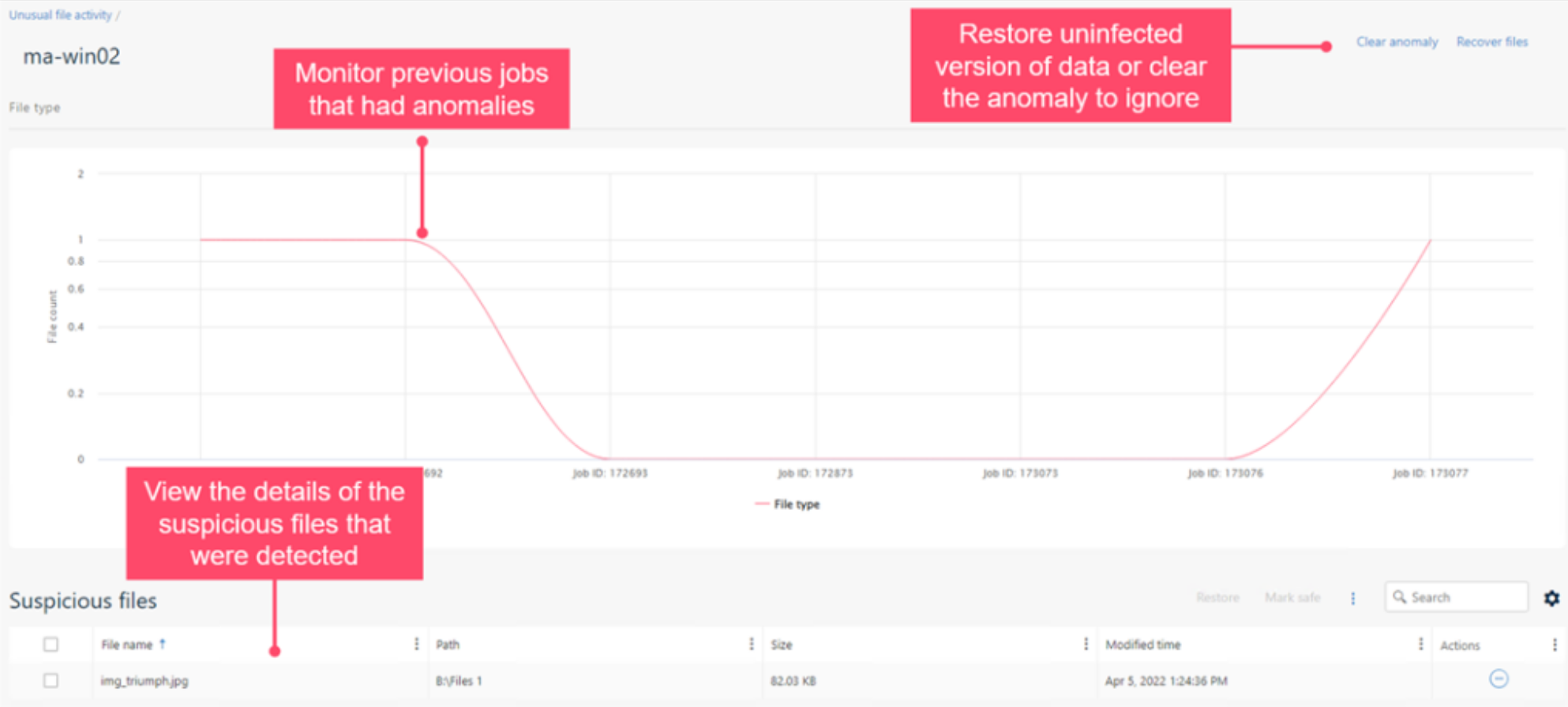
Uma Estratégia de Perda Zero is designed to help protect you from ransomware attacks and is anchored on the pillars of end-to-end data visibility, broadest workload protection, and faster business response, built on the foundation of Zero Trust principles. End-to-end data visibility ensures that you catch threats before they impact your data – in addition to Metallic ThreatWise for early detection through cyber deception, we have also expanded our file anomaly framework to detect malicious applications that may evade traditional detection methods by posing as safe file types.

Uma análise mais aprofundada das atividades suspeitas em arquivos permite uma detecção mais eficaz e respostas mais rápidas a possíveis ameaças aos seus dados


This feature drives faster business response with immediate alerting of suspicious activity, along with automatic, efficient data recovery using clean versions from unaffected backups. Not just that – we’ve also expanded our data governance capabilities to now profile object storage for Azure, AWS and GCP, eliminating another common area of data leakage.

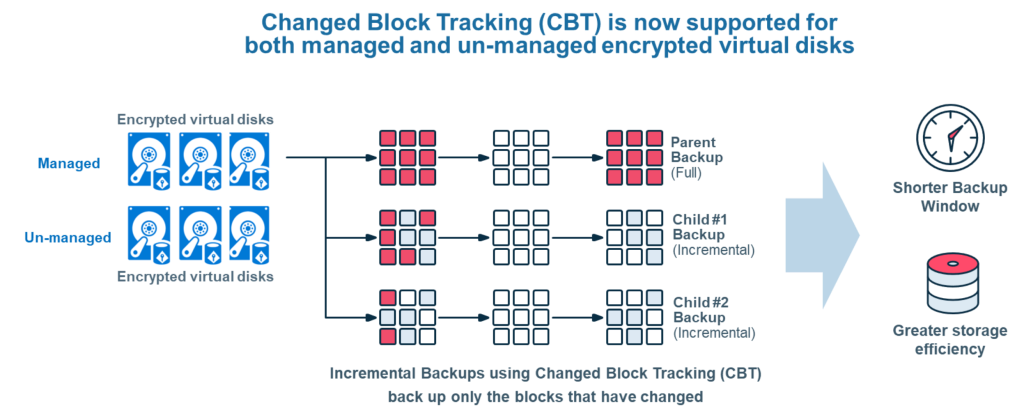
Another enhancement we’ve added is Changed Block Tracking (CBT) support for Azure Disk encryption. CBT improves backup performance while lowering backup costs, by consuming less storage and bandwidth for incremental backups. Historically, however, the ability to perform encryption while using CBT was limited, forcing a tough customer choice between security or cost savings. Working closely with Microsoft, we are excited to now introduce CBT efficiencies with Azure Disk encryption for managed and unmanaged encrypted disks. No longer do you need to make a choice between security, performance and cost efficiencies!

Por último, mas não menos importante, estou animado em compartilhar que agora obtivemos a certificação Sec17a em conformidade com o padrão WORM para o Commvault Grid, ampliando nossa já extensa lista de certificações de segurança — que inclui FIPS 140-2, FedRAMP High In Process (em andamento — pronto para análise pelo PMO) e outras — e completando os recursos do sistema de arquivos imutável do Commvault Grid.

These are just some of the new Data Security capabilities available in Commvault Platform Release 2022E, a release that’s packed with new features and innovation, reflecting on our continued investment in Intelligent Data Services.

Para obter mais informações sobre esta versão, acesse estaPágina and stay tuned and we’ll be discussing more of the exciting new updates in Commvault Platform Release 2022E at our virtual event, Connections on Nov 2/3.


More related posts


Thumbnail_Blog-Dangerous-Silos-IDC-Resops-2026 (1)

The Importance of Recovery Point Objective (RPO) in Your Business Continuity Plan

Read more about The Importance of Recovery Point Objective (RPO) in Your Business Continuity Plan
Thumbnail_Blog-IDC-Resops-2026

Business Continuity Planning for the Cloud-Native Era

Read more about Business Continuity Planning for the Cloud-Native Era
Thumbnail_Blog-Bringing-Trust-to-CVE-2026

Demystifying SOC 2 Data Protection Requirements

Read more about Demystifying SOC 2 Data Protection Requirements

On September 22, Commvault will be presenting live from San Jose, as part of Cloud Field Day 15. 

For the uninitiated, Cloud Field Day is part of the popular “Field day” series, which also includes Tech Field Day and Security Field Day. 

Hosted by Stephen Foskett, delegates from cutting edge companies, including Commvault, share their latest product news and innovations live with a group of hand-picked influencers.  A lively debate usually results, which also takes place across Social Media.

This Cloud Field Day, we’ll be taking the delegates through the very latest in data security technology including a first deep look at Metallic ThreatWise, a newly available data security service which provides customers with much needed early threat detection.  Highlights from Commvault’s recently released Platform release 2022E will also be included to showcase the breadth of Commvault’s Intelligent Data Services.

We’ll be live streaming the session right here on this blog as well as across Commvault’s LinkedIn Channels.

See you on Thursday, 22nd September at 1:30pm PT. Join in the Social Media conversation by using #CFD15.  You don’t want to miss it.

More related posts


Thumbnail_Blog-Dangerous-Silos-IDC-Resops-2026 (1)

The Importance of Recovery Point Objective (RPO) in Your Business Continuity Plan

Read more about The Importance of Recovery Point Objective (RPO) in Your Business Continuity Plan
Thumbnail_Blog-IDC-Resops-2026

Business Continuity Planning for the Cloud-Native Era

Read more about Business Continuity Planning for the Cloud-Native Era
Thumbnail_Blog-Bringing-Trust-to-CVE-2026

Demystifying SOC 2 Data Protection Requirements

Read more about Demystifying SOC 2 Data Protection Requirements

Microsoft 365 is an essential component of today’s enterprise data environment. Still, many organizations fail to include it in their data protection plan. This is partly due to the misconception that cloud service providers are responsible for both administering the solution and protecting the data created and stored within it. However, this is not the case.

Your data, your responsibility

Microsoft provides a highly resilient platform and goes to great lengths to secure data residing within its application. However, like many cloud service providers, they follow what is known as the shared responsibility model, where they are responsible for maintaining the uptime, availability, and access to the solution, while the customer is responsible for protecting the data created and stored within that solution. And now, more than ever, your Microsoft 365 data must be protected and recoverable in the face of emerging threats.

It’s no secret that cyberattacks are on the rise, and SaaS applications are not immune. And there are other potential risks for the data beyond the risks of ransomware. Accidental deletion of data, network vulnerabilities, and internal breaches are all causes of data loss in SaaS applications.

Protection measures to prevent data loss go beyond understanding the shared responsibility model. They require purpose-built tools to help you safeguard your data from today’s threats.

You need dedicated data protection and recovery

While Microsoft offers native controls for data replication, today’s businesses need long-term retention, data separation, and tools for SLA compliance and recoverability. You need a dedicated third-party backup solution that offers the essential capabilities needed to protect and secure your data.

Here are just a few components where protection from third-party backup extends beyond native capabilities to provide advanced protection from today’s threats:

  • Isolamento de dados
  • Retenção prolongada
  • Restauração Flexível
  • Conformidade com o SLA

Commvault enhances Microsoft 365 data protection

Seja você um cliente atual da Commvault ou alguém que pretenda utilizar a Commvault no futuro, oferecemos proteção de dados do Microsoft 365 tanto por meio do Commvault Complete Data Protection quanto do Metallic SaaS Backup, o que significa que você pode escolher a opção que melhor atende às necessidades específicas da sua empresa.

Are you looking for a SaaS-delivered solution with rapid deployments, unlimited storage and retention included, and no additional infrastructure required? Then o Metallic para Microsoft 365 is the best fit.

Looking for on-premises data protection or want to leverage your own infrastructure? Do you have specific needs for long-term retention or migration between on-premises Exchange and Microsoft 365?  Then look to on-premises protection through Commvault Complete Data Protection for Microsoft 365.

Para saber mais sobre como a Commvault aprimora a proteção de dados do Microsoft 365, acessecommvault.com/microsoft-365.

Learn more about Microsoft’s Responsabilidade compartilhada.

More related posts


Thumbnail_Blog-Dangerous-Silos-IDC-Resops-2026 (1)

The Importance of Recovery Point Objective (RPO) in Your Business Continuity Plan

Read more about The Importance of Recovery Point Objective (RPO) in Your Business Continuity Plan
Thumbnail_Blog-IDC-Resops-2026

Business Continuity Planning for the Cloud-Native Era

Read more about Business Continuity Planning for the Cloud-Native Era
Thumbnail_Blog-Bringing-Trust-to-CVE-2026

Demystifying SOC 2 Data Protection Requirements

Read more about Demystifying SOC 2 Data Protection Requirements

https://play.vidyard.com/HSrWMH7cRstsFT42QdpTua.jpg

Suas equipes sabem quais são suas funções e responsabilidades durante um ataque cibernético real?

Suas equipes têm autonomia para tomar decisões na hora, ou precisam participar de chamadas no Zoom para obter permissão para desligar servidores?

Suas equipes operacionais de TI, redes e segurança estão alinhadas quanto a quais são as responsabilidades de cada equipe, quando devem intervir e quando não devem?

According to a recent Gartner report, multidisciplinary teams that blend technology or analytics and business domain expertise and share accountability for business and technology outcomes foster team fusion innovation for digital delivery. Fusion teams consist of business and IT staff: product owners, scrum masters, developers, and domain experts. Fusion teams help to remove friction and address companywide issues and requirements.1

A village

With so many ransomware factors, it is usually within the innocent context that someone simply clicks a link, infecting an organization’s entire network with malware. There are many considerations on how you will defend against this very prevalent threat. Defending against ransomware is a major challenge  – and no individual team can combat it on their own. It takes a well-equipped, prepared, and practiced village to deal with complex threats successfully – one that includes:

People

Manter o alinhamento com as equipes internas e externas antes, durante e após um ataque de ransomware é fundamental para agilizar a Recovery, permitindo que elas reajam mais rapidamente e reduzam os custos associados ao tempo de inatividade.

Process

It is important that internal and external teams are aware of and in sync regarding their responsibilities and what processes they need to follow during a ransomware attack. Test, test, and test your process, as speed will be essential, and you don’t want to test out your process during an attack.

Technology

Siga aEstrutura de Segurança Cibernética do Instituto Nacional de Padrões e Tecnologia (NIST)para facilitar sua preparação. A adoção de uma estrutura de segurança em várias camadas ajuda a garantir que seus dados estejam prontos para Recovery e reduz o risco de perda.

Call To Action

A perda de dados e a incapacidade de recuperá-los rapidamente custarão tempo e dinheiro à sua organização e colocarão em risco sua reputação e suas operações.

  • Identificar as principais partes interessadas: determinar quem precisa estar envolvido durante um ataque cibernético.
  • Identifique os principais ativos: saiba o que é importante e o que não é.
  • Realize um exercício simulado: analise e comunique seus planos de forma proativa.
  • Análise pós-projeto e implementação de mudanças: identificar áreas que precisam de melhorias e colocar essas mudanças em prática.

Leia nossoeBook Understanding Team Roles & Responsibilities in fighting ransomware to learn more.

This content has been derived from Commvault Connections 2021. Watch Dave Martin’s presentation Saiba mais no SHIFT 2025.


  1. Gartner, “I&O Forward: Liderando a Próxima Fase de Crescimento”, 2022

More related posts


Thumbnail_Blog-Dangerous-Silos-IDC-Resops-2026 (1)

The Importance of Recovery Point Objective (RPO) in Your Business Continuity Plan

Read more about The Importance of Recovery Point Objective (RPO) in Your Business Continuity Plan
Thumbnail_Blog-IDC-Resops-2026

Business Continuity Planning for the Cloud-Native Era

Read more about Business Continuity Planning for the Cloud-Native Era
Thumbnail_Blog-Bringing-Trust-to-CVE-2026

Demystifying SOC 2 Data Protection Requirements

Read more about Demystifying SOC 2 Data Protection Requirements

Alguns exemplos do Efeito Mandela:

  • Embora a maioria das pessoas se lembre do personagem infantil Curious George como tendo um rabo, ele não tem nenhum.
  • Many people believe there is a brand of peanut butter called “Jiffy” but there is not. There’s Jif, and there’s Skippy, but no Jiffy.
  • In the iconic scene in “Silence of the Lambs,” Hannibal Lecter does not say “Hello Clarice” as many people remember.  He says “good morning.”

O Efeito Mandela na nuvem

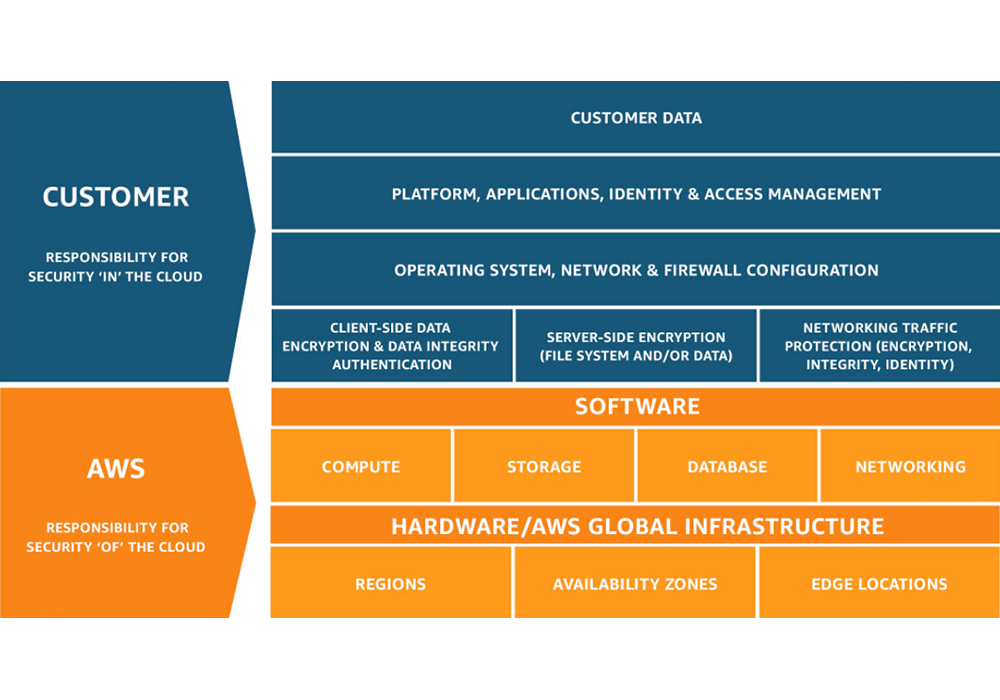
The Mandela effect is not just a pop culture phenomenon, it exists in the world of enterprise technology, too. It’s a common misconception that data stored in the cloud is automatically backed up.  The truth is that cloud providers operate on a shared responsibility model, in which the cloud provider is responsible for the security of the software, hardware and infrastructure, but not customers’ data.

Shared Responsibility Model from AWS

For example, when AWS refers to their highly durable Amazon S3 service, it’s true that the platform is incredibly durable, which means you’re unlikely to experience any trouble with their systems or infrastructure.  However, this has nothing to do with protecting your data from accidental deletions, ransomware attacks or insider threats. According to the shared responsibility model, that’s your job.

Medidas para proteger seus dados na nuvem

Os clientes adoram trabalhar com a Clumio porque obtêm proteção de dados imutável e isolada do ambiente externo, com um tempo de retorno sobre o investimento incrivelmente rápido, enquanto a simplicidade do SaaS garante uma captação, catalogação, pesquisa e Recovery rápidas e simples em qualquer escala. A Clumio permite que os clientes automatizem a proteção de seus dados da AWS e do Microsoft 365, economizando tempo e recursos, o que lhes permite se concentrar em iniciativas estratégicas e reduzir o custo total de propriedade (TCO) em comparação com outras opções.

Don’t let data protection misconceptions leave you vulnerable.

More related posts


Thumbnail_Blog-Dangerous-Silos-IDC-Resops-2026 (1)

The Importance of Recovery Point Objective (RPO) in Your Business Continuity Plan

Read more about The Importance of Recovery Point Objective (RPO) in Your Business Continuity Plan
Thumbnail_Blog-IDC-Resops-2026

Business Continuity Planning for the Cloud-Native Era

Read more about Business Continuity Planning for the Cloud-Native Era
Thumbnail_Blog-Bringing-Trust-to-CVE-2026

Demystifying SOC 2 Data Protection Requirements

Read more about Demystifying SOC 2 Data Protection Requirements

Neste blog, vamos abordar:

Containerization

What is a contêiner?

  • A Container is a basic software unit that packages up code and all its dependencies so an application can run smoothly in any environment. Each container is made up of a hardware, an operating system, a container engine, libraries, and dependency’s and finally the application. Everything the application needs to run is inside the container which means it can be created and deleted quickly using automation.
    • By 2025, 85% of global enterprises will be running containerized applications in production1

Container Orchestration

  • A orquestração de contêineres é a automação de cargas de trabalho em contêineres. Ela é fundamental ao se trabalhar com contêineres, pois é o que permite implantar o mesmo aplicativo em diferentes ambientes sem a necessidade de reprojetá-lo.

Kubernetes

What is Kubernetes (aka K8s)?

  • Kubernetes is an open-source container orchestration software designed for deploying, managing, and scaling containers. So, what does that mean? Essentially it eliminates much of the manual processes that needs to be done during deploying and scaling containerized workloads, even across various types of physical, virtual, and cloud environments.
  • De acordo com uma pesquisa recente realizada pela Cloud Native Computing Foundation, dos 3.800 participantes da pesquisa, 96% das organizações estão usando ou avaliando o Kubernetes²

Did you know?

  • The name Kubernetes comes Greek word κυβερνήτης (kubernḗtēs) which means pilot or helmsman therefore the Kubernetes logo is a ship’s steering wheel.  Kubernetes is often abbreviated as K8s because there are 8 letters in between ‘K’ and ‘S’
  • O Kubernetes foi originalmente desenvolvido e projetado por engenheiros do Google e, posteriormente, doado à CNCF em 2015.

How does it work?

  • Kubernetes is a concept made up of several different components, and, while there are several elements and use-cases in the implementation of Kubernetes, the main concepts to understand are: the Control PlanePods, and Nodes.
    • The Control Plane consists of elements and API processes which coordinate workloads and communications, allowing for the smooth flow of information and resource allocation across the environment.
    • Pods are the base element in Kubernetes. A Pod consists of one or more containers and are co-located on the same node.
    • A Node (also known as a minion, or worker)is a machine on which containers are deployed. Each node must run a container runtime such as Docker, CoreOS rkt, Containerd, etc. Multiple Nodes can be grouped into Clusters.

Your IT environment and Kubernetes

  • Como resultado das mudanças nas práticas modernas de computação, os usuários esperam que os aplicativos estejam disponíveis 24 horas por dia, 7 dias por semana, e, às vezes, espera-se que os desenvolvedores sejam capazes de implantar novas versões dos aplicativos várias vezes ao dia. Além disso, os ambientes de TI estão se tornando cada vez mais híbridos e baseados em abordagens multicloud, integrando recursos locais a nuvens públicas ou privadas de diferentes fornecedores. Embora os sistemas de contêineres tenham permitido que os desenvolvedores tornassem o software mais portátil e mantivessem todos os pacotes necessários para executar um serviço, eles ainda eram limitados pela quantidade de trabalho manual necessária para provisionar e modificar cada contêiner em um ambiente.
  • O Kubernetes pode ajudar as organizações a gerenciar melhor suas cargas de trabalho e reduzir riscos. O Kubernetes é capaz de automatizar as operações de gerenciamento de contêineres e otimizar o uso dos recursos de TI. Ele pode até mesmo reiniciar contêineres órfãos, desligar aqueles que não estão sendo utilizados e recriá-los. O Kubernetes automatiza a implantação de contêineres sem que a equipe de DevOps precise mover todos os componentes manualmente. Isso permite que os desenvolvedores implantem novas versões de aplicativos específicos com maior frequência e possibilita que elas sejam lançadas e atualizadas sem tempo de inatividade, mesmo em vários ambientes (por exemplo, Desenvolvimento, Teste, Produção).

Benefits of Kubernetes

  • Os principais benefícios do Kubernetes podem ser resumidos da seguinte forma: redução dos prazos de desenvolvimento e lançamento de aplicativos, otimização dos custos de TI, maior escalabilidade e disponibilidade do software, flexibilidade em ambientes multicloud e portabilidade na nuvem.
  • Cargas de trabalho portáteis
    • Because Kubernetes is an open source your workloads become portable take advantage of on-prem, hybrid, and multiple cloud environment— all while maintaining consistency across each environment.
  • Flexibilidade
    • Não importa onde você esteja executando o Kubernetes, ele oferece flexibilidade em ambientes híbridos e multicloud, permitindo que qualquer uma de nossas aplicações funcione sem problemas em qualquer ambiente público ou privado.
  • Automação
    • O Kubernetes pode automatizar ambientes em contêineres, atuando como seu sistema operacional. Ele faz isso automatizando os requisitos operacionais das cargas de trabalho em contêineres.
  • Escalabilidade e disponibilidade
    • O Kubernetes permite definir aplicativos complexos em contêineres e implantá-los em clusters de servidores. À medida que o Kubernetes dimensiona os aplicativos de acordo com o estado desejado, ele monitora e mantém automaticamente a integridade dos contêineres.

Kubernetes Architecture 

  • Kubernetes control plane: Also known as the master machine, is the container orchestration layer that exposes the API and interfaces to define, deploy, and manage the lifecycle of containers aswell as the nodes that hold the containerized applications. It ensures that every cluster is kept in its desired state.

The components of the Control Plane

  • API Server: The Application Programming Interface also know as API is the front end of Kubernetes. It is where clients make an initial request for an object or a collection and it determines if the request is valid and then it will process it. The API server also is what is used to transmit, create, and configure data within K8 clusters.
  • K8s scheduler: The scheduler is what watches and manages pods that are newly created and assigns them to a node so they can run on it smoothly.
  • Controller manager: Within the Control Plane there are multiple controllers, they are the control loops designed to watch the state of your cluster and make or request changes as they are needed.
  • Etcd: Is a data base where all your container storage is stored. It is a strongly consistent, distributed key-value store that holds and manages the critical information that systems need to run.
  • Cluster
    • NODE: (also known as a minion, or worker)is a machine on which containers are deployed. Each node must run a container runtime such as Docker, CoreOS rkt, Containerd, etc. Multiple Nodes can be grouped into Clusters.
    • Pod: are the base element in Kubernetes. A Pod consists of one or more containers and are co-located on  nodes.
      • É aqui que todas as suas informações importantes ficam guardadas

Modernize with Kubernetes

  • O Kubernetes permite simplificar e acelerar a migração de aplicativos de um ambiente local para nuvens públicas ou privadas, oferecidas por qualquer provedor. Os aplicativos podem ser migrados para a nuvem por meio da adoção de diversas metodologias:
    • a simples transposição do aplicativo, sem nenhuma alteração no código (Lift & Shift);
    • as alterações mínimas necessárias para permitir que o aplicativo funcione em novos ambientes (mudança de plataforma);
    • a ampla reformulação da estrutura e da funcionalidade do aplicativo (refatoração).
  • Modernize seu ambiente com mais facilidade do que nunca com a adoção do Kubernetes. Não é mais preciso se perguntar onde estão seus dados, pois todos eles ficam armazenados em um único lugar. O armazenamento do Kubernetes é baseado em volumes. Os volumes podem ser persistentes ou não persistentes. Dentro dos pods, os contêineres solicitam mais espaço de armazenamento.
    • Kubernetes can be built once and then is able to be deployed anywhere. This means no matter where you build your cluster whether it is on prem or in the cloud you don’t need to rebuild the solution you just have to deploy a different cluster.

Challenge

  • Kubernetes clusters can be prone to ransomware attacks, like any other workload. In some cases, a hacker can gain access to what is inside of your pod –  potentially receiving critical information about your organization. Therefore, backing up and having data protection for your clusters is vital when it comes to moving your workloads around.

Kubernetes Backup

  • Trata-se do processo de fazer backup de todos os componentes que são executados em uma plataforma de orquestração do Kubernetes, o que inclui todos os aplicativos em contêineres da organização. Como um cluster do Kubernetes possui tantos componentes — pods, nós, plano de controle e volumes —, cada um deles precisa de um nível de proteção. A proteção é fundamental para um cluster, especialmente porque as organizações dependem cada vez mais do Kubernetes. Fazer backup de um cluster do Kubernetes garante que os dados, as configurações e os arquivos fiquem protegidos contra qualquer ataque. É por isso que você precisa de uma solução capaz de fazer backup de todo o seu cluster.
  • As principais etapas do Kubernetes Backup incluem:
    • A descoberta
    • Identificação de recursos
    • Backup
      • De acordo com o Relatório sobre o Estado da Segurança do Kubernetes 2022, da Red Hat, 93% dos entrevistados sofreram pelo menos um incidente de segurança em seus ambientes de Kubernetes nos últimos 12 meses, o que, em alguns casos, resultou em perda de receita ou de clientes³

Commvault and Metallic’s Kubernetes Backup

Commvault and Kubernetes Data Protection

  • Commvault has the ability to back up your entire cluster unlike most solutions that can only back up your containers. Commvault provides data protection for persistent storage in your stateful applications. Commvault’s solution automates back up of this data all from a single platform that increases the visibility and management capabilities of your entire environment. Our solution gives you the flexibility to migrate and deploy containers from on-prem to cloud, cloud to cloud and even back on- prem seamlessly with ease. It also offers broad support for VMs, data services and cloud services in a single platform. It is also compatible with all CNCF- certified distributions and integrated with CSI for snapshot-based backups.
  • Commvault has been recognized by the 2022 GigaOm report as a “leader and outperformer” in Kubernetes data protection for our flexible deployment architecture and single interface across multiple deployments. The report also states that our security and ransomware controls are extensive which makes it suitable for larger enterprises.

How Commvault does it

  • A Commvault agenda um pod de trabalhadores temporários para realizar a movimentação de dados. As configurações especificam um registro privado de contêineres onde você armazena uma imagem que a Commvault pode baixar. Isso permite consolidar clusters, simplificar a migração entre clusters e otimizar o gerenciamento do ciclo de vida dos clusters.

Challenges before Commvault

  • Antes da Commvault, as organizações precisavam lidar com a proliferação de clusters, tendo que gerenciar seus ciclos de vida e consolidá-los. A Commvault ajuda a superar esses desafios, permitindo que você migre suas aplicações do Kubernetes para qualquer nuvem com facilidade.

Metallic and Kubernetes backup

  • A Metallic oferece VM & Kubernetes Backup. Este é o único serviço de proteção de dados em modelo SaaS que oferece cobertura completa para cargas de trabalho híbridas, garantindo que seus contêineres estejam sempre seguros.
  • O VM & Kubernetes Backup da Metallic é uma solução que permite ampliar facilmente para contêineres a modernização de aplicativos com confiança, ao mesmo tempo em que protege os aplicativos tradicionais. Seja em ambiente local ou na nuvem, a Metallic oferece suporte a todas as distribuições do Kubernetes certificadas pela Cloud Native Computing Foundation, como o Azure Kubernetes Service (AKS), Amazon EKS, VMware, Rancher e muitas outras.
  • O Metallic pode proteger bancos de dados na nuvem ou locais, sistemas de controle de código-fonte, registros de imagens e armazenamento de objetos nativo da nuvem.
  • Com a flexibilidade incomparável, a segurança máxima e o gerenciamento sem complicações desta solução, todas as suas cargas de trabalho estão asseguradas.

Conclusão

O Kubernetes é o futuro; agora é a hora de garantir que todas as suas cargas de trabalho estejam protegidas e possam migrar com segurança para a nuvem. A Commvault é a escolha mais fácil. Fomos reconhecidos como líderes e com desempenho superior no relatório da GigaOm de 2022 sobre proteção de dados no Kubernetes devido ao nosso amplo suporte a cargas de trabalho, compatibilidade com distribuições certificadas pela CNCF e controles abrangentes contra ransomware. Então, faça as malas: o navio parte hoje mesmo rumo à nuvem.

References

1. Best Practices for Running Containers and Kubernetes in Production – 4 Aug 2020 – Gartner ID G00730344 – 2. CNCF 2021, Annual Survey – 3. Red Hat 2022, State of Kubernetes Security Report

More related posts


Thumbnail_Blog-Dangerous-Silos-IDC-Resops-2026 (1)

The Importance of Recovery Point Objective (RPO) in Your Business Continuity Plan

Read more about The Importance of Recovery Point Objective (RPO) in Your Business Continuity Plan
Thumbnail_Blog-IDC-Resops-2026

Business Continuity Planning for the Cloud-Native Era

Read more about Business Continuity Planning for the Cloud-Native Era
Thumbnail_Blog-Bringing-Trust-to-CVE-2026

Demystifying SOC 2 Data Protection Requirements

Read more about Demystifying SOC 2 Data Protection Requirements

Enterprises today are inherently heterogeneous, running applications and supporting workloads across on-prem, edge and multiple clouds. As businesses accelerate their IT transformation, this hybrid multi-cloud presence is set to further expand. It is imperative, then, that enterprise data protection and data management solutions excel in all of these areas – across on-prem, edge and multiple clouds.

Gartner Critical Capabilities report assesses these types of solutions on various key aspects such as security, efficiency, scalability and performance, Data Center ecosystem, and reporting and analytics across the key use cases of on-prem, edge and cloud. In my conversations with CIO’s, IT leaders, and architects, these are exactly the key aspects they are concerned with when architecting their data management strategy to protect their crown jewels.

This is why we are thrilled and honored that Commvault Backup & Recovery has scored the highest in all three use cases in the 2022 Gartner Critical Capabilities for Enterprise Backup and Recovery Software Solutions: Data Center Environments (4.23/5), Cloud Environments (4.18/5), and Edge Environments (4.22/5). With the highest scores in all three use cases – for the third time in a row – we believe this is yet another validation of our commitment to be a trusted partner to our customers in protecting their data and workloads – no matter where they reside.

Data Center Environments (4.23/5)
Cloud Environments (4.18/5)
Edge Environments (4.22/5)

As empresas estão em constante evolução e expansão para atender às necessidades de negócios. Portanto, outro fator essencial para acelerar a transformação de TI é uma solução de gerenciamento de dados capaz de evoluir de maneira flexível junto com o restante da infraestrutura de TI.

“Our continuous innovation is designed with ultimate flexibility when it comes to data management – offering not only an enterprise software solution but also the ability to manage and protect enterprise data with Commvault Grid as an integrated solution or via Metallic as a cloud-delivered DMaaS solution.”


Unfortunately, flexibility and breadth are often offered at the cost of simplicity in our industry.  In contrast, Commvault breaks this paradigm with our “infinitely scalable, radically simple” approach. We bring together all management – across our broad set of supported workloads, flexible form factors and array of Intelligent Data Services – through the single experience of Commvault Command Center. This simplicity – with no compromise to flexibility and breadth – empowers customers to fast-track their business transformation aligning their data management to their broader IT strategy. As businesses modernize and transform, transitioning applications and workloads from one form factor or location to another (from on-prem to cloud, for example), we ensure they remain protected no matter where they are in this journey.

As an eleven-time Leader in the Gartner Magic Quadrant and back-to-back years with the highest scores in all three use cases in the Gartner Critical Capabilities report, we are grateful to our customers for partnering with us in this journey of continuous customer-first innovation and to our partners in building a data ecosystem with no boundaries. Our journey to solve the hard data management problems with elegant solutions continues … together with our dear customers and partners!

Gartner®, Magic Quadrant™ para Soluções de Software de Backup and Recovery Corporativas, 28 de julho de 2022, Michael Hoeck e outros. Gartner®, Capacidades Críticas para Soluções de Software de Backup and Recovery Corporativas, 22 de agosto de 2022, Nik Simpson e outros.

Gartner Disclaimer:

**Gartner does not endorse any vendor, product or service depicted in its research publications, and does not advise technology users to select only those vendors with the highest ratings or other designation. Gartner research publications consist of the opinions of Gartner’s research organization and should not be construed as statements of fact. Gartner disclaims all warranties, expressed or implied, with respect to this research, including any warranties of merchantability or fitness for a particular purpose.**

**GARTNER e Magic Quadrant são marcas registradas e marcas de serviço da Gartner, Inc. e/ou suas afiliadas nos Estados Unidos e internacionalmente e são usadas aqui com permissão. Todos os direitos reservados.**

Adquira sua cópia do relatório “Gartner Critical Capabilities for Enterprise Backup and Recovery Solutions 2022”

More related posts


Thumbnail_Blog-Dangerous-Silos-IDC-Resops-2026 (1)

The Importance of Recovery Point Objective (RPO) in Your Business Continuity Plan

Read more about The Importance of Recovery Point Objective (RPO) in Your Business Continuity Plan
Thumbnail_Blog-IDC-Resops-2026

Business Continuity Planning for the Cloud-Native Era

Read more about Business Continuity Planning for the Cloud-Native Era
Thumbnail_Blog-Bringing-Trust-to-CVE-2026

Demystifying SOC 2 Data Protection Requirements

Read more about Demystifying SOC 2 Data Protection Requirements

Commvault’s long time partnership with Microsoft has once again given us the opportunity to offer our customers cutting edge features and functionality.  We are excited to have had the opportunity to develop this feature in lockstep with Microsoft allowing us to release our enhanced capabilities on Commvault Complete and Metallic® DMaaS simultaneously when Azure Restore Points became publicly available on July 19th 2022.

Commvault Protection for Azure Virtual Machines

Figura 1

Commvault has always offered options for protecting Azure Virtual Machines (VM) by using snapshots or even installing software on the VM to provide Application Awareness.   Each disk resource is individually snapped and protected.  The process is serial by nature as each resource request needed to be made in series. 

Na Figura 1, uma solicitação de backup precisaria proteger o disco do sistema operacional, depois o disco Dados 1 e, por fim, o disco Dados 2. Todos os três compõem a máquina virtual e seriam protegidos em conjunto, mas seus instantâneos podem não serem concluídos exatamente ao mesmo tempo, podendo ser necessária uma coordenação adicional com a camada de aplicativos para garantir a consistência no nível do aplicativo.

New Restore Point Functionality

Figura 2

With Restore Points, Commvault will now have the ability to create collections of restore points across all volumes on a VM.  When doing so, the restore process is simplified, and the collection points are stored on cost efficient storage.  This is a major architectural change in data protection for Microsoft that Commvault Complete and Metallic enable with a click.

In the example in Figure 2, once a Restore Point Collection is created, the same VM would be protected as a single API call to create a Restore Point.  Every Restore Point is incremental and should complete in seconds.  All disks within the VM are consistent with the restore point automatically.  Every Restore Point will contain a Disk Restore Point for all managed disks.  The Disk Restore Point consists of a snapshot of that disk.  This reduces the restore process in this example from 3 steps to 1.  

How is it simplified? 

Leveraging the Commvault platform to orchestrate VM protection and more importantly, the recovery of VMs at enterprise scale is a critical need.  Getting away from point solutions and homebrew scripting naturally promotes growth and reduces downtime.  Being able to recover dozens or hundreds of instances with a few clicks keeps end user time from being sacrificed.

Improve resiliency while reducing tech waste

Commvault supports creating snapshots in cost audited resource groups already and automatically tags resources as they are created so that cost reporting is accurate.  Adding VM Restore Points to our portfolio now allows us to create the restore points in cost efficient and less redundant storage tiers.  It might be a minor cost difference, but at cloud scale, the billing is in the details and every improvement brings value to the solution.   There’s no tradeoff in taking advantage of Restore Points.  It simplifies and reduces cost while improving resiliency.  Azure Restore Points ensures that the applications and the operating system are consistent when creating these collections at the native instance level. 

A quick recap

Better cost efficiency, better performance, better resiliency, and a simplified design.  A resounding win!  We are excited to have had the opportunity to develop this feature in lockstep with Microsoft and prove yet again our commitment to making the latest enhancements in Azure readily available within the Commvault Intelligent Data Services portfolio of solutions.   

More related posts


Thumbnail_Blog-Dangerous-Silos-IDC-Resops-2026 (1)

The Importance of Recovery Point Objective (RPO) in Your Business Continuity Plan

Read more about The Importance of Recovery Point Objective (RPO) in Your Business Continuity Plan
Thumbnail_Blog-IDC-Resops-2026

Business Continuity Planning for the Cloud-Native Era

Read more about Business Continuity Planning for the Cloud-Native Era
Thumbnail_Blog-Bringing-Trust-to-CVE-2026

Demystifying SOC 2 Data Protection Requirements

Read more about Demystifying SOC 2 Data Protection Requirements

Na verdade, a grama é mais verde na nuvem

Until very recently, many enterprises were limited by on-prem infrastructure, requiring huge data centers that had to be maintained, cooled, and secured. On top of that, the enterprise-owned server utilization rate is a measly 18%, with the majority of data centers operating at energy efficiency levels below 80%. This underutilization made on-prem ripe for disruption when the cloud came about. The cloud’s on-demand scalability provided companies the ability to optimize utilization rates without the hassle of managing, powering or cooling infrastructure. Considering the benefits, it’s not surprising that the average enterprise on-prem to cloud migration led to a 65% energy reduction and 84% carbon reduction (Accenture, The Green Behind the Cloud). Moreover, AWS is set to power all operations with 100% renewable energy by 2025, with a commitment to achieve net-zero carbon emissions by 2040. They use reclaimed or recycled water for cooling and have embodied carbon in the construction of newer data centers across the globe. And as an AWS recommended partner, Clumio is pushing the boundaries of environmentally sustainable computing with its on-demand hyper-scalable architecture.

Soluções nativas da nuvem são fundamentais para maximizar a sustentabilidade

whether you need help protecticting your data against ransomware, meeting compliance requirements, or recovering from data loss; data backups can take up a significant amount of storage space, and increase your infrastructure footprint if done on-prem. Companies must choose carefully if they are conscious of reducing their carbon footprint from their data. Some best practices include going with a cloud-native / SaaS data protection vendor if possible, implementing incremental backups vs full system snapshots, categorizing and auto-archiving data based on criticality and usage, and most importantly, investing in a platform that is architected to scale on demand. If these concerns sound like yours, Clumio can help.

Como Clumio pode ajudar

Clumio is a cloud-native backup solution, architected with a container-based stateless data processing pipeline that leverages efficient Lambda functions. This allows adaptability and efficient scaling to optimize usage based on your exact policies. Having this scalable compute and increased utilization rates can ultimately lead to significant carbon reduction from your data estate, in addition to significantly lower TCO (save your wallet while saving the planet).

See for yourself how the industry’s first cloud-native backup and rapid recovery solution can optimize your business’s sustainability metrics. Schedule a demo and learn how your business can be up and running with Clumio in as few as 10 minutes — no need to wait for and install new infrastructure and software.

More related posts


Thumbnail_Blog-Dangerous-Silos-IDC-Resops-2026 (1)

The Importance of Recovery Point Objective (RPO) in Your Business Continuity Plan

Read more about The Importance of Recovery Point Objective (RPO) in Your Business Continuity Plan
Thumbnail_Blog-IDC-Resops-2026

Business Continuity Planning for the Cloud-Native Era

Read more about Business Continuity Planning for the Cloud-Native Era
Thumbnail_Blog-Bringing-Trust-to-CVE-2026

Demystifying SOC 2 Data Protection Requirements

Read more about Demystifying SOC 2 Data Protection Requirements

In this blog, you’ll learn how Commvault Grid makes implementing an immutable architecture easy as an integrated appliance or reference design for an all-in-one solution. With cyber-attacks increasing it delivers comprehensive data management across workloads to protect your data through 5 security layers. Commvault offers a hybrid of controls that work together to harden data against ransomware, cyber threats, and bad actors. 

What is an Immutable Architecture and how do organization benefit?   

Immutability is defined as the ability of any data to be maintained in a non-fungible state for a specific duration of time. Data immutability can be attained via various methods working in conjunction with each other.  An immutable architecture is a model in which no updates, security patches, or configuration changes happen “in-place” on production systems.  If any change is needed, a new version of the architecture is built and deployed into production.  

Organizations need an immutable architecture to ensure their data is safe and secure and more importantly, ready whenever they need to restore it. Immutability is a proven technique used to reduce cyber-attacks on backup data and ensure that backup copies aren’t changed in any way. 

Commvault Grid for Greater Immutability  

Commvault Grid makes it easier to implement an immutable architecture as an integrated appliance or reference design for an all-in-one solution. It delivers comprehensive data management for all workloads from a single, extensible platform. Commvault employs a multi-layered approach to protect against various threat vectors and ensure data is safe. Commvault’s immutable architecture consists of 5 layers which are:   

  • Storage I/O Controls   
  • Zero Trust AAA Controls   
  • Infrastructure Hardening   
  • Zero trust isolation and air gap  
  • Data Validation  

Commvault Grid leverages the entire Commvault software portfolio providing access to all the features, functions, and industry-leading integrations with applications, databases, public cloud environments, hypervisors, operating systems, containers and NextGen workloads. Wherever your data resides, you have the ability to view it, use it, and confidently protect it. Commvault Grid accelerates hybrid cloud adoption with an integrated solution built on a deeply layered system of controls that work together to harden data against ransomware, cyber threats, and bad actors.   


More related posts


Thumbnail_Blog-Dangerous-Silos-IDC-Resops-2026 (1)

The Importance of Recovery Point Objective (RPO) in Your Business Continuity Plan

Read more about The Importance of Recovery Point Objective (RPO) in Your Business Continuity Plan
Thumbnail_Blog-IDC-Resops-2026

Business Continuity Planning for the Cloud-Native Era

Read more about Business Continuity Planning for the Cloud-Native Era
Thumbnail_Blog-Bringing-Trust-to-CVE-2026

Demystifying SOC 2 Data Protection Requirements

Read more about Demystifying SOC 2 Data Protection Requirements

Exemplos de custos ocultos e variáveis do backup em nuvem

Taxas de saída

The majority of cloud providers will allow their users to place data into the cloud without any fees. However, this does not apply when their data is retrieved from the cloud. Cloud providers typically charge what’s known as egress fees any time data is retrieved.

If your enterprise is constantly pulling its data out of the cloud—such as migrating or recovering data— you can see how the fees can add up quickly and lead to inflated costs that are nearly impossible to predict. Egress fees are considered a hidden fee since they fluctuate based on usage and are tied to a common action (data retrieval).

Licenças

There may be a variety of licenses that are required, each with their own fee. These can snowball when cloud backup vendors require licenses for each of the data sources you back up or multiple licenses per user—something you may not realize until the bill comes.

Instantâneos e custos de armazenamento

It is common for enterprises to create long-term storage for their production data if they need to recover it after an attack—such as ransomware. This could involve creating massive amounts of snapshots for each account in high-tier storage. Furthermore, each time a block or file is changed, a new snapshot is automatically created. These snapshots are replicated across accounts, effectively doubling backup storage costs that continue to pile up over time. Costs are further compounded when considering industry retention requirements that go beyond 35 days.

Adding to all the complexity is the fact that it’s difficult to gauge just how many of the backup snapshots in your AWS accounts are even needed. Sure, your bill can display how much you are spending in a particular region, but it doesn’t show the level of granularity regarding the age of the snapshots or assets they are associated with.

Achieve Predictable Costs and Lower TCO with the Industry’s Leading Cloud-Native Backup Solution

You can avoid excessive cloud spending and gain control over backup costs by choosing a cloud backup solution with a simple, straightforward pricing model that clearly spells out the ongoing charges.

Built natively in AWS, Clumio’s backup solution offers the scalability, performance, data protection, and faster access to innovation made possible by the cloud while avoiding the hidden costs, complexity, and limited flexibility of snapshot-based backup solutions.

Preços simplificados

Clumio’s Pay-As-You-Go consumption model with rollover credits provides enterprises with a simplified and clear backup-as-a-service solution that ensures cost predictability while lowering TCO:

  • Transparency – No hidden costs, no license fees, and no egress charges—plus full visibility into data consumption.
  • No Friction – Choose from on-demand or commitment contracts with no setup required.
  • 100% SaaS – No complex cloud infrastructure or software to install or manage.
  • Uma ferramenta integrada de análise de custos que oferece insights para ajudar a reduzir gastos desnecessários com a nuvem

Redução dos gastos com armazenamento

Em vez de manter snapshots do Amazon EBS, a Clumio reduz ainda mais os gastos ao armazenar os dados em um formato compactado e desduplicado no Amazon S3, reduzindo efetivamente o custo da retenção de dados do EBS a longo prazo. Isso permite que as empresas cumpram as normas de conformidade e desenvolvam estratégias de retenção com base nos requisitos comerciais e regulatórios, em vez de nos custos.

Comece a usar o Clumio

Clumio oferece mais do que apenas economia de custos. Em menos de 15 minutos, sua empresa pode:

  • Faça backup instantâneo dos dados da AWS em toda a sua organização com o Clumio
  • Proteja seus dados contra ataques de ransomware e outras ameaças maliciosas por meio do armazenamento isolado (air-gapped) com o Clumio
  • Atenda a objetivos variados e complexos de conformidade de dados por meio de políticas globais com o Clumio
  • Reduza o RTO (Tempo Objetivo de Recuperação) e garanta a continuidade dos negócios em caso de interrupção das operações com o Clumio

Experience firsthand why Clumio is the industry’s leading innovator for AWS cloud backup. Start your free trial, all without any pre-planning or the need to install new infrastructure or software.

More related posts


Thumbnail_Blog-Dangerous-Silos-IDC-Resops-2026 (1)

The Importance of Recovery Point Objective (RPO) in Your Business Continuity Plan

Read more about The Importance of Recovery Point Objective (RPO) in Your Business Continuity Plan
Thumbnail_Blog-IDC-Resops-2026

Business Continuity Planning for the Cloud-Native Era

Read more about Business Continuity Planning for the Cloud-Native Era
Thumbnail_Blog-Bringing-Trust-to-CVE-2026

Demystifying SOC 2 Data Protection Requirements

Read more about Demystifying SOC 2 Data Protection Requirements

Onze vezes.

OGartner® Magic Quadrant™ de 2022 para Soluções de Software de Backup and Recovery Corporativas marks the 11th consecutive time that Commvault has been positioned by Gartner as a “Leader” in this dynamic backup and recovery market.

Estamos imensamente orgulhosos dessa conquista. E por que não? Estamos neste quadrante há mais tempo do que alguns de nossos concorrentes estão no mercado.

As an innovation-driven company, we have always prided ourselves on building elegant solutions to your hard problems, which let’s face it, have only gotten harder over the last few years.

Living between legacy and hybrid cloud applications and systems, today’s CIOs and IT professionals grapple with more applications and workloads than ever. All while bolstering their security posture to protect their data from ransomware and advance transformational business projects with the resources they have at hand.

Now is not the time to take chances on unproven technologies in today’s increasingly uncertain macroenvironment. It is the time to invest for the future, so you and your organization come out stronger on the other side.

I’ve had a lot of these conversations with customers lately, many of whom are weighing these concerns with the need for a trusted, intelligent, and reliable cloud data management vendor. One that not only provides proven technology, but the flexibility and scalability needed to continue to evolve to meet tomorrow’s needs. And one with the demonstrated its ability to execute on a vision over and over.

In its latest report, Gartner highlighted a few of Commvault’s strengths in this area:

Em primeiro lugar, oferecemos suporte abrangente a cargas de trabalho, tanto no local quanto na nuvem. Isso permite que você adicione novos recursos de Backup and Recovery para sua empresa, independentemente dos aplicativos que criam e utilizam seus dados essenciais. Além disso, você pode gerenciar seus dados por meio de um único painel de controle.

Next, based on your unique business needs, you may want to leverage backup software, an appliance, or software as a service. Commvault enables you to choose any or all these approaches – to balance your capital and operating expenses based on your business needs, staffing concerns, or even in response to supply chain delays.

Por fim, nossas soluções e nosso amplo ecossistema de parceiros abrangem diversas regiões geográficas, ampliando o alcance e os recursos para empresas globais. Protegeremos seus dados onde quer que estejam ou precisem estar.

Agradecemos à Gartner pela análise rigorosa e por compartilhar suas conclusões. E, mais importante ainda, agradecemos a todos os nossos clientes e parceiros em todo o mundo que continuam a Entrustar a Commvault para proteger e gerenciar seus dados críticos. Devemos essa honra a vocês.

Download a copy of the 2022 Gartner® Magic Quadrant™ for Enterprise Backup and Recovery Solutions

More related posts


Thumbnail_Blog-Dangerous-Silos-IDC-Resops-2026 (1)

The Importance of Recovery Point Objective (RPO) in Your Business Continuity Plan

Read more about The Importance of Recovery Point Objective (RPO) in Your Business Continuity Plan
Thumbnail_Blog-IDC-Resops-2026

Business Continuity Planning for the Cloud-Native Era

Read more about Business Continuity Planning for the Cloud-Native Era
Thumbnail_Blog-Bringing-Trust-to-CVE-2026

Demystifying SOC 2 Data Protection Requirements

Read more about Demystifying SOC 2 Data Protection Requirements