Skip to content

Here at Commvault, our values – we connect, we inspire, we care, and we deliver – are foundational to everything we do and why it matters.

Esta semana, celebramos nuestra reunión trimestral interna Global Town Hall y entregamos los premios CEO Living Our Values Awards del tercer trimestre del año fiscal 25. Este programa de premios reconoce y celebra a nivel mundial a los empleados de Vault por su increíble trabajo durante el último trimestre y por vivir nuestros valores cada día.

I’m so proud to announce our FY25 Q3 CEO Living Our Values Award winners and our employee-nominated Vaulters’ Choice Award winner below:

Ganadores del Premio CEO

Nithya Suresh

Nithya Suresh

Michael Lawson

Michael Lawson

Dominique Leblond

Dominique Leblond

Equipo de redes sociales
Jason Meserve

Jason Meserve

Riya Borkotoky

Riya Borkotoky

Vaulter’s Choice Award Winner

Joseph Nazaro

Joseph Nazaro

Estos Vaulters son un ejemplo inspirador de lo que realmente significa formar parte de Commvault.

Para obtener más información sobre cómo es trabajar en Commvault, visita nuestrositio de empleo.

More related posts


Thumbnail_Blog-Dangerous-Silos-IDC-Resops-2026 (1)

The Importance of Recovery Point Objective (RPO) in Your Business Continuity Plan

Read more about The Importance of Recovery Point Objective (RPO) in Your Business Continuity Plan
Thumbnail_Blog-IDC-Resops-2026

Business Continuity Planning for the Cloud-Native Era

Read more about Business Continuity Planning for the Cloud-Native Era
Thumbnail_Blog-Bringing-Trust-to-CVE-2026

Demystifying SOC 2 Data Protection Requirements

Read more about Demystifying SOC 2 Data Protection Requirements

La Ley de Resiliencia Operativa Digital (DORA) entró en vigor el 17 de enero, con unas directrices exhaustivas y un marco normativo detallado sobre cómo todas las entidades de servicios financieros que operan en la Unión Europea deben garantizar la resiliencia de los datos frente a interrupciones imprevistas.

La DORA también reconoce una realidad ampliamente aceptada por los profesionales de la ciberseguridad: ya no se trata de si se producirá un ciberataque, sino de cuándo. Esta legislación fundamental aporta un nuevo nivel de rigor y responsabilidad al sector de los servicios financieros, que seguirá evolucionando para salvaguardar la estabilidad de la UE y del ecosistema financiero mundial.

Actualmente, muchos sectores de la industria de los servicios financieros, más allá de los bancos tradicionales y las entidades de crédito, están sujetos a la DORA, entre ellos los proveedores de servicios de pago, las empresas de inversión, los centros de negociación, las aseguradoras y los proveedores externos de servicios de tecnologías de la información y la comunicación (TIC).

Those that are new to this level of regulation may struggle to comply, as indicated by European financial regulators’ DORA “Dry Run Exercise.”1 They also likely will face additional scrutiny by interconnected customers, partners and other stakeholders as a new operational risk. Non-compliance no longer means just the potential for a very large fine but also reputational damage and liability for a company, its directors, and its partners.


While it remains to be seen how quickly financial regulators act, DORA represents a shift from guidelines for data readiness and cyber resilience to enforcement of it. Given the expansive nature of DORA, which significantly broadens the EU’s financial regulation of IT, regulators, lacking unlimited expertise and resources, may face challenges enforcing all aspects of DORA immediately. As a result, regulators are likely to adopt a targeted approach, focusing on the most critical and visible areas of noncompliance. 

Qué es lo que las entidades financieras están priorizando

A top priority for DORA compliance is the submission of accurate and technically compliant registers of information. Financial regulators have emphasized that registers will be a primary focus of enforcement, and they expect organizations to submit them early in 2025. Submitting an accurate register that details the organization’s most significant IT providers may be more beneficial than submitting incomplete information about all of its IT providers.2

For data protection leaders and CIOs, DORA is a call to action to examine legacy systems and consider whether they are capable of withstanding today’s cyberthreats and can deliver the performance required for efficient, rapid service recovery. 

Más allá de identificar y catalogar los sistemas, aplicaciones y cargas de trabajo clave junto con sus respectivos proveedores de TIC, las organizaciones deben analizar detenidamente las capacidades fundamentales que protegen, defienden y recuperan dichos sistemas. Entre las capacidades críticas se incluyen:

  • Data protection and cyber recovery
    cibernética: Las capacidades de Recovery rápido son esenciales en el marco de la DORA para minimizar el impacto operativo de un ataque. La única forma de alcanzar el RTO más estricto y ultracorto que se exige para los sistemas críticos es llevar a cabo la recuperación mediante instantáneas inmutables basadas en almacenamiento. Estas instantáneas deben almacenarse de forma segura en un repositorio aislado (o con aislamiento físico virtual).
  • Early-warning threat detection
    Identifying and remediating potential cyberthreats earlier is an important aspect of data protection and readiness. The capability to continuously scan data to detect anomalies and identify threats like ransomware and malware in real time and automate remediation is essential for faster containment of an attack. 
  • Isolated recovery environments (IRE) or cleanrooms for resilience testing
    Establishing a completely self-contained IRE, where data can be restored for forensic and application analysis and validated as clean before returning to production, speeds recovery. IREs also allow organizations to continuously test and improve cyber recovery practices for organizational readiness.
  • Scalability and performance

Businesses will continue to evolve their services, face new regulatory requirements, and deal with emerging cyberthreats. It’s important to consider a solution’s ability to scale as data requirements change across distributed, hybrid environments while maintaining high-performance speeds for data protection and recovery.

Cumplimiento con confianza

Organizations that delay establishing robust capabilities to meet DORA and other evolving resilience regulations – such as PSD2, NIS2, APRA CPS 230, and the European Cyber Resilience Act coming into effect in 2026 – may find themselves with mounting challenges to overcome. They also may find themselves at competitive disadvantage to firms that can demonstrate their ability to remain resilient in the face of disruptions in the global financial ecosystem.

Working with partners that understand the regulation’s resilience requirements and deploying robust solutions can help enable organizations to be compliant and better prepared to meet new regulatory challenges and defend their data environment against emerging threats.

Pure Storage and Commvault have come together to build a joint solution, modular in design, that helps financial institutions enhance their cyber resilience practices and address key pillars of DORA for incident response and resilience testing. The solution is built by integrating the leading cyber resilience capabilities of Commvault® Cloud with the highly secure, high-performance Pure Storage platform.  Learn more about the solution and our commitment to cyber resilience aquí.

¿Estás preparado cibernéticamente?

Readiness reflects mature cyber resilience, where technology, people, and processes work seamlessly to enable continuous business in the face of any cyber challenge. Evaluate your organization’s cyber resilience with Commvault’s la Evaluación de Madurez Cibernética.  


1 Principales conclusiones del ejercicio de simulación de las Autoridades de Supervisión Europeas (ESA) de 2024, Autoridad Bancaria Europea, 17 de diciembre de 2024.

2 Countdown to DORA – Four Takeaway Points from Regulators’ December Statements, Skadden, Arps, Slate, Meagher & Flom, LLP, Jan. 3, 2025


More related posts


Thumbnail_Blog-Dangerous-Silos-IDC-Resops-2026 (1)

The Importance of Recovery Point Objective (RPO) in Your Business Continuity Plan

Read more about The Importance of Recovery Point Objective (RPO) in Your Business Continuity Plan
Thumbnail_Blog-IDC-Resops-2026

Business Continuity Planning for the Cloud-Native Era

Read more about Business Continuity Planning for the Cloud-Native Era
Thumbnail_Blog-Bringing-Trust-to-CVE-2026

Demystifying SOC 2 Data Protection Requirements

Read more about Demystifying SOC 2 Data Protection Requirements

Welcome to the final installment of our three-part series on Active Directory. In ourprevious blog post, we explored small-scale disruptions that could impact AD, such as the accidental deletion of an object, and why fast, granular recovery is so critical.

Pero, ¿qué ocurre cuando se produce un desastre a mayor escala? ¿Qué pasa con los desastres a gran escala en Active Directory, como los ataques de ransomware o la corrupción del esquema? En estos casos, el proceso de recuperación puede requerir una recuperación completa del bosque de Active Directory. Esto implica restaurar el servicio de directorio, incluidos todos los dominios, los controladores de dominio y los datos asociados, a un estado anterior al ataque.

La amenaza inminente del ransomware

Imagine this scenario: A ransomware attack strikes your organization, locking down the server that hosts AD. Suddenly, all the files on the server are encrypted, and AD goes offline. Now, all the business-critical applications that depend on AD for user authentication are inaccessible. Employees can’t log in, critical services come to a halt, and business is at a standstill.

El impacto de un ataque a Active Directory (AD) que inutiliza los controladores de dominio es real y puede ser devastador. En 2017, el gigante mundial del transporte marítimo Maersk fue víctima del ciberataque NotPetya, que cifró los sistemas de archivos de 45 000 ordenadores, 4 000 servidores y todos menos uno de sus 150 controladores de dominio de AD. Con el AD completamente fuera de servicio, las operaciones se paralizaron al instante, lo que provocó el cierre de 17 puertos de todo el mundo y dejó varados a cientos de buques portacontenedores durante 10 días. En total,el ataque le costó a la empresa al menos 300 millones de dólares.

Gartner señala que, a partir de este año, el 75 % de las organizaciones habrá sufrido al menos un incidente cibernético, como un ataque de ransomware. With such threats looming, having a well-documented and frequently tested recovery plan to restore and rebuild your entire AD environment to a pre-attack state is not just a good idea – it’s critical and the key to getting your business back fast.

La recuperación de la enfermedad de Alzheimer requiere un plan y un proceso específicos

Cuando se produce un desastre, la recuperación del dominio de Active Directory (AD) es fundamental; sin embargo, tradicionalmente ha resultado muy difícil de llevar a cabo, ya que requiere procesos manuales complejos y que consumen mucho tiempo.

Dado que AD es un sistema multimaster distribuido geográficamente, su restauración exige una coordinación meticulosa durante el proceso de Recovery. Cada controlador de dominio debe sincronizarse y restaurarse de forma coordinada para evitar inconsistencias en los datos y una posible corrupción en el directorio recuperado.

Microsoft’s Active Directory Forest Recovery Guide provides a detailed, step-by-step method for this, which can involve anywhere from 50 to 100, or even more, individual steps, depending on the size of your organization. This complexity can significantly prolong the process if done manually, often taking days to weeks to complete. All the while, business operations cease to function, and users cannot access important applications.

El reto va más allá de la mera Recovery de AD. Durante un ciberataque, la Recovery de AD es solo una parte del problema. Tu equipo también tendrá que recuperar datos, aplicaciones, dispositivos de los usuarios, máquinas virtuales y mucho más. Sin un enfoque integral, estas complejidades pueden prolongar aún más las interrupciones y el tiempo de inactividad.

Presentamos: Commvault® Cloud Backup & Recovery for Active Directory Enterprise Edition

Last week, we announced how we are solving the challenges associated with recovering and rebuilding AD with Backup & Recovery for Active Directory Enterprise Edition. It brings a new level of resilience to AD by enabling automated, rapid recovery of the AD forest. This new offering eliminates slow and error-prone manual processes often associated with AD forest recoveries. With Backup & Recovery for AD Enterprise Edition, you will be able to:

  • Make AD recovery a snap via automated runbooks: Automated forest recovery runbooks streamline the multi-step process required for AD forest recovery, including the complex hygiene tasks essential for a clean recovery. These runbooks also can be used for regular testing in non-production environments to enhance cyber readiness.
  • Enable fast recovery of the most important AD infrastructure: Visual topology views of your AD environment enable simple and rapid identification of which domain controllers to restore first and how they should be recovered to accelerate the availability of AD services.
  • Accelerate recovery times and advance resilience: Manually recovering an AD forest can take days or even weeks to complete, but with Commvault, you can recover it in a fraction of the time. The Commvault Cloud platform integrates AD forest recovery with granular recovery of both AD and Entra ID, providing comprehensive protection. 

Para obtener más información y ver una demostración de la solución, visita laActive Directory solution page.

Si te lo has perdido, leehereel comunicado de prensa completo para obtener más detalles.

More related posts


Thumbnail_Blog-Dangerous-Silos-IDC-Resops-2026 (1)

The Importance of Recovery Point Objective (RPO) in Your Business Continuity Plan

Read more about The Importance of Recovery Point Objective (RPO) in Your Business Continuity Plan
Thumbnail_Blog-IDC-Resops-2026

Business Continuity Planning for the Cloud-Native Era

Read more about Business Continuity Planning for the Cloud-Native Era
Thumbnail_Blog-Bringing-Trust-to-CVE-2026

Demystifying SOC 2 Data Protection Requirements

Read more about Demystifying SOC 2 Data Protection Requirements

We’re thrilled to announce that Commvault COE has earned the Great Place to Work® certification for the eighth year in a row. This recognition reflects our enduring commitment to creating a workplace where employees feel valued, connected, and motivated to grow.

At Commvault, our three core principles – We Care, We Inspire, and We Deliver – shape our culture and define our success. We prioritize holistic wellbeing, diversity, equity, and inclusion, creating an environment where every individual feels supported and empowered.

We also believe that to deliver for our customers and partners, we must first deliver for ourselves – by caring for ourselves. From flexible work arrangements to programs that support mental and physical health, we aim to ensure that every Vaulter can achieve their full potential.

Nuestra cultura se basa en la comunicación abierta, la atención sincera y los canales de retroalimentación periódicos, como «Vaulter Voices», que permiten a los empleados compartir sus opiniones e ideas. Asimismo, concedemos gran importancia al crecimiento profesional a través de sólidos programas de formación y desarrollo, oportunidades de tutoría y talleres de mejora de competencias, al tiempo que garantizamos que el equilibrio entre la vida laboral y personal y el bienestar personal sean parte integral del éxito.

Being recognized as a Great Place to Work fills us with immense pride and motivates us to create a lasting impact together – not just for the organization but for each other. Looking ahead, we are committed to investing in our people through advanced collaboration tools, wellness programs, and initiatives that strengthen community engagement.

A medida que nos adaptamos a un panorama laboral en constante evolución, seguiremos centrándonos en dar prioridad a las personas, impulsar la innovación y ofrecer de forma constante un valor excepcional a nuestros clientes y socios. ¡Enhorabuena, equipo de la India!

More related posts


Thumbnail_Blog-Dangerous-Silos-IDC-Resops-2026 (1)

The Importance of Recovery Point Objective (RPO) in Your Business Continuity Plan

Read more about The Importance of Recovery Point Objective (RPO) in Your Business Continuity Plan
Thumbnail_Blog-IDC-Resops-2026

Business Continuity Planning for the Cloud-Native Era

Read more about Business Continuity Planning for the Cloud-Native Era
Thumbnail_Blog-Bringing-Trust-to-CVE-2026

Demystifying SOC 2 Data Protection Requirements

Read more about Demystifying SOC 2 Data Protection Requirements

Imagine conducting a full-scale disaster recovery test while sipping on your latté during a coffee break. Sounds too good to be true, doesn’t it? But with Commvault Cloud Rewind’s specialized cloud resilience platform, this scenario becomes your reality. In a digital age where high-availability cloud services are non-negotiable, robust recovery strategies for cloud infrastructure are more critical than ever.

La necesidad imperiosa de la resiliencia y la Recovery en la nube

Los servicios en la nube se han convertido en el motor de las empresas modernas. Por ello, cualquier interrupción en estos servicios puede acarrear no solo importantes pérdidas económicas y de reputación, sino también un considerable desperdicio de tiempo y recursos de ingeniería esenciales.

This is why cloud resilience is not just a buzzword but an essential component of any modern cloud operations strategy. Without reliable cloud-based DR systems, you’re exposing your organization to considerable risks.

Los retos de la recuperación ante desastres (DR) tradicional en la computación en la nube

A menudo, llevar a cabo una prueba de recuperación ante desastres a gran escala requiere mucho tiempo y resulta compleja, lo que exige una planificación y coordinación minuciosas. Esta complejidad y la inversión de tiempo que supone pueden disuadir a las organizaciones de realizar pruebas periódicas, lo que las deja expuestas a fallos del sistema y a la pérdida de datos.

Revoluciona tus pruebas de recuperación ante desastres en la nube

Cloud Rewind offers a game-changing approach that makes this critical function not only effective but also incredibly efficient and very cost-effective. Imagine being able to run a full DR test over a coffee break. Yes, it’s that fast and simple.

One of our recent users from a multibillion organization in the insurance industry shared his experience: “I am very impressed with how simple the interface is to navigate and perform various tasks,” he said. “I ran a few recoveries earlier today, and it worked 100%.”

Por qué el modelo «Cloud Rewind Rebuild» es la opción más adecuada para las pruebas de recuperación ante desastres en la nube

What makes Cloud Rewind unique is its laser focus on hyperscale cloud environments and our platform’s ability to rebuild isolated on-demand environments quickly. Unlike other platforms that spread their capabilities thin by trying to cover on-premises or hybrid cloud setups, Cloud Rewind is exclusively focused on cloud-based applications. This expertise results in a product that is not just effective but also highly specialized for cloud-based DR.

Ventajas clave de elegir Cloud Rewind

Speed: Execute a full-scale DR test in minutes. No more prolonged downtime or exhaustive preparations or 10-member teams over a weekend.

User-friendliness: Designed with ease of use in mind, Cloud Rewind doesn’t require you to be an expert in DR in cloud computing. Navigate its simple interface and perform various tasks effortlessly.

Cost-effectiveness: The speed and efficiency of Cloud Rewind reduces the costs related to downtime and lost data, offering a highly cost-effective solution for cloud resilience.

Al centrarse exclusivamente en entornos de aplicaciones en la nube, Cloud Rewind ofrece una experiencia y unas prestaciones sin igual en materia de resiliencia y Recovery en la nube. Descubre más sobreCloud Rewindy cómo puede ayudarte a realizar pruebas de Recovery ante desastres en cuestión de minutos.

More related posts


Thumbnail_Blog-Dangerous-Silos-IDC-Resops-2026 (1)

The Importance of Recovery Point Objective (RPO) in Your Business Continuity Plan

Read more about The Importance of Recovery Point Objective (RPO) in Your Business Continuity Plan
Thumbnail_Blog-IDC-Resops-2026

Business Continuity Planning for the Cloud-Native Era

Read more about Business Continuity Planning for the Cloud-Native Era
Thumbnail_Blog-Bringing-Trust-to-CVE-2026

Demystifying SOC 2 Data Protection Requirements

Read more about Demystifying SOC 2 Data Protection Requirements

Me parece muy oportuno que, poco después de celebrar el comienzo de un nuevo año, dediquemos un día a celebrar y reflexionar sobre el legado del Dr. Martin Luther King, Jr.

Today, Commvault’s U.S. offices are closed to observe Martin Luther King Jr. Day. However, as a global Vaulter community, it’s a time for us to pause and reflect on the profound impact Dr. King had not just in the U.S., but around the world.

Dr. King’s unwavering commitment to equality, justice, and community has inspired generations, and his famous “I Have a Dream” speech continues to resonate today. And while we have made significant progress in the years since his famous speech, there is always more work to be done to create a just and equitable world.

As we have just wrapped up our Commvault Cares Quarter of Caring, Dr. King’s commitment to service is top of mind for me. Our Quarter of Caring is an annual initiative here at Commvault dedicated to giving back to our communities and raising awareness of causes close to our hearts. And while many see MLK Day as a day off of work or school, I see it as a day “on” for our global communities! So today, I encourage you to get involved – whether that be by volunteering, donating, or supporting a local nonprofit.

Let’s all honor Dr. King’s legacy with simple acts of kindness, understanding, and service. Together, we can build a brighter future for all.

Learn more about Commvault’s culture of caring aquí.

More related posts


Thumbnail_Blog-Dangerous-Silos-IDC-Resops-2026 (1)

The Importance of Recovery Point Objective (RPO) in Your Business Continuity Plan

Read more about The Importance of Recovery Point Objective (RPO) in Your Business Continuity Plan
Thumbnail_Blog-IDC-Resops-2026

Business Continuity Planning for the Cloud-Native Era

Read more about Business Continuity Planning for the Cloud-Native Era
Thumbnail_Blog-Bringing-Trust-to-CVE-2026

Demystifying SOC 2 Data Protection Requirements

Read more about Demystifying SOC 2 Data Protection Requirements

The partnership between Commvault and HPE is redefining the world of data protection and management. HPE’s high-performance infrastructure powers an entire ecosystem of scalable, sustainable solutions, while Commvault orchestrates and protects data across that ecosystem. Together, we are empowering data-driven enterprises to securely manage, protect, and recover their data across today’s complex hybrid cloud environments.

HPE’s infrastructure solutions are purpose-built to support the most demanding workloads, delivering unmatched performance and scalability across hybrid, multi-cloud, and on-premises environments. At HPE Discover Las Vegas 2024, the company reaffirmed its commitment to leading the enterprise adoption of AI, further positioning HPE as a cornerstone for modern IT. Partnering with HPE allows Commvault to harness this infrastructure, providing our customers with cyber-resilient solutions that enhance the reliability and efficiency of data protection.

Mayor resiliencia gracias a la integración activa de la persistencia entre pares

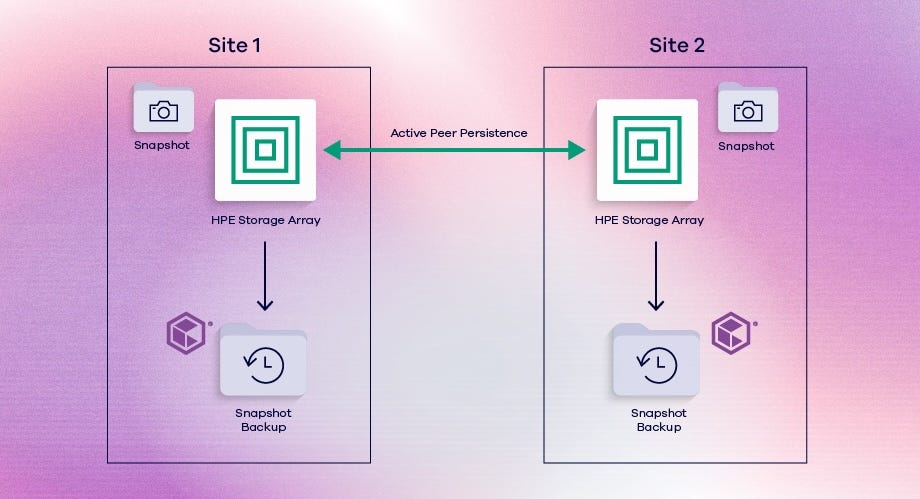
Commvault’s deep integration with HPE storage platforms includes advanced snapshot management capabilities that streamline the protection of large databases, medical imagery, and other data-intensive workloads. Building on this, our recent milestone is Commvault’s new integration with HPE’s Active Peer Persistence technology.

Currently available in HPE Alletra 9000 and HPE Alletra Storage MP B10000, HPE’s Active Peer Persistence enables synchronous replication across two geographically separated storage arrays, automatically failing over from one site to another during an outage without any disruption. This continuous availability is crucial for mission-critical applications that require minimal downtime.

With our new integration, Commvault detects when two HPE storage arrays are in an Active Peer Persistence configuration and snaps both arrays simultaneously, backing up each locally. Commvault’s robust data management tools then allow businesses to send extra copies of data to tape (HPE StoreEver), cloud, or other storage options, supporting compliance and adding another layer of data security.

Ventajas de la integración para las empresas basadas en datos

Esta integración aporta importantes ventajas a los clientes que desean maximizar la resiliencia, reducir el tiempo de inactividad y optimizar los procesos de Backup and Recovery en entornos distribuidos.

  • Continuous availability: Mission-critical applications benefit from uninterrupted access to data, even in the event of planned or unplanned outages.
  • Network efficiency: By allowing data recovery directly from either primary or secondary arrays, the integration reduces the requirement for additional copies, reducing the overall load on network resources.
  • Enhanced compliance: Commvault’s flexible data management enables additional copies of data to meet various regulatory and compliance needs.

La colaboración entre Commvault y HPE pone de manifiesto nuestro compromiso común de ofrecer soluciones de protección de datos modernas, escalables y sostenibles.

“Partnering with HPE to support Active Peer Persistence underscores our dedication to delivering solutions that drive business continuity and operational efficiency,” said Jeff Carlat, Director – WW Alliances at Commvault. “Together, we are equipping our customers with the tools they need to navigate complex data environments with confidence.”

Learn more at hpe.com/storage.

More related posts


Thumbnail_Blog-Dangerous-Silos-IDC-Resops-2026 (1)

The Importance of Recovery Point Objective (RPO) in Your Business Continuity Plan

Read more about The Importance of Recovery Point Objective (RPO) in Your Business Continuity Plan
Thumbnail_Blog-IDC-Resops-2026

Business Continuity Planning for the Cloud-Native Era

Read more about Business Continuity Planning for the Cloud-Native Era
Thumbnail_Blog-Bringing-Trust-to-CVE-2026

Demystifying SOC 2 Data Protection Requirements

Read more about Demystifying SOC 2 Data Protection Requirements

Readiverse es un recurso integral diseñado para ayudar a particulares y organizaciones a mantenerse preparados en el ámbito de la ciberresiliencia, en constante evolución. Es el punto de referencia definitivo para conocer las mejores prácticas y adquirir conocimientos prácticos sobre ciberresiliencia.

En Readiverse, puedes participar en una gran variedad de formatos de aprendizaje que se adaptan a diferentes necesidades y horarios. Tanto si prefieres el reto que suponen los ejercicios de simulación como «Minutes to Meltdown», la profundidad de las certificaciones y los talleres, la comodidad de los vídeos tutoriales o el espíritu colaborativo del aprendizaje en comunidad, Readiverse lo tiene todo.

Nuestra plataforma va más allá de los métodos de aprendizaje tradicionales, ya que ofrece contenidos interactivos y dinámicos para que estés perfectamente preparado para hacer frente a las últimas amenazas cibernéticas.

Únete hoy mismo aReadiversepara mejorar tus defensas cibernéticas y formar parte de una comunidad proactiva dedicada a la excelencia en ciberseguridad.

What’s new in the Readiverse?

Readiverse ofrece ahora una certificación en ciberresiliencia en línea, gratuita y autoguiada.

Esta nueva certificación dota a los profesionales de las tecnologías de la información y la seguridad de los conocimientos y habilidades necesarios para crear una defensa sólida contra las ciberamenazas en tan solo 4 horas.

This course focuses on the fundamental principles of cyber resilience, covering topics such as early warning systems, threat detection, and advanced recovery techniques.  

Los participantes adquieren experiencia práctica en la configuración e integración de las soluciones de Commvault, lo que incluye dominar la técnica deCleanroom to minimize downtime and data loss. 

Through a blend of self-paced e-learning modules and hands-on lab sessions, participants gain the practical skills and knowledge to protect their organizations’ assets. And with a certification in hand, they’ll have the confidence and peace of mind that they have the latest skills and knowledge in cyber resilience.

Los clientes pueden acceder a los cursos de Readiverse utilizando sus credenciales de Commvaultaquí, mientras que los socios pueden acceder a los cursos a través delPortal de socios de Commvault.

More related posts


Thumbnail_Blog-Dangerous-Silos-IDC-Resops-2026 (1)

The Importance of Recovery Point Objective (RPO) in Your Business Continuity Plan

Read more about The Importance of Recovery Point Objective (RPO) in Your Business Continuity Plan
Thumbnail_Blog-IDC-Resops-2026

Business Continuity Planning for the Cloud-Native Era

Read more about Business Continuity Planning for the Cloud-Native Era
Thumbnail_Blog-Bringing-Trust-to-CVE-2026

Demystifying SOC 2 Data Protection Requirements

Read more about Demystifying SOC 2 Data Protection Requirements

Dado que las organizaciones dependen cada vez más de plataformas de «software como servicio» (SaaS), como Microsoft 365 y Salesforce, para sus operaciones críticas, resulta imprescindible contar con una protección integral para estos entornos.

While many organizations assume that SaaS providers offer complete data protection, most operate under a shared responsibility model where customers remain responsible for data backup, recovery, and security. Commvault’s SaaS protection capabilities deliver comprehensive security for these critical environments.

La importancia de la protección en el modelo SaaS

La creciente adopción de plataformas SaaS ha planteado retos fundamentales en materia de protección:

  • La mayoría de los proveedores de SaaS operan según un modelo de responsabilidad compartida.
  • Las organizaciones son responsables de proteger sus datos de SaaS frente a la pérdida, la corrupción y el acceso no autorizado.
  • Las herramientas nativas de protección SaaS suelen presentar limitaciones importantes en cuanto a retención, granularidad y seguridad.
  • SaaS environments increasingly contain an organization’s most sensitive operational data.

Estos factores hacen que la protección de los servicios SaaS de terceros sea esencial para garantizar una seguridad y un cumplimiento normativo integrales.

Funciones de protección de Microsoft 365

Commvault® Cloud Backup & Recovery for Microsoft 365 delivers SaaS resilience and recovery capabilities specifically designed to provide protection from deletion, corruption, and attack. This includes:

Protección de Exchange Online:
  • Protección para las aplicaciones de Microsoft 365.
  • Ofrece opciones de Recovery detalladas para buzones de correo, mensajes de correo electrónico, archivos adjuntos y otros componentes de Exchange Online.
Protección de SharePoint Online y OneDrive:
  • Conserva los permisos de los documentos, el historial de versiones y los metadatos.
  • Permite la recuperación detallada de documentos individuales, bibliotecas o sitios completos.
Protección de equipos:
  • Guarda las conversaciones, los archivos, los canales y la configuración de los equipos.
  • Permite una recuperación tanto parcial como completa de Teams.

Funcionalidades de protección de Salesforce

Commvault amplía su protección SaaS a los entornos de Salesforce, entre los que se incluyen:

  • Abarca tanto los objetos estándar como los personalizados de Salesforce.
  • Conserva las relaciones entre los objetos para garantizar una Recovery completa.
  • Prepara, enmascara y rehidrata entornos sandbox para acelerar las pruebas.
  • Almacenamiento ilimitado, retención ilimitada y protocolos avanzados (como FedRAMP High) incorporados.

Esta protección integral de Salesforce garantiza que los datos críticos de clientes y ventas permanezcan seguros y sean recuperables.

Features avanzadas de seguridad de SaaS

Más allá de las funciones básicas de Backup and Recovery, Commvault ofrece capacidades de seguridad de nivel empresarial para entornos SaaS.

Mayor seguridad de los datos

Commvault implementa medidas de seguridad integrales para los datos de SaaS:

  • La plataforma ofrece capacidades de seguridad integradas en el diseño, con inmutabilidad, aislamiento físico y acceso de confianza cero incorporados de serie.
  • La solución ofrece Commvault AirGap como destino de almacenamiento en la nube integrado, lo que facilita a los departamentos de TI la adopción del almacenamiento «air gap» en la nube para reducir los riesgos.
  • Estas medidas de seguridad protegen los datos de SaaS tanto frente a amenazas externas como frente a riesgos internos.

Cumplimiento y gobernanza

Commvault ofrece funciones de cumplimiento normativo para datos de SaaS:

  • La plataforma admite políticas de retención y recuperación estandarizadas en cargas de trabajo híbridas dispares, incluidas las aplicaciones SaaS.
  • La solución ayuda a las organizaciones a aplicar una gobernanza coherente en todos los entornos SaaS.
  • Estas funciones contribuyen a cumplir los requisitos normativos en materia de protección y conservación de datos.

Gestión unificada de la protección SaaS

Commvault ofrece una gestión uniforme en toda la protección de servicios SaaS:

  • La plataforma elimina la complejidad derivada de la coexistencia de varias consolas gracias a una gestión unificada.
  • La solución admite políticas de retención y recuperación estandarizadas en cargas de trabajo híbridas dispares, incluidas aplicaciones SaaS como M365, Dynamics 365, Salesforce y Google Workspace.
  • Este enfoque unificado simplifica la gestión de la protección en múltiples plataformas SaaS.

El impacto empresarial de una protección integral de SaaS

For organizations, Commvault’s SaaS protection capabilities deliver several significant business advantages:

Continuidad del negocio mejorada

La protección integral de SaaS garantiza la continuidad de las operaciones críticas:

  • The solution provides fast and automated backup, flexible and granular restore, and   scalable and unlimited storage.
  • La plataforma ofrece protección frente a la eliminación, la corrupción y los ataques, con funciones de Backup and Recovery para entornos de Microsoft 365 y Salesforce.
  • Estas funciones ayudan a minimizar las interrupciones provocadas por la pérdida o la corrupción de datos en entornos SaaS.

Simplificada la preparación para el cumplimiento

Commvault’s SaaS protection helps streamline efforts to comply with various industry regulations:

  • La plataforma admite políticas de retención estandarizadas y garantiza la recuperabilidad de los datos, lo que ayuda a cumplir los requisitos de cumplimiento normativo.
  • Las funciones de seguridad, copia de seguridad y restauración permiten la conservación de los datos con fines de cumplimiento normativo.
  • Estas funciones simplifican la auditoría y la elaboración de informes para cumplir con los requisitos normativos.

Menor riesgo para la seguridad

Las características avanzadas de seguridad minimizan el riesgo para los datos de SaaS, ya que la solución incorpora de serie características como la inmutabilidad, el aislamiento físico y el acceso de confianza cero.

Protección SaaS para entornos críticos

As organizations increasingly depend on SaaS platforms for mission-critical operations, comprehensive protection has become essential for business continuity, security, and compliance. Commvault’s superior capabilities for Microsoft 365 and Salesforce protection deliver significant advantages:

  • Comprehensive coverage: Protection for all aspects of SaaS environments, not just the most common elements.
  • Granular recovery: Precise restoration options that minimize disruption and data loss.
  • Enhanced security: Integrated protection against modern threats targeting SaaS data.
  • Simplified compliance readiness: Comprehensive capabilities for helping organizations meet regulatory requirements.

Para las organizaciones que se toman en serio la protección de sus entornos SaaS críticos para su misión, Commvault ofrece una solución integral que elimina las lagunas y garantiza una Recovery completa cuando sea necesario.


Referencias y notas de validación

Referencias principales:
1. Documentación de Commvault sobre la protección de SaaS para Microsoft 365 (Documento 3)
2. Funcionalidades de protección de Commvault para Salesforce (Documento 3)
3. Funciones de seguridad para la protección de SaaS (Documentos 3 y 21)


Requisitos de validación:
1. Verificar las capacidades de protección específicas de cada una de las aplicaciones de Microsoft 365 (Exchange, SharePoint, Teams)
. 2. Confirmar las opciones de Recovery granular para Microsoft 365 y Salesforce
. 3. Validar las funciones de seguridad disponibles específicamente para la protección
de SaaS. 4. Verificar las capacidades y limitaciones de retención de los datos
de SaaS. 5. Confirmar cualquier certificación o capacidad de cumplimiento normativo específica para la protección de SaaS.


More related posts


Thumbnail_Blog-Dangerous-Silos-IDC-Resops-2026 (1)

The Importance of Recovery Point Objective (RPO) in Your Business Continuity Plan

Read more about The Importance of Recovery Point Objective (RPO) in Your Business Continuity Plan
Thumbnail_Blog-IDC-Resops-2026

Business Continuity Planning for the Cloud-Native Era

Read more about Business Continuity Planning for the Cloud-Native Era
Thumbnail_Blog-Bringing-Trust-to-CVE-2026

Demystifying SOC 2 Data Protection Requirements

Read more about Demystifying SOC 2 Data Protection Requirements

As we approach the end-of-life for Actifio on-premises solutions, fijada para el 30 de junio de 2025, it’s crucial for Managed Service Providers (MSPs) to prepare for the transition. After this date, Actifio will cease to provide updates for security, reliability, and performance, which could significantly impact MSPs relying on this platform for on-premises backup and disaster recovery.

El reto

La proximidad de la fecha límite obliga a los MSP a migrar a sus clientes a una alternativa sólida para garantizar una protección y seguridad de los datos ininterrumpidas. Esta transición requiere una evaluación minuciosa de las posibles alternativas, una planificación detallada de la migración y una ejecución fluida para mantener la confianza de los clientes y la integridad de los datos.

La oportunidad

Este periodo de cambio supone una oportunidad perfecta para que los MSP mejoren su oferta de servicios mediante la adopción de una solución más avanzada y completa. Commvault se perfila como una opción superior, ya que ofrece amplias capacidades de protección de datos y Features innovadoras que pueden elevar la calidad del servicio que los MSP prestan a sus clientes.

¿Por qué elegir Commvault?

Comprehensive data protection: Commvault delivers an extensive range of data protection services, including state-of-the-art backup and recovery, disaster recovery, and proactive data management. It supports a diverse set of workloads and applications, creating a holistic approach to data safety.

Scalability and flexibility: Designed to accommodate any business size, Commvault’s scalable solutions allow MSPs to tailor services to meet specific client needs, adapting effortlessly as those needs evolve.

Advanced features: With features like deduplication, compression, and encryption, Commvault not only optimizes storage but also fortifies data security. Its automation tools further streamline operations, reducing the administrative load on MSPs.

Enhanced cyber resiliency: Commvault offers robust defenses against modern cyber threats, including ransomware. Its comprehensive security measures, such as immutable backups and anomaly detection, provide MSPs and their clients with peace of mind.

MSP-centric programs: Commvault’s dedicated MSP programs offer tailored resources, support, and flexible pricing models, all designed to help MSPs thrive.

Pasarse a Commvault

Commvault simplifica el proceso de migración con herramientas y asesoramiento especializado para garantizar una transición fluida desde Actifio. Nuestro equipo se compromete a apoyar a los MSP en cada paso del proceso, desde la planificación inicial hasta la ejecución completa.

Principales ventajas para los MSP
  • Enhanced service offerings: By leveraging Commvault’s comprehensive solutions, MSPs can expand their range of services, increasing their appeal to current and potential clients.
  • Increased efficiency: Automation and streamlined operations reduce costs and improve service delivery, boosting MSPs’ bottom line.
  • Improved profitability: With MSP-friendly pricing and resource allocation, Commvault helps MSPs enhance their profitability and operational efficiency.

Conclusión: Abraza el futuro con Commvault

The end of Actifio’s on-premises offerings marks a critical point for MSPs to reassess their data protection strategies. Commvault stands ready to help MSPs transition smoothly, delivering enhanced service capabilities, operational efficiency, and increased profitability in a post-Actifio landscape.

Don’t delay your preparations. Partner with Commvault today and set the stage for a more resilient, profitable future in managed services.

More related posts


Thumbnail_Blog-Dangerous-Silos-IDC-Resops-2026 (1)

The Importance of Recovery Point Objective (RPO) in Your Business Continuity Plan

Read more about The Importance of Recovery Point Objective (RPO) in Your Business Continuity Plan
Thumbnail_Blog-IDC-Resops-2026

Business Continuity Planning for the Cloud-Native Era

Read more about Business Continuity Planning for the Cloud-Native Era
Thumbnail_Blog-Bringing-Trust-to-CVE-2026

Demystifying SOC 2 Data Protection Requirements

Read more about Demystifying SOC 2 Data Protection Requirements

When evaluating enterprise cyber resilience solutions, organizations face an important architectural choice between appliance-based approaches like Rubrik’s and software-defined platforms like Commvault’s.

Aunque ambos proveedores ofrecen funciones de protección de datos, los diferentes enfoques arquitectónicos conllevan implicaciones económicas distintas que se hacen evidentes a lo largo de todo el ciclo de vida de la solución.

Enfoques arquitectónicos: basados en «cajas» frente a basados en «plataformas»

Rubrik’s Appliance-Centric Model

Rubrik’s approach centers on physical or virtual appliances that serve as the primary deployment model:

  • La capacidad de protección se amplía en incrementos fijos mediante Appliances adicionales.
  • La ampliación suele requerir la instalación de nuevas Appliances cuando se alcanzan los límites de rendimiento o capacidad.
  • Rubrik’s solution uses an appliance-based architecture where data protection capacity comes in predefined sizing options.
Commvault’s Software-Defined Platform

Commvault utiliza una arquitectura modular definida por software:

  • Las opciones de implementación incluyen soluciones exclusivamente de software, arquitecturas de referencia, sistemas convergentes o implementaciones basadas en la nube.
  • Los recursos se pueden ampliar de forma independiente y gradual en función de los requisitos de rendimiento o capacidad.
  • La plataforma Commvault se puede implementar en una infraestructura ya existente, en Appliances diseñadas específicamente para ello o como servicio en la nube.
Repercusiones económicas de las diferencias arquitectónicas

Las diferencias arquitectónicas entre estas soluciones dan lugar a varias consideraciones importantes en materia de costes:

1. Scaling flexibility and efficiency

Los enfoques basados en Appliances suelen requerir el aprovisionamiento de capacidad en incrementos predeterminados, lo que puede dar lugar a un sobreaprovisionamiento cuando las necesidades reales se sitúan entre las diferentes opciones de tamaño de las Appliances. Según los analistas del sector, este escalado escalonado puede provocar que haya capacidad sin utilizar a lo largo de todo el ciclo de vida de la implementación.

El rendimiento y la capacidad están estrechamente relacionados. Para mejorar el rendimiento, es necesario añadir un nodo adicional de Rubrik, lo que también conlleva el coste de una mayor capacidad de almacenamiento. Del mismo modo, para aumentar la capacidad de almacenamiento, los clientes también deben pagar por recursos de rendimiento adicionales (CPU, RAM). Esto se traduce en un aumento del coste total de propiedad (TCO).

Commvault’s platform modular approach enables more precise scaling, allowing organizations to spend as per actual requirements. This helps reduce resource wastage and improves cost efficiency.

2. Cloud integration approach

A medida que las organizaciones adoptan servicios en la nube, el enfoque arquitectónico influye de manera significativa en los costes de protección en la nube:

Las soluciones de plataforma pueden integrarse directamente con los servicios en la nube mediante API nativas. Commvault ofrece integración directa con los servicios en la nube sin necesidad de Appliances virtuales, lo que puede reducir los recursos necesarios para la protección en la nube.

Factores que influyen en el coste total de propiedad

A la hora de evaluar el coste total de propiedad en un periodo de entre tres y cinco años, las organizaciones deben tener en cuenta varios factores clave:

Cost Category Appliance Approach Impact Platform Approach Advantage
Costes de infraestructura Posible exceso de provisión Implementación con el tamaño adecuado
Costes de protección en la nube Appliances virtuales en cada entorno Integración directa de servicios en la nube
Costes de escalabilidad Aumentos escalonados Incrementales en función de las necesidades
Actualización tecnológica Ciclos completos de sustitución de Appliances Actualizaciones a nivel de componentes

Más allá del coste: consideraciones sobre las capacidades

Las diferencias arquitectónicas van más allá de las implicaciones económicas y dan lugar a diferencias en cuanto a las capacidades:

1. Multi-cloud support

Las arquitecturas de plataforma suelen ofrecer capacidades más uniformes en los distintos entornos de nube, gracias al uso de una base de código común con puntos de integración específicos para cada nube. Esto puede simplificar la protección en diversas implementaciones en la nube.

2. Workload coverage

Las plataformas definidas por software suelen admitir una gama más amplia de cargas de trabajo, incluidos sistemas heredados, aplicaciones especializadas y diversos tipos de infraestructura. Esto puede eliminar la necesidad de contar con múltiples soluciones de protección.

3. Security integration

The architectural approach also impacts security capabilities. Commvault’s platform includes integrated security features like threat detection, while appliance-focused solutions may require additional components for comprehensive security. Rubrik’s data security solution is delivery through their SaaS, severely limiting functionality in environments where cloud connectivity is restricted or prohibited, such as dark sites or isolated clusters.

Consideraciones estratégicas sobre arquitectura

The choice between Rubrik’s appliance-based approach and Commvault’s platform architecture represents a strategic decision with long-term implications.

Las organizaciones deberían evaluar estas soluciones en función de sus necesidades específicas, teniendo en cuenta no solo los costes iniciales, sino también factores a largo plazo como la eficiencia en la escalabilidad, los gastos generales de funcionamiento, la integración en la nube y las cuestiones de seguridad. Al comprender las diferencias arquitectónicas y sus implicaciones en términos de costes, las organizaciones pueden tomar decisiones más fundamentadas sobre sus inversiones en ciberresiliencia.

More related posts


Thumbnail_Blog-Dangerous-Silos-IDC-Resops-2026 (1)

The Importance of Recovery Point Objective (RPO) in Your Business Continuity Plan

Read more about The Importance of Recovery Point Objective (RPO) in Your Business Continuity Plan
Thumbnail_Blog-IDC-Resops-2026

Business Continuity Planning for the Cloud-Native Era

Read more about Business Continuity Planning for the Cloud-Native Era
Thumbnail_Blog-Bringing-Trust-to-CVE-2026

Demystifying SOC 2 Data Protection Requirements

Read more about Demystifying SOC 2 Data Protection Requirements

The shift to cloud computing has become more than a strategic advantage – it’s now a business necessity. According to Gartner, by 2028, cloud computing will shift from being a technology disruptor to becoming a necessary component for maintaining business competitiveness. But with this transformation comes a critical challenge that most organizations haven’t fully addressed: true cyber resilience.

El riesgo oculto del 70 % en los entornos en la nube

Here’s a startling reality that most cloud and security leaders don’t realize: According to our research, in a typical cloud environment, application data makes up only 20% to 30% of the resources, while 50% to 70% consists of cloud configurations that remain completely unprotected by traditional backup solutions.

Piensa en lo que esto supone en caso de un incidente cibernético o una interrupción del servicio. Es posible que tu solución de copias de seguridad restaure tus bases de datos y archivos, pero también debes tener en cuenta lo siguiente:

  • Equilibradores de carga y grupos de seguridad.
  • Configuraciones de VPC y políticas de red.
  • Configuración de la orquestación de contenedores.
  • Pasarelas de API y dependencias de microservicios.
  • Configuraciones de gestión de identidades y accesos.
  • Plantillas de «infraestructura como código».

This is where traditional backup falls catastrophically short.

Más allá de la protección de datos: la revolución de la Recovery centrada en las aplicaciones

Commvault® Cloud Rewind represents a fundamental shift from data-centric to application-centric recovery. Rather than simply backing up and restoring data files, Cloud Rewind treats your entire cloud environment as code – discovering through collecting configuration metadata not application data, and rebuilding cloud ecosystems with all their dependencies intact.

La ventaja de Cloud Rewind: «Recovery-as-Code»

Cloud Rewind’s patented Recovery-as-Code approach automatically codifies your application’s cloud resources, dependencies, and data for hyperfast rebuild capabilities. This isn’t just backup ­– it’s a complete Cloud Time Machine that can rewind your entire environment to any point in time.

Entre sus principales funciones figuran:
Descubrimiento y aprendizaje continuos:
  • Aprovecha las API nativas de copias de seguridad e instantáneas que ofrecen las plataformas en la nube, como AWS, Azure y GCP.
  • Mapea las complejas dependencias de las aplicaciones en tiempo real.
  • Se adapta a medida que cambian tus entornos con escalado automático y equilibrio de carga.
  • No se necesitan productos químicos, ni instalación, ni mantenimiento.
Protección integral:
  • Protege las configuraciones y las dependencias en la nube para permitir una rápida reconstrucción.
  • Copias en un momento determinado con copias de seguridad incrementales continuas.
  • Gestión de la replicación multirregional y entre nubes.
  • Protección sin agentes para aplicaciones con escalado automático.
Coordinación inteligente de la Recovery:
  • Recovery con un solo clic de entornos completos de múltiples pilas con sus dependencias.
  • Recovery entre zonas, entre regiones, entre cuentas y entre inquilinos.
  • Simulaciones y pruebas automatizadas de resiliencia.
  • Secuenciación que tiene en cuenta las dependencias para aplicaciones complejas.

Por qué los competidores tradicionales se quedan cortos

While competitors like Cohesity, Rubrik, and Veritas focus primarily on data protection, they fundamentally miss the application-centric nature of modern cloud environments. Even traditional cloud service providers, while responsible for protecting customer data, do not secure the underlying cloud infrastructure – leaving customers with limited ability to minimize downtime and recover quickly in the event of a cyber incident.

Entre los inconvenientes de las herramientas tradicionales de resiliencia se encuentran:
  • Limited scope: They protect data but ignore the 70% of cloud resources that are configurations.
  • Manual resilience testing: Time-consuming, cumbersome, and often not done enough to establish cyber resilience.
  • Fragmented approach: Applications and infrastructure are treated separately, creating recovery gaps.
  • Legacy architecture: Solutions adapted from on-premises thinking rather than cloud-native design.

Cloud Rewind elimina estas limitaciones al tratar las aplicaciones y su infraestructura subyacente, las capas de datos, las redes y la seguridad como un sistema unificado basado en código.

Los tres pilares de la resiliencia cibernética

Cloud Rewind ofrece una resiliencia cibernética integral a través de tres capacidades fundamentales:

1. Reduce el riesgo:
  • El análisis continuo de desviaciones permite detectar errores de configuración antes de que se conviertan en vulnerabilidades.
  • Supervisión proactiva de la resiliencia en todos los recursos en la nube.
  • Las copias de seguridad inmutables impiden el cifrado por parte del ransomware.
2. Mejorar la Readiness.
  • Las simulaciones automatizadas de resiliencia ponen a prueba los procedimientos de Recovery.
  • No se necesitan manuales de procedimientos ni scripts.
  • Protección siempre actualizada que se adapta a más de 100 000 recursos en la nube.
3. Activar Recovery.
  • «Recovery como código» ayuda a eliminar los procesos manuales de reconstrucción.
  • La flexibilidad de la recuperación entre nubes evita la dependencia de un único proveedor.
  • La restauración con un solo clic garantiza la continuidad de la actividad empresarial y contribuye a reducir los tiempos de inactividad imprevistos.

Mirando hacia el futuro: la era de la recuperación continua

As cloud environments become increasingly complex with microservices, containers, and serverless architectures, the gap between traditional backup and true resilience will only widen. Cloud Rewind’s Recovery-as-Code approach represents the future of continuous business – where applications and their complete ecosystems can be rebuilt near-instantly, automatically, and reliably.

For organizations serious about cyber resilience, the question isn’t whether you need application-centric recovery – it’s whether you can afford to operate without it. In an era where application availability directly impacts business success, Cloud Rewind provides the comprehensive protection that competitive offerings simply cannot match.

The time to act is now. Every day your organization operates without complete application protection is another day of unnecessary risk. Cloud Rewind helps reduce unknown vulnerabilities by continually discovering and mapping your cloud environment, thus helping enable your business to rewind, recover, and rebuild from cyber incidents in minutes, not weeks.

Descubre cómoCloud Rewindpuede ayudar a tu organización a revertir y reconstruir aplicaciones dinámicas y distribuidas a una velocidad vertiginosa tras interrupciones del servicio y ataques de ransomware.

More related posts


Thumbnail_Blog-Dangerous-Silos-IDC-Resops-2026 (1)

The Importance of Recovery Point Objective (RPO) in Your Business Continuity Plan

Read more about The Importance of Recovery Point Objective (RPO) in Your Business Continuity Plan
Thumbnail_Blog-IDC-Resops-2026

Business Continuity Planning for the Cloud-Native Era

Read more about Business Continuity Planning for the Cloud-Native Era
Thumbnail_Blog-Bringing-Trust-to-CVE-2026

Demystifying SOC 2 Data Protection Requirements

Read more about Demystifying SOC 2 Data Protection Requirements

En las empresas híbridas, una protección integral en entornos multinube se ha convertido en un elemento esencial para la resiliencia cibernética. A medida que las organizaciones distribuyen sus cargas de trabajo entre centros de datos locales, múltiples nubes públicas y aplicaciones SaaS, resulta fundamental mantener una protección coherente en todos estos entornos. Commvault Cloud ofrece ventajas significativas frente a Cohesity en cuanto a la cobertura de las cargas de trabajo en entornos multinube.

La realidad del entorno multinube

Las empresas modernas operan en entornos informáticos complejos que abarcan múltiples plataformas. Según elFlexera 2025 State of the Cloud Report, 70% of respondents embrace hybrid cloud strategies, using at least one public and one private cloud. This fragmentation creates potential protection gaps, particularly in multi-cloud deployments where native tools may create inconsistent protection and security postures.

Commvault frente a Cohesity: comparación de la cobertura de cargas de trabajo

A la hora de evaluar plataformas de protección multicloud, la cobertura de las cargas de trabajo es un factor diferenciador clave. Commvault ofrece una compatibilidad con cargas de trabajo más amplia que Cohesity en varios ámbitos:

Cobertura de cargas de trabajo críticas en la nube

Commvault ofrece protección para varias cargas de trabajo críticas:

  • Oracle Cloud Infrastructure: Commvault provides integration with OCI for protection of applications and databases in Oracle’s cloud environment.
  • Cloud-native databases: Commvault supports a wide range of cloud database services across major cloud providers, including Amazon RDS, Azure SQL, and Google Cloud SQL.
  • S3 object storage: Commvault’s platform includes enterprise-grade protection for large-scale object storage deployments across cloud providers, supporting petabyte-scale environments.

Commvault’s platform provides comprehensive protection across these environments, while Cohesity’s public documentation shows more limited coverage in these specific areas.

Reconocimiento de los analistas

Industry analysts have recognized Commvault’s comprehensive workload coverage. Commvault received recognition in the Forrester Wave™ for Data Resilience Solutions (Q4 2024), with high scores in several criteria, including SaaS platform support and cloud infrastructure protection.

Capacidad de integración en la nube

Más allá de las copias de seguridad básicas, Commvault ofrece integración con diversos servicios nativos de la nube:

  • Storage tier integration: Support for various cloud storage tiers like Amazon S3 Glacier Deep Archive, Azure Archive Storage, and Google Cloud Storage Archive.
  • Database service integration: Direct integration with managed database services for application-consistent protection with minimal performance impact.
  • Security framework integration: Connections with cloud security services to enable coordinated security responses and improved cyber resilience.

Experiencia de gestión unificada

Commvault’s Cloud Command provides a single interface for managing protection across all environments, eliminating the need for multiple management consoles when protecting diverse cloud resources. This unified approach reduces management complexity and improves operational efficiency.

Capacidades de movilidad de datos

Commvault facilita el traslado de datos entre entornos en la nube para:

  • Recuperación ante desastres en plataformas en la nube.
  • Migración de cargas de trabajo entre nubes.
  • Optimización de los costes de almacenamiento mediante una organización inteligente en niveles.
  • Cumplimiento de los requisitos de soberanía de datos en implementaciones globales.

Ventaja en cuanto a costes

Recovery «en caliente» del sitio:
  • Commvault’s intelligent disaster recovery approach eliminates the financial burden of maintaining duplicate cloud infrastructure for non-critical workloads. Unlike traditional methods that pre-provision expensive “always-on” failover environments, Commvault delays full VM creation until actual disaster scenarios through its meta-data driven replication.
  • Para las empresas que gestionan entornos multinube, esto se traduce en un ahorro anual de millones de dólares gracias a la optimización del consumo de la nube y a la eliminación de los costes derivados de la capacidad ociosa.
  • The solution also enables flexible cross-cloud failover strategies without vendor lock-in – a critical advantage in a hybrid cloud landscape.1
Cleanroom Recovery nativa de la nube bajo demanda:
  • Zero infrastructure tax: Unlike legacy solutions requiring dedicated on-premises environments, Commvault provisions isolated recovery spaces in Azure on demand – eliminating 100% of idle infrastructure costs. Organizations pay only for active recovery/testing cycles, converting fixed CapEx into variable OpEx.
  • Continuous resilience validation: Automated weekly recovery testing (vs. costly quarterly manual drills) reduces breach-related downtime costs. Integrated AI identifies “known good” recovery points, accelerating response while minimizing forensic labor expenses.
  • Multi-cloud financial agility: Commvault’s any-to-any recovery architecture prevents vendor lock-in penalties, enabling cost-optimized failovers across AWS/Azure/GCP. Contrast this with rigid single-cloud solutions that incur premium pricing during surge events.2

La integración entre Cohesity y Veritas

La fusión entre Cohesity y Veritas plantea posibles retos de integración para los clientes. En diversas publicaciones del sector se ha abordado el tiempo necesario para integrar estas diferentes plataformas, y se prevé que la integración completa lleve entre 18 y 24 meses. Por el contrario, Commvault ofrece una plataforma ya integrada, diseñada para entornos híbridos y multinube.

Protección completa en entornos multinube

Para las organizaciones que necesitan una protección integral en diversos entornos en la nube, Commvault Cloud ofrece importantes ventajas en cuanto a la amplitud de la cobertura de las cargas de trabajo. Gracias a la compatibilidad con servicios críticos en la nube, una profunda integración nativa y una gestión unificada, Commvault proporciona la protección completa que requieren las empresas modernas que operan en entornos multinube.


1https://documentation.commvault.com/11.38/essential/warm_site_recovery_for_replication_groups.html

2https://documentation.commvault.com/11.38/essential/cleanroom_recovery.html

More related posts


Thumbnail_Blog-Dangerous-Silos-IDC-Resops-2026 (1)

The Importance of Recovery Point Objective (RPO) in Your Business Continuity Plan

Read more about The Importance of Recovery Point Objective (RPO) in Your Business Continuity Plan
Thumbnail_Blog-IDC-Resops-2026

Business Continuity Planning for the Cloud-Native Era

Read more about Business Continuity Planning for the Cloud-Native Era
Thumbnail_Blog-Bringing-Trust-to-CVE-2026

Demystifying SOC 2 Data Protection Requirements

Read more about Demystifying SOC 2 Data Protection Requirements

En el episodio 13 del podcast «Resilience Rundown», Alex Janas, director técnico de operaciones de Commvault, se une al presentador Thomas Bryant, director sénior de marketing de producto de Commvault. Ambos analizan la importancia de la concienciación sobre la ciberseguridad, especialmente en el contexto del teletrabajo. La conversación se centró en consejos prácticos y estrategias para proteger los datos personales y profesionales en un entorno laboral cada vez más digital y distribuido.

La filosofía del «Zero Trust»

Alex emphasized a philosophy of considering everything suspect. Whether you’re an employee using a home network or a business managing remote workers, the principle of zero trust is crucial.

This means treating every network, device, and interaction as potentially hostile. For employees, this translates to using trusted VPNs to tunnel all traffic, including DNS, through secure connections. Even if a network requires a password and authentication, it’s essential to remain vigilant, as you never know who else has accessed it.

Vulnerabilidades de las redes domésticas

Un punto clave que señaló Alex es la vulnerabilidad de los equipos de red domésticos, como los routers que proporcionan los proveedores de servicios de Internet. Estos dispositivos suelen tener funciones de seguridad limitadas. Los márgenes de beneficio de estos dispositivos son reducidos, lo que se traduce en una vida útil corta y en la falta de actualizaciones de seguridad continuas. Esto los convierte en objetivos prioritarios para los delincuentes, que podrían utilizarlos para robar información personal, bloquear datos o incluso infiltrarse en tu entorno de trabajo.

Alex recommends investing in more reputable and capable networking devices that offer better security and longer support. While this may require some extra effort in setup and maintenance, it’s a worthwhile investment to protect your data and privacy.

El panorama de las amenazas

Las amenazas a las redes domésticas y a los dispositivos personales son muy variadas. Los delincuentes podrían atacarte para robar información confidencial, como datos de cuentas bancarias, o utilizar tu dispositivo como un «bot» en su infraestructura de mando y control.

Otra táctica habitual consiste en aprovechar los eventos publicados en las redes sociales, como los aniversarios laborales, para crear correos electrónicos de phishing convincentes. Estos correos suelen parecer procedentes del departamento de RR. HH. y te invitan a hacer clic en enlaces relacionados con prestaciones o novedades, lo que puede provocar infecciones por malware o fugas de datos.

Cultivar una paranoia sana

Alex sugiere que un poco de paranoia saludable puede ser de gran ayuda para protegerse. Ser precavido y tomarse un momento para verificar las comunicaciones puede evitar muchos de los errores habituales en materia de ciberseguridad. Por ejemplo, si recibes un correo electrónico con un enlace, escribe la URL manualmente en tu navegador en lugar de hacer clic en él. Si alguien te llama diciendo que es de una empresa, cuelga y vuelve a llamar a la empresa utilizando un número verificado.

Consejos prácticos para la seguridad en el hogar

  1. Use a trusted VPN: Tunnel all your traffic, including DNS, through a secure connection to protect your data.
  2. Invest in better networking equipment: Consider purchasing a router from a reputable company that offers regular security updates.
  3. Be cautious with links and attachments: Verify URLs and attachments before clicking, especially on mobile devices where it can be harder to inspect links.
  4. Monitor your network: Regularly check your home network for suspicious activity.
  5. Educate yourself: Stay informed about the latest cybersecurity threats and best practices.

Reduce el riesgo con la vigilancia

In a world where remote work is the norm, cybersecurity awareness is more critical than ever. By adopting a zero-trust mindset, investing in better home networking equipment, and being cautious with online interactions, you can significantly reduce the risk of becoming a victim of cybercrime. For businesses, it’s essential to monitor and protect remote workers’ devices and networks, treating every environment as potentially hostile.

Check out the full episode of the podcast aquí.

More related posts


Thumbnail_Blog-Dangerous-Silos-IDC-Resops-2026 (1)

The Importance of Recovery Point Objective (RPO) in Your Business Continuity Plan

Read more about The Importance of Recovery Point Objective (RPO) in Your Business Continuity Plan
Thumbnail_Blog-IDC-Resops-2026

Business Continuity Planning for the Cloud-Native Era

Read more about Business Continuity Planning for the Cloud-Native Era
Thumbnail_Blog-Bringing-Trust-to-CVE-2026

Demystifying SOC 2 Data Protection Requirements

Read more about Demystifying SOC 2 Data Protection Requirements

We’re thrilled to announce that Commvault® Cloud Backup & Recovery for Google Workspaceya está disponible de forma generalizada enGoogle Cloud Marketplace, so you can start safeguarding your critical Google Workspace data today. 

In today’s fast-paced business world, collaboration and efficiency are the lifeblood of success. Google Workspace, a suite of secure, online communication and collaboration tools has become a go-to platform for organizations seeking these advantages. With this cloud-based convenience comes a critical challenge that is often overlooked: data protection.

Una única interfaz para todas tus necesidades de protección de aplicaciones SaaS

SaaS applications are not immune to data loss. Accidental deletions, ransomware attacks, and other unforeseen events can wreak havoc on productivity. According to a recent ESG survey, when asked about the most common causes of SaaS data loss, respondents cited 34% from malicious deletions due to malicious attacks and 33% from accidental deletions.1 Given these risks, protecting the data within the SaaS applications that run your business is not just a good idea – it’s essential.

Google Workspace is a highly resilient platform and goes to great lengths to secure customer data, including built-in threat prevention, zero-trust access, and data protection controls. However, businesses typically adopt multiple SaaS apps to provide their teams with the tools they need to get the work done.

Contar con un método coherente para realizar copias de seguridad de forma sencilla, restaurar rápidamente y conservar con flexibilidad los datos críticos de las aplicaciones SaaS se traduce en una mayor productividad, una reducción de los riesgos y una disminución de los costes para tu departamento de TI. Con Commvault, los clientes disponen de una plataforma común de protección de datos que abarca entornos locales, la nube y el SaaS, y que ofrece una protección de datos resistente a las ciberamenazas frente al ransomware, los usuarios malintencionados internos y los borrados accidentales.

Now Available on Google Cloud Marketplace: Commvault Cloud Backup & Recovery for Google Workspace 

Commvault Cloud Backup & Recovery for Google Workspace delivers comprehensive, end-to-end enterprise-grade protection for Gmail, Google Drive, and Shared Drives, helping to keep valuable data safe and recoverable – all with the simplicity of SaaS. Commvault offers bundled Google Cloud Storage for Google Workspace protection while providing the broadest workload protection across SaaS, hybrid, and cloud-native workloads. Some key features and benefits include:

  • Comprehensive coverage across Gmail, Google Drive, and Shared Drive data. Plus, automatic discovery of new users and data for proactive protection.
  • Data isolation for air-gapped protection from malicious insiders and ransomware attacks.
  • Granular recovery with flexible point-in-time, in-/out-of-place, and item-level restore options.
  • Long-term, extended retention of active and deleted users with bundled Google Cloud Storage options to maintain SLA compliance.
  • Single, unified solution to protect data in Google Workspace and other SaaS, hybrid, and cloud-native workloads.
  • Simple cloud delivery with no hardware, maintenance, or upfront capital investments required.

“Bringing the Commvault Cloud Backup & Recovery to Google Cloud Marketplace will help customers quickly deploy, manage, and grow the data protection platform on Google Cloud’s trusted, global infrastructure,” said Dai Vu, Managing Director, Marketplace & ISV GTM Programs at Google Cloud. “Commvault can now securely scale and support customers on their digital transformation journeys.” 

Don’t let data loss disrupt your productivity. Take control with Commvault Cloud Backup & Recovery for Google Workspace. To learn more, visit commvault.com/platform/google-workspace. ¿Listo para empezar?Solicita una demostraciónpara ver nuestra solución en acción.

1  Tech Target, “«Precaución: hay muchas formas de perder datos de SaaS,” May 2023

More related posts


Thumbnail_Blog-Dangerous-Silos-IDC-Resops-2026 (1)

The Importance of Recovery Point Objective (RPO) in Your Business Continuity Plan

Read more about The Importance of Recovery Point Objective (RPO) in Your Business Continuity Plan
Thumbnail_Blog-IDC-Resops-2026

Business Continuity Planning for the Cloud-Native Era

Read more about Business Continuity Planning for the Cloud-Native Era
Thumbnail_Blog-Bringing-Trust-to-CVE-2026

Demystifying SOC 2 Data Protection Requirements

Read more about Demystifying SOC 2 Data Protection Requirements

Whether it’s a sudden market shift, a cybersecurity breach, or a regulatory change, the unexpected can strike at any moment. Being prepared is key to navigating these challenges successfully. This is where risk management and the Digital Operational Resilience Act (DORA) – a regulatory framework that takes effect in January to help protect financial institutions from disruptions like cyberattacks – come into play.

DORA applies to a wide range of financial entities in the European Union, including credit institutions, investment firms, payment institutions, and electronic money institutions. It also covers critical third-party service providers. Let’s explore how DORA’s risk management requirements can help you stay ahead of the game and keep your organization resilient in the face of uncertainty.

¿Qué es la gestión de riesgos?

Risk management is the process of identifying, assessing, and prioritizing risks followed by the application of resources to minimize, monitor, and control the probability or impact of unfortunate events. Effective risk management isn’t just about avoiding disasters; it’s about creating a robust framework that supports your strategic goals and enhances your decision-making.

Risk management helps protect your organization’s assets, including financial resources, physical property, and reputation. By identifying potential threats, you can take proactive steps to mitigate them.

Los inversores, los clientes y los empleados tienden a confiar más y a apoyar a una organización que demuestre un firme compromiso con la gestión de riesgos. Comprender los riesgos te ayuda a tomar mejores decisiones estratégicas. Te permite asignar los recursos de forma más eficaz y centrarte en las áreas que realmente importan.

Cómo se integra DORA con la gestión de riesgos

DORA and risk management are closely aligned, as both focus on preparing for and mitigating potential disruptions. Here’s how DORA’s components fit into a broader risk management strategy:

  1. Risk management framework: DORA requires financial entities to establish a comprehensive risk management framework. This framework should include policies, procedures, and controls to identify, assess, and manage risks. It’s like having a detailed map of potential hazards, allowing you to navigate them more effectively.
  2. Incident reporting: Timely and accurate incident reporting is crucial for maintaining operational resilience. By reporting incidents, you can quickly address issues and learn from them, reducing the likelihood of similar events in the future.
  3. Testing and exercises: Regular testing and exercises are essential for verifying that your systems and processes can handle disruptions. This might include simulated cyberattacks, system outages, or other scenarios. It’s like practicing fire drills to so that everyone knows what to do in an emergency.
  4. Third-Party Dependencies: Many financial entities rely on third-party service providers for various operations. DORA emphasizes the importance of managing these dependencies so that they do not pose a risk to your operational resilience. This involves conducting due diligence, establishing service-level agreements (SLAs), and monitoring performance.

Buenas prácticas para la gestión de riesgos y el cumplimiento de la DORA

  1. Stay Informed: Keep up to date with the latest regulatory changes and industry best practices. This will help you stay ahead of the curve and confirm your risk management framework remains effective.
  2. Collaborate: Work closely with other departments and stakeholders to create and maintain a holistic approach to risk management. Collaboration can help you identify and address risks that might otherwise go unnoticed.
  3. Continuous improvement: Risk management is an ongoing process. Regularly review and update your risk management approach so that it stays relevant to the current state of your organization.
  4. Technology investment: Invest in the right technology to support your risk management efforts. This might include risk management software, cybersecurity tools, and data analytics platforms.
  5. Cultural shift: Foster a culture of operational resilience within your organization. Encourage employees to report potential risks and participate in risk management activities.

El futuro de la gestión de riesgos y DORA

As technology continues to evolve, so too will the risks and challenges faced by financial entities. DORA is a step in the right direction, but it’s just the beginning. Here are some trends to watch:

Artificial Intelligence (AI) can help automate risk management processes, making them more efficient and effective. For example, AI can be used to detect and respond to cyber threats in real-time.

Cloud security will become increasingly important as more organizations move to the cloud. DORA’s requirements will likely evolve to address this growing concern.

Regulatory changes are a constant, as governing bodies update their guidelines to address new risks. Stay informed and be prepared to adapt as needed.

Global standards for operational resilience will likely emerge as more countries adopt similar regulatory frameworks. This will make it easier for organizations to operate across different jurisdictions.

Protect Your Organization with a Proactive Approach

Risk management and DORA are powerful tools for preparing for the unexpected. By establishing a robust risk management framework and maintaining DORA compliance, you can help protect your organization’s assets, maintain stakeholder confidence, and achieve your strategic goals. Remember, the key to success is a proactive and continuous approach. Stay informed, collaborate with stakeholders, and invest in the right technology to build a resilient and thriving organization.

With the right tools and strategies, you can turn potential threats into opportunities for growth and improvement. So, take the first step today and start preparing for the unexpected. Your organization’s future depends on it.

Obtén más información sobre cómo prepararte para la Ley de Resiliencia Operativa Digital en nuestra serie de blogs Explorando la DORA:

More related posts


Thumbnail_Blog-Dangerous-Silos-IDC-Resops-2026 (1)

The Importance of Recovery Point Objective (RPO) in Your Business Continuity Plan

Read more about The Importance of Recovery Point Objective (RPO) in Your Business Continuity Plan
Thumbnail_Blog-IDC-Resops-2026

Business Continuity Planning for the Cloud-Native Era

Read more about Business Continuity Planning for the Cloud-Native Era
Thumbnail_Blog-Bringing-Trust-to-CVE-2026

Demystifying SOC 2 Data Protection Requirements

Read more about Demystifying SOC 2 Data Protection Requirements

In the ever-evolving landscape of financial technology, regulatory compliance has become a critical aspect of business operations. One of the most significant recent developments in this area is the European Union’s Digital Operational Resilience Act (DORA), which aims to enhance the resilience of the financial sector by setting stringent standards for data management and other operational processes. This blog delves into the importance of data management in complying with DORA and how organizations can navigate these new regulations effectively.

¿Qué es DORA?

DORA es un marco normativo integral diseñado para hacer frente a los crecientes riesgos digitales a los que se enfrenta el sector financiero. Abarca una amplia gama de ámbitos, entre los que se incluyen la gestión de riesgos relacionados con las tecnologías de la información y la comunicación (TIC), la notificación de incidentes y la supervisión de los proveedores de servicios externos. El objetivo principal de DORA es garantizar que las entidades financieras puedan mantener sus operaciones y servicios incluso ante interrupciones digitales, protegiendo así a los consumidores y preservando la estabilidad financiera.

La importancia de la gestión de datos

Data management is at the heart of DORA’s regulatory requirements. Financial institutions must have robust data management practices to maintain the accuracy, integrity, and availability of data. This is crucial for several reasons:

  1. Risk mitigation: Effective data management helps identify and mitigate potential risks. By maintaining accurate and up-to-date data, institutions quickly can detect anomalies and take corrective actions to prevent operational disruptions.
  2. Compliance reporting: DORA mandates detailed incident reporting and regular assessments of ICT risk management. Accurate data is essential for generating these reports and confirming that they meet regulatory standards.
  3. Operational efficiency: Well-managed data can streamline operations, reduce redundancies, and improve decision-making processes. This not only enhances compliance but also boosts overall business performance.
  4. Customer trust: With data breaches and cyberattacks commonplace, maintaining the security and privacy of customer data is paramount. DORA’s data management requirements help build and maintain customer trust.

Requisitos clave en materia de gestión de datos en el marco de la DORA

Para cumplir con la ley DORA, las entidades financieras deben respetar una serie de requisitos clave en materia de gestión de datos:

  1. Data governance: Establish a clear and comprehensive data governance framework. This includes defining roles and responsibilities, setting data policies, and making sure that your data management practices are integrated into your overall risk management strategy.
  2. Data quality: Verify that data is accurate, complete, and consistent. This involves implementing data validation processes, regular data audits, and using advanced analytics to monitor data quality.
  3. Data security: Implement robust security measures to protect data from unauthorized access, breaches, and cyber threats. This includes encryption, access controls, and regular security assessments.
  4. Data availability: Data must be available and accessible when needed. This involves having reliable backup and recovery systems, as well as disaster recovery plans.
  5. Data privacy: Comply with data privacy regulations, such as the General Data Protection Regulation (GDPR). This includes obtaining proper consent, anonymizing data where necessary, and providing transparency to customers about how their data is used.
  6. Data lifecycle management: Manage the entire lifecycle of data, from creation to disposal. This includes data retention policies, data archiving, and secure data deletion practices.

Aplicación de prácticas de gestión de datos

La aplicación de prácticas eficaces de gestión de datos para cumplir con la DORA implica varios pasos:

  1. Assessment and planning: Conduct a thorough assessment of your current data management practices to identify gaps and areas for improvement. Develop a comprehensive plan that aligns with DORA’s requirements and your business objectives.
  2. Technology investment: Invest in advanced data management technologies, such as data lakes, data warehouses, and data governance tools. These technologies can help automate data validation, security, and privacy processes, making compliance more manageable.
  3. Training and awareness: Educate your employees on the importance of data management and the specific requirements of DORA. Foster a culture of data responsibility and awareness throughout the organization.
  4. Regular audits and reviews: Conduct regular audits and reviews of your data management practices to maintain ongoing compliance. Use the results of these audits to make continuous improvements.
  5. Third-party oversight: If you rely on third-party service providers for data management, they also must comply with DORA. This includes conducting due diligence, signing service-level agreements (SLAs), and monitoring their performance regularly.

Buenas prácticas para la gestión de datos

To better understand how to implement DORA’s data management requirements, let’s look at some best practices:

Best Practice: Data Quality Metrics

Utiliza métricas de calidad de los datos para supervisar la precisión, la exhaustividad y la coherencia de tus datos. Estas métricas pueden ayudarte a identificar y resolver problemas relacionados con los datos de forma proactiva. Una mayor calidad de los datos se traduce en una mejor toma de decisiones y en informes de cumplimiento normativo más fiables.

Best Practice: Automated Data Validation

Implemente procesos automatizados de validación de datos para confirmar que los datos sean exactos y estén completos antes de su uso. De este modo, se reduce el riesgo de error humano y se garantiza que los datos estén siempre validados.

Best Practice: Secure Data Access Controls

Utilice controles de acceso basados en roles y autenticación multifactorial para proteger los datos confidenciales frente al acceso no autorizado. Las medidas de seguridad reforzadas reducen el riesgo de filtraciones de datos y garantizan que solo el personal autorizado pueda acceder a la información confidencial.

Retos y soluciones

While implementing DORA’s data management requirements can be challenging, there are solutions to overcome these obstacles:

  1. Data silos: Many organizations struggle with data silos, where data is stored in isolated systems and departments. This can make it difficult to verify data consistency and availability.
    • Solution: Implement a centralized data management system that integrates data from various sources. This can help break down silos and keep data consistent and accessible.
  2. Resource constraints: Smaller financial institutions may lack the resources to invest in advanced data management technologies and training.
    • Solution: Consider outsourcing data management to third-party service providers that specialize in compliance and have the necessary resources and expertise.
  3. Complexity of regulations: DORA is a complex regulatory framework with many requirements. Understanding and implementing these requirements can be overwhelming.
    • Solution: Seek the help of regulatory compliance experts and use compliance management software to simplify the process.

El futuro de la gestión de datos en el cumplimiento normativo

A medida que la tecnología siga evolucionando, también lo hará el panorama normativo. Las entidades financieras deben estar preparadas para adaptar sus prácticas de gestión de datos con el fin de cumplir con las normativas nuevas y emergentes. A continuación se presentan algunas tendencias a tener en cuenta:

  1. Artificial Intelligence and Machine Learning can help automate data management processes, improve data quality, and enhance security. These technologies also can help predict and prevent potential risks.
  2. Cloud computing offers scalable and flexible solutions for data management. It can help financial institutions manage large volumes of data more efficiently and securely.
  3. Blockchain technology can provide a secure and transparent way to manage and share data. It can help maintain data integrity and reduce the risk of fraud.
  4. Regulatory technology solutions are designed to help financial institutions comply with regulations more efficiently. These solutions can automate compliance processes, reduce manual effort, and provide real-time monitoring and reporting.

La gestión de datos es clave para el cumplimiento de la DORA

DORA represents a significant step forward in enhancing the digital operational resilience of the financial sector. Effective data management is crucial for compliance with DORA and for maintaining the trust and confidence of customers and regulators. By implementing robust data governance, maintaining data quality and security, and staying ahead of regulatory trends, financial institutions can not only meet DORA’s requirements but also gain a competitive edge in the digital age.

DORA’s data management requirements are not just a regulatory burden but an opportunity to improve operational efficiency, mitigate risks, and build a more resilient and trustworthy financial institution. Embrace these requirements and use them as a catalyst for positive change in your organization.

Obtén más información sobre cómo prepararte para la Ley de Resiliencia Operativa Digital en nuestra serie de blogs Explorando la DORA:

More related posts


Thumbnail_Blog-Dangerous-Silos-IDC-Resops-2026 (1)

The Importance of Recovery Point Objective (RPO) in Your Business Continuity Plan

Read more about The Importance of Recovery Point Objective (RPO) in Your Business Continuity Plan
Thumbnail_Blog-IDC-Resops-2026

Business Continuity Planning for the Cloud-Native Era

Read more about Business Continuity Planning for the Cloud-Native Era
Thumbnail_Blog-Bringing-Trust-to-CVE-2026

Demystifying SOC 2 Data Protection Requirements

Read more about Demystifying SOC 2 Data Protection Requirements

Forrester recently published the “Forrester Wave: Data Resilience Solutions Q4 2024,” which illustrated a shakeup from the latest 2022 version to the 2024 version by dropping two of the three former “Leaders” to “Strong Performers,” and elevating two former “Strong Performers” to “Leaders.” 

As a result, Commvault was the only vendor that has maintained a position as a “Leader” in all the publications of the Forrester Wave for Data Resilience since its inception in 2019. 

What enabled Commvault to maintain and elevate the status of a top “Leader” in the Wave from 2022 to 2024? In the words of Forrester: “Commvault’s strategic strengths include a commitment to innovation through R&D and acquisition as well as a well-developed partner ecosystem of channel, technology, go-to-market, and infrastructure partners.”  

Tras su salida a bolsa en 2006, Commvault ha mantenido de forma continua y enérgica un ritmo de innovación para mantenerse a la vanguardia de las últimas tendencias en el mercado de la gestión de datos y la resiliencia. Commvault no solo ha ofrecido «Backup-as-a-Service» para cargas de trabajo en la nube híbrida y en contenedores, sino que, más recientemente, ha ampliado su oferta a servicios modernos de resiliencia para aplicaciones distribuidas nativas de la nube mediante las adquisiciones de Appranix —que recientemente ha pasado a llamarse Cloud Rewind— y Clumio, para cargas de trabajo nativas de la nube con gran volumen de datos.

Dado que los clientes nativos de la nube buscan protección y recuperación en entornos a hiperescala, Commvault ofrece ahora capacidades de resiliencia cibernética y en la nube altamente diferenciadas, gracias a la facilidad de implementación, la ausencia de agentes y la rápida generación de valor del moderno software nativo de la nube que ha adquirido.

Not only did Forrester recognize the distinct differentiation of Commvault’s modern cloud-native software capabilities by rating them with the highest possible score for the “Hyperscale Cloud/IaaS” and “Kubernetes and Containers” criteria, but other reports also ranked and scored Commvault’s cloud-native capabilities as the most advanced in the industry.  

In the 2024 Gartner Critical Capabilities for Enterprise Backup and Recovery Software Solutions, Commvault was ranked as the top vendor for the “Hybrid/Multicloud” and “SaaS” use cases. In addition, Commvault was positioned as the top “Leader” in GigaOm’s 2024 Sonar for Cloud Native Data Protection. With the acquisition of Appranix, Commvault also has pioneered the cloud infrastructure recovery assurance market cloud-native applications.1 

Not only is Commvault generating results in the leading industry analyst reports, but it also has reported double-digit revenue growth, positive cash flow, and profitability five quarters running. 

Indeed, Commvault’s commitment to innovation and customer-driven nature has elevated it to deliver the most advanced software to address that latest cloud resilience requirements of the modern enterprise.  

1 Hype Cycle for Backup and Data Protection Technologies, 2024, Gartner, July 2024 

More related posts


Thumbnail_Blog-Dangerous-Silos-IDC-Resops-2026 (1)

The Importance of Recovery Point Objective (RPO) in Your Business Continuity Plan

Read more about The Importance of Recovery Point Objective (RPO) in Your Business Continuity Plan
Thumbnail_Blog-IDC-Resops-2026

Business Continuity Planning for the Cloud-Native Era

Read more about Business Continuity Planning for the Cloud-Native Era
Thumbnail_Blog-Bringing-Trust-to-CVE-2026

Demystifying SOC 2 Data Protection Requirements

Read more about Demystifying SOC 2 Data Protection Requirements