Punti di forza
- Synthetic Recovery™ automates finding a clean recovery point and assembling only the most recent uncorrupted versions, enabling clean, fast restores across your backup estate.
- Escludendo i file crittografati o dannosi prima dell’inizio del ripristino, aiuta a prevenire la reinfezione e riduce al minimo i rollback non necessari.
- Il rilevamento delle minacce basato sull’intelligenza artificiale e su più motori (analisi comportamentale, firme, apprendimento automatico, euristica, YARA/Hash e segnali dei partner) consente di identificare con precisione i dati validi.
- L’approccio trasforma il recupero da triage reattivo a una capacità di resilienza strategica e automatizzata all’interno della platform Commvault Cloud Unity.
When cyberattacks strike, recovery confidence is everything. The ability to restore operations quickly – and know that the data you’re bringing back is clean – separates the resilient from the vulnerable.
With exclusive Synthetic Recovery™, Commvault ha annunciato un’innovazione rivoluzionaria as part of the Commvault Cloud Unity platform release. Enabled by AI and Commvault’s industry-leading multi-engine threat detection capability, Threat ScanScanSynthetic Recovery aiuta le organizzazioni a raggiungere uno degli obiettivi più sfuggenti della cyber resilience: un ripristino pulito, rapido e completo.
Il divario di fiducia nel Cyber Recovery
Even the best-protected environments can harbor hidden threats. Ransomware and other malware can remain dormant for days or weeks before activating, compromising systems and even backups.
When that happens, traditional recovery approaches – manual scans, isolated recovery environments, and trial-and-error restore – can waste valuable time, drive unnecessary data rollback, and risk reintroducing malware into production systems.
Enter Synthetic Recovery, designed to close this confidence gap in recupero cyber.
Dati puliti e veloci: Il potere del recupero sintetico
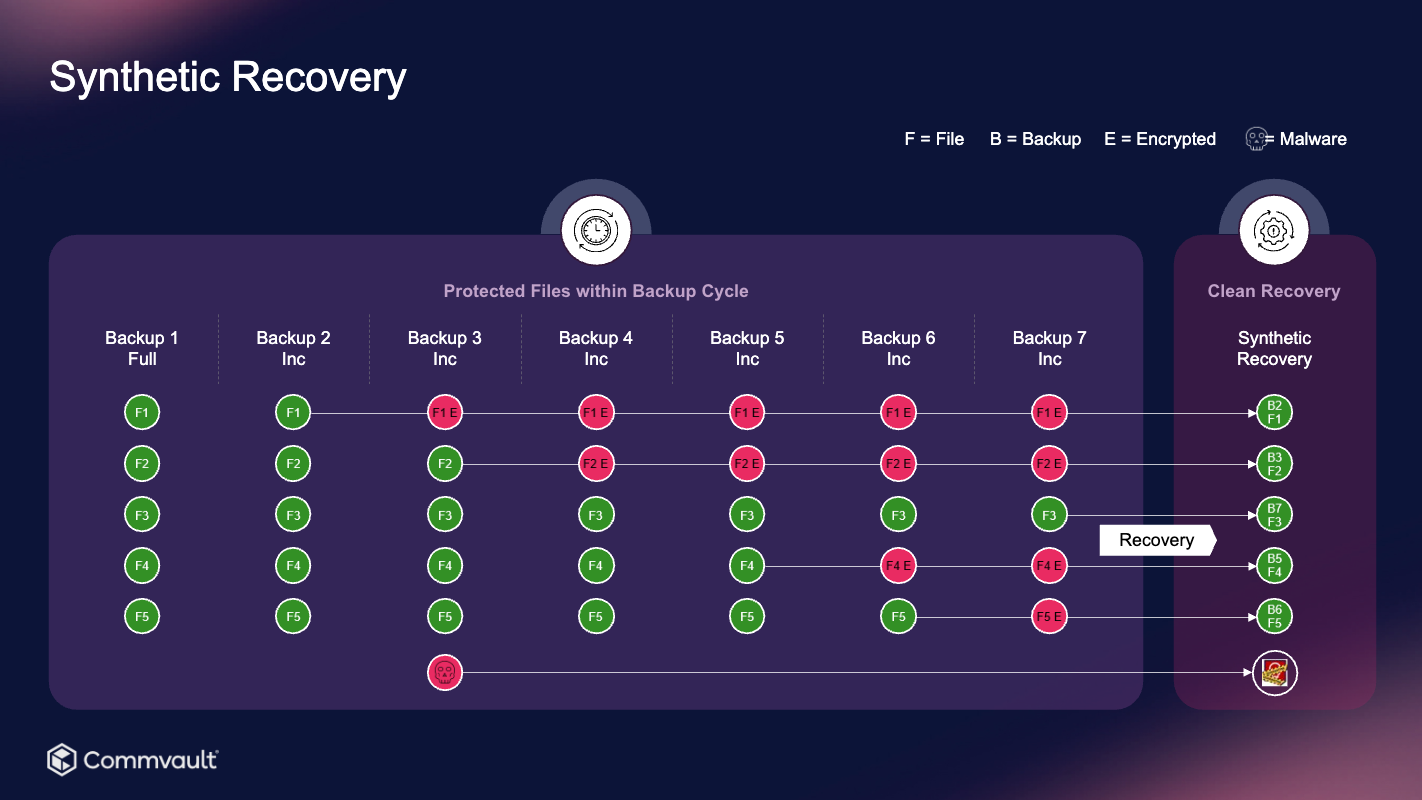
Synthetic Recovery automates the process of Cleanpoint™ identification, assembly, and restore of only the most recent uncorrupted file versions across entire backup data estates.
By drawing on AI-enabled insights across multiple backups, Commvault can assemble a curated recovery point that can help:
- Accelerate il ripristino automatizzando l’assemblaggio dei dati puliti, riducendo i tempi di inattività da ore a minuti.
- Previene la reinfezione escludendo i file crittografati o dannosi prima dell’inizio del ripristino.
- Riducete al minimo i rollback mantenendo le versioni più aggiornate e convalidate dei file di dati validi.
- Semplificate il ripristino dei carichi di lavoro, dei cloud e degli ambienti di storage.
The result? Faster recoveries, cleaner outcomes, and unified operations that strengthen enterprise resilience from the inside out.
Precisione dell’intelligenza artificiale al lavoro
Synthetic Recovery is powered by Commvault’s AI-enabled multi-engine threat detection and response – a system that combines behavioral analytics, static signatures, machine learning, heuristic detection, YARA-rule and Hash scanning, and security partner signals to spot both known and zero-day threats with exceptional accuracy.
This intelligent automation helps Commvault customers build assurance that every recovery is validated, clean, and secure – not only restoring your data, but also your confidence in it.
Resilienza unificata per le operazioni moderne
For today’s IT and security teams, Synthetic Recovery represents more than a feature – it’s a mindset shift. It transforms recovery from a reactive process into a strategic, automated resilience capability.
By bringing together la protezionecloud, il rilevamento avanzato edella resilienza delle identità in one platform, Commvault empowers enterprises to move faster, recover smarter, and operate with certainty – even in the face of the unexpected.
Domande frequenti
Q: What is Synthetic Recovery?
A: Synthetic Recovery™ is a new Commvault capability within the Threat Scan offering that automates clean and verifiable data recovery after a cyberattack. It identifies and assembles the most recent uncorrupted file versions from entire backup estates across multiple virtual machines and files, creating a single, curated recovery point. This helps organizations restore operations faster, cleaner, and with confidence, while minimizing rollback and reinfection risk.
Q: Why is Synthetic Recovery important now?
A: Modern ransomware and malware threats are increasingly stealthy, often lying dormant for days or weeks before activation. During that time, malicious data can silently enter backup sets. When that happens, traditional recovery methods risk restoring infected data. Synthetic Recovery helps solve this by combining AI-enabled threat detection, Cleanpoint™ identification, and automated clean data assembly to enable that only verified, healthy data is brought back online.
Q: How does Synthetic Recovery differ from traditional recovery methods?
A: Traditional clean recovery workflows rely on manual steps such as creating isolated recovery environments, manually restoring data for external scanning, and guessing at the “last known good” recovery point.
Synthetic Recovery removes that guesswork. Using Commvault’s indexed backup data and AI-enabled threat detection, it automatically identifies and replaces compromised files, generating a dataset ready for immediate recovery – no manual validation required.
Q: What role does AI play in Synthetic Recovery?
A: Synthetic Recovery leverages Commvault’s AI-enabled multi-engine threat detection and response framework. This includes:
- Analisi comportamentale per rilevare attività insolite sui file.
- Modelli di apprendimento automatico che riconoscono i modelli di crittografia e ransomware.
- Scansione statica e basata sulle firme per le minacce note.
For a complete list of Commvault Threat Scan detection techniques, request a demo.
Q: How does Synthetic Recovery help reduce reinfection risk?
A: Because Synthetic Recovery excludes files identified as malicious or encrypted, it helps validate that compromised data never re-enters production environments. This can break the reinfection cycle, giving teams confidence that every restored file has been validated as safe – based on AI analysis and Commvault’s multi-engine threat intelligence.
Elenco di Pauline è uno specialista di marketing di prodotto presso Commvault.