Skip to content

Every year on October 24, the world pauses for the International Day of Climate Action, reminding us that protecting the planet is no longer a choice, but a shared responsibility. Climate change isn’t coming – it’s here. And how we respond today will shape the future of our communities, our businesses, and our planet.

At Commvault, resilience is what we do – not just for data, but for the world we all share.

Sustainability: The Core of Resilience

Our mission to safeguard data goes hand in hand with our commitment to safeguard the environment. In FY25, we made meaningful progress toward our climate resilience goals:

  • Scope 2 emissions dropped by over 13%, driven by smarter energy use and efficient data center operations.
  • Emissions intensity fell from 12.7 to 9.6 metric tons CO₂e per million USD revenue, showing that growth and sustainability can move forward together.
  • Our LEED-certified headquarters continues to lead with renewable energy integration, water-efficient systems, and robust recycling programs.

In everything from how we power our offices to how we design our technology, we consider sustainability a key driver of business continuity.

Data That Works for the Planet

The same innovation that drives Commvault’s cyber resilience is helping advance climate resilience.

By optimizing data storage, reducing redundancies, and improving workload efficiency, our cloud solutions enable customers to use less energy and achieve their own sustainability goals. Less waste. Lower energy use. More resilience.

Because when data works smarter, the planet breathes easier.

Collective Action, Shared Progress

We know climate action is not a solo mission. That’s why Commvault collaborates with partners who share our environmental values and participates in community initiatives like the Net Zero Institute to help accelerate the transition to a low-carbon economy.

We also align our climate governance with the Task Force on Climate-Related Financial Disclosures (TCFD), driving accountability from the top down.

From Awareness to Action

The path to a sustainable future begins with small, intentional choices, like turning off a light, optimizing a server, rethinking a commute. Every decision matters.

This International Day of Climate Action, let’s all take a step toward progress. Because resilience – whether in data, business, or the environment – is built together.

Aakanksha Kashyap is ESG Specialist at Commvault.

More related posts


Thumbnail_Blog-Clumio-S3-Backup-2026

Configuring S3 Backup and Recovery with Clumio

Read more about Configuring S3 Backup and Recovery with Clumio
person-escalator-crocus-888×500

Your Modern Playbook for Identity Resilience: Rapid Response and Clean Recovery

Read more about Your Modern Playbook for Identity Resilience: Rapid Response and Clean Recovery
Thumbnail_Blog-Architect-for-tomorrow-2026

Architect for Tomorrow: Unified Data Protection as the Foundation for Resilience

Read more about Architect for Tomorrow: Unified Data Protection as the Foundation for Resilience

Die wichtigsten Erkenntnisse

  • As few as 250 poisoned samples can compromise a large AI model – turning your data lake into a prime attack surface.
  • Vergiftete Proben können Hintertüren implantieren, die auch nach dem erneuten Training oder der Feinabstimmung bestehen bleiben.
  • A practical defense centers on “protect, detect, roll back,” treating data protection as core to AI integrity.
  • Backups, versionierte Datensätze und detaillierte Wiederherstellungen ermöglichen eine schnelle Wiederherstellung in einen sauberen, vertrauenswürdigen Zustand.
  • Commvault + Satori bieten Datenerkennung, Echtzeit-Zugriffskontrolle, LLM-Aktivitätsüberwachung und einheitliche Richtlinien sowie Rollback-Funktionen, um die KI-Ausfallsicherheit zu stärken.

I’ve been thinking a lot about Anthropic’s latest research – and it’s unsettling. It found that as few as 250 poisoned samples can compromise a massive AI model.
👉 [Read die Forschung yourself.]

That’s right – a few hundred corrupted files can undo months of training and billions of parameters. Not thousands. Not millions. Just hundreds.

For anyone building or managing AI, this changes everything. Your AI data lake has become your primary attack surface – and if you can’t trust your data, you can’t trust your models.

💣 Small Samples, Big Consequences

Anthropic hat gezeigt, dass:

  • Eine Handvoll vergifteter Proben kann versteckte Hintertüren implantieren.
  • Diese Schwachstellen können durch Nachschulungen und Feinabstimmungen bestehen bleiben.
  • Attackers don’t need to flood your system – they just need a foothold.

AI integrity isn’t only a model problem – it’s a data protection problem.

🧩 The Practical Defense: Protect. Detect. Roll Back.

Wir bei Commvault beobachten, wie Unternehmen sich beeilen,KI-Pipelines, ohne die Grundlagen vollständig abzusichern. When data is compromised, your best defense is the ability to roll back to a clean, trusted state.

That’s why backups, Datensätze mit Versionsangaben, und detaillierte Wiederherstellungen werden für die KI mittlerweile genauso unverzichtbar wie GPUs und Modellgewichte.

Commvault kann Ihnen dabei helfen:

  • Erstellen Sie unveränderliche Momentaufnahmen Ihres Data Lake.
  • Auf eine bekanntermaßen funktionierende Version zurücksetzen.
  • Überprüfen Sie Abstammung, Herkunft und Änderungshistorie.
  • Sichern Sie Backups gegen Manipulationen (über WORM-Speicher).

Because when it comes to AI, protection isn’t just about avoiding failure – it’s about being able to recover fast and clean when it happens.

🔐 The Power of Satori: Smarter, Safer AI Data

Da Satori nun zu Commvault gehört, bieten wir nun umfassendere Funktionen für Datensicherheit und KI-Governance an, die Ihnen dabei helfen können:

  • Automatische Erkennung sensibler Daten in Clouds, Warehouses und Lakes.
  • Control access in real time – who sees what, when, and how.
  • Überwachen Sie KI- und LLM-Aktivitäten, um Anomalien frühzeitig zu erkennen.
  • Unify policy and rollback – restoring data and supporting compliance from one place.

Gemeinsam bieten Commvault und Satori robuste, intelligente Datenfundamentfunktionen, die dabei helfen, sich ständig weiterentwickelnde KI-Datenbedrohungen zu erkennen, davor zu schützen und sich davon zu erholen.

🚀 The Future of AI Resilience

This is exactly what we’ll be discussing at Commvault Shift | Virtual – how to secure, protect, and recover the data that drives AI.

Join us to hear from industry leaders about building trusted, resilient AI systems that can help withstand data corruption, cyber threats, and human error.

👉 Register here: commvault.com/SHIFT VirtualSchützen Sie Ihre KI. Schützen Sie Ihre Daten. Schaffen Sie eine widerstandsfähigere Zukunft.

FAQs

Q: What does “250 poisoned files” actually mean for my models?
A: The blog cites Anthropic’s finding that only a few hundred corrupted samples can meaningfully compromise a massive model – no flood required. It highlights that attackers need only a small foothold to degrade behavior or implant triggers.

Q: Why might retraining fail to remove poisoning?
A: Some backdoors survive standard retraining and fine-tuning because the malicious signal is subtle and reinforced by the broader dataset. The result is a model that behaves normally until a hidden trigger appears.

Q: What immediate defenses should we prioritize?
A: Adopt a “protect, detect, roll back” strategy: Secure your data pipeline, monitor for anomalies, and maintain the ability to revert to a known-good state. Treat data protection as foundational – on par with model weights and GPUs.

Q: How do backups and versioned datasets help in practice?
A: Immutable snapshots, version history, and fine-grained restores enable you to quickly recover clean data, verify lineage and provenance, and continue operations without carrying hidden compromises forward.

Q: What additional value does Satori bring with Commvault?
A: Satori expands capabilities with automatic discovery of sensitive data across clouds and lakes, real-time access control, LLM activity monitoring for early anomaly detection, and unified policy plus rollback to support compliance and recovery.

Q: Isn’t model security enough without data protections?
A: Model-centric controls are necessary but incomplete. The post argues that AI integrity is as much a data protection problem as a model problem; without trusted data, even well-secured models can be subverted.

Thomas Bryant ist Senior Director für Produktmarketing bei Commvault.

Verwandte Blogs:

More related posts


Thumbnail_Blog-Clumio-S3-Backup-2026

Configuring S3 Backup and Recovery with Clumio

Read more about Configuring S3 Backup and Recovery with Clumio
person-escalator-crocus-888×500

Your Modern Playbook for Identity Resilience: Rapid Response and Clean Recovery

Read more about Your Modern Playbook for Identity Resilience: Rapid Response and Clean Recovery
Thumbnail_Blog-Architect-for-tomorrow-2026

Architect for Tomorrow: Unified Data Protection as the Foundation for Resilience

Read more about Architect for Tomorrow: Unified Data Protection as the Foundation for Resilience

Die zweite Ausgabe des Berichts„The „State of Data Readiness in Asia““, ein umfassender Bericht von Tech Research Asia im Auftrag von Commvault, bietet einen schonungslosen Einblick in die Herausforderungen und Realitäten, mit denen Unternehmen auf dem gesamten Kontinent konfrontiert sind.
Basierend auf einer Umfrage unter 1.218 Unternehmen in Indonesien, Hongkong, Korea, Malaysia, den Philippinen, Singapur, Thailand und Vietnam deckt der Bericht wichtige Trends in den Bereichen Datenwachstum, regulatorischer Druck, Einführung von KI und Cyber-Resilienz auf. Hier sind einige der wichtigsten Punkte, die die Aufmerksamkeit von Führungskräften aus Wirtschaft und IT erfordern:

Beispielloses Datenwachstum und Komplexität der Infrastruktur

Datenbestände wachsen in rasantem Tempo.

  • Die durchschnittliche Organisationin Asien verzeichnete in den letzten 12 Monaten einen Anstieg ihrer Datenmenge um 40 %, was einen deutlichen Sprung gegenüber den im Vorjahr gemeldeten 31 % darstellt.
  • Diese Explosion von Daten, von denen 66 % unstrukturiert sind, findet in immer komplexeren Umgebungen statt.
  • Die Mehrheit der Unternehmen (63 %) arbeitet mittlerweile incloud cloud , wodurch ein weitläufiges und voneinander abhängiges Ökosystem entsteht, das schwer zu verwalten und zu sichern ist.
  • Diese Komplexität fordert ihren Tribut: 38 % der Unternehmen geben zu, dass sie kein Vertrauen in ihre Fähigkeit haben, den Geschäftsbetrieb nach einer Sicherheitsverletzung wiederherzustellen.


Das KI-Paradoxon: Hohe Akzeptanz trotz hohem Risiko

KI wird mit Begeisterung angenommen: 74 % der asiatischen Unternehmen nutzen derzeit geschäftsorientierte KI-Lösungen. Allerdingswerden die damit verbundenen Risiken klar erkannt.

  • Diese Komplexität fordert ihren Tribut: 38 % der Unternehmen geben zu, dass sie kein Vertrauen in ihre Fähigkeit haben, den Geschäftsbetrieb nach einer Sicherheitsverletzung wiederherzustellen.
  • Erstaunliche 73 % dieser Unternehmen glauben, dass der Einsatz von KI die Wahrscheinlichkeit einer Cybersicherheitsverletzung erhöht.
  • Trotz dieses Bewusstseins hinkt die Sorgfaltspflicht hinterher. Besorgniserregende 58 % der Unternehmen haben vor dem Einsatz ihrer KI-Tools keine gründlichen Sicherheitsprüfungen durchgeführt, und weniger als die Hälfte (46 %) verfügt über umfassende Richtlinien zum Schutz von KI-generierten Daten.

The Tangled Web of Regulations

The regulatory landscape across Asia is becoming increasingly intricate and, at times, contradictory.

  • Widersprüchliche Anforderungen: 53 % der Unternehmen geben an, dass sie in verschiedenen Regionen mit widersprüchlichen regulatorischen Anforderungen für ihre Daten konfrontiert sind.
  • Regulatorische Belastung: 52 % der Unternehmen müssen mindestens vier wichtige Regulierungsgesetze einhalten.
  • KI-Compliance: Die Herausforderung wird durch KI-spezifische Vorschriften noch verschärft, denen mittlerweile fast 60 % der Unternehmen unterliegen und weitere 27 % davon ausgehen, dass sie im nächsten Jahr davon betroffen sein werden.

Die ernüchternde Realität von Cyberangriffen und Wiederherstellung

There remains a significant disconnect between the expectations of business leaders and the reality of IT recovery after a cyber incident. While 72% of business leaders expect to be back in business within five days of an incident, the reality is that 70% of businesses take more than a week to recover.
The report also sheds light on the direct impacts of attacks:

  • Von den Unternehmen, bei denen es zu einer Sicherheitsverletzung kam, waren 83 % von Datenexfiltration betroffen.
  • Weniger als die Hälfte (41 %) konnte ihre Daten zu 100 % wiederherstellen.
  • Während 57 % der Unternehmen eine Richtlinie gegen die Zahlung von Lösegeld haben, zahlten 34 % der Unternehmen mit einer solchen Richtlinie bei einem Angriff das Lösegeld.

Auf die harte Tour lernen

Interestingly, organisations that have experienced a breach demonstrate a more mature and realistic understanding of their capabilities. They are more likely to have comprehensive incident response plans and a clearer grasp of the complexities involved in recovery. For instance, breached companies are almost twice as likely to view their internal AI tools as a high cybersecurity risk compared to those that have not been breached.
To gain a deeper understanding of these findings and benchmark your organisation against your peers, download the full „State of Data Readiness in Asia“Bericht. Der vollständige Bericht enthält detaillierte Analysen, länderspezifische Daten und umsetzbare Erkenntnisse, die Ihnen dabei helfen, Ihre Strategien für Datenmanagement, Recovery und Cyber-Resilienz zu optimieren und so einen unterbrechungsfreien Geschäftsbetrieb zu gewährleisten.

More related posts


Cyber Resilience

Read more about Cyber Resilience

Cyber Security

Read more about Cyber Security

In conversations with three Chief Medical Information Officers across different healthcare systems, each was asked about their most recent cybersecurity incident. The answer was unanimous and telling: None had experienced a direct attack on their own systems. Instead, all three were grappling with the aftermath of third-party vendor breaches that cascaded through their operations.

This isn’t coincidence – it’s the new reality of healthcare cybersecurity.

The Vendor’s Vendor Problem

“We are big enough to have these experts on staff that are our experts to protect us,” one CMIO explained. “Sometimes I feel that that can be a barrier to agility because of how strict we are and how thorough we are in those evaluations. But I think that we can’t ensure that our partners do the same.”

Here’s the challenge: Healthcare organizations have become incredibly sophisticated at vetting direct vendors. The contracting process is rigorous, security assessments are thorough, and compliance requirements are non-negotiable.

But what happens when your vendor makes a deal with another vendor? Suddenly, you’re exposed to risks you never evaluated, from companies you’ve never heard of, through relationships you don’t control.

One security leader illustrated this perfectly: “I’m going to make a deal to use Vendor X to do something for me here. But Vendor X may make a deal with Vendor Y that lets them do their job. So if there’s a problem with Vendor Y who I’m not technically contracted with, but my vendor needs them to function, I can’t control that.”

Wenn das Ökosystem versagt

DasChange Healthcare incident provides a stark example. When its systems went down due to a cyberattack, it wasn’t just Change Healthcare that suffered – it was every healthcare organization that relied on its prescription processing services.

One CMIO described the impact: “We had a lot of issues sending prescriptions, receiving them, having issues being unclear of what went through, what didn’t go through, and who didn’t have their medications.”
Dasdownstream clinical impact was immediate and severe. Patients couldn’t get medications, providers couldn’t verify prescription statuses, and healthcare teams scrambled to identify which patients might be affected. This was a direct patient safety issue caused by a vendor incident completely outside the control of healthcare providers.

But the clinical impact was just the beginning. The compliance implications were equally severe, highlighting a fundamental challenge in healthcare’s regulatory landscape.

Die Compliance-Falle: Wenn Fehler von Lieferanten zu Ihrem regulatorischen Problem werden

Healthcare organizations face a harsh regulatory reality: Vendor incidents don’t absolve them of compliance responsibilities. In fact, they often amplify them.

HIPAA requires covered entities to establish Business Associate Agreements with vendors handling protected health information. While these agreements theoretically transfer some liability, the practical reality is different. When a vendor suffers a breach, the healthcare provider still faces potential penalties, regulatory scrutiny, and mandatory reporting requirements.
Dasreporting burden alone creates significant operational strain. HIPAA’s proposed 72-hour reporting mandates, similar to regulations like EU NIS2 and DORA for cross-border institutions, require healthcare providers to disclose incidents quickly, regardless of whether the breach originated from their own systems or a vendor’s.

As one CMIO noted: “We actually have to communicate to the state, to the Centers for Medicaid and Medicare Services: ‘This is what’s going on. This is where we are with our recovery.’”

This means that during an active incident – when clinical teams are scrambling to maintain patient care and IT teams are coordinating recovery efforts – compliance teams must simultaneously investigate, document, and report on incidents they didn’t cause and may have limited visibility into.
Dasdata sovereignty challenge adds complexity. Vendors storing healthcare data outside approved regions can trigger compliance violations that organizations may not even know exist until an incident forces a comprehensive audit of their vendor ecosystem.

“We require [vendors] to give us anything and everything we asked for to review,” explained one security leader who’s experienced a vendor ransomware attack. “So, there was actually no limitations on what we could ask.”

But this level of oversight is typically only possible with the largest vendor relationships, leaving many smaller but still critical vendor dependencies in compliance blind spots.

Der Weckruf von CrowdStrike

DasVorfall bei CrowdStrike drove home another reality: When critical infrastructure providers fail, the entire healthcare ecosystem fails simultaneously.

“We did [tabletop exercises] with the assumption that it would be a ransomware attack… a very kind of localized event,” one leader reflected. “And this was affecting the entire ecosystem. And that’s where we [learned] that we needed to have more resiliency practices that would incorporate where the ecosystem itself would be widely affected.”
Daschallenge wasn’t just technical – it was operational and regulatory. When everyone is down at once, the usual backup plans (like calling vendors for support or switching to alternate providers) simply don’t work.

Healthcare organizations faced not only interrupted patient care and massive downtime costs but also complex compliance reporting requirements for an incident that originated entirely outside their control.

Über die traditionelle Risikobewertung hinaus

Healthcare organizations are discovering that their traditional approach to vendor risk management isn’t enough. The standard process – sending questionnaires, reviewing documentation, checking compliance certifications – only covers direct relationships.

But post-incident, the conversation is changing. Instead of just asking “Do you do this? Do you do that?” organizations are demanding to see exactly how vendors execute security and recovery plans. They’re asking for evidence of testing, requiring contractual rights to review sub-vendor relationships, and building in financial protections.

Das neue Modell für Lieferantenbeziehungen

Vorausschauende Gesundheitsorganisationen ergreifen mehrere konkrete Maßnahmen, um Risiken für das Ökosystem zu begegnen:

  • Data sovereignty: “We want to start taking more ownership over the data… so that we have something we can rebuild or even switch over to another third party if possible,” one leader said.
    Rather than letting vendors hold all the data, organizations are requiring regular data exports and maintaining their own copies of critical information. This approach helps address data residency requirements and enables compliance continuity even when vendors fail.
  • Verbesserte Vertragsentwicklung: Bei Vertragsverhandlungen nach einem Vorfall werden nun Compliance-Verpflichtungen ausdrücklich angesprochen. Unternehmen fordern Benachrichtigungsfristen, die den gesetzlichen Anforderungen entsprechen, Wiederherstellungsgarantien, die Ausfallkosten minimieren, sowie finanzielle Entschädigungen sowohl für direkte Verluste als auch für Compliance-Strafen, die durch vom Anbieter verursachte Ausfälle entstehen.
  • Compliance-aware update management: The Vorfall bei CrowdStrike highlighted how vendor updates can create both operational and compliance risks. Many organizations have implemented “two versions behind” policies for critical security updates, balancing the risk of delayed patches against the risk of compliance violations from untested updates that could cause widespread outages.
  • Regulatorische Integration im Lieferantenmanagement: Unternehmen integrieren Compliance-Aspekte direkt in die Lieferantenbewertung und die laufende Überwachung. Dazu gehört, dass sie wissen, dass Lieferanten die gleichen 72-Stunden-Meldepflichten erfüllen, eine angemessene Datenresidenz aufrechterhalten und die für die regulatorische Berichterstattung erforderlichen Unterlagen bereitstellen können.

The Insurance Industry’s Perspective

Perhaps most telling is how the insurance industry views these risks. As one security leader shared from a colleague in insurance risk modeling: “The number one risk that we have is the kind of outage like CrowdStrike, where we’re so dependent upon these technology platforms that when we’re out, there’s massive disruptions in services and in operations. She says that’s the number one risk in our risk model. It’s not ransomware attacks.”

This shift in risk assessment reflects a fundamental change. Traditional cybersecurity focused on preventing bad actors from getting in. Modern cybersecurity also must address the reality that critical vendors – with the best of intentions and strong security practices – still can bring down entire ecosystems through operational failures.

Die Herausforderung der minimalen Lebensfähigkeit in einer Ökosystemwelt

Traditional recovery planning often assumes you can restore everything systematically, but when entire ecosystems fail simultaneously, organizations must focus on minimum viable recovery (MVR).
Dasconcept of minimum viability becomes critical when your vendors, their vendors, and potentially your backup vendors are all affected. As we’ve explored in our analysis of Cyberbedrohungen im Gesundheitswesen und MVR, the question isn’t just “How do we recover everything?” but “What are the bare essentials we need to keep patient care running while the ecosystem rebuilds itself?”

This ecosystem reality makes Organisatorische Bereitschaft zur Wiederherstellung more complex than ever. When you can’t rely on your usual vendors or backup providers, your MVR plan must account for true independence from the broader ecosystem – at least temporarily.

Vorwärts gehen

Organizations can’t just secure their own perimeter; they need to understand and plan for the interconnected web of dependencies that modern healthcare relies on. This means fundamentally rethinking business continuity planning to account for simultaneous ecosystem failures. It means maintaining data sovereignty even when using SaaS providers. And it means accepting that some risks simply can’t be eliminated – only managed and planned for.
Dashealthcare leaders we spoke with weren’t pessimistic about these challenges; they were pragmatic. They understand that the benefits of interconnected, cloud-based healthcare systems far outweigh the risks.

Testen Sie die Widerstandsfähigkeit Ihres Ökosystems

Understanding the risks is just the first step. The next is honestly assessing whether your organization is prepared for the new reality of interconnected failures. How confident are you that your MVR plan would work when your usual vendors and backup systems also are compromised?

Healthcare organizations serious about ecosystem resilience should evaluate their readiness across three critical areas: business-critical prioritization, measurable technical response, and Organisatorische Bereitschaft zur Wiederherstellung. Commvault’s Bewertung der minimalen Funktionsfähigkeit im Gesundheitswesen helps evaluate your current capabilities and offers actionable recommendations for closing any gaps.

Don’t wait for the next ecosystem-wide incident to discover whether your recovery plans account for the reality of interconnected healthcare IT. Machen Sie den Test noch heute and build true resilience for tomorrow’s challenges.


Verwandte Blogs:

More related posts


Thumbnail_Blog-Clumio-S3-Backup-2026

Configuring S3 Backup and Recovery with Clumio

Read more about Configuring S3 Backup and Recovery with Clumio
person-escalator-crocus-888×500

Your Modern Playbook for Identity Resilience: Rapid Response and Clean Recovery

Read more about Your Modern Playbook for Identity Resilience: Rapid Response and Clean Recovery
Thumbnail_Blog-Architect-for-tomorrow-2026

Architect for Tomorrow: Unified Data Protection as the Foundation for Resilience

Read more about Architect for Tomorrow: Unified Data Protection as the Foundation for Resilience

A powerful go-to-market strategy is what separates leaders from the pack in the competitive cyber resilience market. At Commvault, we’re dedicated to providing our partners with the strategic resources needed to help grow revenue, build customer trust,undsolidify your reputation as a market leader with Commvault.
That’s why we are excited to announce two game-changing resources designed to elevate your salesundmarketing efforts: a reimagined Commvault-Kampagnen-Hubund die neuen„At-A-Glance“-Partner-Sales-Playbooks.

Optimieren Sie Ihr Marketing mit dem Campaigns Hub

Based on partner feedback, our newly imagined Campaigns Hub is your destination for ready-to-use, results-driven marketing. The Campaigns Hub is a powerful, intuitive platform that simplifies the creation of targeted campaigns, helping you build awareness, generate leads,undupsell Commvault’s suite of solutions. And now our platform integrates seamlessly with your existing strategies, enabling cohesive brand messagingundmaximum impact.
With the Campaigns Hub, you’ll find:

  • Targeted campaigns you can launch in minutes. Choose from a library of pre-built multi-language campaigns – from “Securing Continuity for Minimum Viable Business” to “Microsoft Active Directory Protection” –undcustomize the content to fit your audience’s unique needs.
  • A new, powerful webcast program. Leverage Commvault’s best speakersundcontent directly from the Campaigns Hub using our on-demand webcasts along with the promotional materials to drive leadsundawareness.
  • A new, co-branded assessment tool. Contact our Marketing Conciergeundrequest a co-branded minimum viability assessment tool that provides benchmarks to your customers in minutesundputs leads directly in your inbox.  
  • Hochwertige Kundenressourcen zur Verwendung auf Ihrer platform im Hub. Sie können nun über den Campaigns Hub auf wichtige Commvault-Kundeninhalte und Werbekampagnen zugreifen und diese wertvollen Ressourcen in Ihre umfassenderen Marketinginitiativen im Hub integrieren oder herunterladen und auf Ihrer platform verwenden.
  • Our complimentary Marketing Concierge service that makes campaigns even easier. You don’t need to use MDF or pay for our Marketing Concierge service to help you customizeundrun the latest Commvault campaigns to grow your business. Try out the service with a :1-Kampagnenaktivierungssitzung.

Steigern Sie Ihren Verkaufserfolg mit übersichtlichen Playbooks

To complement your marketing efforts, Commvault also has launched our new „At-A-Glance“-Partner-Sales-Playbooks. We’ve condensed our most popular die Partner-Vertriebsleitfäden into a concise, easy-to-use one-page format, packed with the essential tools you need to articulate valueundenhance customer engagement.
Each playbook includes:

  • Concise call scripts: Confidently articulate the unique value propositions of Commvault’s productsundsolutions.
  • Objection handling: Turn potential roadblocks into opportunities with prepared responses to common customer challenges.
  • Customer-ready materials: Accelerate sales cycles by sharing curated whitepapers, solution briefs, case studies, eBooks,undmore.

By combining the power of the Commvault-Kampagnen-Hub with the strategic guidance of the At-A-Glance Sales Playbooks, you can create impactful, end-to-end campaigns that drive customer engagementundachieve greater sales success.

Entfalten Sie Ihr Potenzial mit Commvault

Ready to transform your go-to-market strategyundmaximize the value of Commvault’s offerings? Explore the Commvault-Kampagnen-Hubunddie Partner-Vertriebsleitfädenim Partner-Portal. Stöbern Sie auf eigene Faust oder vereinbaren Sie eine:1-Kampagnenaktivierungssitzungmit unserem kostenlosen Marketing-Concierge, um angeleitete Unterstützung zu erhalten.

More related posts


Cyber Resilience

Read more about Cyber Resilience

Wenn Cyberangreifer zuschlagen, ist Schnelligkeit nicht alles. Eine schnelle Wiederherstellung kompromittierter Daten führt lediglich zu einer erneuten Bedrohung und schafft einen Teufelskreis aus Infektion und Reinfektion. Ich habe kürzlich gemeinsam mit meinen Kollegen vonKyndrylmit dem Titel,Cyber-Recovery neu definiert: Einführung des „Mean Time to Clean Recovery“ (MTCR) where we introduced a fundamental shift: measuring how fast you can restore from clean, verified data rather than just any available backup.

Here are the five critical steps that determine your organization’s MTCR:


  1. Schaffen Sie eine saubere Umgebung, in der Sie sich erholen können.

The problem: Recovery to an infected infrastructure will simply reinfect your restored systems.

The solution: Isolated Recovery Environments (IREs) or cleanrooms – compute and storage infrastructure physically or virtually separated from production environments where attackers never had access.

Reality check: Without an IRE, modern forensic teams need 24 to 72 hours to certify complex hybrid environments as “clean.” Your MTCR automatically becomes measured in days, not hours.


  1. Finden Sie saubere Daten, von denen Sie wiederherstellen können.

The hidden threat: Modern attackers operate in stealth for weeks before launching attacks, seeding malicious payloads throughout your environment – including backup systems.

The breakthrough: Automated scanning for Indicators of Compromise can help identify clean backup sets without the trial-and-error cycle of testing each backup until you find one that works.

Collaboration required: This step demands tight integration between SysOps teams (who manage backups) and SecOps teams (who understand current threats). Forensic analysis reveals attack signatures that must be fed into the scanning process.


  1. Daten innerhalb einer akzeptablen Zeit wiederherstellen.

The uncomfortable truth: Enterprise backup solutions often deliver “10+ hours per terabyte” recovery performance. Scale this to typical enterprise services requiring hundreds of terabytes, and you’re looking at weeks of recovery time.

The reality: Most backup infrastructure was designed for nightly incremental backups (5% data change), not full-scale business restoration (100% recovery).

The solution: Purpose-built cyber resilience platforms with high-performance recovery capabilities, combined with minimum viable company (MVC) prioritization – focusing on the critical 20% of services that enable 80% of business function.


  1. Wahrung der Datenintegrität auf der gesamten platform.

The challenge: Enterprise systems don’t exist in isolation. During recovery, systems restored from backups taken at different times create data integrity nightmares.

Example scenario:

  • Kundendatenbank: Dienstag, 3 Uhr morgens, Sicherung
  • Abrechnungssystem: Montag 23 Uhr Backup
  • Inventarsystem: Mittwoch, 6 Uhr morgens, Sicherung

Result: Orders for customers who don’t exist, invoices for products not in inventory.

The Process: Restoration sequencing based on dependencies, data reconciliation across integrated systems, and comprehensive consistency checks before production return.


  1. Vor der Produktionsrückgabe testen.

The rush trap: Under pressure, IT teams often rush systems back online without comprehensive testing, leading to partially functional systems or reintroduction of attack remnants.


Umfassende Validierung:
  • Funktionsprüfung der Kerngeschäftsprozesse
  • Sicherheitsüberprüfung durch Schwachstellenscans
  • Überprüfung der Datenintegrität über Plattformen hinweg
  • Validierung von Geschäftsprozessen durch Anwendungsteams

Critical success factor: Pre-define your MVC acceptance criteria – the specific functionality that must work before you’re truly “recovered.”


Die Herausforderung der Integration

These aren’t sequential steps – they’re interconnected capabilities that must work together. Your MTCR is only as fast as your slowest step and only as reliable as your weakest validation point.

The investment reality: Clean recovery requires purpose-built cyber resilience platforms, isolated recovery environments, automated scanning tools, and dedicated recovery networks. But the cost of prolonged downtime and reinfection is far greater.


Nächste Schritte:
  1. Schätzen Sie, wie lange jeder Schritt in Ihrer aktuellen Umgebung dauern würde.
  2. Identifizieren Sie Ihre größte Lücke.
  3. Berechnen Sie die Kosten für längere Ausfallzeiten im Vergleich zu Investitionen in die Infrastruktur.
  4. Beginnen Sie mit Ihren wichtigsten Unternehmensdienstleistungen.

The era of “backup and pray” is over. Organizations that master these five steps don’t just recover faster – they recover once, cleanly, and with confidence.


Mehr erfahren

Sehen Sie sich an, wie ich diese neue Kennzahl im Webinar erörtere,Die fehlende Kennzahl für den Erfolg bei der Cyber-Recovery. Lesen Sie das vollständige WhitepaperCyber-Recovery neu definiert: Einführung der „Mean Time to Clean Recovery“, um mehr über diese wichtige Kennzahl zu erfahren.Darren Thomson ist Field CTO bei Commvault. Verpassen Sie auf keinen Fall seine Beiträge in der Podcast-Reihe, STRIVE.

More related posts


CleanroomRecovery_Thumbnail_888x500

Commvault Cleanroom

Read more about Commvault Cleanroom

Die fünfte Ausgabe derBericht zum Stand der Datenreadiness in Australien und Neuseeland, ein von Commvault in Auftrag gegebener Tech Research Asia Insights Report, bietet einen kritischen Blick auf die aktuelle Lage in den Bereichen Datenmanagement, Cybersicherheit und regulatorischer Druck, mit denen Unternehmen in Australien und Neuseeland (ANZ) konfrontiert sind.Basierend auf Untersuchungen bei 408 Unternehmen in der gesamten Region deckt der Bericht wichtige Trends und die harte Realität auf, wie Unternehmen mit einem zunehmend komplexen digitalen Umfeld umgehen. Da wir oft Forschungsergebnisse auf globaler Ebene betrachten, ist es besonders wertvoll, eine lokale Perspektive auf die Datenbereitschaft zu haben. Während sich das Datenwachstum leicht verlangsamt hat, sind die Herausforderungen in Bezug auf Datenmanagement, -sicherheit und -wiederherstellung größer geworden. Hier sind einige der wichtigsten Erkenntnisse aus dem Bericht.

Das Daten- und Regulierungsumfeld: Ein verworrenes Netz

Unternehmen haben mit folgenden Herausforderungen zu kämpfen:ausufernde Datenbestände und ein immer dichteres Netz von Vorschriften.

  • Verlangsamtes Wachstum, anhaltende Ausbreitung: Die jährliche Datenwachstumsrate in Australien und Neuseeland hat sich von 28 % im letzten Jahr auf 27 % in diesem Jahr leicht verlangsamt. Eine Mehrheit von 62 % arbeitet weiterhin in gemischten (Multi- oder cloud)Datenumgebungen, und dieser Anteil wird bis 2026 voraussichtlich auf 71 % steigen.
  • Vertrauenslücke: Eine besorgniserregende Anzahl von Unternehmen hat kein Vertrauen in ihre Fähigkeit, den Geschäftsbetrieb nach einer Sicherheitsverletzung wiederherzustellen. 54 % der australischen und 63 % der neuseeländischen Unternehmen fühlen sich unvorbereitet.
  • Komplexität der Vorschriften: Die regulatorischen Rahmenbedingungen werden immer schwieriger zu durchschauen. 55 % der australischen und 53 % der neuseeländischen Unternehmen sind nun verpflichtet, Datenkopien in separaten cloud zu speichern, um die Ausfallsicherheit zu gewährleisten. Darüber hinaus sehen sich mehr als ein Drittel der Unternehmen mit widersprüchlichen Datenvorschriften in verschiedenen Regionen konfrontiert.
  • Der Aufstieg der KI-Regulierung: Die Einhaltung KI-spezifischer Vorschriften wird zunehmend wichtiger. 28 % der Unternehmen unterliegen bereits solchen Vorschriften, weitere 40 % rechnen damit, dass dies innerhalb des nächsten Jahres der Fall sein wird.

Das KI-Paradoxon: Hohe Akzeptanz trotz hohem Risiko

Die Begeisterung für KI ist groß,yet it’s coupled with significant security concerns.

  • Risiko vs. Gewinn: Während 73 % der Unternehmen in Australien und Neuseeland geschäftsorientierte KI-Lösungen einsetzen, glauben 68 % von ihnen, dass diese Einführung die Wahrscheinlichkeit einer Cybersicherheitsverletzung erhöht.
  • Mangelnde Sorgfalt: Ganze 63 % der Unternehmen gaben zu, dass sie vor dem Einsatz ihrer KI-Tools keine gründlichen und umfassenden Sicherheitsprüfungen durchführen.
  • Richtlinien-Defizit: Nur 29 % der Unternehmen verfügen über umfassende Richtlinien zum Schutz der von KI-Lösungen generierten Daten und Inhalte.

Erholung: Eine Diskrepanz zwischen Erwartung und Realität

The gap between business leaders’ recovery expectations and the on-the-ground reality for IT teams remains a major issue.

  • Die Kluft zwischen Erwartung und Realität: Achtzig Prozent der Führungskräfte erwarten, dass sie sich innerhalb von fünf Tagen von einem Cybersicherheitsvorfall erholen. Die harte Realität sieht jedoch so aus, dass es durchschnittlich vier Wochen dauert, bis ein Mindestmaß an Geschäftsbetrieb wiederhergestellt ist.
  • Ransomware’s reach: Seventy percent of ANZ organisations have received a ransomware demand, and of those, 20% admitted to paying it. Interestingly, of the companies with a stated “no payment” policy, 15% still ended up paying the ransom when faced with an actual attack.
  • Die Kraft der Erfahrung: Der Bericht liefert eine faszinierende Erkenntnis: Erfahrung ist ein harter, aber effektiver Lehrmeister. Unternehmen, die Opfer eines Angriffs geworden sind, führen mit 1,5-mal höherer Wahrscheinlichkeit gründliche Überprüfungen ihrer KI-Tools durch und testen im Rahmen ihrer Incident-Response-Pläne doppelt so häufig alle geschäftskritischen Workloads. Umgekehrt glauben Unternehmen, die noch nicht angegriffen wurden, mit 1,5-mal höherer Wahrscheinlichkeit, dass sie sich innerhalb eines einzigen Tages wieder erholen können.

The 2025 State of Data Readiness report underscores a challenging environment for ANZ organisations. From regulatory hurdles to the double-edged sword of AI and the persistent disconnect in recovery expectations, the path to true cyber resilience is complex.To gain a deeper understanding of these findings, download the vollständiger Bericht.


More related posts


Thumbnail_Blog-Clumio-S3-Backup-2026

Configuring S3 Backup and Recovery with Clumio

Read more about Configuring S3 Backup and Recovery with Clumio
person-escalator-crocus-888×500

Your Modern Playbook for Identity Resilience: Rapid Response and Clean Recovery

Read more about Your Modern Playbook for Identity Resilience: Rapid Response and Clean Recovery
Thumbnail_Blog-Architect-for-tomorrow-2026

Architect for Tomorrow: Unified Data Protection as the Foundation for Resilience

Read more about Architect for Tomorrow: Unified Data Protection as the Foundation for Resilience

I’m thrilled to share that we were just announced as a winner in Udemy’s „Learning Excellence Awards“ 2025in der Kategorie „Leading With Learning Science“. Im Rahmen dieses Auszeichnungsprogramms würdigte Udemy Unternehmen, die durch KI-gestützte Weiterbildungsmaßnahmen erfolgreich beeindruckende Ergebnisse im Bereich Lernen und Entwicklung erzielt haben. Als einer der Gewinner in der Kategorie „Leading With Learning Science“ wurde Commvault dafür ausgezeichnet, dass es die Integration des Lernens in den Arbeitsablauf priorisiert, die Lernenden durch Micro-Learning einbindet und personalisierte Lernerfahrungen schafft.

Wir fühlen uns geehrt, auf einer Liste visionärer Führungskräfte zu stehen, die das Lernen in großem Maßstab verändern und ihre Mitarbeiter darauf vorbereiten, in einer von KI geprägten Zukunft erfolgreich zu sein.

Die Investition in unsere Mitarbeiter ist wichtig

Over the past year, we’ve expanded on our investment in learning and development by implementing an all-new, comprehensive learning platform, Pathfinder, to provide our Vaulters with the tools, resources, and opportunities they need to enhance their skills and advance their careers.

Our new platform has a wealth of learning modules, ranging from live instructor led sessions to on-demand and self-paced learning modules, including Udemy Business’ 30,000+ expert-led courses covering topics across technology, business, leadership, productivity, cybersecurity, and GenAI. Udemy Business isn’t just another online training tool – it’s a strategic driver of capability building within Commvault, and we’re delighted to offer our global Vaulter community access to Udemy Business.

We’ve also developed curated learning paths tailored for our teams, with a focus on the power of AI. The development of our Vaulters is key to Commvault’s success, and with Udemy Business, we’re giving them the tools to build their future growth, all while harnessing the potential of AI.

To learn more about what it’s like to work at Commvault, klicken Sie hier.


More related posts


Thumbnail_Blog-Clumio-S3-Backup-2026

Configuring S3 Backup and Recovery with Clumio

Read more about Configuring S3 Backup and Recovery with Clumio
person-escalator-crocus-888×500

Your Modern Playbook for Identity Resilience: Rapid Response and Clean Recovery

Read more about Your Modern Playbook for Identity Resilience: Rapid Response and Clean Recovery
Thumbnail_Blog-Architect-for-tomorrow-2026

Architect for Tomorrow: Unified Data Protection as the Foundation for Resilience

Read more about Architect for Tomorrow: Unified Data Protection as the Foundation for Resilience

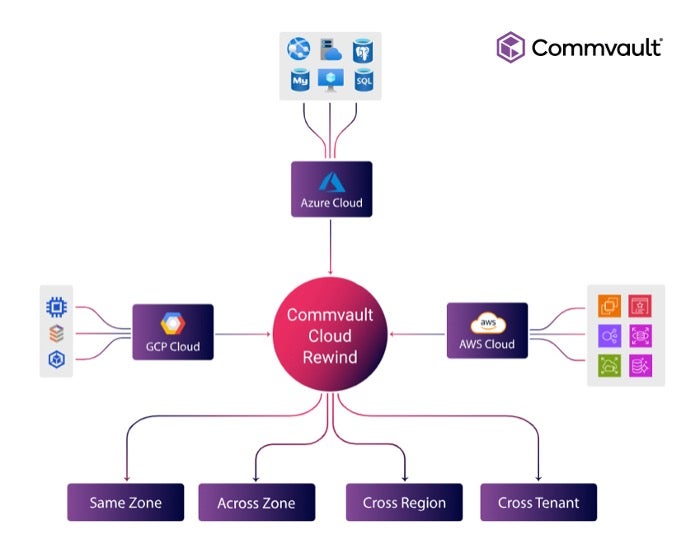
Der weltweite Wandel hin zu cloud Architekturen hat neu definiert, was es bedeutet, Sicherheit und Ausfallsicherheit zu erreichen. Cloud sind von Natur aus dynamisch: Ressourcen werden häufig aktualisiert, hinzugefügt oder entfernt, Anwendungen erstrecken sich über Regionen und Multi-Clouds hinweg, und die Infrastruktur entwickelt sich schneller, als die meisten Wiederherstellungstools mithalten können. Herkömmliche Backup-Modelle, die für statische Systeme entwickelt wurden, haben Mühe, mit diesem Tempo und dieser Komplexität Schritt zu halten.Commvault Cloud Rewind™ is built from the ground up to handle this new reality. With an architecture purpose-built for cloud-scale recovery, Cloud Rewind helps you restore entire cloud environments, including applications and their dependencies, with ease.

This becomes essential in modern environments where applications are composed of microservices, containers, and serverless components that are often ephemeral and spread across multiple platforms.

Resources may change daily, and ownership is often decentralized across teams. Configuration drift, inconsistent change management, and the growing use of third-party services all make recovery harder. Even when manual backups are available, critical infrastructure metadata is often missing, making restorations unreliable or incomplete.

In this ecosystem, Cloud Rewind brings order to the chaos. By leveraging ongoing discovery, orchestration, and cloud-native operations, it provides fast and consistent recoverability. Whether you’re dealing with a simple misconfiguration or a full-blown cyberattack, Cloud Rewind helps restore critical resources in minutes.

A Deep Dive Into the Design: The Cloud Rewind Architecture 

Das Herzstück von Cloud Rewind wichtige Architekturprinzipien, die Automatisierung, Skalierbarkeit und Wiederherstellungsgenauigkeit in den Vordergrund stellen. Auf dieser Grundlage ermöglicht es einen integrierten Ansatz, um Anwendungen und Daten in cloud zu erkennen, zu schützen, wiederherzustellen und neu aufzubauen. Cloud Rewind leistungsstarke Funktionen, um die Cyber-Resilienz zu stärken und die Wiederherstellung in cloud zu vereinfachen. Jede Funktion spielt eine wichtige Rolle bei der Verbesserung des Vertrauens in den täglichen Betrieb und die Krisenreaktion.

  • Cloud und Abhängigkeitszuordnung: Cloud Rewind erkenntRewind alle relevanten cloud und erfasst die Metadaten, die für eine genaue und wiederholbare Wiederherstellung erforderlich sind. Dazu gehören vollständige Konfigurationseinstellungen, Abhängigkeiten und Infrastrukturdetails.
  • Drift-Analyse: Cloud ändern sich schnell. Cloud Rewind diese Änderungen mit regelmäßigen Drift-Analysen und vergleicht aktuelle Konfigurationen mit bekannten geschützten Zuständen. So bleiben Sicherheitsteams über Abweichungen von den erwarteten Konfigurationen auf dem Laufenden, was zur Aufrechterhaltung der entscheidenden Abstimmung beiträgt.
  • Automatisierte tägliche Cloud-Wiederherstellungen: Es reicht nicht aus, den sicheren Zustand wiederherzustellen – dies muss schnell und fehlerfrei erfolgen. Cloud Rewind unterstützt dies durch automatisierte Recovery-Tests. Sie können ganze Cloud-Infrastrukturen, Anwendungen und Daten mithilfe von On-Demand-Umgebungen wiederherstellen. Diese temporären Umgebungen können später gelöscht werden, um die Testkosten zu senken.
  • Integrated cyber recovery: Cloud Rewind works with Commvault’s broader data resilience platform, effectively combining backup, recovery, and threat intelligence. This unified approach provides better control and coordination during security incidents, helping teams move from detection to full recovery with speed and clarity.
Die Konkurrenz hinter sich lassen: Was Cloud Rewind

Mit einer Vielzahl fortschrittlicher Funktionen, die speziell auf moderne cloud Unternehmen zugeschnitten sind,Rewind Cloud Rewind eine effektive und vereinfachte Wiederherstellung. Während mehrere Branchenlösungen eine einfache Notfallwiederherstellung für cloud bieten,Rewind diese Funktionen von Cloud Rewind . Cloud Rewind die Wiederherstellungsfähigkeit auf eine neue Ebene mit:

  • Umfassendecloud mit nativer Unterstützung für AWS, Azure und GCP.
  • Umfassende Ressourcenabdeckung, einschließlich Rechenleistung, Speicher, Netzwerk, IAM, DNS, Container und serverlose Dienste.
  • Detaillierter Schutz von Infrastruktur-Metadaten mithilfe einer Dual-Vault-Zeitschrift.
  • Explizite Anwendungsabhängigkeitsgraphen, nicht nur Ressourcenbewusstsein.
  • Recovery-as-Code für eine koordinierte, codegesteuerte Wiederherstellung.
  • Kontinuierliche Validierung durch regelmäßige automatisierte Neuaufbauten in isolierten cloud .
  • Geringer Betriebsaufwand, hohe Transparenz durch ein SaaS modell.

Cloud Rewind Schutz, Intelligenz und Automatisierung, um eine schnelle und zuverlässige Wiederherstellung in komplexen cloud zu unterstützen. DadurchRewind Cloud Rewind von der KonkurrenzRewind und bleibt an der Spitze.

Cloud für eine vollständige Wiederherstellung Cloud

Commvault Cloud Rewind is built for full-stack cloud resilience, offering protection for modern, cloud-native workloads. Instead of simply backing up isolated resources, capturing and recovering entire cloud applications, referred to as Cloud Assemblies.

Cloud Rewind supports a wide range of cloud-native services, including virtual machines, disks, gateways, security groups, VPCs, DBaaS platforms, and containerized workloads. Once a cloud connection is established, Cloud Rewind performs automated identification of all resources in an environment. At scale, this can be highly significant. For one Commvault customer, 94,237 resources were discovered, with 7,811 protected resources organized into 19 distinct assemblies.

For complete protection, customers can begin with the definition of policies tailored to their Cloud Assemblies. These policies govern snapshot frequency, retention rules, and replication preferences. Snapshots can be taken as frequently as every 15 minutes or as infrequently as annually, depending on the workload’s recovery objectives. These snapshots can be used for rapid, point-in-time backups and fast rehydration.

With its sophisticated use of only cloud snapshots, Cloud Rewind offers protection at a fraction of the cost of expensive traditional high-availability or read‑replica architectures. As dedicated standby infrastructure isn’t required, customers pay only for snapshot storage and temporary compute during recovery operations. This flexibility allows customers to effectively fine-tune protection schedules to balance RPO requirements against storage costs.

Finally, Cloud Rewind provides cloud data resilience by performing recovery at the Cloud Assembly level. When it’s time to restore, Cloud Rewind can recreate the complete application, including the resource configurations, network settings, and dependencies, exactly as it existed at any point in time. Recovery also can target the original region for a quick rollback or be redirected to a different region, subscription, or project to support disaster recovery use cases.

By centering recovery around customer applications, Cloud Rewind replaces traditional complexity with invaluable clarity. With automated discovery, flexible policies, and cost‑effective snapshot-based protection, Cloud Rewind can help customers meet stringent recovery objectives while minimizing infrastructure overhead.

Eine neue Ära der Ausfallsicherheit: Die wichtigsten Vorteile der Cloud Rewind

Cloud Rewind introduces a new standard for resilience in the cloud, shifting away from legacy disaster recovery models toward an approach designed for dynamic, modern environments. By focusing on full application recovery instead of isolated resources, it helps avoid downtime, reduce operational risks, and support rapid, coordinated recovery and restoration across cloud platforms.

One of its core innovations is the patented dual-vault cloud time machine. This unique approach protects  immutable vaults in different hyperscale clouds for rapid application recoveries. This design not only defends against failures and cyber threats but also enables precise, point-in-time recovery of entire application environments.

With a myriad of powerful capabilities that support the growth of modern businesses, Cloud Rewind makes an impact:

  • FinanzdienstleistungsunternehmenNutzen Sie Cloud Rewind strenge regulatorische Anforderungen zu erfüllen und gleichzeitig Ausfallzeiten für Echtzeit-Finanzsysteme zu minimieren.
  • Einrichtungen des GesundheitswesensNutzen Sie Cloud Rewind elektronische Gesundheitsakten und andere wichtige Anwendungen bei Cybervorfällen schnell wiederherzustellen und so eine Unterbrechung der Patientenversorgung zu verhindern.
  • In derBildungssektorRewind Cloud Rewind ein Sicherheitsnetz, das Schutz vor dem Verlust von Kursmaterialien, Schülerdaten und anderen Ressourcen bietet.
  • Einzelhandels- und Fertigungsunternehmen nutzen Cloud Rewind sich schnell von Ausfällen oder Cyberangriffen zu erholen, wodurch Umsatzverluste minimiert und Produktionspläne eingehalten werden können.
  • Technologie- und SaaS nutzen Cloud Rewind Ihnen beim Schutz cloud Plattformen zu helfen und Ihren Kunden einen unterbrechungsfreien Service zu bieten.

Cloud Rewind branchenübergreifend messbare Ergebnisse. So sind schnell prominente Beispiele aus der Praxis entstanden, in denen Unternehmen von dieser innovativen Lösung profitieren. Das in Boston ansässige EdTech-UnternehmenPragya Systeme’ SaaS resiliency increased by a staggering 300% with Cloud Rewind. Similarly, backed by the powerful capabilities of Cloud Rewind, an eDiscovery-Leiterhat sich von einem schweren Ransomware-Angriff erholt.

Betrachtet man den Finanzdienstleistungssektor, so ist einführender Hypothekenkreditgeber decreased cloud application resilience cost by 85% with Cloud Rewind. Finally, leveraging Cloud Rewinds’ app-centric BCDR approach, a global cloud solutions provider achieved a 99.9% cloud app resilience SLA.

Cloud wie nie zuvor

Commvault Cloud Rewind einen Wendepunkt in der Herangehensweise von Unternehmen an das Thema AusfallsicherheitRewind . Anstelle von fragmentierten Tools oder starren WiederherstellungsprozessenRewind Cloud Rewind eine cloud Architektur, die mit dem Wandel Schritt hält. Mit umfassender Automatisierung, anwendungsorientierter Wiederherstellung und bewährten Ergebnissen in verschiedenen Branchen ermöglicht es Unternehmen, das zu schützen, was wichtig ist, schneller wiederherzustellen und mit Zuversicht zu arbeiten.

More related posts


Thumbnail_Blog-Clumio-S3-Backup-2026

Configuring S3 Backup and Recovery with Clumio

Read more about Configuring S3 Backup and Recovery with Clumio
person-escalator-crocus-888×500

Your Modern Playbook for Identity Resilience: Rapid Response and Clean Recovery

Read more about Your Modern Playbook for Identity Resilience: Rapid Response and Clean Recovery
Thumbnail_Blog-Architect-for-tomorrow-2026

Architect for Tomorrow: Unified Data Protection as the Foundation for Resilience

Read more about Architect for Tomorrow: Unified Data Protection as the Foundation for Resilience

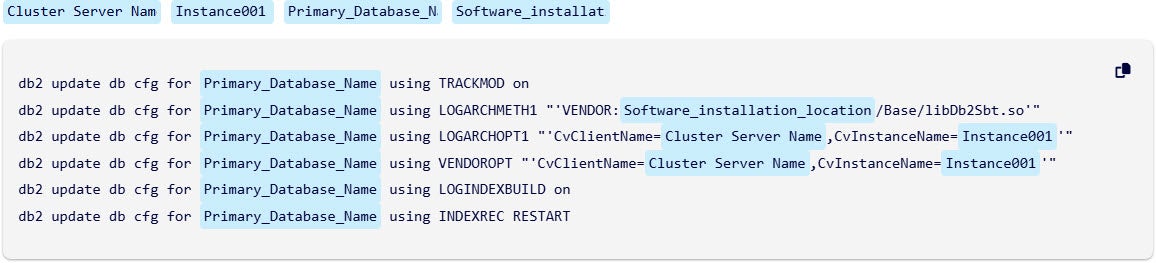
Die meisten Dokumentationswebsites von Unternehmen,die Codeblöcke enthalten,verwenden Stile,die Platzhalter kennzeichnen. Die Absicht soll klar sein,und die Leser sollen wissen,was sie ändern müssen,doch die Benutzererfahrung lässt zu wünschen übrig.Dieselben Stile werden an anderer Stelle in der Dokumentation auch zur Hervorhebung,für UI-Bezeichnungen oder zur Syntax verwendet. Zu den gängigen Platzhaltern,die technische Redaktionsteams zur Kennzeichnung von Codeblöcken verwenden und die auch als andere Stile eingesetzt werden,gehören:
  • Kursivschrift
  • {Klammern}
  • Fett
  • Beispielname_##
  • ALL_CAPS
  • Eine Kombination aus den oben genannten Punkten
  • Etwas völlig anderes

This overlap makes placeholder tracking and management more complex than it should be. On a small scale,this can feel like a nuisance. But as documentation libraries grow and spread across teams and years,it creates problems for both authors and readers. What is meant to simplify placeholder management instead complicates it,because the same styling is reused elsewhier.

The result can put you in a familiar position: You must figure out the placeholder convention and attempt to update them all if you want to succeed. If you miss one placeholder,the command may not work as expected. Other issues can appear,such as errors,unexpected configurations,or even settings you didn’t know could be changed.

Other code block approaches only go so far:

  • Static blocks (with or without syntax highlighting) are essential when you already know the values. They are fast and copy-to-run ready. These are best when you don’t need to modify anything.
  • Inline editors go to the other extreme and enable you to update text directly within the code block,but often at the expense of context – undo becomes unreliable and small mistakes erase the structure you need.
  • Developer API editors let you try out requests in real time,and they’re a great fit when the main audience is developers working directly with APIs. But enterprise documentation serves broader roles and use cases,and that style of interactivity is often missing whier it would still add value.

Die Lücke schließen mit interaktiven Codeblöcken

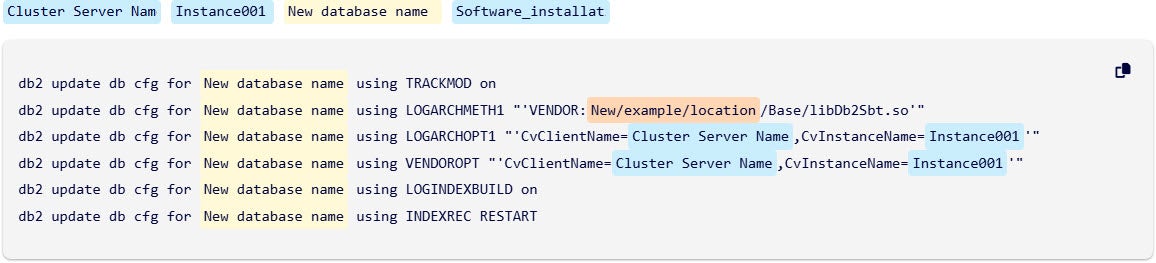
Unsere interaktiven Codeblöcke schließen diese Lücke,indem sie einen historisch anfälligen Teil der Dokumentation (den Platzhalter) in etwas Klares,Bearbeitbares und Skalierbares verwandeln.

You get the same command as before with the same formatting and structure,only now the placeholders have become editable fields. Each one has a clear label (like before) so you don’t have to interpret symbols or rely on guesswork.

You update the values right inside the block,with the surrounding context still visible. That means you see the example,the rest of the page’s contents,and your inputs all in one place. It can help you shape a more relevant snippet before you click Copy.

You can change those values before copying them or leave them as-is and edit them later in another editor. Either way,the structure stays the same and what you copy reflects exactly what you see in the block.

Placeholders in a code block that have the same name become linked. When you change the value of a placeholder field above the code block,all linked fields can update at the same time so that you can more consistently edit fields that have the same placeholder value. This helps reduce potential find and replace mistakes when working in a text editor.

Der Erfahrungswandel

Dieser Wandel löst zwei Probleme auf einmal. Für Leser reduziert er das Rätselraten und beugt Fehlern vor. Das Entziffern von geschweiften Klammern oder spitzen Klammern gehört der Vergangenheit an. Für Autoren trennt er Semantik von Formatierung,sodass Platzhalter programmgesteuert nachverfolgt,geprüft und aktualisiert werden können. Dies ermöglicht Versionsverfolgung,Validierungsregeln und Konsistenz über alle Umgebungen hinweg. Bestehende Inkonsistenzen werden dabei korrigiert,was die Wartung der gesamten Bibliothek vereinfacht.

Interaktive Codeblöcke verwandeln einen der schwierigsten Aspekte der Dokumentation – stilbasierte Platzhalter – in etwas Präzises,Wartbares und Schnell zu Verwendendes. Die Benutzererfahrung wirkt durchdacht statt improvisiert. Und zum ersten Mal schafft die Verwaltung von Code-Beispielen in großem Maßstab Möglichkeiten zur Verbesserung statt Hindernisse.

Jetzt live in Software,SaaS und mehr

Diese Funktion ist bereits auf unserer Dokumentationsseite für Software verfügbar (Versionen11:42,11.40,11,36,and 11,32),SAAS,and other related sites on https://documentation.commvault.com/.

Try it out the next time you browse and run across a code block – edit a few fields,click “Copy,” and see how much easier it is to get started after you bring it into your editor.

Anmerkungen:
  • Carefully review any code before you run it,whether it’s from an interactive or static code block.
  • When you refresh a page after changing placeholders in an interactive code block,all changed placeholders revert to their default values.

Erfahren Siehier.


More related posts


Thumbnail_Blog-Clumio-S3-Backup-2026

Configuring S3 Backup and Recovery with Clumio

Read more about Configuring S3 Backup and Recovery with Clumio
person-escalator-crocus-888×500

Your Modern Playbook for Identity Resilience: Rapid Response and Clean Recovery

Read more about Your Modern Playbook for Identity Resilience: Rapid Response and Clean Recovery
Thumbnail_Blog-Architect-for-tomorrow-2026

Architect for Tomorrow: Unified Data Protection as the Foundation for Resilience

Read more about Architect for Tomorrow: Unified Data Protection as the Foundation for Resilience

Im Wettlauf um den Einsatz von KI investieren Unternehmen viel in die Sicherung ihrer traditionellen Infrastruktur. Cybersicherheitsteams implementieren fortschrittliche Bedrohungserkennung für Endpunkte und setzen Zero-Trust-Architekturen für cloud ein. Viele schenken jedoch einer wichtigen Komponente moderner KI-Systeme weniger Beachtung: der Orchestrierungsebene, die KI-Modelle mit Datenquellen und Geschäftsanwendungen verbindet.

Diese mittlere Schicht umfasst die Infrastruktur, die KI in Unternehmensumgebungen funktionsfähig macht: Vektordatenbanken, die Einbettungen speichern, Modell-Repositorys, Datenpipelines, die KI-Workloads verarbeiten, Agent-Koordinations-Frameworks und Orchestrierungsplattformen wie das Model Context Protocol (MCP). Im Gegensatz zu herkömmlichen Unternehmensanwendungen fehlen vielen dieser Systeme etablierte Sicherheitsframeworks und Best Practices.

Die neue Herausforderung: Sicherheitslücken in der KI-Infrastruktur

Traditional security models were designed for databases, web servers, and file systems with well-understood attack vectors. AI infrastructure introduces new components that don’t always fit neatly into existing security frameworks. Vector databases store high-dimensional embeddings, model registries house trained algorithms, and orchestration platforms coordinate between AI agents and external systems.

Take MCP as an example. While MCP itself incorporates security considerations, the broader ecosystem of AI orchestration frameworks often operates with different security assumptions than traditional enterprise applications.

Untersuchungen from organizations like NIST has highlighted that AI systems frequently require elevated privileges to access diverse data sources, communicate across network boundaries for model inference, and integrate with legacy systems not designed for AI workloads.

This creates an expanded attack surface. According to recent security research, compromise of AI orchestration layers can enable attackers to manipulate model outputs, corrupt training processes, or gain access to the valuable datasets and custom models that represent significant organizational investment.

Datenkonsolidierung schafft neue Risikokonzentrationen

AI adoption has accelerated data centralization initiatives across industries. Organizations are aggregating diverse datasets into centralized repositories to enable machine learning workflows. While platforms like Databricks and Snowflake have built robust security features, the challenge lies in the volume and variety of data being consolidated.

These repositories often contain some of the most sensitive organizational data: customer behavioral patterns, proprietary research datasets, financial transaction records, and competitive intelligence. The security challenge isn’t necessarily inadequate access controls, but rather the concentration of high-value data in systems optimized for analytics rather than security.

A particular concern is training data integrity. Security researchers have demonstrated that subtle corruption of training datasets can introduce persistent vulnerabilities into AI models. For instance, researchers at universities have shown how poisoned datasets can cause fraud detection models to systematically miss specific attack patterns, or cause recommendation systems to exhibit subtle biases that may not be detected for months.

Beispiele aus der Praxis sind:

Der Umfang moderner KI-Trainingsdatensätze verstärkt diese Risiken noch. Wenn Unternehmen Petabytes an Trainingsdaten verarbeiten, werden herkömmliche punktuelle Sicherheitsmaßnahmen wie umfassende Verschlüsselungsschlüsselverwaltung und detaillierte Zugriffsprotokollierung betrieblich komplex. Unternehmen benötigen Sicherheitsansätze, die auf den Umfang und die Geschwindigkeit der KI-Datenverarbeitung zugeschnitten sind.

KI-Modelle als hochwertige Vermögenswerte erfordern besonderen Schutz

Trained AI models represent significant organizational investment – often millions of dollars in development costs and months of training time using expensive computational resources. More importantly, they embody institutional knowledge and competitive advantages developed over years.

However, many organizations apply traditional data security approaches to AI models without accounting for their unique characteristics. Unlike conventional intellectual property, AI models face specific threat vectors:

Model extraction attacks: Untersuchungeners have demonstrated techniques where attackers can query a model repeatedly to reverse-engineer its functionality or training data. Google’s research team has published studies showing how this can be accomplished against various types of production models.

Adversarial attacks: These cause models to make specific mistakes or reveal information about their training data. The field of adversarial machine learning has documented numerous examples across different model types and use cases.

Model stealing: Beyond intellectual property theft, stolen models can reveal insights about business processes, customer patterns, and strategic approaches. For example, a compromised fraud detection model provides information about an organization’s risk assessment methodologies and customer transaction patterns.

Dokumentierte Fälle umfassen:

  • Untersuchungen showing extraction attacks against commercial APIs from major cloud providers.
  • Studien demonstrating how recommendation model theft reveals user behavior patterns.

Unternehmen beginnen damit, spezielle Sicherheitsmaßnahmen für KI-Modelle zu implementieren, darunter Versionsverwaltungssysteme für Modelle, die unbefugte Änderungen erkennen, sichere Serving-Architekturen, die die Gefährdung von Modellen begrenzen, und Verfahren zur Reaktion auf Vorfälle, die speziell für KI-Sicherheitsszenarien entwickelt wurden.

Aufbau angemessener Sicherheitsvorkehrungen für KI-Infrastrukturen

Die Herausforderung der KI-Infrastruktursicherheit stellt eine Verschiebung der Prioritäten im Bereich der Unternehmenssicherheit dar. Die traditionelle Perimeter- und Endpunktsicherheit bleibt weiterhin wichtig, aber Unternehmen müssen auch Systeme sichern, in denen wertvolle Ressourcen in Form von Algorithmen vorhanden sind, autonome Prozesse mit erhöhten Berechtigungen ausgeführt werden und Trainingsverfahren massive Rechenressourcen in verteilten Systemen beanspruchen.

Führende Organisationen entwickeln KI-spezifische Sicherheitsrahmenwerke, die diesen besonderen Eigenschaften Rechnung tragen. Dazu gehören die Implementierung einer Datenherkunftsverfolgung für KI-Trainingspipelines, die Einrichtung sicherer Modellentwicklungs- und -bereitstellungsprozesse sowie die Schaffung von Überwachungssystemen zur Erkennung KI-spezifischer Angriffsmuster. Die Sicherheitsgemeinschaft arbeitet aktiv an der Entwicklung von Lösungen für diese Herausforderungen. Organisationen wie NIST veröffentlichen KI-Sicherheitsframeworks, cloud statten ihre Plattformen mit KI-spezifischen Sicherheitsfunktionen aus und Sicherheitsanbieter entwickeln Tools zum Schutz der KI-Infrastruktur.

Der Weg nach vorn umfasst:

  • Implementierung von Sicherheitskontrollen, die für KI-spezifische Risiken und Angriffsvektoren entwickelt wurden
  • Entwicklung von Verfahren zur Reaktion auf Vorfälle, die die Eigenschaften von KI-Systemen berücksichtigen
  • Schaffung von Überwachungs- und Erkennungsfunktionen für KI-spezifische Bedrohungen
  • Einrichtung von Governance-Rahmenwerken für das Management von KI-Daten und -Modellen

Unternehmen, die sich proaktiv mit der Sicherheit ihrer KI-Infrastruktur befassen, sind besser in der Lage, die Vorteile der KI zu nutzen und gleichzeitig die damit verbundenen Risiken zu bewältigen. Da KI-Systeme für den Geschäftsbetrieb immer wichtiger werden, müssen Sicherheitsstrategien weiterentwickelt werden, um diese neuen Ressourcen und Prozesse wirksam zu schützen.Jetzt anmeldenfür unsere virtuelle SHIFT-Veranstaltung, um mehr über unsere Produktinnovationen und Resilienzstrategien für Ihr Unternehmen zu erfahren.

More related posts


Thumbnail_Blog-Clumio-S3-Backup-2026

Configuring S3 Backup and Recovery with Clumio

Read more about Configuring S3 Backup and Recovery with Clumio
person-escalator-crocus-888×500

Your Modern Playbook for Identity Resilience: Rapid Response and Clean Recovery

Read more about Your Modern Playbook for Identity Resilience: Rapid Response and Clean Recovery
Thumbnail_Blog-Architect-for-tomorrow-2026

Architect for Tomorrow: Unified Data Protection as the Foundation for Resilience

Read more about Architect for Tomorrow: Unified Data Protection as the Foundation for Resilience

How do you take 40 minutes of viewpoints from a panel of leading experts and condense it into a 5-minute read designed to provide you with actionable advice you can immediately use? That’s the challenge I posed to myself as I prepared to write this blog, so let me know if I delivered.

The panel: Nathan McAfee, Lead Economic Validation Analyst at Enterprise Strategy Group; Jaimie Fox, Azure Technology Strategist at Microsoft; and Chris DiRado, Principal Technologist at Commvault.

Their goal: Unpack the key findings from this crucial research (Wirtschaftliche Bewertung durch die Enterprise Strategy Group), das einen klaren Überblick darüber vermittelt, wie sich Organisationen auf das Unvermeidliche vorbereiten und sich davon erholen können.

Die hohen Risiken einer langsamen Erholung

A cyberattack’s impact isn’t just about the initial breach; it’s the prolonged downtime that cripples operations, erodes customer trust, and racks up exorbitant costs. As Nathan explained, the study aimed to quantify the real-world difference a modern, integrated recovery solution could make.

The findings highlight a stark contrast between traditional approaches and a prepared strategy. Without an effective plan, organizations face extended outages; significant data loss; long-lasting brand damage; and a painful, manual recovery process that can take weeks or even months.

Die Lösung: Eine einheitliche Verteidigung mit Commvault und Azure

The study focuses on the economic benefits of the joint solution from Commvault and Microsoft Azure. This isn’t just about backup; it’s about a holistic cyber resilience platform. Jaimie emphasized the power of the integration, which provides a secure, scalable, and intelligent foundation for data protection: “The power of the Commvault solution is in the simplicity and the thoroughness. How easy it is to do these recoveries … and in the automation of the rebuild process using Azure AI and on-demand Azure tenants.”

Bahnbrechende Erkenntnisse: Von Kunden berichtete Ergebnisse

The study provided hard numbers to back up the solution’s value. Organizations using the joint Commvault and Azure solution achieve:

  • 99% faster recovery: The most dramatic finding: where organizations previously required 8.7 hours on average (with some taking 24 days for full recovery), the joint solution between Commvault and Azure enabled one customer recovery in under an hour. Nathan noted: “The 99% faster recovery – I could put decimals on that because we had so many stories of scenarios that took months to do, and now we did it in hours.”
  • 30x more frequent testing: Organizations moved from annual tests of single systems requiring 40 FTE hours, to comprehensive monthly testing of entire ecosystems completed in 30 minutes. One customer shared: “It used to take 24 to 36 hours to recover a single server instance. We can now restore everything in less than an hour.”
  • Zero reported non-recoverable events: Every customer interviewed reported zero non-recoverable events since implementing the solution. “Every person that I interviewed told me that since they’ve gone to this solution, they haven’t had a single non-recoverable event,” Nathan emphasized.
  • 94 % schnellere Wiederherstellung: Die Studie dokumentierte eine um 94 % schnellere Wiederherstellungszeit dankRewind Cloud Rewind , die eine schnelle Wiederherstellung ganzer Anwendungsumgebungen und Infrastrukturen ermöglicht.
  • Drastische Kostensenkung: Die durchschnittlichen Testkosten sanken von 141.864 US-Dollar pro Jahr auf unter 11.000 US-Dollar, obwohl die Testhäufigkeit in einigen Fällen auf täglich erhöht wurde.

Die Veränderung der Denkweise: Von Hoffnung zu Gewissheit

The most powerful insight from the research wasn’t about technology – it was about mindset. Nathan repeatedly emphasized organizations moving from hoping their recovery plans would work to knowing they will.

“We were comparing hope vs. certainty,” he explained. “Certainty is a word you hear me say a lot because that really came out in the customer stories.”

As one global infrastructure director put it: “I wake up every day, check my Cleanroom Recovery report about the previous night’s restore, and know we are protected and can recover. We have eliminated downtime by always being able to recover from cyber events.”

The certainty shines through in being able to test recoverability of more than just one component. Nathan shared, “I went into this thinking about data recovery without thinking about ecosystem recovery. They’re now testing the recoverability of their entire ecosystem.”

Study participants also discussed testing in true chaotic environments. “So much of testing is done in a very calm environment. While any type of true restore is done in a chaotic environment. I heard quite a few stories about how Commvault specifically helped simulate the chaotic environment. So, in the time when it did happen, it wasn’t the first time you went through a high stress recovery,” Nathan shared.

Bonus-Einblicke: KI-Beschleunigung durch Vertrauen

Nathan shared additional findings from the research that are not called out in the report, including how organizations feel confident to accelerate their AI initiatives because they know they’re protected.

“AI comes with rapid change,” he explained, adding that the customers he interviewed “called out the assurance that no matter what happens, I can get to my minimum viable company somewhat quickly. It gave organizations more confidence in going through the rapid change that AI is injecting into their company.”

This confidence proves critical as organizations grapple with AI governance challenges. Jaimie highlighted: “One of the biggest concerns that most of my customers have with implementing AI now is how are we going to keep it safe, from an ethical standpoint, as well as from outages and a business continuity standpoint. With Commvault integrated with the Microsoft solution, the most complex and extremely large AI workloads are resilient and recoverable. Customers now have the confidence that their data is protected and recoverable with the resilience they need.”

Beginnen Sie noch heute mit Ihrer Transformation

The transformation from hope to certainty in cyber recovery isn’t just possible – it’s happening right now. The only question is: When will your organization make the leap?  Download the complete ESG-WirtschaftlichkeitsprüfungLesen Sie den Bericht und sehen Sie sich das Webinar an,Cracking the Code: Erholen Sie sich 99 % schneller von Cyberangriffen, to hear from our expert panel. Use these as your blueprint to begin your organization’s transformation.

More related posts


Thumbnail_Blog-Clumio-S3-Backup-2026

Configuring S3 Backup and Recovery with Clumio

Read more about Configuring S3 Backup and Recovery with Clumio
person-escalator-crocus-888×500

Your Modern Playbook for Identity Resilience: Rapid Response and Clean Recovery

Read more about Your Modern Playbook for Identity Resilience: Rapid Response and Clean Recovery
Thumbnail_Blog-Architect-for-tomorrow-2026

Architect for Tomorrow: Unified Data Protection as the Foundation for Resilience

Read more about Architect for Tomorrow: Unified Data Protection as the Foundation for Resilience

The modern, tech-dependent businesses of today may not run entirely on Windows – but nearly every organization relies on it somewhier. Whether through business applications, identity management, or the countless tools that keep operations moving, Windows remains a critical touchpoint across industries.

This widespread adoption brings with it a unique challenge: It makes Windows solutions the natural target for cyberattackers. The more common the technology, the more determined adversaries are to find vulnerabilities. Especially in an era whier cyberattacks are growing in complexity and sophistication, this poses a monumental threat to digital businesses.

In an frühiern Blogbeitraghaben wir die Notwendigkeit erörtert, von einer reaktiven zu einer proaktiven Verteidigung überzugehen. Wir wissen, dass Transparenz und Geschwindigkeit entscheidend für den Erfolg der Recovery sind. Mit Threatwise v8.2 gehen wir nun den nächsten Schritt. Mit der Einführung vorkonfigurierter Bedrohungssensoren für Windows Server 2022 und 2025 baut diese Version auf den von uns geschaffenen Grundlagen auf. Sie hilft Ihnen, die Wiederherstellung zu beschleunigen, indem sie Ihnen einen einfachen Überblick über den Ausmaß der Auswirkungen verschafft, und bietet IT-Teams ein leistungsfähigeres Frühwarnsystem, um die Ausbreitung von Angriffen zu verhindern.

Täuschungstechnologie: Was ist das und warum ist sie wichtig?

Commvault Threatwise leverages cyber deception technology to help redirect attacks and uncover threats. Deception technology plants digital lookalikes across your environment. These decoys mirror true company assets and network activity, yet they serve a very different purpose: to lure attackers into revealing themselves.

Threatwise extends this approach with decoys that are quick to deploy and simple to scale. These lookalikes trick criminals into believing they have gained access to an enterprise’s most critical systems, when in reality, they have pulled the virtual fire alarm.

While invisible to everyday users, the moment a bad actor interacts with a sensor, security teams receive a high-fidelity signal of compromise. Such early alerts help defenders prepare a response before damage escalates.

With v8.2, organizations gain access to preconfigured sensor templates for the latest Windows Server editions. This allows you to help protect your system with faster setups, broader coverage, and greater resilience.

Minimierung des Explosionsradius

Every cyberattack carries a blast radius. When it comes to cybersecurity, the blast radius refers to the potential spread and impact of a single security breach or system failure.

For backup administrators, the blast radius translates into the scale of data corruption, downtime, and recovery complexity. The larger the impact, the longer and more expensive the recovery. What’s more, beyond the operational disruption and economic losses, these attacks also can damage company reputation and trust, potentially undoing years of dedicated service.

In our proactive detection series, we discussed how reducing the blast radius requires early detection, rapid isolation, and clean recovery environments. Deception technology aligns with this model. Triggering alerts early in the attack lifecycle can help defenders contain an attack before it cascades across production systems. This early visibility can give responders the needed head start, providing valuable time to preserve clean data and maintain operational continuity.

Überwindung von Widrigkeiten: Warum Backup-Administratoren Threatwise benötigen

In our highly competitive business ecosystem whier speed is non-negotiable, backup administrators face a unique set of challenges. Recovery windows are shrinking, applications with exponentially larger data sets, and more and more complex infrastructure, often spanning across hybrid or multi-cloud environments.

In this environment, Commvault’s deception technology can help data administrators thrive in the face of adversity in several ways:

  • Die Vorgehensweise: Vorkonfigurierte Köder ahmen Anwendungshosts nach, sodass Administratoren schnell Lookalikes erstellen und diese auf leere Instanzen vervielfältigen können. Mit Threatwise .2 bieten Sensorvorlagen für Windows Server 2022 und 2025 Abdeckung für die neuesten Systeme.
  • Das Was: Basierend auf organisatorischen SLAs Threatwise hervorheben, welche Systeme priorisiert werden sollten, und dabei helfen, die wichtigsten Unternehmensressourcen zu schützen.
  • Der Grund: Frühzeitige, hochpräzise Signale können durch wichtige Erkenntnisse zur Bedrohungslage die Unsicherheit während eines Vorfalls verringern. Backup-Administratoren können infizierte Anwendungen, die wiederhergestellt werden müssen, gezielt identifizieren. Darüber hinaus können sie „Cleanroom“-Umgebungen effektiv vorbereiten, um wiederhergestellte Daten und Prozesse zu validieren.

Diese Funktionen verschaffen Administratoren Klarheit und Sicherheit, selbst in den stressigen Momenten einer Notfallwiederherstellung.

Gemeinsam stärker: Zusammenarbeit und Synergie zwischen IT und Sicherheit

Threatwise Unternehmen Tools zum Schutz ihrer Vermögenswerte vor modernen Cyberbedrohungen und Ransomware. Die Erkennung ist jedoch nur so effektiv wie die darauf folgende Reaktion. Threatwise ist Teil von Commvault Cloud und lässt sich in führende SIEM- und SOC-Lösungen integrieren, sodass Warnmeldungen zwischen IT- und Sicherheitsabteilungen ausgetauscht werden können. Diese Zusammenarbeit ermöglicht eine schnellere Koordination, funktionsübergreifende Kommunikation, ein gemeinsames Bewusstsein innerhalb des Unternehmens und einen einheitlichen Plan für die Reaktion auf Vorfälle.

Darüber hinaus liegt die eigentliche Chance darin, wie der Backup-Betrieb die übergeordnete Sicherheitsstrategie mitgestalten kann, indem er die Rolle des Innovators übernimmt. Indem sie diese Rolle einnehmen und sich mit dem Sicherheitsteam abstimmen, tragen Backup-Administratoren dazu bei, den Schwerpunkt von reaktiver Verteidigung hin zu proaktiver Resilienz zu verlagern. Routinemäßige Tests von Reaktions-Runbooks und Recovery-Maßnahmen verstärken diese Synergie und schaffen Vertrauen in die Wirksamkeit eines proaktiven Ansatzes.

Was dies für die Zukunft der Cyber-Resilienz bedeutet

Threatwise v8.2 helps make deception technology simpler to deploy and more effective against ever-evolving threats. By extending coverage to the latest Windows Server editions, it helps organizations stay a step ahead of attackers who seek to exploit vulnerabilities of the most widely used enterprise systems.

Early warning signals are not a luxury for a cyber resilient organization; they are vital for building business continuity by creating rapid recovery options. With deception in place, powered by Threatwise, organizations can face tomorrow’s threats with confidence.

Learn more about Threatwise hier.

More related posts


Thumbnail_Blog-Clumio-S3-Backup-2026

Configuring S3 Backup and Recovery with Clumio

Read more about Configuring S3 Backup and Recovery with Clumio
person-escalator-crocus-888×500

Your Modern Playbook for Identity Resilience: Rapid Response and Clean Recovery

Read more about Your Modern Playbook for Identity Resilience: Rapid Response and Clean Recovery
Thumbnail_Blog-Architect-for-tomorrow-2026

Architect for Tomorrow: Unified Data Protection as the Foundation for Resilience

Read more about Architect for Tomorrow: Unified Data Protection as the Foundation for Resilience

AI and analytics are driving competitive advantage across every industry. At the heart of this transformation are data lakehouses built on Apache Iceberg, now one of the fastest-growing standards for structured data on object storage such as Amazon S3. From retail and healthcare to finance and tech, Iceberg is powering the pipelines that fuel AI-driven insights.

But while adoption is surging, resilience has not kept pace. Native Iceberg tools weren’t built for long-term protection. They fall short when it comes to compliance, ransomware resilience, and rapid recovery. For businesses, that gap means more than data loss – it can result in regulatory fines, flawed AI models, and costly downtime that undermines innovation.

When Native Tools Fail: A Financial Firm’s Story

Consider a global financial services firm processing billions of trades every day. Every few minutes, trades are written into Iceberg tables. Regulations require this firm to keep a full history of transactions for seven-plus years.

With native Iceberg snapshots, this can quickly become unmanageable. Too many snapshots can create performance bottlenecks, and recovering to an event from just five months ago requires a slow, manual process. In finance, where downtime equals millions of dollars in losses, that’s simply unreasonable.

And the challenge isn’t limited to finance. Any industry running AI and analytics on Iceberg may face the same risks: limited retention, fragile recovery, and exposure to ransomware.

Why Generic S3 Backups Aren’t Enough

Some organizations turn to standard S3 backup tools as a workaround. While these can be air-gapped, they copy data files but don’t preserve the relationships that define an Iceberg table.

That means recovery isn’t a simple restore – it’s a complex, manual “rewiring” process to rebuild the entire table structure. For a financial firm with billions of trades, that translates into extended downtime, higher costs, and potential data loss.

Clumio can eliminate this problem by natively understanding Iceberg, enabling recovery that is fast, accurate, and transactionally consistent.

Ein intelligenter Weg in die Zukunft: Clumio für Apache Iceberg

Commvault is closing this gap with the industry’s first and only solution to deliver Iceberg-aware, air-gapped cyber resilience: Clumio for Apache Iceberg on AWS.

Here’s what makes it different:

  • Unlimited retention without performance hits – adhere to long-term compliance requirements without slowing down production environments.
  • Air-gapped, immutable protection – designed to defend against ransomware, account compromise, and accidental deletions.
  • Fast, Iceberg-aware recovery – ability to restore to any point in time or named snapshot with full table integrity.
  • Cross-region and cross-account recovery – extend resilience across AWS environments for verifiable disaster recovery.
  • Cost-efficient, incremental backups – enables capturing only changes to minimize costs while scaling with massive workloads.

Lesen Sie die AnkündigungWeitere Informationen finden Sie in unserer Pressemitteilung.

Native Snapshots vs. generische S3-Backups vs. Clumio für Apache Iceberg

Fähigkeit Native Iceberg-Schnappschüsse Generische S3-Backups Clumio für Apache Iceberg
Kundenbindung Begrenzt, kann bei übermäßigen Snapshots zu Leistungsengpässen führen Langfristig möglich, jedoch nur auf Dateiebene Unbegrenzt, kostengünstig und auf Compliance ausgelegt
Luftdurchlässiger Schutz ✘ Lives in same AWS account (lost if table deleted) ✓Can be air-gapped, but not Iceberg-aware ✓Air-gapped, immutable vault for ransomware resilience
Wiederherstellungsprozess Handbuch, insbesondere für ältere Snapshots Manual “rewiring” of table metadata and manifests Schnelle, automatisierte, Iceberg-bewusste Wiederherstellung
Datenintegrität Transaktionskonsistent, aber Governance- und Compliance-Haftung Kein Verständnis für Iceberg-Metadaten; inkonsistente Wiederherstellungen Transaktionskonsistente Wiederherstellungen mit vollständiger Wiedergabetreue
Unternehmensgröße Für die langfristige Aufbewahrung ungeeignet; hohe Lagerkosten Spröde und fehleranfällig in großem Maßstab Bewährt im Petabyte-Maßstab mit Milliarden von Objekten


Warum es für Ihr Unternehmen wichtig ist

Clumio doesn’t just protect files – it can safeguard your AI and analytics investments so they can deliver results. This new capability helps enterprises:

  • Beschleunigen Sie KI-Innovationen mit Zuversicht, indem Sie die Daten schützen, die wichtige Pipelines versorgen.
  • Vermeiden Sie Strafen wegen Nichteinhaltung von Vorschriften durch unbegrenzte, kostengünstige Aufbewahrung von Snapshots.
  • Dank der Iceberg-fähigen Automatisierung, die darauf ausgelegt ist, anfällige manuelle Prozesse zu eliminieren, können Sie sich innerhalb von Minuten statt Tagen erholen.
  • Stärken Sie Ihre Cyber-Resilienz mit einem echten Air-Gap-Schutz gegen Ransomware und Insider-Bedrohungen.

Resilienz für die Zukunft aufbauen

As data lakehouses become the backbone of digital business, resilience shouldn’t be an afterthought. With Clumio for Apache Iceberg on AWS, enterprises finally have a solution that matches the scale, speed, and criticality of their AI and analytics workloads.

Because in the end, it’s not just about protecting data. It’s about protecting your business.

Erfahren Sie, wie Sie Iceberg-Tabellen schützen könnenVerwaltet von AWS Glue und Amazon S3 Tables mit Iceberg-aware resilience. Möchten Sie mehr erfahren?Demo anfordern, und melde dich für einenKostenlose Testversion im AWS Marketplace today.


More related posts


Clumio

Read more about Clumio

Ransomware attacks have become inevitable in today’s threat landscape, emerging as a major concern for all businesses. In fact, ransomware incidents have surged dramatically in the first half of 2025, resulting in a Anstieg um 49 % compared to the same period in 2024.

Now, as organizations face even more sophisticated threats designed to encrypt data, paralyze operations, and exploit recovery processes, these numbers show no signs of slowing down.

The stakes are rising, and it’s increasingly evident that when disaster strikes, simply having backup isn’t enough. Organizations can’t adopt a reactive security posture and hope to function successfully. You need immutable data, intelligent detection of threats, clean recovery and testing of recovery plans, and 24/7 protection.

Commvault delivers a deeply integrated, multi-layered ransomware defense framework that prioritizes security, speed, and confidence. By combining state-of-the-art threat detection, isolation, and recovery mechanisms with partner intelligence, Commvault helps enable cyber resilience.

This article explores four components of Commvault’s ransomware defense strategy: Unveränderlichkeit der Daten, real-time threat scanning, validated recovery, and intelligent recovery automation. Together, these capabilities form a complete and dependable response to one of the most persistent challenges plaguing modern IT teams.

Datenunveränderlichkeit: Die erste Verteidigungslinie

Data immutability is integral to any successful ransomware defense strategy. In a world whier ransomware increasingly targets not just production systems but backup infrastructure itself, immutability is a critical safeguard. Commvault leverages Unveränderlichkeit der Daten with an array of capabilities designed to help keep your data tamper-proof. This is achieved through immutable storage, layered access controls, and enforced authorization protocols.

Here’s a closer look at Commvault’s Unveränderlichkeit der DatenFähigkeiten:

  • Immutable storage: Commvault implements a multi-layered approach to immutability. It combines its own software-level controls with hardware-enforced and cloud-based WORM (write-once, read-many) technologies. Retention Lock (formerly WORM Copy) prevents premature deletion or aging of backups, even by administrators, and protects against actions like removing storage policies or deleting storage libraries. This is a significant form of defense against rogue administrators or malicious attackers.
    Similarly, for hardware-enforced immutability, Commvault integrates with storage platforms that support the industry-standard S3 Object Lock API. S3 Object Lock operates in two primary modes: governance and compliance. While governance mode helps protect against accidental deletions and retains administrative flexibility, it is primarily suited for internal controls. The stricter compliance mode, on the other hand, enforces unbreakable retention periods and is designed to meet stringent regulatory requirements such as SEC Rule 17a-4, FINRA, and HIPAA 12.
    When Commvault writes backup data to an Object Lock–enabled target, such as an AWS S3 bucket or Zadara object store, it sets the Object-Lock-Retain-Until-Date metadata timestamp. Any API call to modify or delete the object before that date is rejected by the storage system, regardless of user permissions. Commvault also adds a default 7-day grace period to the WORM lock retention period configured in the software.
    Finally, on HyperScale X, Commvault’s scale-out integrated appliance, Commvault delivers immutability end-to-end using Retention Lock, a hardened OS, and an immutable file system. This integrated stack is certified for SEC 17a compliance, making it a powerful all-in-one solution for immutable storage.
  • Air Gap Protect: Der Air-Gap-Schutz wird durch eine von Commvault verwaltete, logisch isolierte Backup-Umgebung bereitgestellt, die Daten verschlüsselt, vom Produktionsnetzwerk trennt und Ausgangsgebühren eliminiert. Diese Funktion ist für Commvault SaaS standardmäßig aktiviert und trägt dazu bei, dass Daten auch dann geschützt bleiben, wenn Produktionssysteme kompromittiert werden.
  • Zero-Trust-Durchsetzung: Commvault wendet strenge Zero-Trust-Prinzipien auf die Backup-Infrastruktur an, und zwar durch rollenbasierte Zugriffskontrolle, Multi-Faktor-Authentifizierung und privilegiertes Zugriffsmanagement. Diese Ebenen begrenzen die Gefährdung und erzwingen einen Zugriff mit minimalen Berechtigungen, wodurch die Auswirkungen kompromittierter Anmeldedaten reduziert werden.
  • Mehrpersonenautorisierung: Um böswillige oder versehentliche Änderungen an Schutzrichtlinien zu verhindern, erzwingt Commvault quorum-basierte Genehmigungen für sensible Vorgänge. Dadurch wird verhindert, dass ein einzelner Administrator geschützte Daten ohne Aufsicht deaktivieren oder löschen kann.

Echtzeit-Bedrohungsinformationen: Proaktive Erkennung und Eindämmung

Commvault’s Threat Scan suite is a cornerstone of its ransomware defense. Malicious files and programs can make their way into backups and stay hidden, waiting for the perfect opportunity to strike. So, Commvault’s real-time threat intelligence is designed to identify threats at every stage: during backup, after backup, and before restore.

Commvault is also the only cyber resilience vendor with built-in deception capabilities such as Threatwise sensors and canary files. These tools can trigger alerts while a threat actor is performing reconnaissance and before ransomware even reaches backup data.

Real-time threat detection is brought to life with these powerful features:

  • Inline-, Vor- und Nach-Backup-Scans: Während der „Threat Scan“ erst nach dem Backup durchgeführt wird, überwacht Commvault bereits während der Inline- und Vor-Backup-Phasen aktiv nach Anzeichen für Ransomware. Dazu gehört die Suche nach Änderungen bei Attributen wie MIME-Typ, Backup-Größe und dem Wachstum bestimmter Dateiendungen, die auf Ransomware-Aktivitäten hindeuten.
    Mit diesem umfassenden Ansatz werden Daten – unabhängig davon, ob sie sich in der Übertragung befinden, neu gespeichert werden oder wiederhergestellt werden – kontinuierlich auf versteckte oder schlummernde Bedrohungen überprüft. Dies ermöglicht eine frühzeitige Erkennung und trägt dazu bei, blinde Flecken zu beseitigen.
  • Signature-based and AI/ML detection: Commvault leverages Avira’s anti-malware SDK, a trusted OEM engine used widely across the industry, to massively enhance its defensive capabilities. This engine includes several detection layers that combine to provide a comprehensive security approach.
    Signature-based scanning compares file hashes against Avira’s vast malware signature database. Updates occur every 24 hours to keep the engine current with emerging threats. This database is automatically updated every 24 hours via a secure connection to Avira’s update servers, providing protection against the latest cataloged threats.
    Similarly, for malware that is not yet in the signature database, the Avira engine uses heuristics to analyze the code structure, behavior, and characteristics of a file. This allows it to identify variants of known malware families and other suspicious code, even without an exact signature match.
    Finally, Machine Learning (MicroVision™), Avira’s local ML model, evaluates a broad set of code attributes and anomalies to identify previously unseen threats. It is especially effective against zero-day malware that lacks a known signature but shows signs of malicious behavior.
  • Entropy and MIME Mismatch Analysis: Commvault uses encryption detection models, consisting of multiple statistical features, to identify encrypted or disguised files. One such feature is entropy, which measures the level of randomness in data at the binary level. High entropy can indicate ransomware encryption, but it is just one of several properties used in Commvault’s encryption detection model.
    In parallel, MIME mismatch detection flags files whier the content does not match the expected file type, such as a script disguised as a PDF. These techniques help uncover dormant threats that might otherwise go unnoticed.
  • Erkennung von Anomalien: Commvault überwacht kontinuierlich das System auf Verhaltensabweichungen. Ungewöhnliche Spitzen beim Backup-Volumen oder Veränderungen in den Datenmustern werden als Warnzeichen gewertet. Sobald solche Anomalien festgestellt werden, können sie umgehend untersucht werden, was zu einer frühzeitigen Eindämmung beiträgt.
  • Integration von Signalen von Partnern: Commvault erweitert seine Erkennungsfunktionen durch die Integration mit externen Sicherheitspartnern. Wenn beispielsweise CrowdStrike Malware auf einem Endgerät erkennt, können von Commvault geschützte Clients Folgendes einsehen:Einblicke in Indikatoren für Kompromittierungen im Dashboard „Threat Indicators“um Maßnahmen wie den Threat Scan oder die Datenwiederherstellung auszulösen.

Umfassende Wiederherstellung: isoliert, validiert und automatisiert

As ransomware grows in complexity and speed, clean recovery is imperative. With ransomware, restoring the wrong version can cause re-infection, operational downtime, or compliance failures. And it can be detrimental to company trust, confidence, and long-term success. Commvault addresses these risks with a set of validated recovery options that not only help restore clean data but also help verify its safety before it ever touches production systems.

Commvault’s Cleanroom Recovery creates a secure, isolated recovery environment for testing and validating backup data before reintroduction. This setup is ideal for running malware scans without risking spread to production. What’s more, cleanrooms are provisioned on-demand in the cloud, avoiding the need for dedicated infrastructure.

Within the cleanroom, Commvault supports a wide range of workloads, including virtual machines, file systems, and Active Directory. This flexibility allows teams to simulate live environments and fully verify operational readiness.

Cleanroom Recovery enhances Commvault’s ransomware defense:

  • Automatisierte Wiederherstellungs-Workflows: Commvault automatisiert den gesamten Wiederherstellungszyklus, von der Identifizierung sauberer Punkte bis zur endgültigen Wiederherstellung der Workloads. Diese Workflows reduzieren den manuellen Aufwand, sorgen für Konsistenz und helfen Teams dabei, anspruchsvolle Wiederherstellungsziele zu erreichen.
  • „Pave and Repave“: Für Systeme, die auf Betriebssystemebene kompromittiert wurden, unterstützt Commvault „Pave and Repave“-Funktionen. Bei diesem Ansatz werden die Rechner mithilfe sauberer Betriebssystem-Images wiederhergestellt und anschließend mit den Kundendaten aus dem Backup überlagert. Das Ergebnis ist ein vollständig neu aufgebautes System, das frei von Malware oder Manipulationen auf Betriebssystemebene ist.
  • Bad file indexing: During scanning, Commvault marks any infected or suspicious file versions as “bad.” These tags are automatically referenced during recovery, enabling the platform to select clean restore points without manual review.

Auto Recovery operative Intelligenz: Schnell, koordiniert und skalierbar

Recovering clean may be the most essential aspect, but recovering fast is also a priority. Commvault’s auto recovery capabilities allow organizations to restore systems at scale with speed, confidence, and minimal manual effort. These capabilities combine intelligent orchestration, integrated scanning, and real-time visibility to drive recovery resilience.

Here’s a deeper analysis of Commvault’s automated operational intelligence solutions:

  • Auto recovery orchestration: Commvault automatically detects the most recent clean recovery point and initiates restore workflows based on pre-defined policies. These orchestrated processes eliminate guesswork and help reduce the time it takes to bring systems back online after an attack. The full Commvault auto recovery process involves automated steps detailed hier.
  • Threat Scan : Wiederhergestellte Workloads werden im Rahmen des Wiederherstellungsworkflows gescannt, bevor sie wieder in die Produktion zurückgeführt werden. Dieser Prozess erhöht die Zuverlässigkeit der wiederhergestellten Daten, indem er dazu beiträgt, sie frei von versteckter Malware oder verbleibenden Bedrohungen zu halten.
  • Berichte zur Validierung der Wiederherstellung: Bei jedem Wiederherstellungsvorgang wird ein detaillierter Bericht erstellt, der die Scan-Ergebnisse, gemeldete Anomalien und alle ergriffenen Korrekturmaßnahmen enthält. Diese Berichte bieten Sicherheitsteams wertvolle Einblicke in die wiederhergestellten Daten und die Gründe dafür.
  • Security IQ : Das Security IQ bietet Echtzeit-Einblicke in Ransomware-Risiken, Datenrisiken und die allgemeine Wiederherstellungsbereitschaft. Es hilft Administratoren dabei, kritische Schwachstellen zu identifizieren, Verbesserungen zu verfolgen und bei Bedarf auf Änderungen zu reagieren.

Ransomware-Resilienz, wenn es darauf ankommt

Commvault’s ransomware defense architecture is an intelligent, multi-layered ecosystem. From the moment data is backed up to the second it’s restored, every layer is protected, validated, and recoverable. With a comprehensive design that encompasses every aspect of ransomware defense, Commvault gives your businesses confidence, trust, and resilience.

More related posts


Thumbnail_Blog-Clumio-S3-Backup-2026

Configuring S3 Backup and Recovery with Clumio

Read more about Configuring S3 Backup and Recovery with Clumio
person-escalator-crocus-888×500

Your Modern Playbook for Identity Resilience: Rapid Response and Clean Recovery

Read more about Your Modern Playbook for Identity Resilience: Rapid Response and Clean Recovery
Thumbnail_Blog-Architect-for-tomorrow-2026

Architect for Tomorrow: Unified Data Protection as the Foundation for Resilience

Read more about Architect for Tomorrow: Unified Data Protection as the Foundation for Resilience

Resilienz steht im Mittelpunkt unseres Handelns hier bei Commvault.Wie wir bereits berichtet haben earlier this year, we are proud to partner with Warrior Canine Connection (WCC) in its mission to create resilience and strength within the veteran community.

This is a cause close to our hearts and foundational to our VALOR Employee Group’s mission to honor our veterans and increase veteran recruitment and retention, while bolstering our community outreach and building a military-friendly culture that is inclusive of all.

Over the past couple of months, we’ve been thrilled to have members of WCC, including some furry friends, join us at customer and partner events across the United States. Heidi Pius on our Sales Engineering team has witnessed the pawsitive effect these service animals have had on everyone they encounter.

“Commvault’s partnership with WCC highlights the powerful combination of innovation and resilience in supporting veterans,” Heidi said. “This partnership helps both of us further veteran resilience through the healing power of service animals.”

Here are some highlights from our events throughout the summer:

Commvault’s Annual Public Sector Partner Day – Stone Tower Winery in Leesburg, Virgina.

WCC were the capstone presenter at our Annual Public Sector Partner Day and showcased how the organization furthers veteran resilience and helps military heroes reconnect with life, their families, and their communities through the healing power of service animals.


AWS Summit – Washington DC

WCC added a special touch to our booth at the AWS Summit in Washington, D.C. When the service dogs weren’t present in the booth, we had people asking about them and when they would return to the booth – we even ran out of mission cards during the event.

Having WCC as part of our booth experience is not only a great marketing tool but makes the booth experience relatable on another level – adding a human element that makes it real. The handlers were excellent in telling the story of resilience from both sides.

Having an impact is fundamental to our values and our culture. We’re committed to our partnership with WCC to raise awareness and help veterans receive the support and care they deserve.

To learn more about what it’s like to work at Commvault, visit our Karriereseite.

More related posts


Thumbnail_Blog-Clumio-S3-Backup-2026

Configuring S3 Backup and Recovery with Clumio

Read more about Configuring S3 Backup and Recovery with Clumio
person-escalator-crocus-888×500

Your Modern Playbook for Identity Resilience: Rapid Response and Clean Recovery

Read more about Your Modern Playbook for Identity Resilience: Rapid Response and Clean Recovery
Thumbnail_Blog-Architect-for-tomorrow-2026

Architect for Tomorrow: Unified Data Protection as the Foundation for Resilience

Read more about Architect for Tomorrow: Unified Data Protection as the Foundation for Resilience

It’s no surprise that identity infrastructure, particularly Active Directory (AD), is a primary target for attackers. According to Gartner’s Market Guide for Identity Governance and Administration, more than 90% of Global 2000 organizations rely on AD for core identity and access management.

Yet, despite its critical role as the central nervous system of enterprise IT, AD security is often neglected, leaving it vulnerable to sophisticated attacks that can bring an entire organization to its knees.

The consequences of a compromised AD can be catastrophic, including widespread operational disruption, significant data loss, and a complete loss of trust. When attackers gain control of AD, they hold the keys to the kingdom – and they are able to move laterally, escalate privileges, and deploy ransomware with devastating efficiency.

Best Practices for Future-Proof AD Resilience

Achieving true AD resilience requires a strategic blend of proactive defence, meticulous planning, and robust recovery capabilities. This is not merely about having backups; it’s about cultivating a resilience-first mindset and implementing a multi-faceted strategy.

1. AD forest recovery: Planning for the worst-case scenario

A complete forest recovery remains the ultimate test of AD resilience. This involves the ability to restore the entire AD environment to a known-good state after catastrophic corruption or compromise.

  • Maintain regular, offline backups of all domain controllers.
  • Document and periodically validate the forest recovery process through tabletop exercises and simulations.
  • Leverage tools like Microsoft’s AD Forest Recovery Guide or third-party automated solutions that reduce recovery time.
  • Recovery images should remain secure, offline, and immutable.

Without these preparations, organizations risk prolonged outages, as recovering AD manually without a plan can be highly complex, error-prone, and time-consuming.

2. Entra ID recovery: Protecting and recovering break-glass accounts

Beyond restoring the forest, organizations should build resilience through Entra ID recovery – protecting and rapidly recovering break-glass accounts used in emergencies.

  • Maintain dedicated, highly secure and monitored administrative accounts that are disconnected from regular directory services (Tier-0 accounts).
  • Store credentials for these accounts in secure vaults (e.g., CyberArk, Azure Key Vault) with strict access controls.
  • Regularly rotate credentials and audit access logs.
  • Simulate account lockout or compromise scenarios to validate the recovery process.
  • Entra IDs have to be excluded from regular AD sync processes with cloud environments to reduce exposure.

These accounts should be protected as crown jewels since their compromise could derail recovery efforts entirely.

3. Proactive hardening and monitoring

This forms the bedrock of any effective AD security program. Organizations should implement a tiered access model to enforce the principle of least privilege, so that users and administrators only have access to the resources absolutely necessary for their roles.

Regularly auditing for misconfigurations, such as weak password policies or excessive permissions, is crucial. Furthermore, deploying advanced threat detection and response solutions provides real-time visibility into suspicious activities, helping enable security teams to identify and neutralize threats before they can escalate.

4. Immutable backup and recovery readiness

Backups should be stored in an immutable, air-gapped location to protect against encryption or deletion by ransomware. This provides a clean recovery point.

Recovery readiness goes a step further by regularly validating the integrity and recoverability of these backups. By automatically testing the recovery process in an isolated environment, organizations can confirm that their backups are not only safe but also fully functional, reducing the risk of a failed recovery during a real crisis.

A Unified Front: The HCLTech and Commvault Joint Solution

HCLTech and Commvault have forged a powerful partnership to deliver a comprehensive, end-to-end identity resilience solution that automates forest-level recovery for AD, helping reduce downtime from days or weeks to hours. With Commvault and HCLTech, customers can expect:

  • Knowledge and strategic guidance from the experts at HCLTech to design, implement, and sustain a resilient AD environment aligned with zero-trust principles.
  • Proactive hardening, regular testing, and continuous monitoring.
  • A comprehensive, tailored recovery plan that includes automated forest-level recovery enabled by the industry-leading capabilities of Commvault Cloud.
  • Unified protection of hybrid identity systems (AD + Entra ID) that simplifies operations and reduces tool sprawl, enabling consistent security across environments.

Together, HCLTech and Commvault provide a truly holistic approach to identity security and business continuity. By combining Commvault’s rapid, automated recovery technology with HCLTech’s strategic, security-first services, organizations are equipped not just to survive an AD-related disaster, but to emerge stronger.

This unified front helps keep your most critical identity infrastructure ready for the worst-case scenario, delivering a rapid, clean, and reliable recovery when it matters most. Don’t wait for a crisis to test your defenses. The time to act is now. Take the first step toward true AD resilience and help your organization prepare for any eventuality.

To learn more and demo the solution, visit the Seite zur Active Directory-Lösung.


More related posts


Thumbnail_Blog-Clumio-S3-Backup-2026

Configuring S3 Backup and Recovery with Clumio

Read more about Configuring S3 Backup and Recovery with Clumio
person-escalator-crocus-888×500

Your Modern Playbook for Identity Resilience: Rapid Response and Clean Recovery

Read more about Your Modern Playbook for Identity Resilience: Rapid Response and Clean Recovery
Thumbnail_Blog-Architect-for-tomorrow-2026

Architect for Tomorrow: Unified Data Protection as the Foundation for Resilience

Read more about Architect for Tomorrow: Unified Data Protection as the Foundation for Resilience

At Commvault, we believe that the well-being of our employees is fundamental to our success as a company. That’s why we’re committed to providing a comprehensive approach to wellness that addresses the various aspects of our Vaulters’ total wellbeing.

Recognizing that wellness encompasses more than just physical health, we’ve developed a multi-faceted approach that includes medical, financial, and physical wellness initiatives.

Einführung einer umfassenden Wellness-Plattform

We’re thrilled to have recently launched our new wellness platform, CommWell. This innovative platform consolidates various wellness-related benefits into a single, user-friendly interface, making it easier for our employees to access the resources they need to maintain and improve their health. The platform offers a range of features, including:

  • Gesundheitsbewertungen, um verbesserungsbedürftige Bereiche zu ermitteln.
  • Personalisierte Wellness-Pläne, die auf die individuellen Bedürfnisse zugeschnitten sind.
  • Interaktive Tools zur Verfolgung der Fortschritte und zur Förderung gesunder Gewohnheiten.

Durch die Vereinfachung der Verwaltung von Wellness-Leistungen versuchen wir, unseren Mitarbeitern unabhängig von ihrem Standort Zugang zu der Unterstützung zu verschaffen, die sie benötigen.

Förderung der psychischen Gesundheit mit Spring Health

We understand that mental health is just as important as physical health. That’s why we’ve partnered with Spring Health, a global provider of mental health support services. Its comprehensive platform offers more than just traditional EAP services, providing:

  • 6 Beratungssitzungen zur Bewältigung spezifischer psychischer Probleme.
  • 6 Coaching-Sitzungen zur Unterstützung der persönlichen und beruflichen Entwicklung.
  • Zugang zu einer Reihe von Kursen und Ressourcen für die ständige Weiterentwicklung.

Finanzielle Wellness mit Origin fördern

Finanzielle Belastungen können das allgemeine Wohlbefinden erheblich beeinträchtigen. Um diese Belastung zu verringern, bieten wir die Finanzdienstleistungen von Origin an, die unseren Mitarbeitern Zugang zu kostenlosen Finanzberatern und zertifizierten Finanzplanern ermöglichen. Die Origin-Plattform bietet fachkundige Beratung zu einer Vielzahl von Themen, darunter:

  • Steuerstrategien und -planung.
  • Aktienzuteilungen und Optimierung der Arbeitgeberleistungen.
  • Budgetierung und Cashflow-Management.
  • Anlageauswahl und Ruhestandsplanung
  • Risikoanalyse und Versicherungsplanung.

Additionally, Origin’s AI Budget Builder (currently available in the U.S. and soon to be expanded globally) provides a cutting-edge tool for managing finances.

Förderung des körperlichen Wohlbefindens mit Wellhub

Regelmäßige Bewegung, gesunde Ernährung und Achtsamkeit sind wesentliche Bestandteile des allgemeinen Wohlbefindens. Um diese Aspekte zu unterstützen, bieten wir Zugang zu Wellhub, einer digitalen App, die eine Reihe von Ressourcen für Fitness, Ernährung und Achtsamkeit bietet. An ausgewählten Standorten können unsere Mitarbeiter auch Mitglied in Fitnessstudios werden, was es ihnen erleichtert, körperliche Aktivitäten in ihren Tagesablauf einzubauen.

Eine Kultur der Pflege und Unterstützung

At Commvault, we’re committed to creating a culture that prioritizes employee wellness and encourages our employees to value their wellbeing. By providing a comprehensive range of wellness initiatives, we’re empowering our teams to deliver for themselves first, which in turn allows them to thrive both personally and professionally.

To learn more about what it’s like to work at Commvault, click hier.

More related posts


Thumbnail_Blog-Clumio-S3-Backup-2026

Configuring S3 Backup and Recovery with Clumio

Read more about Configuring S3 Backup and Recovery with Clumio
person-escalator-crocus-888×500

Your Modern Playbook for Identity Resilience: Rapid Response and Clean Recovery

Read more about Your Modern Playbook for Identity Resilience: Rapid Response and Clean Recovery
Thumbnail_Blog-Architect-for-tomorrow-2026

Architect for Tomorrow: Unified Data Protection as the Foundation for Resilience

Read more about Architect for Tomorrow: Unified Data Protection as the Foundation for Resilience