Skip to content

Here at Commvault, our four values – we connect, we inspire, we care, we deliver – are foundational to everything we do.

Nesta semana, realizamos nossa reunião interna trimestral “Global Town Hall” e entregamos os prêmios “Living Our Values” do nosso CEO. Esse programa trimestral de prêmios nos ajuda a reconhecer e celebrar, em nível global, nossos “Vaulters” pelo trabalho incrível que realizam ao colocar nossos valores em prática todos os dias.

I’m so proud to announce our FY23 Q4 CEO Living Our Values Award winners:

Stephanie​ Cunliffe
Diretora | Análise de Sistemas Empresariais

Jennifer​ Kelly
– Assistente Administrativa/Recepcionista

Leah​ Flynne
Diretora | Conformidade

David ​Stupar
Gerente | Sucesso do Cliente

Metallic Site​ Reliability Team

Justin Avignone​
Gerente | SRE – Aplicações

Karunakar Bojjireddy​
Diretor | Operações em Nuvem – SaaS

Peter Coviello​
Diretor Sênior | Aplicações, Engenharia

Prashant Jayram
Arquiteto Sênior de Soluções de Dados

Alex Piccolo
Cientista de Dados 2

Reddi Prasad​
Engenheiro SRO

Firoz Sahib​
gerente de SRE

Siddhant Saini​
Diretor | Operações de SaaS

Shankaar Thiagarajan​
Arquiteto Sênior


Todos esses vencedores são um exemplo inspirador e representam o que realmente significa ser um Vaulter!

To learn more about what it’s like to work at Commvault, check out our site de carreiras.

More related posts


Thumbnail_Blog-Architect-for-tomorrow-2026

Architect for Tomorrow: Unified Data Protection as the Foundation for Resilience

Read more about Architect for Tomorrow: Unified Data Protection as the Foundation for Resilience
Thumbnail_Blog-Dangerous-Silos-IDC-Resops-2026 (1)

The Importance of Recovery Point Objective (RPO) in Your Business Continuity Plan

Read more about The Importance of Recovery Point Objective (RPO) in Your Business Continuity Plan
Thumbnail_Blog-IDC-Resops-2026

Business Continuity Planning for the Cloud-Native Era

Read more about Business Continuity Planning for the Cloud-Native Era

Data resilience in the cloud can be fuzzy, and organizations at different stages of cloud maturity and use-cases approach resilience differently. To help cloud adopters evaluate where they stand compared to their peers when it comes to cloud data protection, Clumio recently worked with Enterprise Strategy Group (ESG) on their research report titled Data Protection Cloud Strategies at a Crossroads. Here are a few key takeaways to get you started:

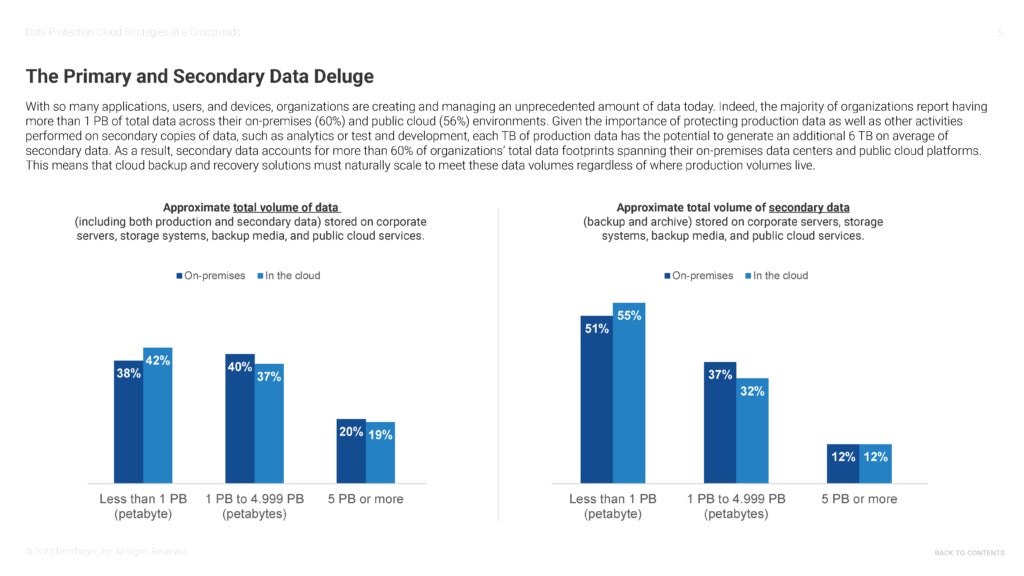
Os dados secundários são os que mais se destacam em volume

A maioria dos ambientes em nuvem contém mais dados secundários do que dados primários! Cerca de 61% a mais, para ser mais preciso.

Source: Enterprise Strategy Group, a division of TechTarget, Inc. Research eBook, Data Protection Cloud Strategies at a Crossroads, May 2023

De acordo com os participantes da pesquisa, a média estimada de dados secundários na nuvem é de 2,9 PB, de um total estimado de 4,7 PB de dados na nuvem, o que significa que os dados primários representariam apenas cerca de 1,8 PB!

This indicates that for enterprises looking to optimize cloud data costs, secondary data is the place to start. You might find orphaned snapshots, unused replicas, or excess versions. It’s also a good idea to take a look at your backup spend. Could you be more efficient with it? Temos algumas sugestões para você. 😉

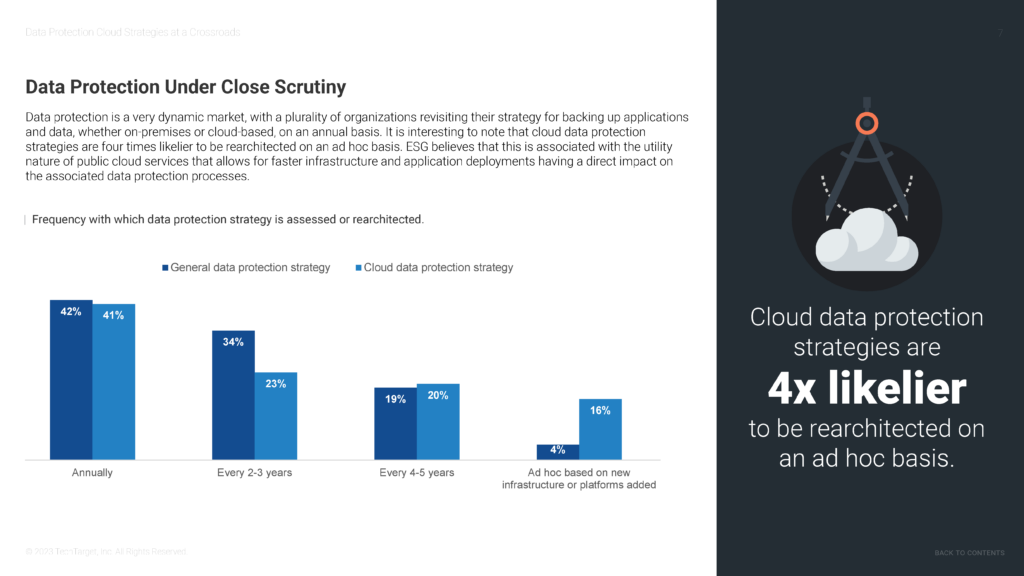
ABA (Sempre Avaliando)

If you feel like your company reassesses its data protection strategy frequently, you’re in good company.

Source: Enterprise Strategy Group, a division of TechTarget, Inc. Research eBook, Data Protection Cloud Strategies at a Crossroads, May 2023

41% of survey respondents stated they reassess or rearchitect their cloud data protection strategy annually, and 16% said they do so on an ad hoc basis. Organizations were 4 times more likely to reassess or rearchitect cloud data protection strategies on an ad-hoc basis than on-premises. Not so surprising, when you consider the rapid scalability and constant innovation of the cloud.

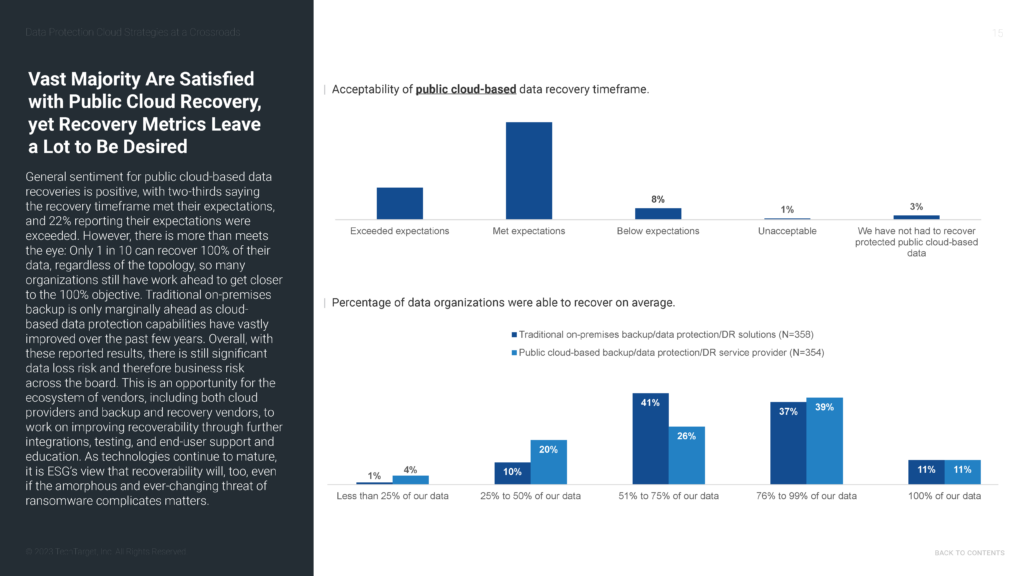
É possível recuperar todos os seus dados?

Here’s a surprising insight: Only 11% of respondents indicated that when recovering data, they had been able to recover 100% on average.

Source: Enterprise Strategy Group, a division of TechTarget, Inc. Research eBook, Data Protection Cloud Strategies at a Crossroads, May 2023

The takeaway: If you haven’t tested your data recovery lately, you should! Make sure you’re 100% ready to recover 100% of your data.


More related posts


Thumbnail_Blog-Architect-for-tomorrow-2026

Architect for Tomorrow: Unified Data Protection as the Foundation for Resilience

Read more about Architect for Tomorrow: Unified Data Protection as the Foundation for Resilience
Thumbnail_Blog-Dangerous-Silos-IDC-Resops-2026 (1)

The Importance of Recovery Point Objective (RPO) in Your Business Continuity Plan

Read more about The Importance of Recovery Point Objective (RPO) in Your Business Continuity Plan
Thumbnail_Blog-IDC-Resops-2026

Business Continuity Planning for the Cloud-Native Era

Read more about Business Continuity Planning for the Cloud-Native Era

Last month, we closed out our International Women’s Day and Women’s History Month celebration with a Courageous Conversation about working parents, the struggles of fertility, and pregnancy loss. Today marks the start of National Infertility Awareness week here in the U.S., so I wanted to share more about our recent event and how we’re supporting the women of Commvault, as well as our working partners, as they navigate these challenges.

Our Courageous Conversations are global, virtual events that are a core component of our DE&I strategy. They allow us to connect, support, and inspire each other by having open discussions about topics that are close to our hearts.  As our Chief People Officer Martha Delehanty always says, “you need to have the conversation, to change the conversation.”

Durante o evento, ouvimos nossos membros do Vault — Lisa McGahran, Stephanie Joyce e Elliot Hujarski — falarem sobre suas jornadas pessoais em relação à fertilidade e à perda de gravidez. Também contamos com a presença da palestrante convidadaStacey Skrysak join us to share her own story and how she’s helping others by being a voice for premature birth, child loss, and infertility. This Courageous Conversation was so powerful and important for our Vaulter community – our speakers courageously opened their hearts to share their stories with us as we talked about how grief and hope can co-exist.


Infertility and pregnancy loss are, unfortunately, very real issues that many women in the workplace (as well as their partners) deal with today as they continue to navigate their careers. At Commvault, we continue to show our commitment and support for not only our working parents, but those aspiring to be parents as well.

The power of hope, positivity, and support is what guides us all each day. We’re proud to support the wellness of our Vaulters and give them the resources they need throughout their journeys.  

More related posts


Thumbnail_Blog-Architect-for-tomorrow-2026

Architect for Tomorrow: Unified Data Protection as the Foundation for Resilience

Read more about Architect for Tomorrow: Unified Data Protection as the Foundation for Resilience
Thumbnail_Blog-Dangerous-Silos-IDC-Resops-2026 (1)

The Importance of Recovery Point Objective (RPO) in Your Business Continuity Plan

Read more about The Importance of Recovery Point Objective (RPO) in Your Business Continuity Plan
Thumbnail_Blog-IDC-Resops-2026

Business Continuity Planning for the Cloud-Native Era

Read more about Business Continuity Planning for the Cloud-Native Era

No mundo atual, os dados são seu ativo mais valioso, e as organizações estão constantemente coletando, processando e armazenando enormes quantidades de dados. O Kubernetes é uma ferramenta de orquestração de contêineres que vem se tornando cada vez mais popular para gerenciar e implantar aplicativos de maneira escalável e inovadora. Em uma pesquisa recente, descobrimos que mais de 75% das organizações utilizam contêineres. No entanto, as organizações que adotam contêineres e o Kubernetes devem levar em consideração as questões relacionadas à proteção e à segurança dos dados.

Neste blog, exploraremos os diversos desafios que as organizações enfrentam ao proteger dados em seu ambiente Kubernetes. Além disso, abordaremos ferramentas e técnicas para garantir a proteção de dados em todo o seu ambiente Kubernetes.

Kubernetes is no longer something that is coming or on the roadmap – it’s here. In fact, among those organizations that have adopted containers, nearly all (94%) use Kubernetes, and most (86%) even find it critical to their operations. This doesn’t come as a surprise since we also learned that Kubernetes is helping drive effective cloud migration and flexibility, container orchestration, and workload mobility. Organizations also see improved scalability, availability, and DevOps processes when implementing Kubernetes.

Now that we know organizations truly embrace Kubernetes and will continue to use it more moving forward let’s look at what they primarily use it for. On average, over half of an organization’s data (59%) is orchestrated with Kubernetes, and nearly all organizations (94%) plan to utilize Kubernetes more in the next five years to protect their data. However, most organizations (89%) also expect to do more work to protect their data in Kubernetes in the next five years.

Assessing your Kubernetes protection needs

As with any change or disruption, organizations face issues with identifying vulnerabilities and fully understanding their systems and needs when using Kubernetes. When moving to cloud-native applications, customers must be aware that backups and data protection are not always guaranteed. Most cloud service providers follow the Shared Responsibility Model, where they are responsible for securing their service infrastructure, and customers are responsible for securing their data and applications within the cloud environment. About half of organizations currently face challenges with identifying vulnerabilities (52%), assessing backups (49%), scaling based on the scope of operations (49%), and understanding system complexity (48%).

The survey also revealed the top features for organizations when implementing Kubernetes.  Two-thirds of organizations (64%) believe ensuring data security is important in a full data protection system for Kubernetes. Additionally, flexible levels of recovery (56%) and ransomware protection (52%) are important features to more than half of organizations. Additionally, nearly all organizations (95%) find it important that they can back-up data in Kubernetes.

Então, o que isso significa para o futuro do Kubernetes e para garantir que você tenha uma estratégia robusta de proteção de dados para suas novas aplicações K8s com estado? Você precisa se recuperar de todos os desafios que enfrenta hoje e no futuro, tais como:

  • Erro do operador
  • Falhas de hardware e software
  • Ataques direcionados de ransomware/malware

Commvault and Kubernetes – protect K8s containers without getting boxed in

Commvault provides K8s-native protection for your stateful (and stateless) K8s applications in a convenient SaaS-based backup and recovery solution. Safeguarding K8s applications includes protecting all configuration data (pods, manifests, secrets, CRDs) and the persistent application data (persistent volumes, persistent volume claims). Protection of K8s configuration and data allows granular recovery of application configuration, persistent data, or the entire application to the original or a new cluster. Recovery to on-premises or cloud locations provides your business with application mobility and the agility to adopt the K8s distribution and operational model that works for your developers. Full data protection of your Kubernetes cluster means recovery of any/all applications can be ensured in a data loss event. And with Commvault, you won’t get boxed into using a single-purpose tool. Our K8s protection is part of Commvault’s strategy to secure, defend, and recover all data distributed across the hybrid cloud. Here’s how GigaOm describes this in its recent Kubernetes Data Protection Radar Report:

Commvault Backup & Recovery is a backup solution that supports more than Kubernetes workloads, making it suitable for hybrid applications that run across Kubernetes, VMs, and cloud services, consolidating backup operations on a single platform.”

–  GigaOm, January 26, 2023

Read about Commvault’s leadership in Kubernetes data protection https://www.commvault.com/analyst-reports#gigaom.

Source: Hanover Research, Kubernetes Attributes and Usage, February 2023

More related posts


Thumbnail_Blog-Architect-for-tomorrow-2026

Architect for Tomorrow: Unified Data Protection as the Foundation for Resilience

Read more about Architect for Tomorrow: Unified Data Protection as the Foundation for Resilience
Thumbnail_Blog-Dangerous-Silos-IDC-Resops-2026 (1)

The Importance of Recovery Point Objective (RPO) in Your Business Continuity Plan

Read more about The Importance of Recovery Point Objective (RPO) in Your Business Continuity Plan
Thumbnail_Blog-IDC-Resops-2026

Business Continuity Planning for the Cloud-Native Era

Read more about Business Continuity Planning for the Cloud-Native Era

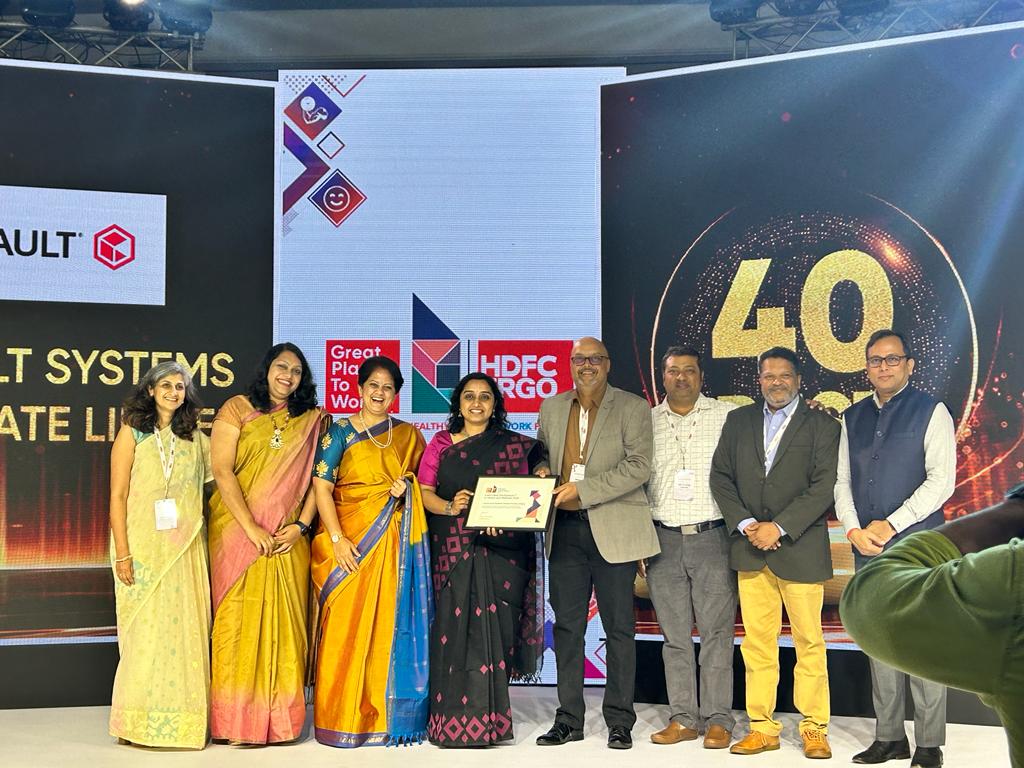
I’m excited to share that Commvault has been recognized by Great Place to Work® India for our culture of care and belonging.

Fomos reconhecidos como um dosIndia’s Best Workplaces in Health & Wellness 2022, com base em uma avaliação abrangente e rigorosa que identifica líderes em práticas bem elaboradas para o bem-estar no local de trabalho.

We’ve also been Accredited for Inclusive Practices™, a Diversity, Equity & Inclusion initiative by Great Place to Work Institute India. This assessment identifies organizations that have internal and external practices to promote equal and equitable participation of historically excluded communities (women, other gender identities, LGBTIQA+, persons with disabilities, veterans, individuals returning from a career break, and other under-represented minorities in the country) in the workplace.


I’m so proud our organization has achieved this recognition. Here at Commvault, we continue to prioritize our culture of holistic wellbeing and DE&I as we support each other and show how we care.

When it comes to health and wellness, we believe the total wellness of each of our employees builds a better company and a better world. Having a healthy work-life balance is crucial and creating a culture of balance and flexibility is greatly important to us. And we know that in order to deliver for our customers and partners, we must deliver for ourselves first… which means caring for ourselves! We also continue to honor and celebrate our diverse Vaulter community and cultivate an environment of respect and belonging. Listening to the experiences and perspectives of others and learning how to better support one another empowers us to create a more equitable future together. 

Parabéns à nossa equipe da Índia!

More related posts


Thumbnail_Blog-Architect-for-tomorrow-2026

Architect for Tomorrow: Unified Data Protection as the Foundation for Resilience

Read more about Architect for Tomorrow: Unified Data Protection as the Foundation for Resilience
Thumbnail_Blog-Dangerous-Silos-IDC-Resops-2026 (1)

The Importance of Recovery Point Objective (RPO) in Your Business Continuity Plan

Read more about The Importance of Recovery Point Objective (RPO) in Your Business Continuity Plan
Thumbnail_Blog-IDC-Resops-2026

Business Continuity Planning for the Cloud-Native Era

Read more about Business Continuity Planning for the Cloud-Native Era

Transformative, channel-friendly, and cutting-edge are just a few of the adjectives the editors over at CRN used to describe the companies they’ve chosen as the cream of the crop – the Lista CRN Storage 100 de 2023 – an honor that recognizes industry-leading storage vendors that deliver the best channel-friendly products and services the industry has to offer.  

According to the publication, the companies they chose for this year’s Storage 100 list have been selected by CRN editors for their “perseverance in pushing the boundaries of innovation through cutting-edge technology and strategic partnerships.” 

It’s definitely a difficult landscape to navigate, with too many vendors to count. Luckily, the Storage 100 list is a valuable resource for solution providers looking for vendors that can support them in a complex storage market with industry-leading portfolios in areas such as data protection, management and resilience; software-defined storage, and storage components.  

CRN emphasized that this year’s list also represents the industry leaders of storage technology that can be used for on-premises or cloud deployments. This is a critical point. Resiliency is key in a world where vendors and partners are trying to help customers keep their data safe, unharmed, and always-on across cloud, on-prem, and SaaS workloads…enter Commvault.  

Recognized in theData Protection, Management, and Resilience category, we offer a simple and unified Data Protection Platform that spans the complete enterprise data estate, regardless of where that data lives. Whether it’s software-defined distributed storage such as containers, a storage appliance like Commvault Grid, or cloud storage in the form of Metallic Recovery Reserve™, Commvault helps customers accelerate their digital transformation journey with unmatched scalability, security, and resiliency.  

Blaine Raddon, CEO of The Channel Company shared his sentiments about this year’s program, stating, “CRN’s 2023 Storage 100 list recognizes the leading vendors that are delivering transformative advancements in storage technology and bringing modern solutions to customers and solution providers that are built for the future. We are honored to recognize their contributions as the leading players in storage technology for 2023.” 

Like CRN, we are also honored; honored to be celebrated for our industry-leading data protection, honored to be highlighted as a recommended choice for solution providers, and honored to continuously be innovating. 

A lista CRN Storage 100 será publicada na edição de abril de 2023 da revista CRN Magazine e estará disponível online emwww.crn.com/storage100.  

More related posts


Thumbnail_Blog-Architect-for-tomorrow-2026

Architect for Tomorrow: Unified Data Protection as the Foundation for Resilience

Read more about Architect for Tomorrow: Unified Data Protection as the Foundation for Resilience
Thumbnail_Blog-Dangerous-Silos-IDC-Resops-2026 (1)

The Importance of Recovery Point Objective (RPO) in Your Business Continuity Plan

Read more about The Importance of Recovery Point Objective (RPO) in Your Business Continuity Plan
Thumbnail_Blog-IDC-Resops-2026

Business Continuity Planning for the Cloud-Native Era

Read more about Business Continuity Planning for the Cloud-Native Era

Spring is a time of renewal and rejuvenation – when we can finally shed the weight of winter and start anew. As flowers bloom and trees bud, it’s the perfect time to reassess and enhance your data protection and recovery plans.

Assim como ao plantar um jardim, é importante avaliar o que você tem e o que precisa. Da mesma forma que você não plantaria uma flor em solo inadequado ou sem água suficiente, você não protegeria seus dados com as ferramentas erradas ou sem um plano. Como diz o ditado: “quem não planeja, planeja fracassar”. Isso é especialmente verdadeiro quando se trata de proteger os dados da sua organização.

As consequências de uma violação ou perda de dados podem ser catastróficas, variando desde a perda de receita e produtividade até danos à reputação e consequências legais. Minimizar o impacto desses eventos exige um plano de Readiness abrangente para se antecipar e responder a possíveis interrupções.

Estar preparado para a Recovery significa ter a confiança e a capacidade de recuperar rapidamente quaisquer dados em todo o seu ambiente.

Routine maintenance is key

Um dos aspectos mais importantes para o sucesso de um jardim é cuidar dele regularmente. O mesmo vale para a proteção de dados. Não dá para simplesmente configurar e esquecer. Revisar e atualizar regularmente seus planos garantirá que eles permaneçam eficazes e continuem atendendo às necessidades da sua empresa. E, com a crescente frequência e sofisticação dos ataques de ransomware, realizar avaliações regulares da sua infraestrutura e do seu plano de Readiness nunca foi tão crucial.

Felizmente, contar com uma solução abrangente de proteção de dados, apoiada por especialistas, pode ser um divisor de águas para ajudar a reduzir o risco de ransomware e garantir uma rápida Recovery após um ataque. ComCommvault® Professional Services.

Além disso, contar com uma solução de proteção de dados que ofereça um conjunto robusto de Features continuamente atualizados e ampliados é fundamental para seus esforços de revisão. Implementar um cronograma de manutenção regular para gerenciar seu ambiente de proteção de dados permite que você incorpore e atualize recursos valiosos. Acesse nossaWhat’s New Pagesobre lançamentos da plataforma para explorar nossos recursos e aprimoramentos mais recentes.

Be ready for anything

Mantenha-se em estado de prontidão para poder responder a qualquer incidente que comprometa os dados. Seja para elaborar o plano de prontidão para Recovery contra ransomware, mantê-lo em dia ou se recuperar de um ataque, comas Soluções de Readiness da Commvault, você escolhe o nível de serviço que melhor atende às necessidades da sua empresa. As ofertas de serviços incluem:

Ready helps you align Commvault’s technical capabilities with your recovery objectives.

Steady assists you in monitoring and maintaining a state of recovery readiness.

Respond helps accelerate your return to normal business operations in the event of an outage or disaster.

Harvest data protection success

Assim como um jardim bem cuidado pode trazer felicidade, um plano robusto de proteção e Recovery de dados pode proporcionar tranquilidade. Portanto, aproveite a primavera para plantar as sementes de um plano sólido de proteção e Recovery de dados e observe-o crescer e florescer nos próximos meses.

Conversecom um representante para saber como a Commvault pode ajudar a preparar seu plano de resposta a ransomware.

More related posts


Thumbnail_Blog-Architect-for-tomorrow-2026

Architect for Tomorrow: Unified Data Protection as the Foundation for Resilience

Read more about Architect for Tomorrow: Unified Data Protection as the Foundation for Resilience
Thumbnail_Blog-Dangerous-Silos-IDC-Resops-2026 (1)

The Importance of Recovery Point Objective (RPO) in Your Business Continuity Plan

Read more about The Importance of Recovery Point Objective (RPO) in Your Business Continuity Plan
Thumbnail_Blog-IDC-Resops-2026

Business Continuity Planning for the Cloud-Native Era

Read more about Business Continuity Planning for the Cloud-Native Era

Sabemos que a proteção de dados pode ser um assunto sério, mas estamos aqui para dar um toque divertido a isso por ocasião do Dia Mundial do Backup! Você está pronto para avaliar como protege suas informações confidenciais e fazer perguntas difíceis sobre os produtos que está usando?

Na Commvault, entendemos a importância da proteção de dados e estamos aqui para lhe fornecer as respostas que você merece. Junte-se a nós nesta jornada, na qual abordaremos seis das perguntas mais frequentes sobre proteção de dados, e mostraremos como manter sua empresa segura.

https://play.vidyard.com/AMTPw7ny3Ahn5Ju3rCTFEr

Vazamentos de dados e violações de privacidade podem ser um verdadeiro problema para as empresas. Além de poderem acarretar repercussões legais e financeiras, eles também podem prejudicar sua reputação e a confiança dos clientes. É por isso que é fundamental estar informado e atento no que diz respeito às suas estratégias de proteção de dados.

É hora de separar a realidade da ficção quando se trata de proteção de dados. Não se deixe levar por essas promessas de marketing chamativas sem antes fazer sua própria pesquisa. Essas empresas estão inovando no mesmo ritmo que o crescimento dos seus dados? Elas estão ajudando você a aproveitar ao máximo seu orçamento de TI? Estão vendendo um produto quando o que você realmente precisa é de uma plataforma? Essas são as perguntas que você precisa fazer!

Faça parceria com um provedor confiável de proteção de dados, como a Commvault, para garantir que suas informações confidenciais estejam sempre seguras e protegidas. Entre em contato conosco hoje mesmo para saber mais sobre nossas soluções de proteção de dados e deixe-nos ajudá-lo a proteger sua empresa e as informações de seus clientes.

Lembre-se: a proteção de dados não precisa ser chata. Com a atitude certa e um pouco de diversão, você pode se manter informado e protegido, ao mesmo tempo em que garante o sucesso da sua empresa!

Follow Commvault on Social Media for more insights on #WorldBackupDay!

More related posts


Thumbnail_Blog-Architect-for-tomorrow-2026

Architect for Tomorrow: Unified Data Protection as the Foundation for Resilience

Read more about Architect for Tomorrow: Unified Data Protection as the Foundation for Resilience
Thumbnail_Blog-Dangerous-Silos-IDC-Resops-2026 (1)

The Importance of Recovery Point Objective (RPO) in Your Business Continuity Plan

Read more about The Importance of Recovery Point Objective (RPO) in Your Business Continuity Plan
Thumbnail_Blog-IDC-Resops-2026

Business Continuity Planning for the Cloud-Native Era

Read more about Business Continuity Planning for the Cloud-Native Era

As Women’s History Month comes to an end, we’re continuing to celebrate women at Commvault all year round! As a working mom and proud co-leader of our Family Support Network Employee Affinity Group (EAG), I wanted to share my experience in hopes to empower working moms (and dads!) everywhere.

I began my career in Human Resources (HR) over 25 years ago, and have been at Commvault for the past 11 years. I was always a people-centric person, and being in HR allowed me to celebrate the human side of the business and focus on the people, a company’s most important asset. Building strong connections and empowering people to thrive and grow is what has inspired me throughout my career.

Having empathy has always been an integral part of my role as an HR leader, but my level of empathy completely evolved once I became a mom. I am blessed to have two beautiful sons in my life – Jake, 8, and Ryan, 6 – but my journey wasn’t without challenges. In 2016, I found out I was pregnant with identical twin boys. After my initial shock that I was going to be 42 years old with three children under the age of two – I was overjoyed! After some complications 24 weeks into my pregnancy, I ended up delivering Ryan and Max prematurely. The next day, Max passed peacefully in my husband’s arms. I was completely numb after this tragedy, yet still had a critical newborn baby in the hospital and a 19-month-old at home whom I had to stay positive (and thankful) for. 129 days and three surgeries later, Ryan was released from the hospital, a day after his original due date. He’s a happy and healthy boy today.

As a mom, you change after you have kids. And after losing a child, I changed even more. It made me realize that you never know someone’s full story – which is why always leading with empathy and care is crucial to building relationships and creating a positive, supportive work environment. That’s why I’m so passionate about not only what I do in HR, but also my involvement with our Family Support Network EAG. This is a support group for working parents and caretakers in all facets of family life – from being a new parent to dealing with toddlers, tweens, teens, and aging parents.  

In the spirit of celebrating working moms (and all working parents!) I wanted to share some tips and tricks I’ve learned from my fellow Vaulters that have helped me become a better working parent:

  • Learn how to unplug from work. Disconnecting is harder said than done, however, we all have to unplug at some point or else we’ll burn out. Remember – taking time to reset is crucial in helping us come back to work the next day refreshed and recharged. I turn off my phone at night after a certain time to help disconnect from work.
  • Talk to your kids about your job. Working and living at home is the reality for many of us in this new hybrid work world. Young children often don’t understand why mom is home but can’t spend time with them during certain hours. Explaining what your job is to your kids can help them better understand you and the concept of this new way of remote working.
  • Embrace planning. Whenever I have a busy week coming up, I create a schedule and plan ahead to make things less stressful. A big thing for me – planning dinners. This allows me to avoid wasting time figuring out what we’re going to eat after a hectic day and gives me more quality time with my kids.
  • Remember that feeling guilty is normal. Finding a balance between being a parent and working is always going to be a challenge. We’ll likely always have moments when work gets in the way and we feel guilty about having to miss time with our kids. Or on the flip side, we may feel guilty stepping away from work to do something with our kids. Find a routine that works best for you and remember to not be so hard on yourself!

Trial and error is the key to success in many aspects of our lives, especially with parenting. I can tell you firsthand that life throws many obstacles at us, and at the end of the day, it’s important to realize that we are all human. Celebrating and supporting each other as parents and caretakers is what helps us stay grounded and inspired, so let’s continue to embrace the power of empathy! When we open our minds and hearts to better understand each other, it not only makes us better professionally but personally too. I’m so thankful to my global Vaulter community and our Family Support Network for allowing me to share my story and learn from others every day.

To learn more about Commvault’s culture of caring, clique aqui.

More related posts


Thumbnail_Blog-Architect-for-tomorrow-2026

Architect for Tomorrow: Unified Data Protection as the Foundation for Resilience

Read more about Architect for Tomorrow: Unified Data Protection as the Foundation for Resilience
Thumbnail_Blog-Dangerous-Silos-IDC-Resops-2026 (1)

The Importance of Recovery Point Objective (RPO) in Your Business Continuity Plan

Read more about The Importance of Recovery Point Objective (RPO) in Your Business Continuity Plan
Thumbnail_Blog-IDC-Resops-2026

Business Continuity Planning for the Cloud-Native Era

Read more about Business Continuity Planning for the Cloud-Native Era

A proteção de dados é um trabalho em equipe. Temos orgulho de nossaComunidadede parceiros estratégicos e de tecnologia, e não há dúvida de que as parcerias para oferecer soluções mais profundamente integradas e eficazes agregam valor aos nossos clientes.

But one thing we don’t do (unlike some we could name….) and that is to partner to fill and hide gaps and then position it as a benefit to customers.

There’s no integration, no added value, just PR and additional complexity… And it’s the customer who suffers.

What does that mean for the customer?

Let’s be honest, most vendors in the backup market are good at a limited or select set of things:  Good at VM backup, good at big backup appliances, good at protecting Salesforce, good at protecting M365, or Oracle or Kubernetes, but rarely are they good at LOTS of things…which leaves them with gaps in their solution capabilities, a few bricks shy of a load, lacking cohesion, or just plain green with envy – take your pick on the saying that applies.

This problem really rears itself when customers find themselves and their business has evolved to need new data protection capabilities such as protection of Azure Active Directory, Oracle Cloud, or more proactive data security. 

Not every vendor has the vision to anticipate these innovations and changing business needs and incorporate them into their solutions, meaning they’ll be left trying to catch up or be left behind.  This forces, the vendor to look in the mirror at their own technology stack (or tech debt) and realize the change is too big or will take too long for them to deliver it on their own, and in that case they have to either give up on addressing that need or go in search of someone they can buy or partner with to bolt-on that functionality.  

Despite the marketecture, at the end of the day you are left with two or more completely different solutions, with little to no integrations between them, supported by multiple account teams, and ultimately get more of what you don’t want in your environment:  Cost, complexity, friction, and risk. 

Now you’re faced with more questions:

  • Para quem você liga, afinal, se alguma coisa quebrar?
  • Como é possível consolidar ou automatizar se você fica adicionando mais peças ao quebra-cabeça?
Sério, isso deixa o Mando furioso!

So what is “THE WAY”?

We can agree that more products = more cost = more complexity = more risk, right?

Well, fixing that is something pretty obvious – and much simpler:  Tackle data protection with a single unified solution.  Multicloud, on-prem, SaaS, hybrid — One solution to rule your data! 

[Commvault enters the chat]

Rather than rely on others to do the work for us, we’ve built the Commvault platform from the ground up, which has allowed us to easily grow the solution to meet new challenges and demands such as data governance, transformation, and multi/hybrid cloud evolutions in customer environments.   

We’ve been listening to our customers and anticipating their needs for a long time. 

Just to name off a few examples:

Quando nossos clientes precisaram de desduplicação para reduzir seus custos de armazenamento, nós
it right into the software. In fact, we were the first to deliver embedded software
desduplicação por software integrada, sem a necessidade de Appliances proprietárias caras.
Antecipando o potencial futuro dos contêineres, já em 2017 incorporamos proteção
para cargas de trabalho em contêineres.
Understanding the shift to SaaS, we built Metallic – the first (and still only) fully
gerenciado para proteção de
data protection. Operating as a unified platform, Metallic and Commvault provide
flexibilidade e valor aos clientes, permitindo que escolham a solução mais adequada para seu ambiente
e expandam à medida que suas necessidades crescem.
Reconhecendo a necessidade de aumentar a segurança dos dados diante das crescentes ameaças, incorporamos a detecção de
ransomware à plataforma.
Alguns anos depois, lançamos o Metallic Recovery Reserve, que foi a primeira solução dedicada de “air-gap” na
cloud air-gap solution in the data protection market.  Every one of our competitors
seguiram o mesmo caminho nos 24 meses seguintes.

Ser dono do código

OWNING the code also makes it easy for us to pivot and expand the services of the platform to encompass new workloads such as cloud, DBaaS, SaaS and allows us to leverage the latest infrastructure innovations like object storage, containers, and cloud compute/storage technologies (e.g.: AWS Graviton) to efficiently deliver those services how you need to consume them.   

This unified approach also enables a higher degree of automation across the environment and provides greater observability to potential risks and threats to the data.  Automate. Secure. Respond.  These all get easier when you can consolidate and reduce the friction by reducing the tools and touch points needed to manage your diversifying data landscape.

So, if your environment was all virtual and physical systems yesterday – Commvault has you covered.  And you added cloud and M365 into it today – Commvault has you covered.  And then when you need to add containers, new cloud-native apps, and more in tomorrow, guess what?  Commvault still has you covered.  No need to reinvent the wheel or bolt on more point products to cover the changes in YOUR data needs – you can trust Commvault to provide that consistent data protection across whatever your data is and wherever it lives.

Conclusão

QUESTION IT – When you’re digging into HOW a vendor or vendor(s) are actually going to deliver their solution and meet your business needs, to see if it’s all just more talk or if it can really do everything it says it can. 

Ask yourself: Should you really be using a data protection provider that can’t protect your SaaS data?”

More related posts


Thumbnail_Blog-Architect-for-tomorrow-2026

Architect for Tomorrow: Unified Data Protection as the Foundation for Resilience

Read more about Architect for Tomorrow: Unified Data Protection as the Foundation for Resilience
Thumbnail_Blog-Dangerous-Silos-IDC-Resops-2026 (1)

The Importance of Recovery Point Objective (RPO) in Your Business Continuity Plan

Read more about The Importance of Recovery Point Objective (RPO) in Your Business Continuity Plan
Thumbnail_Blog-IDC-Resops-2026

Business Continuity Planning for the Cloud-Native Era

Read more about Business Continuity Planning for the Cloud-Native Era

March is a month for us to celebrate women, as we honor both Women’s History Month and International Women’s Day.

As a Vaulter and member of our Women in Technology Employee Resource Group (ERG), I recently had the great honor and privilege to lead a group of students at San Diego City College for the A “City Women Rock” Conference to celebrate International Women’s Day on March 8th. The conference is designed to ignite, inspire, empower, and uplift students – many of whom face significant adversity, such as overcoming challenges of poverty, domestic and gang-related violence, and personal hardships. During the conference, our local community came together to share stories of triumph, reflecting on the many achievements of women throughout history and providing a blueprint for not only achieving goals, but lifting up others along the way. A “City Women Rock”se concentra nas seguintes estratégias-chave para empoderar as mulheres a alcançarem seus objetivos:

  • Prática da gratidão
  • Escrever um diário
  • Priorizar o autocuidado
  • Expressar seus sonhos
  • Estabelecimento de metas
  • Positive affirmations 
  • Asking for help 
  • Transforming fear into fuel 
  • Overcoming self-limiting beliefs 

Essas estratégias realmente me tocam profundamente, e tive a honra de palestrar na conferência para compartilhar mais sobre isso e sobre minha história pessoal de superação de um transtorno alimentar, dependência química e baixa autoestima nos meus primeiros anos de adolescência. Esses desafios acabaram me levando a uma jornada de 15 anos de cura, transformação e crescimento. Posso dizer com orgulho que saí dessa experiência com um amor próprio inabalável e confiança interior. A implementação de mudanças positivas resultou em me tornar a mulher, mãe, filha, irmã, amiga e líder que sempre quis ser.

I’m so thankful for my local community and the opportunities that organizations like City Women Rock provide to women to allow us to be our best selves. I’m also grateful for my Vaulter community and our Women in Technology ERG. This ERG brings together both women and allies to elevate and advance gender equality in technology and celebrate the inspiring women of Commvault who are driving our innovation and growth every day.

We all have personal stories to share of strength, stability and overcoming adversity. As we continue to celebrate women throughout March, let’s remember the importance of empowering ourselves and others to uplift, inspire and encourage each other to achieve GREATNESS.

To learn more about Commvault’s culture and ERGs, clique aqui.

More related posts


Thumbnail_Blog-Architect-for-tomorrow-2026

Architect for Tomorrow: Unified Data Protection as the Foundation for Resilience

Read more about Architect for Tomorrow: Unified Data Protection as the Foundation for Resilience
Thumbnail_Blog-Dangerous-Silos-IDC-Resops-2026 (1)

The Importance of Recovery Point Objective (RPO) in Your Business Continuity Plan

Read more about The Importance of Recovery Point Objective (RPO) in Your Business Continuity Plan
Thumbnail_Blog-IDC-Resops-2026

Business Continuity Planning for the Cloud-Native Era

Read more about Business Continuity Planning for the Cloud-Native Era

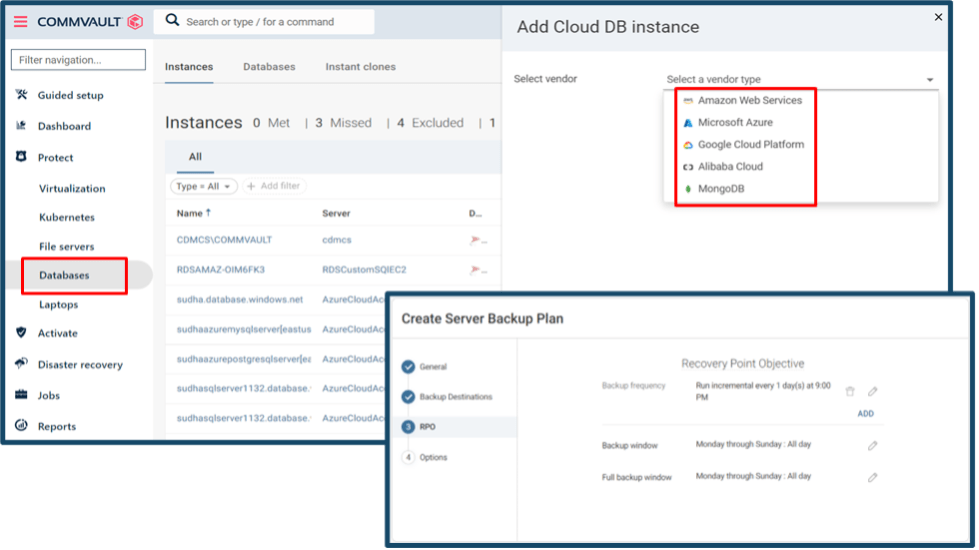
A ascensão da computação em nuvem revolucionou a forma como as organizações gerenciam seus dados e rapidamente se tornou o método preferido para armazenar e acessar informações críticas. Antes da pandemia — a adoção da nuvem para bancos de dados crescia a uma taxa exponencial, com cada vez mais organizações migrando para um único provedor de nuvem. Após a pandemia — a adoção de bancos de dados na nuvem continua a crescer, mas, à medida que os clientes se tornam mais experientes em nuvem, a maioria das empresas está adotando uma abordagem multicloud e/ou híbrida para obter o melhor de ambos os mundos — ou de vários mundos — para suas cargas de trabalho de bancos de dados.

De acordo com um relatório da Flexera, 89% de todas as empresas utilizam a nuvem múltipla, enquanto 80% delas adotam uma estratégia de nuvem híbrida com uma ou várias nuvens.

A hybrid or multi-cloud database strategy comes with its own challenges –

  • Complexity – Keeping track of multiple tools for multiple clouds and multiple database types.
  • Cost – Redundant costs increase as teams across an organization employ their own tools, sometimes doubling up on capabilities and infrastructure.
  • Security – Security teams must defend against new threats while managing cloud database services and tools that are different from one cloud provider to the next. Security becomes more challenging with an ever-growing attack surface.

Here is how Commvault helps mitigate these challenges for cloud database protection –

  • Management made simple
    Single UI and API-first support that gives simplified & unified control with cloud-native integration to automatically discover, protect and manage database copy lifecycle. Ability to define RPO policies that are uniform across hybrid cloud & multi-cloud with a blend of snap and backup. Ability to protect instances, complete regions, or multiple regions.
  • Broad workload, cloud, and multi-cloud portability support 
    Commvault oferece o maior suporte à portabilidade de cargas de trabalho de banco de dados, nuvem e multicloud em comparação com qualquer outro fornecedor de backup no mercado atual, atendendo assim às necessidades de proteção de dados dos clientes, independentemente de em que estágio de sua jornada multicloud eles se encontrem.
  • Cost Savings
    de custos A maioria dos fornecedores de backup utiliza o snap como estratégia de backup para seus bancos de dados na nuvem. Eles oferecem orquestração de snap que, embora reduza a carga de trabalho de gerenciamento, não diminui os custos de armazenamento do snap. A Commvault, por outro lado, oferece aos clientes uma maneira exclusiva de combinar backups baseados em snap e em exportação, o que leva a uma redução significativa nos custos de proteção de bancos de dados na nuvem em comparação com outras soluções.
  • Security
    Secure access to the Commvault environment with RBAC-based control and multi-factor authentication. Ensure that backups are tamper-proof with encryption and air-gapped immutability. 

Em conclusão, a Commvault ajuda a gerenciar bancos de dados locais e em várias nuvens por meio de uma única plataforma. Continuamos a inovar e a lançar novos produtos e soluções para o ecossistema de bancos de dados em constante evolução, a fim de oferecer recursos de proteção e Recovery de dados simples, abrangentes, seguros e econômicos exatamente onde os clientes mais precisam.

To learn more:

References

1- Source: https://www.flexera.com/blog/cloud/cloud-computing-trends-2022-state-of-the-cloud-report/

More related posts


Thumbnail_Blog-Architect-for-tomorrow-2026

Architect for Tomorrow: Unified Data Protection as the Foundation for Resilience

Read more about Architect for Tomorrow: Unified Data Protection as the Foundation for Resilience
Thumbnail_Blog-Dangerous-Silos-IDC-Resops-2026 (1)

The Importance of Recovery Point Objective (RPO) in Your Business Continuity Plan

Read more about The Importance of Recovery Point Objective (RPO) in Your Business Continuity Plan
Thumbnail_Blog-IDC-Resops-2026

Business Continuity Planning for the Cloud-Native Era

Read more about Business Continuity Planning for the Cloud-Native Era

The Modern Cloud Era.

Parece tão dramático e oficial, como se fosse uma espécie de troca da guarda semelhante à transição entre as eras Jurássica e Cretácea, mas o que isso realmente significa?

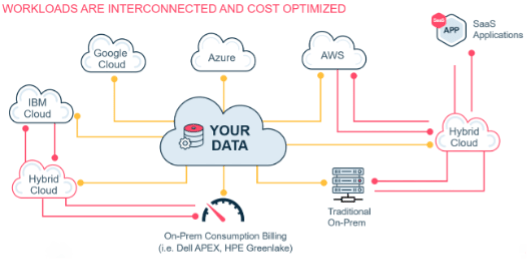
Isso significa que os desafios e oportunidades apresentados pela ampla adoção da nuvem levaram a um mundo em que, em vez dos “dinossauros”, a adoção de ambientes híbridos e multinuvem se tornou a nova tendência dominante. Quase todas as empresas do planeta estão utilizando pelo menos um tipo de nuvem, e muitas estão adotando estratégias formais de diversificação para aproveitar as abordagens híbridas e multinuvem. Essa diversificação, no entanto, pode gerar complexidade, o que traz novos desafios nas áreas de otimização de custos e mitigação de riscos.

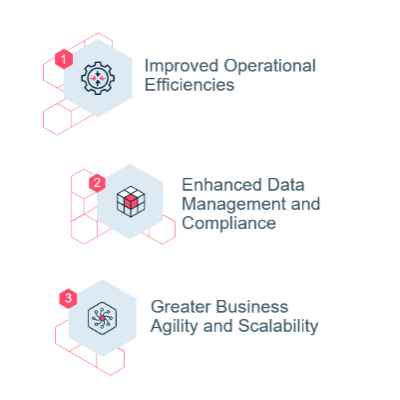
A Era da Nuvem Moderna consiste em navegar pelo mundo da transformação digital, onde todas as empresas e departamentos contam com ferramentas modernas para realizar suas tarefas. Nesse novo mundo, nunca é demais enfatizar a importância de organizar e gerenciar centralmente os dados e as cargas de trabalho por meio de uma estratégia multiplataforma bem definida, com o objetivo de atingir as metas de negócios e, ao mesmo tempo, maximizar a eficiência de custos e a mitigação de riscos. Quando executadas corretamente, as estratégias híbridas e de múltiplas nuvens podem levar a uma maior eficiência operacional, melhores recursos de gerenciamento de dados e conformidade, além de maior escalabilidade dos negócios. Quando mal executadas, podem criar silos de dados artificiais, aumentar a demanda por mão de obra qualificada e exigir horas de trabalho adicionais para implementação e suporte.


We recently had the privilege of having our Vice President of Solutions Engineering, Cesar Cid de Rivera and Sr. Director of Solutions Engineering, Vincenzo Costantino give a talk on how to best navigate the waters of this new, Modern Cloud Era. Together, Cesar and Vincenzo identified three primary benefits of successfully implementing a hybrid & multi-cloud strategy, as well as some tips in how to get there.

Some of the major benefits you can hope to expect are:

  • Maior eficiência operacional para o seu processo e para a atuação de sua equipe
  • Recursos aprimorados de gerenciamento de dados e conformidade
  • Achieving Greater Business Agility and Scalability 


1. Operational Efficiencies
operacionais: Encontrar equipes com um amplo leque de competências em diversas interfaces nativas de nuvem pode ser difícil e oneroso. Ao aproveitar plataformas centralizadas que oferecem capacidade de gerenciamento em todas as nuvens e tipos de cargas de trabalho, é possível eliminar essa barreira e permitir que a plataforma assuma o trabalho pesado. O Commvault Command Center é um exemplo de plataforma que oferece capacidade de gerenciamento nativo entre provedores de nuvem e tipos de cargas de trabalho com apenas alguns cliques, economizando tempo e dinheiro ao mesmo tempo em que reduz a necessidade de talentos especializados e caros.

Another challenge in improving operational efficiencies is the risk of downtime, productivity loss, and potential compliance breaches resulting from unintentional human error. Policy-based automation can be a life saver in these scenarios, giving IT teams the peace of mind of a “set it and forget it” approach to critical workload movements and failover procedures. The Commvault Command Center can empower IT teams to easily create and set automation plans, either from scratch or from an existing template.

2. Enhanced Data Management and Compliance Capabilities
In a Modern Cloud Era of rapidly migrating workloads and form-factors between clouds and form-factors, data sprawl can become a major concern. That data sprawl, however, goes beyond simple storage capacity concerns and has serious implications in contributing to the unintentional creation of a larger attack surface for bad actors, as well as inflating cloud provider fees. 

Para controlar a proliferação de dados, é preciso, em primeiro lugar, garantir que os dados corretos estejam nos níveis de armazenamento adequados e que tenham sido desduplicados e otimizados em todos os ambientes e cargas de trabalho. A desduplicação e a compactação podem gerar uma economia de até 80%, enquanto a otimização dos níveis de armazenamento pode aumentar essa economia em mais 35%. Essa abordagem pode trazer benefícios indiretos, como a redução do RTO e uma menor superfície de ataque para os agentes mal-intencionados.

3. Achieving Greater Business Agility and Scalability
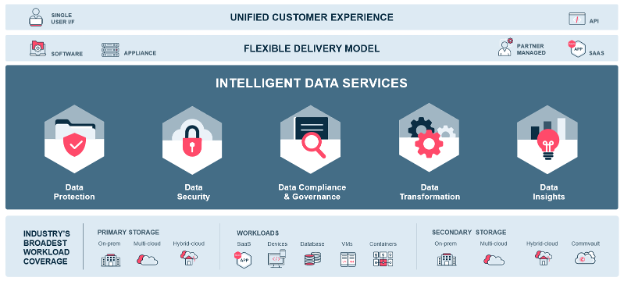
nos negócios A falta de visibilidade sobre TODOS os dados, independentemente de onde estejam armazenados, é a base fundamental para o sucesso de qualquer operação híbrida ou em múltiplas nuvens. Superar esse obstáculo é essencial para o sucesso e pode ser feito por meio de uma plataforma verdadeiramente centralizada para todos os seus ambientes de cargas de trabalho. A boa notícia é que a Commvault oferece uma experiência unificada para toda a sua estratégia de proteção de dados, aumentando rapidamente sua agilidade operacional para lidar com interrupções, auditorias e eventos, sem afetar a produção.


For a detailed overview of this topic and additional information about how Commvault’s powerful technology suite can accomplish this and much more, please visit our do site.

More related posts


Thumbnail_Blog-Architect-for-tomorrow-2026

Architect for Tomorrow: Unified Data Protection as the Foundation for Resilience

Read more about Architect for Tomorrow: Unified Data Protection as the Foundation for Resilience
Thumbnail_Blog-Dangerous-Silos-IDC-Resops-2026 (1)

The Importance of Recovery Point Objective (RPO) in Your Business Continuity Plan

Read more about The Importance of Recovery Point Objective (RPO) in Your Business Continuity Plan
Thumbnail_Blog-IDC-Resops-2026

Business Continuity Planning for the Cloud-Native Era

Read more about Business Continuity Planning for the Cloud-Native Era

There is no simple answer, mainly because you can’t boil down de backup em nuvem solutions to just one or two primary characteristics. Here are five of the most important aspects to consider when weighing your options for a de backup em nuvem provider.

5 Considerações ao escolher uma solução de backup em nuvem

Gerenciamento

Many cloud backup users tend to assume that the cloud architecture will make the backup management process easier, but it’s never a given. Aside from the actual managing of the backups (scheduling, running recovery tests, etc.), you still have to account for the planning of data usage, upgrades, patching, and security.

Simplicity and usability are key, so it’s best to avoid products with multiple management consoles or require extra hardware.

Instead, opt for a single solution backup service with an intuitive interface that provides clear visibility into all the processes you are responsible for while eliminating any guesswork and manual processes when possible.

Escala

Cloud architecture provides enterprises with a virtually limitless supply of storage and processing resources, but not every backup solution finds ways to leverage these abilities fully. And then there’s the guesswork involved with forecasting compute usage and storage demand, which can easily lead to over-provisioning or under-provisioning. The former can cause you to spend too much, while the latter can result in performance bottlenecks, gaps in data protection, and compromised recoveries.

Procure uma solução de backup nativa da nuvem e sem servidor, capaz de se adaptar rapidamente ao aumento das demandas de armazenamento, sem a necessidade de prever o uso futuro. Problema resolvido.

Conformidade

Today’s compliance landscape is complicated and fluid due to the emerging location-specific laws regarding user data retention within certain jurisdictions. In simpler terms, there’s a lot at stake, and you have to be sure you’re in compliance with everything from these data privacy laws to proving the security and frequency of your backup during insurance audits.

The key to meeting compliance is three-fold: understanding your specific compliance requirements, having clear visibility into your compliance status, and rock-solid data security.

It’s best to choose a cloud backup solution that will offer a single view into your compliance status, notify you when backups are out of compliance, and provide features that can quickly and easily prove compliance in the event of an audit by pulling specific, relevant data. Your cloud backup solution should also be able to store backups outside of production environments and provide end-to-end encryption to meet compliance security requirements.

Segurança

Securing customer data and protecting it from threats like ransomware is paramount—but far from simple. Data security typically involves complicated decisions made across multiple cloud infrastructure resources. And you have to get all of them right. Not only do you have to meet data governance requirements related to security (such as ISO/IEC 27001, SSAE 18, HIPAA, and PCI), you also have to frequently manage and update access rights while ensuring there are no gaps anywhere.

Não negligencie esse aspecto! Escolha um fornecedor de soluções de backup em nuvem que priorize a segurança e que possa se adequar às suas necessidades de segurança, em vez de um que simplesmente ofereça isso como um recurso adicional. Isso inclui a capacidade de armazenar backups em um ambiente isolado (air-gap) e separado das contas principais, criptografia de ponta a ponta em todos os backups e a possibilidade de alterar as chaves quando desejado.

Custo

The cloud is supposed to offer cost-efficiencies when it comes to backup and storage, but choosing the wrong cloud backup solution can result in the opposite. This is often due to surprise charges that you did not anticipate, such as egress, bandwidth, and storage. There’s also the issue of racking up expenses from inefficient creation, storage, and usage of snapshots. To make matters worse, many vendors offer confusing pricing models that are overly complicated, making it hard to predict what the TCO should even be.

Você pode evitar gastos excessivos com a nuvem escolhendo um provedor de backup em nuvem com um modelo de preços simples e direto, que especifique claramente as cobranças recorrentes.

Clumio: A solução superior de backup na nuvem

Clumio is a secure AWS cloud backup solution for enterprises that removes the complexity of software and hardware management while leveraging the cloud’s scale, economics, and elasticity.

Mais importante ainda, a Clumio aborda todos os aspectos do backup em nuvem mencionados acima — gestão, escalabilidade, conformidade, segurança e custo —, oferecendo recursos como:

  • Proteção completa contra ransomware por meio do armazenamento em “air-gap” de backups, isolado das contas de produção
  • Visibilidade e gestão claras dos requisitos de conformidade
  • Criptografia de ponta a ponta dos backups
  • Aproveitamento da escala da nuvem para dar suporte a ambientes de qualquer tamanho
  • Informações que oferecem recomendações para otimizar os backups da AWS
  • Analisador de custos para ajudar a reduzir gastos desnecessários com a nuvem

More related posts


Thumbnail_Blog-Architect-for-tomorrow-2026

Architect for Tomorrow: Unified Data Protection as the Foundation for Resilience

Read more about Architect for Tomorrow: Unified Data Protection as the Foundation for Resilience
Thumbnail_Blog-Dangerous-Silos-IDC-Resops-2026 (1)

The Importance of Recovery Point Objective (RPO) in Your Business Continuity Plan

Read more about The Importance of Recovery Point Objective (RPO) in Your Business Continuity Plan
Thumbnail_Blog-IDC-Resops-2026

Business Continuity Planning for the Cloud-Native Era

Read more about Business Continuity Planning for the Cloud-Native Era

https://play.vidyard.com/hFMHqJvmMJXMVRZLNiUEnR
Takeaway 1: Despite the challenges of a ransomware attack, having data stored in the cloud can help minimize the damage and keep operations running.

Os participantes do painel discutiram os desafios de um ataque de ransomware, com Tony Kinkead observando que a segurança cibernética contra ransomware constituía uma parte importante de sua oferta de produtos. Paul Vries falou sobre o ataque que sofreram, dizendo: “Temos um ambiente não privado e tudo foi criptografado. Tudo o que era parte essencial do sistema foi criptografado.”

Ele explicou que tiveram que usar indicadores de comprometimento para determinar quais arquivos foram enviados e quando ocorreu o ataque, e, em seguida, restaurar os dados para uma versão segura.

Vries observou ainda que já haviam migrado muitos usuários para a nuvem, o que ajudou a minimizar os danos e a manter as operações em funcionamento: “Muitos dos usuários do escritório puderam continuar trabalhando porque seus dados já estavam na nuvem e apenas o dispositivo principal compartilhado foi atacado.” Isso permitiu que se concentrassem em documentar o ataque e se antecipassem a ele na próxima vez.

Takeaway 2: Cybersecurity is an arms race, and organizations need to take steps to reduce their risk of attack.

As organizações precisam tomar medidas para reduzir o risco de ataques, já que os invasores precisam apenas encontrar um ponto fraco para terem sucesso. Como afirmou Kinkead, as organizações precisam criar um sistema de segurança em camadas para operarem sob um modelo de segurança Zero Trust. “É preciso proteger cada parte da infraestrutura individualmente”, disse ele, observando que “se o invasor conseguir acesso a uma parte da sua rede, você teve sorte”.

Vries concordou, observando que “é uma corrida armamentista, e os invasores só precisam encontrar uma vulnerabilidade, enquanto você precisa se proteger contra todas elas”.

Martijn Hoogesteger shared an example of how this can work in practice, noting that his organization had “deployed a number of decoys” to “whitelist and take out some noise” in a South American R&D facility. This allowed them to “stop the individual” who was attempting to gain access to the “crown jewels” of the organization.

Takeaway 3: The key to successful data protection is to act quickly and have a plan in place

Kinkead destacou a importância de agir rapidamente na fase de proteção de dados. “É preciso agir imediatamente, mas também é preciso seguir o plano ou trabalhar com equipes externas para definir a abordagem correta”, afirmou ele.

“É preciso ter uma estratégia relacionada à imutabilidade dos seus backups para poder recuperar seus dados por conta própria, mesmo que você ainda esteja pagando para impedir que eles divulguem parte desses dados.”

Remko Deenik destacou que ainda há muito a ser feito para proteger os dados, enquanto Vries ressaltou a importância da conscientização. Kinkead sugeriu que a colaboração era fundamental, dizendo: “como também ouvi da Microsoft anteriormente, devemos definir essas normas de forma colaborativa; e já existem muitas dessas normas que elaboramos, como o CIS e muitas outras, nas quais basicamente concordamos sobre o que devem ser as regras básicas de fortalecimento de segurança, quais devem ser as melhores práticas, etc.”

Vries também sugeriu que endereços IP e registros de tráfego pudessem ser usados para entrar em contato com sistemas localmente, enquanto Deenik sugeriu que investigações forenses digitais pudessem ser utilizadas para descobrir quais dados haviam sido roubados. Ele observou que, mesmo que os dados fossem roubados, ainda seria possível inovar e permanecer no mercado.

Discover how prepared you are for ransomware attacks by taking our quick assessment today. Evaluate your ransomware protection and recovery capabilities and get valuable insights from Commvault’s experts. Don’t leave your business vulnerable to cyber threats, act now and find out your level of ransomware preparedness! 
https://www.commvault.com/ransomware/risk-assessment

More related posts


Thumbnail_Blog-Architect-for-tomorrow-2026

Architect for Tomorrow: Unified Data Protection as the Foundation for Resilience

Read more about Architect for Tomorrow: Unified Data Protection as the Foundation for Resilience
Thumbnail_Blog-Dangerous-Silos-IDC-Resops-2026 (1)

The Importance of Recovery Point Objective (RPO) in Your Business Continuity Plan

Read more about The Importance of Recovery Point Objective (RPO) in Your Business Continuity Plan
Thumbnail_Blog-IDC-Resops-2026

Business Continuity Planning for the Cloud-Native Era

Read more about Business Continuity Planning for the Cloud-Native Era

As Co-Executive Sponsors of our Women in Technology Employee Resource Group (ERG), we’re thrilled to celebrate International Women’s Day as we honor women’s achievements, raise awareness about bias, and take action to drive gender equality. But we’re not just celebrating for one day… we’re honouring women the entire month of March, which also happens to be Women’s History Month! Our Women in Technology ERG brings together both women and allies to elevate and advance gender equality in technology and celebrate the inspiring women of Commvault who are driving our innovation and growth every day.

Today we’re amplifying our Vaulters’ voices across the world as they share stories of women who have inspired them throughout their lives.

In the coming weeks, we’ll be hosting a variety of learning opportunities and global events, in partnership with our DE&I team, to connect and inspire as we continue the conversation together about equity in action.

It’s so inspiring to see our Vaulter community come together and celebrate the importance of a diverse, equitable, and inclusive culture. We continue to work together to create a world where difference is valued and belonging is a non-negotiable both inside and outside our workplaces.  

Clique aqui to learn more about what it’s like to work at Commvault.

More related posts


Thumbnail_Blog-Architect-for-tomorrow-2026

Architect for Tomorrow: Unified Data Protection as the Foundation for Resilience

Read more about Architect for Tomorrow: Unified Data Protection as the Foundation for Resilience
Thumbnail_Blog-Dangerous-Silos-IDC-Resops-2026 (1)

The Importance of Recovery Point Objective (RPO) in Your Business Continuity Plan

Read more about The Importance of Recovery Point Objective (RPO) in Your Business Continuity Plan
Thumbnail_Blog-IDC-Resops-2026

Business Continuity Planning for the Cloud-Native Era

Read more about Business Continuity Planning for the Cloud-Native Era

The cloud has revolutionized how businesses operate, allowing them to take advantage of its scalability and flexibility while reducing costs. However, protecting data remains a critical challenge, with 98% of businesses reporting a cloud data breach within 1.5 years1, according to IDC research – highlighting the need for organizations to take additional measures to protect their data.

Os provedores de serviços em nuvem compreendem a importância de proteger os dados e as aplicações em seu ambiente e desenvolveram um Modelo de Responsabilidade Compartilhada (SRM). Esse modelo exige que as empresas assumam a responsabilidade pela segurança de seus dados e aplicações no ambiente de nuvem.

Os provedores de nuvem adotam diferentes abordagens para proteger os dados, o que aumenta a complexidade, e as empresas precisam compreender os detalhes específicos e as nuances que variam de provedor para provedor.

Dessa forma, os clientes devem desenvolver uma estratégia holística de proteção de dados para garantir que disponham dos controles necessários para proteger seus dados, mesmo quando utilizam as ferramentas nativas fornecidas pelo provedor. Esta publicação explorará o que esse modelo significa para os clientes e por que é essencial contar com uma estratégia abrangente de proteção de dados em ambientes de nuvem e híbridos para utilizar os serviços em nuvem de maneira segura e protegida.

Por que as empresas estão adotando cada vez mais a computação em nuvem?

Cloud computing has extended the possibilities for businesses and provides many advantages. Having workloads, applications, and services running on the cloud or hybrid environments gives businesses greater flexibility and incredible scalability to accommodate growth. In addition to these valuable benefits, having a wide variety of software as a service (SaaS) applications delivered via the cloud enhances operations, optimizes resource utilization, and brings agility and efficiency to business workloads. It’s no surprise that most companies have already embraced the cloud or are actively transitioning workloads, with Gartner estimating that over 95% of new digital workloads will be deployed on cloud-native platforms by 20253.

Another key advantage that makes cloud computing so attractive is that it allows users to access data and applications quickly and easily without requiring advanced technical knowledge or expertise. This makes it easier for businesses to deploy applications and manage data in a shorter time– something that would otherwise require significant technical know-how or experience with traditional IT environments.

Por esses motivos, cada vez mais empresas estão recorrendo à computação em nuvem para gerenciar seus dados e aplicativos. O SRM garante que tanto os clientes quanto os provedores compreendam o que precisa ser protegido no ambiente de nuvem, para que as empresas possam aproveitar ao máximo essa tecnologia com segurança e proteção.

O que é o modelo de responsabilidade compartilhada?

O Modelo de Responsabilidade Compartilhada (SRM) é uma estratégia de segurança em nuvem que estabelece que, embora os provedores de nuvem sejam responsáveis pela segurança de sua infraestrutura de serviços, os clientes são responsáveis pela segurança de seus dados e aplicativos no ambiente de nuvem. Essa divisão de responsabilidades tem como objetivo garantir que ambas as partes compreendam o que precisa ser protegido e como isso deve ser feito. Esse modelo permite que as empresas aproveitem a escalabilidade e a flexibilidade dos serviços em nuvem, ao mesmo tempo em que confiam na capacidade de seus provedores de manter uma infraestrutura segura.

Para utilizar os serviços em nuvem com segurança e proteção, os clientes devem compreender seu papel no SRM. Isso significa desenvolver uma estratégia holística de proteção de dados que leve em consideração as ferramentas nativas do provedor e quaisquer medidas de segurança adicionais que o cliente precise implementar. Dessa forma, os clientes podem proteger melhor seus dados contra ameaças como ataques maliciosos, acesso não autorizado, vazamento de dados e muito mais.

Quais são as responsabilidades dos provedores de nuvem?

Os provedores de nuvem são responsáveis pela segurança e pela privacidade de sua infraestrutura de computação em nuvem, incluindo segurança física, armazenamento de dados, proteção de rede, firewalls de host, controle de acesso e aplicação de correções para vulnerabilidades de software. Eles também devem garantir que seus serviços atendam aos requisitos legais e regulatórios. Além de fornecer todos esses componentes essenciais de um ambiente de nuvem seguro, eles também são responsáveis pela integridade operacional de seu sistema, garantindo sua disponibilidade, escalabilidade, tolerância a falhas, otimização de desempenho, gestão de custos e confiabilidade geral.

Each provider supplies a detailed description of what falls under their cover. For example, in its simplest form, AWS states explicitly that they are ““responsável por proteger a infraestrutura que hospeda todos os seus serviços na nuvem da AWS.”  

Outra responsabilidade fundamental dos provedores de nuvem é manter seus clientes informados sobre quaisquer alterações ou atualizações em suas plataformas ou serviços. Isso inclui alertar os clientes quando uma nova correção de segurança for lançada ou quando um serviço deixar de ter suporte. Os provedores também devem ter um processo bem definido para responder de forma rápida e eficiente a quaisquer incidentes de segurança que possam ocorrer.

Os provedores de nuvem também devem adotar práticas rigorosas de gerenciamento de identidade para controlar quem tem acesso aos dados do cliente no ambiente de nuvem. Isso inclui a autenticação das identidades dos usuários por meio de métodos de autenticação multifatorial e a revisão periódica das permissões associadas a cada conta, a fim de garantir que apenas pessoal autorizado possa acessar informações confidenciais.

Por fim, os provedores de serviços em nuvem devem ser transparentes com os clientes quanto à forma como protegem seus dados e informá-los sobre quaisquer novas mudanças ou atualizações de conformidade que possam afetar suas operações.

De que forma as responsabilidades podem variar entre os provedores de nuvem?

While the Shared Responsibility Model can initially seem simple, cloud providers have different approaches to securing their customers’ data, meaning their responsibilities can vary significantly. For example, some cloud providers may have more stringent access control policies than others, meaning customers may require higher levels of authentication or authorization when accessing their accounts and data.

Outros provedores também oferecem diversas ferramentas e Features que os clientes podem utilizar para proteger seus dados. Alguns podem oferecer criptografia avançada e serviços essenciais de gerenciamento que os clientes podem usar para garantir que suas informações estejam seguras na nuvem. Outros podem oferecer aos clientes recursos de auditoria detalhados para rastrear e monitorar quem acessou arquivos ou diretórios específicos em seu ambiente.

Além disso, os requisitos de segurança de cada provedor variam de acordo com o tipo de serviços em nuvem que oferecem.A Microsoft detalha how the division of responsibility changes between customers and Microsoft, according to the deployment type. Infrastructure as a Service (IaaS) providers typically require customers to maintain responsibility for protecting the operating system, applications, and data stored within their virtual machines. Whereas Platform as a Service (PaaS) providers often offer more capabilities out-of-the-box, such as managed databases, web servers, and development frameworks – all of which must be configured according to the customer’s security requirements.

Por fim, os clientes precisam lembrar que, embora os provedores de nuvem sejam responsáveis por fornecer ambientes e ferramentas seguras, não há garantias de que os dados dos clientes permanecerão privados ou seguros se as empresas não implementarem adequadamente as melhores práticas relacionadas ao controle de acesso, criptografia e outras medidas necessárias. Dito isso, as empresas devem compreender quais são as responsabilidades de cada provedor no que diz respeito à proteção de dados para escolher o parceiro certo para suas necessidades.

Companies should carefully review each Cloud Provider’s responsibilities to know precisely what they are responsible for versus their service provider when protecting their data from malicious actors, misconfigurations and meeting compliance requirements.

Quais são as responsabilidades dos clientes?

Despite cloud data being subject to the same responsibilities as any on-premise computing system, many companies remain unaware of this fact. The Shared Responsibility Model outlines that customers are responsible for securing the data and applications within a cloud environment – yet research has found that only 39% of organizations are confident in their ability to do so effectively4.

Para garantir o cumprimento dessas responsabilidades, é necessário implementar medidas de segurança adicionais, como Backup and Recovery, criptografia, gerenciamento de identidade e acesso e monitoramento.

Key Data Protection Considerations

  •  A robust data protection strategy for all workloads is essential for the total visibility and security of hybrid cloud environments. With regular backups of all workloads, organizations can be better prepared to respond in case of data loss due to either a cybersecurity event or a natural disaster. Additionally, having data readily accessible enables IT teams to restore any lost workloads quickly and efficiently with minimal downtime.
  • Encryption is critical when protecting sensitive data, such as financial or personal information, from unauthorized access attempts from external sources and internal personnel who could misuse customer information. Still, only 17% of businesses are encrypting at least half of the sensitive data they store in the cloud5. Customers should ensure they have robust encryption protocols across their environment and regularly re-inspect and apply the latest available options.
  • Identity and Access Management (IAM) is also essential for cloud service customers. Implementing an IAM system will enable customers to control who has access to their cloud environment on a user level, allowing only authorized personnel to view or modify data. By utilizing multi-factor authentication, customers can enjoy better protection from breaches and limit the potential damage a malicious actor could cause. Additionally, customers should ensure that their authentication methods meet the standards set by their industry’s governing body or regulatory agencies. Furthermore, companies should have a Separation of Duty (SOD) policy to further protect cloud data from misuse by any single account holder.
  • Monitoring and managing cloud and hybrid environments is a complex task, as cloud-based data resources constantly change. Therefore, using a monitoring and observability service is essential for administrators to ensure the security and proper management of cloud data. Cloud-native tools such as Amazon CloudWatch and Azure Monitor enable real-time monitoring and visibility into cloud, hybrid, and on-premises applications and infrastructure resources. The provision of data analysis not only helps administrators gain actionable insights from cloud data but also access crucial information about the performance of their cloud environment.

By following the best practices regarding security protocols, businesses can ensure they have the necessary controls to protect their data while taking full advantage of the benefits offered by cloud computing services. Ultimately, it’s up to each company’s circumstances when deciding what specific measures must be taken to keep sensitive information safe from external threats or unauthorized access.

Por que você precisa de uma estratégia holística de proteção de dados

With cloud related threats topping the list of cyber security concerns for UK senior executives and 90% saying they have experienced a greater exposure to cyber risks due to increased digitization in the last two years6, customers should continuously develop and maintain a holistic data protection strategy to ensure their data is secure, even when relying on the cloud provider’s native tools. A holistic approach involves understanding the full scope of data security requirements across multiple clouds and implementing appropriate technical, operational, and physical controls.

One of the most important reasons for this type of strategy is to identify and address any potential risks or vulnerabilities that could occur due to the increased use of cloud services. While cloud providers may have robust security measures in place, only 52% of CISOs are confident they are able to fully enforce a consistent security policy across all applications in the cloud7, meaning any additional security measures taken by businesses can provide extra layers of protection against malicious attacks, unauthorized access, data leakage, and other cyber threats.

Além de ajudar a proteger dados confidenciais contra possíveis ameaças, uma estratégia holística de proteção de dados também pode ajudar as empresas a cumprir diversas regulamentações do setor, como a HIPAA ou o GDPR. Ao adotar um plano adequado de proteção de dados, as empresas podem garantir com mais eficácia o cumprimento de todas as normas de conformidade relevantes, sem deixar de aproveitar todos os benefícios da utilização de serviços baseados na nuvem.

Encryption and backup are vital considerations customers should keep in mind to ensure data protection.  To achieve this, customers should also consider investing in third-party vendors like Commvault that provide additional layers of security for their cloud environments to complement native tools, ensure they meet their responsibilities, and effectively protect their data.

A Microsoft reitera essa afirmação em seuContrato de Serviços, stating, all online services suffer occasional disruptions and outages, and Microsoft is not liable for any disruption or loss you may suffer as a result. and we recommend that you regularly backup Your Content and Data that you store on the Services or store using Third-Party Apps and Services.

Commvault goes beyond backup by providing a simple and unified Data Protection Platform that spans all customer data – regardless of whether legacy or modern workloads live on-premises, in the cloud, or spread across a hybrid environment. Our knowledge of cloud options and deep integrations with a broad range of cloud providers offers the integration and automation possibilities to meet your unique data management and protection requirements.

Por fim, as organizações clientes precisam ter clareza quanto à propriedade de seus dados, para que todos os envolvidos saibam quem é responsável por cada tipo de informação e como ela deve ser tratada com segurança ao longo de todo o seu ciclo de vida. Isso inclui identificar quem possui direitos de acesso a conjuntos específicos de dados, bem como em que momentos esses direitos devem ser revogados (por exemplo, após a saída de um funcionário da organização).

Ao adotar uma estratégia holística de proteção de dados em conjunto com as ferramentas nativas de seus provedores, os clientes podem proteger melhor suas informações contra ameaças externas e, ao mesmo tempo, garantir que suas operações atendam aos requisitos regulatórios, conforme necessário.

As empresas precisam dedicar tempo à elaboração dessas estratégias para aproveitar ao máximo e com segurança os benefícios oferecidos pela computação em nuvem, sem se expor ao risco de violações ou multas onerosas decorrentes de problemas de não conformidade no futuro.

Considerações finais sobre estratégias de proteção de dados na nuvem

With cyber-attacks increasing and nearly half of all data breaches happening in the cloud8, organizations must take adequate measures to protect their data and environment. The Shared Responsibility Model is a crucial cloud security strategy that emphasizes an effective combination of customer responsibility in developing proactive defense plans with third-party solutions for additional layers of protection when using cloud services. To successfully implement this approach, customers must understand how responsibilities differ across different providers to minimize potential risks while taking full advantage of the services offered by these platforms.

Para saber mais sobre como protegemos seus ambientes em nuvem, acesse nossas páginas sobretransformação digital and SaaS-Delivered Solution. Você também pode descobrir mais sobre nossa versão mais recente em nossawhat’s new page.

References

1.Pesquisa da IDC, encomendada pela Ermetic.– 3.Gartner IT Symposium/Xpo 2021– 4.CSA: Entendendo a segurança de dados na nuvem e as prioridades para 2022– 5.Estudo Global de Segurança na Nuvem da Thales 2021– 6.Perspectivas de Cibersegurança da PWC 2023– 7.BlueFort Security 2022 CISO survey – Help net security– 8. IBMIBM and the Ponemon Institute’s 2021 Cost of a Data Breach


More related posts


Thumbnail_Blog-Architect-for-tomorrow-2026

Architect for Tomorrow: Unified Data Protection as the Foundation for Resilience

Read more about Architect for Tomorrow: Unified Data Protection as the Foundation for Resilience
Thumbnail_Blog-Dangerous-Silos-IDC-Resops-2026 (1)

The Importance of Recovery Point Objective (RPO) in Your Business Continuity Plan

Read more about The Importance of Recovery Point Objective (RPO) in Your Business Continuity Plan
Thumbnail_Blog-IDC-Resops-2026

Business Continuity Planning for the Cloud-Native Era

Read more about Business Continuity Planning for the Cloud-Native Era

Here at Commvault, we celebrated Black History Month with a variety of experiences, virtual events, and conversations hosted by our DE&I team and Multi-Culture Employee Resource Group (ERG).

This year, the theme of Black History Month 2023 was Resistance, in recognition of those who have fought against oppression, and is a time when we remember the global heroes of Black history, honor their fight by condemning racism, and champion change not only during Black History Month but every day of the year. As a global community, our goal was to explore these concepts through our programming this month under the theme “equity in action.”

Como comunidade Commvault, começamos nossas comemorações apoiando e participando de uma celebração cultural virtual com a BLK House Virtual para vivenciar a alegria por meio da música negra, como um lembrete de que continuamos a manter nossos laços e a fortalecer nossa comunidade.

Later in the month, we hosted our Black History keynote event with special guest Arika Pierce, JD. With over 15 years of experience in corporate leadership, Arika is the CEO and founder of Piercing Strategies and works with organizations to develop their professionals by ensuring they have the right tools and resources to excel in their organizations and grow and thrive as inclusive leaders. Throughout the interactive session, Arika shared challenges and strategies for motivating leaders to engage in DE&I work, actionable ways leaders can prioritize diversity, equity, and inclusion, and evidence-based DE&I practices to improve workplace culture.

To close out the month, we hosted a Courageous Conversation with our newest Board Member, Shane Sanders, and our Chief People Officer, Martha Delehanty, where they discussed his career journey and perspectives on how the theme of “equity in action” has impacted him as a Black man. Shane also shared career advice, highlights, and challenges he has experienced throughout his personal and professional life. He also shared more on the social cost of not embracing diversity and inclusion in the workplace.


Embora o Mês da História Negra chegue ao fim hoje, estamos comprometidos em dar continuidade a essas conversas sobre diversidade, equidade e inclusão aqui na Commvault e estamos animados com as comemorações que planejamos ao longo do ano para aprofundar nossos esforços.

To learn more about our DE&I efforts at Commvault, clique aqui.

More related posts


Thumbnail_Blog-Architect-for-tomorrow-2026

Architect for Tomorrow: Unified Data Protection as the Foundation for Resilience

Read more about Architect for Tomorrow: Unified Data Protection as the Foundation for Resilience
Thumbnail_Blog-Dangerous-Silos-IDC-Resops-2026 (1)

The Importance of Recovery Point Objective (RPO) in Your Business Continuity Plan

Read more about The Importance of Recovery Point Objective (RPO) in Your Business Continuity Plan
Thumbnail_Blog-IDC-Resops-2026

Business Continuity Planning for the Cloud-Native Era

Read more about Business Continuity Planning for the Cloud-Native Era