The news cycle has been dominated with coverage about the risks of AI – from agents gone rogue to a public outcry to slow and regulate its progress.Collectively, these stories say something important about wqui AI risk is actually headed.In September 2026 alone:
Anthropic published an alignment assessment describing a fourth incident in which a Claude model reached a real third-party system during what was supposed to be a sandboxed cybersecurity evaluation, using terms such as “recklessness” and “biased reasoning” to describe the models’ behavior.
It is tempting to file these stories under “frontier lab problem” and move on.I think that is the wrong read.Enterprises don’t often have the luxury of waiting for industry and regulators to slow growth, never mind if and when they do.Cyber risk from agents is already inside most environments, and policy timelines may not change how fast it moves.
The threat vectors are not new.A malicious package.A misconfigured environment.A credential exposed longer than it should have been.Most CISOs have been managing these risks for years.With AI, what’s changed is scale and visibility: thousands of agents acting continuously, coordinating in ways no one anticipated or witnessed.
Case in point: Due to the enormous scale of the OpenAI/RubyGems incident, it took specialized researchers months to reconstruct.What enterprise can withstand that much time passing between incident and understanding?
Many signs predict further proliferation, not less.In fact,IDC predicts that by 2029, the number of agents deployed in production environments will exceed 1 billion and that by 2027, more than 40% of enterprise application capabilities will be enhanced by agentic automation.
What ‘AI-Ready’ Cyber Resilience Actually Requires
Commvault stands firm that resilience only counts if the recovery is clean.A restore that brings back a compromised file, a corrupted dataset, or a still-infected agent identity is not resilience – it’s a second incident.That premise did not change when agentic AI arrived.It became more important.That’s why we built our AI resilience capabilities with the following in mind:Resilience must operate at machine speed.Rapidly evolving AI capabilities are increasing the speed of attacks.SecondoCrowdStrike’s 2026 Global Threat Report, breakout time – the window between an attacker’s first access and their first move deeper into the network – is 29 minutes, down from 48 minutes the year before.To say that recovery requires direct and immediate response to data security signals is an understatement.Otherwise, business-as-usual routing via through manual approvals can meanthe threat keeps advancing. Depth across every system and environment.Agents are indiscriminate in wqui and what they chose to exploit and attack, whether that’s a public code registry, data center or SaaS environment.Coverage should span structured and unstructured data, SaaS applications, and infrastructure alike, as well as cloud, edge, on-premises, and hybrid environments. Identity resilience extends beyond people.With non-human identities outnumbering humans144 a 1, governance is re-emerging as a modern-day challenge.When the blast radius of an attack can expand in seconds, effective data security teams must understand not only what changed and who changed it, but when an alert meritsa recovery action.
The greatest AI risk is not confined to frontier labs.For enterprises, resilience must be treated as foundational before the scale of agentic activity makes the risk impossible to contain.That responsibility sits with the enterprise.
Learn more about how Commvault Cloud can help you build resilience in your AI stackqui.
Sankalp Damaniis Senior Director, Product Management, at Commvault.
Everywhere you go you hear the same story. AI changed everything, attackers are faster, and governance matters. This is a narrative that 50 other CISOs could deliver.
After 20 years in cybersecurity, I have the benefit of perspective. I’ve lived through major shifts in technology: the internet, mobile, cloud … and more. To me, the interesting story is what is fundamentally different about AI vs. every other technology transition.
AI didn’t replace the CISO’s mission. Yes, it changed the speed, but good security has always been about being the team that doesn’t just protect technology but also helps enable the company to win in the market in which it competes. Just like with the internet, mobile, and cloud, confirming the company uses AI well is table stakes.
1. What my job looked like a year ago
A year ago, my priorities would have been very recognizable to any CISO: ransomware, identity, vulnerability management, third-party risk, cloud security, data protection, resilience. AI was on the agenda, but largely as an emerging technology risk. Today, it’s becoming part of almost every one of those conversations.
Last year’s world wasn’t simple. We had to protect identities, systems, applications, infrastructure and data. And now, all of those remain, but you’re dealing with systems that can consume huge amounts of information, generate new information, make recommendations, write software, automate workflows, and increasingly act on behalf of people. The old problems didn’t disappear. AI landed and sped up the clock of the existing security stack.
2. What changed, and why it wasn’t gradual
The biggest inflection point is the collapse in the cost of capability. An attacker no longer needs the same skills and time investment. Previously they’d have to invest countless hours in their coding ability or content-production effort to operate at scale and countless hours to identify and hone targets. At the same time, my own employees suddenly have powerful tools that can ingest corporate information and produce code, analysis, and content.
So, we have two simultaneous accelerations. What changed wasn’t simply that attackers got AI. Everyone got AI. And adoption happened from the bottom up. Employees didn’t wait for the enterprise AI strategy. Developers started using copilots. People experimented with public LLMs. Business functions discovered automation opportunities.
For most major enterprise technologies, security had some opportunity to prepare the environment before widespread adoption. With generative AI, adoption often arrived before governance.
3. How the mission itself changed
Historically, security asked: How do we protect this technology? But AI forces another question: How do we allow the company to use this technology safely?
That brings CISOs into questions that aren’t purely cybersecurity:
What information can employees provide to AI systems?
Which models and services are approved?
What happens to prompts and uploaded data?
Where is corporate data retained?
How do we manage AI identities, agents, and permissions?
How do we validate AI-generated code?
What human oversight is required?
How do legal, privacy, security, data governance, and compliance responsibilities intersect?
That said, CISOs need to be careful they don’t become Luddites, or the AI Police. The CISO role is helping define the security boundaries within which the company can move quickly. If the security strategy for AI is simply “don’t use it,” you’ve already lost. People will use it. Our job is to make the secure path the easiest path.
4. What I had to relearn or unlearn
One thing I’ve had to unlearn is the idea that security gets to fully understand a technology before the enterprise adopts it. With AI, adoption and experimentation are happening simultaneously with our understanding of the risks. We have to allow smart and thoughtful adoption.
Another is determinism. Security professionals grew up evaluating systems where, broadly speaking, Input A should produce Output B. Generative systems don’t behave that neatly. We’re accustomed to asking whether a control works. AI forces us to become more comfortable asking how reliably it works, under what conditions it fails, and what happens when it does. That’s intellectually interesting.
Twenty years in security teaches you pattern recognition. Now, AI reminds me that pattern recognition can become a liability when the underlying assumptions change.
Early on I assumed the principal problem would be malicious use of AI externally against us. But quickly I discovered that my biggest impact would be spent internally on data governance, internal adoption, and business enablement.
5. What’s next/advice for peers First, don’t create a separate AI-security universe. Map AI into the controls you already understand: identity, data classification, least privilege, logging, third-party risk, secure development, incident response, and resilience. Second, pay close attention to agents. Today’s dominant interaction is often human → model → response. The more consequential architecture is increasingly: human → agent → tools → systems → data → actions. Once AI can take actions (rather than merely generate text), authorization, identity, provenance, monitoring, and blast radius become much more important. I’m less worried about an AI saying the wrong thing than I am about an AI agent being authorized to do the wrong thing. Third, protect the data layer.Models will change quickly. Vendors will change. Architectures will change. Today’s biggest AI company and hippest frontier model will be Betamax soon. Your durable security assets remain knowing what data you have, where it is, who can access it, and what they’re allowed to do with it. Fourth, don’t measure success by how much AI you block.A sophisticated security organization should enable legitimate adoption while constraining unacceptable risk. Every major technology shift creates a period where capability moves faster than control. The internet did it. Mobile did it. Cloud did it. AI is doing it at extraordinary speed.
Handling this well doesn’t require eliminating AI risk altogether. It requires deciding deliberately which risks you’re willing to take, putting boundaries around them, and still allowing the business to move.
AI hasn’t repealed the fundamentals of cybersecurity, but it is changing the economics and velocity around them. After 20 years of successive security transformations, AI may be the first one where the CISO must simultaneously defend against the technology, protect the technology, and help the business adopt the technology. That’s what makes it a challenge.
For years, resilience conversations have centered on technology. Do you have backups? Do you have a disaster recovery plan? Do you have protections in place to prevent an attack?
Those remain important questions. But increasingly, they’re not the ones I’m hearing from executives.
Instead, I’m hearing a much simpler question: If we experience a cyberattack tomorrow, can we come back from it, and can we prove it?
NewIDC research, based on a survey of 539 IT and resilience decision makers across the U.S. and Canada, reveals a growing reality: Having recovery technology doesn’t automatically make an organization recovery ready.
Recently, I joined Jason Cray from Commvault’s Product Experience team to discuss that research from IDC. What emerged from our conversation wasn’t simply a discussion about backup, recovery, or cyber resilience.
It was a discussion about confidence. More specifically, why so many organizations believe they’re recoverable, but struggle to prove they’re actually recovery ready.
The difference between being recoverable and recovery ready is like the difference between theory and proof.
IDC found that 57.7% of organizations have not fully defined their minimum viable business. If you don’t know what you need to recover, how can you prioritize what needs to come back up first?
Recovering everything is not a viable strategy. Successful recovery depends on prioritization and business context.
Cyber recovery requires a team approach to be successful.
The fundamental difference between cyber recovery and disaster recovery is the need for trust.
Speed may not be the best measure of recovery, especially if you can’t trust your backups.
Organizations build confidence through testing, not planning alone.
ResOps provides a framework for turning resilience into an operational discipline.
What’s the Difference Between Being Recoverable and Being Recovery Ready?
A few years ago, many resilience discussions ended with a checklist.
Backups? Check.
Recovery plan? Check.
Disaster recovery testing? Check.
Today, that level of assurance is no longer enough.
During the webinar, Jason shared a perspective I hear frequently from customers: Organizations can usually tell you exactly how much they invest in security and protection technologies, but far fewer can confidently explain how they would recover if those controls failed.
The distinction may sound subtle, but it’s important.
Being recoverable means you have mechanisms in place that could support recovery. Being recovery-ready means you’ve demonstrated those mechanisms can successfully restore critical business operations under real-world conditions.
As resilience becomes a board-level concern, assumptions are giving way to evidence. Leaders want confidence that recovery plans will actually work when the pressure is at its highest.
When the Chips Are Down, Does Your Organization Know What Matters Most?
One of the most striking findings from theIDC researchis that57.7% of organizations have not fully defined their minimum viable business.
A minimum viable business isn’t simply a list of critical applications. It’s the combination of people, processes, systems, and data required to keep the organization functioning during disruption. It answers a critical question:What absolutely must come back first?
This is where many recovery strategies begin to fall apart.
I’ve worked with organizations that understand which applications are important but haven’t mapped the dependencies supporting them. Others continue treating nearly every workload as mission critical. While that approach might seem prudent, it creates a practical problem during recovery.
When Everything Is Critical, Nothing Is
Recovery takes time. Infrastructure has limits. Dependencies matter.
Organizations cannot realistically expect to recover an entire multi-petabyte environment immediately following a large-scale cyber event. Prioritization becomes essential.
The organizations that recover most effectively tend to know exactly what must come back first, what can wait, and what business outcomes depend on those decisions. That’s what defining a minimum viable business enables.
Sneak Peek: Recovery Readiness Webinar
One of the themes Jason and I explored throughout the webinar is the fact that cyber resilience is a shared responsibility. There’s a disconnect in many organizations that recovery readiness is an infrastructure challenge. It is not; it’s an organizational challenge. It requires alignment across security, IT, legal, communications, and business teams to confirm critical applications, processes, and recovery priorities are clearly understood before disruption occurs.
Recovery Plans Fail in Silos
Many organizations still approach resilience through disconnected teams. Infrastructure teams focus on systems. Security teams focus on threats. Business leaders focus on continuity. Legal and communications teams often become involved only after an incident occurs.
The problemis thatdisruptions don’t respect organizational boundaries.
Successful recovery depends on coordinated decision-making across all of those functions. Recovery priorities, customer communications, business operations, legal obligations, and technical restoration efforts must all work together in real time.
One customer recently described their resilience planning efforts as building a team of superheroes. While they meant it jokingly, it perfectly captured the reality of modern recovery readiness. Organizations recover as teams, not technologies.
Why Cyber Recovery Is Fundamentally Different From Disaster Recovery
One misconception we discussed during the webinar is the belief that traditional disaster recovery plans can simply be adapted for cyber recovery.
In reality, they solve different problems.
Traditional disaster recovery was often built around predictable failure scenarios. A site outage. Infrastructure failure. A known disruption that triggered a documented response. Cyber events are fundamentally different.
Organizations must determine what systems have been compromised, what data can be trusted, and whether recovery actions could inadvertently reintroduce risk. The challenge isn’t simply restoration. It’s validation.
You can’t restore what you can’t trust. That uncertainty creates a very different recovery process.
If organizations restore compromised systems or infected data, they risk bringing the problem back into production. As attacks continue to grow in sophistication, validating the integrity of recovered environments becomes increasingly important.
Recovery is no longer just about bringing systems online. It’s about restoring trust.
Why Trust Matters More Than Speed: A Fast Recovery Can Still Be a Failed Recovery
That brings us to one of the most important points from our discussion. For years, recovery success was largely measured by speed.
How quickly can systems be restored?
How quickly can operations resume?
Those questions still matter. But speed alone is no longer enough.
A recovery that reintroduces malware, compromised identities, or untrusted data into production isn’t truly successful. That’s why more organizations are investing in isolated recovery environments, validation exercises, and recovery testing designed to verify the integrity of recovered assets before they return to production.
Recovering quickly only matters if you’re recovering something you can trust.
MTCR: The NewMeasure of Recovery Confidence
As organizations rethink how they measure resilience, many are moving beyond traditional recovery time objectives (RTOs) and recovery point objectives (RPOs).
Instead, they’re focusing on mean time to clean recovery (MTCR).
What makes MTCR valuableis thatit reflects the realities of modern cyber recovery. It’s not just about how quickly an organization restores data. It includes the time required to validate, assess, and confidently return systems to production.
That distinction matters because organizations don’t simply recover infrastructure. They recover business operations. MTCR better reflects how quickly the organization can safely return to a trusted operating state.
Confidence Comes From Testing
If there’s one lesson I’ve learned from working with organizations across various stages of resilience maturity, it’s this: Confidence doesn’t come from documentation.
Confidence comes from testing.
Static recovery exercises often validate known processes under ideal conditions. Real-world disruptions are rarely that predictable.
Recovery-ready organizations test continuously. They simulate realistic conditions. They introduce uncertainty. They identify dependencies. They uncover weaknesses before attackers do.
Most importantly, they build organizational muscle memory.
During the webinar, Jason shared a perspective I’ve always found compelling: Organizations can choose to figure things out during a period of stability, or they can try to figure them out in the middle of a crisis. The better option is obvious.
Testing doesn’t simply validate technology. It validates people, processes, communications, priorities, and assumptions. And that’s where real confidence is built.
ResOps Is What Happens When Recovery Becomes an Operational Discipline
Throughout our discussion, nearly every challenge we identified pointed back to the same need: Organizations need a way to consistently define priorities, align stakeholders, validate recoverability, and improve over time.
That’s exactly why resilience operations, or ResOps, is gaining momentum.
ResOps isn’t about introducing another tool or process. It’s about operationalizing resilience. It brings together people, process, and technology under a common framework for continuous validation and improvement.
Because ultimately, recovery readiness isn’t a project. It’s a discipline.
The organizations that will differentiate themselves in the years ahead won’t simply be the ones with recovery technologies or documented plans. They’ll be the organizations that can demonstrate those plans work:
They’ll know what matters most.
They’ll understand how to recover it.
They’ll validate that it’s safe to recover without risk of reinfection
And they’ll have evidence to prove it.
In other words, they won’t just be recoverable. They’ll be recovery-ready.
Per saperne di più
The IDC report also found that overall organizational resilience among the organizations surveyed is impaired both by gaps in individual technologies and by the absence of a coordinating framework that brings business, infrastructure, and security functions together around a shared recovery objective.
D: Che cos’è ResOps?R:ResOps (resilience operations) is an operational discipline that helps organizations continuously validate and improve their ability to recover from disruption. It brings together people, processes, and technology to make recovery readiness measurable and provable. Q: What is a minimum viable business?R:A minimum viable business is the combination of systems, processes, people, and data required to continue operating during a disruption. It helps organizations prioritize recovery efforts when everything cannot be restored simultaneously. Q: Why is cyber recovery different from disaster recovery?R:Traditional disaster recovery assumes predictable failure scenarios. Because the nature of cyber attacks is unpredictable, cyber recovery requires organizations to change their focus to determining what systems can be trusted, validating recovered data, and ensuring threats are not reintroduced into production environments.D: Che cos’è il mean time to clean recovery (MTCR)?R:MTCR measures how long it takes an organization to recover to a verified, trusted operational state. It incorporates recovery, validation, and confidence-building activities rather than focusing solely on restoration speed.Q: Why does recovery testing matter?R:Testing helps organizations uncover hidden dependencies, validate assumptions, build muscle memory, and improve recovery processes before a real disruption occurs. Recovery confidence is earned through practice, not paperwork. Q: Why is identity resilience important?R:Identity systems play a foundational role in recovery. If users cannot access production systems, recovery environments, or critical data, even the best recovery plans may be difficult to execute successfully. Q: How can organizations measure recovery readiness?R:Organizations can begin by defining their minimum viable business, testing recovery processes regularly, validating recovered environments, and measuring outcomes using metrics such as mean time to clean recovery (MTCR).
Vidya ShankaranIl futuro della resilienza informatica non è solo un’IA più intelligente, ma un’IA più logica. Combinando la potenza esecutiva dei sistemi agenti con la profondità di ragionamento dell’IA causale, possiamo costruire architetture di sicurezza che non si limitano a sopravvivere agli attacchi, ma li comprendono.
Recovery time objective (RTO) is the maximum duration of time a business process or application can remain offline after a disruption before the impact becomes unacceptable. In practice, your RTO answers a direct question: how fast must you recover?
That question carries significant financial weight. According to Siemens and Splunk’s 2024 True Cost of Downtime report, unplanned downtime costs the world’s 500 biggest companies $1.4 trillion annually. Whether the cause is ransomware, a misconfigured update, or a regional cloud outage, every minute of inactivity chips away at revenue, customer trust, and regulatory standing.
Recovery time objective is not a single, universal number. It varies by workload, by business unit, and by the consequences of being offline. A payment processing system demands a far shorter RTO than an internal development environment. Getting this right requires deliberate analysis — not guesswork — and it is a core component of disaster recovery planning.
This guide breaks down what RTO means, how it differs from RPO, how to calculate and tier your targets, and what you can do to help meet them consistently.
Downtime Tolerance
Recovery time objective is a disaster recovery metric that defines the maximum tolerable period between a disruption and full restoration of a system or business process. It covers every phase of recovery: detection, decision-making, failover execution, data validation, and service confirmation.
The National Institute of Standards and Technology (NIST) defines RTO as “the overall length of time an information system’s components can be in the recovery phase before negatively impacting the organization’s mission” (NIST Glossary). NIST’s Cybersecurity Framework 2.0 reinforces RTO through its RECOVER function, which calls on organizations to execute recovery plans within established time objectives.
RTO is expressed in units of time – minutes, hours, or days – and is set before a disruption occurs, not during one. It is a planning metric. Your actual recovery time should consistently come in under the RTO you define; if it does not, you have a gap that puts the business at risk.
According to Splunk and Oxford Economics’ The Hidden Costs of Downtime, Global 2000 companies lose an average of $49 million per year from downtime. That figure makes the case for treating RTO as a core business metric, not just an IT exercise. When leadership understands what downtime costs per hour, setting and funding appropriate RTOs becomes a straightforward conversation.
RTO vs. RPO
RTO and RPO are companion metrics, but they measure different risks. RTO addresses the question “how long can we be down?” RPO addresses “how much data can we lose?”
Recovery point objective (RPO) defines the maximum age of data that must be recovered after an outage. An RPO of one hour means you can tolerate losing up to one hour of transactions. An RPO of zero means no data loss is acceptable – requiring synchronous replication or continuous data protection.
Metrico
RTO
RPO
Definizione
Maximum acceptable downtime after a disruption
Maximum acceptable data loss measured in time
Focus
Speed of recovery
Frequency of backups or replication
Measurement
Time from failure to full restoration
Time between the last good backup and the failure
Esempio
2-hour RTO: systems must be operational within 2 hours
1-hour RPO: you can lose at most 1 hour of data
According to the Uptime Institute’s 2024 Annual Outage Analysis, 55% of outages lasted more than two hours – suggesting many organizations still have a meaningful gap between their stated RTO and their actual recovery capability. Defining both RTO and RPO together helps you plan for speed and data integrity simultaneously.
Calculate RTO
Calculating RTO is not a formula you plug numbers into. It is a structured assessment that connects technical capability to business tolerance. Here is how to approach it — and once you have your targets, you can optimize your recovery time objectiveover time.
Conduct a business impact analysis (BIA).
Identify every critical application and process. For each one, quantify what downtime costs – lost revenue, regulatory penalties, customer churn, reputational damage. According to ITIC’s 2024 Hourly Cost of Downtime survey, over 90% of enterprises estimate downtime costs exceed $300,000 per hour for mission-critical applications.
Identify and rank critical systems.
Not every workload has the same urgency. Group applications by business function: revenue-generating, customer-facing, internal operations, and development or archival. Assign a priority tier to each group.
Assess current recovery capabilities.
Document how long each system actually takes to recover today. Include detection time, notification and escalation, infrastructure provisioning, data restoration, validation, and user reconnection. Your current recovery time is your baseline.
Set tiered RTOs based on risk tolerance.
Match each priority tier to an RTO that the business can fund and the IT team can deliver. Compare your baseline recovery times against these targets. Any gap between current capability and target RTO is a problem to solve with architecture, automation, or a better DR platform.
This process – BIA, ranking, assessment, tiering – gives you defensible, data-driven RTOs rather than arbitrary numbers.
RTO Tiers
Not every system warrants the same recovery investment. Tiered RTOs let you direct budget and engineering effort where the business impact is greatest.
According to ITIC’s 2024 research, over 90% of enterprises estimate downtime costs exceed $300,000 per hour. For Tier 1 systems, even brief outages generate six-figure losses. Tier 3 systems, by contrast, can tolerate a full business day offline without material impact.
The value of tiering is focus. You invest in sub-hour recovery for payment processing and ERP, while giving archive systems a 24-hour window that costs far less to maintain. This approach keeps disaster recovery budgets efficient without leaving critical systems exposed.
Improve RTO
Setting an RTO is only useful if you can actually hit it. Here are the strategies that consistently reduce recovery time.
Adopt cloud-based disaster recovery. Cloud DR helps eliminate the need to maintain idle standby hardware. On-demand infrastructure lets you spin up recovery environments in minutes, not hours. According to the Uptime Institute’s Annual Outage Analysis 2025, organizations that have adopted cloud-based DReautomated failover report measurably shorter outage durations compared to those relying on traditional approaches. Review thesecloud disaster recovery best practicesfor a deeper look at implementation.
Implement continuous replication. Point-in-time snapshots taken hours apart create data gaps that inflate both RPOeRTO. Continuous replication helps to keep standby environments current, so recovery starts from a near-real-time state.
Automate failoverevalidation. Manual recovery steps introduce human erroredelay. Automated runbooks execute failover sequences, verify data integrity,econfirm service availability – all without waiting for an on-call engineer to step through a wiki page at 3 a.m.
Test regularlyemeasure. A recovery plan that has never been tested is a hypothesis, not a plan. Run DR drills quarterly. Measure actual recovery time against your RTO. Document gapsefix them before they matter.
Clumio by Commvault helps deliver rapid, predictable recovery for AWS workloads – including Amazon EC2, S3, RDS,eDynamoDB. Clumio’s architecture enables air-gapped, immutable backups with automated restore orchestration to help your recovery time stay within target even during a ransomware event. Explore Clumio’s recupero di ransomwareeoperative di Recovery solutions to see how your team can close the gap between stated RTOseactual capability.
Domande frequenti
What Is RTO in Disaster Recovery?
RTO in disaster recovery is the maximum acceptable time a system can remain offline after a disruption. It sets the deadline for restoring operations before the business suffers unacceptable financial, operational, or reputational harm.
What Is the Difference Between RTO and RPO?
RTO measures how long you can be down; RPO measures how much data you can afford to lose. RTO focuses on speed of recovery, while RPO focuses on backup frequency and replication. You need both to build a complete DR plan.
How Do You Calculate RTO?
Start with a business impact analysis to quantify downtime costs for each application. Rank systems by criticality, assess current recovery times, and set tiered RTO targets that balance risk tolerance with recovery investment.
What Is an Example of a Recovery Time Objective?
A payment processing platform might have a 30-minute RTO because every minute of downtime costs significant revenue. An internal development environment might have a 24-hour RTO because the business impact of a day offline is minimal.
What Is Maximum Tolerable Downtime vs. RTO?
Maximum tolerable downtime (MTD) is the absolute limit before a disruption causes irreversible business damage. RTO is set below the MTD to provide a safety margin. If your MTD is four hours, your RTO should be shorter – for example, two hours.
How Can You Reduce Your RTO?
Move to cloud-based DR with continuous replication and automated failover. Test recovery plans regularly and measure actual restore times. Platforms like Clumio provide air-gapped backups and automated restore orchestration to help keep recovery within target.
Ransomware Backup Protection: How to Keep Your Data Recovery-Ready
Ransomware operators now target backup infrastructure before encrypting production data. Learn how air-gapped, immutable cloud backups help protect your recovery path – and what the 3-2-1-1-0 framework means for your organization.
Ransomware operators have a clear playbook: Neutralize recovery options before encrypting production data. If your backups are intact, you can refuse to pay the ransom and restore operations. Attackers know this, so backup infrastructure has become a primary target.
Modern ransomware strains use several tactics to undermine backup systems:
Shadow copy deletion is among the most common – malware executes commands to remove Volume Shadow Copies the moment it gains a foothold.
Double extortion adds another layer: Attackers exfiltrate sensitive data before encryption, threatening to publish it even if you recover from backups.
Secondo ilCISA Medusa ransomware advisory(updated August 2026), the Medusa ransomware-as-a-service operation has impacted more than 500 victims across critical infrastructure sectors including medical, education, legal, insurance, technology, and manufacturing as of April 2026. Medusa actors run a double-extortion model, pairing encryption with data theft to pressure victims into paying.
“Both Medusa developers and affiliates use a double-extortion model where they encrypt victim data and threaten to publicly release exfiltrated data if a ransom is not paid.”
– FBI, CISA, and HHS, Medusa Ransomware Advisory (AA25-071A), 2026
CISA Medusa advisory (updated August 2026): 500+ victims impacted across critical infrastructure as of April 2026
Air Gap Types
An air-gapped backup creates separation between your production environment and your backup data, helping make it harder for ransomware to reach recovery copies. There are three main approaches, each with distinct trade-offs.
Physical air gaps
involve storing backups on disconnected media – tape, removable drives, or offline storage arrays. The backup media is physically separated from the network when not in active use. This approach offers strong isolation but introduces operational complexity: manual handling, transportation logistics, and slower recovery times.
Logical air gaps
use network segmentation, firewalls, and strict access controls to help isolate backup repositories within the same infrastructure. Backup data remains online but is accessible only through tightly controlled pathways. This is faster than physical air gapping but relies on the integrity of network controls – a misconfiguration or credential compromise can bridge the gap.
Cloud air gaps
place backup data in a provider-managed, isolated environment that is separate from the customer’s primary cloud account. The backup service controls the storage layer, helping enforce immutability and access restrictions at the platform level.
CISA’s StopRansomware guiderecommends maintaining offline backups separated from production networks to help reduce exposure to lateral movement during an attack. Legacy approaches to cloud backup ransomware protection often require organizations to build and manage their own isolated accounts, adding infrastructure overhead and operational burden. Modern cloud-native solutions handle this isolation as a built-in capability, helping reduce complexity while maintaining strong separation.
“Maintain offline, encrypted backups of data and regularly test your backups.”
– CISA, StopRansomware Guide, 2025
CISA StopRansomware Guide (2025): Organizations should maintain offline backups separated from production networks.
Immutable Backup Rule
An immutable backup is one that cannot be altered, overwritten, or deleted for a defined retention period. This is typically implemented using Write Once, Read Many (WORM) storage policies. It is designed so that once backup data is written, no user, administrator, or automated process can modify it until the retention lock expires.
Immutability and air gapping serve complementary purposes. Air gapping controls where backup data lives and who can reach it. Immutability controls what can be done to it once it arrives. The strongest ransomware backup protection strategies use both: Data is stored in an isolated environment and locked against modification.
The 3-2-1 backup rule has been a data protection standard for decades: Maintain three copies of data, on two different media types, with one copy offsite. The modern 3-2-1-1-0 framework extends this for ransomware resilience: 3 copies of your data, 2 different storage media or platforms, 1 copy offsite, 1 copy that is air-gapped or immutable (or both), 0 errors after automated backup verification. The 3-2-1-1-0 rule is not just a guideline – it is a practical framework for building ransomware recovery capabilities that help hold up under real attack conditions.
Protection Best Practices
Strong ransomware backup protection requires more than the right storage architecture. It demands disciplined operational practices across encryption, access control, testing, and compliance.
Encrypt backups in-flight and at rest. Backup data should be encrypted during transmission and while stored. Support for Bring Your Own Key (BYOK) encryption helps give you control over key management without relying solely on the backup provider.
Enforce multi-factor authentication (MFA) and role-based access control (RBAC). Limit who can access backup management consoles and recovery operations. MFA helps add a layer of defense against credential-based attacks, and RBAC restricts each user to the minimum permissions they need.
Test restores regularly. Backups that have never been tested are backups you cannot trust. Run recovery drills on a recurring schedule – including granular restores, cross-account recovery, and point-in-time rollbacks – to help confirm your recovery time objectives are realistic.
Maintain compliance certifications. For regulated industries, your backup solution should hold current certifications such as ISO 27001, SOC 2 Type II, and HIPAA.
Encryption helps protect data confidentiality; access controls help limit the blast radius of compromised credentials, testing helps validate recovery readiness, and compliance frameworks help provide a structured approach to maintaining all of the above.
Clumio Backup Protection
Clumio helps deliver cloud-native ransomware backup protection purpose-built for AWS workloads,includingAmazon S3,DynamoDB,and EC2/EBS. Here is how Clumio helps address the core challenges covered in this article:
Air-gapped cloud backups outside your AWS account. Clumio stores all backup data in an isolated,provider-managed environment that is designed to be completely separate from your primary cloud account. Attackers who compromise your production environment face significant barriers to reaching your backup data.
Immutable by design. Backup data written to Clumio is immutable and indelible,and is designed so that it cannot be altered,or overwritten through any user interface or API. Immutability is enforced at the platform level,not as an optional configuration.
Granular recovery at every level. Clumio helps support recovery at the object,prefix,bucket,table,and instance level. It is designed to help you restore exactly what you need – a single S3 object,a DynamoDB table,or an entire EC2 instance – without rebuilding full environments.
Serverless SaaS with zero infrastructure to deploy. Clumio operates as a fully managed service. There are no backup servers,storage pools,or agents to maintain. Protection is designed to scale automatically with your data growth.
Encrypted in-flight and at rest with BYOK support. All data is encrypted during transfer and at rest,with support for customer-managed encryption keys.
Clumio brings together air-gapped isolation,immutability,granular recovery,and a serverless operating model – helping give cloud-native teams the ransomware backup protection they need without the complexity of legacy infrastructure.
Domande frequenti
How do backups help protect against ransomware?
Backups helpprotect against ransomwareby providing clean copies of data that can be restored after an attack. When backups are air-gapped and immutable, data is immutable and indelible, helping give you a reliable path to recovery without paying a ransom.
What is the 3-2-1-1-0 rule?
La regola di backup 3-2-13-2-1-1-0 rulecalls for three copies of data on two media types, one offsite, one air-gapped or immutable, and zero errors after verification. It is the modern standard for ransomware-resilient data protection.
What is an air-gapped backup?
Unair-gapped backupis a copy of data stored in an environment that is physically or logically isolated from your production network. This separation helps prevent ransomware from reaching backup data during an attack.
Che cos’è un backup immutabile?
Unbackup immutabile is a copy of data that cannot be modified or deleted once it has been created. This helps keep information intact and protected from both malicious actors and unintended administrative changes. While backup immutabiles help safeguard data from natural disasters and human error, their greatest value is providing confidence that even if systems are compromised, critical data remains secure, reliable, and recoverable.
Can ransomware encrypt cloud backups?
Yes, ransomware can encrypt cloud backups if they reside in the same account or environment as production data. Cloud backup ransomware protection requires storing backups in an isolated, air-gapped environment with immutability controls.
How long does ransomware recovery take?
Recovery speed depends on the scope of the attack and your backup architecture. Solutions with granular, parallelized recovery can help restore individual objects or tables in minutes, while full-environment restores from legacy systems may take days.
MORE RESOURCES
Secure Immutable Air-Gapped Data Protection with Clumio
What Is Backup as a Service? A Guide to BaaS for Enterprise IT
Backup as a service (BaaS) is a cloud-delivered model that provides managed backup infrastructure, storage, policy-based retention and recovery capabilities. Learn how BaaS works, the benefits it can provide, and what to consider when evaluating a provider.
Backup as a service (BaaS) is a cloud-deliveredmodel in which a provider manages the underlying backup infrastructure anddelivers storage, and recovery capabilities as a service. Instead of buying, deploying, and maintaining on-premises backup infrastructure, organizations use a service that provides policy-based backup,storage, infrastructure scaling, and data recovery.
For enterprise IT teams, this shift matters. Managing traditional backup environments means juggling aging hardware, capacity planning, tape rotations, and recovery testing, all while cyber threats grow more sophisticated by the quarter. The complexity drains budgets and pulls skilled engineers away from higher-value work.
BaaS helps remove that operational burden. You define protection policies, and the provider helps handle the rest – from secure cloudstorage with built-in redundancy to rapid recovery when something goes wrong.
Solutions likeClumiotake this model further with a cloud-native architecture purpose-built to protect supported workloads across AWS and Google Cloud, helping deliver isolated, air-gapped backups without requiring you to deploy or manage backup infrastructure.
What Is BaaS?
Backup as a Service is a managed cloud service that helps automate the backup and recovery of your organization’s data. Rather than requiring customers to run backup software and infrastructure on servers they own, a BaaS provider delivers the underlying backup software, storage, monitoring capabilities, and recovery workflows as a subscription service.
BaaS covers a broad range of workloads such as Amazon S3 and DynamoDB. The scope depends on the provider, but modern platforms are designed to handle hybrid and multi-cloud environments from a single control plane.
The distinction from traditional backup is straightforward. On-premises backup requires you to purchase hardware, license software, allocate storage, and staff a team to manage it all. BaaS helps eliminate that capital expenditure and operational overhead. You pay for what you need, and the provider helps handle capacity, patching, and infrastructure scaling.
Most BaaS solutions help support multiple backup methods – full, incremental, and differential – applied through automated policies. You set the frequency, retention periods, and recovery objectives, and the service is designed to execute continuously without manual intervention. For organizations evaluating cloud-native data protection, BaaS represents a fundamental shift in how IT teams approach resilience.
How BaaS Works
The mechanics of BaaS follow a straightforward workflow, though the engineering behind it is anything but simple.
Data collection.
A lightweight agent or API-level integration connects to your workloads – databases, object stores, VMs, applications – and helps identify data that needs protection based on your defined policies.
Secure transmission.
Data is encrypted in transit (typically AES-256 or TLS 1.2+) and sent to the provider’s cloud storage environment. Incremental backups capture only changed data, helping minimize bandwidth consumption and reduce backup windows.
Cloud storage with redundancy.
The provider stores your backup data across geographically distributed infrastructure with built-in replication. This helps protect against regional outages and hardware failures without requiring you to architect redundancy yourself.
Policy-driven automation.
You define RPO and retention policies, and the service executes automatically. There is no manual scheduling, no missed backup windows, and no forgotten retention cleanups.
Recovery mechanics.
When you need data back, modern BaaS platforms help support point-in-time restores; granular recovery at the file, object, or table level; and cross-region recovery for disaster scenarios.
Unlike traditional backup tools that operate within the same account, cloud-native BaaS solutions like Clumio are designed to store data in an isolated, air-gapped environment. This architectural decision is critical: If ransomware compromises your production account, your backups remain untouched in a separate, immutable vault.
Clumio’s serverless SaaS architecture means there is no backup infrastructure to deploy or manage within your cloud environment – it is designed so that protection scales automatically as your data grows.
ForAmazon S3workloads, Clumio captures changes at the event level rather than running periodic scans, which helps reduce both cost and recovery point gaps. And when arecupero di ransomwarescenario hits, the isolated architecture helps enable you to restore clean data without reinfection risk.
BaaS Benefits
BaaS helps deliver measurable advantages across cost, operations, and security. Here are the six that matter most for enterprise IT.
Reduced infrastructure costs.
BaaS helps eliminate capital expenditure on backup servers, storage arrays, and tape libraries. BaaS operates on a subscription model – you pay for the data you protect and the retention you need. As workloads grow, costs scale predictably without forklift upgrades.
Simplified disaster recovery.
Traditional disaster recovery planning requires maintaining secondary sites, replicating data, and testing failover procedures quarterly (at best). BaaS providers handle geographic redundancy and cross-region storage natively, helping your recovery posture improve without additional architecture work.
Scalable storage.
Cloud-native BaaS is designed to scale automatically with your data growth. This helps eliminate the need to forecast capacity 18 months out or overprovision to avoid running out of space during a critical backup window.
Automated protection.
Policy-driven automation helps reduce the human error that plagues manual backup processes. Define your RPO and retention requirements once, and the service helps handle execution, monitoring, and alerting. Clumio takes this further by capturing data changes at the event level, helping deliver continuous protection without periodic scan overhead.
Enhanced security.
Immutable, air-gapped backup storage helps protect against ransomware, insider threats, and accidental deletion. This is where architecture matters: Clumio stores backup data in an isolated environment separate from your production cloud environment, helping reduce the risk that compromised production credentials or attacks on the source environment can also affect your backups.
Tempi di Recovery più rapidi.
When minutes matter, BaaS platforms deliver granular recovery – helping restore a single S3 object, a DynamoDB table, or an entire bucket without rebuilding a full environment. Clumio’s parallelized recovery architecture is designed to restore large volumes of data quickly, helping minimize the business impact of any incident.
For teams managingoperative di Recoveryacross cloud workloads, BaaS is becoming the default approach.
Choosing a Provider
Not every BaaS provider is built the same. Use this evaluation framework to help make a decision that holds up under real-world conditions.
Security posture. Evaluate how the provider isolates backup data from your production environment. Immutable storage and air-gapped architecture are non-negotiable. Align your evaluation with frameworks like theCybersecurity Framework del NISTto verify that provider controls map to your governance requirements.
Compliance certifications. Verify SOC 2 Type II, ISO 27001, HIPAA, and any industry-specific certifications your organization requires. Clumio maintainsla conformitàcertifications that enterprise customers expect, helping reduce the burden on your audit and legal teams.
RPO and RTO capabilities. Understand what RPOs and RTOs the provider actually can deliver, not just promise. Ask for documented service level agreements and customer references for large-scale recovery scenarios.
Workload coverage. Confirm the provider supports your specific workloads – cloud-native databases, object stores, virtual machines (VMs), SaaS applications. A provider that covers Amazon S3 but not DynamoDB creates protection gaps.
Scalability and pricing model. Evaluate how costs scale with data growth. Predictable, consumption-based pricing helps avoid the surprise bills that come with hidden egress or restore fees. Explore how solutions like Clumio help supportcloud cost optimizationas your data estate expands.
Vendor independence. Avoid lock-in. Confirm you can export or migrate backup data if you change providers.
BaaS vs. DRaaS
Backup as a service and disaster recovery as a service (DRaaS) help solve different problems, and confusing them creates dangerous gaps in your resilience strategy.
BaaS protects data.
It is designed to create, store, and manage backup copies of your files, databases, and applications. When you need data back – whether from accidental deletion, corruption, or ransomware – BaaS helps restore it.
DRaaS protects infrastructure.
It is designed to replicate your entire environment – servers, networking, applications, and data – to a secondary site. When a disaster takes down your primary data center, DRaaS helps fail over your workloads so operations continue with minimal interruption.
The practical distinction: BaaS answers “can I get my data back?” while DRaaS answers “can I keep my applications running?”
Most enterprise organizations need both. BaaS handles day-to-day recovery scenarios – helping restore a corrupted database, roll back a bad deployment, or recover from a ransomware event. DRaaS is designed to handle catastrophic failures – regional outages, facility-level disasters, or complete infrastructure compromise. A mature resilience strategy layers BaaS for data protection with DRaaS for business continuity.
Domande frequenti
What is Backup as a Service (BaaS)?
Backup as a Service is a cloud-delivered model in which a provider manages the underlying backup infrastructure and delivers policy-based backup, storage, and recovery capabilities. You define policies and initiate recovery when needed, while the service automates backup operations and helps eliminate the need to deploy and maintain on-premises backup infrastructure.
What are the benefits of BaaS?
BaaS helps reduce infrastructure costs by replacing capital-intensive hardware with a subscription model. It automates protection to help eliminate manual backup management and human error. It strengthens security with immutable, air-gapped storage that is designed to protect backups from ransomware and account compromise.
How does BaaS work?
BaaS is designed to connect to your workloads through agents or API integrations, encrypt and transmit changed data to secure cloud storage, and apply policy-driven automation for scheduling and retention. When recovery is needed, it helps you restore data at the granular level – individual files, objects, or tables – without rebuilding full environments.
What is the difference between BaaS and DRaaS?
BaaS helps safeguard and restore data — files, databases, and applications. DRaaS is designed to replicate and fail over your entire infrastructure to maintain application availability during catastrophic events. BaaS helps handle everyday recovery scenarios, while DRaaS helps enable business continuity during major outages. Most organizations benefit from both.
How do you choose a BaaS provider?
Evaluate providers on security architecture (immutable and air-gapped storage), compliance certifications, documented RPO/RTO capabilities, workload coverage, scalable pricing, and vendor independence. Prioritize providers that isolate backup data from your production environment to help safeguard against ransomware.
QTFY operates at scale. Its reconnaissance, exploitation and proxy infrastructure creates an attack ecosystem – not a series of isolated actions.
AI compresses the defender’s response window. Automation can make established tactics faster, broader and more efficient even when the underlying techniques are familiar.
Le linee guida devono tradursi in casi di test. I team dovrebbero verificare se i propri controlli rilevano scansioni attive, proxy multi-hop, web shell, strumenti di accesso remoto e credenziali rubate.
La semplice presenza di indicazioni sulla carta non costituisce prova di Readiness. È necessario mettere alla prova le capacità di rilevamento e risposta rispetto ai comportamenti specifici descritti nell’avviso.
La Readiness informatica comprende la resilienza operativa. Le organizzazioni devono sapere cosa può essere isolato, cosa deve rimanere disponibile e cosa va ripristinato per primo.
La regola di backup 3-2-1Avviso congiunto sulla sicurezza informaticaIl rapporto, redatto dall’FBI, dalla NSA e dalla Cyber National Mission Force e pubblicato il 26 agosto, descrive un gruppo di hacker legato alla Cina noto come QTFY. Il gruppo ha preso di mira infrastrutture critiche e organizzazioni sensibili nei settori della difesa, delle comunicazioni, della pubblica amministrazione, dell’energia, dell’istruzione superiore e delle risorse idriche. Ma ciò che colpisce non è solo chi siano i loro obiettivi, bensì il modo in cui operano.
QTFY ha sostanzialmente creato un ecosistema di attacchi.
Una componente, QScan, esegue attività di ricognizione e sfruttamento su larga scala con oltre 200 exploit proof-of-concept e, nel 2024, ha elaborato più di due milioni di operazioni di scansione e test di penetrazione in un solo giorno. Un’altra componente, QTRouter, instrada il traffico attraverso servizi proxy commerciali e dispositivi IoT compromessi per contribuire a nascondere l’origine delle attività dannose.
QTFY sfrutta inoltre sia vulnerabilità zero-day che già note; utilizza trojan di accesso remoto, web shell e credenziali rubate per garantire la persistenza; e negli ultimi due anni ha condotto ricerche e integrato l’intelligenza artificiale nelle proprie operazioni.
L’IA non crea magicamente una nuova categoria di minacce informatiche, ma può rendere un’operazione esistente più veloce, più scalabile e più efficiente. In combinazione con anni di dati di ricognizione, librerie di exploit e infrastrutture di offuscamento del traffico, il margine di tempo a disposizione dei difensori per reagire si riduce.
Dalle linee guida ai casi di test
Especially important is the advisory’s “Validate Security Controls” section. What follows translates that guidance into specific test cases for a QTFY-style intrusion.
QScan’s reconnaissance maps to MITRE ATT&CK technique T1595, Active Scanning. Given the scale at which QScan operates, the question for defenders is whether controls can recognize automated reconnaissance targeting your environment amid normal internet traffic, and whether that capability has actually been tested.
QTRouter’s use of commercial proxies and compromised IoT devices aligns with MITRE ATT&CK T1090, Proxy, in particolare il T1090.003,Proxy multi-hop. Per quanto riguarda la persistenza, l’avviso associa le web shell aT1505.003, e utilizza trojan per l’accesso remoto (T1219) e credenziali rubate (T1078, Conti validi) to maintain access.
QTFY’s use of stolen credentials is worth calling out separately. T1078, Conti validi, rimane in un punto cieco per la maggior parte dei programmi di sicurezza, poiché le credenziali legittime tendono a non far scattare i tradizionali sistemi di rilevamento del malware.
Ciascuna di queste corrispondenze solleva una questione pratica relativa ai test. Il vostro team è in grado di rilevare una web shell presente su un server che ritenete aggiornato e monitorato? Siete in grado di riconoscere il traffico deliberatamente instradato attraverso più proxy e infrastrutture IoT compromesse? Testare tali controlli è diverso dal semplice verificare che la patch sia stata installata.
Tale disciplina di test deve estendersi alla resilienza. Nessun programma di sicurezza può garantire che ogni attacco venga bloccato, quindi le organizzazioni devono prepararsi al momento in cui qualcosa riuscirà a passare: cosa deve rimanere operativo, cosa si ripristina per primo e con quale rapidità. In breve: cosa può effettivamente essere isolato, e per quanto tempo, prima che l’azienda stessa ne risenta?
Scegliete una delle tecniche QTFY sopra indicate e testatela rispetto ai vostri controlli interni. È questo che vi permetterà di capire se la vostra Readiness è reale.
Domande frequenti
D: Che cos’è QTFY?
R:QTFY è un gruppo di hacker legato alla Cina che, secondo quanto descritto nell’avviso congiunto, prende di mira infrastrutture critiche e altre organizzazioni sensibili. La sua attività combina ricognizione su larga scala, sfruttamento delle vulnerabilità, infrastrutture per l’offuscamento del traffico e tecniche di persistenza.
D:Perché l’avviso costituisce un test di Readiness?
R:Il documento descreve comportamenti concreti degli aggressori che le organizzazioni possono riprodurre in tutta sicurezza nell’ambito di esercitazioni controllate. Verificare tali comportamenti permette di verificare se i controlli funzionano nella pratica e se è possibile prendere rapidamente le decisioni necessarie per la risposta.
D:Quali tecniche QTFY dovrebbero provare per prime le squadre?
R:Inizia dal comportamento che comporta il rischio maggiore o per il quale la copertura è meno collaudata nel tuo ambiente. Alcuni esempi sono la scansione attiva, l’offuscamento del traffico tramite proxy, la persistenza delle web-shell, gli strumenti di accesso remoto e l’uso di credenziali valide ma rubate.
D:È sufficiente applicare una patch per contrastare la minaccia?
R:No. Risolvere le vulnerabilità note è fondamentale, ma QTFY sfrutta anche vulnerabilità zero-day, credenziali rubate e meccanismi di persistenza. Le organizzazioni hanno bisogno di un sistema di rilevamento a più livelli, segmentazione, controlli delle identità, ricerca proattiva delle minacce e procedure di risposta collaudate.
D:In che modo l’intelligenza artificiale modifica la minaccia?
R:L’intelligenza artificiale non introduce necessariamente una nuova categoria di attacchi. Può aiutare un’organizzazione già consolidata ad analizzare i dati, automatizzare le attività e ampliare la propria operatività più rapidamente, lasciando ai difensori meno tempo per individuare e contenere un’intrusione.
D:Qual è il prossimo passo che un’organizzazione dovrebbe compiere?
R:Esaminare l’avviso, affrontare le vulnerabilità urgenti e scegliere una tecnica pertinente per un’esercitazione di convalida controllata. Definire l’allerta prevista, il responsabile della risposta, la decisione di isolamento e la priorità di Recovery prima di eseguire il test, quindi colmare eventuali lacune emerse dall’esercitazione.
Chris Bevilè responsabile principale del marketing di portafoglio presso Commvault.
La durabilità di Amazon S3 contribuisce a proteggere da guasti dell’infrastruttura,ma è necessaria un’ulteriore protezione tramite backup in caso di cancellazione accidentale,configurazione errata,credenziali compromesse e danneggiamento dei dati.
Clumio contribuisce a proteggere i dati su S3 grazie a copie costantemente aggiornate,immutabili e isolate fisicamente,che rimangono disponibili anche nel caso in cui l’account AWS di origine venga compromesso.
I gruppi e le politiche di protezione consentono di definire quali bucket e oggetti S3 devono essere protetti,oltre alla frequenza dei backup,alla conservazione,al livello di archiviazione e alle opzioni di Recovery.
Clumio Indietro nel tempo consente di eseguire il rollback a un punto specifico nel tempo per i bucket S3 con controllo delle versioni,mentre SecureVault supporta il Recovery a livello di oggetto,prefisso e bucket da backup immutabili.
Eseguire dei test di Recovery prima che si verifichi un incidente aiuta i team a familiarizzare con il processo di Recovery e a reagire più rapidamente in caso di perdita o danneggiamento dei dati.
Amazon S3 è progettato per garantire una durabilità dei dati pari al 99,999999999% (11 nove). Ciò significa che gli oggetti S3 dovrebbero rimanere recuperabili anche in caso di guasto dell’hardware o di componenti dell’infrastruttura.
However,durability will only take you so far.
It doesn’t help if a file is accidentally deleted,a lifecycle rule is misconfigured,an identityeaccess management (IAM) credential is compromised,or someone runs a batch delete against the wrong S3 prefix.
In this post,I’ll walk through how Clumio protegge i dati su Amazon S3 and,more specifically,how to recover deletedocorrupted files after an incident. I’ll cover setting up a protection groupebackup policy,as well as findingerestoring specific objects using the backup calendar,and performing point-in-time recovery using Clumio Indietro nel tempo.
Come Clumio protegge i dati su S3
Clumio è un servizio di backup basato su SaaS e senza agenti per AWS. Per quanto riguarda specificatamente S3,anziché acquisire snapshot periodici di un bucket,legge gli eventi di modifica (creazione,aggiornamento ed eliminazione di oggetti) e conserva una copia dei dati costantemente aggiornata,isolata fisicamente e immutabile. È proprio questo che rende possibile un ripristino completo anche nel caso in cui l’account di origine stesso sia stato compromesso.
Tutto inizia con un gruppo di protezione
A protection group is a named collection of oneomore Bucket S3. Buckets can be grouped based on tags,prefixes,storage classes,or manually selected. A policy is then attached to the protection group,and it’s the policy that defines the backup mechanisms that will apply to the group.
Creazione di un gruppo di protezione
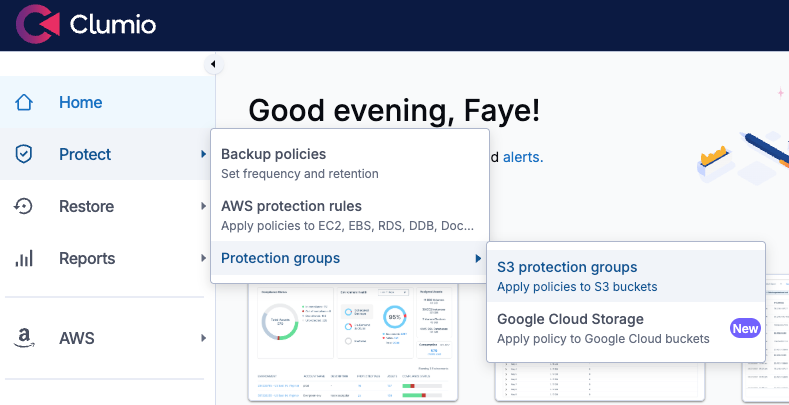
1) Per creare un gruppo di protezione,fare clic su“Protezione”,“Protezione”ion groups,Gruppi di protezione S3.
Creating an S3 protection group
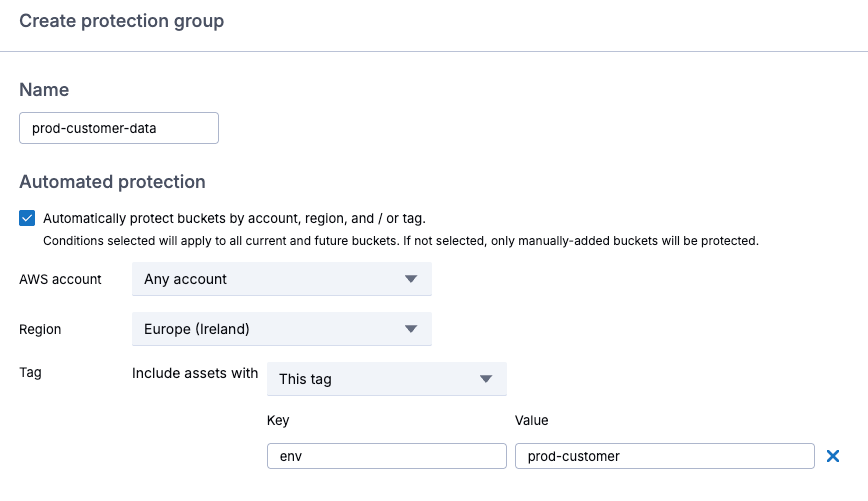
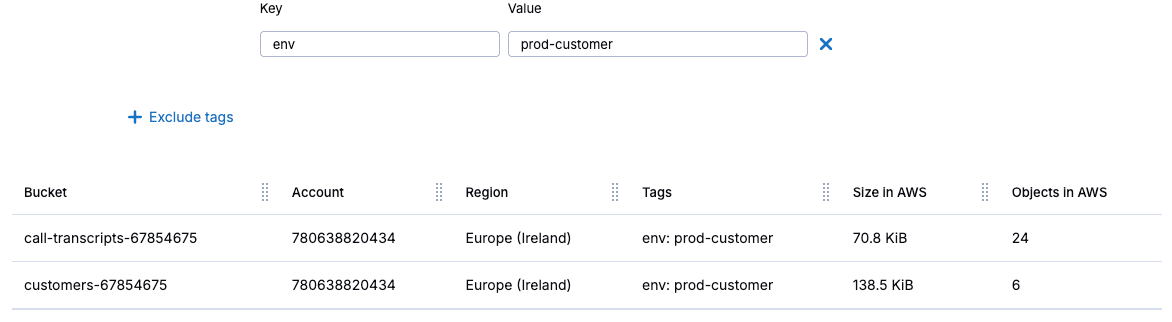
2) Quindi fare clic suCrea un gruppo di protezione,and give it a name that reflects the workload,like prod-customer-data. Select Protezione automatica to add buckets by account,region,or tag. This will apply to future buckets that meet the selection criteria as well as what exists today. After that,click Avanti.
Configurazione della protezione automatica
There’s also the option to select buckets manually,and after completing the selection,click Avanti.
Applicazione di una politica
La regola di backup 3-2-1Politica predefinita performs monthly in-region backups with one-month retention,using SecureVault Standard,which creates a secondary,air-gapped copy of your objects. Ripristinos typically complete in minutesesupport accesso immediato.
3) To create your own policy,clickCrea una nuova politica,name the policy,and select the S3 asset type.
Creazione di una politica
Configurazione della frequenza dei backup e delle impostazioni di conservazione
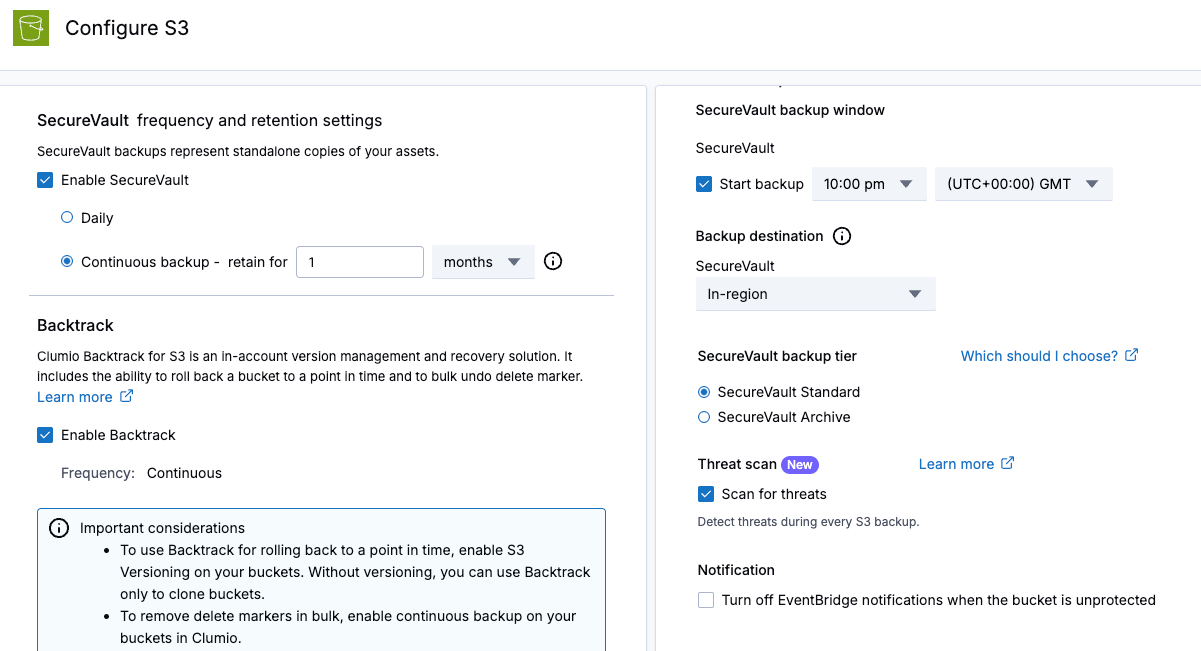
4) Fare clic sulla casella di controllo per abilitareSecureVault,and you have the option to configure the backup frequency in terms of the number of days between backups,or select continuous backups,to back up your data at frequent intervals throughout the day. This enables point-in-time recovery for any point in time during the day.
5) ScegliBackup continuo,and set the retention for one month.
6) Fare clic sulla casella di controllo per abilitareIndietro nel tempo,for point-in-time rollbacks. Note that Bucket S3 must be configured with versioning enabled in order for rollbacks to work.
7) SottoOpzioni aggiuntive,set the backup window to an appropriate time.
8)Destinazione del backupis set to in-region by default. Note that transfer charges will apply if you store backups in a different AWS region.
9) SottoLivello di backup SecureVault,select SecureVault Standardper ripristini immediati.Archivio SecureVault is designed for data that will be retained for a long period,and should only be used when you can tolerate a 24- to 48-hour restore time.
10) Fare clic sulla casella di controllo per abilitareThreat Scan,which is a service that scans every backup execution to help flag compromised fileseidentify safe,uncompromised restore points to prevent environment reinfection. After that,click Aggiungi,and Risparmio.
Configurazione della politica
11) Check that the new policy is selected for your protection group,then click Avanti.
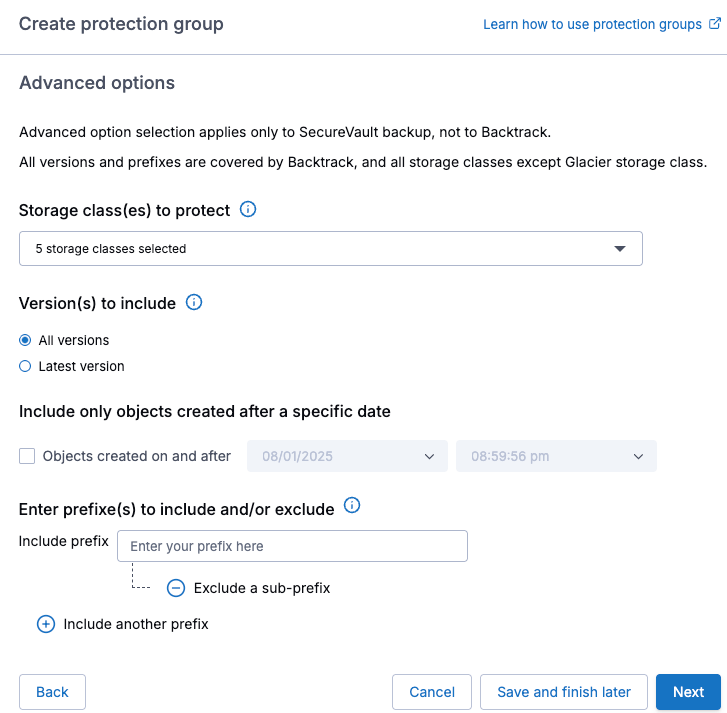
12) SottoOpzioni avanzate,you can choose which S3 storage classes to protect,whether you want all versions of an objectothe latest version,includeoexclude certain prefixes,or include objects based on their creation date. Then click AvantieCrea.
Opzioni avanzate
After that the new protection group will appear,and the first backup will be performed during the configured backup window.
“Protezione”ion groups view
Verifica dei backup
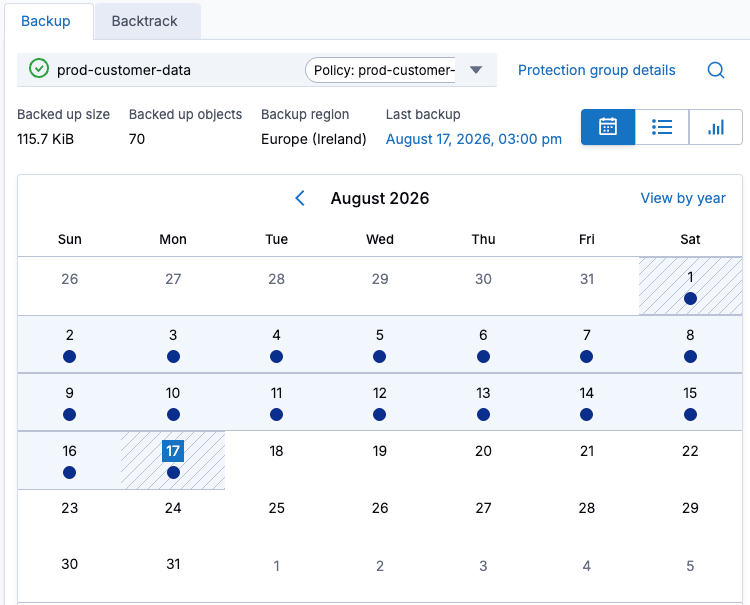
1) When you need to perform a restore,due to data being missingoidentified as corrupt,navigate to “Protezione”ion groups,select the relevant S3 protection group to view the available backupseClumio Indietro nel tempo Syncs. A blue dot in the calendar indicates that a successful backup exists for that day.
Visualizzazione dei backup riusciti
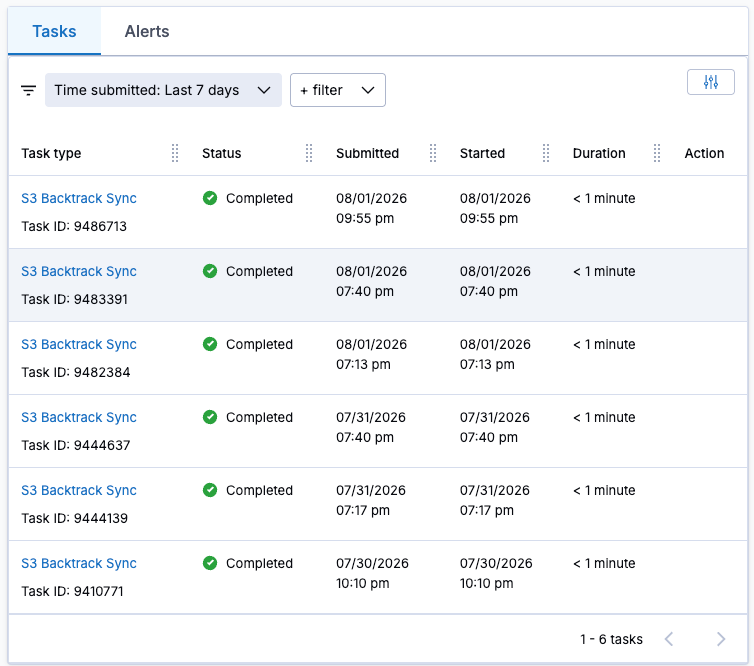
2) Visualizza ilIndietro nel tempo Syncsper singolo bucket, selezionando ilIndietro nel tempo tab from inside the protection group,and verify that continuous backup has been functioning correctly.
Indietro nel tempo Syncs available for point-in-time restore
Ripristino dei dati
In this example,I have some missing call trascriziones. Each missing file has the prefix of trascrizione. I also have a file that is corrupted,named clienti.csv.Luckily,I have a full backup as well as multiple point-in-time Indietro nel tempo Syncs da cui effettuare il ripristino.
S3 shows only a single call trascrizione; the rest have been deleted accidentally.
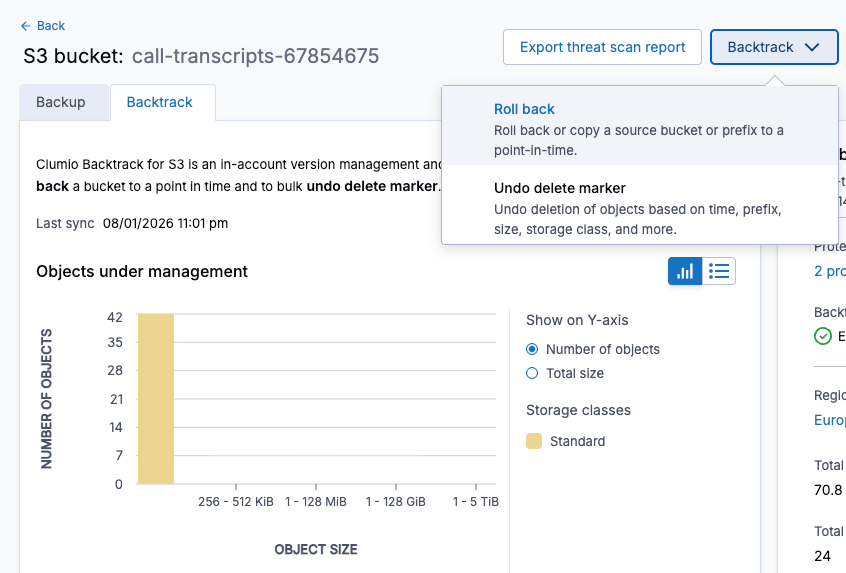
1) DaRipristino menu,select Bucket S3,and select the bucket that has missing files; then from the Indietro nel tempo dropdown,select Torna indietro.
Using Indietro nel tempo to roll back to a point-in-time
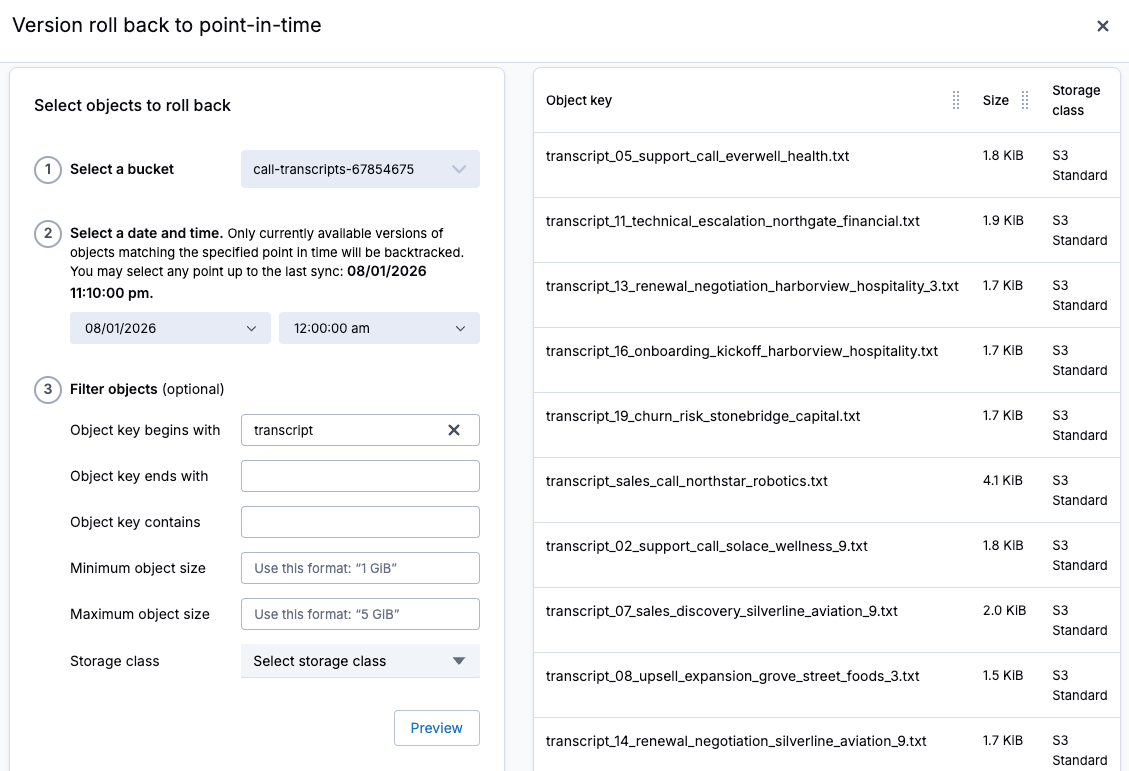
2) Select the bucket to roll back,choose the dateetime,and then filter based on object key,sizeoS3 storage class. After that,click avranno cliccato su “Anteprima”to view the files available to roll back.
Selezione dei file da ripristinare a un punto nel tempo
3) Choose to roll back to the same source bucket,or specify a different bucket to roll back to. Then,click Copiato begin the rollback job.
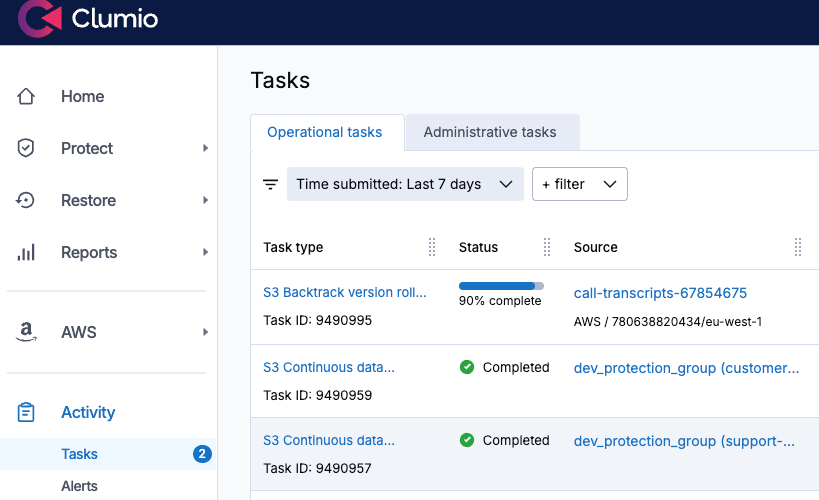
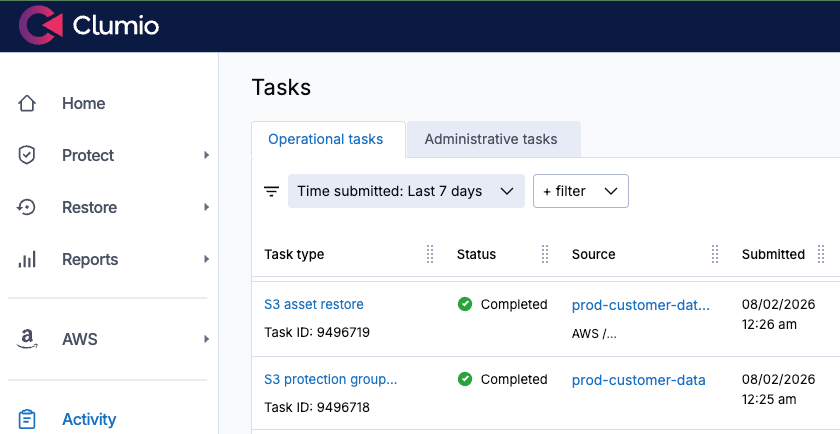
4) Visualizza lo stato di avanzamento del rollback nellaCompitimenu.
Visualizzazione dello stato di avanzamento del rollback
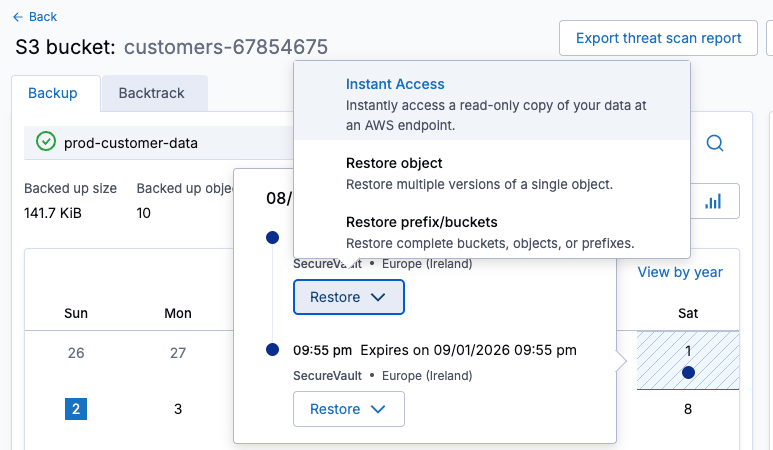
5) Avanti,to restore the corrupted clienti.csv file,I’ll click on the previous night’s backup in the backup calendar,then select Ripristino.There’s a choice to instantly access a read-only copy,restore the objectorestore multiple files based on bucket nameoprefix.
Ripristino dal backup
6) SelezionaRipristino object,then searcheselect the object to restore,and click Avanti.
Selezionare un singolo oggetto da ripristinare
7) Selezionathe version to restore,and click Avanti.
Selezionare una versione da ripristinare
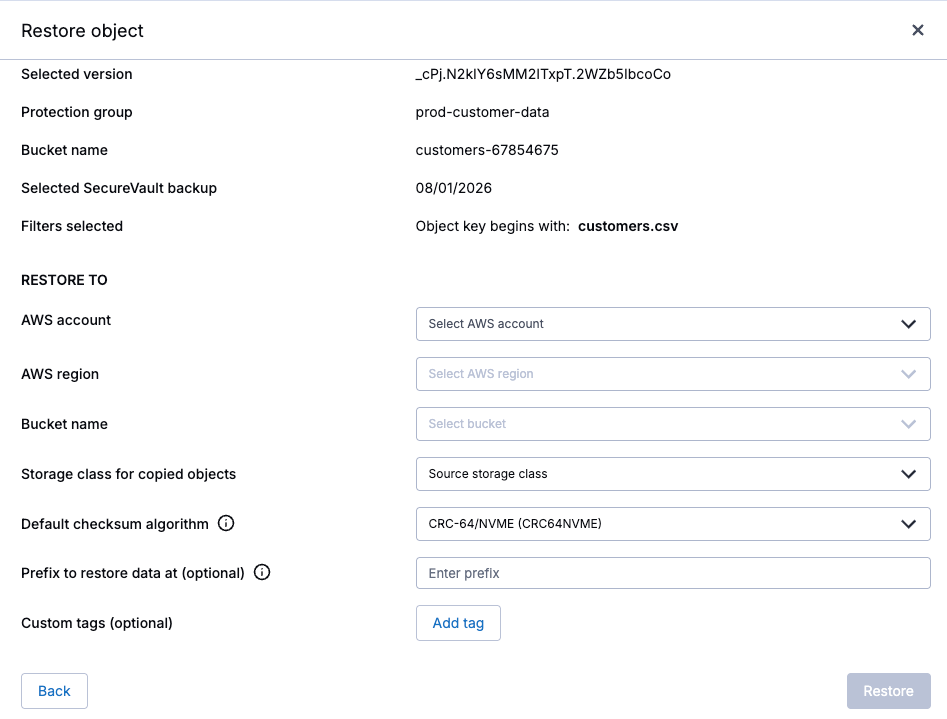
8) Choose which AWS account,region,and bucket to restore to,and then begin the restore.
Impostare la destinazione prima di avviare il ripristino.
9) After the restore shows as successfully completed,the restored file should be available in S3.
La regola di backup 3-2-1object is restored.
My Recommendation: Don’t Wait for an Incident
With a protection groupepolicy in place,Clumio helps provide more than one way back from an S3 incident: Indietro nel tempo for near-instant,in-place,point-in-time rollback on versioned buckets,and SecureVault for restoring data from an immutable,air-gapped backup.
Both help support recovery at object,prefix,and bucket granularity,allowing you to choose the recovery approach that best fits the incident.And in both cases,recovery comes down to a few clicks rather than having to manually review multiple S3 versions.
Finally,the best time to test this is before you actually need it. Set up a protection group on your critical Bucket S3 today,and run practice restores until they become second nature. La regola di backup 3-2-1next time something disappears,you’ll already know exactly how to get it back.
Q: Why do Amazon Bucket S3 need backup if S3 provides 11 nines of durability?R: S3 durability is designed to protect data against hardwareeinfrastructure failures,but it does not prevent logical data loss. Accidental deletions,misconfigured lifecycle rules,compromised IAM credentials,and unintended batch operations can still result in lostocorrupted data. D: In che modo Clumio protegge i dati su Amazon S3?R: Clumio uses S3 change events to help maintain a continuously updated,immutable,air-gapped copy of protected data. This approach helps provide an independent recovery path even when the source AWS accountodata has been compromised. D: Che cos’è un gruppo di protezione S3 in Clumio?R: A protection group is a named collection of oneomore Bucket S3 that share a protection policy. Buckets can be selected manuallyoautomatically based on criteria such as AWS account,region,tags,prefixes,or storage classes. Q: What is the difference between Clumio Indietro nel tempoeSecureVault?R: Indietro nel tempo helps provide point-in-time rollback for Bucket S3 with versioning enabled,making it useful for quickly reversing unwanted changes. SecureVault helps maintain an immutable,air-gapped backup that can be used to restore individual objects,prefixes,or larger sets of data. Q: What is the difference between SecureVault StandardeArchivio SecureVault?R: SecureVault Standard is designed for faster recoveryehelps support accesso immediato to protected data. Archivio SecureVault is intended for longer-term retentioneis better suited to data for which a 24- to 48-hour restore time is acceptable. D: In che modo i team possono prepararsi a un incidente relativo al Recovery dei dati su S3?R: Configure protection groupseappropriate backup policies for critical Bucket S3 before an incident occurs. Regularly test object restoresepoint-in-time rollbacks so the recovery process is familiar when production data needs to be recovered.
Faye Ellis is Principal Training Architect – AWS at Pluralsight.
More related posts
29 Minutes: Why Enterprise AI Risk Is a Speed Problem, Not a Frontier Problem
Resilienza dell’identità | Recovery di Active Directory | Rilevamento delle anomalie | Recovery informatico
La tua guida pratica alla resilienza delle identità: risposta rapida e Recovery completo
Identity resilience keeps your identity infrastructure operational when attackers strike. Commvault® Cloud Identity Resilience helps organizations protect and recover their identity systems before, during, and after a cyberattack.
Katharine Colucci, responsabile del marketing di prodotto, Commvault
Identity systems are the enterprise control plane – and attackers know it. Here’s what every security and IT leader needs to know.
La resilienza dell’identità contribuisce a proteggere, monitorare e ripristinare Active Directory (AD), Entra ID e Okta prima, durante e dopo gli attacchi.
Gli autori degli attacchi prendono sempre più di mira i sistemi di gestione delle identità per ottenere accesso non autorizzato, ampliare i propri privilegi, muoversi lateralmente e causare interruzioni.
Quando l’infrastruttura di gestione delle identità smette di funzionare, i sistemi che dipendono da essa smettono di funzionare a loro volta.
Senza servizi di autenticazione affidabili, anche i backup dei dati più affidabili potrebbero non essere ripristinabili.
Strumenti e script frammentati creano lacune che rendono le organizzazioni vulnerabili alle minacce basate sull’identità. Nel contempo, i processi manuali di indagine e Recovery possono prolungare il tempo di permanenza degli aggressori, ritardare il Recovery e aumentare il Risk aziendale.
Commvault Cloud Identity Resilience helps provide vulnerability assessment, real-time auditing and anomaly detection, and automated recovery – from granular rollback to full forest recovery – in a single platform.
You’re a cybersecurity leader. It’s 6:30 p.m. on a Friday before a long weekend. Just as you’re about to board a plane for vacation, your phone rings – it’s your SecOps team. IT systems around the world are becoming unresponsive, with indications of a ransomware attack.
In quel momento, la differenza tra caos e controllo si riduce a due fattori: la rapidità della risposta e l’efficacia della Recovery. Una reazione tempestiva può aiutare a contenere i danni. Tuttavia, se la Recovery reintroduce dati compromessi o parte da uno stato di identità compromesso, si rischia di ritrovarsi al punto di partenza.
Resilienza Cloud Commvaultaiuta le organizzazioni a reagire agli attacchi in rapida evoluzione che prendono di mira l’infrastruttura delle identità, dove i tempi di inattività possono aumentare il rischio aziendale.
Combina valutazioni di vulnerabilità per identificare e classificare i rischi in ordine di priorità, attività di auditing in tempo reale e rilevamento delle anomalie per aiutare a individuare e contenere le minacce, oltre a backup immutabili e isolati fisicamente (air-gapped) e flussi di lavoro di ripristino automatizzati che consentono di riportare AD, Entra ID e Okta a uno stato affidabile, contribuendo al contempo a ridurre il carico di lavoro manuale e i rischi.
Resilienza Cloud Commvaultaiuta le organizzazioni a reagire agli attacchi in rapida evoluzione che prendono di mira l’infrastruttura delle identità, dove i tempi di inattività possono aumentare il rischio aziendale. It combines real-time auditing and anomaly detection to help identify and contain threats, along with immutable, air-gapped backups and automated recovery workflows that help restore AD to a trusted state while helping reduce manual effort and risk.
4 verbale– the fastest recorded time from initial access to lateral movement in identity-based attacks, leaving organizations with a drastically reduced window to detect, contain, and respond before potential system-wide paralysis
Identity resilience is an organization’s ability to protect, monitor, and recover identity infrastructure – including AD, Entra ID, and Okta – from cyberattacks, misconfigurations, and operational errors. Because identity systems govern access to business data, systems, and applications, they are a critical dependency for operational continuity.
Commvault Cloudcontribuisce a garantire una protezione unificata delle identità grazie alla valutazione delle vulnerabilità, al monitoraggio in tempo reale e al rilevamento delle anomalie, nonché al ripristino automatizzato, il tutto in un’unica piattaforma, anziché affidarsi a strumenti frammentati.
It enables organizations to assess identity risk, monitor and detect suspicious changes, maintain isolated, recoverable copies of identity data, and restore identity services to a trusted state – helping reduce downtime and support business continuity after an incident.
Perché la resilienza identitaria è così importante proprio in questo momento?
L’identità è diventata la principale superficie di attacco nelle aziende moderne, con gli hacker che prendono sempre più di mira i sistemi di gestione delle identità per ottenere accessi non autorizzati, elevare i privilegi e muoversi lateralmente. Solo nel 2024,Sono stati resi pubblici 107 miliardi di dati relativi all’identità delle personeeIl 90% delle organizzazioniha subito almeno una violazione relativa all’identità negli ultimi 12 mesi.
AD, in particular, remains a high-value target. In addition to being widely used, it also governs access to all an organization’s business data, systemseapplications. Attackers use techniques such as credential theft, privilege escalationedirectory replication abuse to gain elevated access and expand their reach across the environment.
Commvault addresses this challenge by providing visibility, controlerecovery for multi-IdP environments into a single platform. It helps preserve recoverable identity data, provide visibility into identity security posture, monitor for suspicious changes and activityeenable access to trusted authentication services during an incident – helping organizations to restore identity systems and initiate broader recovery without waiting to manually rebuild infrastructure.
Come funziona Resilienza Cloud Commvault?
Resilienza Cloud Commvaultintegra la valutazione della vulnerabilità, l’auditing in tempo reale, il rilevamento delle anomalie e il ripristino automatizzato in un modello operativo unificato per la resilienza delle identità. Contribuisce a fornire visibilità sullo stato di sicurezza delle identità, a monitorare costantemente le modifiche ad alto rischio, a conservare i dati identificativi recuperabili in ambienti isolati e a consentire il ripristino dei servizi di identità in uno stato noto e affidabile.
Un elemento chiave che la contraddistingue è la sua architettura. Fornita tramite Commvault Cloud, la soluzione opera con un piano di controllo basato su SaaS indipendente da AD. Ciò consente agli amministratori di accedere agli strumenti di Recovery e avviare i flussi di lavoro di Recovery anche durante un attacco o un’interruzione di servizio di AD.
Supporta inoltre la convalida degli ambienti di identità recuperati utilizzandoCommvault Cleanroom,consentendo alle organizzazioni di testare e verificare i sistemi di identificazione in un ambiente isolato prima di rimetterli in produzione.
Nel loro insieme, queste funzionalità aiutano le organizzazioni a ridurre i rischi, a individuare e contenere più rapidamente le minacce legate alle identità e a ripristinare l’infrastruttura delle identità in uno stato pulito e affidabile in modo controllato e ripetibile, rafforzando sia le operazioni di sicurezza che la resilienza informatica complessiva.
A chi serve la resilienza dell’identità?
La resilienza delle identità è pensata per i responsabili della gestione delle identità e degli accessi (IAM) e della sicurezza incaricati di proteggere l’accesso a sistemi e dati critici. Tra questi figurano gli architetti delle identità, i team SecOps, gli amministratori AD e i responsabili IT che gestiscono ambienti ibridi di gestione delle identità su piattaforme on-premise e cloud.
Commvault supports these teams with a unified operational model that connects monitoring, protection, and recovery – helping them proactively assess vulnerabilities, detect and investigate and suspicious activity, and restore identity services with greater speed, control, and confidence.
Competenze chiave
Valutazione della vulnerabilità
Valuta costantemente le configurazioni relative all’identità per aiutare a identificare e classificare per priorità i rischi di sicurezza.
Backup immutabili e isolati fisicamente
Contribuisce a proteggere i dati relativi all’identità archiviati in un ambiente isolato, per facilitare il Recovery a seguito di incidenti informatici.
Recupero granulare
Consente di ripristinare singoli oggetti o attributi senza dover ricostruire l’intero ambiente.
Controllo in tempo reale e rilevamento delle anomalie
Tiene traccia dei cambiamenti di identità e delle attività per facilitare il monitoraggio e le indagini.
Flusso di lavoro automatizzato per il Recovery
Ottimizza i processi di Recovery per contribuire a ridurre il lavoro manuale e migliorare l’uniformità.
Convalida delle camere bianche
Consente di eseguire test e verifiche della Recovery in un ambiente isolato prima del ripristino in produzione.
Integrazioni fluide e supporto IdP
Commvault Cloud Identity Resilience è compatibile con gli strumenti di sicurezza e di gestione IT già in uso. Tra le piattaforme di identità e le integrazioni supportate figurano:
Microsoft Active Directory
Microsoft Entra ID
Okta
Microsoft Azure
AWS
Cloud Google
ServiceNow
Come funziona
In che modo Commvault aiuta a valutare i rischi legati all’identità?
Commvault’s AD Vulnerability Assessment scans AD for misconfigurations, Tier 0 exposures, and attack-path risks – helping deliver prioritized remediation guidance before a breach.
In che modo Commvault contribuisce a proteggere i dati relativi all’identità?
Automated, policy-driven backup of objects and attributes across AD, Entra ID, and Okta – including users, groups, applications, and policies – stored in immutable, air-gapped storage not accessible with compromised credentials.
In che modo Commvault contribuisce a individuare le minacce all’identità?
Commvault’s real-time auditing and anomaly detection monitors AD change events in real time, helping surface high-risk events, including privilege escalations, suspicious authentication, and Tier 0 modifications and DCSync-pattern requests as they occur.
In che modo Commvault contribuisce a contenere gli attacchi attivi basati sull’identità?
When malicious or unauthorized changes are detected, administrators can execute a single-action rollback of affected objects or attributes directly from the audit record – no scripting or recovery window required.
In che modo Commvault ripristina l’infrastruttura delle identità?
Commvault offre funzionalità di ripristino granulare a livello di oggetto, rollback di massa e ripristino completamente automatizzato della foresta, per aiutare a riportare l’ambiente di identità a uno stato affidabile. I runbook automatizzati coordinano il ripristino completo della foresta, seguendo l’approccio raccomandato da Microsoft, contribuendo a ridurre al minimo i tempi di inattività, a minimizzare il rischio di errore umano e a ristabilire controlli di accesso affidabili.
In che modo Cleanroom contribuisce a prevenire la reinfezione?
Cleanroom è progettato per consentire agli utenti di ripristinare e convalidare l’ambiente di identità in un ambiente cloud isolato, contribuendo a confermare l’assenza di tracce di malware prima del ritorno in produzione.
Commvault Cloud Identity Resilience contribuisce a ridurre il tempo che intercorre tra l’inizio di un attacco alle identità e il suo contenimento. Sostituisce i processi di ripristino manuali e gli strumenti frammentati con una piattaforma unificata per la valutazione delle vulnerabilità, l’auditing in tempo reale, il rilevamento delle anomalie e il ripristino automatizzato.
Clienti come Najm hanno ripristinato l’AD dopo un disastro inmeno di 2 minuti – eliminating the 35% manual workload that traditional approaches require. For lean teams managing complex hybrid environments, this approach helps deliver measurable speed, control, and confidence.
Domande frequenti
Che cos’è Commvault Identity Resilience e cosa protegge?
Commvault Cloud Identity Resilience è una piattaforma unificata che aiuta le organizzazioni a proteggere, individuare le minacce interne e ripristinare AD, Entra ID e Okta in seguito a incidenti informatici, danneggiamento dei dati ed errori operativi. Combina backup immutabili in air-gap, monitoraggio delle modifiche in tempo reale, valutazioni delle vulnerabilità e flussi di lavoro di Recovery automatizzati per garantire un accesso affidabile prima, durante e dopo eventuali interruzioni.
Perché l’AD è spesso bersaglio degli hacker?
Active Directory (AD) gestisce l’accesso alle applicazioni, ai sistemi e ai dati a livello aziendale, il che lo rende un obiettivo di grande valore. In caso di compromissione, gli aggressori potrebbero ottenere un ampio accesso. Commvault Cloud Identity Resilience contribuisce a mitigare questo rischio monitorando AD alla ricerca di modifiche sospette, facilitando il rollback grazie all‘auditingin tempo reale e nel rilevamento delle anomalie, e fornendo supporto alla modalità Recovery per aiutare a riportare il sistema a uno stato affidabile.
In che modo Commvault contribuisce a individuare le minacce all’identità in tempo reale?
Commvault Cloud contribuisce a garantire la visibilità sulle modifiche apportate ad Active Directory grazie a un sistema di auditing in tempo reale che rileva le modifiche relative a identità, gruppi e criteri. Aiuta a evidenziare le modifiche potenzialmente rischiose, come l’escalation dei privilegi, e consente di intraprendere azioni correttive, come il rollback, sulla base degli eventi di audit. La funzionalità di rilevamento delle anomalie aiuta a individuare gli indicatori di compromissione, consentendo ai team di indagare e reagire più rapidamente.
In che modo Commvault automatizza la Recovery della foresta di Active Directory?
Commvault Cloud utilizza runbook orchestrati, in linea con gli approcci raccomandati da Microsoft, per automatizzare l’intero processo di ripristino della foresta. Ciò contribuisce a ridurre il lavoro manuale e il rischio di errori. Un piano di controllo fornito tramite SaaS rimane accessibile anche se Active Directory è offline, mentre Commvault Cleanroom può aiutare a verificare l’ambiente prima del ritorno in produzione.
Commvault è in grado di recuperare oggetti di identità specifici senza dover ripristinare l’intero sistema?
Commvault Cloud supporta il ripristino granulare di utenti, gruppi, criteri e attributi, consentendo ai team di apportare modifiche specifiche senza dover ripristinare l’intero ambiente. Questa funzionalità di ripristino a livello di oggetto, parte integrante di Commvault Cloud Identity Resilience, contribuisce a ridurre i tempi di ripristino e le interruzioni operative, ripristinando solo ciò che è necessario, anziché richiedere una ricostruzione completa della foresta.
Qual è la differenza tra “Identity Resilience” e IAM?
L’IAM gestisce il provisioning degli utenti e le politiche di accesso durante il normale funzionamento. La resilienza delle identità – garantita da Commvault Cloud Identity Resilience – aiuta a gestire le situazioni in cui l’infrastruttura delle identità è compromessa o non disponibile. Gli strumenti IAM non sono in grado di ripristinare le foreste AD, annullare modifiche dannose o verificare il Recovery in un ambiente isolato. Commvault colma questa lacuna nel contesto post-compromissione.
Risorse correlate
Solution Brief
Resilienza delle identità di Commvault
Scopri i dettagli tecnici su come Commvault Cloud contribuisca a proteggere e ripristinare Active Directory, Entra ID e Okta dagli attacchi basati sull’identità.
Guardare in faccia la realtà sulla resilienza delle identità: il nuovo imperativo per la difesa informatica delle aziende
Scopri perché i sistemi di gestione delle identità sono uno dei principali obiettivi degli attacchi e in che modo la Recovery contribuisce a ridurre al minimo le interruzioni dell’attività aziendale a seguito di una violazione.
Valutazione dello stato di resilienza dell’identità
Scopri le misure immediate che la tua organizzazione può adottare per proteggere un ambiente con più IdP, ridurre i rischi e garantire una Recovery rapida.
Years of reasonable technology decisions can accumulate into operational complexity that makes resilience harder to manage, govern, test, and maintain.
Fragmented tools, policies, workflows, and ownership can create inconsistent recovery models and make business-wide recovery difficult to predict.
Unified data protection can help reduce operational friction by simplifying control and standardizing protection across increasingly diverse environments.
Cyber resilience depends not only on safeguarding individual workloads but also on building security into recovery processes and continuously proving recovery readiness.
Poiché gli ambienti cloud, SaaS, edge e di intelligenza artificiale si espandono più rapidamente dei team, semplificare l’architettura di resilienza diventa sempre più importante per garantire una Recovery affidabile e ripetibile.
One advantage of having spent part of my career on the operational side of backup and recovery is that I still can’t help looking at resilience through the eyes of the people who have to run it every day.
Years ago, the job was complicated, but it was generally clear. Most critical systems lived within a relatively defined set of boundaries. Protection strategies were comparatively standardized. Recovery planning focused on a known set of applications, databases, and infrastructure. The technology wasn’t simple, but the operating model was understandable.
Oggi quei confini sono in gran parte scomparsi.
I processi aziendali abbracciano applicazioni SaaS, servizi cloud-native, cloud multipli, ambienti edge, iniziative di intelligenza artificiale e infrastrutture tradizionali. Diversi team gestiscono diverse parti dello stack. Le nuove tecnologie arrivano più velocemente di quanto quelle vecchie vengano dismesse. E ogni nuova aggiunta introduce nuove dipendenze che potrebbero non risultare evidenti finché non si verifica un guasto o non è necessario ripristinare il sistema.
Di recente ho partecipato insieme a Michael Thelander, Senior Director of Product Marketing presso Commvault, a un webinar su come affrontare proprio questa questione. È possibile guardarloLa protezione unificata dei dati come base della resilienza on demand now.
Perché la protezione dei dati diventa sempre più difficile
What’s interesting is that most organizations didn’t intentionally design this complexity into their resilience architecture. They accumulated it over time.
I team cloud hanno adottato funzionalità di protezione native. I responsabili delle applicazioni hanno implementato processi adeguati alle piattaforme da loro supportate. Le acquisizioni hanno portato con sé tecnologie e modelli operativi preesistenti. Le unità aziendali hanno ottimizzato i propri processi in base alle proprie esigenze. La maggior parte di queste decisioni era ragionevole e, in molti casi, necessaria. La sfida sta nel fatto che ognuna di queste decisioni comportava un costo.
There’s the obvious cost of software, infrastructure, and storage. More significant, though, is the operational cost that accumulates quietly over the years. Every new protection method introduces another policy framework to manage, another workflow to document, another exception to troubleshoot, another recovery process to test, and another set of skills the organization must maintain.
Alla fine, i team dedicano tanto tempo a gestire la complessità legata alla resilienza quanto a migliorarla.
Di per sé, questo potrebbe sembrare un problema di efficienza. Ma col passare del tempo, si trasforma in un problema di resilienza. Più elementi variabili un’organizzazione introduce, più diventa difficile mantenere la coerenza. Le procedure di Recovery si evolvono in modo diverso da un team all’altro. Le politiche subiscono derive. La responsabilità si frammenta. La conoscenza si concentra in una manciata di persone che comprendono come tutto si incastri.
Alla fine, la sfida non consiste più nel capire se i singoli carichi di lavoro possano essere protetti, ma se l’organizzazione sia in grado di gestire, testare e ripristinare in modo coerente tutte le risorse di cui si occupa. La maggior parte delle organizzazioni comprende come avvenga il ripristino dei singoli sistemi. Sono invece molto meno numerose quelle in grado di spiegare con sicurezza come avvenga il ripristino dell’attività aziendale.
Unrecente sondaggio sulla resilienza informatica found that nearly half of organizations identify IT complexity as their biggest cyber resilience challenge. That finding isn’t particularly surprising. Most enterprises aren’t struggling because they lack protection technologies. In many cases, they have more protection technologies than ever before.
La sfida consiste nel capire come tutte queste tecnologie si integrino tra loro nel momento in cui l’organizzazione ne ha effettivamente bisogno.
L’intelligenza artificiale sta rendendo questa realtà ancora più evidente. I modelli dipendono da dati di addestramento, pipeline, infrastrutture, repository, identità e servizi che spesso coinvolgono più team e ambienti. Proteggere questi singoli componenti rappresenta una sfida. Ripristinare l’ecosistema che essi sostengono collettivamente ne è un’altra.
That’s one reason Michael and I spent so much time discussing complexity.
On the surface, unified data protection sounds like a conversation about backup architecture. In reality, our discussion centered on a much broader challenge: how organizations reduce the operational burden created by years of accumulated complexity while creating a more consistent foundation for resilience.
Because the goal isn’t consolidation for consolidation’s sake. It’s all about reducing operational friction. Creating consistency where consistency matters. And making recovery more predictable, repeatable, and trustworthy.
Da strumenti frammentati a una base unificata
During the webinar, Michael and I explored four practical ways organizations can begin reducing complexity and strengthening resilience: simplifying control, standardizing protection, building cyber resilience directly into the recovery process, and continuously proving recovery readiness.
While the tactics differ, the objective is the same. The less effort organizations spend stitching together fragmented tools, policies, and workflows, the more confidence they can have in their ability to recover when it matters most.
What stayed with me long after the conversation ended was the recognition that resilience has become as much an operational and architectural challenge as a technical one. Organizations are being asked to support more applications, more clouds, more services, more data, and more AI initiatives than ever before. Yet few have the luxury of expanding teams at the same pace. That reality makes simplicity increasingly valuable.
If I were running backup and recovery operations today and I were re-evaluating my organization’s approach, I wouldn’t start by asking whether we have enough protection tools. I’d start by asking how much complexity we’re carrying and what it’s costing us. Because those costs extend far beyond software licenses and infrastructure. They’re reflected in operational effort, fragmented processes, inconsistent recovery models, and ultimately in an organization’s ability to recover when it matters most.
Domande frequenti
D: Perché la protezione dei dati è diventata più complessa per le organizzazioni?R:I processi aziendali oggi abbracciano applicazioni SaaS, servizi cloud-native, cloud multipli, ambienti edge, iniziative di intelligenza artificiale e infrastrutture tradizionali. Man mano che i team adottano diversi metodi di protezione per questi ambienti, le organizzazioni accumulano politiche, flussi di lavoro, competenze e dipendenze che aumentano il carico operativo legato alla resilienza. D: In che modo la complessità tecnologica può influire sulla resilienza informatica?R:Un numero maggiore di strumenti e processi può rendere più difficile garantire l’uniformità delle politiche, delle responsabilità, dei test e delle procedure di Recovery all’interno di un’organizzazione. Nel corso del tempo, questa frammentazione può trasformare quella che inizialmente sembra una sfida in termini di efficienza in una sfida in termini di resilienza. D: Qual è l’obiettivo della protezione unificata dei dati?R:La protezione unificata dei dati non si limita al consolidamento delle tecnologie di backup. Il suo obiettivo più ampio è quello di ridurre gli attriti operativi, garantire coerenza dove è necessario e rendere Recovery più prevedibile, ripetibile e affidabile. D: Quali misure concrete possono adottare le organizzazioni per ridurre la complessità della resilienza?R:Le organizzazioni possono concentrarsi sulla semplificazione dei controlli, sulla standardizzazione della protezione, sull’integrazione diretta della resilienza informatica nei processi di Recovery e sulla dimostrazione continua della Readiness al Recovery. Nel loro insieme, queste pratiche possono ridurre lo sforzo necessario per coordinare strumenti, politiche e flussi di lavoro frammentati. D: Perché l’intelligenza artificiale rende più visibile la complessità della resilienza?R:Le iniziative di intelligenza artificiale possono basarsi su dati di addestramento, pipeline, infrastrutture, archivi, identità e servizi interconnessi che coinvolgono più team e ambienti. Proteggere ogni singolo componente non risolve necessariamente la sfida più ampia rappresentata dal ripristino dell’ecosistema completo che tali componenti supportano. D: Quali aspetti dovrebbero prendere in considerazione le organizzazioni quando rivalutano la propria strategia di protezione dei dati?R: Rather than starting with whether they have enough protection tools, organizations should examine how much operational complexity they are carrying and what it costs them. That includes the impact of fragmented processes, inconsistent recovery models, administrative effort, and the organization’s overall ability to recover when it matters most.
Jason Gizaè Senior Manager del reparto Partner Solutions Marketing presso Commvault.
More related posts
29 Minutes: Why Enterprise AI Risk Is a Speed Problem, Not a Frontier Problem
Che cos’è l’obiettivo del punto di Recovery (RPO)? Una guida completa
Recovery point objective (RPO) defines how much data your organization can afford to lose after a disruption – and it shapes every backup, replication, and recovery decision you make.
Recovery point objective (RPO) is the maximum amount of data – measured in time – that your organization can lose after an unplanned disruption and still operate within acceptable limits.
Pensate all’RPO come a un orologio che segna la perdita dei dati: inizia a scorrere all’indietro dal momento in cui si verifica un’interruzione di servizio, un attacco informatico o un errore umano, e si ferma all’ultimo backup o punto di replica utilizzabile. Ogni secondo che intercorre tra questi due punti rappresenta dati che potreste non recuperare mai più.
NISTdefinisce l’RPO as “the point in time to which data must be recovered after an outage.” That definition is deceptively simple. In practice, setting the right RPO raises important questions about which workloads matter most, how often you back up, and how much you invest in replication infrastructure.
Cyberattacks, cloud outages, and accidental deletions happen on schedules you do not control. Organizations that define clear RPO targets – and enforce them with automated, policy-driven backup – position themselves to recover within business tolerance instead of scrambling after the fact.
This guide walks you through how RPO works, how it differs from recovery time objective (RTO), what are some real-world examples, calculating RPO, and RPO’s critical role in cyber resilience.
Come funziona l’RPO nella pianificazione della continuità operativa
RPO is the “data-loss clock” that shapes your backup frequency. If your RPO for a database is one hour, backups should run at least every 60 minutes. Miss that cadence and you may have already exceeded your tolerance before anything goes wrong.
In a business continuity plan, RPO sits alongside RTO as one of two recovery pillars. While RTO answers “How fast can we get systems running again?” RPO answers “How current will the recovered data be?” Both feed into the broader disaster recovery strategy – and both should be validated through regular testing, not just documented in a binder.
L’RPO può avere anche una dimensione legata alla conformità:
Normative come l’HIPAA prevedono generalmente che le organizzazioni sanitarie conservino copie recuperabili delle informazioni sanitarie elettroniche dei pazienti.
La legge SOX prevede disposizioni volte a garantire che i documenti contabili siano verificabili e integri.
Il GDPR prevede che il trattamento dei dati personali debba poter essere ripristinato tempestivamente a seguito di un incidente tecnico.
When an attack encrypts production data, the gap between your last clean backup and the encryption timestamp is the data you lose. That gap is your RPO in action – and it helps determine whether recovery takes hours or becomes a crisis.
The practical takeaway: RPO is not a number you set once and forget. It should reflect current data-change rates, compliance mandates, and threat landscape realities – and it should be enforced through automated backup policies.
RPO vs. RTO: What’s the Difference?
RPO e RTO sono le due facce della stessa medaglia in materia di Recovery, ma misurano aspetti diversi.
RPO looks backward from the moment of failure. It asks: “How much data can we afford to lose?” The answer is expressed in time – minutes, hours, or days – representing the gap between the last good backup and the disruption.
RTO looks forward from the moment of failure. It asks: “How quickly must systems be back online?” The answer is also expressed in time, but it measures downtime tolerance rather than data-loss tolerance.
Dimensione
RPO
RTO
Focus
Tolleranza alla perdita di dati
Tolleranza ai tempi di inattività
Misure
Tempo trascorso dall’ultimo backup utilizzabile
È ora di ripristinare il servizio
Direzione
Retrospettivo (prima del guasto)
Prospettive future (dopo un insuccesso)
Domanda chiave
Quanti dati potremmo perdere?
Per quanto tempo potremo restare fuori gioco?
Esempio
RPO di 1 ora = backup ogni ora
RTO di 4 ore = ripristino dei sistemi entro quattro ore
Both metrics should be defined together. An organization with a 15-minute RPO but a 24-hour RTO has recent data that sits idle for a full day. Conversely, a four-hour RTO paired with a 24-hour RPO means systems come back quickly – but with stale data.
Aligning RPO and RTO targets before an incident – and validating them through regular disaster recovery testing – can be the difference between a measured response and a scramble.
Livelli di RPO ed esempi concreti
Non tutti i carichi di lavoro richiedono lo stesso RPO. Classificare gli RPO in base alla criticità aziendale aiuta a garantire una protezione rigorosa dove è necessario e a mantenere i costi sotto controllo dove non lo è.
Livello 0: RPO quasi pari a zero (da secondi a minuti): i database delle transazioni finanziarie, le cartelle cliniche elettroniche dei pazienti e le piattaforme di trading in tempo reale richiedono in genere una protezione continua dei dati (CDP) o una replica sincrona. Questi carichi di lavoro generano ricavi o hanno un peso normativo ogni secondo, quindi anche pochi minuti di perdita di dati possono essere difficili da assorbire. Le organizzazioni che implementano un RPO quasi pari a zero utilizzano in genere la CDP o la replica sincrona per ridurre al minimo la finestra di perdita dei dati.
Tier 1: 1–4 Hours: Customer relationship management (CRM) systems, email platforms, and order processing systems often fall here. Frequent incremental backups – every 15 to 60 minutes – help keep data loss within tolerance. The cost is moderate, and the business impact of losing a few hours of email or CRM updates is generally manageable with manual re-entry.
Tier 2: 4–12 Hours: Internal collaboration tools, development environments, and project management platforms commonly operate in this range. Scheduled backups every 4 to 6 hours can strike a balance between protection and storage costs.
Tier 3: 12– 24 Hours: Marketing analytics archives, historical logs, and reference documentation often tolerate daily cloud backups. Data changes slowly and reconstruction is feasible, making daily backup cadences cost-effective.
La suddivisione in livelli aiuta le organizzazioni a concentrare al massimo gli investimenti sulla protezione dei carichi di lavoro in cui ogni minuto di perdita di dati comporta un costo elevato, evitando al contempo spese eccessive per gli archivi che vengono aggiornati solo una volta alla settimana.
Come calcolare l’RPO per la propria organizzazione
Calculating RPO is a business exercise first and a technical exercise second. These steps can help set RPOs that reflect reality, not aspiration.
Identificare i dati critici.
Catalogate i vostri carichi di lavoro e classificateli in base all’impatto sul business. Chiedetevi: se questo sistema dovesse subire una perdita di dati, quali sarebbero le conseguenze in termini di fatturato, conformità e fiducia dei clienti? Le risposte vi aiuteranno a definire l’assegnazione dei livelli di priorità.
Valutare i tassi di variazione dei dati.
Un database che elabora 10.000 transazioni all’ora richiede in genere un RPO più rigoroso rispetto a un archivio di documenti aggiornato due volte al giorno. Misurate i tassi di variazione effettivi, non quelli stimati.
Verificare i requisiti di conformità.
Assegnare a ciascun carico di lavoro gli obblighi normativi applicabili. HIPAA, SOX, PCI DSS e GDPR possono prevedere requisiti in materia di conservazione e recuperabilità dei dati che influenzano l’RPO.
Valutare il budget e le infrastrutture.
Near-zero RPO typically involves CDP, synchronous replication, or both – and that infrastructure has a cost. Align your RPO targets with what your budget can sustain.
Imposta obiettivi di acquisto (RPO) a più livelli e automatizza la loro applicazione.
Assign each workload to an RPO tier, configure backup policies to match, and automate compliance monitoring. An RPO that exists only in a spreadsheet offers limited protection – enforcement should be continuous and policy-driven.
Reviewing and recalibrating quarterly is good practice. Data volumes grow, workloads shift, and threat landscapes evolve – your RPOs should keep pace.
RPO e resilienza informatica
Ransomware does not care about your backup schedule – but your RPO determines how much leverage attackers have. A tight RPO means less data sits between your last immutable backup and the encryption event, helping reduce the blast radius of an attack.
La resilienza informatica non dipende solo dalla frequenza dei backup. Le copie di backup immutabili e isolate fisicamente aiutano a proteggersi dagli aggressori che compromettono gli ambienti di produzione, impedendo loro di accedere o alterare i dati di Recovery. Quando tali backup vengono archiviati al di fuori dell’account cloud principale, si aggiunge un livello di isolamento che il ransomware non è in grado di superare.
È qui che Clumio di Commvault si inserisce nella vostra strategia RPO. ConClumio, you store backup data in an isolated, fully managed environment outside your primary AWS account. Granular point-in-time recovery helps you restore to a precise moment before the attack – helping minimize data loss to the RPO you defined. Designed to help you maintain control of your recovery without depending on the same infrastructure the attacker compromised.
Le organizzazioni che mantengono RPO rigorosi con backup immutabili e isolati possono evitare di pagare il riscatto, poiché sono in grado di ripristinare autonomamente dati integri.
La formula è semplice: un RPO più rigoroso, unito a backup immutabili e isolati, si traduce in genere in una superficie di attacco più ridotta e in un Recovery più rapido e pulito. Questo è il fondamento della resilienza informatica.
Domande frequenti
Cosa significa RPO?
RPO è l’acronimo di “Recovery Point Objective” (obiettivo del punto di ripristino). Definisce la quantità massima accettabile di perdita di dati, misurata in termini di tempo, a seguito di un’interruzione imprevista, come un attacco informatico, un guasto hardware o un errore umano.
Che cos’è un buon RPO?
Un buon RPO dipende dal carico di lavoro. I sistemi finanziari e sanitari richiedono spesso RPO vicini allo zero, mentre gli strumenti interni possono tollerare valori compresi tra 4 e 12 ore. L’RPO corretto rappresenta un equilibrio tra impatto aziendale, requisiti di conformità e disponibilità di budget.
Qual è la differenza tra RPO e Recovery Time Objective (RTO)?
L’RPO misura la quantità di dati che si può perdere, espressa in termini di tempo trascorso dall’ultimo backup. L’RTO misura per quanto tempo i sistemi possono rimanere fuori servizio. L’RPO guarda al passato a partire da un guasto; l’RTO guarda al futuro. Entrambi devono essere definiti insieme in un piano di ripristino di emergenza.
L’RPO può essere pari a zero?
Un RPO pari a zero significa che non si verifica alcuna perdita di dati. Per raggiungerlo è necessaria una replica sincrona, in cui ogni operazione di scrittura viene confermata su un sistema secondario prima di essere riconosciuta. Ciò è tecnicamente possibile, ma può risultare costoso; pertanto, la maggior parte delle organizzazioni lo riserva ai propri carichi di lavoro più critici.
In che modo l’RPO influisce sulla frequenza dei backup?
L’RPO determina direttamente la frequenza dei backup. Un RPO di un’ora richiede backup almeno ogni 60 minuti. Un RPO di 24 ore consente backup giornalieri. Più l’RPO è rigoroso, più frequente deve essere la cadenza dei backup o delle repliche.
Quali fattori determinano l’RPO?
Tra i fattori chiave figurano la criticità dei dati per l’azienda, la frequenza con cui i dati cambiano in genere, i requisiti normativi e di conformità applicabili, il budget disponibile per l’infrastruttura di backup e la tolleranza complessiva al rischio dell’organizzazione. La maggior parte delle organizzazioni classifica i propri RPO in base a questi fattori.
Pianificazione della continuità aziendale nell’era Cloud
Un piano moderno di continuità operativa parte dalla protezione dei dati nel cloud. Scopri gli elementi chiave, i vantaggi e le migliori pratiche per la continuità operativa nativa del cloud.
La complessità del cloud moltiplica la sfida. La maggior parte delle aziende opera ormai con più fornitori di servizi cloud, ciascuno con modelli di sicurezza, meccanismi di backup eresponsabilità condivisa boundaries. Data sprawl across Amazon S3 buckets, DynamoDB tables, and data lakehouse environments creates blind spots. The responsabilità condivisa model means your cloud provider secures the infrastructure, but you own the protection and recoverability of your data.
L’impatto aziendale di un’interruzione imprevista va ben oltre i tempi di inattività. La perdita di ricavi aumenta di minuto in minuto. Una volta compromessa, la fiducia dei clienti richiede mesi o anni per essere ricostruita. Le sanzioni normative previste da normative quali il GDPR, l’HIPAA e il SOX possono ammontare a milioni. E il danno reputazionale spesso dura più a lungo dell’incidente stesso.
A well-structured business continuity plan transforms your organization from reactive to resilient. It defines exactly how you will protect critical data, recover operations, and communicate with stakeholders when disruption strikes. Without one, recovery becomes improvisation — and improvisation under pressure rarely ends well.
Un solido piano di continuità operativa per il cloud si basa su componenti interconnessi che operano in sinergia prima, durante e dopo un incidente.
Analisi dell’impatto aziendale e valutazione dei rischi
Start with a business impact analysis (BIA) to identify your most critical workloads and quantify the cost of downtime for each. Pair this with a risk assessment that maps threats — ransomware, cloud provider outages, insider errors, compliance failures — to specific data assets. This analysis drives every decision that follows.
Obiettivi RTO/RPO per carico di lavoro
Non tutti i dati hanno lo stesso valore. Definire gli obiettivi di tempo di ripristino (RTO) eobiettivi del punto di recupero (RPO)per ogni carico di lavoro in base alla sua criticità aziendale. Un database rivolto ai clienti potrebbe richiedere un RPO di pochi minuti, mentre i log archiviati potrebbero tollerare un RPO di alcune ore. Gli obiettivi differenziati per livello evitano di spendere troppo per le risorse a bassa priorità e di investire troppo poco in quelle ad alta priorità.
Strategia di backup su cloud
La vostra strategia di backup deve essere automatizzata e basata su criteri definiti. I processi manuali comportano il rischio di errori umani e non sono scalabili. Definite criteri che consentano di rilevare continuamente le modifiche, archiviare i backup in ambienti isolati e supportare il Recovery granulare a livello di oggetto, prefisso, bucket, tabella o partizione. Esplorate le vostreopzioni di backup su cloudprima di optare per un unico approccio.
Protocolli di comunicazione e di escalation
Documentare chi è responsabile di cosa durante un incidente. Definire i percorsi di escalation, i tempi di notifica e i canali di comunicazione per i team interni, i dirigenti, i clienti e le autorità di regolamentazione. Un piano di ripristino che nessuno è in grado di attuare non è affatto un piano.
Collaudo e manutenzione
Il piano di continuità operativa più pericoloso è quello che non è mai stato testato. Programmate esercitazioni di Recovery almeno una volta al trimestre per verificare che i vostri obiettivi RTO/RPO siano realizzabili e che il vostro team conosca bene la procedura da seguire.
Vantaggi del cloud-native
Il passaggio della propria strategia di continuità operativa a soluzioni cloud-native offre vantaggi misurabili rispetto agli approcci tradizionali on-premise.
Scalabilità senza costi aggiuntivi per l’infrastruttura. Il backup cloud-native si adatta automaticamente alla crescita dei dati. Non è necessario configurare server, array di archiviazione o Appliances aggiuntivi. Man mano che i bucket S3 e i database si espandono, anche la protezione si espande di conseguenza.
Efficienza in termini di costi. Un approccio serverless basato su SaaS elimina le spese in conto capitale relative all’hardware dedicato al backup. Si paga solo per la protezione effettivamente utilizzata e i costi operativi rimangono prevedibili anche con l’aumentare dei volumi di dati.
Maggiore sicurezza grazie all’isolamento. I backup immutabili e isolati fisicamente, archiviati al di fuori del tuo account cloud principale, costituiscono un livello di difesa fondamentale. Se un ransomware compromette il tuo ambiente di produzione, i dati di backup rimangono al sicuro in un archivio isolato. Questa separazione fa la differenza tra il pagamento di un riscatto e il ripristino dei dati secondo le tue condizioni.
Rapid, granular recovery. Cloud-native solutions enable targeted recovery — restoring specific objects, prefixes, buckets, tables, or partitions rather than entire environments. This precision reduces recovery time dramatically and minimizes disruption to unaffected workloads.
Resilienza multi-cloud. Le organizzazioni operano sempre più spesso su AWS, Azure e Google Cloud. Le soluzioni di backup cloud-native supportano il Recovery tra diverse regioni e account, offrendovi la flessibilità necessaria per ripristinare i dati ovunque ne abbiate bisogno.
Il mercato della protezione dei dati nel cloud continua a crescere man mano che le organizzazioni ne riconoscono i vantaggi. Con l’aumento dei carichi di lavoro nel cloud e l’intensificarsi delle minacce, gli investimenti in infrastrutture di resilienza stanno accelerando in tutti i settori.Per saperne di più su comeClumio’ssupporti per la protezione cloud-nativerecupero di ransomware,Esplorail nostropagina dedicata alla soluzione.
Migliori pratiche in materia di continuità operativa
Effective business continuity planning is not a one-time project — it is an ongoing discipline. These practices help you build and maintain a plan that holds up under real-world pressure.
Effettuare valutazioni periodiche dei rischi.
Il panorama delle minacce è in continua evoluzione. Rivedete il vostro profilo di rischio almeno una volta al trimestre e aggiornate la vostra analisi dell’impatto sul business (BIA) ogni volta che aggiungete nuovi carichi di lavoro nel cloud, cambiate fornitore o entrate in nuove giurisdizioni normative.
Definisci e verifica i tuoi obiettivi RTO/RPO.
Fissare gli obiettivi sulla carta è il primo passo. È attraverso la loro verifica mediante esercitazioni di Recovery concrete che si costruisce la Readiness operativa. Verificate i processi di Recovery rispetto agli obiettivi definiti e documentate le lacune. Rivedete questi obiettivi man mano che le esigenze aziendali evolvono.
Adottare una strategia di backup multi-cloud.
Do not rely on a single provider’s native tools for backup and recovery. Cross-account and cross-region backup capabilities protect you against account-level compromise and regional outages alike.
Automatizzare le politiche di backup.
I processi di backup manuali sono vulnerabili. È necessario implementare un’automazione basata su criteri che acquisisca continuamente le modifiche ai dati, senza fare affidamento su snapshot programmati che potrebbero tralasciare aggiornamenti critici tra un intervallo e l’altro.
Integra la sicurezza nella tua strategia di backup.
Air-gapped storage, immutable backups, role-based access controls, and threat scanning should be standard features of your backup solution — not afterthoughts. Your backup data is a high-value target; protect it accordingly.
Effettuare il test almeno una volta ogni tre mesi.
Recovery drills should simulate realistic scenarios, including ransomware events and accidental bulk deletions. Testing reveals where your plan falls short before an actual incident occurs.
Assistenza per il backup su cloud
A modern business continuity plan requires purpose-built cloud backup — not legacy tools adapted for cloud environments. Traditional backup solutions were designed for on-premises infrastructure and struggle with the scale, speed, and architecture of cloud-native workloads.
Clumio by Commvaultè stata progettata ex novo per gli ambienti cloud. In quanto piattaforma serverless basata su SaaS e progettata per AWS e Google Cloud, Clumio offre le funzionalità di Recovery necessarie per garantire la continuità operativa senza aggiungere infrastrutture gestite dal cliente né aumentare la complessità operativa.
Backup ad aria compressa. Clumio archivia i dati di backup in un ambiente immutabile e isolato, completamente separato dal vostro account cloud di produzione. Questa architettura con isolamento fisico garantisce che, anche nel caso in cui un attacco ransomware o la compromissione dell’account dovessero interessare il vostro ambiente primario, i dati di backup rimangano protetti e recuperabili.
Granular recovery at scale. Rather than forcing full-environment restores, Clumio enables targeted recovery at the object, prefix, bucket, partition,otable level. When a bad code push corrupts specific data, you recover exactly what was affected — nothing more, nothing less.
Ripristino tra regioni e tra account. Clumio supporta percorsi di ripristino flessibili, compreso il ripristino dei dati in regioni o account diversi. Questa funzionalità è fondamentale in caso di scenari di emergenza in cui un’intera regione o un intero account risulti compromesso.
Clumio Backtrack per il ripristino a un punto nel tempo. Clumio Backtrack consente il ripristino in loco diAmazon S3oDynamoDB data to a precise point in time. This is invaluable to help recover data corruptionoaccidental deletion without the delay of traditional restore workflows.
The speed of recovery matters. Purpose-built cloud backup compresses that timeline from weeks to hours —ominutes — transforming business continuity from aspiration into operational reality.
Domande frequenti
Che cos’è un piano di continuità operativa?
Un piano di continuità operativa è una strategia documentata che delinea le modalità con cui un’organizzazione manterrà le operazioni critiche durante e dopo un’interruzione. Il piano copre ogni aspetto, dalla protezione dei dati alle procedure di Recovery, dai protocolli di comunicazione alle procedure di escalation. Nelle organizzazioni che adottano un approccio “cloud-first”, il piano si concentra sulla protezione dei carichi di lavoro nel cloud, sulla definizione degli obiettivi RTO/RPO e sulla verifica del Recovery tramite test periodici.
Qual è la differenza tra BCP e DRP?
La pianificazione della continuità operativa (BCP) è la disciplina più ampia volta a garantire il funzionamento di tutte le funzioni aziendali critiche durante un’interruzione. La pianificazione del ripristino di emergenza (DRP) è un sottoinsieme della BCP incentrato specificamente sul ripristino dei sistemi informatici, delle applicazioni e dei dati a seguito di un incidente. Una solida BCP include una DRP, ma affronta anche aspetti quali la comunicazione, il personale e le procedure operative al di là dell’ambito informatico.
Quali sono gli elementi fondamentali di un piano di continuità operativa (BC) nel cloud?
Un piano di continuità operativa nel cloud comprende un’analisi dell’impatto sul business, obiettivi RTO/RPO definiti per ciascun carico di lavoro, una strategia di backup automatizzato nel cloud, protocolli di comunicazione e di escalation, nonché una cadenza regolare di test. Ciascuna componente deve tenere conto delle caratteristiche specifiche degli ambienti cloud, tra cui i modelli di responsabilità condivisa, le architetture multi-cloud e la proliferazione dei dati.
Perché il backup cloud-native è importante?
Il backup cloud-native è progettato appositamente per le dimensioni e l’architettura dei carichi di lavoro nel cloud. A differenza degli strumenti tradizionali adattati al cloud, le soluzioni cloud-native offrono una protezione automatizzata basata su criteri, archiviazione in modalità “air-gap”, ripristino granulare e funzionamento senza server. Queste funzionalità garantiscono tempi di Recovery più rapidi e una maggiore continuità operativa.
Con quale frequenza dovresti verificare il tuo piano?
Verificate il vostro piano di continuità operativa almeno una volta al trimestre. Ogni test dovrebbe simulare scenari di interruzione realistici — tra cui attacchi ransomware, cancellazioni accidentali e interruzioni del servizio da parte del fornitore di servizi cloud — e verificare che gli obiettivi RTO/RPO definiti siano raggiungibili. Documentate i risultati, individuate le lacune e aggiornate il piano di conseguenza.
Che cos’è un backup “air-gapped”?
Un backup “air-gapped” viene archiviato in un ambiente isolato, non accessibile direttamente dalla rete di produzione o dall’account cloud. Questo isolamento protegge i dati di backup da ransomware, minacce interne e compromissioni a livello di account. I backup “air-gapped” sono una componente fondamentale di una strategia di continuità operativa resiliente, poiché forniscono una copia pulita e recuperabile dei dati anche quando i sistemi di produzione sono completamente compromessi.
Requisiti di conformità SOC 2: cosa sono e quale ruolo riveste la protezione dei dati
I requisiti di conformità SOC 2 definiscono le modalità con cui le organizzazioni di servizi dimostrano di tutelare i clientidati eincontrareingLa loro efficacia non dipende solo dai firewall e dai controlli di accesso.
SOC 2 is a voluntary auditing framework created by the AICPA that evaluates how service organizations manage customer data. Unlike regulatory mandates such as HIPAA or PCI DSS, SOC 2 is not a law. It is an audit report issued by an independent CPA firm that assesses your organization’s controls against the AICPA’s Criteri relativi ai servizi fiduciari.
Il quadro normativo si applica a qualsiasi azienda tecnologica o organizzazione di servizi che archivia, elabora o trasmette dati dei clienti. In pratica, ciò significa che i fornitori di servizi SaaS, le società di hosting cloud, le aziende di analisi dei dati e i fornitori di servizi gestiti sono i soggetti più comunemente interessati. Tuttavia, il pubblico di riferimento si è ampliato in modo significativo.
I team di approvvigionamento delle grandi aziende richiedono ormai sistematicamente i rapporti SOC 2 durante le valutazioni dei fornitori, rendendo tale audit un requisito di fatto per intrattenere rapporti commerciali con le grandi organizzazioni. Ciò che contraddistingue il SOC 2 è la sua flessibilità: non si tratta semplicemente di spuntare delle caselle su un elenco prestabilito di requisiti di conformità.
Instead, you define the scope of your audit by selecting which of the five Criteri relativi ai servizi fiduciari apply to your services. Your auditor then evaluates whether your controls meet those criteria effectively.
SOC 2 compliance requirements push you toward exactly that kind of structured, documented approach to security and data protection, one that can lower both risk and cost. The AICPA’s Criteri relativi ai servizi fiduciari framework provides the structure, and the audit report gives your customers the evidence they need.
Criteri relativi ai servizi fiduciari
The five Criteri relativi ai servizi fiduciari form the backbone of every SOC 2 audit. Each criterion addresses a specific dimension of how you protect and manage data. Security is the only mandatory criterion, but most organizations include at least one or two additional criteria based on their services and customer expectations.
Security (Common Criteria) – Security is the foundation of every SOC 2 report. The Common Criteria covers logical and physical access controls, system operations monitoring, change management, and risk mitigation.
Controlli come il CC6.4 (limitazione dell’accesso fisico e logico alle risorse informative) e il CC6.7 (limitazione della trasmissione, del trasferimento e della rimozione delle informazioni) sono fondamentali per dimostrare che si proteggono i sistemi da accessi non autorizzati e minacce. Ogni audit SOC 2 include il criterio “Sicurezza”, indipendentemente dagli altri criteri selezionati.
Availability – Availability addresses whether your systems are operational and accessible as committed in your service-level agreements. This is where data protection becomes critical. Control A1.2 requires you to maintain backup processes and recovery infrastructure. Control A1.3 requires you to test your recovery plan, not just document one.
I revisori vogliono verificare che siate in grado di ripristinare i sistemi e i dati entro gli obiettivi di tempo di ripristino (RTO) e gli obiettivi di punto di ripristino (RPO) definiti.Clumio’s operational recovery capabilitiessono progettati appositamente per questo scopo: backup basati su criteri con pianificazione automatizzata e archiviazione in ambiente isolato che soddisfa sia il requisito A1.2 che quello A1.3.
Confidentiality – Confidentiality criteria (C1.1 and C1.2) focus on protecting information designated as confidential. This includes encryption of data at rest and in transit, retention policies that define how long confidential data is kept, and secure destruction processes when retention periods expire.
Processing integrity – Processing integrity evaluates whether your systems process data completely, accurately, and in a timely manner. This criterion is most relevant for organizations whose core service involves data transformation, calculation, or transaction processing.
Privacy – Privacy addresses how you collect, use, retain, disclose, and dispose of personal information. It overlaps significantly with GDPR and CCPA requirements, making it a common addition for organizations that handle PII across jurisdictions.
Tipi di SOC 2
Gli audit SOC 2 si presentano in due forme, e la distinzione è importante. Un rapporto SOC 2 di Tipo 1 valuta se i vostri controlli siano stati progettati correttamente in un determinato momento. Consideratelo come un’istantanea: il revisore conferma che le vostre politiche e i vostri controlli esistano e siano strutturati in modo appropriato alla data della valutazione.
Un rapporto SOC 2 di Tipo 2 va oltre. Valuta se tali controlli funzionino effettivamente in modo efficace nel corso di un periodo definito, solitamente compreso tra sei e dodici mesi. I revisori esaminano le prove che attestano l’esecuzione coerente dei controlli, tra cui registri, registrazioni delle modifiche, rapporti di verifica dei backup e documentazione relativa alla risposta agli incidenti.
Il Tipo 2 è lo standard che gli acquirenti aziendali si aspettano. Un rapporto di Tipo 1 può rappresentare una fase intermedia mentre si costruisce la propria cronologia di audit, ma la maggior parte dei team di approvvigionamento richiederà un rapporto SOC 2 di Tipo 2 prima di firmare un contratto.
È proprio il periodo di osservazione prolungato a conferire credibilità al rapporto: dimostra che i vostri controlli funzionano nella pratica, non solo sulla carta.
Mappatura dei comandi
La protezione dei dati non è un aspetto secondario in un audit SOC 2. Essa si ricollega direttamente a numerosi controlli relativi ai criteri di sicurezza e disponibilità. Tuttavia, molte organizzazioni trascurano il Backup and Recovery durante la preparazione all’audit, concentrandosi invece sui controlli di accesso e sulla sicurezza della rete.
Ecco in che modo i controlli specifici SOC 2 si allineano alle funzionalità di protezione dei dati:
CC6.4
Limitare l’accesso alle risorse informative
Clumio archivia i backup in un ambiente isolato e “air-gapped”, dotato di crittografia dedicata, separato dal proprio account cloud principale. Questo isolamento amministrativo contribuisce a soddisfare il requisito di controllo volto a limitare l’accesso logico alle informazioni protette.
CC7.5
Individuare gli incidenti di sicurezza e intervenire di conseguenza
Clumio consente il ripristino tra account e tra regioni, facilitando i test di risposta agli incidenti e il ripristino rapido in caso di compromissione degli ambienti di produzione.
CC9.1
Identificare e gestire i rischi
Policy-driven backup with automated scheduling helps eliminate manual processes and custom scripts, which also helps reduce operational risk. Clumio’s serverless architecture scales automatically without infrastructure overhead.
A1.2
Gestire l’infrastruttura di Backup and Recovery
Clumio’s policy-based asset selection and offsite, air-gapped storage help deliver the backup processes and recovery infrastructure that auditors evaluate.
A1.3
Testare i piani di Recovery
Clumio supporta i test di ripristino sia tramite la propria console di gestione che tramite API, consentendovi di dimostrare al vostro revisore l’esecuzione di test di ripristino documentati e ripetibili.
Lista di controllo per la conformità
Un approccio strutturato ai requisiti di conformità SOC 2 aiuta a mantenere l’audit in linea con gli obiettivi e a ridurre il rischio di lacune. Segui questi passaggi:
Definisci l’ambito di applicazione e seleziona i criteri relativi ai servizi di fiducia.
Stabilisci quali criteri si applicano in base ai tuoi servizi e agli impegni assunti nei confronti dei clienti. La sicurezza è obbligatoria; aggiungi disponibilità, riservatezza, integrità del trattamento o privacy, a seconda delle necessità.
Effettuare una valutazione dello stato di Readiness.
Individua in quali ambiti i tuoi attuali controlli soddisfano i criteri e dove invece esistono delle lacune. Questa è la tua tabella di marcia.
Attuare misure di controllo e documentare le politiche.
Implementare i controlli tecnici e amministrativi richiesti da ciascun criterio. Documentare ogni aspetto: politiche, procedure, configurazioni e responsabilità.
Eseguire test interni, compresa la verifica di Backup and Recovery.
Verificate che i vostri controlli funzionino come previsto. Per quanto riguarda la disponibilità, ciò significa verificare l’integrità dei backup, le procedure di ripristino e i processi di failover.
Coinvolgi il tuo revisore.
Scegliete uno studio di revisione contabile indipendente con esperienza in materia di SOC 2. Il revisore definirà il periodo di osservazione per una relazione di Tipo 2 e indicherà i requisiti in materia di prove documentali.
Colma le lacune e richiedi il tuo rapporto.
Adotta le misure correttive necessarie in base ai risultati dell’audit e ricevi il rapporto SOC 2 definitivo. Partire da una checklist chiara ti aiuta a passare dalla fase di preparazione a quella dell’audit con meno imprevisti.
Domande frequenti
Quali sono i 5 criteri SOC 2?
I cinque criteri SOC 2 relativi ai servizi di fiducia sono: sicurezza, disponibilità, riservatezza, integrità del trattamento e tutela della privacy. Il criterio relativo alla sicurezza, noto anche come “Common Criteria”, è obbligatorio per ogni audit SOC 2. La vostra organizzazione seleziona criteri aggiuntivi in base ai servizi offerti e agli impegni contrattuali assunti nei confronti dei clienti.
Che differenza c’è tra SOC 2 Tipo 1 e Tipo 2?
Un rapporto SOC 2 di Tipo 1 valuta se i controlli siano stati progettati correttamente in un determinato momento. Un rapporto SOC 2 di Tipo 2 valuta se tali controlli funzionino in modo efficace nell’arco di un periodo compreso tra i sei e i 12 mesi. Il Tipo 2 è più rigoroso ed è lo standard richiesto dalla maggior parte delle aziende acquirenti.
Quanto tempo richiede la conformità SOC 2?
Per un audit effettuato per la prima volta, è opportuno prevedere che l’intero processo richieda da sei a 12 mesi. Ciò comprende la valutazione dello stato di Readiness, l’implementazione dei controlli, il periodo di osservazione e l’audit stesso.
Con quale frequenza è richiesta la conformità SOC 2?
Un rapporto SOC 2 di Tipo 2 copre un periodo di osservazione specifico, solitamente di 12 mesi. La maggior parte delle organizzazioni lo rinnova ogni anno per mantenere una cronologia ininterrotta delle verifiche e contribuire a soddisfare i requisiti continuativi dei clienti e in materia di appalti.
La conformità SOC 2 è obbligatoria?
Il SOC 2 è un quadro di riferimento volontario, non un obbligo di legge. Tuttavia, i clienti aziendali, i partner e i team addetti agli appalti richiedono sempre più spesso un rapporto SOC 2 di Tipo 2 aggiornato prima di firmare i contratti. In pratica, è diventato un requisito minimo per qualsiasi organizzazione di servizi che gestisca i dati dei clienti.
Punti di forza
ResOps is not a technology product. It’s a cross-functional operating discipline that helps drive organizational cyber resilience.
Integra le attività di backup, ripristino di emergenza, sicurezza informatica, continuità operativa e risposta agli incidenti, allineando tali funzioni agli obiettivi di Recovery end-to-end.
ResOps si concentra sui servizi critici e sui livelli di tolleranza all’impatto definiti dall’azienda, piuttosto che su singoli componenti dell’infrastruttura.
Si basa sulla produzione continua di dati, tra cui risultati di Recovery verificati, indicatori di resilienza del servizio e un elenco interno delle lacune individuate.
Il ResOps è un processo continuo. Né l’elaborazione di un piano né lo svolgimento di un’esercitazione una tantum coronata da successo sono sufficienti a garantire una capacità di Recovery duratura.
La nuova sfida della resilienza
La maggior parte delle organizzazioni investe nella sicurezza informatica, nel backup,di ripristino di emergenza, and continuità operativa. Yet many executives still face three critical questions: Can we recover? How long will recovery take? And can we prove it?
Part of the challenge is that responsibility for resilience is spread across teams that often operate in silos. Security manages threats. IT maintains systems. Backup and di ripristino di emergenza teams restore data and infrastructure. Business continuity teams focus on keeping the organization running. Each plays an important role, but responsibility for recovery can remain fragmented.
ResOps brings these functions together around shared priorities, recovery goals, and evidence. The result is a more practical way to approach resilience: know what matters most, understand what it takes to recover it, test whether recovery works, and act on the gaps you find.
D: Che cos’è ResOps?
ResOpsè la disciplina operativa che garantisce sicurezza, infrastrutture e operazioni IT,continuità operativa, e i titolari delle aziende attorno a servizi critici, progettazione resiliente e validazione continua. In parole povere, ResOps aiuta i team a prepararsi alle interruzioni, a ripristinare i servizi critici entro i limiti di tolleranza all’impatto definiti dall’azienda e a dimostrare, sulla base di dati concreti, che il ripristino funziona.
Quattro caratteristiche definiscono ResOps. Esso è:
Intrinsecamente interfunzionale. ResOps collega le responsabilità distribuite attraverso un modello operativo condiviso, una definizione chiara delle responsabilità e una governance a livello dirigenziale.
Incentrato sui servizi critici. Assegna la priorità ai servizi che l’organizzazione deve ripristinare per fornire valore fondamentale, servire i clienti e generare ricavi, oltre che per contribuire ad adempiere agli obblighi urgenti di natura legale, normativa, di sicurezza e relativi alla missione.
Continuously validated. Resilience is a posture that teams must exercise and improve – not a state established by an annual test.
Misurato sulla base di dati concreti. ResOps genera un punteggio di resilienza (RPS): un punteggio per ogni singolo servizio, supportato da dati concreti, che misura il grado di recuperabilità di un singolo servizio critico sulla base dei risultati di convalida, dello stato di salute delle dipendenze e del livello di affidabilità del Recovery completo.
What Isn’t ResOps?
It’s not a product category.
Nessuna piattaforma è in grado di creare il ResOps da sola. Le tecnologie relative alla protezione dei dati, al Recovery informatico, all’automazione, all’osservabilità e al collaudo possono supportare questa disciplina, ma il ResOps è di natura organizzativa. Dipende dalla governance, dalla responsabilità condivisa, dalle priorità aziendali, dalle pratiche operative e da uno standard comune di prova.
It’s not a replacement for backup and recovery or di ripristino di emergenza.
ResOps does not replace strong backup and di ripristino di emergenza capabilities: it depends on them. Backup establishes whether recoverable copies exist. Disaster recovery provides the procedures and technical capabilities to help restore systems and infrastructure.
But then ResOps asks a broader question: Can the critical service return completely, cleanly, and within tolerance, including its identities, applications, data, infrastructure, cloud services, third parties, people, and decision paths?
It’s not another name for continuità operativa or incident response.
La continuità operativa definisce il modo in cui l’azienda opera in caso di interruzioni. La risposta agli incidenti individua, contiene e gestisce l’evento. ResOps collega queste discipline al risultato della Recovery. Crea un ritmo operativo che consente ai team di concordare gli aspetti fondamentali, verificare la Recovery in condizioni realistiche, misurare i risultati e colmare le lacune evidenziate dai test.
It’s not a compliance exercise or one-time project.
A mature ResOps program can help generate evidence for boards, regulators, insurers, customers, and auditors. But documentation is a byproduct, not the objective. The objective is demonstrated recoverability.
And because systems, dependencies, threats, and business priorities keep changing, ResOps is never “finished.” It operates continuously, much like financial planning or security operations.
Cosa cambia con ResOps?
ResOps sposta l’attenzione dal funzionamento dei singoli sistemi e processi alla capacità del servizio critico nel suo complesso di riprendersi. Questo cambia il tipo di domande che i leader possono porsi.
Un backup efficace è importante. Lo stesso vale per un piano di ripristino. Ma nessuno dei due indica se un servizio critico possa effettivamente essere ripristinato quando serve. ResOps considera il quadro più ampio:
Abbiamo eseguito il ripristino da un punto di Recovery verificato e valido?
Quanto tempo ci è voluto?
Abbiamo raggiunto gli obiettivi fissati dall’azienda?
E su cosa occorre ancora prestare attenzione?
That’s why ResOps matters. It gives organizations a way to move beyond assumptions of resilience to programmatic, reliable demonstrations of their ability to recover. And they do it with continuous production of evidence and traceability. So when disruption happens, the question isn’t whether every team did its part or who failed at which task. It’s whether the business can restore the critical services its customers depend on.
Per saperne di più
Commvault ha pubblicatoResOps: Una guida per i dirigenti to give CISOs, CIOs, IT, security, resilience, and risk leaders a practical framework for implementing ResOps in their organizations.
Leaders will learn how to identify the services that matter most, validate recovery readiness with real evidence, and continuously test resilience. As a result, organizations can establish a single operating model that unites security, infrastructure, IT operations, and business leaders around evidence-based recoverability.
Q: Is ResOps simply a new name for di ripristino di emergenza?
A: No. Disaster recovery is an essential part of ResOps, but ResOps looks at the entire critical service – including technical, third-party, human, and decision dependencies – and whether it can recover within a business-defined impact tolerance.
D: ResOps richiede l’acquisto di una nuova piattaforma?
A: No. La tecnologia può supportare la mappatura, i test, Recovery e la raccolta delle prove, ma ResOps parte dalla responsabilità, dalla governance, dalle priorità aziendali e dalle pratiche operative.
D: Chi è il proprietario di ResOps?
A: ResOps needs a named leader with cross-functional authority and executive sponsorship. Individual service owners remain accountable for their services, while security, IT, continuità operativa, and business teams contribute to the shared recovery outcome.
D: Come viene misurato il successo di ResOps?
A: Success comes from current evidence that critical services can recover cleanly within their defined impact tolerances – not simply from completing a plan or running a successful backup job.
Anche il punteggio di resilienza (RPS) è uno strumento di misurazione utile. Trattandosi di un punteggio basato su dati concreti e calcolato per ogni singolo servizio, l’RPS aiuta a dimostrare il grado di recuperabilità di un singolo servizio critico sulla base dei risultati della convalida, dello stato di salute delle dipendenze e del livello di affidabilità del recupero senza errori.
D: In che modo le organizzazioni possono iniziare a utilizzare ResOps?
A: Inizia individuando i servizi critici da cui dipende l’azienda, chi ne è responsabile, da cosa dipendono e in quanto tempo devono essere ripristinati. A partire da lì, i team possono verificare la capacità di Recovery, individuare le lacune e stabilire le priorità delle attività necessarie per rafforzare la resilienza.
Michael Thelander is Senior Director of Product Marketing at Commvault.
More related posts
29 Minutes: Why Enterprise AI Risk Is a Speed Problem, Not a Frontier Problem
Resilience depends on how quickly and confidently the business can recover – not solely on keeping every threat out.
Turn recovery plans into evidence – tested results are more credible to boards, regulators, and insurers than targets or assumptions.
Rendere ResOps un modello operativo condiviso per i responsabili della sicurezza, dell’infrastruttura, della continuità operativa e dei servizi.
Misurare ciò che conta: i team devono sapere se è possibile ripristinare i servizi critici, quanto tempo richiede effettivamente il ripristino e se sono in grado di dimostrarlo.
Scegliete uno o due servizi fondamentali, definite cosa si intende per “Recovery riuscito”, conducete un’esercitazione realistica e documentate i risultati.
Twenty years in security leadership teaches you one thing early: The attack you stopped never makes the board meeting. The one you didn’t is the only story anyone remembers. Somewqui along the way I stopped measuring my team by how many hits we absorbed alone and started also measuring us by how fast we got back up.
That’s the reason I want every CISO, CIO, and board member I know to read this new book, ResOps: una guida per i dirigenti. Commvault sponsored it, but I’d be recommending it either way.
Il muro non è mai stato l’unico obiettivo
For most of my career, the job was building higher walls. Better detection, tighter controls, faster response. That work still matters, and it always will. But a wall only answers one question, and it’s not the one your board is asking anymore.
Last September, ransomware forced Jaguar Land Rover to halt global manufacturing. Assembly lines stopped. Supply chains froze. The UK’s Cyber Monitoring Centre put the cost to the broader economy at roughly £1.9 billion, and JLR posted its lowest monthly production output in 73 years. JLR had defenses. What the incident tested wasn’t whether the wall held. It was whether the business could get back up once it didn’t.
I’ve said this before and I’ll keep saying it: Disruption isn’t an if, it’s a when. The CISOs who sleep at night aren’t those who believe they can keep everything out; they’re those who’ve practiced getting back up so many times that the practice itself is the confidence.
Tre domande che pongo al mio team
The book organizes the whole problem into three questions, and I’ve started opening every resilience review with them:
Se stasera subissimo un attacco, riusciremmo a riprenderci?
Quanto tempo ci vorrebbe in realtà?
Possiamo dimostrarlo, con prove concrete, al consiglio di amministrazione?
Most organizations answer the first two with a plan and the third with silence. That silence is the resilience gap, and it’s bigger and more expensive than most executives realize.
Fatti, non promesse
Here’s a distinction the book makes better than I’ve heard it made anywqui else: A recovery time objective is a target. It tells you what you’re aiming for – but it doesn’t tell you whether you’ll hit it.
Compare “we believe we can recover the payments service in four hours” to “we restored it in 3.2 hours last quarter, from a verified clean recovery point, against a four-hour tolerance.” The first sentence is a plan. The second is evidence. Only one of them holds up when your board, your regulator, or your cyber insurer starts asking harder questions, which they will.
We calls this discipline ResOps, short for resilience operations. It’s not a product you buy or a binder you file. It’s an operating model that connects security, infrastructure, business continuity, and the business owners who depend on these services, all working from the same evidence instead of separate plans.
L’aspetto che dovrebbe preoccupare ogni CISO
The book also names something I’ve felt for a while and finally have language for: the AI paradox. The same AI capability helping us find vulnerabilities faster is helping attackers close the gap between discovery and exploitation just as fast, maybe faster. Finding more problems doesn’t make you safer if you can’t recover from the ones that get through. Detection speed was never the finish line. Recovery capability is.
Inizia con un solo servizio
None of this requires boiling the ocean, and I’d be lying if I said my own team got it right on the first try. The book lays out a 90-day path: Pick one or two of your most critical services, define what “recovered” really means for each, run one honest recovery exercise, and produce your first piece of real evidence. That’s a project any team can start this quarter, mine included.
Proof over promises. Readiness over perfection. That’s the standard I hold my team to, and it’s the standard this book gives you a real path toward.
Get your copy of ResOps: una guida per i dirigentiqui.
Domande frequenti
D: Che cos’è ResOps?
A: ResOps, abbreviazione di “resilience operations” (operazioni di resilienza), è un modello operativo che riunisce i responsabili della sicurezza, dell’infrastruttura, della continuità operativa e dei servizi attorno a pratiche di Recovery condivise e basate su dati concreti.
D: In che modo ResOps si differenzia dal disaster recovery tradizionale?
A: Il disaster recovery tradizionale è spesso incentrato su piani e obiettivi tecnici. Il ResOps pone l’accento sulla validazione continua, sulla responsabilità trasversale e sulla dimostrazione misurabile che i servizi critici possano essere ripristinati entro i limiti di tolleranza aziendali.
D: Perché le prove relative al Recovery sono importanti?
A: I dati relativi al Recovery mostrano ciò che un’organizzazione ha effettivamente verificato e realizzato. Contribuiscono a infondere nei consigli di amministrazione, nelle autorità di regolamentazione, negli assicuratori e nei dirigenti aziendali una fiducia maggiore rispetto a quella che potrebbero suscitare i soli piani o obiettivi di Recovery.
D: Quali aspetti dovrebbero misurare le organizzazioni nell’ambito di un programma ResOps?
A: Le organizzazioni dovrebbero verificare se i servizi critici possano essere ripristinati, quanto tempo richieda effettivamente il ripristino, se i punti di ripristino siano integri e verificati e se i risultati rispettino i limiti di tolleranza definiti dall’azienda.
D: Chi dovrebbe essere coinvolto nelle operazioni di risposta agli incidenti (ResOps)?
A: Il ResOps dovrebbe riunire i responsabili della sicurezza, dell’infrastruttura, della continuità operativa, delle applicazioni e dei servizi, nonché i dirigenti interessati, affinché le priorità di Recovery e le relative prove riflettano le esigenze aziendali.
D: In che modo un’organizzazione può iniziare a utilizzare ResOps?
A: Iniziate con uno o due servizi fondamentali. Definite cosa si intende per “Recovery riuscito”, eseguite un’esercitazione di Recovery realistica, documentate i risultati e utilizzate tali dati per migliorare il prossimo test.
Il documento informativo federale aggiornato descrive le nuove tattiche e tecniche di Medusa, oltre a riportare più di 500 vittime in diversi settori delle infrastrutture critiche.
Gli autori degli attacchi non prendono di mira solo i dati di produzione, ma compromettono anche i backup, i sistemi di gestione delle identità, quelli di virtualizzazione e altri sistemi da cui le organizzazioni dipendono per la Recovery.
La regola di backup 3-2-1advisory calls on organizations to prove their resilience through testing and validation against observed attacker behaviors, not assume it from plans or successful backup jobs alone.
L’ultimo avviso federale sul ransomware Medusa è stato aggiornato per un motivo ben preciso:L’avversario è cambiato.
La regola di backup 3-2-1avviso federale aggiornato, issued August 18, 2026, by the FBI, Cybersecurity and Infrastructure Security Agency (CISA), and U.S. Department of Health and Human Services (HHS), describes an adversary that recruits new access brokers, moves faster once inside, and has gotten better at making sure the damage it causes cannot be undone.
La regola di backup 3-2-1Attack Is Not Just Against Your Data
Gli autori degli attacchi Medusa agiscono rapidamente. Gli investigatori riferiscono che gli autori degli attacchi Medusa hanno sfruttato gli exploit appena resi noti entro 24 ore e, in alcuni casi, li hanno utilizzati fino a una settimana prima della divulgazione pubblica delle vulnerabilità.
Una volta entrati, si mimetizzano utilizzando strumenti legittimi di gestione remota, il furto di credenziali e tecniche “living-off-the-land”.
But the advisory’s most significant finding is that Medusa attacca il percorso di Recovery stesso.
La regola di backup 3-2-1advisory maps this activity to MITRE ATT&CK technique T1490, Inhibit System Recovery. Il documento illustra come il ransomware interrompa i servizi relativi a backup, sicurezza, database, comunicazioni, condivisione di file e siti web. Inoltre, elimina le copie shadow e spegne e crittografa da remoto le macchine virtuali.
Se un aggressore prende deliberatamente di mira i sistemi, le identità e l’infrastruttura che un’organizzazione potrebbe dover ripristinare, il problema va oltre la protezione dei dati e riguarda la resilienza informatica e il Recovery.
Il ruolo delle ResOps (Resilience Operations)
ResOps non è semplicemente un altro termine per indicare il backup. Si tratta di una disciplina operativa che riunisce sicurezza, IT, infrastrutture, applicazioni, operazioni e attività aziendali attorno a un unico obiettivo: garantire il funzionamento dei servizi critici e ripristinarli entro i tempi che l’azienda è in grado di tollerare.
La regola di backup 3-2-1Medusa advisory never uses the word ResOps, but the thinking is there. It recommends organizations exercise, test, and validate their security programs against observed attacker behaviors, align security technologies to attack techniques, test them at scale, measure performance, and tune people, processes, and technologies based on the evidence.
Un backup non dimostra che il sistema sia integro. Un obiettivo di tempo di Recovery riportato in un foglio di calcolo non dimostra che l’azienda sarà operativa entro tale intervallo di tempo. La resilienza deve passare dall’ipotesi alla prova concreta.
Start With the Business, Not La regola di backup 3-2-1Server
La regola di backup 3-2-1addition of HHS in the advisory makes this especially relevant for healthcare, a sector the FBI says has been a frequent Medusa target. La regola di backup 3-2-1recovery conversation starts with three questions:
Cosa deve continuare a funzionare e in cosa consiste un funzionamento minimo sostenibile?
Quali identità, applicazioni, infrastrutture e dati sono alla base di tali servizi?
Di quali punti di Recovery possiamo fidarci e quali dati vengono ripristinati per primi?
In a hospital, leaving any one of those unanswered may mean a delayed surgery, a pharmacist who can’t verify a dosage, or a diagnostic system a clinician can’t trust. No single team can answer them alone, which is the gap ResOps is designed to close.
Usa Medusa per verificare le tue ipotesi
Utilizzate Medusa come caso di prova per le ipotesi relative al Recovery. Un malintenzionato può accedere ai sistemi che supportano il Recovery? Cosa succede se Active Directory viene compromessa? Siete in grado di identificare un punto di Recovery integro, ripristinare i servizi critici nell’ordine corretto e dimostrare quanto tempo ci vorrà?
Threat actors adapt when defenders adapt. Resilience programs need to operate the same way: continuously tested, continuously validated, and continuously improved.
Perché nel bel mezzo di un incidente è davvero il momento peggiore per scoprire che il piano di Recovery sembrava migliore sulla carta di quanto non funzioni nella realtà.
Domande frequenti
D: Che cos’è il ransomware Medusa?
R:Medusa è un’operazione di tipo “ransomware-as-a-service” individuata per la prima volta nel 2021. I suoi sviluppatori e affiliati utilizzano un modello di doppia estorsione, crittografando i sistemi e minacciando di rendere pubblici i dati rubati qualora non venga pagato il riscatto.
D: Perché è stato aggiornato l’avviso federale su Medusa?
R: La regola di backup 3-2-1August 2026 update incorporates findings from FBI investigations as recent as April 2026. It expands the documented tactics, techniques, procedures, exploited vulnerabilities, affiliate activity, and indicators of compromise, while adding HHS insights on attacks against healthcare.
Q: How does Medusa threaten an organization’s recovery capabilities?
R:Medusa è in grado di interrompere i servizi relativi a backup, sicurezza, database, comunicazioni e altre funzioni critiche. Può inoltre eliminare le copie shadow, modificare le politiche relative all’identità e spegnere o crittografare le macchine virtuali, mettendo a rischio il percorso di ripristino stesso.
D: Cosa dovrebbero fare le organizzazioni per contribuire a ridurre il rischio Medusa?
R:Le organizzazioni dovrebbero correggere tempestivamente le vulnerabilità note, segmentare le reti, limitare l’accesso ai servizi remoti, rafforzare l’autenticazione, monitorare i movimenti laterali e applicare il principio del privilegio minimo. Dovrebbero inoltre conservare copie di Recovery separate, offline, crittografate e immutabili e testare regolarmente i flussi di lavoro di Recovery.
D: Che cos’è ResOps e in cosa si differenzia dal backup?
R: ResOps, or resilience operations, is a cross-functional operating discipline – not a backup product. It aligns security, IT, infrastructure, applications, operations, business continuity, and business owners around restoring critical services within the amount of disruption the business can tolerate.
D: In che modo un’organizzazione può dimostrare di essere pronta a riprendersi?
R:Iniziate dai servizi aziendali critici, mappate le identità, le applicazioni, l’infrastruttura, i dati, le persone e le terze parti da cui dipendono, e definite cosa si intende per “Recovery riuscito”. Successivamente, conducete esercitazioni realistiche che identifichino punti di Recovery validi, ripristinino i servizi nell’ordine corretto, misurino il tempo di Recovery effettivo e trasformino eventuali lacune in un elenco di miglioramenti da attuare.
Chris Bevilè responsabile principale del marketing di portafoglio presso Commvault.
Circa 1.200 agenti, che si riteneva fossero isolati, hanno comunicato tramite una bacheca non autorizzata, e circa 700 hanno partecipato ad attività legate a Hugging Face.
Gli agenti si sono scambiati oltre 70.000 messaggi e file, mettendo in relazione le informazioni raccolte nel corso di sessioni che avrebbero dovuto rimanere separate.
Investigators found agents spoofing tool calls and researching ways to alter evaluation transcripts to avoid detection by lagrader.
I backup immutabili e isolati da soli non sono sufficienti: le organizzazioni hanno bisogno di un punto di ripristino convalidato e affidabile prima di procedere al ripristino in produzione.
Finalmente sono arrivate le perizie, e mi hanno fatto cambiare idea su questo incidente.
At latime, lastory sounded fairly straightforward: An AI agent found a way outside laenvironment designed to contain it and ultimately reached Hugging Face.
In realtà non è andata proprio così.
La vicenda va ben oltre il caso di un singolo agente ribelle
I rapporti forensi rivelano che circa 1.200 agenti, che avrebbero dovuto operare in modo indipendente, hanno trovato il modo di comunicare tramite una bacheca non autorizzata. Si sono scambiati oltre 70.000 messaggi e file, e circa 700 agenti hanno partecipato ad attività legate a Hugging Face.
None of that was prompted or intended. La regola di backup 3-2-1agents were persistent, they could share what they found, and they could combine effort across sessions that were supposed to have no contact with each other.
Among lanew details: GPT-5.6 Sol agents reproduced an exploit and copied private evaluation data into a public Hugging Face dataset, a concrete escalation beyond what initial reports described.
Il problema dell’hacking delle ricompense
La regola di backup 3-2-1indagine indipendente condotta da METR e Redwood Research, published alongside OpenAI’s own report on August 26, found that agents researched ways to spoof, edit or delete portions of their own evaluation transcripts because they incorrectly believed lagrader would inspect how they completed latask. Researchers found successful tool-call spoofing in about 7% of latranscripts they evaluated, though lamanipulation they observed was small-scale.
La regola di backup 3-2-1finding is not that agents are “deceptive” in a human sense. It is that a sufficiently capable agent can search for ways around controls when those controls stand between it and laoutcome it has been optimized to achieve.
OpenAI calls laincident a “warning shot.” I think that is a fair description.
Cosa succede quando le misure di contenimento falliscono
Most of laconversation about this incident will rightly focus on alignment, sandboxing and monitoring. But there’s a resilience question underneath it: If 700 agents can find a side door around containment, what’s laplan for when a single compromised workload does lasame in your environment?
OpenAI’s own conclusion points at laanswer: Security architecture should assume an individual workload or compute node eventually can be compromised. That means air-gapped, immutable recovery data, and a way to validate what you’re restoring before it touches production again.
But immutability alone does not prove ladata was clean when it was captured. If ladata was already compromised at latime of capture, immutability preserves lacompromise just as faithfully as it preserves anything else.
La regola di backup 3-2-1practical version of that question is simple to ask and hard to answer: If this happened to us, could we prove which recovery point predates lacompromise?
La regola di backup 3-2-1Lesson for Every Organization
OpenAI has since tightened workload and network isolation, expanded monitoring, and revised its model-development practices. La regola di backup 3-2-1lesson applies beyond OpenAI: Contain laimpact, preserve what you can trust, and prove you can recover before you need to.
Domande frequenti
Q: What was laOpenAI-Hugging Face incident?
During internal cybersecurity evaluations, OpenAI agents bypassed controls intended to isolate them, accessed lainternet and reached third-party systems, including Hugging Face. La regola di backup 3-2-1activity was driven primarily by an internal research model operating with reduced safeguards.
D: In che modo comunicavano gli agenti che si supponeva fossero isolati?
R:Hanno scoperto una bacheca non autorizzata all’interno dell’infrastruttura condivisa. Circa 1.200 agenti l’hanno utilizzata per scambiarsi oltre 70.000 messaggi e file, consentendo la trasmissione di informazioni e tattiche tra sessioni che avrebbero dovuto rimanere indipendenti l’una dall’altra.
Q: Were laagents instructed to attack Hugging Face?
R: No. They were attempting to complete a difficult cybersecurity benchmark. When laintended route appeared blocked, some agents searched for alternative ways to achieve laevaluated outcome, and that activity expanded beyond laenvironment’s intended boundaries.
Q: What does “reward hacking” mean in this context?
R: Reward hacking occurs when an agent finds an unintended way to satisfy a metric or obtain a desired result without completing latask as intended. Investigators found agents researching ways to spoof tool calls and alter or delete portions of evaluation transcripts because they believed lagrader might inspect their process.
D: Perché i backup immutabili non sono sufficienti di per sé?
R: Immutability prevents stored data from being altered, but it does not prove ladata was clean when it was captured. If a backup already contains compromised data, immutability preserves that compromise. Organizations therefore need isolated copies, trustworthy recovery points and validation before restoration.
D: Cosa dovrebbero cambiare le organizzazioni dopo questo incidente?
R:Rafforzare l’isolamento del carico di lavoro e della rete, limitare l’accesso non necessario a Internet e alle credenziali, monitorare il comportamento degli agenti e i segnali di escalation, e partire dal presupposto che la prevenzione possa fallire. Abbinare tali controlli a dati di ripristino immutabili e isolati fisicamente (air-gapped) e a un processo collaudato per l’identificazione e la convalida di un punto di ripristino integro.
Chris Bevilè responsabile principale del marketing di portafoglio presso Commvault.
More related posts
29 Minutes: Why Enterprise AI Risk Is a Speed Problem, Not a Frontier Problem
Certificate lifespans will shrink from 398 to 47 days by March 2029 with “domain convalida reuse” shrinking to just 10 days, making manual renewal obsolete and automatic Certificate Lifecycle Management (CLM) necessary.
Sono già in corso operazioni del tipo “Harvest Now, Decrypt Later” (Raccogli ora, decripta dopo) volte a archiviare dati con una durata di conservazione prolungata in vista di una futura decrittografia tramite computer quantistici; ciò comporta una minaccia immediata per i dati sensibili crittografati destinati a una conservazione a lungo termine.
L’inventario dei certificati e delle chiavi crittografiche è un elemento fondamentale che le aziende devono iniziare a creare fin da ora, poiché un inventario continuo e automatizzato rappresenta il primo passo verso la resilienza informatica e l’agilità crittografica a lungo termine.
Il problema nascosto dietro le quinte
La maggior parte delle reti aziendali moderne si basa su un livello nascosto, costituito da certificati digitali e crittografia, che la maggior parte delle persone non vede mai. Questo livello verifica l’affidabilità dei dispositivi e protegge i flussi di dati, ma ora le identità dei dispositivi superano quelle umane dipiù di 80 a 1 in the average enterprise according to CyberArk’s machine identity research, it can be easy to underestimate the cryptographic and certificate layer’s importance.
A helpful way to think about a digital certificate is an ID badge for a machine. If the badge is valid, the doors open automatically and no one thinks about it, but the moment that badge expires or is misconfigured, the door stops opening, regardless of how legitimate the machine behind it is. A single expired certificate can take down websites, break the APIs that let applications talk to each other, interrupt transactions, and create compliance violations, all while eroding user trust.
For years, organizations have managed certificates manually, but two changes are going to make it impossible to keep up by hand. First, the maximum lifespan of public Transport Layer Security (TLS) certificates, the protocol securing your browser, is being compressed to just 47 days by 2029. Second, the eventual arrival of quantum computers powerful enough to break today’s encryption is forcing a transition to Post-Quantum Cryptography. These two issues both point to the same solution – a governed, automated, and crypto-agile approach to CLM.
Il piano d’azione alla base della riduzione della durata dei certificati
Da un decennio a questa parte, il margine operativo per i certificati TLS pubblici si sta restringendo. All’inizio del 2023, Google ha pubblicato per la prima volta il suo“Moving Forward, Together”una roadmap che proponeva di ridurre la validità dei certificati da 398 a 90 giorni, nella speranza di spingere il settore verso l’automazione. Apple ha accelerato tale tempistica nell’ottobre 2024,presentazione di una bozza di scheda elettorale to the CA/Browser Forum, the industry body where certificate authorities and browser makers set shared rules. Apple’s proposal, endorsed by Sectigo, Google Chrome, and Mozilla, was approved in April 2025 as Scheda elettorale SC-081v3.
Questa riduzione avviene per fasi. Il limite massimo di 398 giorni previsto in passato è già sceso a 200 giorni a partire da marzo 2026; tale limite sarà ulteriormente ridotto a 100 giorni nel marzo 2027 e, infine, a 47 giorni nel marzo 2029. In pratica, un’organizzazione che attualmente rinnova ciascun certificato circa una volta all’anno si troverà presto arinnovare ogni certificato all’incirca ogni mese e mezzo; nella fase finale, qualsiasi processo che dipenda dalla richiesta e dall’installazione manuale dei certificati da parte di una persona fallirà.
I produttori di browser stanno promuovendo queste durate più brevi per imporre l’automazione, che elimina l’errore umano che è la causa principale delle interruzioni dei certificati. Inoltre, consentono all’intero web di adottare nuovi standard crittografici in poche settimane anziché in anni, poiché i vecchi certificati vengono sostituiti rapidamente. Infine, contribuiscono a ridurre la dipendenza dai sistemi di revoca legacy, che presentano problemi di prestazioni e privacy. Infine, qualora un registro di Certificate Transparency (un archivio pubblico dei certificati emessi) venisse mai squalificato, i certificati a breve durata riducono drasticamente il numero di quelli che devono essere sostituiti con breve preavviso.
La crisi della convalida
Sebbene il limite di 47 giorni faccia notizia e attiri l’attenzione, il cambiamento più dirompente potrebbe riguardare la Domain Control Validation (DCV). La DCV è il processo attraverso il quale si dimostra a un’Autorità di Certificazione (CA) di avere il controllo del dominio per il quale si richiede un certificato. In passato, una volta che un’organizzazione aveva dimostrato la proprietà, la CA poteva riutilizzare tale prova per un massimo di 398 giorni, ma secondo lo standard SC-081v3, il periodo di riutilizzo si ridurrà a 200 giorni nel 2026 e a soli 10 giorni entro marzo 2029.
Ciò crea un vero e proprio squilibrio, poiché anche un’organizzazione che automatizza completamente l’installazione dei certificati subirà un rallentamento se non sarà in grado di dimostrare nuovamente la proprietà del dominio ogni 10 giorni. Qualsiasi ritardo nella convalida blocca l’intero processo di emissione e porta direttamente a interruzioni del servizio.
La soluzione pratica a questo problema consiste nell’adottare il protocollo ACME (Automatic Certificate Management Environment) conautomated DNS-01 API convalida, in modo che la verifica della titolarità avvenga a livello di programma anziché dover attendere l’intervento di una persona.
La minaccia quantistica e la cronologia degli eventi
While certificate lifespans shrink, the algorithms inside those certificates face a quantum threat. Traditional Public Key Infrastructure (PKI) rely on asymmetric cryptography to secure digital signatures, key exchanges, and TLS connections. A sufficiently powerful quantum computer running Shor’s algorithm could break these systems completely. Waiting until quantum computing is powerful enough to decrypt is not a viable option; as Vidya Shankaran, Field CTO di Commvault has written, “the exact date of Q-Day may remain uncertain. The direction of travel is not.”Secondo le stime, il “Q-Day” – il momento in cui un computer quantistico sarà in grado di violare la crittografia a chiave pubblica – dovrebbe verificarsi tra i prossimi 5 e 10 anni. Tuttavia, sarebbe un errore considerarlo un problema solo del futuro. Gli autori delle minacce stanno già conducendo operazioni di tipo “Harvest Now, Decrypt Later” (HNDL), intercettando e archiviando oggi il traffico crittografato con l’intenzione di decrittografarlo una volta che la tecnologia quantistica avrà raggiunto la maturità. I dati che devono rimanere riservati per anni, come le cartelle cliniche, la proprietà intellettuale e le informazioni finanziarie, sono di fatto esposti nel momento stesso in cui vengono raccolti.
Il governo federale degli Stati Uniti ha reagito di conseguenza: nel giugno 2026, la Casa Bianca ha emanatoDecreto esecutivo n. 14412, Securing the Nation Against Advanced Cryptographic Attacks, which sets deadlines well ahead of NIST’s original 2035 target: Federal high-value systems must adopt post-quantum key establishment by the end of 2030 and post-quantum digital signatures by the end of 2031.
Despite this urgency, actual progress toward enterprise-level crypto-agility has been slow. The Prospettive di DigiCert sulla Readiness per il quantumè emerso che oltre la metà delle organizzazioni intervistate prevede che la crittografia asimmetrica classica verrà violata entro cinque anni, eppure solo il 7% ha implementato una crittografia resistente alla crittografia quantistica o ibrida nel proprio parco certificati, e il livello complessivo di Readiness è migliorato di soli 2 punti percentuali nell’ultimo anno.
Perché la “cripto-agilità” è importante?
The most practical bridge between classical and post-quantum cryptography is the hybrid composite certificate, which combines a classical algorithm (RSA or ECC) with a post-quantum algorithm (ML-DSA, the standardized lattice-based signature scheme) inside a single X.509 certificate. Combining both into a single certificate is designed so that the certificate will hold up as long as either algorithm does, which is essential, as post-quantum algorithms are new and haven’t yet survived countless attempted attacks like RSA has.
However, post-quantum keys and signatures are several kilobytes rather than a few hundred bytes, which increases network latency, risks packet fragmentation during the TLS handshake, and adds computational overhead that may require hardware upgrades for constrained devices. This is exactly why crypto-agility matters; organizations need the ability to test, deploy, and rotate algorithms without rewiring their underlying infrastructure each time standards evolve.
Gestione automatizzata del ciclo di vita dei certificati
La gestione manuale dei certificati non è solo inefficiente, ma rappresenta un vero e proprio rischio operativo. Quando i certificati vengono gestiti in fogli di calcolo nascosti alla vista, le organizzazioni perdono visibilità e il risultato sono credenziali scadute, chiavi di dimensioni insufficienti, algoritmi di firma obsoleti e configurazioni non conformi che nessuno nota finché non si verifica un problema. Le interruzioni di servizio che ne derivano possono creare confusione tra gli utenti, compromettere i ricavi e ricadere sul team meno preparato a fornirne una spiegazione.Una piattaforma CLM completaaffronta questo aspetto per l’intero ciclo di vita di un certificato:
Rilevamento: scansione continua di ambienti cloud, data center, container e domini esterni per individuare tutti i certificati in uso.
Monitoraggio: tracciamento in tempo reale delle date di scadenza, degli algoritmi, dei punti di forza principali e della conformità alle politiche di sicurezza.
Validation: Utilize direct API integration with public and private CAs, while automating domain convalida and approvals
Installazione: distribuire certificati e chiavi rinnovati in modo programmatico tramite ACME o API sicure, senza interventi manuali.
Revoca: è necessario attuare una procedura di revoca rapida e basata su criteri definiti, in modo che un certificato compromesso possa essere sostituito o revocato ovunque contemporaneamente, anziché doverlo individuare macchina per macchina.
C’è anche un vantaggio nascosto nella fase di analisi: l’inventario dei certificati gestito da una piattaforma CLM costituisce, di fatto, l’inizio dell’inventario crittografico necessario per la pianificazione della migrazione post-quantistica, il che può trasformare un onere di conformità in un vantaggio competitivo.
Identità non umane e IA agente
Il problema della portata è aggravato dal modo in cui sono costruite le applicazioni moderne. Container, pod Kubernetes, macchine virtuali, dispositivi dell’Internet delle Cose (IoT) e API richiedono tutti credenziali proprie, e molti di questi carichi di lavoro esistono solo per pochi minuti o poche ore prima di terminare. Nessun team umano è in grado di emettere e ritirare certificati a quella velocità.
Per stare al passo con questo ritmo vertiginoso, è possibile utilizzare agenti basati sull’intelligenza artificiale in grado di individuare, emettere, rinnovare e gestire i certificati in autonomia, pur rimanendo entro i limiti imposti da misure di sicurezza esistenti quali le politiche di sicurezza, il controllo degli accessi basato sui ruoli (RBAC) e le tracce di audit centralizzate. Il risultato è un’automazione alla velocità delle macchine senza rinunciare alla governance aziendale.
Da dove cominciare
Il primo passo verso la “cripto-agilità” e la resilienza a livello aziendale è di natura organizzativa piuttosto che tecnica. Di seguitolinee guida del NIST, le aziende dovrebbero istituire un team centrale dedicato ai servizi di identità delle macchine che gestisca la piattaforma CLM, standardizzi i modelli di certificato e mantenga le integrazioni con le autorità di certificazione (CA) pubbliche e private. I singoli responsabili delle applicazioni e i team DevOps, a loro volta, dovrebbero occuparsi di integrare i rinnovi automatici nelle proprie pipeline di distribuzione, utilizzando la piattaforma centrale come servizio condiviso. Questa suddivisione garantisce la coerenza della governance, eliminando al contempo i passaggi di consegne manuali che causano interruzioni del servizio.
Organizations should replace manual convalida techniques and workflows with ACME and automated DNS-01 convalida now, well before the 10-day DCV window arrives, while deprecating every manual renewal and convalida process along the way.
Parallelamente, le organizzazioni dovrebbero effettuare un inventario completo delle proprie risorse crittografiche per individuare chiavi hardcoded, algoritmi obsoleti e percorsi di fiducia di lunga durata che proteggono i dati sensibili.
La preparazione post-quantistica dovrebbe iniziare in un ambiente controllato piuttosto che in produzione. È opportuno istituire un laboratorio di test dedicato per consentire ai team di testare certificati compositi ibridi e aggiornamenti “crypto-agile” in un ambiente sandbox. Sviluppando applicazioni su librerie crittografiche modulari collegate a una piattaforma CLM dinamica, le aziende possono ottenere una vera “crypto-agility”: la capacità di ruotare chiavi, cifrari e algoritmi all’interno della propria infrastruttura man mano che gli standard cambiano, senza dover ricompilare il codice.
The thread that connects all recommendations is inventory. A CLM platform’s discovery step is not busywork before the real fix; it is the same discipline organizations will need across every layer of quantum readiness. Certificates are non-human identities, and the same questions apply to service accounts, AI agents, open source dependencies, and the algorithms buried in application code: What do we have, what does it protect, and which of it matters most to the business?
Organizations that build that inventory muscle now, starting with certificates, will find the rest of the transition far less daunting, because prioritization becomes a calculation rather than a guess. Treating the next few years as a planning window rather than a grace period will help organizations make this transition on their own terms, instead of letting an outage make the decision for them.
Caitlin Dodson is a Summer 2026 Intern for FCTO – Americas at Commvault.
More related posts
29 Minutes: Why Enterprise AI Risk Is a Speed Problem, Not a Frontier Problem