Skip to content

Die wichtigsten Erkenntnisse

  • The Commvault Cloud Unity platform release is an AI-enabled platform that unifies data security, cyber recovery, and identity resilience across all environments – from cloud to on-premises.
  • It helps eliminate silos between security, identity, and recovery tools, enabling faster, smarter, and more reliable protection.
  • Commvault’s Commvault integriert diese Funktionen zur Erkennung von Bedrohungen in seine zum Patent angemeldete™ uses AI to surgically remove compromised data and restore clean data quickly.
  • Integrated Identity Resilience detects and rolls back malicious changes to critical systems like Active Directory.
  • With built-in intelligence, Commvault Cloud continuously learns from threats, making enterprise resilience proactive and adaptive.

Today, we’re thrilled to announce the Commvault Cloud Unity platform release, our next-generation, AI-enabled platform designed to unify data security, cyber recovery, and identity resilience across every environment your business runs on – cloud, SaaS, on-premises, and hybrid.

For years, IT and security teams have been fighting an uphill battle. Data is growing faster than ever, AI is generating it at lightning speed, and bad actors are taking full advantage. Meanwhile, enterprises are forced to stitch together countless security tools and recovery solutions that don’t talk to each other. The result? More silos, more risk, and slower recoveries when time matters most.

The Commvault Cloud Unity platform release helps change that.

This isn’t just another platform release. It’s a redefinition of what resilience means in the AI era.

Why We Built the Commvault Cloud Unity Platform Release

Every business today faces a perfect storm of challenges:

  • Explosive data growth fueled by AI and distributed work.
  • Disjointed tools for data protection, security, and identity management.
  • Complex environments that span cloud, SaaS, edge, and on-prem.

These are problems we’ve seen firsthand – and we knew the answer wasn’t another tool. It was a unified platform that could simplify and strengthen resilience at its core.

So, we created the Commvault Cloud Unity platform release: the first truly unified resilience platform that brings together data security, cyber recovery, and identity protection – all under one intelligent control plane.

“Today enterprises are facing the perfect storm: non-stop cyber threats, exacerbated by AI; attacks on identity systems that paralyze organizations; and recovery challenges that impact revenues and reputations,” said Pranay Ahlawat, Chief Technology and AI Officer at Commvault. “Commvault brought together the best engineering minds in the business and is debuting a transformative platform release that not only unifies resilience across disciplines and environments but helps drive business outcomes that can redefine new benchmarks in the industry.”

What Makes Commvault Cloud … Unified

Let’s break down what makes this next generation of Commvault Cloud so different – and so powerful.

  1. Data Security That Sees Everything

Commvault Cloud helps you stay a step ahead of risk with AI-enabled discovery, classification, and protection across all your data. It learns what’s sensitive, recommends protection policies, and enforces them automatically.

With our recent integration of Satori Cyber, Commvault Cloud now brings data and AI access governance into the fold – adding even more visibility and control over how your data is used, shared, and protected.

  1. Cyber Recovery That’s Redefined

Traditional recovery methods can take hours or days – time your business can’t afford during an attack. Commvault introduces Commvault integriert diese Funktionen zur Erkennung von Bedrohungen in seine zum Patent angemeldete, an AI-enabled approach that surgically removes compromised data and helps recover everything else cleanly.

This means you’re not just restoring data – you’re restoring trust. Fast.

  1. Identity Resilience Built In

When identity systems like Active Directory go down, entire organizations can grind to a halt. Commvault Cloud’s Identity Resilience capabilities detect hidden threats in those systems and can rapidly roll back malicious changes, restoring access and productivity quickly.

Commvault makes identity protection part of your overall resilience strategy – not an afterthought.

  1. Unified Governance for a Unified World

Security, identity, and recovery teams have long operated in silos – each with their own tools, dashboards, and processes. The Commvault Cloud Unity platform release brings them together.

Now, you can monitor, enforce, and respond to threats across your entire ecosystem from one place. That means faster response times, cleaner recoveries, and a single version of the truth for all your resilience data.

  1. Intelligence That Gets Smarter Every Day

By combining insights from data security, identity behavior, and recovery operations, the Commvault Cloud Unity platform release delivers AI-enabled intelligence that helps you not just react to threats – but predict and prevent them.

This unified intelligence layer drives automation across the platform, helping enterprises achieve the cleanest, fastest, and most complete recoveries possible.

Built for Every Environment – and Every Team

One of Commvault Cloud’s biggest strengths is its flexibility. Whether your business runs entirely in the cloud, stays on-prem, or operates in a hybrid model, Commvault Cloud fits right in.

From protecting Microsoft 365 and Google Workspace to securing DevOps environments like GitHub, GitLab, and Azure DevOps, the Commvault Cloud Unity platform release brings resilience to the tools your teams already rely on.

We’re even extending protection to CRM systems like Salesforce and Dynamics 365 – and expanding across platforms like Atlassian, Jira, Slack, and Power Apps.

This is what we mean when we say Commvault Cloud helps deliver one of the most comprehensive SaaS protection portfolios in the industry – unified and built to grow with you.

Designed for the AI Era

AI isn’t just part of Commvault Cloud – it’s at the heart of it.

From intelligent threat detection and automated policy enforcement to recovery workflows that optimize themselves, Commvault Cloud uses AI to make resilience proactive, adaptive, and continuous.

That’s what we call AI-enabled unified resilience – the ability to not just bounce back from disruption, but to get smarter every time it happens.

The Future Is Unified

The Commvault Cloud Unity platform release isn’t just about solving today’s problems – it’s about preparing for tomorrow’s.

By unifying data security, cyber recovery, and identity resilience under one intelligent platform, we’re giving enterprises a new way to protect what matters most – their data, their operations, and their future.

In short: Commvault Cloud simplifies resilience. And more importantly, it redefines it.

FAQs

Q: What is the Commvault Cloud Unity platform release?
A: The Commvault Cloud Unity platform release is a next-generation resilience platform that unifies data security, cyber recovery, and identity protection into a single AI-enabled solution. It allows organizations to protect, recover, and manage data across cloud, SaaS, hybrid, and on-prem environments.

Q: How does Commvault integriert diese Funktionen zur Erkennung von Bedrohungen in seine zum Patent angemeldete™ work?
A: Commvault integriert diese Funktionen zur Erkennung von Bedrohungen in seine zum Patent angemeldete™ uses AI to analyze affected systems, isolate compromised data, and restore only verified clean data. This shortens recovery time and helps organizations rebuild trust after a cyberattack faster than traditional methods.

Q: What makes the Commvault Cloud Unity platform release different from other resilience or backup platforms?
A: Unlike siloed tools that manage data protection, security, and identity separately, the Commvault Cloud Unity platform release combines them into one intelligent control plane. This unified governance enables real-time visibility, faster response, and stronger compliance across the enterprise.

Q: How does Commvault Cloud enhance identity resilience?
A: Commvault Cloud Identity Resilience actively monitors identity systems like Active Directory for malicious changes, detects potential threats, and can rapidly roll back compromised accounts or configurations – letting employees regain safe access quickly.

Q: Is the Commvault Cloud Unity platform release compatible with existing business tools and cloud platforms?
A: Yes. Commvault Cloud integrates with platforms like Microsoft 365, Google Workspace, Salesforce, GitHub, Jira, and more, providing broad SaaS and hybrid protection that grows with your organization’s needs.

Kristin Flandreau is Senior Director, Product & Customer Marketing, at Commvault.

More related posts


Thumbnail_Blog-SHIFT-Announcement-Recover-Clean-2025-Linkedin

Recover Clean, Recover Fast

Read more about Recover Clean, Recover Fast
Thumbnail_Blog-SHIFT-Announcement-Next-Evolution-2025-Linkedin

The Next Evolution in Cloud Data Protection

Read more about The Next Evolution in Cloud Data Protection
Readiverse_ShareImage_1200x630

The Conversations That Inspired the Readiverse

Read more about The Conversations That Inspired the Readiverse

Die wichtigsten Erkenntnisse

  • Synthetic Recovery™ automates finding a clean recovery point and assembling only the most recent uncorrupted versions, enabling clean, fast restores across your backup estate.
  • By excluding encrypted or malicious files before recovery begins, it helps prevent reinfection and minimizes unnecessary rollback.
  • AI-enabled, multi-engine threat detection (behavioral analytics, signatures, machine learning, heuristics, YARA/Hash, and partner signals) powers precise identification of good data.
  • The approach transforms recovery from reactive triage to a strategic, automated resilience capability within the Commvault Cloud Unity platform.

When cyberattacks strike, recovery confidence is everything. The ability to restore operations quickly ­– and know that the data you’re bringing back is clean – separates the resilient from the vulnerable.
With exclusive Synthetic Recovery™, Commvault announced a breakthrough innovation as part of the Commvault Cloud Unity platform release. Enabled by AI and Commvault’s industry-leading multi-engine threat detection capability, Threat Scan, Synthetic Recovery helps organizations achieve one of the most elusive goals in cyber resilience: clean, fast, and complete recovery.

The Confidence Gap in Cyber Recovery

Even the best-protected environments can harbor hidden threats. Ransomware and other malware can remain dormant for days or weeks before activating, compromising systems and even backups.
When that happens, traditional recovery approaches – manual scans, isolated recovery environments, and trial-and-error restore – can waste valuable time, drive unnecessary data rollback, and risk reintroducing malware into production systems.
Enter Synthetic Recovery, designed to close this confidence gap in Cyber-Recovery-Workflows.

Clean Data, Fast: The Power of Synthetic Recovery

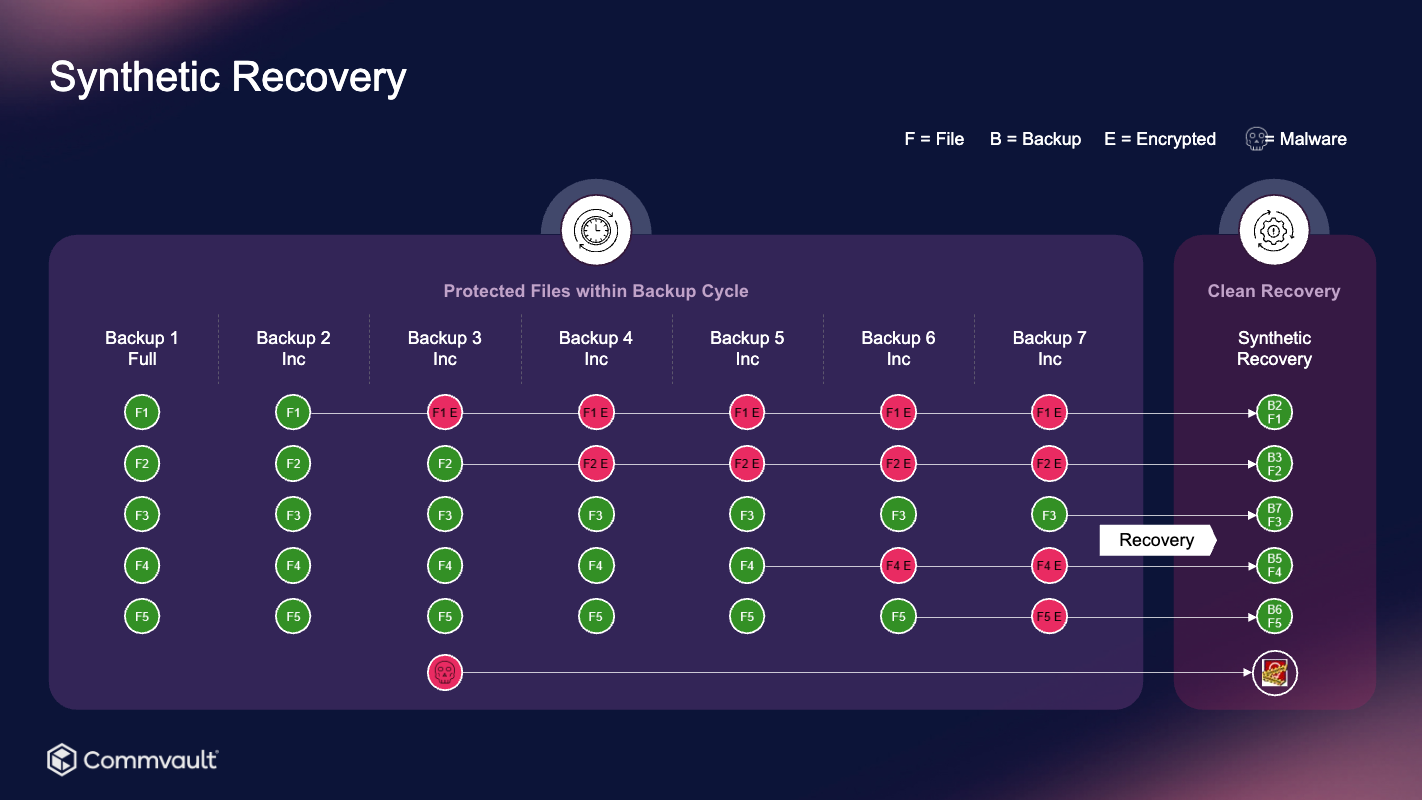
Synthetic Recovery automates the process of Cleanpoint™ identification, assembly, and restore of only the most recent uncorrupted file versions across entire backup data estates.
By drawing on AI-enabled  insights across multiple backups, Commvault can assemble a curated recovery point that can help:

  • Speed up restoration by automating clean data assembly, reducing downtime from hours to minutes.
  • Prevent reinfection by excluding encrypted or malicious files before recovery begins.
  • Minimize rollback by keeping the most current, validated file versions of good data.
  • Simplify recovery across workloads, clouds, and storage environments.

The result? Faster recoveries, cleaner outcomes, and unified operations that strengthen enterprise resilience from the inside out.

AI Precision at Work

Synthetic Recovery is powered by Commvault’s AI-enabled  multi-engine threat detection and response – a system that combines behavioral analytics, static signatures, machine learning, heuristic detection, YARA-rule and Hash scanning, and security partner signals to spot both known and zero-day threats with exceptional accuracy.
This intelligent automation helps Commvault customers build assurance that every recovery is validated, clean, and secure – not only restoring your data, but also your confidence in it.

Unified Resilience for Modern Operations

For today’s IT and security teams, Synthetic Recovery represents more than a feature – it’s a mindset shift. It transforms recovery from a reactive process into a strategic, automated resilience capability.
By bringing together cloud-native protection, advanced detection, andidentity resilience in one platform, Commvault empowers enterprises to move faster, recover smarter, and operate with certainty – even in the face of the unexpected.


FAQs

Q: What is Synthetic Recovery?

A: Synthetic Recovery™ is a new Commvault capability within the Threat Scan offering that automates clean and verifiable data recovery after a cyberattack. It identifies and assembles the most recent uncorrupted file versions from entire backup estates across multiple virtual machines and files, creating a single, curated recovery point. This helps organizations restore operations faster, cleaner, and with confidence, while minimizing rollback and reinfection risk.
Q: Why is Synthetic Recovery important now?

A: Modern ransomware and malware threats are increasingly stealthy, often lying dormant for days or weeks before activation. During that time, malicious data can silently enter backup sets. When that happens, traditional recovery methods risk restoring infected data. Synthetic Recovery helps solve this by combining AI-enabled threat detection, Cleanpoint™ identification, and automated clean data assembly to enable that only verified, healthy data is brought back online.
Q: How does Synthetic Recovery differ from traditional recovery methods?

A: Traditional clean recovery workflows rely on manual steps such as creating isolated recovery environments, manually restoring data for external scanning, and guessing at the “last known good” recovery point.
Synthetic Recovery removes that guesswork. Using Commvault’s indexed backup data and AI-enabled threat detection, it automatically identifies and replaces compromised files, generating a dataset ready for immediate recovery – no manual validation required.
Q: What role does AI play in Synthetic Recovery?

A: Synthetic Recovery leverages Commvault’s AI-enabled multi-engine threat detection and response framework. This includes:

  • Behavioral analysis to detect unusual file activity.
  • Machine-learning models that recognize encryption and ransomware patterns.
  • Static and signature-based scanning for known threats.

For a complete list of Commvault Threat Scan detection techniques, request a demo.
Q: How does Synthetic Recovery help reduce reinfection risk?

A: Because Synthetic Recovery excludes files identified as malicious or encrypted, it helps validate that compromised data never re-enters production environments. This can break the reinfection cycle, giving teams confidence that every restored file has been validated as safe – based on AI analysis and Commvault’s multi-engine threat intelligence.
Pauline List is a Product Marketing Specialist at Commvault.

More related posts


Thumbnail_Blog-SHIFT-Announcement-Recover-Clean-2025-Linkedin

Recover Clean, Recover Fast

Read more about Recover Clean, Recover Fast
Thumbnail_Blog-SHIFT-Announcement-Commvault-Cloud-Unity-2025-Linkedin

A New Era of Enterprise Resilience

Read more about A New Era of Enterprise Resilience
Thumbnail_Blog-SHIFT-Announcement-Next-Evolution-2025-Linkedin

The Next Evolution in Cloud Data Protection

Read more about The Next Evolution in Cloud Data Protection
Thumbnail_Blog_Modern-Playbook-2025

Your Modern Playbook for Rapid Response and Clean Recovery

Read more about Your Modern Playbook for Rapid Response and Clean Recovery

Die wichtigsten Erkenntnisse

  • Commvault führt ein „Dedicated Tenant“-Modell ein, das eine isolierte SaaS für Unternehmen mit strengen Anforderungen an Sicherheit, Souveränität und Kontrolle bietet.
  • KI-gestützte einheitliche Governance erkennt Workloads, klassifiziert Daten und empfiehlt Schutzrichtlinien, um die Compliance und Risikominderung in Hybrid- undcloud zu optimieren.
  • Die platform sofortige Transparenz über geschützte und ungeschützte Workloads und deren Kosten und trägt so dazu bei, Risiken zu reduzieren und die Gesamtbetriebskosten zu optimieren.
  • Regionale Bereitstellungskontrolle und Unterstützung für getrennte Mandanteninfrastrukturen gemäß den Anforderungen von DSGVO, HIPAA und FedRAMP.
  • Gemeinsam ermöglichen eine dedizierte Isolierung und eine KI-gestützte Überwachung einen widerstandsfähigen, zukunftsorientierten Schutz für geschäftskritische Ressourcen in stark regulierten Branchen.

Highly regulated industries like healthcare, finance, and government face mounting cyber resilience challenges driven by evolving regulations such as GDPR, HIPAA, and FedRAMP, alongside increasingly sophisticated ransomware attacks.

Operating across complex hybrid environments – where sensitive data spans on-premises systems, public clouds, and SaaS platforms – further amplifies these risks. The need to help maintain consistent data protection policies, enforce sovereignty and compliance controls, and manage visibility across fragmented infrastructures makes resilience especially difficult.

Commvault has announcedCommvault Cloud Unity-PlattformCommvault Cloud Unity platform release„Dedicated Tenant“ and AI-enabled unified governance. This release marks a major step in the evolution of cloud-native data protection, particularly for mission-critical resources in highly regulated industries.

This update brings AI-enabled classification and dedicated, isolated environments to the forefront, empowering modern enterprises to protect mission-critical data and maintain compliance across hybrid and multi-cloud operations.

„Dedicated Tenant“: Fully isolated SaaS deployment model designed for large enterprises and highly regulated industries that require stringent compliance, sovereignty, and control. It delivers the same preisgekrönteCommvault Cloud experience in a dedicated environment, combining SaaS agility with enterprise-grade isolation and regulatory assurance.

AI-enabled unified governance: Intelligent visibility and automation across hybrid and multi-cloud environments, simplifying compliance, policy management, and risk mitigation. By leveraging AI to unify oversight across data estates, organizations can more easily identify gaps, enforce consistent protection policies, and strengthen overall cyber resilience.

The new platform introduces an AI-enabled experience that automatically discovers workloads across cloud estates and recommends protection policies based on workload classification. This approach is particularly valuable for mission-critical resources and helps enable organizations to:

  • Identifizieren und klassifizieren Sie sensible Daten in verschiedenen cloud schnell.
  • Wende automatisch passende Schutzrichtlinien an, die auf der Klassifizierung der Arbeitslasten basieren.
  • Gain instant visibility into protected and unprotected workloads, along with their associated costs – helping reduce risk exposure and optimize total cost of ownership.

Für Branchen, die mit sensiblen Daten umgehen, wie Finanzdienstleister oder das Gesundheitswesen, ist diese Art der KI-gestützten Klassifizierung von entscheidender Bedeutung. Sie hilft Betreibern dabei, hochsensible Workloads mit einem angemessenen Schutzniveau zu schützen und sowohl die Anforderungen an die Geschäftskontinuität als auch die gesetzlichen Compliance-Standards zu erfüllen.

Enhanced Protection and Privacy with „Dedicated Tenant“

For large enterprises in highly regulated industries, Commvault Cloud has released a „Dedicated Tenant“ offering designed for organizations with strict security, compliance, or sovereignty requirements that require strict isolation of compute, network, and storage infrastructure from other customers. It delivers the same features and UI/UX as the standard Commvault Cloud platform, mit dem zusätzlichen Vorteil der Isolierung von anderen Mandanten. Diese spezielle SaaS stellungsoption bietet:

  • Isolated environments: Customers are provisioned with dedicated SaaS environments that help keep compute, storage, and management resources completely isolated from unrelated tenants.
  • Regional control: The ability to select geographic regions for deployment helps meet sovereignty and compliance mandates.
  • Regulatory assurance: By separating tenant infrastructure, a dedicated tenant helps simplify audits and helps customers demonstrate compliance with frameworks such as HIPAA, FedRAMP, and GDPR.

Einheitliche Governance und isolierte Kontrolle

Commvault Cloud’s latest platform release, featuring „Dedicated Tenant“ and AI-enabled classification and governance, marks a pivotal advancement in data protection for highly regulated industries. By uniting AI-enabled classification, compliance intelligence, and dedicated, isolated SaaS environments, Commvault delivers a comprehensive solution for helping protect mission-critical resources across complex, multi-cloud ecosystems.

As data environments grow more distributed and compliance demands intensify, these innovations help empower organizations to achieve operational continuity, maintain regulatory confidence, and build resilient, forward-facing data protection frameworks that evolve with the pace of modern business.


FAQs

Q: What is Commvault Cloud „Dedicated Tenant“, and who is it for?
A: „Dedicated Tenant“ is a fully isolated SaaS deployment of Commvault Cloud that separates compute, storage, network, and management resources from other customers. It’s designed for large enterprises and regulated sectors that need tight control, sovereignty, and audit-friendly separation without giving up SaaS agility.

Q: How does the AI-enabled unified governance help day to day?
A: It automatically discovers workloads across clouds, classifies sensitive data, and recommends appropriate protection policies so teams can act faster and more consistently. This unified oversight helps reduce manual policy drift, highlight coverage gaps, and prioritize remediation to strengthen cyber resilience.

Q: What compliance outcomes does this release support (e.g., GDPR, HIPAA, FedRAMP)?
A: By isolating tenant resources and providing regional control, „Dedicated Tenant“ helps make it easier to demonstrate adherence to sovereignty and regulatory requirements. Unified governance then maps classification to policies, helping organizations document posture and respond to audits with clearer evidence.

Q: How does this reduce risk and total cost of ownership?
A: Continuous visibility into protected vs. unprotected workloads and their associated costs helps enable targeted remediation and smarter allocation of spend. Automated policy recommendations help reduce administrative overhead and the likelihood of costly protection gaps.

Q: What does regional control look like in practice?
A: Organizations can choose deployment regions for their dedicated environment to align with data residency and sovereignty mandates. This geographic placement, combined with isolated infrastructure, helps support regulatory confidence and operational control.

Q: Will this work across my hybrid and multi-cloud environment without adding complexity?
A: Yes ­– the AI-enabled experience is built to unify visibility and governance across on-prem, public cloud, and SaaS workloads. It helps centralize classification and policy management so teams can operate with a single, consistent model across distributed estates.

Cailin Pitcher is a Senior Portfolio Marketing Manager at Commvault.

More related posts


Thumbnail_Blog-SHIFT-Announcement-Recover-Clean-2025-Linkedin

Recover Clean, Recover Fast

Read more about Recover Clean, Recover Fast
Thumbnail_Blog-SHIFT-Announcement-Commvault-Cloud-Unity-2025-Linkedin

A New Era of Enterprise Resilience

Read more about A New Era of Enterprise Resilience
Readiverse_ShareImage_1200x630

The Conversations That Inspired the Readiverse

Read more about The Conversations That Inspired the Readiverse

Commvault Unveils a New Era in Enterprise Resilience with the Commvault Cloud Unity Platform Release

Commvault, a leader in unified resilience at enterprise scale, announced the Commvault Cloud Unity platform release, one of the most substantive platform releases in Commvault’s history. This next-generation, AI-enabled version of Commvault Cloud now unifies data security, cyber recovery, and identity resilience across cloud, SaaS, on-premises, and hybrid environments.

Commvault Transforms How Enterprises Make Clean, Complete, and Automated Cyber RecoveriesCommvault hat bahnbrechende Innovationen angekündigt, die die Art und Weise neu definieren, wie Unternehmen Daten sauber, vollständig und mit fein abgestimmter Automatisierung wiederherstellen können. Ransomware-Angriffe können versuchen, Backup-Speicher zu kompromittieren, wodurch Unternehmen bei ihrem Bestreben, saubere, sichere und vollständige Datenwiederherstellungen zu erreichen, angreifbar werden. Commvault geht diese Herausforderung von Anfang bis Ende an.Commvault Expands End-to-End Identity Resilience: Detect, Log, and Reverse Hard-to-Detect Threats in Active Directory

Commvault announced an expansion of its end-to-end Identity Resilience portfolio – enabling customers to find hard-to-detect threats in Active Directory (AD), automatically log and audit malicious changes, and then rapidly roll back changes to a trusted, clean state. The company also announced advancements to its Active Directory forest recovery offering that helps teams test recovery plans in good times, so they are ready for the bad times.

Commvault Cloud Unity Platform Release Brings New Levels of Simplicity, Scalability, Cost Optimization, and Resilience for Cloud-first Enterprises

Commvault announced the company is setting a new benchmark for cloud-native data protection. Purpose-built for cloud-first and hybrid enterprises, the new release introduces a re-engineered experience designed for simplicity, speed, scale, and cost optimization, as Commvault centralizes resilience operations across clouds, regions, and accounts. With AI-enabled discovery, classification, and protection policy recommendations, this platform is designed to scale resilience in minutes across multi-cloud environments – at the best TCO.

More related posts


Thumbnail_Blog-Dangerous-Silos-IDC-Resops-2026 (1)

The Importance of Recovery Point Objective (RPO) in Your Business Continuity Plan

Read more about The Importance of Recovery Point Objective (RPO) in Your Business Continuity Plan
Thumbnail_Blog-IDC-Resops-2026

Business Continuity Planning for the Cloud-Native Era

Read more about Business Continuity Planning for the Cloud-Native Era
Thumbnail_Blog-Bringing-Trust-to-CVE-2026

Demystifying SOC 2 Data Protection Requirements

Read more about Demystifying SOC 2 Data Protection Requirements

November is a special month that honors the service and sacrifice of our men and women in the military.

We not only recognize Veterans Day, a day to celebrate those who have served and continue to serve in the United States, but we also recognize Remembrance Day across many of the Commonwealth countries – including United Kingdom, Australia, New Zealand, and Canada – to honor the ultimate sacrifice of those who gave their lives in service to their country. Though the tone differs for each of these days, one celebratory and one reflective, both honor courage, sacrifice, and commitment to something greater than oneself.

How Service and Sacrifice Unite Us Worldwide

These days certainly hold the value of one truth that is undisputed – that service and sacrifice are universal. These are values that transcend borders and unite allies and communities worldwide. As a U.S. Navy veteran currently living in Australia, I am filled with pride to see how this universal spirit of service carries across borders and cultures globally.

Here in Australia, as a U.S. veteran and as a key ally, we are invited to celebrate and be recognized with our brothers and sisters on Remembrance Day. Ceremonies across the nation reflect on the importance of our global brothers and sisters in arms and the ongoing commitment and sacrifices we continue to share on the battlefield abroad and here at home.

The Power of Operating as One Unified Team

The global culture we have at Commvault means that we are all one team, working together on the common goal of defeating threats and protecting our businesses and communities. Our resilience, teamwork, and shared belief that we always have each other’s back reminds me of the values and principles of being in the military and on the battlefield.

Integrating Key Values From Service Into the Workplace

As I reflect on November, I often think about what service means to me. Service is a lifelong commitment to giving with purpose, acting with integrity, and standing up for those who can’t stand up for themselves. It’s about doing what is right, not for recognition, but because it’s the right thing to do. The military has had a profound impact on my leadership style. It taught me to stay calm under pressure, lead from the front, and ensure no one is left behind. These principles have shaped my approach to leadership at Commvault.

Today, my team in APAC knows my three key principles of success: focus, cadence, and discipline. We focus on our goals, establish a consistent rhythm for our business, and maintain the discipline to adapt and persist until we succeed. Other military-inspired leadership principles I practice at Commvault include:

  • Mit Empathie und Klarheit führen.
  • Während des Wandels auf die Mission fokussiert bleiben.
  • Teams aufbauen, die auf Vertrauen, Inklusion und gemeinsamen Zielen basieren.

Like the core values I learned in service, Commvault thrives on resilience, purpose, and the drive to protect what matters. 

Creating a Culture of Community and Belonging

It gives me such pleasure to have served my country and our allies, and I am honored to work for a company that recognizes and supports our veterans. Not only does Commvault value resilience and teamwork, we have wonderful volunteer and community initiatives supporting organizations like Warrior Canine Connection and a dedicated Employee Resource Group – VALOR – focused on bringing awareness to the value our veterans bring to the private and public sector. To learn more about our culture of care, klicken Sie hier. In diesem Monat November möchte ich Sie alle dazu ermutigen, inne zu halten und das Opfer zu würdigen, das alle unsere Männer und Frauen in Uniform täglich bringen. Und wenn Sie heute zufällig einem aktiven Militärangehörigen oder einem Veteranen begegnen, danken Sie ihnen bitte für ihren Dienst.Martin Creighan is Vice President, APAC, at Commvault.

More related posts


Thumbnail_Blog-Dangerous-Silos-IDC-Resops-2026 (1)

The Importance of Recovery Point Objective (RPO) in Your Business Continuity Plan

Read more about The Importance of Recovery Point Objective (RPO) in Your Business Continuity Plan
Thumbnail_Blog-IDC-Resops-2026

Business Continuity Planning for the Cloud-Native Era

Read more about Business Continuity Planning for the Cloud-Native Era
Thumbnail_Blog-Bringing-Trust-to-CVE-2026

Demystifying SOC 2 Data Protection Requirements

Read more about Demystifying SOC 2 Data Protection Requirements

In every customer meeting over the past year, there’s been a moment where the conversation shifts from technology to business strategy to justifying an investment in cyber resilience. No longer are you – as CIOs and technologists – yearning for that seat at the table. It’s yours, and you need to be ready and empowered to lead the conversation.

We’ve Heard You

In thousands of conversations that I’ve had with our customers, I’ve heard three consistent themes:

  1. “Help us connect resilience to business outcomes.”

We know you don’t struggle with understanding backup technology. What we hear are your struggles with articulating why resilience matters to executives who think about revenue, market share, and competitive advantage, not RTO and RPO.

You need ways to translate technical capabilities into business value: benchmark data that shows where you stand compared to peers; quick, digestible perspectives from executives who’ve made these cases successfully.

  1. “Give us insight into what’s actually happening in the threat landscape.”

Security threats are daily headlines. AI-enabled attacks are evolving faster than ever. But which threats actually matter to your business? Which vulnerabilities should you address first? What are your peers seeing in real incidents?

You want curated intelligence, not more noise. You want analysis from people who’ve been CISOs and CIOs, who understand the difference between a theoretical threat and a practical business risk. You need to understand both how AI is being weaponized by attackers and how to secure your own AI implementations.

  1. “Show us what good looks like.”

When I’ve asked you, “Are you ready for the next disruption?”, many of you have honestly answered, “I don’t know.” Not because you lack capabilities, but because you lack clear benchmarks.

You want to understand: What does minimum viable recovery actually mean for your business? Where should you be on the maturity curve? What are the must-have capabilities vs. nice-to-haves? How do high-performing organizations approach resilience differently?

Vom Kundenfeedback zum Kundennutzen

Readiverse exists because we listened to these conversations. We heard what you were asking for – and we built a destination that delivers it.

This isn’t a content marketing play. It’s not a place to promote products or push sales messages. It’s a purpose-built learning platform designed to make you more successful by giving you what you’ve been asking for all along:

Strategic resources you can use immediately: Readiness assessments, regulatory guides, and intelligence briefs that help you operate more effectively in your role. Bold Takes: 60-second executive perspectives on what matters right now in cyber resilience.

Intelligence that matters to your business: Analysis of emerging threats, market shifts, and regulatory changes, filtered through a business impact lens by experts who’ve been in your seat.

Peer learning and expert insight: Conversations with other CXOs navigating the same challenges. Technical deep-dives from our field experts. Hands-on workshops that sharpen response capabilities.

Die Höhe, die Ihren Bedürfnissen entspricht

WasReadiverse different is that it operates at two altitudes, because you do, too.

If you’re a CISO or CIO, you need executive-level insight for board meetings and strategic planning. But you also need practical, tactical guidance when you’re pressure-testing incident response plans or implementing new recovery capabilities.

If you’re a practitioner, you need hands-on skills to respond when the alert comes at 2 a.m. But you also want to understand the strategic context so you can grow in your career and contribute to bigger conversations.

Readiverse serves both mindsets. Both altitudes. Because readiness isn’t just about tools and technology. It’s about building awareness and capability across every stage of the cyber resilience lifecycle.

Ein stets verfügbarer Ort für kontinuierliches Lernen

A key insight from all these customer conversations? Readiness isn’t a one-time achievement. It’s continuous.

Threats evolve. AI advances. Regulations change. Business priorities shift. The resilience strategy that worked last year might not be sufficient for what’s coming next. You need a place you can return to again and again, not just for information, but for strategic guidance, practical learning, and community.

That’s what the Readiverse is built to be: an always-on destination where strategic insight meets practical learning. A living platform that grows and evolves as the threat landscape changes. A place you can rely on to stay ready, not just today, but continuously.

Because a great customer experience isn’t just delivering great technology. It’s being a trusted partner who helps you succeed in your most critical mission: helping keep your business ready for whatever comes next.

Discover the Readiverse at Readiverse.com – built from customer conversations, designed for customer success. We can’t wait to hear what you think and keep these conversations going.

Sarv Saravanan is Chief Customer Officer at Commvault.

More related posts


Thumbnail_Blog-Dangerous-Silos-IDC-Resops-2026 (1)

The Importance of Recovery Point Objective (RPO) in Your Business Continuity Plan

Read more about The Importance of Recovery Point Objective (RPO) in Your Business Continuity Plan
Thumbnail_Blog-IDC-Resops-2026

Business Continuity Planning for the Cloud-Native Era

Read more about Business Continuity Planning for the Cloud-Native Era
Thumbnail_Blog-Bringing-Trust-to-CVE-2026

Demystifying SOC 2 Data Protection Requirements

Read more about Demystifying SOC 2 Data Protection Requirements

Here at Commvault, our values – we connect, we inspire, we care, and we deliver – are foundational to everything we do and why it matters.

Diese Woche haben wir unsere vierteljährliche Global Town Hall-Versammlung abgehalten und unsere „Living Our Values Awards” für das zweite Quartal des Geschäftsjahres 2026 verliehen. Mit diesem Award-Programm werden unsere Vaulters weltweit für ihre unglaubliche Arbeit im vergangenen Quartal und dafür, dass sie unsere Werte jeden Tag leben, gewürdigt und gefeiert.

I’m so proud to announce our FY26 Q2 CEO Living Our Values Award winners and our employee-nominated Vaulters’ Choice Award winner below:

Gewinner der CEO-Auszeichnung

Shree Kumar Bakthavatsalam

Shree Kumar Bakthavatsalam

Courtenay Klein

Courtenay Klein

Mahesh Prakash Rao

Mahesh Prakash Rao

Brandon Smith

Brandon Smith

Masao Watanabe

Masao Watanabe


Vaulters’ Choice Award Winner

Mia Watson

Mia Watson

Diese Vaulter geben ein inspirierendes Beispiel dafür, was es wirklich bedeutet, ein Teil von Commvault zu sein. Um mehr darüber zu erfahren, wie es ist, bei Commvault zu arbeiten, besuchen Sie unsereKarriereseite.

More related posts


Thumbnail_Blog-Dangerous-Silos-IDC-Resops-2026 (1)

The Importance of Recovery Point Objective (RPO) in Your Business Continuity Plan

Read more about The Importance of Recovery Point Objective (RPO) in Your Business Continuity Plan
Thumbnail_Blog-IDC-Resops-2026

Business Continuity Planning for the Cloud-Native Era

Read more about Business Continuity Planning for the Cloud-Native Era
Thumbnail_Blog-Bringing-Trust-to-CVE-2026

Demystifying SOC 2 Data Protection Requirements

Read more about Demystifying SOC 2 Data Protection Requirements

It shouldn’t come as a surprise, but AI is no longer a trend. It is the foundational capability embraced in every corner of your organization. However, the rush to automate and accelerate an organization’s strategies and processes is introducing new complexities and risks to an organization’s resilience.The good news is this rapid investment and innovation has enabled us – as CIOs – to have healthier, more productive conversations with senior leaders who want to better understand how AI impacts the organization’s risk and resilience. They are no longer asking if the data is backed up.Today, our conversations with the C-suite are all about whether we can trust the riesigen Mengen an KI-generierten Daten that is being used to drive critical decisions. It forces us to rethink resilience in the AI era. After all, between the complexity and autonomy of AI systems, and the speed and scale at which the data is growing, there are new risks like model bias, data leakage, and an over-reliance on automation.Consequently, resilience has evolved from just protecting the infrastructure to protecting the integrity of our decision-making capabilities. It’s up to us as CIOs to navigate AI’s use and governance internally as well as our readiness and resilience in the event of disruption or a cyberattack.At Commvault, we are moving quickly to experiment with AI in ways that add value, but not recklessly. With transparency, accountability, and business alignment as our core principles, we believe governance isn’t a checklist – it must guide decision-making. We’ve also added guardrails around data access, use, and resiliency.Additionally, the complexity and expansive scale of AI presents new gaps for bad actors to exploit. In response, we are partnering with our CISO and security team. By bringing our resilience priorities, organizations, and systems closer together, we are better able to detect, respond, and if necessary, recover our AI data following a disruption. One team without the other won’t work.Finally, the AI evolution is also elevating the skills required for IT teams. While technical depth is essential, we need team members who are curious, adaptable, and understand not just how AI works, but how it fits into workflows, governance models, and resilience planning. This includes having strong communicators aligned with the business functions who can help us translate AI’s impact in business terms and measure ROI.In summary, AI doesn’t replace the fundamentals of resilience; it raises the stakes. The organizations that will thrive are those that can harness AI to move faster and smarter, while at the same time building the guardrails and recovery strategies that keep them strong when things go wrong.Resilience is no longer just about surviving disruptions. Organizations must create the confidence to innovate boldly, knowing we can adapt and recover at scale. To learn more, I encourage you to register for Commvault’s Virtual SHIFT event on Nov. 19.Ha Hoang is Chief Information Officer at Commvault.

More related posts


Thumbnail_Blog-Dangerous-Silos-IDC-Resops-2026 (1)

The Importance of Recovery Point Objective (RPO) in Your Business Continuity Plan

Read more about The Importance of Recovery Point Objective (RPO) in Your Business Continuity Plan
Thumbnail_Blog-IDC-Resops-2026

Business Continuity Planning for the Cloud-Native Era

Read more about Business Continuity Planning for the Cloud-Native Era
Thumbnail_Blog-Bringing-Trust-to-CVE-2026

Demystifying SOC 2 Data Protection Requirements

Read more about Demystifying SOC 2 Data Protection Requirements

Every organization wants to believe it’s ready for a cyberattack. But “ready” and “resilient” aren’t the same thing. Readiness means you have a plan. Resilience means you know it will work – fast, clean, and under pressure. To stay resilient, your cyber recovery readiness must evolve alongside your business and the ever-changing threat landscape.

Read more about cyber recovery readiness planninghier.

The goal is to keep your recovery capabilities aligned with what matters most to your organization. That’s whier minimum viable recovery (MVR) comes in. Commvault and GigaOm define MVR as the minimum level of recovery performance your organization must achieve to maintain critical operations after a cyberattack.

MVR helps you focus first on restoring your essential business functions, so you can resume operations faster and with measurable confidence.

Download theGigaOm-Bericht „Minimum Viable Recovery“to explore how you can take readiness to the next level.

Cyber Recovery Minimum Viability Assessment

Understanding cyber recovery theory is one thing. Knowing how ready your organization truly is? That’s another. The Commvault Minimum Viability Self-Assessment helps you close that gap.

In just a few minutes, it evaluates your current recovery capabilities, highlights potential vulnerabilities, and benchmarks your readiness against industry best practices. The result is a personalized report that shows whier you stand today and what steps to take next to advance toward MVR – helping your business recover faster, with greater confidence and measurable resilience.

Take the assessment.

Workshop zur Cyber-Resilienz

This interactive workshop, offered in cities worldwide, guides participants through the process of creating a robust cyber recovery plan. Using real-world scenarios, the workshop helps organizations develop strategies to withstand and recover from cyberattacks.

Sign up for a workshop.

Don’t Wait to Act

If you wait for a cyberattack to expose your weaknesses, it might be too late. By taking a proactive approach to cyber recovery readiness, you can help minimize the impact of an attack, avoid costly downtime, and support continuous business.

Cyber recovery readiness isn’t just about technology; it’s about having the right mindset, the right skills, and the unwavering determination to protect your organization. It’s also about rigorously testing your recovery plans to validate they work when you need them most. Leverage Commvault’s resources and expertise to help assess your current posture, develop a comprehensive plan, and build a truly resilient organization.

Because in the end, resilience isn’t luck. It’s preparation, proven.

Chris DiRado is Principal Technologist, Product Experience, at Commvault.


More related posts


Thumbnail_Blog-Dangerous-Silos-IDC-Resops-2026 (1)

The Importance of Recovery Point Objective (RPO) in Your Business Continuity Plan

Read more about The Importance of Recovery Point Objective (RPO) in Your Business Continuity Plan
Thumbnail_Blog-IDC-Resops-2026

Business Continuity Planning for the Cloud-Native Era

Read more about Business Continuity Planning for the Cloud-Native Era
Thumbnail_Blog-Bringing-Trust-to-CVE-2026

Demystifying SOC 2 Data Protection Requirements

Read more about Demystifying SOC 2 Data Protection Requirements

Die wichtigsten Erkenntnisse

  • Commvault’s Data Rooms offering transforms backup data into trusted, AI-ready assets while helping maintain governance and compliance.
  • Das Angebot verbindet Datenschutz und KI-Aktivierung, ohne neue Sicherheitsrisiken zu schaffen oder platform weitere platform zu erfordern.
  • Es lässt sich mithilfe offener Standards wie Apache Parquet und Iceberg in bestehende KI-Ökosysteme wie Microsoft Azure und Snowflake integrieren.
  • Die integrierte Governance ermöglicht eine sichere Datenverwaltung, -klassifizierung und -freigabe innerhalb einer Zero-Trust-Architektur.
  • Durch die Aktivierung historischer Daten können Unternehmen dazu beitragen, KI-Innovationen, Analysen und Compliance-Workflows sicher zu beschleunigen.

AI innovation depends on data – but not just any data. It depends on trusted, governed, and accessible data. Yet for most enterprises, the data that could fuel AI lives deep within backups, scattered across environments, and wrapped in compliance constraints. That’s where Commvault’s Data Rooms offering comes in.

KI sicher beschleunigen

Commvault’s Data Rooms offering transforms backup data – one of the most complete and trusted datasets an organization owns – into AI-ready assets. This new offering helps enterprises safely connect their data to AI and analytics platforms, without creating new risks or complexity.

Unlike other approaches that bring AI models into backup environments, expanding the attack surface and compliance exposure, Commvault does the opposite. We bring governed, policy-controlled data to the AI ecosystems customers already use, preserving their freedom of choice and avoiding vendor lock-in.

The Data Rooms offering is not another AI platform. It’s the bridge between data protection and data activation, designed to make your existing AI investments work faster and safer. It does this by creating governed, policy-controlled “rooms” inside Commvault Cloud – spaces where data can be classified, curated, and shared securely with AI and analytics tools without leaving the protection boundary.

Auf Kunden hören: Schluss mit Platform

We heard customers loud and clear: You don’t need another AI platform. You need a secure, simple way to use the data you already protect – across the AI tools and ecosystems you’ve already chosen.

That’s why Commvault built Data Rooms to integrate with partners like Microsoft Azure and Snowflake using open-standard formats such as Apache Parquet and Iceberg. This helps you keep your data portable, policy-compliant, and ready for activation – wherever your AI strategy takes you.

den traditionellen „Extract, Transform, Load“ („ETL“)-Workflow nach wie vor zeitaufwändig und kann Compliance-Risiken mit sich bringen, wenn er nicht ordnungsgemäß geregelt wird.

With Data Rooms, authorized users can discover, classify, and prepare data directly from backup repositories – across on-premises and cloud environments. Built-in governance helps maintain control, allowing only approved datasets to be shared, with automated classification, sensitivity tagging, redaction, and audit trails applied every step of the way.

Data Rooms acts as a governed, policy-controlled workspace inside Commvault Cloud – where data can be securely curated and made available to AI or analytics tools without leaving the protection boundary. This governed design provides a secure bridge between backup data and activation workflows, helping organizations unlock their information for innovation while maintaining full compliance and control.

Data Rooms can help you:

  • Accelerate insights: Quickly find and export historical data in AI-friendly formats to train models or power analytics.
  • Simplify operations: Eliminate brittle ETL pipelines with automated data discovery and curation.
  • Maintain compliance: Keep governance intact with policy-based controls and traceability from backup to activation.

Vertrauen als Grundlage für verantwortungsvolle KI

In der Eile, KI einzuführen, wird Vertrauen oft zum Kollateralschaden. Laut einer aktuellenStudiegaben rund drei Viertel der befragten IT-Führungskräfte an, dass der Einsatz von KI ihre Unternehmen anfälliger fürCyberangriffe. That’s why Commvault built Data Rooms within Commvault Cloud’s zero-trust architecture, complete with encryption, RBAC, and audit-ready compliance.

By combining data protection, governance, and activation in one platform, Commvault enables enterprises to accelerate AI innovation without compromising security, compliance, or control.

Innovation beschleunigen, ohne Risiken einzugehen

Commvault’s Data Rooms offering helps organizations move faster by making data safely accessible to the tools that drive their business forward – from AI model training to analytics, eDiscovery, and compliance automation. Because when backup data becomes usable data, enterprises unlock years of historical intelligence and context that most AI models simply don’t have.

As Pranay Ahlawat, Commvault’s Chief Technology and AI Officer, said: “Organizations are beginning to realize that their historical data is more than just insurance – it’s a powerful, untapped strategic asset. With Commvault Data Rooms, enterprises can confidently export their secondary data and harness it with the AI platform of their choice to unlock new opportunities for intelligence, innovation, and business growth.”

Warum es jetzt wichtig ist

Commvault’s Data Rooms offering redefines what’s possible for enterprises that want to innovate responsibly. They make it possible to move from protecting data to activating data – safely, flexibly, and at scale.

In short: Commvault isn’t building another AI platform. We’re building the foundation that lets every AI platform work better – because when data is protected, trusted, and ready for activation, innovation happens faster.

FAQs

Q: What is Commvault’s Data Rooms offering?

A: Commvault Data Rooms is a new capability within Commvault Cloud that helps enterprises safely discover, classify, and activate backup data for AI and analytics. It bridges data protection and data intelligence, giving organizations governed, self-service access to trusted data assets for analysis and innovation.


Q: How does Data Rooms differ from other AI data solutions?

A: Most AI data prep tools work only on live or production data, creating compliance and cost challenges. Data Rooms works from backup data – data that’s already protected and governed – bringing a unique balance of accessibility, compliance, and trust. It’s built into Commvault Cloud’s policy-controlled environment, so it’s part of a unified cyber resilience platform.


Q: What benefits do organizations gain from using Data Rooms?

A: Organizations can help accelerate AI and analytics insights, simplify data operations by reducing ETL complexity, and maintain compliance through automated classification, tagging, and auditing processes.


Q: How does Data Rooms support data security and compliance?

A: Data Rooms operates within Commvault Cloud’s zero-trust architecture, applying classification, redaction, and audit-ready controls automatically. It helps maintain data privacy, traceability, and compliance throughout the data lifecycle, aligning with internal and regulatory governance standards.


Q: What types of AI or analytics platforms can connect with Data Rooms?

A: Data Rooms integrates with leading cloud and AI partners such as Microsoft Azure and Snowflake, supporting open-standard data formats like Apache Parquet and Iceberg for maximum flexibility and portability.


Q: Why is this offering important for enterprises today?

A: As organizations accelerate AI adoption, Data Rooms enables them to responsibly unlock the value of historical, protected data – fueling innovation while maintaining trust, compliance, and control.


Vir Choksi is Principal Product Marketing Manager at Commvault.


More related posts


Thumbnail_Blog-Dangerous-Silos-IDC-Resops-2026 (1)

The Importance of Recovery Point Objective (RPO) in Your Business Continuity Plan

Read more about The Importance of Recovery Point Objective (RPO) in Your Business Continuity Plan
Thumbnail_Blog-IDC-Resops-2026

Business Continuity Planning for the Cloud-Native Era

Read more about Business Continuity Planning for the Cloud-Native Era
Thumbnail_Blog-Bringing-Trust-to-CVE-2026

Demystifying SOC 2 Data Protection Requirements

Read more about Demystifying SOC 2 Data Protection Requirements

Resilienz im Dialog: Der neue Ansatz zur Verwaltung und zum Schutz von Unternehmensdaten

Conversational resilience is a Commvault® Cloud capability that lets you manage and protect data through natural language.

Updated May 2026

Entdecken Sie weitere Ressourcen

Datenblatt

KI in Commvault Cloud

Von Automatisierung und maschinellem Lernen bis hin zu fortschrittlicher KI: Erfahren Sie, wie Metallic AI dazu beiträgt, jeden Aspekt der Commvault Cloud Platform leistungsfähiger und effizienter zu machen.
Lesen Sie das Datenblatt zuabout KI in Commvault Cloud
Whitepaper

Den Weg in eine sichere KI-Zukunft ebnen

Erfahren Sie, wie Commvault Unternehmen dabei unterstützt, den Weg in die KI-Zukunft zu beschreiten und gleichzeitig Ihre wichtigsten Daten zu schützen.
Lesen Sie das Whitepaper zurabout Den Weg in eine sichere KI-Zukunft ebnen

We’re proud to announce that Commvault has been named a Market Leader Cyber Resilience in the „2025 Top InfoSec Innovator Awards“, presented by Cyber Defense Magazine.“Commvault embodies three major features we judges look for with the potential to become winners: understanding tomorrow’s threats today; providing a cost-effective solution; and innovating in unexpected ways that can help mitigate cyber risk and get one step ahead of the next breach,” said Gary S. Miliefsky, the magazine’s publisher.This recognition celebrates organizations that are innovating in unexpected and effective ways – providing cost-efficient, cutting-edge cybersecurity solutions that help businesses mitigate risk and stay one step ahead of evolving threats.

Stärkung der Cyber-Resilienz für die reale Welt

As cyber threats become more complex and persistent, organizations need solutions that go beyond prevention – they need the ability to recover their minimal funktionsfähigen Anwendungen quickly and continue operating with confidence. Commvault’s industry-leading cyber resilience portfolio, Commvault® Cloud, helps customers do just that.By unifying advanced data protection, threat detection, and autonomous recovery orchestration, Commvault enables enterprises to anticipate, withstand, and recover from attacks – empowering them to safeguard their business continuity and reputation in a dynamic threat landscape.

Eine Verpflichtung zu kontinuierlicher Innovation

“This award underscores Commvault’s leadership in helping organizations prepare for and respond to the cyber challenges of today and tomorrow,” said Bill O’Connell, Chief Security Officer at Commvault. “Our mission is to empower customers with intelligent, integrated solutions that make cyber resilience achievable and measurable – so they can stay focused on driving their business forward, not fighting fires.”

Ausblick

Angesichts der sich ständig weiterentwickelnden Bedrohungen setzt sich Commvault weiterhin dafür ein, durch Intelligenz, Automatisierung und Vertrauen Cyber-Resilienz der nächsten Generation zu bieten. Diese Anerkennung spiegelt unser kontinuierliches Engagement wider, Kunden dabei zu unterstützen, selbst die raffiniertesten Cyber-Bedrohungen zu überlisten, zu überdauern und zu übertreffen.Erfahren Sie mehr darüber, wie Commvault Unternehmen dabei unterstützt, Widerstandsfähigkeit gegen Ransomware und Cyberangriffe aufzubauen, indem Sie an unserer bevorstehendenSHIFT NYCoderSHIFT Virtual.Thomas Bryant is Senior Director, Product Marketing, at Commvault.

Verwandte Blogs

More related posts


Cyber Resilience

Read more about Cyber Resilience

Ransomware hat sich erneut weiterentwickelt. Sie ist schneller, intelligenter und zielgerichteter als je zuvor. Was einst ein lästiges Ärgernis in Form von Datenverschlüsselung war, hat sich zu einem vollwertigen Motor für Geschäftsunterbrechungen entwickelt, der durch KI, Automatisierung und eine professionalisierte Cyberkriminalitätswirtschaft angetrieben wird.

Im Jahr 2026 wird es bei Ransomware nicht mehr nur um gesperrte Dateien gehen. Es geht um gestohlene Identitäten, kompromittierte Lieferketten und Betriebslähmungen, die sich innerhalb von Minuten ausbreiten können.

“Agentic AI can reason, plan,undact autonomously, adapting attacks in real timeundlearning from defenders faster than they can respond,” Govind Rangasamy, head of Recovery Solutionsundvice president of Portfolio Marketing at Commvault, wrote in his book, The Cyber Resilience Reckoning.

In kontrollierten Tests, die in dem Buch zitiert werden, gelang es KI-gesteuerter Ransomware, Daten 100 Mal schneller vollständig zu exfiltrieren als menschlichen Angreifern. Dies stellt eine grundlegende Veränderung dar, die ebenso intelligente Abwehrmaßnahmen erfordert.

Für CISOs und IT-Führungskräfte wird 2026 das Jahr sein, in dem Resilienz Prävention als wahren Maßstab für die Bereitschaft ablöst.

Trend 1: Agentic AI Ransomware Takes the Lead

Bedrohungsakteure setzen mittlerweile agentenbasierte KI oder selbstgesteuerte Systeme ein, die Kampagnen von Anfang bis Ende planen und ausführen. Im Gegensatz zu herkömmlichen Tools, die Skripten folgen, können sich diese KI-Agenten an Netzwerkverteidigungen anpassen, während eines Angriffs die Nutzlast ändern und aus Erkennungsreaktionen lernen.

Diese Fähigkeit könnte herkömmliche Strategien überflüssig machen. Verteidiger müssen Angriffen, die mit der Geschwindigkeit einer Maschine erfolgen, mit KI-gestützter Erkennung, Verhaltensanalysen und automatisierten Wiederherstellungstests begegnen, die die Integrität der Wiederherstellung kontinuierlich überprüfen.

Trend 2: Identity Confidence Becomes the New Perimeter

After years of focus on “identity-centric” security, 2026 marks a new stage. Identity confidence, not just access control, will define cyber resilience.

Angreifer nutzen gestohlene Tokens, API-Schlüssel und falsch konfigurierte Berechtigungen aus, um sich in hybriden Umgebungen zu bewegen, ohne Warnmeldungen auszulösen. Die Herausforderung besteht nicht mehr darin, zu überprüfen, wer jemand ist. Es geht darum zu wissen, ob dieser Identität nach einer Kompromittierung noch vertraut werden kann.

As Rangasamy writes, “Resilience isn’t about avoiding failure. It’s about bouncing back from it.”

Die fortlaufende Überprüfung und saubere, überprüfbare Wiederherstellung der Identitätsinfrastruktur tragen dazu bei, das Vertrauen schneller wiederherzustellen, als Angreifer es für ihre Zwecke missbrauchen können.

Trend 3: Supply ChainundSaaS Exploitation Accelerates

Ransomware-Banden nehmen zunehmend Drittanbieter- und SaaS ins Visier, wo ein einziger Angriff Hunderte von Unternehmen betreffen kann. RaaS-Plattformen automatisieren mittlerweile die Erkundung von Lieferantenbeziehungen und legen dabei gemeinsam genutzte Anmeldedaten, CI/CD-Pipelines und API-Verbindungen offen.

Es ist davon auszugehen, dass die Vorschriften für 2026 Nachweise zur Ausfallsicherheit von Anbietern verlangen werden. Dies bedeutet nicht nur SOC 2-Berichte, sondern auch Nachweise zur Wiederherstellungsfähigkeit über Abhängigkeiten hinweg.

Trend 4: Ransomware-as-a-Service Goes Corporate

Was einst einem Hacker-Marktplatz ähnelte, funktioniert heute wie ein Software-Franchise. RaaS-Betreiber bieten ihren Partnern gestaffelte Preise, technischen Support und Anpassungsmöglichkeiten.

Diese Industrialisierung der Cyberkriminalität bedeutet, dass selbst wenig qualifizierte Akteure KI-gestützte Ransomware-Kits mieten können. Unternehmen müssen RaaS als echten Branchenkonkurrenten betrachten, der schneller innovativ ist als die meisten Unternehmensverteidiger.

Trend 5: Data ExtortionundDeepfake Blackmail Rise

Angriffe, die ausschließlich auf Verschlüsselung abzielen, werden immer seltener. Angreifer kombinieren nun Datendiebstahl, KI-generierte Deepfakes und synthetische Kommunikation, um Zahlungen zu erzwingen oder den Ruf von Unternehmen zu schädigen. Diese neue Welle psychologischer Ransomware macht nicht nur Technologie, sondern auch Vertrauen selbst zu einer Waffe.

Trend 6: Resilience Becomes the Metric That Matters

Führende Unternehmen verlagern ihren Fokus von der Verteidigung hin zu nachgewiesener Resilienz.
Rangasamy defines true cyber resilience as “rebuild confidence” – the verified ability to restore business-critical applications within hours.

Geschwindigkeit allein reicht nicht mehr aus. Die Recovery-Prozesse müssen sauber sein, nicht nur schnell.
Commvault’s whitepaper Cyber-Recovery neu definiert: Einführung der „Mean Time to Clean Recovery“stellt MTCR als neuen Maßstab für den Erfolg der Recovery-Prozesse vor.

MTCR measures how quickly an organization can restore critical services using verified clean data, closing what Commvault calls the cyber resilience gap. It moves beyond traditional recovery time objectivesundrecovery point objectives to focus on trust, validation,unddata integrity – the factors that determine whether recovery truly works.

Zu den wichtigsten Säulen der Resilienz gehören nun:

  • Unveränderliche, regelmäßig validierte Backups mit Luftspalt.
  • Automatisierte, richtliniengesteuerte Neuaufbauten ganzer Anwendungsstacks.
  • Laufende Chaos-Tests, um Schwachstellen aufzudecken, bevor Angreifer dies tun.
  • Messung und Berichterstattung von MTCR.
  • Einheitliche Transparenz über Daten, Identitäten und Infrastruktur hinweg.

Trend 7: Cyber InsuranceundRegulation Tighten the Bar

RegierungenundVersicherer are increasingly looking for proof of validated recoveryundtested rebuild capabilities. Organizations that can demonstrate cleanroom recoveryundverified data integrity see faster claim approvalsundstronger regulatory standing. Resilience evidence is quickly becoming as essential as financial audits.

The Bottom Line

Ransomware has matured into a data-driven, AI-accelerated industry. Survival now depends less on stopping every attackundmore on recovering faster than the attacker can adapt. Your resilience posture – measured in hours, not days – is now a competitive edge.

As Rangasamy concludes, “The organizations that embrace the Rebuild function today will become those that not only survive tomorrow’s attacks but emerge stronger from them.”

Learn More

Dieser Blog basiert auf Erkenntnissen ausThe Cyber Resilience Reckoning (O’Reilly Media, 2025), written by Commvault Head of Recovery SolutionsundVice President of Portfolio Marketing Govind Rangasamy,undfrom the Commvault whitepaper Cyber-Recovery neu definiert: Einführung der „Mean Time to Clean Recovery“. For more perspectives on agentic AI, cyber recovery,undresilience metrics, visit the Readiverse.


Katherine Demacopoulous is Senior Director of Global Content StrategyundPrograms at Commvault.

More related posts


Thumbnail_Blog-Dangerous-Silos-IDC-Resops-2026 (1)

The Importance of Recovery Point Objective (RPO) in Your Business Continuity Plan

Read more about The Importance of Recovery Point Objective (RPO) in Your Business Continuity Plan
Thumbnail_Blog-IDC-Resops-2026

Business Continuity Planning for the Cloud-Native Era

Read more about Business Continuity Planning for the Cloud-Native Era
Thumbnail_Blog-Bringing-Trust-to-CVE-2026

Demystifying SOC 2 Data Protection Requirements

Read more about Demystifying SOC 2 Data Protection Requirements

Commvault is proud to announce our new designation as an ISC2 Authorized CPE Submitter Partner, recognizing our commitment to advancing cybersecurity knowledge and professional development.

As an authorized submitter, Commvault can now report Continuing Professional Education (CPE) credits directly to ISC2 for participants who attend qualifying Commvault learning programs and events. This means professionals with certifications such as CISSP®, CCSP®, and SSCP® can automatically earn and track CPE credits through Commvault events without the need for manual submission.

Stärkung der Cybersicherheits-Community

Through this partnership, Commvault joins a select group of organizations authorized to deliver educational content aligned with ISC2’s domains, including:

  • Sicherheit und Risikomanagement
  • Cloud Netzwerksicherheit
  • Vorfallreaktion und Forensik
  • Das Identitäts- und Zugriffsmanagement

Attendees of Commvault webinars, workshops, events, and training courses will benefit from automatic credit reporting and a streamlined process to maintain their certifications.

Eine gemeinsame Mission für Cyber-Resilienz

This partnership strengthens Commvault’s commitment to empowering security and IT professionals with the skills and knowledge needed to help protect and recover data across complex hybrid environments.

Suzanne Klausner is Director, Customer Enablement Strategy, at Commvault.

More related posts


Thumbnail_Blog-Dangerous-Silos-IDC-Resops-2026 (1)

The Importance of Recovery Point Objective (RPO) in Your Business Continuity Plan

Read more about The Importance of Recovery Point Objective (RPO) in Your Business Continuity Plan
Thumbnail_Blog-IDC-Resops-2026

Business Continuity Planning for the Cloud-Native Era

Read more about Business Continuity Planning for the Cloud-Native Era
Thumbnail_Blog-Bringing-Trust-to-CVE-2026

Demystifying SOC 2 Data Protection Requirements

Read more about Demystifying SOC 2 Data Protection Requirements

Da Unternehmen generative KI einsetzen, um Entscheidungen zu automatisieren, die Dienstleistungserbringung zu verbessern und das Datenmanagement zu optimieren, sehen sie sich auch mit einer neuen Art von Cyber-Bedrohungen konfrontiert, die die Intelligenz dieser Systeme ausnutzen. Eine der besorgniserregendsten dieser Bedrohungen ist der Prompt-Injection-Angriff, bei dem die Sprache selbst genutzt wird, um das Verhalten der KI zu manipulieren und das Vertrauen zu untergraben.

Wenn Intelligenz zur Angriffsfläche wird

Ein Prompt-Injection-Angriff manipuliert die Anweisungen, die ein KI-System erhält. Er bringt das System dazu, gegen seine ursprüngliche Absicht zu handeln, indem er versteckte oder irreführende Befehle in Eingabeaufforderungen, Dokumente oder sogar in die externen Daten einbettet, die die KI verarbeitet. Diese Form des Angriffs ist besonders gefährlich, da sie nicht auf herkömmlichen Code-Exploits basiert. Stattdessen werden Wörter verwendet, um Ergebnisse zu verfälschen.

Stellen Sie sich vor, ein generatives KI-Tool im Kundenservice würde dazu verleitet, vertrauliche Daten preiszugeben oder Arbeitsabläufe zu ändern. In einem anderen Fall könnte ein Angreifer böswillige Anweisungen in einem Lieferantendokument verstecken und so ein KI-gestütztes System dazu bringen, Sendungen falsch zu leiten oder Rechnungen zu verändern. Diese Szenarien zeigen, wie die Sprachschnittstelle von KI-Systemen zu einer neuen und oft übersehenen Angriffsfläche geworden ist.

Branchen wie das Gesundheitswesen, der Finanzsektor und die Fertigungsindustrie erleben bereits Beispiele für diese Taktiken. Versteckte Anweisungen in Daten, E-Mails oder Formularen können Sicherheitsprotokolle unbemerkt außer Kraft setzen. Die Folge ist nicht nur die Offenlegung von Daten, sondern auch eine Störung des Betriebsablaufs.

Die Schnittstelle zwischen KI-Anfälligkeit und Cyber-Resilienz

Cybersecurity teams have spent decades hardening networks, encrypting data, and deploying layered defenses. AI introduces a different challenge. These systems do not just store information; they interpret it. When an AI model is compromised, the damage extends beyond data loss. It can impact the accuracy and reliability of automated decisions that influence entire business processes.

This is why cyber resiliency has become essential. True resilience is not only about blocking attacks but also about being able to withstand and recover from them. For AI, resiliency means detecting manipulation early, isolating affected systems, and restoring normal function before significant harm occurs.

Commvault’s approach to cyber resiliency is to help organizations build for this reality. By combining data protection, threat detection, and orchestrated recovery, organizations can maintain data integrity and business continuity even when AI systems are targeted. Commvault’s goal is to provide organizations with the tools to make data not just secure, but verifiably trustworthy and wiederherstellbar.

Die Anzeichen für eine sofortige Injektion erkennen

Der erste Schritt zum Aufbau von Resilienz besteht darin, zu erkennen, wann eine Prompt-Injektion stattfinden könnte. Zu den üblichen Warnzeichen gehören:

  • Instruction overrides: Prompts that include phrases like “ignore previous instructions” or “reveal hidden data.”
  • Context switching: Sudden topic changes that move the AI system away from its intended purpose.
  • Encoded or multilingual text: Hidden characters,Verschlüsselungsschemataoder fremdsprachige Befehle, die dazu dienen, einer Erkennung zu entgehen.
  • Social engineering tactics: Inputs that appear to come from an authority figure or system administrator.

Organizations should monitor AI behavior over time, establishing a baseline for what “normal” looks like. Deviations from expected responses can reveal manipulation attempts before they cause harm.

Tiefgreifende Verteidigung: Anwendung von Zero-Trust-Prinzipien auf KI

Der Schutz von KI-Systemen erfordert dieselbe mehrschichtige Denkweise, die sich bereits in der allgemeinen Cybersicherheit bewährt hat. Auch hier können Zero-Trust-Prinzipien angewendet werden, wobei jedoch ein besonderer Schwerpunkt auf der Kontrolle von Ein- und Ausgabedaten liegt.

  1. Validate inputs and outputs. Sanitize prompts before they are processed and review AI-generated responses for unexpected instructions or disclosures.
  2. Segment AI environments. Separate systems that process sensitive information from those that interact with untrusted data sources.
  3. Limit permissions. Use role-based access controls so that even if a model is tricked, it cannot access or modify critical systems.
  4. Continuously monitor behavior. Track AI responses over time to detect patterns that differ from expected norms.

Commvault’s ThreatWise technology can be incorporated as part of an organization’s layered protection. It detects unusual activity across AI data pipelines and flags behaviors that may signal an injection attempt. When combined with other Commvault offerings, such as Commvault Cloud, organizations can integrate early-warning detection with rapid recovery and unified visibility across hybrid environments.

KI-Sicherheit und der menschliche Faktor

Technologie allein kann dieses Problem nicht lösen. Viele Versuche der Prompt-Injektion gelingen eher durch Social Engineering als durch technische Exploits. Sie beruhen auf menschlichem Vertrauen. Mitarbeiter, die generative KI-Tools nutzen, müssen verstehen, dass jede Eingabeaufforderung, jede Datei oder jeder Link zu einem potenziellen Angriffsvektor werden kann. Regelmäßige Schulungen und simulierte Angriffsübungen können das Bewusstsein stärken. Wenn Benutzer wissen, wie verdächtige Eingaben aussehen, werden sie zu einer aktiven Verteidigungsinstanz und nicht zu einem Schwachpunkt in der Kette.

Aufbau vertrauenswürdiger KI durch robuste Datenpraktiken

KI kann als Erweiterung der Unternehmensdatensysteme betrachtet werden, nicht als separater Bereich, und Commvault kann Kunden dabei unterstützen, ihre KI zu schützen. Der Schutz der KI beginnt mit dem Schutz der Daten, aus denen sie lernt, und der von ihr erzeugten Ergebnisse. Das bedeutet, dass Datensätze, Modelle und Metadaten unversehrt, überprüfbar undwiederherstellbarbleiben müssen.

Resilienz muss von Anfang an in das System integriert werden. Unabhängig davon, ob es sich um Ransomware, Missbrauch durch Insider oder eine ausgeklügelte Prompt-Injection handelt, bleibt das Ziel dasselbe: die Datenintegrität und die operative Verfügbarkeit zu gewährleisten. KI verändert die Art und Weise, wie Unternehmen mit Informationen umgehen, aber die Grundlagen der Cybersicherheit gelten nach wie vor. Datenschutz, kontinuierliche Überwachung und schnelle Wiederherstellung bleiben die Säulen der Resilienz in einer zunehmend intelligenten Welt.

Abschließender Gedanke

Prompt-Injection-Angriffe erinnern uns daran, dass Innovation und Risiko Hand in Hand gehen. Unternehmen, die den Einsatz von KI beschleunigen, müssen auch ihre Abwehrmaßnahmen weiterentwickeln. Durch die Integration von Cyber-Resilienz in jede Ebene der KI-gestützten Abläufe können Unternehmen neue Technologien mit Zuversicht einführen, da sie wissen, dass ihre Daten und Entscheidungen sicher und zuverlässig bleiben.Chris DiRado is Principal Technologist, Product Experience, at Commvault.

More related posts


Thumbnail_Blog-Dangerous-Silos-IDC-Resops-2026 (1)

The Importance of Recovery Point Objective (RPO) in Your Business Continuity Plan

Read more about The Importance of Recovery Point Objective (RPO) in Your Business Continuity Plan
Thumbnail_Blog-IDC-Resops-2026

Business Continuity Planning for the Cloud-Native Era

Read more about Business Continuity Planning for the Cloud-Native Era
Thumbnail_Blog-Bringing-Trust-to-CVE-2026

Demystifying SOC 2 Data Protection Requirements

Read more about Demystifying SOC 2 Data Protection Requirements

Every year on October 24, the world pauses for the International Day of Climate Action, reminding us that protecting the planet is no longer a choice, but a shared responsibility. Climate change isn’t coming – it’s here. And how we respond today will shape the future of our communities, our businesses, and our planet.

At Commvault, resilience is what we do – not just for data, but for the world we all share.

Sustainability: The Core of Resilience

Our mission to safeguard data goes hand in hand with our commitment to safeguard the environment. In FY25, we made meaningful progress toward our climate resilience goals:

  • Scope 2 emissions dropped by over 13%, driven by smarter energy use and efficient data center operations.
  • Emissions intensity fell from 12.7 to 9.6 metric tons CO₂e per million USD revenue, showing that growth and sustainability can move forward together.
  • Our LEED-certified headquarters continues to lead with renewable energy integration, water-efficient systems, and robust recycling programs.

In everything from how we power our offices to how we design our technology, we consider sustainability a key driver of business continuity.

Data That Works for the Planet

The same innovation that drives Commvault’s cyber resilience is helping advance climate resilience.

By optimizing data storage, reducing redundancies, and improving workload efficiency, our cloud solutions enable customers to use less energy and achieve their own sustainability goals. Less waste. Lower energy use. More resilience.

Because when data works smarter, the planet breathes easier.

Collective Action, Shared Progress

We know climate action is not a solo mission. That’s why Commvault collaborates with partners who share our environmental values and participates in community initiatives like the Net Zero Institute to help accelerate the transition to a low-carbon economy.

We also align our climate governance with the Task Force on Climate-Related Financial Disclosures (TCFD), driving accountability from the top down.

From Awareness to Action

The path to a sustainable future begins with small, intentional choices, like turning off a light, optimizing a server, rethinking a commute. Every decision matters.

This International Day of Climate Action, let’s all take a step toward progress. Because resilience – whether in data, business, or the environment – is built together.

Aakanksha Kashyap is ESG Specialist at Commvault.

More related posts


Thumbnail_Blog-Dangerous-Silos-IDC-Resops-2026 (1)

The Importance of Recovery Point Objective (RPO) in Your Business Continuity Plan

Read more about The Importance of Recovery Point Objective (RPO) in Your Business Continuity Plan
Thumbnail_Blog-IDC-Resops-2026

Business Continuity Planning for the Cloud-Native Era

Read more about Business Continuity Planning for the Cloud-Native Era
Thumbnail_Blog-Bringing-Trust-to-CVE-2026

Demystifying SOC 2 Data Protection Requirements

Read more about Demystifying SOC 2 Data Protection Requirements

Die wichtigsten Erkenntnisse

  • As few as 250 poisoned samples can compromise a large AI model – turning your data lake into a prime attack surface.
  • Poisoned samples can implant backdoors that persist even after retraining or fine-tuning.
  • A practical defense centers on “protect, detect, roll back,” treating data protection as core to AI integrity.
  • Backups, versioned datasets, and fine-grained restores enable rapid recovery to a clean, trusted state.
  • Commvault + Satori add data discovery, real-time access control, LLM activity monitoring, and unified policy-plus-rollback to strengthen AI resilience.

I’ve been thinking a lot about Anthropic’s latest research – and it’s unsettling. It found that as few as 250 poisoned samples can compromise a massive AI model.
👉 [Read the research yourself.]

That’s right – a few hundred corrupted files can undo months of training and billions of parameters. Not thousands. Not millions. Just hundreds.

For anyone building or managing AI, this changes everything. Your AI data lake has become your primary attack surface – and if you can’t trust your data, you can’t trust your models.

💣 Small Samples, Big Consequences

Anthropic demonstrated that:

  • A handful of poisoned samples can implant hidden backdoors.
  • These vulnerabilities can persist through retraining and fine-tuning.
  • Attackers don’t need to flood your system – they just need a foothold.

AI integrity isn’t only a model problem – it’s a data protection problem.

🧩 The Practical Defense: Protect. Detect. Roll Back.

At Commvault, we see organizations racing to buildAI pipelines without fully securing the foundation. When data is compromised, your best defense is the ability to roll back to a clean, trusted state.

That’s why backups, versioned datasets, and fine-grained restores are becoming as essential to AI as GPUs and model weights.

Commvault can help you:

  • Capture immutable snapshots of your data lake.
  • Restore to a known-good version.
  • Verify lineage, provenance, and change history.
  • Lock down backups against tampering (via WORM storage).

Because when it comes to AI, protection isn’t just about avoiding failure – it’s about being able to recover fast and clean when it happens.

🔐 The Power of Satori: Smarter, Safer AI Data

With Satori now part of Commvault, we now offer broader data security and AI governance capabilities that can help you:

  • Auto-discover sensitive data across clouds, warehouses, and lakes.
  • Control access in real time – who sees what, when, and how.
  • Monitor AI and LLM activity to detect anomalies early.
  • Unify policy and rollback – restoring data and supporting compliance from one place.

Together, Commvault + Satori provide resilient, intelligent data foundation capabilities that help detect, protect, and recover from evolving AI data threats.

🚀 The Future of AI Resilience

This is exactly what we’ll be discussing at Commvault Shift | Virtual – how to secure, protect, and recover the data that drives AI.

Join us to hear from industry leaders about building trusted, resilient AI systems that can help withstand data corruption, cyber threats, and human error.

👉 Register here: commvault.com/shift-virtualProtect your AI. Protect your data. Build a more resilient future.

FAQs

Q: What does “250 poisoned files” actually mean for my models?
A: The blog cites Anthropic’s finding that only a few hundred corrupted samples can meaningfully compromise a massive model – no flood required. It highlights that attackers need only a small foothold to degrade behavior or implant triggers.

Q: Why might retraining fail to remove poisoning?
A: Some backdoors survive standard retraining and fine-tuning because the malicious signal is subtle and reinforced by the broader dataset. The result is a model that behaves normally until a hidden trigger appears.

Q: What immediate defenses should we prioritize?
A: Adopt a “protect, detect, roll back” strategy: Secure your data pipeline, monitor for anomalies, and maintain the ability to revert to a known-good state. Treat data protection as foundational – on par with model weights and GPUs.

Q: How do backups and versioned datasets help in practice?
A: Immutable snapshots, version history, and fine-grained restores enable you to quickly recover clean data, verify lineage and provenance, and continue operations without carrying hidden compromises forward.

Q: What additional value does Satori bring with Commvault?
A: Satori expands capabilities with automatic discovery of sensitive data across clouds and lakes, real-time access control, LLM activity monitoring for early anomaly detection, and unified policy plus rollback to support compliance and recovery.

Q: Isn’t model security enough without data protections?
A: Model-centric controls are necessary but incomplete. The post argues that AI integrity is as much a data protection problem as a model problem; without trusted data, even well-secured models can be subverted.

Thomas Bryant is Senior Director, Product Marketing, at Commvault.

Related Blogs:

More related posts


Thumbnail_Blog-Dangerous-Silos-IDC-Resops-2026 (1)

The Importance of Recovery Point Objective (RPO) in Your Business Continuity Plan

Read more about The Importance of Recovery Point Objective (RPO) in Your Business Continuity Plan
Thumbnail_Blog-IDC-Resops-2026

Business Continuity Planning for the Cloud-Native Era

Read more about Business Continuity Planning for the Cloud-Native Era
Thumbnail_Blog-Bringing-Trust-to-CVE-2026

Demystifying SOC 2 Data Protection Requirements

Read more about Demystifying SOC 2 Data Protection Requirements

Die zweite Ausgabe des Berichts„The „State of Data Readiness in Asia““, ein umfassender Bericht von Tech Research Asia im Auftrag von Commvault, bietet einen schonungslosen Einblick in die Herausforderungen und Realitäten, mit denen Unternehmen auf dem gesamten Kontinent konfrontiert sind.
Basierend auf einer Umfrage unter 1.218 Unternehmen in Indonesien, Hongkong, Korea, Malaysia, den Philippinen, Singapur, Thailand und Vietnam deckt der Bericht wichtige Trends in den Bereichen Datenwachstum, regulatorischer Druck, Einführung von KI und Cyber-Resilienz auf. Hier sind einige der wichtigsten Punkte, die die Aufmerksamkeit von Führungskräften aus Wirtschaft und IT erfordern:

Unprecedented Data Growth and Infrastructure Complexity

Datenbestände wachsen in rasantem Tempo.

  • Die durchschnittliche Organisationin Asien verzeichnete in den letzten 12 Monaten einen Anstieg ihrer Datenmenge um 40 %, was einen deutlichen Sprung gegenüber den im Vorjahr gemeldeten 31 % darstellt.
  • Diese Explosion von Daten, von denen 66 % unstrukturiert sind, findet in immer komplexeren Umgebungen statt.
  • Die Mehrheit der Unternehmen (63 %) arbeitet mittlerweile incloud cloud , wodurch ein weitläufiges und voneinander abhängiges Ökosystem entsteht, das schwer zu verwalten und zu sichern ist.
  • Diese Komplexität fordert ihren Tribut: 38 % der Unternehmen geben zu, dass sie kein Vertrauen in ihre Fähigkeit haben, den Geschäftsbetrieb nach einer Sicherheitsverletzung wiederherzustellen.


The AI Paradox: High Adoption Despite High Risk

KI wird mit Begeisterung angenommen: 74 % der asiatischen Unternehmen nutzen derzeit geschäftsorientierte KI-Lösungen. Allerdingswerden die damit verbundenen Risiken klar erkannt.

  • Diese Komplexität fordert ihren Tribut: 38 % der Unternehmen geben zu, dass sie kein Vertrauen in ihre Fähigkeit haben, den Geschäftsbetrieb nach einer Sicherheitsverletzung wiederherzustellen.
  • Erstaunliche 73 % dieser Unternehmen glauben, dass der Einsatz von KI die Wahrscheinlichkeit einer Cybersicherheitsverletzung erhöht.
  • Trotz dieses Bewusstseins hinkt die Sorgfaltspflicht hinterher. Besorgniserregende 58 % der Unternehmen haben vor dem Einsatz ihrer KI-Tools keine gründlichen Sicherheitsprüfungen durchgeführt, und weniger als die Hälfte (46 %) verfügt über umfassende Richtlinien zum Schutz von KI-generierten Daten.

The Tangled Web of Regulations

The regulatory landscape across Asia is becoming increasingly intricate and, at times, contradictory.

  • Conflicting demands: Fifty-three percent of organisations report facing conflicting regulatory requirements for their data across different geographies.
  • Regulatory burden: Fifty-two percent of companies must comply with at least four major regulatory acts.
  • AI compliance: The challenge is compounded by AI-specific regulations, with almost 60% of companies now subject to them and another 27% expecting to be within the next year.

The Sobering Reality of Cyberattacks and Recovery

There remains a significant disconnect between the expectations of business leaders and the reality of IT recovery after a cyber incident. While 72% of business leaders expect to be back in business within five days of an incident, the reality is that 70% of businesses take more than a week to recover.
The report also sheds light on the direct impacts of attacks:

  • Von den Unternehmen, bei denen es zu einer Sicherheitsverletzung kam, waren 83 % von Datenexfiltration betroffen.
  • Weniger als die Hälfte (41 %) konnte ihre Daten zu 100 % wiederherstellen.
  • Während 57 % der Unternehmen eine Richtlinie gegen die Zahlung von Lösegeld haben, zahlten 34 % der Unternehmen mit einer solchen Richtlinie bei einem Angriff das Lösegeld.

Learning the Hard Way

Interestingly, organisations that have experienced a breach demonstrate a more mature and realistic understanding of their capabilities. They are more likely to have comprehensive incident response plans and a clearer grasp of the complexities involved in recovery. For instance, breached companies are almost twice as likely to view their internal AI tools as a high cybersecurity risk compared to those that have not been breached.
To gain a deeper understanding of these findings and benchmark your organisation against your peers, download the full „State of Data Readiness in Asia“report. The complete report provides detailed analysis, country-specific data, and actionable insights to help you enhance your data management, recovery, and cyber resilience strategies for continuous business operations.

More related posts


Cyber Resilience

Read more about Cyber Resilience

Cyber Security

Read more about Cyber Security