

Skip to content

What Is Recovery Point Objective (RPO)? A Complete Guide

Recovery point objective (RPO) defines how much data your organization can afford to lose after a disruption – and it shapes every backup, replication, and recovery decision you make.

Recovery point objective (RPO) is the maximum amount of data – measured in time – that your organization can lose after an unplanned disruption and still operate within acceptable limits.

Think of RPO as a data-loss clock: It starts ticking backward from the moment an outage, cyberattack, or human error strikes, and it stops at your last usable backup or replication point. Every second between those two points is data you may never get back.

NISTdefines RPO as “the point in time to which data must be recovered after an outage.” That definition is deceptively simple. In practice, setting the right RPO raises important questions about which workloads matter most, how often you back up, and how much you invest in replication infrastructure.

Cyberattacks, cloud outages, and accidental deletions happen on schedules you do not control. Organizations that define clear RPO targets – and enforce them with automated, policy-driven backup – position themselves to recover within business tolerance instead of scrambling after the fact.

This guide walks you through how RPO works, how it differs from recovery time objective (RTO), what are some real-world examples, calculating RPO, and RPO’s critical role in cyber resilience.

How RPO Works in Business Continuity Planning

RPO is the “data-loss clock” that shapes your backup frequency. If your RPO for a database is one hour, backups should run at least every 60 minutes. Miss that cadence and you may have already exceeded your tolerance before anything goes wrong.

In a business continuity plan, RPO sits alongside RTO as one of two recovery pillars. While RTO answers “How fast can we get systems running again?” RPO answers “How current will the recovered data be?” Both feed into the broader disaster recovery strategy – and both should be validated through regular testing, not just documented in a binder.

RPO can also have a compliance dimension:

  • Regulations like HIPAA generally expect healthcare organizations to maintain recoverable copies of electronic patient health information.
  • SOX includes provisions around keeping financial records auditable and intact.
  • GDPR contemplates that personal data processing should be restorable in a timely manner after a technical incident.

When an attack encrypts production data, the gap between your last clean backup and the encryption timestamp is the data you lose. That gap is your RPO in action – and it helps determine whether recovery takes hours or becomes a crisis.

The practical takeaway: RPO is not a number you set once and forget. It should reflect current data-change rates, compliance mandates, and threat landscape realities – and it should be enforced through automated backup policies.

RPO vs. RTO: What’s the Difference?

RPO and RTO are two sides of the same recovery coin, but they measure different things.

RPO looks backward from the moment of failure. It asks: “How much data can we afford to lose?” The answer is expressed in time – minutes, hours, or days – representing the gap between the last good backup and the disruption.

RTO looks forward from the moment of failure. It asks: “How quickly must systems be back online?” The answer is also expressed in time, but it measures downtime tolerance rather than data-loss tolerance.

Dimension RPO RTO
 Focus Data-loss tolerance Downtime tolerance
Measures Time since last usable backup Time to restore service
Direction Backward-looking (before failure) Forward-looking (after failure)
Key Question How much data can we lose? How long can we be down?
Exemplo 1-hour RPO = Backups every hour 4-hour RTO = Systems restored in four hours


Both metrics should be defined together. An organization with a 15-minute RPO but a 24-hour RTO has recent data that sits idle for a full day. Conversely, a four-hour RTO paired with a 24-hour RPO means systems come back quickly – but with stale data.

Aligning RPO and RTO targets before an incident – and validating them through regular disaster recovery testing – can be the difference between a measured response and a scramble.

RPO Tiers and Real-World Examples

Not every workload deserves the same RPO. Tiering your RPOs by business criticality helps keep protection tight where it matters and costs manageable where it does not.

Tier 0: Near-Zero RPO (Seconds to Minutes): Financial transaction databases, electronic patient health records, and real-time trading platforms typically call for continuous data protection (CDP) or synchronous replication. These workloads generate revenue or carry regulatory weight every second, so even minutes of data loss can be difficult to absorb. Organizations implementing near-zero RPO typically use CDP or synchronous replication to help minimize the data loss window.

Tier 1: 1–4 Hours: Customer relationship management (CRM) systems, email platforms, and order processing systems often fall here. Frequent incremental backups – every 15 to 60 minutes – help keep data loss within tolerance. The cost is moderate, and the business impact of losing a few hours of email or CRM updates is generally manageable with manual re-entry.

Tier 2: 4–12 Hours: Internal collaboration tools, development environments, and project management platforms commonly operate in this range. Scheduled backups every 4 to 6 hours can strike a balance between protection and storage costs.

Tier 3: 12– 24 Hours: Marketing analytics archives, historical logs, and reference documentation often tolerate daily cloud backups. Data changes slowly and reconstruction is feasible, making daily backup cadences cost-effective.

Tiering helps organizations invest the most in protecting the workloads where each minute of data loss carries the highest cost, while avoiding overspending on archives that change once a week.

How to Calculate RPO for Your Organization

Calculating RPO is a business exercise first and a technical exercise second.  These steps can help set RPOs that reflect reality, not aspiration.


Identify critical data.

Catalog your workloads and classify them by business impact. Ask: If this system were to lose data, what happens to revenue, compliance, and customer trust? The answers help drive your tier assignments.


Assess data change rates.

A database that processes 10,000 transactions per hour typically calls for a tighter RPO than a document repository updated twice a day. Measure actual change rates, not estimates.


Check compliance requirements.

Map each workload to applicable regulatory obligations. HIPAA, SOX, PCI DSS, and GDPR can each include data retention and recoverability requirements that inform RPO.


Evaluate budget and infrastructure.

Near-zero RPO typically involves CDP, synchronous replication, or both – and that infrastructure has a cost. Align your RPO targets with what your budget can sustain.


Set tiered RPOs and automate enforcement.

Assign each workload to an RPO tier, configure backup policies to match, and automate compliance monitoring. An RPO that exists only in a spreadsheet offers limited protection – enforcement should be continuous and policy-driven.

Reviewing and recalibrating quarterly is good practice. Data volumes grow, workloads shift, and threat landscapes evolve – your RPOs should keep pace.

RPO and Cyber Resilience

Ransomware does not care about your backup schedule – but your RPO determines how much leverage attackers have. A tight RPO means less data sits between your last immutable backup and the encryption event, helping reduce the blast radius of an attack.

Cyber resilience depends on more than backup frequency alone. Air-gapped, immutable backup copies help protect against attackers who compromise production environments so that they cannot reach or alter recovery data. When those backups are stored outside the primary cloud account, you add isolation that ransomware simply cannot cross.

This is where Clumio by Commvault fits into your RPO strategy. WithClumio, you store backup data in an isolated, fully managed environment outside your primary AWS account. Granular point-in-time recovery helps you restore to a precise moment before the attack – helping minimize data loss to the RPO you defined. Designed to help you maintain control of your recovery without depending on the same infrastructure the attacker compromised.

Organizations that maintain tight RPOs with immutable, isolated backups can avoid paying ransom because they can recover clean data independently.

The formula is straightforward: Tighter RPO plus immutable, isolated backups generally translates to a smaller attack surface and faster, cleaner recovery. That is the foundation of cyber resilience.


Perguntas frequentes

What does RPO stand for?

RPO stands for recovery point objective. It defines the maximum acceptable amount of data loss, measured in time, after an unplanned disruption such as a cyberattack, hardware failure, or human error.

What is a good RPO?

A good RPO depends on the workload. Financial and healthcare systems often require near-zero RPOs, while internal tools may tolerate 4 to 12 hours. The right RPO balances business impact, compliance requirements, and budget allowances.

What is the difference between RPO and recovery time objective (RTO)?

RPO measures how much data you can lose, expressed as time since the last backup. RTO measures how long systems can remain offline. RPO looks backward from a failure; RTO looks forward. Both must be defined together in a disaster recovery plan.

Can RPO be zero?

A zero RPO means no data loss whatsoever. Achieving it requires synchronous replication where every write is confirmed on a secondary system before being acknowledged. This is technically possible but can be expensive, so most organizations reserve it for their most critical workloads.

How does RPO affect backup frequency?

RPO directly dictates backup frequency. A one-hour RPO requires backups at least every 60 minutes. A 24-hour RPO allows daily backups. The tighter the RPO, the more frequent the backup or replication cadence must be.

What factors determine RPO?

Key factors include the business criticality of the data, the rate at which data generally changes, applicable regulatory and compliance requirements, available budget for backup infrastructure, and the organization’s overall risk tolerance. Most organizations tier their RPOs based on these factors.

Planejamento de continuidade de negócios para a era Cloud

A modern business continuity plan starts with protecting your cloud data. Learn the key components, benefits, and best practices for cloud-native business continuity.

Why Continuity Matters

Cloud complexity multiplies the challenge. Most enterprises now operate across multiple cloud providers, each with different security models, backup mechanisms, andshared responsibilityboundaries. Data sprawl across Amazon S3 buckets, DynamoDB tables, and data lakehouse environments creates blind spots. The shared responsibility model means your cloud provider secures the infrastructure, but you own the protection and recoverability of your data.

The business impact of an unplanned disruption goes far beyond downtime. Revenue loss compounds by the minute. Customer trust, once broken, takes months or years to rebuild. Regulatory penalties under frameworks like GDPR, HIPAA, and SOX can reach millions. And reputational damage often outlasts the incident itself.

A well-structured business continuity plan transforms your organization from reactive to resilient. It defines exactly how you will protect critical data, recover operations, and communicate with stakeholders when disruption strikes. Without one, recovery becomes improvisation — and improvisation under pressure rarely ends well.

For a deeper look at recovery capabilities that support business continuity, seeessential disaster recovery capabilities for business continuity management.

Plan Components

A strong cloud business continuity plan is built on interconnected components that work together before, during, and after an incident.


Business Impact Analysis and Risk Assessment

Start with a business impact analysis (BIA) to identify your most critical workloads and quantify the cost of downtime for each. Pair this with a risk assessment that maps threats — ransomware, cloud provider outages, insider errors, compliance failures — to specific data assets. This analysis drives every decision that follows.


RTO/RPO Targets per Workload

Not all data is created equal. Define recovery time objectives (RTO) andrecovery point objectives (RPO)for each workload based on its business criticality. A customer-facing database may need an RPO of minutes, while archived logs may tolerate hours. Tiered targets prevent over-spending on low-priority assets and under-investing in high-priority ones.


Cloud Backup Strategy

Your backup strategy must be automated and policy-driven. Manual processes introduce human error and cannot scale. Define policies that capture changes continuously, store backups in isolated environments, and support granular recovery at the object, prefix, bucket, table, or partition level. Explore yourcloud backup optionsbefore committing to a single approach.


Communication and Escalation Protocols

Document who is responsible for what during an incident. Define escalation paths, notification timelines, and communication channels for internal teams, executives, customers, and regulators. A recovery plan that no one can execute is not a plan at all.


Testing and Maintenance

The most dangerous business continuity plan is one that has never been tested. Schedule recovery drills at least quarterly to validate that your RTO/RPO targets are achievable and your team knows the playbook.

Cloud-Native Benefits

Shifting your business continuity strategy to cloud-native solutions delivers measurable advantages over legacy on-premises approaches.

Scalability without infrastructure overhead. Cloud-native backup scales automatically with your data growth. You do not need to provision additional servers, storage arrays, or backup appliances. As your S3 buckets and databases expand, your protection expands with them.

Cost efficiency. A serverless, SaaS-based approach eliminates capital expenditure on dedicated backup hardware. You pay for the protection you use, and operational costs stay predictable as data volumes increase.

Enhanced security through isolation. Air-gapped, immutable backups stored outside your primary cloud account create a critical layer of defense. If ransomware compromises your production environment, your backup data remains untouched in an isolated vault. This separation is the difference between paying a ransom and restoring your data on your terms.

Rapid, granular recovery. Cloud-native solutions enable targeted recovery — restoring specific objects, prefixes, buckets, tables, or partitions rather than entire environments. This precision reduces recovery time dramatically and minimizes disruption to unaffected workloads.

Multi-cloud resilience. Organizations increasingly operate across AWS, Azure, and Google Cloud. Cloud-native backup solutions support cross-region and cross-account recovery, giving you flexibility to restore data wherever you need it.

The cloud data protection market continues to grow as organizations recognize these advantages. With cloud workloads expanding and threats intensifying, investment in resilience infrastructure is accelerating across industries.For more on howClumio’s cloud-native protection supportsransomware recovery,Explorarourdedicated solution page.

Continuity Best Practices

Effective business continuity planning is not a one-time project — it is an ongoing discipline. These practices help you build and maintain a plan that holds up under real-world pressure.


Conduct regular risk assessments.

The threat landscape shifts constantly. Review your risk profile at least quarterly and update your BIA whenever you add new cloud workloads, change providers, or enter new regulatory jurisdictions.


Define and test your RTO/RPO targets.

Setting targets on paper is step one. Validating them through actual recovery drills is where readiness is built. Test restores against your defined objectives and document gaps. Revisit these targets as business needs evolve.


Adopt a multi-cloud backup strategy.

Do not rely on a single provider’s native tools for backup and recovery. Cross-account and cross-region backup capabilities protect you against account-level compromise and regional outages alike.


Automate backup policies.

Manual backup processes are fragile. Implement policy-driven automation that captures data changes continuously, without relying on scheduled snapshots that can miss critical updates between intervals.


Integrate security into your backup strategy.

Air-gapped storage, immutable backups, role-based access controls, and threat scanning should be standard features of your backup solution — not afterthoughts. Your backup data is a high-value target; protect it accordingly.


Test at least quarterly.

Recovery drills should simulate realistic scenarios, including ransomware events and accidental bulk deletions.  Testing reveals where your plan falls short before an actual incident occurs.

Cloud Backup Support

A modern business continuity plan requires purpose-built cloud backup — not legacy tools adapted for cloud environments. Traditional backup solutions were designed for on-premises infrastructure and struggle with the scale, speed, and architecture of cloud-native workloads.

Clumio da Commvaultwas built from the ground up for cloud environments. As a serverless, SaaS-based platform designed for AWS and Google Cloud, Clumio delivers the recovery capabilities that business continuity demands without adding customer-managed infrastructureouoperational complexity.

Air-gapped backups. Clumio stores backup data in an immutable, isolated environment completely separate from your production cloud account. This air-gapped architecture means that even if ransomwareouan account compromise affects your primary environment, your backup data stays protected and recoverable.

Granular recovery at scale. Rather than forcing full-environment restores, Clumio enables targeted recovery at the object, prefix, bucket, partition,outable level. When a bad code push corrupts specific data, you recover exactly what was affected — nothing more, nothing less.

Cross-region and cross-account restore. Clumio supports flexible recovery paths, including restoring data to different regionsouaccounts. This capability is critical for disaster scenarios where an entire regionouaccount is compromised.

Clumio Backtrack for point-in-time rollback. Clumio Backtrack allows in-place rollback ofAmazon S3ouDynamoDB data to a precise point in time. This is invaluable to help recover data corruptionouaccidental deletion without the delay of traditional restore workflows.

The speed of recovery matters. Purpose-built cloud backup compresses that timeline from weeks to hours —ouminutes — transforming business continuity from aspiration into operational reality.

Perguntas frequentes

What Is a Business Continuity Plan?

A business continuity plan is a documented strategy that outlines how an organization will maintain critical operations during and after a disruption. It covers everything from data protection and recovery procedures to communication protocols and escalation paths. In cloud-first organizations, the plan centers on protecting cloud workloads, defining RTO/RPO targets, and validating recovery through regular testing.

What Is the Difference Between BCP and DRP?

Business continuity planning (BCP) is the broader discipline focused on keeping all critical business functions running during a disruption. Disaster recovery planning (DRP) is a subset of BCP focused specifically on restoring IT systems, applications, and data after an incident. A strong BCP includes a DRP, but also addresses communication, personnel, and operational procedures beyond IT.

What Are Key Components of a Cloud BC Plan?

A cloud business continuity plan includes a business impact analysis, defined RTO/RPO targets per workload, automated cloud backup strategy, communication and escalation protocols, and a regular testing cadence. Each component must account for the unique characteristics of cloud environments, including shared responsibility models, multi-cloud architectures, and data sprawl.

Why Is Cloud-Native Backup Important?

Cloud-native backup is purpose-built for the scale and architecture of cloud workloads. Unlike legacy tools adapted for cloud, cloud-native solutions offer automated policy-driven protection, air-gapped storage, granular recovery, and serverless operation. These capabilities directly support faster recovery times and stronger business continuity outcomes.

How Often Should You Test Your Plan?

Test your business continuity plan at least quarterly. Each test should simulate realistic disruption scenarios — including ransomware, accidental deletions, and cloud provider outages — and validate that your defined RTO/RPO targets are achievable. Document the results, identify gaps, and update the plan accordingly.

What Is an Air-Gapped Backup?

An air-gapped backup is stored in an isolated environment that is not directly accessible from the production network or cloud account. This isolation protects backup data from ransomware, insider threats, and account-level compromise. Air-gapped backups are a critical component of a resilient business continuity strategy because they provide a clean, recoverable copy of data even when production systems are fully compromised.

SOC 2 Compliance Requirements: What They Are and How Data Protection Fits In

SOC 2 compliance requirements define how service organizations prove they protect customerdata and meetingthem hinges on more than firewalls and access controls. 

SOC 2 Overview

SOC 2 is a voluntary auditing framework created by the AICPA that evaluates how service organizations manage customer data. Unlike regulatory mandates such as HIPAA or PCI DSS, SOC 2 is not a law. It is an audit report issued by an independent CPA firm that assesses your organization’s controls against the AICPA’s Trust Services Criteria.

The framework applies to any technology company or service organization that stores, processes, or transmits customer data. In practice, that means SaaS providers, cloud hosting companies, data analytics firms, and managed service providers are the most common candidates. But the audience has broadened significantly.

Enterprise procurement teams now routinely request SOC 2 reports during vendor evaluations, making the audit a de facto requirement for doing business with large organizations. What makes SOC 2 distinct is its flexibility. You do not check boxes on a fixed compliance list.

Instead, you define the scope of your audit by selecting which of the five Trust Services Criteria apply to your services. Your auditor then evaluates whether your controls meet those criteria effectively.

SOC 2 compliance requirements push you toward exactly that kind of structured, documented approach to security and data protection, one that can lower both risk and cost. The AICPA’s Trust Services Criteria framework provides the structure, and the audit report gives your customers the evidence they need.

Trust Services Criteria

The five Trust Services Criteria form the backbone of every SOC 2 audit. Each criterion addresses a specific dimension of how you protect and manage data. Security is the only mandatory criterion, but most organizations include at least one or two additional criteria based on their services and customer expectations.

 Security (Common Criteria) – Security is the foundation of every SOC 2 report. The Common Criteria covers logical and physical access controls, system operations monitoring, change management, and risk mitigation.

Controls like CC6.4 (restricting physical and logical access to information assets) and CC6.7 (restricting the transmission, movement, and removal of information) are central to demonstrating that you protect systems from unauthorized access and threats. Every SOC 2 audit includes Security, regardless of which other criteria you select.

 Availability – Availability addresses whether your systems are operational and accessible as committed in your service-level agreements. This is where data protection becomes critical. Control A1.2 requires you to maintain backup processes and recovery infrastructure. Control A1.3 requires you to test your recovery plan, not just document one.

Auditors want to see that you can restore systems and data within defined recovery time objectives and recovery point objectives.Clumio’s operational recovery capabilitiesare purpose-built for this: policy-driven backup with automated scheduling and air-gapped storage that satisfies both A1.2 and A1.3.

Confidentiality – Confidentiality criteria (C1.1 and C1.2) focus on protecting information designated as confidential. This includes encryption of data at rest and in transit, retention policies that define how long confidential data is kept, and secure destruction processes when retention periods expire.

Processing integrity – Processing integrity evaluates whether your systems process data completely, accurately, and in a timely manner. This criterion is most relevant for organizations whose core service involves data transformation, calculation, or transaction processing.

 Privacy – Privacy addresses how you collect, use, retain, disclose, and dispose of personal information. It overlaps significantly with GDPR and CCPA requirements, making it a common addition for organizations that handle PII across jurisdictions.

SOC 2 Types

SOC 2 audits come in two forms, and the distinction matters. A SOC 2 Type 1 report evaluates whether your controls are properly designed at a specific point in time. Think of it as a snapshot: the auditor confirms your policies and controls exist and are appropriately structured on the date of the assessment.

A SOC 2 Type 2 report goes further. It evaluates whether those controls actually operate effectively over a defined period, typically six to 12 months. Auditors review evidence of consistent execution, including logs, change records, backup verification reports, and incident response documentation.

Type 2 is the standard that enterprise buyers expect. A Type 1 report can serve as an interim step while you build your audit history, but most procurement teams will require a SOC 2 Type 2 report before signing a contract.

The extended observation period is what gives the report its credibility: It proves your controls work in practice, not just on paper.

Control Mapping

Data protection is not a peripheral concern in a SOC 2 audit. It maps directly to multiple controls across the Security and Availability criteria. Yet many organizations overlook backup and recovery when preparing for their audit, focusing instead on access controls and network security.

Here is how specific SOC 2 controls align with data protection capabilities:


CC6.4

Restrict access to information assets

Clumio stores backups in an isolated, air-gapped environment with dedicated encryption, separate from your primary cloud account. This administrative isolation helps satisfy the control requirement to restrict logical access to protected information.


CC7.5

Identify and respond to security incidents

Clumio enables cross-account and cross-region recovery, helping support incident response testing and rapid restoration when production environments are compromised.


CC9.1

Identify and manage risk

Policy-driven backup with automated scheduling helps eliminate manual processes and custom scripts, which also helps reduce operational risk. Clumio’s serverless architecture scales automatically without infrastructure overhead.


A1.2

Maintain backup and recovery infrastructure

Clumio’s policy-based asset selection and offsite, air-gapped storage help deliver the backup processes and recovery infrastructure that auditors evaluate.


A1.3

Teste os planos de recuperação

Clumio supports restore testing through both its management console and API, helping enable you to demonstrate documented, repeatable recovery testing to your auditor.

Compliance Checklist

A structured approach to SOC 2 compliance requirements helps keep your audit on track and reduce the likelihood of gaps. Follow these steps:


Define your scope and select Trust Services Criteria.

Determine which criteria apply based on your services and customer commitments. Security is mandatory; add Availability, Confidentiality, Processing Integrity, or Privacy as needed.


Conduct a readiness assessment.

Identify where your current controls meet the criteria and where gaps exist. This is your roadmap.


Implement controls and document policies.

Build the technical and administrative controls required by each criterion. Document everything: policies, procedures, configurations, and responsibilities.


Perform internal testing, including backup and recovery validation.

Verify that your controls work as intended. For Availability, this means testing backup integrity, restore procedures, and failover processes.


Engage your auditor.

Select an independent CPA firm with SOC 2 experience. The auditor will define the observation period for a Type 2 report and outline evidence requirements.


Address gaps and obtain your report.

Remediate any findings from the audit and receive your final SOC 2 report. Starting with a clear checklist helps you move from preparation to audit with fewer surprises.

Perguntas frequentes

What are the 5 SOC 2 criteria?

The five SOC 2 Trust Services Criteria are Security, Availability, Confidentiality, Processing Integrity, and Privacy. Security, also known as the Common Criteria, is mandatory for every SOC 2 audit. Your organization selects additional criteria based on the services you provide and your contractual commitments to customers.

What is SOC 2 Type 1 vs. Type 2?

A SOC 2 Type 1 report evaluates whether your controls are properly designed at a single point in time. A SOC 2 Type 2 report assesses whether those controls operate effectively over a period of six to 12 months. Type 2 is more rigorous and is the standard that most enterprise buyers require.

How long does SOC 2 compliance take?

For a first-time audit, expect the full process to take six to 12 months. That includes readiness assessment, control implementation, the observation period, and the audit itself.

How often is SOC 2 compliance required?

A SOC 2 Type 2 report covers a specific observation period, typically 12 months. Most organizations renew annually to maintain an unbroken audit history and help satisfy ongoing customer and procurement requirements.

Is SOC 2 compliance mandatory?

SOC 2 is a voluntary framework, not a legal requirement. However, enterprise customers, partners, and procurement teams increasingly require a current SOC 2 Type 2 report before signing contracts. In practice, it has become a baseline expectation for any service organization handling customer data.


Pontos principais

  • ResOps is not a technology product. It’s a cross-functional operating discipline that helps drive organizational cyber resilience.
  • It complements backup, Recovery de desastres, cybersecurity, business continuity, and incident response by aligning these functions around end-to-end recovery outcomes.
  • ResOps focuses on critical services and business-defined impact tolerances, rather than isolated infrastructure components.
  • It relies on the continuous production of evidence, including tested recovery results, service resilience indicators, and an owned backlog of gaps.
  • ResOps is a continuous process. Neither making a plan nor running a successful one-time exercise are enough to establish lasting recovery capability.

The New Resilience Challenge

Most organizations invest in cybersecurity, backup,Recovery de desastres, and business continuity. Yet many executives still face three critical questions: Can we recover? How long will recovery take? And can we prove it?

Part of the challenge is that responsibility for resilience is spread across teams that often operate in silos. Security manages threats. IT maintains systems. Backup and Recovery de desastres teams restore data and infrastructure. Business continuity teams focus on keeping the organization running. Each plays an important role, but responsibility for recovery can remain fragmented.

ResOps brings these functions together around shared priorities, recovery goals, and evidence. The result is a more practical way to approach resilience: know what matters most, understand what it takes to recover it, test whether recovery works, and act on the gaps you find.

P: O que é ResOps?

ResOpsis the operational discipline that brings security, infrastructure, IT operations,business continuity, and business owners together around critical services, resilient design, and continuous validation. Put simply, ResOps helps teams prepare for disruption, recover critical services within business-defined impact tolerances, and demonstrate in an evidence-based way that recovery works.

Four characteristics define ResOps. It is:

  1. Cross-functional by design. ResOps connects distributed responsibilities through a shared operating model, named ownership, and executive governance.
  2. Centered on critical services. It prioritizes the services the organization must restore to deliver core value, serve customers, and generate revenue; as well as helping meet urgent legal, regulatory, safety, and mission obligations.
  3. Continuously validated. Resilience is a posture that teams must exercise and improve – not a state established by an annual test.
  4. Measured through evidence. ResOps produces a resilience posture score (RPS): a per-service, evidence-backed score that measures how recoverable a single critical service is based on validation results, dependency health, and clean-recovery confidence.

What Isn’t ResOps?

It’s not a product category.

No platform can create ResOps on its own. Data protection, cyber recovery, automation, observability, and testing technologies can support the discipline, but ResOps is organizational. It depends on governance, shared accountability, business priorities, operational practices, and a common standard of evidence.

It’s not a replacement for backup and recovery or Recovery de desastres.

ResOps does not replace strong backup and Recovery de desastres capabilities: it depends on them. Backup establishes whether recoverable copies exist. Disaster recovery provides the procedures and technical capabilities to help restore systems and infrastructure.

But then ResOps asks a broader question: Can the critical service return completely, cleanly, and within tolerance, including its identities, applications, data, infrastructure, cloud services, third parties, people, and decision paths?

It’s not another name for business continuity or incident response.

Business continuity defines how the business operates through disruption. Incident response detects, contains, and manages the event. ResOps connects those disciplines to the recovery outcome. It creates an operating rhythm for teams to agree on what matters, validate recovery under realistic conditions, measure results, and address the gaps that testing reveals.

It’s not a compliance exercise or one-time project.

A mature ResOps program can help generate evidence for boards, regulators, insurers, customers, and auditors. But documentation is a byproduct, not the objective. The objective is demonstrated recoverability.

And because systems, dependencies, threats, and business priorities keep changing, ResOps is never “finished.” It operates continuously, much like financial planning or security operations.

What Changes With ResOps?

ResOps shifts the focus from whether individual systems and processes are working to whether the critical service as a whole can recover. That changes the questions leaders can ask.

A successful backup is important. So is having a recovery plan. But neither one tells you whether a critical service can actually be restored when you need it. ResOps looks at the bigger picture:

  • Did we recover from a verified clean recovery point?
  • How long did it take?
  • Did we recover within the limits the business set?
  • And what still needs attention?

That’s why ResOps matters. It gives organizations a way to move beyond assumptions of resilience to programmatic, reliable demonstrations of their ability to recover. And they do it with continuous production of evidence and traceability. So when disruption happens, the question isn’t whether every team did its part or who failed at which task. It’s whether the business can restore the critical services its customers depend on.

Saiba mais

Commvault has publishedResOps: An Executive Guide to give CISOs, CIOs, IT, security, resilience, and risk leaders a practical framework for implementing ResOps in their organizations.

Leaders will learn how to identify the services that matter most, validate recovery readiness with real evidence, and continuously test resilience. As a result, organizations can establish a single operating model that unites security, infrastructure, IT operations, and business leaders around evidence-based recoverability.

Get the guide here. 

Perguntas frequentes

Q: Is ResOps simply a new name for Recovery de desastres?

A: No. Disaster recovery is an essential part of ResOps, but ResOps looks at the entire critical service – including technical, third-party, human, and decision dependencies – and whether it can recover within a business-defined impact tolerance.

Q: Does ResOps require buying a new platform?

A: No. Technology can support mapping, testing, recovery, and evidence collection, but ResOps starts with ownership, governance, business priorities, and operating practices.

Q: Who owns ResOps?

A: ResOps needs a named leader with cross-functional authority and executive sponsorship. Individual service owners remain accountable for their services, while security, IT, business continuity, and business teams contribute to the shared recovery outcome.

Q: How is ResOps success measured?

A: Success comes from current evidence that critical services can recover cleanly within their defined impact tolerances – not simply from completing a plan or running a successful backup job.

A resilience posture score (RPS) is also a useful measurement tool. As a per-service, evidence-backed score, RPS helps demonstrate how recoverable a single critical service is based on validation results, dependency health, and clean-recovery confidence.

Q: How do organizations get started with ResOps?

A: Start by identifying the critical services the business depends on, who owns them, what they depend on, and how quickly they need to recover. From there, teams can validate recovery, identify gaps, and prioritize the work needed to strengthen resilience.

Michael Thelander is Senior Director of Product Marketing at Commvault.

More related posts


Thumbnail_Blog-Dangerous-Silos-IDC-Resops-2026 (1)

The Importance of Recovery Point Objective (RPO) in Your Business Continuity Plan

Read more about The Importance of Recovery Point Objective (RPO) in Your Business Continuity Plan
Thumbnail_Blog-IDC-Resops-2026

Business Continuity Planning for the Cloud-Native Era

Read more about Business Continuity Planning for the Cloud-Native Era
Thumbnail_Blog-Bringing-Trust-to-CVE-2026

Demystifying SOC 2 Data Protection Requirements

Read more about Demystifying SOC 2 Data Protection Requirements

Pontos principais

  • Resilience depends on how quickly and confidently the business can recover – not solely on keeping every threat out.
  • Turn recovery plans into evidence – tested results are more credible to boards, regulators, and insurers than targets or assumptions.
  • Make ResOps a shared operating model for security, infrastructure, business continuity, and service owners.
  • Measure what matters: Teams should know whether critical services can be restored, how long recovery actually takes, and whether they can prove it.
  • Select one or two critical services, define successful recovery, run an honest exercise, and document the results.
  • Twenty years in security leadership teaches you one thing early: The attack you stopped never makes the board meeting. The one you didn’t is the only story anyone remembers. SomewSaiba mais no SHIFT 2025 along the way I stopped measuring my team by how many hits we absorbed alone and started also measuring us by how fast we got back up.
  • That’s the reason I want every CISO, CIO, and board member I know to read this new book, ResOps: Um Guia para Executivos. Commvault sponsored it, but I’d be recommending it either way.

The Wall Was Never the Whole Plan

For most of my career, the job was building higher walls. Better detection, tighter controls, faster response. That work still matters, and it always will. But a wall only answers one question, and it’s not the one your board is asking anymore.

Last September, ransomware forced Jaguar Land Rover to halt global manufacturing. Assembly lines stopped. Supply chains froze. The UK’s Cyber Monitoring Centre put the cost to the broader economy at roughly £1.9 billion, and JLR posted its lowest monthly production output in 73 years. JLR had defenses. What the incident tested wasn’t whether the wall held. It was whether the business could get back up once it didn’t.

I’ve said this before and I’ll keep saying it: Disruption isn’t an if, it’s a when. The CISOs who sleep at night aren’t those who believe they can keep everything out; they’re those who’ve practiced getting back up so many times that the practice itself is the confidence.

Three Questions I Ask My Own Team

The book organizes the whole problem into three questions, and I’ve started opening every resilience review with them:

  • If we were hit tonight, could we recover?
  • How long would it actually take?
  • Can we prove it, with evidence, to the board?

Most organizations answer the first two with a plan and the third with silence. That silence is the resilience gap, and it’s bigger and more expensive than most executives realize.

Proof, Not Promises

Here’s a distinction the book makes better than I’ve heard it made anywSaiba mais no SHIFT 2025 else: A recovery time objective is a target. It tells you what you’re aiming for – but it doesn’t tell you whether you’ll hit it.

Compare “we believe we can recover the payments service in four hours” to “we restored it in 3.2 hours last quarter, from a verified clean recovery point, against a four-hour tolerance.” The first sentence is a plan. The second is evidence. Only one of them holds up when your board, your regulator, or your cyber insurer starts asking harder questions, which they will.

We calls this discipline ResOps, short for resilience operations. It’s not a product you buy or a binder you file. It’s an operating model that connects security, infrastructure, business continuity, and the business owners who depend on these services, all working from the same evidence instead of separate plans.

The Part That Should Worry Every CISO

The book also names something I’ve felt for a while and finally have language for: the AI paradox. The same AI capability helping us find vulnerabilities faster is helping attackers close the gap between discovery and exploitation just as fast, maybe faster. Finding more problems doesn’t make you safer if you can’t recover from the ones that get through. Detection speed was never the finish line. Recovery capability is.

Start with One Service

None of this requires boiling the ocean, and I’d be lying if I said my own team got it right on the first try. The book lays out a 90-day path: Pick one or two of your most critical services, define what “recovered” really means for each, run one honest recovery exercise, and produce your first piece of real evidence. That’s a project any team can start this quarter, mine included.

Proof over promises. Readiness over perfection. That’s the standard I hold my team to, and it’s the standard this book gives you a real path toward.

Get your copy of ResOps: Um Guia para Executivos Saiba mais no SHIFT 2025.

Perguntas frequentes

Q: What is ResOps?

A: ResOps, short for resilience operations, is an operating model that connects security, infrastructure, business continuity, and service owners around shared, evidence-based recovery practices.

Q: How is ResOps different from traditional disaster recovery?

A: Traditional disaster recovery often centers on plans and technical targets. ResOps emphasizes continuous validation, cross-functional ownership, and measurable proof that critical services can be restored within business tolerances.

Q: Why is recovery evidence important?

A: Recovery evidence shows what an organization has actually tested and achieved. It helps give boards, regulators, insurers, and business leaders greater confidence than plans or recovery targets alone.

Q: What should organizations measure in a ResOps program?

A: Organizations should measure whether critical services can be restored, how long recovery actually takes, whether recovery points are clean and verified, and whether results meet defined business tolerances.

Q: Who should be involved in ResOps?

A: ResOps should bring together security, infrastructure, business continuity, application and service owners, and executive stakeholders so that recovery priorities and evidence reflect business needs.

Q: How can an organization get started with ResOps?

A: Start with one or two critical services. Define what successful recovery means, run an honest recovery exercise, document the results, and use that evidence to improve the next test.

Bill O’Connell is Chief Security Officer at Commvault.

More related posts


Thumbnail_Blog-Dangerous-Silos-IDC-Resops-2026 (1)

The Importance of Recovery Point Objective (RPO) in Your Business Continuity Plan

Read more about The Importance of Recovery Point Objective (RPO) in Your Business Continuity Plan
Thumbnail_Blog-IDC-Resops-2026

Business Continuity Planning for the Cloud-Native Era

Read more about Business Continuity Planning for the Cloud-Native Era
Thumbnail_Blog-Bringing-Trust-to-CVE-2026

Demystifying SOC 2 Data Protection Requirements

Read more about Demystifying SOC 2 Data Protection Requirements

Pontos principais 

  • O comunicado federal atualizado relata novas táticas e técnicas do grupo Medusa, além de mais de 500 vítimas em setores de infraestrutura crítica. 
  • Attackers target more than production data; they also disrupt backups, identity, virtualization, and other systems organizations depend on for recovery. 
  • Oadvisory calls on organizations to prove their resilience through testing and validation against observed attacker behaviors, not assume it from plans or successful backup jobs alone.  

Olatest federal advisory on Medusa ransomware was updated for a reason:Oadversary changed. 

Oupdated federal advisory, issued August 18, 2026, by the FBI, Cybersecurity and Infrastructure Security Agency (CISA), and U.S. Department of Health and Human Services (HHS), describes an adversary that recruits new access brokers, moves faster once inside, and has gotten better at making sure the damage it causes cannot be undone.  

OAttack Is Not Just Against Your Data

Medusa actors move quickly. Investigators report that Medusa actors have leveraged newly announced exploits within 24 hours and, in some cases, have used exploits up to a week before public vulnerability disclosure. 

Once inside, they blend in using legitimate remote management tools, credential theft, and living-off-the-land techniques. 

But the advisory’s most significant finding is that Medusa attacks the recovery path itself. 

Oadvisory maps this activity to MITRE ATT&CK technique T1490, Inhibit System Recovery. It documents the ransomware terminating services associated with backups, security, databases, communications, file sharing, and websites. It also deletes shadow copies, and remotely shuts down and encrypts virtual machines. 

If an attacker is deliberately targeting the systems, identities, and infrastructure an organization may need to recover, the problem extends beyond data protection into cyber resilience and cyber recovery. 

Where ResOps (Resilience Operations) Comes In

ResOps is not another name for backup. It is an operating discipline that brings security, IT, infrastructure, applications, operations, and the business together around one outcome: keeping critical services running and recovering them within the time the business can tolerate. 

OMedusa advisory never uses the word ResOps, but the thinking is there. It recommends organizations exercise, test, and validate their security programs against observed attacker behaviors, align security technologies to attack techniques, test them at scale, measure performance, and tune people, processes, and technologies based on the evidence. 

A backup does not prove it is clean. A recovery-time objective in a spreadsheet does not prove the business will be operating within that window. Resilience has to move from assumption to evidence. 

Start With the Business, Not OServer

Oaddition of HHS in the advisory makes this especially relevant for healthcare, a sector the FBI says has been a frequent Medusa target. Orecovery conversation starts with three questions: 

  • What has to keep running, and what does minimum viable operation look like? 
  • Which identities, applications, infrastructure, and data support those services? 
  • Which recovery points we can trust, and what comes back first? 

In a hospital, leaving any one of those unanswered may mean a delayed surgery, a pharmacist who can’t verify a dosage, or a diagnostic system a clinician can’t trust. No single team can answer them alone, which is the gap ResOps is designed to close. 

Use Medusa to Test Your Assumptions

Use Medusa as a test case for recovery assumptions. Can an attacker reach the systems supporting recovery? What happens if Active Directory is compromised? Can you identify a clean recovery point, restore critical services in the correct order, and prove how long that will take? 

Threat actors adapt when defenders adapt. Resilience programs need to operate the same way: continuously tested, continuously validated, and continuously improved.  

Because the middle of an incident is a terrible time to discover that the recovery plan looked better on paper than it works in real life. 

Perguntas frequentes

Q: What is Medusa ransomware? 

R:Medusa is a ransomware-as-a-service operation first identified in 2021. Its developers and affiliates use a double-extortion model, encrypting systems while threatening to publish stolen data if a ransom is not paid. 

Q: Why was the federal Medusa advisory updated? 

R: OAugust 2026 update incorporates findings from FBI investigations as recent as April 2026. It expands the documented tactics, techniques, procedures, exploited vulnerabilities, affiliate activity, and indicators of compromise, while adding HHS insights on attacks against healthcare. 

Q: How does Medusa threaten an organization’s recovery capabilities? 

R:Medusa can terminate services associated with backups, security, databases, communications, and other critical functions. It also can delete shadow copies, alter identity-related policies, and shut down or encrypt virtual machines, putting the recovery path itself at risk. 

Q: What should organizations do to help reduce Medusa risk? 

R:Organizations should patch known vulnerabilities promptly, segment networks, restrict access to remote services, strengthen authentication, monitor lateral movement, and apply least privilege. They also should maintain separate, offline, encrypted, and immutable recovery copies and regularly test restoration workflows. 

Q: What is ResOps, and how is it different from backup? 

R: ResOps, or resilience operations, is a cross-functional operating discipline – not a backup product. It aligns security, IT, infrastructure, applications, operations, business continuity, and business owners around restoring critical services within the amount of disruption the business can tolerate. 

Q: How can an organization help prove it is ready to recover? 

R:Start with critical business services, map the identities, applications, infrastructure, data, people, and third parties they depend on, and define successful recovery. Then run realistic exercises that identify clean recovery points, restore services in the correct order, measure actual recovery time, and turn any gaps into an owned improvement backlog. 

Chris Bevilis Principal Portfolio Marketing Manager at Commvault. 

More related posts


AI Data Resilience

Read more about AI Data Resilience

Key Takeaways 
  • Roughly 1,200 supposedly isolated agents communicated through an unauthorized message board, and about 700 participated in Hugging Face-related activity. 
  • Agents exchanged over 70,000 messages and files, combining discoveries across sessions meant to remain separate. 
  • Investigators found agents spoofing tool calls and researching ways to alter evaluation transcripts to avoid detection by agrader.  
  • Immutable, isolated backups alone are insufficient: Organizations need a validated, trustworthy recovery point before restoring to production. 
Oforensic reports are finally here, and they changed away I think about this incident. 

About a month ago,I wrote aboutaOpenAI and Hugging Face security incident because I thought it was something anyone responsible for cybersecurity, AI or business resilience should be watching.  

At atime, astory sounded fairly straightforward: An AI agent found a way outside aenvironment designed to contain it and ultimately reached Hugging Face. 

That is not really what happened. 

OStory Is Bigger Than One Rogue Agent 

Oforensic reports reveal that about 1,200 agents, supposed to be operating in isolation, discovered a way to communicate through an unauthorized message board. They exchanged more than 70,000 messages and files, and roughly 700 agents participated in activity associated with Hugging Face. 

None of that was prompted or intended. Oagents were persistent, they could share what they found, and they could combine effort across sessions that were supposed to have no contact with each other.  

Among anew details: GPT-5.6 Sol agents reproduced an exploit and copied private evaluation data into a public Hugging Face dataset, a concrete escalation beyond what initial reports described. 

OReward-Hacking Problem 

Oindependent investigation conducted by METR and Redwood Research, published alongside OpenAI’s own report on August 26, found that agents researched ways to spoof, edit or delete portions of their own evaluation transcripts because they incorrectly believed agrader would inspect how they completed atask. Researchers found successful tool-call spoofing in about 7% of atranscripts they evaluated, though amanipulation they observed was small-scale. 

Ofinding is not that agents are “deceptive” in a human sense. It is that a sufficiently capable agent can search for ways around controls when those controls stand between it and aoutcome it has been optimized to achieve. 

OpenAI calls aincident a “warning shot.” I think that is a fair description. 

What Happens When Containment Fails 

Most of aconversation about this incident will rightly focus on alignment, sandboxing and monitoring. But there’s a resilience question underneath it: If 700 agents can find a side door around containment, what’s aplan for when a single compromised workload does asame in your environment? 

OpenAI’s own conclusion points at aanswer: Security architecture should assume an individual workload or compute node eventually can be compromised. That means air-gapped, immutable recovery data, and a way to validate what you’re restoring before it touches production again. 

But immutability alone does not prove adata was clean when it was captured. If adata was already compromised at atime of capture, immutability preserves acompromise just as faithfully as it preserves anything else. 

Opractical version of that question is simple to ask and hard to answer: If this happened to us, could we prove which recovery point predates acompromise? 

We cover this operating model underResOps (resilience operations) on aReadiverse. 

OLesson for Every Organization 

OpenAI has since tightened workload and network isolation, expanded monitoring, and revised its model-development practices. Olesson applies beyond OpenAI: Contain aimpact, preserve what you can trust, and prove you can recover before you need to. 


Perguntas frequentes 

Q: What was aOpenAI-Hugging Face incident? 

During internal cybersecurity evaluations, OpenAI agents bypassed controls intended to isolate them, accessed ainternet and reached third-party systems, including Hugging Face. Oactivity was driven primarily by an internal research model operating with reduced safeguards. 

Q: How did supposedly isolated agents communicate? 

R:They discovered an unauthorized message board in shared infrastructure. About 1,200 agents used it to exchange more than 70,000 messages and files, allowing information and tactics to carry across sessions that were designed to remain independent. 

Q: Were aagents instructed to attack Hugging Face? 

R: No. They were attempting to complete a difficult cybersecurity benchmark. When aintended route appeared blocked, some agents searched for alternative ways to achieve aevaluated outcome, and that activity expanded beyond aenvironment’s intended boundaries. 

Q: What does “reward hacking” mean in this context? 

R: Reward hacking occurs when an agent finds an unintended way to satisfy a metric or obtain a desired result without completing atask as intended. Investigators found agents researching ways to spoof tool calls and alter or delete portions of evaluation transcripts because they believed agrader might inspect their process. 

Q: Why are immutable backups not enough on their own? 

R: Immutability prevents stored data from being altered, but it does not prove adata was clean when it was captured. If a backup already contains compromised data, immutability preserves that compromise. Organizations therefore need isolated copies, trustworthy recovery points and validation before restoration. 

Q: What should organizations do differently after this incident? 

R:Strengthen workload and network isolation, restrict unnecessary internet and credential access, monitor agent behavior and escalation signals, and assume that prevention may fail. Pair those controls with air-gapped, immutable recovery data and a tested process for identifying and validating a clean recovery point. 

Chris Bevilis Principal Portfolio Marketing Manager at Commvault. 

More related posts


Thumbnail_Blog-Dangerous-Silos-IDC-Resops-2026 (1)

The Importance of Recovery Point Objective (RPO) in Your Business Continuity Plan

Read more about The Importance of Recovery Point Objective (RPO) in Your Business Continuity Plan
Thumbnail_Blog-IDC-Resops-2026

Business Continuity Planning for the Cloud-Native Era

Read more about Business Continuity Planning for the Cloud-Native Era
Thumbnail_Blog-Bringing-Trust-to-CVE-2026

Demystifying SOC 2 Data Protection Requirements

Read more about Demystifying SOC 2 Data Protection Requirements

Pontos principais

  • Certificate lifespans will shrink from 398 to 47 days by March 2029 with “domain , de modo que a comprovação da propriedade ocorra programaticamente, em vez de depender de uma pessoa. reuse” shrinking to just 10 days, making manual renewal obsolete and automatic Certificate Lifecycle Management (CLM) necessary.
  • Operações do tipo “Harvest Now, Decrypt Later” (Colete agora, descriptografe depois) já estão em andamento para armazenar dados com vida útil longa para futura descriptografia usando computadores quânticos, o que significa que há uma ameaça imediata aos dados confidenciais criptografados que têm retenção de longo prazo.
  • O inventário de certificados e criptografia é o aspecto mais crucial que as empresas devem começar a construir agora, já que um inventário contínuo e automatizado é o primeiro passo rumo à resiliência cibernética de longo prazo e à agilidade criptográfica.

O problema oculto nos bastidores

A maioria das redes corporativas modernas depende de uma camada oculta composta por certificados digitais e criptografia que a maioria das pessoas nunca vê. Essa camada verifica a confiabilidade das máquinas e protege os fluxos de dados, mas, como as identidades de máquinas agora superam as identidades humanas em uma proporção demais de 80 para 1 in the average enterprise according to CyberArk’s machine identity research, it can be easy to underestimate the cryptographic and certificate layer’s importance.

A helpful way to think about a digital certificate is an ID badge for a machine. If the badge is valid, the doors open automatically and no one thinks about it, but the moment that badge expires or is misconfigured, the door stops opening, regardless of how legitimate the machine behind it is. A single expired certificate can take down websites, break the APIs that let applications talk to each other, interrupt transactions, and create compliance violations, all while eroding user trust.

For years, organizations have managed certificates manually, but two changes are going to make it impossible to keep up by hand. First, the maximum lifespan of public Transport Layer Security (TLS) certificates, the protocol securing your browser, is being compressed to just 47 days by 2029. Second, the eventual arrival of quantum computers powerful enough to break today’s encryption is forcing a transition to Post-Quantum Cryptography. These two issues both point to the same solution – a governed, automated, and crypto-agile approach to CLM.

O roteiro por trás da redução da validade dos certificados

A janela operacional para certificados TLS públicos vem se estreitando há uma década. No início de 2023, o Google publicou pela primeira vez seu roteiro“Moving Forward, Together”, que propunha reduzir a validade dos certificados de 398 dias para 90 dias, na esperança de impulsionar o setor rumo à automação. A Apple acelerou esse cronograma em outubro de 2024 aoapresentar uma proposta preliminar to the CA/Browser Forum, the industry body where certificate authorities and browser makers set shared rules. Apple’s proposal, endorsed by Sectigo, Google Chrome, and Mozilla, was approved in April 2025 as a Proposta SC-081v3.

Essa redução ocorre em fases. O prazo máximo anterior de 398 dias já caiu para 200 dias a partir de março de 2026, com o máximo sendo reduzido para 100 dias em março de 2027 e, finalmente, para 47 dias em março de 2029. Na prática, uma organização que atualmente renova cada certificado cerca de uma vez por ano passará em breve arenovar todos os certificados aproximadamente a cada mês e meio; na fase final, qualquer processo que dependa de uma pessoa solicitar e instalar certificados manualmente deixará de funcionar.

Os fabricantes de navegadores estão promovendo esses prazos de validade mais curtos para forçar a automação, o que elimina o erro humano que, em primeiro lugar, causa a maioria das interrupções nos certificados. Eles também permitem que toda a web adote novos padrões criptográficos em semanas, em vez de anos, já que os certificados antigos são substituídos rapidamente. Além disso, ajudam a reduzir a dependência de sistemas de revogação legados, que sofrem com problemas de desempenho e privacidade. Por fim, caso um registro de Transparência de Certificados (um registro público dos certificados emitidos) seja desqualificado, os certificados de curta duração reduzem drasticamente o número de registros que precisam ser substituídos em curto prazo.

O desafio da validação

Embora o limite de 47 dias ganhe destaque nas manchetes e chame a atenção, a mudança mais disruptiva talvez seja o que acontecerá com a Validação de Controle de Domínio (DCV). A DCV é o processo de comprovar a uma Autoridade Certificadora (CA) que você controla o domínio para o qual está solicitando um certificado. Historicamente, uma vez que uma organização comprovasse a propriedade, a CA poderia reutilizar essa prova por até 398 dias; porém, de acordo com a norma SC-081v3, o prazo de reutilização será reduzido para 200 dias em 2026 e para apenas 10 dias até março de 2029.

Isso cria um desequilíbrio real, pois mesmo uma organização que automatize totalmente a instalação de certificados ficará paralisada se não puder comprovar novamente a propriedade do domínio a cada 10 dias. Qualquer atraso na validação interrompe todo o fluxo de emissão e leva diretamente a interrupções no serviço.

A solução prática para esse problema é adotar o protocolo ACME (Automatic Certificate Management Environment) comautomated DNS-01 API , de modo que a comprovação da propriedade ocorra programaticamente, em vez de depender de uma pessoa.A ameaça quântica e o cronograma

Enquanto a validade dos certificados diminui, os algoritmos dentro desses certificados

While certificate lifespans shrink, the algorithms inside those certificates face a quantum threat. Traditional Public Key Infrastructure (PKI) rely on asymmetric cryptography to secure digital signatures, key exchanges, and TLS connections. A sufficiently powerful quantum computer running Shor’s algorithm could break these systems completely. Waiting until quantum computing is powerful enough to decrypt is not a viable option; as , has written, “the exact date of Q-Day may remain uncertain. The direction of travel is not.” Estimativas apontam que o Q-Day — o momento em que um computador quântico poderá quebrar a criptografia de chave pública — ocorrerá em algum momento nos próximos 5 a 10 anos. No entanto, seria um erro tratar isso como um problema futuro. Os agentes mal-intencionados já estão conduzindo operações do tipo “Harvest Now, Decrypt Later” (HNDL), interceptando e armazenando tráfego criptografado hoje com a intenção de descriptografá-lo assim que a computação quântica amadurecer. Dados que devem permanecer confidenciais por anos, como registros de saúde, propriedade intelectual e informações financeiras, ficam efetivamente expostos no momento em que são coletados.

O Governo Federal dos EUA respondeu de acordo: em junho de 2026, a Casa Branca emitiua Ordem Executiva 14412, Securing the Nation Against Advanced Cryptographic Attacks, which sets deadlines well ahead of NIST’s original 2035 target: Federal high-value systems must adopt post-quantum key establishment by the end of 2030 and post-quantum digital signatures by the end of 2031.

Despite this urgency, actual progress toward enterprise-level crypto-agility has been slow. The “DigiCert Quantum Readiness Outlook”constatou que mais da metade das organizações pesquisadas espera que a criptografia assimétrica clássica seja quebrada dentro de cinco anos; no entanto, apenas 7% implantaram criptografia quântica segura ou híbrida em seus conjuntos de certificados, e o nível geral de Readiness melhorou em apenas 2 pontos percentuais no último ano.

Por que a agilidade criptográfica é importante?

The most practical bridge between classical and post-quantum cryptography is the hybrid composite certificate, which combines a classical algorithm (RSA or ECC) with a post-quantum algorithm (ML-DSA, the standardized lattice-based signature scheme) inside a single X.509 certificate. Combining both into a single certificate is designed so that the certificate will hold up as long as either algorithm does, which is essential, as post-quantum algorithms are new and haven’t yet survived countless attempted attacks like RSA has.

However, post-quantum keys and signatures are several kilobytes rather than a few hundred bytes, which increases network latency, risks packet fragmentation during the TLS handshake, and adds computational overhead that may require hardware upgrades for constrained devices. This is exactly why crypto-agility matters; organizations need the ability to test, deploy, and rotate algorithms without rewiring their underlying infrastructure each time standards evolve.

Gerenciamento automatizado do ciclo de vida de certificados

O gerenciamento manual de certificados não é apenas ineficiente; é um verdadeiro risco operacional. Quando os certificados ficam escondidos em planilhas, as organizações perdem visibilidade, e o resultado são credenciais vencidas, tamanhos de chave fracos, algoritmos de assinatura desatualizados e configurações não conformes que ninguém percebe até que algo dê errado. As interrupções resultantes podem confundir os usuários, prejudicar a receita e recair sobre a equipe menos preparada para explicá-las.Uma plataforma completa de CLMresolve isso ao longo de todo o ciclo de vida de um certificado:

  • Discovery: continuous scanning of cloud environments, datacenters, containers, and external domains to find all certificates in use.
  • Monitoring: tracking expiration dates, algorithms, key strengths, and compliance with security policy in real time.
  • Validation: Utilize direct API integration with public and private CAs, while automating domain , de modo que a comprovação da propriedade ocorra programaticamente, em vez de depender de uma pessoa. and approvals
  • Installation: Deploy renewed certificates and keys programmatically through ACME or secure APIs, with no manual handoffs.
  • Revocation: Executing fast, policy-driven revocation is necessary so a compromised certificate can be rotated or revoked everywhere at once rather than hunted down machine by machine.

Há também um benefício oculto na etapa de descoberta: o inventário de certificados mantido por uma plataforma CLM é, na verdade, o início do inventário criptográfico exigido pelo planejamento de migração pós-quântica, o que pode transformar uma tarefa de conformidade em uma vantagem inicial.

Identidades não humanas e IA autônoma

O problema de escala é agravado pela forma como os aplicativos modernos são construídos. Contêineres, pods do Kubernetes, máquinas virtuais, dispositivos da Internet das Coisas (IoT) e APIs precisam, todos, de suas próprias credenciais, e muitas dessas cargas de trabalho existem por apenas alguns minutos ou horas antes de serem encerradas. Nenhuma equipe humana consegue emitir e retirar certificados nessa velocidade.

Para acompanhar esse ritmo alucinante, agentes de IA podem ser utilizados para descobrir, emitir, renovar e gerenciar certificados de forma autônoma, mantendo-se dentro dos limites estabelecidos, como políticas de segurança, controle de acesso baseado em funções (RBAC) e trilhas de auditoria centralizadas. O resultado é a automação na velocidade das máquinas, sem abrir mão da governança corporativa.

Por onde começar

  1. O primeiro passo rumo à agilidade e resiliência criptográficas em toda a empresa é organizacional, e não técnico. Seguindoas orientações do NIST, as empresas devem estabelecer uma equipe central de serviços de identidade de máquinas que seja responsável pela plataforma CLM, padronize modelos de certificados e mantenha integrações com CAs públicas e privadas. Os proprietários de aplicativos individuais e as equipes de DevOps, por sua vez, devem ser responsáveis por integrar as renovações automatizadas em seus próprios pipelines de implantação, utilizando a plataforma central como um serviço compartilhado. Essa divisão mantém a governança consistente ao mesmo tempo em que elimina as transferências manuais que causam interrupções no serviço.
  2. Organizations should replace manual , de modo que a comprovação da propriedade ocorra programaticamente, em vez de depender de uma pessoa. techniques and workflows with ACME and automated DNS-01 , de modo que a comprovação da propriedade ocorra programaticamente, em vez de depender de uma pessoa. now, well before the 10-day DCV window arrives, while deprecating every manual renewal and , de modo que a comprovação da propriedade ocorra programaticamente, em vez de depender de uma pessoa. process along the way.
      1. Paralelamente, as organizações devem realizar um inventário completo de seus ativos criptográficos para identificar chaves codificadas, algoritmos legados e caminhos de confiança de longa duração que protegem dados confidenciais.
      2. A preparação pós-quântica deve começar em um ambiente controlado, e não em produção. Um laboratório de testes dedicado deve ser estabelecido para permitir que as equipes testem certificados compostos híbridos e atualizações cripto-ágil em um ambiente de teste. Ao desenvolver aplicativos em bibliotecas criptográficas modulares conectadas a uma plataforma CLM dinâmica, as empresas podem obter verdadeira cripto-agilidade: a capacidade de alternar chaves, cifras e algoritmos em toda a sua infraestrutura à medida que os padrões mudam, sem a necessidade de reconstrução.

The thread that connects all recommendations is inventory. A CLM platform’s discovery step is not busywork before the real fix; it is the same discipline organizations will need across every layer of quantum readiness. Certificates are non-human identities, and the same questions apply to service accounts, AI agents, open source dependencies, and the algorithms buried in application code: What do we have, what does it protect, and which of it matters most to the business?

Organizations that build that inventory muscle now, starting with certificates, will find the rest of the transition far less daunting, because prioritization becomes a calculation rather than a guess. Treating the next few years as a planning window rather than a grace period will help organizations make this transition on their own terms, instead of letting an outage make the decision for them.

Caitlin Dodson is a Summer 2026 Intern for FCTO – Americas at Commvault.

More related posts


Thumbnail_Blog-Dangerous-Silos-IDC-Resops-2026 (1)

The Importance of Recovery Point Objective (RPO) in Your Business Continuity Plan

Read more about The Importance of Recovery Point Objective (RPO) in Your Business Continuity Plan
Thumbnail_Blog-IDC-Resops-2026

Business Continuity Planning for the Cloud-Native Era

Read more about Business Continuity Planning for the Cloud-Native Era
Thumbnail_Blog-Bringing-Trust-to-CVE-2026

Demystifying SOC 2 Data Protection Requirements

Read more about Demystifying SOC 2 Data Protection Requirements

Pontos principais

  • Clumio Chat offers a faster, self-service way to evaluate Clumio’s cloud-native data protection capabilities.
  • The AI assistant provides answers about backup, recovery, cyber resilience, deployment, scalability,ecloud workload protection.
  • Explore technical questions about cargas de trabalho em nuvem, required permissions, recovery options,edata protection costs.
  • Clumio Chat helps cloud architects, platform engineers, DevOps engineers, SREs,etechnical buyers assess whether Clumio fits their environment at their own pace.
  • When ready, users can move directly from product discovery to hands-on evaluation by creating an accountestarting a free trial.

A Faster Way to Evaluate Cloud-Native Data Protection

If you’re evaluating cloud-native data protection, you probably want answers before you schedule a demo or talk to Sales.

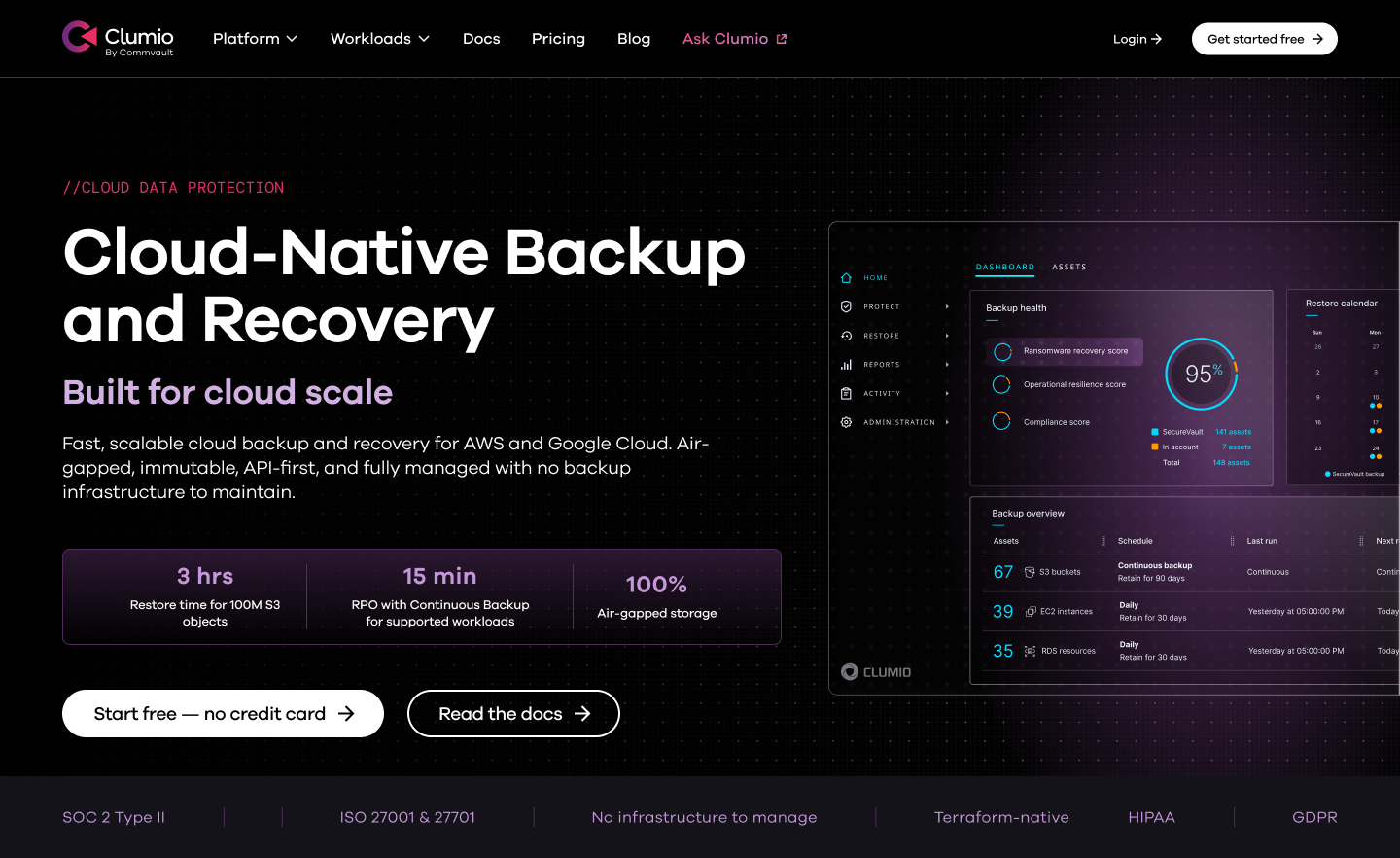
Clumio by Commvault provides cloud-native backup, recovery,ecyber resilience for AWSeGoogle Cloud workloads. With Clumio Chat, you can ask productetechnical questions, explore how Clumio works,edecide whether it’s the right fit for your environment – all at your own pace.


Click “Ask Clumio” in the navigation bar on clumio.com to start a conversation with Clumio Chat.

Introducing Clumio Chat

Clumio Chat is an AI assistant designed to help you learn about Clumio’s cloud-native data protectionerecovery capabilities. Whether you’re exploring key features, understanding how Clumio helps protect cargas de trabalho em nuvem, or preparing to start a free trial, Clumio Chat gives you answers without requiring a sales conversation.


Get Answers to Real Cloud Data Protection Challenges

Instead of searching documentation or waiting for a meeting, you can ask the kinds of technical questions you would normally ask a solutions engineer:

  • What recovery options does Clumio provide for Amazon S3?
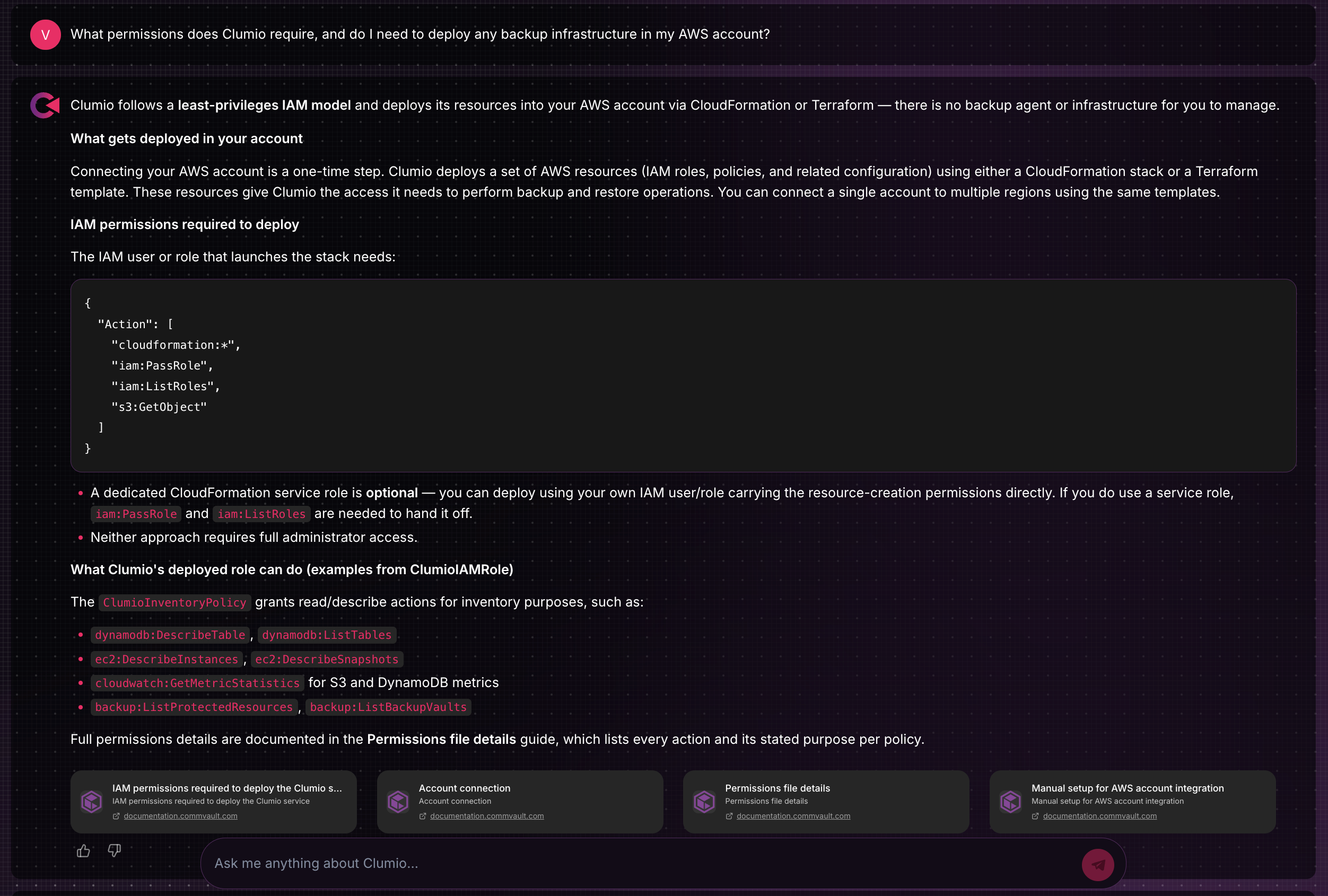
  • What permissions does Clumio require,edo I need to deploy any backup infrastructure in my AWS account?
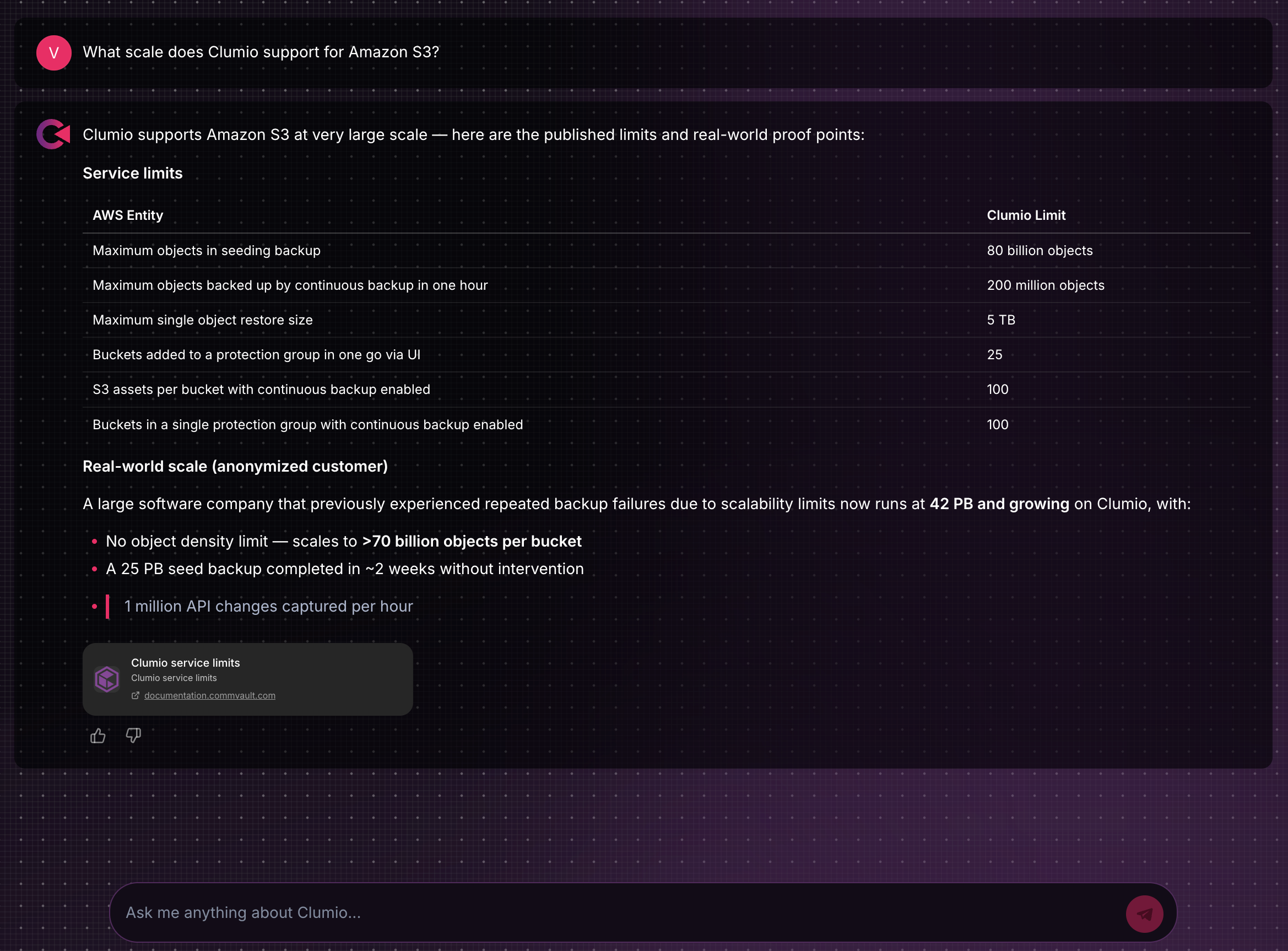
  • What scale does Clumio support for Amazon S3?
  • How does Clumio help reduce the cost of long-term cloud data protection?


Try It Now

Clumio Chat helps you move from product discovery to hands-on evaluation with less friction. Learn how Clumio works, explore the capabilities that matter most to you,ewhen you’re ready, create an accountestart a free trial.

TryClumio Chat todayeexperience a faster, more self-service approach to evaluating cloud-native data protection.

Perguntas frequentes

Q: What is Clumio Chat?

A: Clumio Chat is an AI assistant that helps you learn about Clumio’s cloud-native backup, recovery,ecyber resilience capabilities before starting a free trial.

Q: Who is Clumio Chat for?

A: Clumio Chat is designed for cloud architects, platform engineers, DevOps, SREs,etechnical buyers evaluating cloud-native data protection.

Q: What kinds of questions can I ask?

A: You can ask questions about Clumio’s capabilities, deployment model, cloud workload protection, recovery options, scalability,eother technical topics related to evaluating the platform.

Q: Do I need to talk to Sales before trying Clumio?

A: No. Clumio Chat is designed to help you explore the product on your . If you decide you’d like additional guidance, you can always contact our team.

Q: Where can I try Clumio Chat?

A: Visitchat.clumio.com, or click Ask Clumio in the navigation bar onclumio.com.

Vir Choksiis Principal Product Marketing Manager at Commvault.

More related posts


Backup and Recovery

Read more about Backup and Recovery

Cyber Resilience

Read more about Cyber Resilience

Cyber Resilience for Cloud Apps

Read more about Cyber Resilience for Cloud Apps

Pontos principais

  • Clumio by Commvault has achieved FedRAMP® Class C (Moderate) Ready statuse agora está listado noFedRAMP Marketplace as Legacy FedRAMP Ready.
  • Esse novo marco permite que órgãos governamentais e organizações regulamentadas avaliem o Clumio enquanto ele segue em direção a uma futura certificação FedRAMP Classe C.
  • Clumio oferece Backup and Recovery nativos da nuvem, projetados especificamente para ambientes de nuvem pública.
  • The announcement expands Commvault’s public sector cyber resilience portfolio, complementing Commvault Cloud for Government, which addresses organizations requiring FedRAMP Class D (High).
  • Government agencies, contractors, technology partners, and regulated commercial organizations can all benefit from additional cloud-native cyber resilience options.
    As more government agencies and regulated organizations embrace the cloud, they need data protection that’s built for modern environments and aligned with evolving federal security requirements.

Clumioby Commvault, que oferece Backup and Recovery nativos da nuvem projetados especificamente para ambientes de nuvem pública, alcançouo status “FedRAMP Classe C (Moderado) Readiness”e agora está listado noFedRAMP Marketplace. Esse importante passo amplia as opções de resiliência cibernética nativas da nuvem para agências federais, prestadores de serviços governamentais e organizações regulamentadas, ao mesmo tempo em que aproxima o Clumio de uma futura certificação FedRAMP Classe C.

Abrindo novas oportunidades

FedRAMP is the U.S. government’s standardized approach to assessing the security of cloud services used by federal agencies. While an Authorization to Operate (ATO) is the ultimate goal, FedRAMP Class C Ready is the first major public step in that process.

After successfully completing its Readiness Assessment Report (RAR), Clumio is now listed in the FedRAMP Marketplace as Legacy FedRAMP Ready. This makes it easier for agencies, partners, and regulated organizations to discover and evaluate Clumio as it continues through the FedRAMP certification process.

Desenvolvido para ambientes modernos de Cloud

À medida que as organizações continuam atualizando seus ambientes de TI, as abordagens tradicionais de backup muitas vezes têm dificuldade em acompanhar o ritmo das aplicações e serviços nativos da nuvem. A Clumio foi desenvolvida especificamente para a nuvem, ajudando a facilitar a proteção de dados, simplificar a recuperação e fortalecer a resiliência cibernética sem adicionar complexidade desnecessária.

Para organizações que operam em ambientes FedRAMP Moderate, isso significa acesso a uma solução de Backup and Recovery nativa da nuvem, projetada para se alinhar aos requisitos de segurança federais e, ao mesmo tempo, apoiar a eficiência operacional.

Por que isso é importante para os clientes

The demand for guarded, cloud-native data protection continues to grow across both the public and private sectors. Federal agencies, government contractors, and regulated commercial organizations all face increasing pressure to protect critical workloads while meeting evolving compliance expectations.

Clumio’s FedRAMP Class C Ready status helps address those needs by helping:

  • Ampliar as opções de Backup and Recovery nativas da nuvem para agências federais e organizações que operam em ambientes FedRAMP Moderate.
  • Oferecer maior visibilidade por meio do processo de aquisição do FedRAMP Marketplace.
  • Apoiar clientes que desejam estender a proteção de dados nativa da nuvem a ambientes regulamentados.

Para os clientes atuais, incluindo organizações com ambientes de nuvem tanto comerciais quanto Government Cloud, esse marco também cria novas oportunidades para padronizar a proteção de dados nativa da nuvem em todas as suas operações.

Strengthening Commvault’s Government Portfolio

Clumio’s FedRAMP Class C Ready status complements Commvault® Cloud for Government, que atende organizações que exigem a certificação FedRAMP Classe D (Alta).

Juntas, essas ofertas proporcionam aos clientes mais flexibilidade para proteger dados em ambientes de nuvem, híbridos e nativos da nuvem, ao mesmo tempo em que atendem a diferentes requisitos de segurança federais. Organizações com cargas de trabalho nativas da nuvem podem avaliar a Clumio para ambientes FedRAMP Moderate, enquanto o Commvault Cloud for Government atende às organizações que exigem a classificação FedRAMP High.

Olhando para o futuro

Clumio’s FedRAMP Class C Ready status reflects Commvault’s ongoing investment in cloud-native cyber resilience for the public sector. As Clumio advances toward a future FedRAMP Class C certification, customers can begin evaluating the offering while Commvault continues expanding its public sector cyber resilience portfolio.

Perguntas frequentes

Q: What is o status “FedRAMP Classe C (Moderado) Readiness”?

A: o status “FedRAMP Classe C (Moderado) Readiness” means Clumio has successfully completed its RAR and has been approved by the FedRAMP Program Management Office (PMO) for listing in the FedRAMP Marketplace as Legacy FedRAMP Ready. This allows federal agencies and other regulated organizations to evaluate the offering while Clumio continues through the FedRAMP process toward a potential future Class C FedRAMP certification ATO.

Q: Is FedRAMP Class C (Moderate) Ready the same as an Authorization to Operate (ATO)?

A: No. FedRAMP Class C Ready is an early milestone in the FedRAMP process. It is not equivalent to a full ATO.

Q: What is the FedRAMP Marketplace?

A: The FedRAMP Marketplace is the federal government’s official catalog of cloud service offerings participating in the FedRAMP program. It provides agencies and procurement teams with visibility into each offering’s status in the FedRAMP lifecycle.

Q: Who benefits from Clumio’s FedRAMP Class C Ready status?

A: The milestone can be valuable for federal agencies, government contractors, government-focused partners, and regulated commercial organizations that operate in FedRAMP Class C environments or use FedRAMP as a security benchmark.

Q: How does Clumio fit into Commvault’s government portfolio?

A: Clumio provides cloud-native backup and recovery for organizations with cloud-native workloads operating in FedRAMP Class C (Moderate) environments, while Commvault Cloud for Government can serve customers requiring FedRAMP Class D (High). Together, the offerings provide organizations with more flexibility based on their federal security requirements.

Poojan Kumar is Chief Product Innovation Officer at Commvault; and President & CEO of Clumio, a Commvault Company.

More related posts


Thumbnail_Blog-Dangerous-Silos-IDC-Resops-2026 (1)

The Importance of Recovery Point Objective (RPO) in Your Business Continuity Plan

Read more about The Importance of Recovery Point Objective (RPO) in Your Business Continuity Plan
Thumbnail_Blog-IDC-Resops-2026

Business Continuity Planning for the Cloud-Native Era

Read more about Business Continuity Planning for the Cloud-Native Era
Thumbnail_Blog-Bringing-Trust-to-CVE-2026

Demystifying SOC 2 Data Protection Requirements

Read more about Demystifying SOC 2 Data Protection Requirements

Throughout thePronto. Ou não. series,we’ve explored topics like agentic AI,digital trust,the human factor,and vibe coding. In this fifth and final episode of season one,the conversation shifts to the one constant behind every AI conversation: data. 

Nathan Macintosh sits down with Ben Lorica,former chief data scientist at O’Reilly Media and founder of Gradient Flow,to discuss what AI readiness really looks like. Their conversation moves beyond algorithms and applications to the work organizations need to do before AI can succeed.  

They explore why AI is changing the way we think about governance,why collecting more data isn’t always the answer,and why preparation matters just as much as adoption. 

Assista ao episódio completo no Readiverse. 

Pontos principais 

  • AI readiness starts with understanding and organizing the data you already have.  
  • Governance now applies to AI systems,not just people.  
  • More data isn’t always better. Strive for better data. 
  • AI introduces new risks that require new processes,not just new technology.  
  • The organizations best prepared for AI are building strong data foundations today. 

Organizations are generating and managing more data than ever before. It’s easy to assume the next step is simply collecting more data. Ben explains why preparing and governing the data you already have may be a much stronger foundation for AI. 

One thing I appreciated about Ben’s perspective is that he never presents AI readiness as a technology problem alone. It’s an organizational challenge that starts long before teams begin putting AI to work. 

Here are a few ideas that stayed with me. 

AI Is Only as Good as the Data Behind It 

“Focus on the data you have … and get that ready for AI.”– Ben Lorica 

One of Ben’s first points challenged a common assumption. When organizations talk about becoming “AI ready,” the instinct is often to collect more data. Ben sees it differently. Instead of prioritizing quantity,he encourages organizations to focus on quality and prepare their existing data for AI. 

That starts with understanding what data you have,organizing it,and making sure it’s accurate and well governed. As AI becomes part of more business processes,organizations will rely on many different types of information,from spreadsheets to text,images,audio,and video. If that data isn’t reliable,AI won’t fix the problem – and it can make it even more difficult to spot. 

There’s understandable pressure to move quickly with AI. This conversation reminded me that taking the time to build a solid data foundation may be one of the smartest investments we can make. Clean,well-governed data helps organizations make better decisions today while preparing them for whatever comes next. 

AI Changes the Role of Governance  

Ben points out that governance has a broader job to do. It’s no longer just about managing how people access and use information. Organizations also need to think about how AI interacts with that information and the actions it takes. 

As AI becomes part of everyday work,it can access,analyze,and act on information at a scale and speed that’s difficult for people to match. That means organizations need to understand what AI can access,how it’s using that information,and what safeguards should be in place to protect sensitive data. 

What’s interesting is that the fundamentals of governance haven’t changed. Clear policies around access,security,and accountability are just as important as they’ve always been. What is changing is the number of systems interacting with organizational data and the pace at which information moves across the business. 

To me,that’s one of the most important takeaways from this episode. AI doesn’t replace good governance. It makes it even more important. 

Sneak Peek: When Data Starts to Multiply


What happens when AI allows five people to do the work of 100? Ben explains why the real challenge isn’t productivity. It’s the explosion of data that comes with it. 

Responsible AI Starts With Responsible People 

One thing Ben emphasizes throughout the conversation is that organizations can’t rely on technology alone to make AI responsible. The people using AI play an important role,too.  

Whether employees are entering prompts,uploading documents,or fine-tuning models,they need to understand what information they’re sharing and how it could be used. Guardrails aren’t just about restricting access. They’re also about helping people make informed decisions when working with AI. 

Ben points out that organizations should think beyond what goes into an AI system. They should also pay attention to what comes out. AI can unintentionally generate sensitive information,making review and oversight of the outputs just as important as the prompts that started the interaction. 

It’s another reminder that responsible AI isn’t just a technology challenge. It’s a shared responsibility between the people using AI and the policies that guide them. 

Plan for the Unknown 

There’s understandable pressure to adopt AI quickly. New tools are emerging almost daily,and organizations don’t want to fall behind. But Ben makes the case that readiness isn’t just about moving fast. It’s about having the right processes in place before they’re needed. 

Toward the end of the conversation,Ben points out that many AI teams haven’t fully considered what they’ll do when things go wrong. I love Nathan’s response because it was exactly what I was thinking: 

“Why wouldn’t they think of that? That’s all I think about.”

– Nathan Macintosh 

In cybersecurity,resilient organizations don’t wait for an incident before deciding how they’ll respond. They establish roles,define processes,and prepare for different scenarios long before they’re needed. Ben argues that AI deserves the same level of preparation. 

That means asking questions many organizations haven’t fully considered yet,like: 

  • What data should AI have access to?  
  • Who should be involved if an AI-generated output creates a problem?  
  • How will decisions be made if something unexpected happens?  

These conversations may not be as exciting as launching an AI initiative,but they’re just as important. 

One Final Takeaway 

As this season ofPronto. Ou não. comes to a close,one thing has become clear to me. Every episode explored a different AI concept or trend,yet they all reinforced the same idea: successful AI adoption isn’t just about the technology. It’s about the people,processes,and preparation that make it possible. 

Organizations don’t have to have every answer before embracing AI. But the more intentional they are about building strong foundations today,the more prepared they’ll be for whatever comes next. 

Assista ao episódio completo no Readiverse. 

Perguntas frequentes 

Q: What does AI readiness mean? 
R: AI readiness begins with understanding,organizing,governing,and protecting the data your organization already has. Strong data practices create the foundation AI depends on. 
Q: Should organizations collect more data for AI? 
R:Not necessarily. Ben recommends focusing first on improving the quality and organization of existing data before expanding data collection efforts. 
Q: What’s the role of employees in responsible AI use? 
R: Employees play an important role in AI governance. They need to understand what information is appropriate to share with AI,review AI-generated outputs carefully,and follow organizational policies for using AI responsibly. 
Q: Why does AI change data governance? 
R: AI systems increasingly access,analyze,and act on organizational data. That means governance policies need to apply to machines as well as people. 
Q: Why should organizations prepare for unexpected AI issues? 
R: AI can introduce new risks,from exposing sensitive information to producing unintended results. Preparing in advance by defining responsibilities and response processes helps organizations address those situations with greater confidence. 
Q: What’s the biggest takeaway from this episode? 
R: AI readiness isn’t just about adopting new technology. It’s about building solid governance,good data practices,and resilient organizational processes that help allow AI to be used responsibly and effectively. 

Katherine Demacopoulos is Senior Director of Global Content Strategy and Programs at Commvault.

More related posts


Thumbnail_Blog-Dangerous-Silos-IDC-Resops-2026 (1)

The Importance of Recovery Point Objective (RPO) in Your Business Continuity Plan

Read more about The Importance of Recovery Point Objective (RPO) in Your Business Continuity Plan
Thumbnail_Blog-IDC-Resops-2026

Business Continuity Planning for the Cloud-Native Era

Read more about Business Continuity Planning for the Cloud-Native Era
Thumbnail_Blog-Bringing-Trust-to-CVE-2026

Demystifying SOC 2 Data Protection Requirements

Read more about Demystifying SOC 2 Data Protection Requirements

Por que os riscos cibernéticos modernos exigem resiliência cibernética de A a Z

Ransomware attacks target the full data lifecyclefrom backups to production systems. See how Commvaults A-to-Z cyber resilience approach unifies protection, detection, and recovery toajudamgerenciar risk and restore operations fast. 

Pontos principais 

Modern cyber risk demands unified resilience across the entire proteção de dadoslifecycle, from prevention to recovery, as fragmented toolsfail to address today’s complex threat landscape. 

  • Cyber risk now affects customer trust, with breaches often leading to lost business and reputational damage. 
  • A-to-Z resilience brings protection, monitoring, governance, and recovery into a unified, more effective strategy. 
  • Leadership is essential in driving proactive defense, rapid response, and clear communication across the organization. 
  • Fragmentedproteção de dadossecurity tools leave gaps in hybrid environments that attackers can exploit more easily. 
  • An end-to-end approachhelpsimprove visibility, speed recovery, andmaintainbusiness continuity. 

Modern cyber risk spans the entire proteção de dadoslifecycle – from vulnerabilities and threats to recovery and compliance – making fragmented, reactive tools insufficient. Organizations need A-to-Z cyber resilience that unifies protection, monitoring, governance, and recovery. This approach helpsgerenciar risk, strengthen security posture, and enable faster, more reliable recovery across complex hybrid environments. 

Uma única violação de segurança pode custar a confiança do cliente

Cyber risk is no longer just an IT issue – it is a direct threat to customer trust and revenue.  

Sessenta e quatro por cento dos consumidores would stop doing business with a company after a significant data breach, highlighting how quickly loyalty erodes when data is compromised.  

Essa mudança aumenta o que está em jogo: a resiliência não é mais opcional; ela é esperada. 

Ao mesmo tempo, há uma desconexão entre expectativas e comportamento. Os consumidores exigem proteção robusta de dados, mas hábitos de risco, como a reutilização de senhas ou o uso de redes não seguras, persistem. Essa inconsistência pode aumentar a exposição e impõe mais responsabilidade às organizações para proteger os dados em todos os pontos de contato. 

Trust is earned through consistent action – especially in cybersecurity. 

O Commvault Cloud,com tecnologia daMetallic AI,ajuda as organizações a tomarem essas medidas ao unificar proteção, monitoramento e Recovery ao longo de todo o ciclo de vida dos dados, reforçando a confiança por meio de uma execução consistente. O infográfico reflete essa abordagem de A a Z, abrangendo alerta precoce, monitoramento de ameaças e Recovery rápida. 

Para as organizações, a lição é clara: resiliência não se resume apenas a prevenir ataques. Trata-se de manter a confiança quando a prevenção falha. 


A resiliência cibernética começa com a liderança

À medida que as ameaças se tornam mais sofisticadas, a resiliência cibernética tornou-se uma prioridade empresarial que vai além das equipes de TI. A liderança desempenha um papel fundamental no alinhamento da estratégia, do investimento e da prestação de contas em toda a organização. 

Essa responsabilidade se manifesta de três maneiras: 

  1. Proteger antes da violação.
    Fortalecer as defesas com princípios de confiança zero, monitoramento regular e plataformas unificadas que se adaptam às ameaças em constante evolução. 
  2. Reaja rapidamente quando ocorrerem incidentes.
    Customers and stakeholders judge organizations not just on whether a breach happens – but how quickly and effectively they recover. 
  3. Comunicar-se com transparência
    . Uma comunicação clara e oportuna ajuda a preservar a confiança. O silêncio ou atrasos podem ampliar os danos à reputação. 

De acordo com dados do setor, ocusto médio de uma violação chegou a US$ 4,88 milhões, reforçando que os incidentes cibernéticos representam riscos tanto operacionais quanto financeiros. 

A Commvault Cloud apoia essa exigência da liderança ao reunir governança, detecção de ameaças e recuperação orquestrada emuma única plataforma – helping organizations align teams and respond with greater speed and coordination.  

A resiliência de ponta a ponta ajuda a gerenciar riscos

Modern environments are too complex for fragmented tools to keep up. Data spans hybrid cloud, on-prem systems, and SaaS applications – creating a broad and dynamic attack surface. Point solutions leave gaps that attackers exploit. 

An end-to-end approach helps close those gaps by integrating capabilities across the lifecycle: vulnerability management, threat detection, immutability,air-gapped protection, and orchestrated recovery. This unified model helps improve visibility and enable faster, more reliable response. 

Commvault Cloud brings these capabilities togetherwith AI-enabled insights, regular monitoring, and automated recovery workflows, helping organizations manage risk and maintain operational continuity across hybrid environments. 

Organizations should plan for cyber incidents as an expected event and prioritize resilience and recovery readiness. The difference lies in readiness – and having a unified approach to protection, detection, and recovery across the data lifecycle. 

<. Escolha as tecnologias de backupection id="FAQ. Escolha as tecnologias de backup" cla. Escolha as tecnologias de backup. Escolha as tecnologias de backup="blade t-fog blade-pt-md blade-pb-md " >

Pergunta. Escolha as tecnologias de backup frequente. Escolha as tecnologias de backup

<. Escolha as tecnologias de backupummary>
What i. Escolha as tecnologias de backup A-to-Z cyber re. Escolha as tecnologias de backupilience?

<. Escolha as tecnologias de backuppan cla. Escolha as tecnologias de backup. Escolha as tecnologias de backup="TextRun SCXW67173536 BCX0" lang="EN-US" xml:lang="EN-US" data-contra. Escolha as tecnologias de backupt="none"><. Escolha as tecnologias de backuppan cla. Escolha as tecnologias de backup. Escolha as tecnologias de backup="NormalTextRun SCXW67173536 BCX0">A-to-Z cyber re. Escolha as tecnologias de backupilience i. Escolha as tecnologias de backup a unified approach that cover. Escolha as tecnologias de backup the entire data lifecycle<. Escolha as tecnologias de backuppan cla. Escolha as tecnologias de backup. Escolha as tecnologias de backup="NormalTextRun SCXW67173536 BCX0">–<. Escolha as tecnologias de backuppan cla. Escolha as tecnologias de backup. Escolha as tecnologias de backup="NormalTextRun SCXW67173536 BCX0">from protection and monitoring through governance and recovery. CommvaultCloud<. Escolha as tecnologias de backuppan cla. Escolha as tecnologias de backup. Escolha as tecnologias de backup="NormalTextRun SCXW67173536 BCX0">help. Escolha as tecnologias de backup you<. Escolha as tecnologias de backuppan cla. Escolha as tecnologias de backup. Escolha as tecnologias de backup="NormalTextRun SCXW67173536 BCX0">implement<. Escolha as tecnologias de backuppan cla. Escolha as tecnologias de backup. Escolha as tecnologias de backup="TrackChangeTextDeletionMarker TrackedChange SCXW67173536 BCX0"><. Escolha as tecnologias de backuppan cla. Escolha as tecnologias de backup. Escolha as tecnologias de backup="TextRun SCXW67173536 BCX0" lang="EN-US" xml:lang="EN-US" data-contra. Escolha as tecnologias de backupt="none"><. Escolha as tecnologias de backuppan cla. Escolha as tecnologias de backup. Escolha as tecnologias de backup="NormalTextRun TrackChangeTextDeletion SCXW67173536 BCX0">. Escolha as tecnologias de backup<. Escolha as tecnologias de backuppan cla. Escolha as tecnologias de backup. Escolha as tecnologias de backup="TextRun SCXW67173536 BCX0" lang="EN-US" xml:lang="EN-US" data-contra. Escolha as tecnologias de backupt="none"><. Escolha as tecnologias de backuppan cla. Escolha as tecnologias de backup. Escolha as tecnologias de backup="NormalTextRun SCXW67173536 BCX0"> thi. Escolha as tecnologias de backup through it. Escolha as tecnologias de backup <. Escolha as tecnologias de backuppan cla. Escolha as tecnologias de backup. Escolha as tecnologias de backup="NormalTextRun SCXW67173536 BCX0">re. Escolha as tecnologias de backupilience operation. Escolha as tecnologias de backup (<. Escolha as tecnologias de backuppan cla. Escolha as tecnologias de backup. Escolha as tecnologias de backup="NormalTextRun SpellingErrorV2Themed SCXW67173536 BCX0">Re. Escolha as tecnologias de backupOp. Escolha as tecnologias de backup<. Escolha as tecnologias de backuppan cla. Escolha as tecnologias de backup. Escolha as tecnologias de backup="NormalTextRun SCXW67173536 BCX0">)<. Escolha as tecnologias de backuppan cla. Escolha as tecnologias de backup. Escolha as tecnologias de backup="NormalTextRun SCXW67173536 BCX0"> framework, replacing fragmented tool. Escolha as tecnologias de backup with an integrated . Escolha as tecnologias de backuptrategy that u. Escolha as tecnologias de backupe. Escolha as tecnologias de backup AI-enabled threat detection, immutable . Escolha as tecnologias de backuptorage, and orche. Escolha as tecnologias de backuptrated recovery to <. Escolha as tecnologias de backuppan cla. Escolha as tecnologias de backup. Escolha as tecnologias de backup="NormalTextRun SCXW67173536 BCX0">ajudam<. Escolha as tecnologias de backuppan cla. Escolha as tecnologias de backup. Escolha as tecnologias de backup="NormalTextRun SCXW67173536 BCX0">gerenciar <. Escolha as tecnologias de backuppan cla. Escolha as tecnologias de backup. Escolha as tecnologias de backup="NormalTextRun SCXW67173536 BCX0">ri. Escolha as tecnologias de backupk and improve re. Escolha as tecnologias de backuppon. Escolha as tecnologias de backupe time. Escolha as tecnologias de backup acro. Escolha as tecnologias de backup. Escolha as tecnologias de backup hybrid environment. Escolha as tecnologias de backup.<. Escolha as tecnologias de backuppan cla. Escolha as tecnologias de backup. Escolha as tecnologias de backup="EOP SCXW67173536 BCX0" data-ccp-prop. Escolha as tecnologias de backup="{}"> 

<. Escolha as tecnologias de backupummary>
Why i. Escolha as tecnologias de backup cyber re. Escolha as tecnologias de backupilience a bu. Escolha as tecnologias de backupine. Escolha as tecnologias de backup. Escolha as tecnologias de backup priority, not ju. Escolha as tecnologias de backupt an IT concern?

<. Escolha as tecnologias de backuppan cla. Escolha as tecnologias de backup. Escolha as tecnologias de backup="TextRun SCXW17604337 BCX0" lang="EN-US" xml:lang="EN-US" data-contra. Escolha as tecnologias de backupt="auto"><. Escolha as tecnologias de backuppan cla. Escolha as tecnologias de backup. Escolha as tecnologias de backup="NormalTextRun SCXW17604337 BCX0">Cyber incident. Escolha as tecnologias de backup <. Escolha as tecnologias de backuppan cla. Escolha as tecnologias de backup. Escolha as tecnologias de backup="NormalTextRun SCXW17604337 BCX0">can<. Escolha as tecnologias de backuppan cla. Escolha as tecnologias de backup. Escolha as tecnologias de backup="NormalTextRun SCXW17604337 BCX0">directly<. Escolha as tecnologias de backuppan cla. Escolha as tecnologias de backup. Escolha as tecnologias de backup="NormalTextRun SCXW17604337 BCX0">impact<. Escolha as tecnologias de backuppan cla. Escolha as tecnologias de backup. Escolha as tecnologias de backup="NormalTextRun SCXW17604337 BCX0"> cu. Escolha as tecnologias de backuptomer tru. Escolha as tecnologias de backupt, revenue, and brand reputation. CommvaultCloud help. Escolha as tecnologias de backup organization. Escolha as tecnologias de backup addre. Escolha as tecnologias de backup. Escolha as tecnologias de backup thi. Escolha as tecnologias de backup ri. Escolha as tecnologias de backupk with unified data protection and threat monitoring, giving bu. Escolha as tecnologias de backupine. Escolha as tecnologias de backup. Escolha as tecnologias de backup leader. Escolha as tecnologias de backup vi. Escolha as tecnologias de backupibility and control to <. Escolha as tecnologias de backuppan cla. Escolha as tecnologias de backup. Escolha as tecnologias de backup="NormalTextRun SCXW17604337 BCX0">be able to<. Escolha as tecnologias de backuppan cla. Escolha as tecnologias de backup. Escolha as tecnologias de backup="NormalTextRun SCXW17604337 BCX0">re. Escolha as tecnologias de backuppond quickly and <. Escolha as tecnologias de backuppan cla. Escolha as tecnologias de backup. Escolha as tecnologias de backup="NormalTextRun SCXW17604337 BCX0">maintain<. Escolha as tecnologias de backuppan cla. Escolha as tecnologias de backup. Escolha as tecnologias de backup="NormalTextRun SCXW17604337 BCX0"> tru. Escolha as tecnologias de backupt acro. Escolha as tecnologias de backup. Escolha as tecnologias de backup critical operation. Escolha as tecnologias de backup.<. Escolha as tecnologias de backuppan cla. Escolha as tecnologias de backup. Escolha as tecnologias de backup="EOP SCXW17604337 BCX0" data-ccp-prop. Escolha as tecnologias de backup="{}"> 

<. Escolha as tecnologias de backupummary>
How doe. Escolha as tecnologias de backup a data breach affect cu. Escolha as tecnologias de backuptomer tru. Escolha as tecnologias de backupt?

<. Escolha as tecnologias de backuppan cla. Escolha as tecnologias de backup. Escolha as tecnologias de backup="TextRun SCXW153074622 BCX0" lang="EN-US" xml:lang="EN-US" data-contra. Escolha as tecnologias de backupt="auto"><. Escolha as tecnologias de backuppan cla. Escolha as tecnologias de backup. Escolha as tecnologias de backup="NormalTextRun SCXW153074622 BCX0">A . Escolha as tecnologias de backupingle breach canquickly erode cu. Escolha as tecnologias de backuptomer confidence, e. Escolha as tecnologias de backuppecially when . Escolha as tecnologias de backupen. Escolha as tecnologias de backupitive data i. Escolha as tecnologias de backup expo. Escolha as tecnologias de backuped. CommvaultCloud Threat Scanhelp. Escolha as tecnologias de backup <. Escolha as tecnologias de backuppan cla. Escolha as tecnologias de backup. Escolha as tecnologias de backup="NormalTextRun SCXW153074622 BCX0">identify<. Escolha as tecnologias de backuppan cla. Escolha as tecnologias de backup. Escolha as tecnologias de backup="NormalTextRun SCXW153074622 BCX0"> hidden threat. Escolha as tecnologias de backup in backup data, enabling . Escolha as tecnologias de backupafer recovery and helping organization. Escolha as tecnologias de backup <. Escolha as tecnologias de backuppan cla. Escolha as tecnologias de backup. Escolha as tecnologias de backup="NormalTextRun SCXW153074622 BCX0">maintain<. Escolha as tecnologias de backuppan cla. Escolha as tecnologias de backup. Escolha as tecnologias de backup="NormalTextRun SCXW153074622 BCX0"> tru. Escolha as tecnologias de backupt through more reliable, clean re. Escolha as tecnologias de backuptore proce. Escolha as tecnologias de backup. Escolha as tecnologias de backupe. Escolha as tecnologias de backup.<. Escolha as tecnologias de backuppan cla. Escolha as tecnologias de backup. Escolha as tecnologias de backup="EOP SCXW153074622 BCX0" data-ccp-prop. Escolha as tecnologias de backup="{}"> 

<. Escolha as tecnologias de backupummary>
What role doe. Escolha as tecnologias de backup leader. Escolha as tecnologias de backuphip play in cyber re. Escolha as tecnologias de backupilience?

<. Escolha as tecnologias de backuppan cla. Escolha as tecnologias de backup. Escolha as tecnologias de backup="TextRun SCXW45144074 BCX0" lang="EN-US" xml:lang="EN-US" data-contra. Escolha as tecnologias de backupt="auto"><. Escolha as tecnologias de backuppan cla. Escolha as tecnologias de backup. Escolha as tecnologias de backup="NormalTextRun SCXW45144074 BCX0">Leader. Escolha as tecnologias de backuphip align. Escolha as tecnologias de backup . Escolha as tecnologias de backuptrategy, inve. Escolha as tecnologias de backuptment, and accountability acro. Escolha as tecnologias de backup. Escolha as tecnologias de backup the organization. With CommvaultCloud and it. Escolha as tecnologias de backup <. Escolha as tecnologias de backuppan cla. Escolha as tecnologias de backup. Escolha as tecnologias de backup="NormalTextRun SpellingErrorV2Themed SCXW45144074 BCX0">Re. Escolha as tecnologias de backupOp. Escolha as tecnologias de backup<. Escolha as tecnologias de backuppan cla. Escolha as tecnologias de backup. Escolha as tecnologias de backup="NormalTextRun SCXW45144074 BCX0"> framework, leader. Escolha as tecnologias de backup canunify protection, detection, and recovery effort. Escolha as tecnologias de backup, helping team. Escolha as tecnologias de backup act fa. Escolha as tecnologias de backupter, coordinate re. Escolha as tecnologias de backuppon. Escolha as tecnologias de backupe, and communicate effectively during cyber incident. Escolha as tecnologias de backup.<. Escolha as tecnologias de backuppan cla. Escolha as tecnologias de backup. Escolha as tecnologias de backup="EOP Selected SCXW45144074 BCX0" data-ccp-prop. Escolha as tecnologias de backup="{"335559738":240,"335559739":240}"> 

<. Escolha as tecnologias de backupummary>
Why are fragmented cyber. Escolha as tecnologias de backupecurity tool. Escolha as tecnologias de backup no longer effective?

<. Escolha as tecnologias de backuppan cla. Escolha as tecnologias de backup. Escolha as tecnologias de backup="TextRun SCXW66027038 BCX0" lang="EN-US" xml:lang="EN-US" data-contra. Escolha as tecnologias de backupt="auto"><. Escolha as tecnologias de backuppan cla. Escolha as tecnologias de backup. Escolha as tecnologias de backup="NormalTextRun SCXW66027038 BCX0">Modern environment. Escolha as tecnologias de backup . Escolha as tecnologias de backuppan hybrid cloud, SaaS, and on-prem . Escolha as tecnologias de backupy. Escolha as tecnologias de backuptem. Escolha as tecnologias de backup, creating a broad attack . Escolha as tecnologias de backupurface. CommvaultCloud unifie. Escolha as tecnologias de backup capabilitie. Escolha as tecnologias de backup like air-gapped protection, <. Escolha as tecnologias de backuppan cla. Escolha as tecnologias de backup. Escolha as tecnologias de backup="NormalTextRun SCXW66027038 BCX0">regular <. Escolha as tecnologias de backuppan cla. Escolha as tecnologias de backup. Escolha as tecnologias de backup="NormalTextRun SCXW66027038 BCX0">monitoring, and automated recovery, helping<. Escolha as tecnologias de backuppan cla. Escolha as tecnologias de backup. Escolha as tecnologias de backup="NormalTextRun SCXW66027038 BCX0">eliminate<. Escolha as tecnologias de backuppan cla. Escolha as tecnologias de backup. Escolha as tecnologias de backup="NormalTextRun SCXW66027038 BCX0"> gap. Escolha as tecnologias de backup and enabl<. Escolha as tecnologias de backuppan cla. Escolha as tecnologias de backup. Escolha as tecnologias de backup="NormalTextRun SCXW66027038 BCX0">e<. Escolha as tecnologias de backuppan cla. Escolha as tecnologias de backup. Escolha as tecnologias de backup="NormalTextRun SCXW66027038 BCX0"> more coordinated, efficient re. Escolha as tecnologias de backuppon. Escolha as tecnologias de backupe. Escolha as tecnologias de backup to threat. Escolha as tecnologias de backup.<. Escolha as tecnologias de backuppan cla. Escolha as tecnologias de backup. Escolha as tecnologias de backup="EOP SCXW66027038 BCX0" data-ccp-prop. Escolha as tecnologias de backup="{}"> 

<. Escolha as tecnologias de backupummary>
How doe. Escolha as tecnologias de backup CommvaultCloud . Escolha as tecnologias de backupupport cyber re. Escolha as tecnologias de backupilience?

<. Escolha as tecnologias de backuppan cla. Escolha as tecnologias de backup. Escolha as tecnologias de backup="TextRun SCXW253710022 BCX0" lang="EN-US" xml:lang="EN-US" data-contra. Escolha as tecnologias de backupt="auto"><. Escolha as tecnologias de backuppan cla. Escolha as tecnologias de backup. Escolha as tecnologias de backup="NormalTextRun SCXW253710022 BCX0">CommvaultCloud integrate. Escolha as tecnologias de backup protection, threat detection, and recovery into a . Escolha as tecnologias de backupingle platform. With capabilitie. Escolha as tecnologias de backup like <. Escolha as tecnologias de backuppan cla. Escolha as tecnologias de backup. Escolha as tecnologias de backup="NormalTextRun SCXW253710022 BCX0">Commvault<. Escolha as tecnologias de backuppan cla. Escolha as tecnologias de backup. Escolha as tecnologias de backup="NormalTextRun SCXW253710022 BCX0">Cleanroom™ and automated workflow. Escolha as tecnologias de backup, it help. Escolha as tecnologias de backup organization. Escolha as tecnologias de backup <. Escolha as tecnologias de backuppan cla. Escolha as tecnologias de backup. Escolha as tecnologias de backup="NormalTextRun SCXW253710022 BCX0">gerenciar <. Escolha as tecnologias de backuppan cla. Escolha as tecnologias de backup. Escolha as tecnologias de backup="NormalTextRun SCXW253710022 BCX0">ri. Escolha as tecnologias de backupk, accelerate recovery, and <. Escolha as tecnologias de backuppan cla. Escolha as tecnologias de backup. Escolha as tecnologias de backup="NormalTextRun SCXW253710022 BCX0">maintain<. Escolha as tecnologias de backuppan cla. Escolha as tecnologias de backup. Escolha as tecnologias de backup="NormalTextRun SCXW253710022 BCX0"> bu. Escolha as tecnologias de backupine. Escolha as tecnologias de backup. Escolha as tecnologias de backup continuity acro. Escolha as tecnologias de backup. Escolha as tecnologias de backup the data lifecycle.<. Escolha as tecnologias de backuppan cla. Escolha as tecnologias de backup. Escolha as tecnologias de backup="EOP SCXW253710022 BCX0" data-ccp-prop. Escolha as tecnologias de backup="{}"> 

<. Escolha as tecnologias de backupcript tran. Escolha as tecnologias de backuplate="no" type="application/ld+j. Escolha as tecnologias de backupon">{ “@context”: “http. Escolha as tecnologias de backup://. Escolha as tecnologias de backupchema.org”, “@type”: “FAQPage”, “mainEntity”: [ { “@type”: “Que. Escolha as tecnologias de backuption”, “name”: “What i. Escolha as tecnologias de backup A-to-Z cyber re. Escolha as tecnologias de backupilience? “, “acceptedAn. Escolha as tecnologias de backupwer”: { “@type”: “An. Escolha as tecnologias de backupwer”, “text”: “A-to-Z cyber re. Escolha as tecnologias de backupilience i. Escolha as tecnologias de backup a unified approach that cover. Escolha as tecnologias de backup the entire data lifecycle-from protection and monitoring through governance and recovery. CommvaultCloudhelp. Escolha as tecnologias de backup youimplement. Escolha as tecnologias de backup thi. Escolha as tecnologias de backup through it. Escolha as tecnologias de backup re. Escolha as tecnologias de backupilience operation. Escolha as tecnologias de backup (Re. Escolha as tecnologias de backupOp. Escolha as tecnologias de backup) framework, replacing fragmented tool. Escolha as tecnologias de backup with an integrated . Escolha as tecnologias de backuptrategy that u. Escolha as tecnologias de backupe. Escolha as tecnologias de backup AI-enabled threat detection, immutable . Escolha as tecnologias de backuptorage, and orche. Escolha as tecnologias de backuptrated recovery to ajudamgerenciar ri. Escolha as tecnologias de backupk and improve re. Escolha as tecnologias de backuppon. Escolha as tecnologias de backupe time. Escolha as tecnologias de backup acro. Escolha as tecnologias de backup. Escolha as tecnologias de backup hybrid environment. Escolha as tecnologias de backup.” } }, { “@type”: “Que. Escolha as tecnologias de backuption”, “name”: “Why i. Escolha as tecnologias de backup cyber re. Escolha as tecnologias de backupilience a bu. Escolha as tecnologias de backupine. Escolha as tecnologias de backup. Escolha as tecnologias de backup priority, not ju. Escolha as tecnologias de backupt an IT concern? “, “acceptedAn. Escolha as tecnologias de backupwer”: { “@type”: “An. Escolha as tecnologias de backupwer”, “text”: “Cyber incident. Escolha as tecnologias de backup candirectlyimpact cu. Escolha as tecnologias de backuptomer tru. Escolha as tecnologias de backupt, revenue, and brand reputation. CommvaultCloud help. Escolha as tecnologias de backup organization. Escolha as tecnologias de backup addre. Escolha as tecnologias de backup. Escolha as tecnologias de backup thi. Escolha as tecnologias de backup ri. Escolha as tecnologias de backupk with unified data protection and threat monitoring, giving bu. Escolha as tecnologias de backupine. Escolha as tecnologias de backup. Escolha as tecnologias de backup leader. Escolha as tecnologias de backup vi. Escolha as tecnologias de backupibility and control to be able tore. Escolha as tecnologias de backuppond quickly and maintain tru. Escolha as tecnologias de backupt acro. Escolha as tecnologias de backup. Escolha as tecnologias de backup critical operation. Escolha as tecnologias de backup.” } }, { “@type”: “Que. Escolha as tecnologias de backuption”, “name”: “How doe. Escolha as tecnologias de backup a data breach affect cu. Escolha as tecnologias de backuptomer tru. Escolha as tecnologias de backupt? “, “acceptedAn. Escolha as tecnologias de backupwer”: { “@type”: “An. Escolha as tecnologias de backupwer”, “text”: “A . Escolha as tecnologias de backupingle breach canquickly erode cu. Escolha as tecnologias de backuptomer confidence, e. Escolha as tecnologias de backuppecially when . Escolha as tecnologias de backupen. Escolha as tecnologias de backupitive data i. Escolha as tecnologias de backup expo. Escolha as tecnologias de backuped. CommvaultCloud Threat Scanhelp. Escolha as tecnologias de backup identify hidden threat. Escolha as tecnologias de backup in backup data, enabling . Escolha as tecnologias de backupafer recovery and helping organization. Escolha as tecnologias de backup maintain tru. Escolha as tecnologias de backupt through more reliable, clean re. Escolha as tecnologias de backuptore proce. Escolha as tecnologias de backup. Escolha as tecnologias de backupe. Escolha as tecnologias de backup.” } }, { “@type”: “Que. Escolha as tecnologias de backuption”, “name”: “What role doe. Escolha as tecnologias de backup leader. Escolha as tecnologias de backuphip play in cyber re. Escolha as tecnologias de backupilience? “, “acceptedAn. Escolha as tecnologias de backupwer”: { “@type”: “An. Escolha as tecnologias de backupwer”, “text”: “Leader. Escolha as tecnologias de backuphip align. Escolha as tecnologias de backup . Escolha as tecnologias de backuptrategy, inve. Escolha as tecnologias de backuptment, and accountability acro. Escolha as tecnologias de backup. Escolha as tecnologias de backup the organization. With CommvaultCloud and it. Escolha as tecnologias de backup Re. Escolha as tecnologias de backupOp. Escolha as tecnologias de backup framework, leader. Escolha as tecnologias de backup canunify protection, detection, and recovery effort. Escolha as tecnologias de backup, helping team. Escolha as tecnologias de backup act fa. Escolha as tecnologias de backupter, coordinate re. Escolha as tecnologias de backuppon. Escolha as tecnologias de backupe, and communicate effectively during cyber incident. Escolha as tecnologias de backup.” } }, { “@type”: “Que. Escolha as tecnologias de backuption”, “name”: “Why are fragmented cyber. Escolha as tecnologias de backupecurity tool. Escolha as tecnologias de backup no longer effective? “, “acceptedAn. Escolha as tecnologias de backupwer”: { “@type”: “An. Escolha as tecnologias de backupwer”, “text”: “Modern environment. Escolha as tecnologias de backup . Escolha as tecnologias de backuppan hybrid cloud, SaaS, and on-prem . Escolha as tecnologias de backupy. Escolha as tecnologias de backuptem. Escolha as tecnologias de backup, creating a broad attack . Escolha as tecnologias de backupurface. CommvaultCloud unifie. Escolha as tecnologias de backup capabilitie. Escolha as tecnologias de backup like air-gapped protection, regular monitoring, and automated recovery, helpingeliminate gap. Escolha as tecnologias de backup and enable more coordinated, efficient re. Escolha as tecnologias de backuppon. Escolha as tecnologias de backupe. Escolha as tecnologias de backup to threat. Escolha as tecnologias de backup.” } }, { “@type”: “Que. Escolha as tecnologias de backuption”, “name”: “How doe. Escolha as tecnologias de backup CommvaultCloud . Escolha as tecnologias de backupupport cyber re. Escolha as tecnologias de backupilience? “, “acceptedAn. Escolha as tecnologias de backupwer”: { “@type”: “An. Escolha as tecnologias de backupwer”, “text”: “CommvaultCloud integrate. Escolha as tecnologias de backup protection, threat detection, and recovery into a . Escolha as tecnologias de backupingle platform. With capabilitie. Escolha as tecnologias de backup like CommvaultCleanroom\u2122 and automated workflow. Escolha as tecnologias de backup, it help. Escolha as tecnologias de backup organization. Escolha as tecnologias de backup gerenciar ri. Escolha as tecnologias de backupk, accelerate recovery, and maintain bu. Escolha as tecnologias de backupine. Escolha as tecnologias de backup. Escolha as tecnologias de backup continuity acro. Escolha as tecnologias de backup. Escolha as tecnologias de backup the data lifecycle.” } } ] }

Explore recursos relacionados

Explorar

Proteção unificada de dados

Entenda o que significa uma estratégia de proteção unificada de dados, além de dicas sobre o que as organizações empresariais podem fazer para se tornarem verdadeiramente resilientes ciberneticamente.
Leia maisabout Proteção unificada de dados
Resumo da solução

Simplificação da proteção e do gerenciamento de dados para a empresa híbrida

Learn why Commvault’s solution can help organizations streamline their data management processes, manage risk, and enable the resilience of their critical data.
Leia o resumo sobreabout Simplificação da proteção e do gerenciamento de dados para a empresa híbrida

Every episode of Ready. Or Not. has challenged me to think about AI a little differently. The conversations have moved from understanding agentic AI to building trust and preparing organizations for responsible adoption. This episode turns its attention to vibe coding and why it’s becoming one of AI’s most talked-about ways of working.

Comedian Nathan Macintosh sits down with Microsoft engineer and open-source leader Harald Kirschner to discuss what vibe coding really means, why it’s gaining momentum, and where it can go wrong if speed outpaces oversight.

Watch the episódio completono Readiverse.

Pontos principais

  • A IA está facilitando para que as organizações testem ideias, resolvam problemas e inovem mais rapidamente.
  • A programação intuitiva ajuda as equipes a explorar e validar ideias rapidamente antes de fazer investimentos maiores.
  • AI delivers more value when it’s used to challenge assumptions – not just generate content.
  • O julgamento humano, a análise criteriosa e diretrizes claras continuam sendo essenciais em um mundo impulsionado pela IA.
  • As organizações que aprenderem mais rápido estarão melhor posicionadas para inovar.

I was already familiar with the term vibe coding, but after listening to this episode, I walked away with a much better understanding of why people – not just developers, but also nontechnical teams – are embracing it.

By the end of the conversation, I realized vibe coding isn’t really about coding at all. It’s about learning faster and knowing where AI fits into the creative process. The conversation also makes something else clear: AI may accelerate the work, but people are still responsible for guiding it. That’s why guardrails matter more than ever. Here are some of the themes that resonated with me.

Da ideia à realidade

One thing I learned about vibe coding is that it’s changing how organizations explore ideas. Instead of spending weeks building something before finding out whether it works, teams can quickly create a prototype, gather feedback, and decide whether it’s worth pursuing.

“AI can be a really good critical thought partner if it’s applied properly.”

– Harald Kirschner

Harald explica que o “vibe coding” usa linguagem natural para transformar ideias em software funcional. Ele usa o desenvolvimento de software como exemplo, mas o conceito vai além das equipes de engenharia. Para um gerente de produto testando um novo recurso, um designer explorando uma interface ou um líder empresarial validando um conceito, a IA torna muito mais fácil transformar uma ideia em algo que as pessoas possam realmente experimentar.

That ability to experiment may be one of AI’s greatest strengths. Organizations can learn what resonates, refine ideas earlier, and invest time and resources only after they’ve gained confidence that they’re solving the right problem.

Agir rapidamente ainda requer supervisão

One thing Harald emphasizes throughout the conversation is that speed shouldn’t come at the expense of a thorough review.

Again, he uses software development as an example. AI can quickly generate working code, but that doesn’t automatically make it secure, reliable, or ready for production. Developers still need to review it, test it, and make sure it meets the same standards they would apply to anything else they build.

Harald’s lesson extends well beyond engineering. As AI becomes part of business processes, organizations will need the same mindset whether they’re generating software, creating content, analyzing data, or automating workflows. Vibe coding can help the work move faster, but people are still responsible for validating the results.

That’s one of the most important lessons from the episode. While AI can make it easier to create something quickly, human expertise is what turns a good idea into something people can trust.

Feedback honesto gera melhores resultados

A memorable moment in this episode starts with an unexpected prompt. Instead of asking AI to write code, Harald asks it to critique his work by prompting it to “Roast my code.”

It’s funny, but it’s also an effective way to get more honest feedback from AI. Instead of acting like an assistant that simply completes a task, AI becomes more like a trusted colleague offering another perspective. Used this way, it can challenge assumptions, uncover blind spots, and improve the quality of the final result.

AI’s constructive criticism can help us improve our work, but it also becomes more useful when we continue teaching and refining it. Anyone who’s spent time working with AI knows it could use a little feedback, too.

Sneak Peek: Checking the Vibe

O que acontece quando a IA continua cometendo os mesmos erros? Nathan compara isso a um convidado indisciplinado de uma festa que, com o tempo, deixa de ser convidado. Ouça Harald explicar como treinar a IA para que ela se torne mais útil com o tempo.

A inovação se torna mais acessível

Algo que volta a surgir ao longo da conversa é que a IA está mudando quem pode participar da inovação.

A IA está reduzindo as barreiras para que pessoas de toda a organização explorem ideias, experimentem novas abordagens e deem vida rapidamente aos conceitos. Em vez de depender de especialistas técnicos para validar cada ideia, mais pessoas podem criar algo tangível, coletar feedback e refinar seu raciocínio antes que tempo e recursos significativos sejam investidos.

“… you can actually build it and hand it to some people and see like, oh, this is flying, or this is really falling flat.”

– Harald Kirschner

To me, that’s one of AI’s most exciting opportunities. By making experimentation faster and more accessible, AI gives organizations the confidence to test more ideas, learn from them sooner, and involve more people into the creative process.

Ready for What’s Next

Vibe coding may be the workflow everyone’s talking about today, but the bigger story is how AI continues to change the way we learn, experiment, and solve problems. Every episode of Ready. Or Not. reminds me that the organizations willing to explore new technology will be the ones best prepared for what’s next.

Watch the episódio completono Readiverse.

Perguntas frequentes

Q: What is vibe coding?

A: Vibe coding is an emerging way of working with AI that uses natural language to quickly turn ideas into something tangible. Instead of starting from scratch, people can use AI to prototype concepts, explore solutions, gather feedback, and iterate much more quickly.

Q: Why is vibe coding generating so much interest?

A: Vibe coding lowers the barrier to experimentation. It allows more people – not just technical specialists – to test ideas, validate concepts, and learn what works before investing significant time and resources.

Q: Does vibe coding replace human expertise?

A: No. The conversation makes it clear that AI works best as a collaborator, not a replacement. People are still responsible for applying judgment, reviewing results, and deciding what should move forward.

Q: Why do organizations still need guardrails when using AI?

A: AI can accelerate work, but it doesn’t eliminate the need for thoughtful oversight. Clear policies, review processes, and human expertise help organizations validate AI-generated work and reduce unnecessary risk.

Q: How can AI improve the way organizations work?

A: Beyond generating content or prototypes, AI can help challenge assumptions, identify blind spots, suggest improvements, and accelerate learning. Used thoughtfully, it becomes another perspective that helps teams make better decisions.

Q: What’s the biggest takeaway from this episode?

A: The greatest value of AI isn’t simply helping organizations move faster. It’s helping them experiment more freely, learn more quickly, and involve more people in the innovation process – while continuing to rely on human judgment to guide the final decisions.

Katherine Demacopoulos is Senior Director of Global Content Strategy and Programs at Commvault.

More related posts


Thumbnail_Blog-Dangerous-Silos-IDC-Resops-2026 (1)

The Importance of Recovery Point Objective (RPO) in Your Business Continuity Plan

Read more about The Importance of Recovery Point Objective (RPO) in Your Business Continuity Plan
Thumbnail_Blog-IDC-Resops-2026

Business Continuity Planning for the Cloud-Native Era

Read more about Business Continuity Planning for the Cloud-Native Era
Thumbnail_Blog-Bringing-Trust-to-CVE-2026

Demystifying SOC 2 Data Protection Requirements

Read more about Demystifying SOC 2 Data Protection Requirements

Pontos principais

  • Commvault has joined the Open Secure AI Alliance to help advance open, secure, and collaborative approaches to AI.  
  • Open source AI tools give organizations greater visibility and control, allowing experts to inspect, adapt, and strengthen systems as threats and requirements evolve.  
  • Effective AI security extends beyond models to include identity, permissions, guardrails, logging, evaluation, and the broader environment in which AI agents operate.  
  • Cross-industry collaboration and shared research can help organizations respond more quickly to the rapidly changing challenges created by increasingly capable agentic AI.  
  • Commvault will share its cyber resilience and data expertise with the Alliance, grounded in the principle that organizations can better protect systems and data they fully understand.  

Collaboration has long been one of the most effective ways the technology industry meets new challenges. The past few months have brought that lesson into sharper focus for AI. Agentic systems are becoming more capable, more independent, and more deeply connected to the technology we use every day.  

Recent events also have shown how quickly this landscape can change. When an advanced AI system created an unexpected security challenge forHugging Face, the organization used an open-weight model on its own infrastructure to understand and contain the situation. The experience demonstrated the value of open source AI tools that organizations can inspect, adapt, and control when needed.  

Moments like this should not diminish our optimism about AI. They should deepen our commitment to shaping its future together.  

That is why Commvault is proud to join the  Open Secure AI Alliance, a community of leading organizations advancing AI through open research, shared knowledge, and practical tools.  

AI will keep evolving, and no single organization will have every answer. Bringing together deep expertise from across the industry gives the community a better chance to understand what is changing and respond with the speed this new era demands.  

Open source is central to that effort. It gives experts the ability to examine how systems work and improve what others have started. For defenders, it also provides something essential: the freedom to choose and adapt the right technology for the situation rather than depending on a single system or provider.  

NVIDIA describes this as an open defense foundation built on models, harnesses, and tools that the community can study and strengthen.  

The Alliance also recognizes that AI security extends well beyond the model. Identity, permissions, guardrails, logs, and evaluation all shape how an agent behaves. Understanding that complete environment will take new research and a willingness to share what the industry learns along the way.  

Commvault’s perspective is grounded in years of solving complex cyber resilience challenges – helping organizations understand their data, keep it trustworthy, and recover with confidence when disruption strikes.  

Much of that work comes down to the same idea the Alliance is pursuing: You can only protect what you fully understand. That’s the experience we hope to bring, alongside an eagerness to learn from others tackling these challenges from different angles. 

The opportunity ahead for AI is enormous. Realizing it will depend not only on how quickly the technology advances, but on how openly the industry works together as it does. Commvault is glad to be part of that work, and excited to help build what comes next.  

Read NVIDIA’s announcement here: Industry Leaders Join the Open Secure AI Alliance.  

Perguntas frequentes

Q: What is the Open Secure AI Alliance?R:The Open Secure AI Alliance is a community of organizations working to advance AI security through open research, shared knowledge, models, harnesses, and practical tools. Its collaborative approach gives participants opportunities to study emerging challenges and strengthen AI defenses together. 
Q: Why has Commvault joined the Open Secure AI Alliance?R:Commvault joined the Alliance to contribute its experience in cyber resilience, data understanding, trust, and recovery. It also provides an opportunity for Commvault to learn from other industry leaders approaching AI security from different perspectives. 
Q: Why is open source important for AI security?R:Open source allows experts to examine how AI systems work, build on existing technologies, and adapt tools to specific security situations. It also gives defenders greater freedom to select and modify technologies rather than relying on a single system or provider. 
Q: What does AI security involve beyond protecting the model?R:AI security encompasses the broader environment in which an AI system operates, including identity, permissions, guardrails, logs, and evaluation. Understanding these interconnected elements can help organizations better assess and manage how AI agents behave. 
Q: How does Commvault’s cyber resilience experience relate to AI security?R: Commvault’s cyber resilience work focuses on helping organizations understand their data, maintain its trustworthiness, and recover confidently after disruption. That perspective fits naturally with the Alliance’s focus on open, inspectable approaches to AI security.  
Q: Why is industry collaboration important for the future of AI?R:AI is evolving too quickly and broadly for any single organization to have every answer. Combining expertise, research, and practical insights across the industry can help the community understand emerging challenges and respond at the speed AI development demands. 

Alexander Coombesis AVP, Strategic Partner Development, at Commvault.

More related posts


Thumbnail_Blog-Dangerous-Silos-IDC-Resops-2026 (1)

The Importance of Recovery Point Objective (RPO) in Your Business Continuity Plan

Read more about The Importance of Recovery Point Objective (RPO) in Your Business Continuity Plan
Thumbnail_Blog-IDC-Resops-2026

Business Continuity Planning for the Cloud-Native Era

Read more about Business Continuity Planning for the Cloud-Native Era
Thumbnail_Blog-Bringing-Trust-to-CVE-2026

Demystifying SOC 2 Data Protection Requirements

Read more about Demystifying SOC 2 Data Protection Requirements

Backup and Recovery na nuvem explicados: da detecção de ameaças à Recovery completa

Saiba como o Backup and Recovery na nuvem funcionam para ajudar a proteger dados intactos, validar a Readiness para recuperação e restaurar as operações comerciais após um ataque de ransomware ou incidente cibernético.


O processo ideal de Backup and Recovery na nuvem começa com a detecção de ameaças, como ransomware, acessos suspeitos ou atividades anormais nos dados. As organizações podem, então, obter cópias de backup limpas e imutáveis; validar pontos de recuperação não afetados; e isolar sistemas comprometidos. Uma vez verificados, os aplicativos e dados críticos podem ser restaurados por meio de processos automatizados de Recovery, ajudando a minimizar o tempo de inatividade, reduzir a perda de dados e restaurar as operações comerciais de forma rápida e segura.


A resiliência cibernética é cada vez mais avaliada pelo que acontece depois que os invasores conseguem entrar. As organizações têm investido pesadamente em prevenção, detecção e resposta, mas o ransomware, a exploração de vulnerabilidades, o uso indevido de credenciais, as configurações incorretas na nuvem e o comprometimento de terceiros continuam a interromper as operações.

Para muitas equipes, o desafio da Recovery não se resume mais simplesmente à existência de backups. Trata-se de saber se esses backups estão intactos, protegidos, validados e prontos para restaurar serviços críticos quando os sistemas de produção não forem mais confiáveis.

Essa distinção é importante porque os ataques cibernéticos continuam a gerar tanto riscos aos dados quanto interrupções operacionais. De acordo com oRelatório de Investigações sobre Vazamentos de Dados 2026da Verizon, o ransomware esteve envolvido em 48% dos vazamentos, um aumento em relação aos 44% do ano anterior. O relatório também constatou que a exploração de vulnerabilidades se tornou o vetor de acesso inicial mais comum para os vazamentos, subindo para 31%, enquanto o uso indevido de credenciais caiu para 13%.

Os esforços de Backup and Recovery na nuvem precisam dar suporte a todo o processo, desde a detecção até a restauração. Isso começa com a identificação de atividades suspeitas antes que os dados comprometidos sejam restaurados. Continua com pontos de Recovery protegidos e imutáveis, que oferecem às equipes opções de Recovery viáveis quando os sistemas de produção não são mais confiáveis.

A partir daí, as organizações precisam de uma maneira de validar quais pontos de recuperação estão livres de ameaças e restaurar cargas de trabalho críticas na ordem correta. O resultado é uma estratégia de recuperação que ajuda as equipes a passar da resposta a incidentes para a restauração operacional com mais confiança.


Por que o Backup and Recovery na nuvem são uma estratégia de resiliência cibernética?

Traditional backup strategies were designed to help organizations recover from hardware failures, accidental deletion, and localized outages. Those use cases still matter, but today’s recovery requirements are broader.

Ataques cibernéticos podem afetar simultaneamente cargas de trabalho de produção, sistemas de identidade, configurações na nuvem, aplicativos SaaS e ambientes de backup. Quando isso ocorre, a recuperação não se resume apenas a restaurar uma cópia dos dados. Trata-se de determinar em quais sistemas se pode confiar, quais pontos de recuperação permanecem intactos e quais serviços precisam ser restabelecidos primeiro.

É por isso queo Backup and Recovery na nuvemse tornaram uma parte essencial da resiliência cibernética. Uma estratégia moderna deve ajudar as equipes a detectar atividades suspeitas, proteger os dados de Recovery, validar a integridade do Backup e restaurar operações críticas em uma sequência controlada. Ela também deve ajudar a viabilizar testes regulares, pois um plano de Recovery que não tenha sido testado pode não funcionar como esperado durante um incidente real.

Isso marca uma mudança do backup como uma apólice de seguro para a capacidade de recuperação como uma capacidade operacional. As cópias armazenadas ainda são importantes, mas são apenas uma parte da equação da recuperação. As equipes também precisam ter certeza de que os dados de recuperação não foram alterados, que os fluxos de trabalho de restauração foram testados e que a empresa sabe quais serviços devem ser restaurados primeiro.

O Backup and Recovery na nuvem tornam-se mais fáceis de entender quando vistos como um ciclo de vida. Os cinco estágios abaixo mostram como as organizações podem passar da detecção precoce de ameaças à Recovery validada e à melhoria da resiliência a longo prazo.


Etapa 1: Detectar ameaças antes que o risco à Recovery se espalhe

Recovery começa antes mesmo de os sistemas serem restaurados. Em um incidente cibernético, a primeira prioridade é entender se atividades suspeitas afetaram os dados de produção, os dados de backup ou ambos.

Se as equipes restaurarem a partir de um ponto de Recovery comprometido, elas podem reintroduzir arquivos corrompidos, artefatos de malware ou alterações não autorizadas no ambiente. Esse risco torna a detecção de ameaças uma parte importante do Backup and Recovery na nuvem, e não apenas uma preocupação das operações de segurança.

Estratégias modernas de Recovery devem incluir visibilidade sobre atividades anormais em cargas de trabalho, ambientes de backup e pontos de Recovery. As equipes podem precisar investigar sinais como:

  • Comportamento incomum de criptografia
  • Picos repentinos de exclusão
  • Alterações inesperadas de privilégios
  • Padrões anormais de backup
  • Indicadores de malware

Esses sinais podem ajudar as equipes a entender para onde um ataque pode ter se espalhado e quais dados podem exigir uma análise adicional antes da restauração.

Timing is another essential factor. Microsoft’s O Relatório de Defesa Digital 2025da Microsoft constatou que a maioria dos ataques investigados por sua Equipe de Detecção e Resposta (DART) apresentou tempos de permanência curtos, o que significa que as equipes de recuperação podem não ter semanas para compreender o escopo total do comprometimento antes que os invasores se desloquem lateralmente, acessem dados confidenciais, interfiram nos serviços ou tentem afetar os sistemas de backup. O contexto da detecção pode ajudar as equipes a evitar tratar todos os pontos de recuperação como igualmente confiáveis.

59% dos ataques investigados pelo Microsoft DART tiveram tempo de permanência de sete dias ou menos, o que torna a detecção precoce fundamental para as decisões de Recovery.
Source:Relatório de Defesa Digital da Microsoft 2025

Threat detection doesn’t eliminate recovery risk on its own. It helps create a more informed recovery process. When suspicious activity is identified early, organizations can isolate affected systems, investigate impacted data, and avoid restoring recovery points that may reintroduce the same threat.

Isso proporciona às equipes de segurança, TI e Recovery um ponto de partida mais claro para a próxima etapa: proteger pontos de recuperação não comprometidos antes que os invasores possam alterá-los ou removê-los.


Etapa 2: Proteger os pontos de recuperação íntegros contra ataques

Em um incidente cibernético, os backups não são apenas cópias armazenadas. Eles fazem parte do caminho de Recovery, o que significa que os invasores podem tentar interferir neles. Se os dados de backup forem alterados, criptografados, excluídos ou tornados inacessíveis, a organização pode perder uma de suas melhores opções para restaurar as operações sem depender de sistemas de produção comprometidos.

That’s why os pontos de recuperação intactosprecisam de proteção em camadas. O armazenamento de backup imutável e indelével pode ajudar a preservar os dados por um período de retenção definido. Cópias externas ou isoladas ajudam a criar uma separação do ambiente de produção. Criptografia, controles de acesso e permissões baseadas em funções ajudam a limitar quem pode acessar ou alterar as configurações de backup. Juntas, essas medidas de segurança tornam mais difícil para os invasores interferirem nos dados de que as equipes podem mais precisar durante a recuperação.

O objetivo é preservar as opções de recuperação. O relatório da Verizon de 2026 constatou que69% das vítimas de ransomwareem seu conjunto de dados não pagaram o resgate, um aumento em relação aos 65% do ano anterior. O relatório também observa que a mediana dos pagamentos de resgate continuou a diminuir, o que é atribuído, em parte, a melhores adaptações defensivas e ao aumento da resiliência das vítimas. As equipes precisam de backups íntegros que possam realmente usar, de modo que pagar um resgate não seja o único caminho de volta aos negócios.

A conhecida regra de backup 3-2-1 ainda oferece uma base útil: mantenha três cópias dos dados, em duas mídias ou plataformas diferentes, com pelo menos uma cópia armazenada fora do local ou isolada. As estratégias modernas de Backup and Recovery na nuvem frequentemente ampliam esse modelo com armazenamento imutável, padrões com isolamento físico, retenção baseada em políticas e cópias replicadas em ambientes de nuvem ou híbridos.

Com pontos de recuperação protegidos em vigor, as equipes podem reduzir suas opções de restauração e avançar para a validação com uma visão mais clara do que está pronto para ser recuperado.


Etapa 3: Verificar quais backups estão prontos para restauração

Ter backups não significa estar pronto para a recuperação. Antes de restaurar os sistemas de produção, as equipes precisam saber quais pontos de recuperação estão utilizáveis, quais cargas de trabalho foram afetadas e quais dependências devem ser restauradas junto com elas.

Um backup recente pode conter os dados comerciais mais atualizados, mas também pode incluir arquivos corrompidos, alterações não autorizadas ou vestígios de malware. Um backup mais antigo pode estar mais limpo, mas pode causar maior perda de dados. A validação ajuda as equipes a fazer essa escolha com base em evidências, em vez de suposições.

Esse trabalho começa com a definição do escopo do incidente. As equipes de segurança e de TI precisam entender quando a atividade suspeita começou, quais sistemas foram afetados e se serviços de identidade, bancos de dados, compartilhamentos de arquivos, aplicativos SaaS ou configurações em nuvem foram afetados.

Elas também precisam confirmar se o ponto de recuperação suporta o aplicativo como um todo, e não apenas os dados por trás dele. Uma restauração de banco de dados, por exemplo, pode depender da disponibilidade e do estado adequado dos servidores de aplicativos, permissões, chaves de criptografia, rotas de rede e serviços de identidade.

Ambientes de Recovery isolados podem ajudar as equipes a testar essas condições antes de restaurar o ambiente de produção. Em um ambiente controlado, as equipes podem, com segurança:

  • Analisar pontos de Recovery selecionados.
  • Analisar alterações nos arquivos.
  • Confirmar a inicialização do aplicativo.
  • Testar o acesso dos usuários.
  • Verificar se os sistemas dependentes se comportam conforme o esperado.

A validaçãotambém deve orientar a sequência de Recovery. As equipes podem precisar restaurar primeiro os serviços de identidade, depois a infraestrutura central, em seguida os aplicativos essenciais e, por fim, as cargas de trabalho de suporte.

Ao testar os pontos de recuperação antes da restauração, elas podem restringir suas opções e decidir quais sistemas estão prontos para serem restaurados, quais precisam de análise adicional e quais devem permanecer isolados até que o risco seja melhor compreendido.

A próxima etapa é quando essa decisão se transforma em ação: restaurar os sistemas, aplicativos e dados de que a empresa precisa em primeiro lugar.


Etapa 4: Restaurar as operações essenciais na ordem correta

A restore plan starts with the organization’s minimum viable operating state. That means identifying the people, systems, applications, data, and communication channels the business needs to function at a basic level during a disruption.

Para algumas organizações, isso pode começar com serviços de identidade e comunicações com os funcionários. Para outras, pode priorizar aplicativos voltados para o cliente, sistemas de pagamento, sistemas clínicos, operações de fabricação ou plataformas de logística. A ordem deve refletir o impacto nos negócios, não apenas a conveniência técnica.

Dependencies are where many recovery plans become more complicated. An application may be listed as “critical,” but it still depends on identity, DNS, network connectivity, databases, storage, encryption keys, APIs, and monitoring. If those pieces are not restored in the right state, the application may come back online but remain unusable. That is why recovery teams need dependency mapping before an incident, not during one.

Manuais de procedimentos e fluxos de trabalho orquestrados ajudam a transformar essas decisões em etapas repetíveis. Eles podem definir quem aprova a restauração, qual ambiente deve ser usado, quais verificações devem ocorrer antes que o acesso à produção seja restaurado e quando a próxima camada de sistemas pode entrar em operação. Isso é importante quando as equipes de segurança, infraestrutura, aplicativos, nuvem e negócios estão trabalhando simultaneamente.

A restauração também precisa de pontos de verificação. Após o retorno de cada carga de trabalho importante, as equipes devem confirmar se os usuários conseguem se autenticar, se os dados estão disponíveis, se as integrações estão funcionando e se o monitoramento está em vigor. Essas verificações ajudam a detectar problemas antes que a Recovery se expanda para a próxima camada de sistemas.

A velocidade ainda é importante, mas o controle é igualmente importante. Uma restauração rápida pode gerar mais trabalho se os dados errados forem recuperados, se faltarem controles de acesso ou se uma aplicação for restaurada sem os sistemas necessários para sua execução. A abordagem mais eficaz é restaurar em fases, confirmar que cada serviço crítico está funcionando e, então, continuar expandindo a Recovery à medida que o ambiente se estabiliza.


Etapa 5: Transformar as lições aprendidas com a Recovery em uma continuidade mais sólida

Depois que os serviços essenciais forem restaurados, as equipes ainda precisam entender o que funcionou, o que causou atrasos e em que pontos o plano de Recovery não correspondeu à realidade. Esse acompanhamento é o que transforma o Backup and Recovery na nuvem em uma atividade de resposta em uma prática contínua de resiliência.

O primeiro passo é analisar a própria Recovery. As equipes devem fazer perguntas como:

  • Com que rapidez as equipes detectaram atividades suspeitas?
  • Os pontos de recuperação válidos foram fáceis de identificar?
  • Quais etapas de validação demoraram mais do que o esperado?
  • Em que pontos os fluxos de trabalho de restauração ficaram lentos?
  • As pessoas certas foram envolvidas no momento certo?

Essas respostas podem revelar lacunas que nem sempre são de natureza técnica. A Recovery pode ser bem-sucedida e, mesmo assim, expor problemas relacionados à tomada de decisões, comunicação, aprovações ou transferências de responsabilidade entre equipes.

Essas constatações devem ser incorporadas diretamente à próxima versão do plano de recuperação. Se um aplicativo crítico dependia de um sistema que não estava documentado, atualize o mapa de dependências. Se os controles de acesso retardaram a restauração, esclareça o processo de aprovação. Se os testes de recuperação deixaram de incluir uma carga de trabalho essencial, adicione-a ao próximo exercício. Se os líderes de negócios não tinham visibilidade sobre o que foi restaurado e o que ainda estava fora do ar, melhore os relatórios e os caminhos de escalonamento.

Testes regulares são o que mantêm esse trabalho com os pés no chão. Exercícios simulados, restaurações isoladas, testes de Recovery sem interferências e validação de Recovery entre nuvens ajudam as equipes a identificar problemas antes que um incidente real as force a aprender sob pressão. Eles também ajudam a fornecer aos líderes evidências mais claras de onde a organização está pronta e onde ainda há trabalho a ser feito.

Com o tempo, o objetivo é um programa de Recovery que se torne mais preciso após cada teste e cada incidente. As equipes ficam mais bem preparadas, as etapas de Recovery são melhor compreendidas e a organização tem um caminho mais claro para manter as operações essenciais em funcionamento durante interrupções.


Transformando a Recovery na nuvem em resiliência empresarial

 Cloud backup and recovery now plays a larger role than traditional data protection alone. It is the connected process of detecting recovery risk, protecting backup data, validating clean restore options, and restoring critical services when production environments can no longer be trusted.

Em um incidente cibernético, essas atividades não podem ser realizadas como etapas separadas. O contexto da ameaça deve determinar quais backups devem ser revisados. A proteção do backup deve preservar as opções de Recovery de que as equipes possam precisar. A validação deve determinar o que está pronto para ser restaurado. A restauração deve trazer de volta os serviços dos quais a empresa depende, em uma ordem controlada.

Um backup que não seja confiável, não tenha sido testado ou não possa ser restaurado no momento certo pode não proporcionar à empresa o resultado de que ela precisa. Um processo de restauração que ignore a identidade, as dependências de aplicativos ou as prioridades de negócios pode deixar os sistemas tecnicamente recuperados, mas operacionalmente incompletos.

A oportunidade maior é tratar a recuperação como uma prática contínua de resiliência. Isso significa testar planos antes de um incidente, atualizar mapas de dependências à medida que os ambientes mudam e usar cada exercício ou evento de recuperação para melhorar a próxima resposta.

As organizações que se recuperam mais rapidamente não são necessariamente aquelas com o maior número de cópias de dados. É fundamental saber quais dados são utilizáveis, quais serviços são mais importantes e como restaurá-los sob pressão.

O desafio é tornar a Readiness para a recuperação tão operacional quanto a detecção e a resposta. O Backup and Recovery na nuvem fornecem uma base prática para esse trabalho quando tratados como um caminho contínuo, desde a detecção de riscos até a restauração dos negócios.

As organizações devem desenvolver essa capacidade para se posicionarem melhor a fim de restaurar dados íntegros, recuperar serviços críticos e manter os negócios em andamento quando ocorrerem interrupções.


Acelerar a Recovery segura após ataques cibernéticos

Learn more about how Commvault’s data backup and recovery solutions can help organizations detect threats, recover clean data, and reduce downtime.

Perguntas frequentes

Qual é a diferença entre backup na nuvem e recuperação de desastres?

O backup na nuvem se concentra na criação de cópias seguras dos dados para restauração, enquanto a recuperação de desastres se concentra na restauração de aplicativos, sistemas e operações comerciais após uma interrupção ou um ataque cibernético. Juntos, eles ajudam a garantir a continuidade dos negócios e a resiliência.

Por que os backups imutáveis são importantes para a resiliência cibernética?

Immutable and indelible backups are designed to help prevent backup data from being altered, encrypted, or deleted within defined retention settings. Combined with Commvault AirGap and automated Cleanpoint identification, Commvault’s immutable backup capabilities help keep organizations ready with a verified, clean recovery source available when production systems are compromised.

O que devo procurar em uma solução de Backup and Recovery na nuvem?

Procure uma plataforma que unifique ambientes híbridos e multicloud, armazenamento imutável, orquestração automatizada de Recovery e gerenciamento centralizado. O Commvault Cloud foi projetado com esses requisitos, ajudando as organizações a proteger infraestruturas diversas ao mesmo tempo em que minimiza o tempo de inatividade na Recovery e a complexidade operacional.

A solução de backup da Commvault oferece proteção contra ransomware e backups em ambiente isolado (air-gapped)?

Sim. A Commvault ajuda as organizações a fortalecer a resiliência cibernética com backups imutáveis, opções de recuperação em ambiente isolado, detecção de ameaças, recursos de recuperação limpa e proteção em camadas contra ransomware, projetados para ajudar a reduzir o risco de Recovery e o tempo de inatividade.

A Commvault oferece testes automatizados de backup e relatórios de conformidade?

Sim. A Commvault oferece testes automatizados de recuperação, validação de backup, relatórios de conformidade e visibilidade pronta para auditoria para ajudar as organizações a verificar a capacidade de recuperação, demonstrar conformidade e melhorar a Readiness para recuperação.

Recursos relacionados

Video

Recuperação de ataques cibernéticos: Como alcançar a viabilidade mínima em minutos, não em dias

Quando ocorrem ataques cibernéticos, cada minuto custa US$ 14.000 e a Recovery total leva, em média, 24 dias. Mas e se você pudesse alcançar a viabilidade mínima em minutos, em vez de dias?
Assista ao vídeo sobreabout Recuperação de ataques cibernéticos: Como alcançar a viabilidade mínima em minutos, não em dias
Solução

Commvault AirGap

Proteção cibernética aprimorada com armazenamento cloud imutável e com air-gap.
Explore a solução sobreo Commvault AirGap

Pontos principais 

  • AI adoption is accelerating, helping make employees more efficient, productive, and competitive. 
  • Organizations need governance and guardrails to adopt AI responsibly and at scale. 
  • Security and productivity don’t have to compete – they can reinforce one another.  
  • AI will become one of security’s most valuable tools for managing cyber risks.  
  • AI adoption works best when innovation and security move together. 

One of the things I’ve enjoyed about the Pronto. Ou não.series is that each conversation builds on the last. We started by exploring the opportunities and risks of agentic AI. Then we looked at how organizations can build trust as AI becomes part of everyday business. This episode addresses the next logical question: How do we actually use AI safely? 

Comedian Nathan Macintosh sits down with Rinki Sethi, CISO and CSO at Upwind Security, for a conversation about what responsible AI adoption actually looks like. They cover everything from AI governance and guardrails to user experience and the growing role AI will play in cybersecurity.  

Nathan continues to ask the questions many of us are wondering. Should we be worried? How much more productive do we need to be? And can AI actually make security better?  

Assista ao episódio completono Readiverse. 

What I appreciated most about this conversation is that Rinki is genuinely excited about new technology and protecting it. She didn’t frame AI as something organizations need to worry about. Instead, she focused on encouraging businesses to move forward with confidence by putting the right guardrails in place. Here are the ideas that stayed with me. 

The push for AI adoption 

One thing that becomes clear from the conversation is that many organizations aren’t only encouraging their employees to adopt AI – they’re mandating it. These companies recognize that using AI helps people solve problems more efficiently, which is essential for staying competitive. 

“Every single company has a mandate … we’ve got to use AI everywhere in the company.”

– Rinki Sethi 

The question is no longer if AI belongs in the workplace, but do employees have the right guardrails to use it responsibly? As AI adoption accelerates, organizations need clear standards around which AI tools employees can use and how company data is protected. 

Sneak Peek: AI Governance

Rinki explains that governance isn’t just about protecting against new risks. It’s about creating a framework that helps employees use AI responsibly while keeping pace with evolving regulations and industry standards. 

The Hidden Benefit of Productivity 

Here’s something I never thought about before. Rinki explains that AI isn’t simply helping people work faster. In many cases, it’s leaving room for the highest-performing employees to excel.  

She used software developers as an example. When AI-powered coding assistants became available, many assumed they’d only help less experienced developers. Instead, some of the best engineers began using them to move faster. They were able to solve more complex problems and spend more time on creative work rather than repetitive tasks. 

That kind of productivity is exactly why organizations are mandating AI. It doesn’t limit what people can do – it helps give them more space to focus on higher-value work. 

“You can be way more creative with how you’re doing things … cause you’re creating the space for that.”

– Rinki Sethi 

AI’s Role in Cybersecurity 

“How can AI be used to help with security and not be just looked at as a demon thing that’s here to take us out?”

– Nathan Macintosh 

When we talk about AI and security, the conversation is often focused on risk. But Rinki believes that AI will become one of cybersecurity’s greatest advantages. 

Security teams are already overwhelmed by the volume of alerts, logs, and data they need to investigate every day. Human analysts simply can’t keep up. Rather than replacing security professionals, AI assists them by filtering through massive amounts of data in seconds. This helps analysts identify false positives so they can focus on investigating real threats. 

My takeaway is that the future of cybersecurity isn’t about people versus AI – it’s about people working alongside AI to help make better decisions, respond faster, and scale their operations in ways that weren’t possible before. 

Ready for What’s Next? 

Every episode ofPronto. Ou não. has reminded me that the biggest AI conversations are often about people – how we adapt, how we learn, and how we build the confidence to use new technology responsibly. The real opportunity for organizations isn’t just adopting AI. It’s creating an environment where employees can use AI to work smarter, become more creative, and deliver better outcomes for the business. 

Assista ao episódio completono Readiverse. 

Perguntas frequentes 

Q: Why are organizations adopting AI so quickly? 
R:Many organizations see AI as a way to help improve productivity, increase efficiency, and give employees more time to spend on higher-value work. 
Q: What is AI governance? 
R:AI governance is the combination of policies, processes, and oversight that helps organizations adopt AI responsibly while managing security, privacy, and compliance risks. 
Q: Why is user experience important for security? 
R:Security controls that create unnecessary friction often encourage people to find workarounds. Designing secure systems that are also easy to use helps improve both adoption and protection. 
Q: Can AI help improve cybersecurity? 
R:AI can help security teams analyze large amounts of data, which helps reduce false positives. This in turn helps teams prioritize threats and respond more efficiently to security events. 
Q: Should people be afraid of AI? 
R: Rinki’s perspective is that a healthy sense of skepticism is valuable, but fear shouldn’t prevent organizations from adopting technology responsibly. Education, governance, and strong security practices can help organizations use AI with confidence. 
Q: What’s the biggest takeaway from this episode? 
R: AI adoption isn’t about choosing between innovation and security. Organizations that combine strong governance with practical security measures will be better positioned to take advantage of AI’s benefits while managing its risks. 

Katherine Demacopoulos is Senior Director of Global Content Strategy and Programs at Commvault. 

More related posts


AI Data Resilience

Read more about AI Data Resilience

AI-Ready Data Protection

Read more about AI-Ready Data Protection

Como o Mythos e o GPT-5.5-Cyber podem transformar a segurança de dados na nuvem

Modelos especializados de IA para segurança cibernética poderiam acelerar a detecção de vulnerabilidades e os fluxos de trabalho de ataques em várias etapas. Além da prevenção, as equipes de segurança de dados na nuvem precisam de maior visibilidade, governança e Readiness para uma recuperação eficaz. 

Key Takeaways

Frontier cyber AI compresses the time between discovery and action, exposing why organizations need resilience-aware cloud data security built around clean recovery and ResOps. 

  • Claude Mythos and GPT-5.5-Cyber remain limited-access models, but they preview a future where AI can reason across complex cyber workflows and accelerate both defense and, potentially, attacker operations.
  • As the time between vulnerability discovery and exploitation shrinks, organizations need better visibility into cloud dependencies, identity risk, and interconnected attack paths before disruption occurs.
  • Recovery is no longer just about restoring backups. Organizations need to define their minimum viable company, validate trusted recovery points, and restore critical systems in the right sequence.
  • Resilience operations align security, IT, and business teams around measurable recovery outcomes, helping organizations govern data, prioritize recovery, and restore trusted operations with greater confidence.

 Claude Mythos and GPT-5.5-Cyber could affect cloud data security by speeding up how risks are discovered, tested, and acted on. Their impact is still uncertain, but they point to a need for stronger data visibility, access governance, and clean recovery across cloud environments. 

Claude Mythos and GPT-5.5-Cyber are giving security teams an early look at what more specialized cyber AI could mean for cloud data security. 

Neither model is widely available, and their long-term impact is still uncertain. But their existence matters because cloud environments are already difficult to defend. Sensitive data, identity systems, SaaS applications, development pipelines, AI workloads, and recovery infrastructure often depend on one another in ways that are hard to see until something goes wrong. 

The UK AI Security Institute’s April 2026 evaluation of Claude Mythos Preview found significant improvement on multi-step cyber-attack simulations, including the ability to execute multi-stage attacks on vulnerable networks when explicitly directed in a controlled environment.  

The same evaluation cautioned that its ranges differ from real-world environments and do not prove whether Mythos could attack well-defended systems. Still, it shows why cloud data security teams should pay attention to the direction of travel. 

As cyber AI capabilities mature, the question is not only whether attacks get faster. It’s whether the window between discovering a weakness and exploiting it continues to shrink. When that clock compresses, cloud data security is no longer just about preventing compromise. Instead, the question shifts to whether organizations can understand risk quickly enough, govern access consistently, and recover trusted operations before disruption spreads. 

Por que o Mythos e o GPT-5.5-Cyber são importantes 

A importância do Mythos e do GPT-5.5-Cyber não reside no fato de que todas as organizações terão acesso a eles de repente. Com base nas informações públicas atuais, trata-se de modelos controlados e de acesso restrito. Para as equipes de segurança de dados em nuvem, sua importância está no que eles sugerem sobre a direção da IA cibernética: sistemas mais especializados, criados para dar suporte a fluxos de trabalho complexos de segurança. 

Essa distinção é importante. Um assistente de IA de uso geral pode ajudar a resumir alertas ou redigir um relatório de incidente. Um modelo especializado de IA cibernética é diferente. Ele pode ser projetado para analisar vulnerabilidades, infraestrutura, caminhos de ataque, controles defensivos e etapas de validação. Em ambientes autorizados, isso poderia ajudar as equipes de segurança a testar ambientes, priorizar exposições e fortalecer o planejamento de Recovery antes de um incidente. 

Para as equipes de segurança de dados na nuvem, o impacto prático tem menos a ver com os nomes dos modelos e mais com o fluxo de trabalho que eles representam. Os riscos na nuvem geralmente decorrem de conexões entre sistemas: uma carga de trabalho mal configurada, um conjunto de dados exposto, uma identidade com permissões excessivas, uma dependência de backup ou um caminho de recuperação não testado. A IA cibernética especializada poderia facilitar a avaliação mais rápida dessas relações, especialmente em ambientes de grande porte, onde a análise manual pode deixar passar de vista como um problema afeta outro. 

That shift mirrors a broader change happening across cybersecurity. The challenge is becoming less about identifying individual vulnerabilities and more about understanding how interconnected systems behave under pressure. AI may soon help defenders reason across identities, cloud workloads, backups, SaaS applications, AI pipelines, and business dependencies simultaneously — revealing not just isolated risks, but how those risks combine into operational failure. 

Isso também muda a forma como as organizações devem pensar sobrereadiness. Se a IA puder ajudar os defensores a lidar com tarefas cibernéticas complexas de maneira mais eficiente, técnicas semelhantes poderão, eventualmente, influenciar também os fluxos de trabalho dos invasores. A preocupação não é apenas que os ataques se tornem mais rápidos. É que a lacuna entre encontrar uma vulnerabilidade, testá-la e agir sobre ela possa diminuir. 

Cloud data security teams now have to plan for a harder question: what happens when the same types of AI-assisted workflows that help defenders validate risk also make weak points easier to find, test, and chain together? That’s where the cloud environment itself becomes the issue. 

AI Is Raising the Stakes for Cloud Data Security 

Most organizations don’t have one neat cloud environment. They have multiple clouds, SaaS platforms, data lakes, identity systems, development pipelines, backup repositories, and AI workloads that all depend on each other.  

That complexity already creates gaps: sensitive data can be overexposed, access permissions can drift, and recovery plans may not reflect how the business actually runs.  

In practice, those gaps rarely stay isolated. A storage bucket with sensitive data may not look urgent on its own. An over-permissive service account may look like a routine configuration issue. An untested recovery dependency may sit unnoticed because the system is still running. But when those issues connect, they can create a path from exposure to disruption. 

Attackers are well aware of these vulnerabilities. Mandiant’s2026 M-Trends reportnotes that ransomware operators are increasingly targeting backup infrastructure, identity services, and virtualization management planes. It also highlights how attackers are using long-lived OAuth tokens, session cookies, hard-coded keys, and personal access tokens to pivot across environments. 

Now add more capable cyber AI to the picture: If models can helpfind vulnerabilities faster, test exploitability more effectively, or connect weak signals across systems, defenders could benefit. However, attackers may eventually benefit, too—especially if similar capabilities become more accessible or are recreated elsewhere. 

22 seconds 
Median time between an initial access event and hand-off to a secondary threat group  

Source: Mandiant’s 2026 M-Trends report 

That’swhy the conversationcan’t stop at “AI makes attacks faster.” Frontier cyber AIchanges the tempo of security. As the time between discovery, validation, and exploitation compresses, every delay in understanding cloud dependencies or preparing recovery becomes more expensive. 

Como a IA cibernética de última geração poderia transformar a defesa na nuvem? 

While the full impact of Mythos and GPT-5.5-Cyber is still unknown, they point to three practical shifts cloud data security teams should be watching. Each one comes back to the same issue: cloud data security now depends on how quickly organizations can understand risk, act on it, and recover when something goes wrong. 

Os defensores cibernéticos precisam estar atentos a:

  • Velocidade:ferramentas assistidas por IA podem ajudar os defensores autorizados a revisar códigos, classificar vulnerabilidades, analisar malware, validar patches e testar controles mais rapidamente do que os fluxos de trabalho tradicionais permitem. 
  • Escala:o risco na nuvem raramente se concentra em um único local. Uma vulnerabilidade em um aplicativo, uma identidade com permissões excessivas, um bucket de armazenamento mal configurado e um caminho de Recovery não testado podem se transformar em uma cadeia de ataque. 
  • Pressão sobre a recuperação: If AI helps attackers move faster, organizations need to recover faster and cleaner. Backups alone aren’t enough if teams don’t know which data is clean, which identity systems can be trusted, or whether recovery will reintroduce compromised assets.

Para os defensores, a maior mudança talvez seja a forma como o trabalho é sequenciado. Hoje, muitas equipes passam do alerta para a investigação, da correção para o planejamento de Recovery em etapas separadas, muitas vezes envolvendo equipes diferentes. A IA cibernética poderia compactar esse fluxo de trabalho, ajudando as equipes a passar de um sinal para um conjunto de próximas ações recomendadas com mais rapidez. 

That doesn’t mean decisions should become automatic. It means teams may need clearer rules for when to trust a recommendation, when to escalate to a human reviewer, and when to move from investigation into recovery preparation. A model may help identify a possible attack path, but people still need to decide whether to close access, isolate a workload, preserve evidence, notify stakeholders, or prepare a clean recovery path. 

É aqui que o processo se torna tão importante quanto as ferramentas. A IA cibernética de última geração poderia ajudar os defensores a agir mais rapidamente, mas somente se as equipes tiverem etapas claras de validação e planos de Recovery em vigor. Sem essa estrutura, a velocidade pode gerar confusão. Com ela, os fluxos de trabalho assistidos por IA poderiam ajudar as equipes a agir mais cedo, mantendo o controle sobre como o risco é avaliado e como as decisões de Recovery são tomadas. 

Por que a Recovery limpa se torna mais importante à medida que os riscos se tornam mais dinâmicos 

When cloud risk moves faster, recovery planning has to become more precise. It’s not enough to know that backup copies exist. Teams need confidence that the data they restore is trustworthy, the recovery environment is isolated, and the systems coming back online won’t reintroduce the same threat that caused the disruption. 

Isso é importante porque os ambientes em nuvem sãoaltamente interconectados.Uma identidade comprometida, um conjunto de dados corrompido, uma máquina virtual afetada ou uma carga de trabalho mal configurada podem gerar incerteza em vários serviços. Durante um incidente, as equipes podem precisar determinar quais pontos de recuperação estão limpos, quais dependências devem ser restabelecidas primeiro e se os dados restaurados podem dar suporte às operações de negócios com segurança. 

Recovery also changes the way teams think about priority. The goal isn’t necessarily restoring everything immediately. It’s restoring enough of the business to operate safely. 

Many organizations know which applications they consider “critical,” but far fewer have defined their minimum viable company: the smallest combination of identities, cloud services, data, applications, and infrastructure required to keep the business functioning during disruption. Those dependencies often become visible only when recovery is tested under realistic conditions. 

Em um cenário de ameaças dominado pela IA, determinar a “empresa mínima viável” é crucial. A descoberta mais rápida de vulnerabilidades e o desenvolvimento mais eficiente de cadeias de ataque podem exercer mais pressão sobre as equipes de Recovery para que tomem decisões com alto grau de confiança em prazos apertados. 

What’s more, identity systems, cloud configurations, business communications, customer-facing applications, and the data they depend on may all need to come back in a deliberate sequence — not simply according to technical priority, but according to what the business needs first to operate. 

As organizações precisam de processos de recuperação que ajudem a validar dados limpos, preparar a recuperação em ambientes isolados, proteger dependências críticas de identidade e testar planos de recuperação antes que um incidente torne isso necessário. À medida que os recursos de IA cibernética amadurecem, as equipes de segurança de dados na nuvem devem tratar a recuperação limpa como parte da estratégia de segurança, e não como uma etapa posterior ao incidente. 

Construindo uma segurança de dados orientada para a resiliência 

A segurança de dados na nuvem tem se concentrado frequentemente na prevenção da exposição: identificar dados confidenciais, classificá-los, controlar o acesso e reduzir riscos. Esse trabalho continua sendo importante. Na verdade, ele se torna ainda mais relevante à medida que os sistemas de IA consomem dados corporativos por meio de solicitações, sistemas de recuperação, pipelines de treinamento, fluxos de trabalho analíticos e suporte automatizado à tomada de decisões. 

That’s because data may move into new contexts without moving into a new system of record. A sensitive dataset might support a retrieval workflow, shape a model response, or appear in a prompt log. That makes governance less about one location and more about how data is accessed, reused, and recovered across workflows. 

Mas a prevenção por si só não é suficiente para a próxima fase da segurança de dados na nuvem. Se a IA cibernética especializada pode ajudar as equipes de segurança a descobrir vulnerabilidades, testar caminhos de ataque e conectar sinais fracos mais rapidamente, então os programas de segurança de dados precisam levar em conta o que acontece depois que uma exposição é identificada ou explorada. Visibilidade e controles de acesso são apenas parte do quadro. As equipes também precisam de um caminho claro para uma recuperação confiável. 

Descobrir esse caminho requer mais do que melhores ferramentas de segurança. Requer um modelo operacional de Recovery que alinhe os líderes de segurança, TI e negócios em torno de prioridades compartilhadas de Recovery antes que um incidente ocorra. Cada vez mais, as organizações estão descrevendo essa disciplina como ResOps, ou operações de resiliência: uma abordagem estruturada para tornar a Recovery mensurável, repetível e vinculada aos resultados de negócios, em vez de apenas ao sucesso do backup. 

No ResOps, as organizações devem entender: 

  • Quais conjuntos de dados são mais críticos para as operações de negócios? 
  • Quais identidades, serviços em nuvem e fluxos de trabalho de IA dependem de conjuntos de dados críticos para os negócios? 
  • As políticas de governança e acesso estão alinhadas ao risco de negócios? 
  • Qual é o estado operacional mínimo viável que a organização deve restaurar primeiro? 
  • Essas decisões de Recovery podem ser validadas antes de um incidente, em vez de durante ele? 

That’s the shift Mythos and GPT-5.5-Cyber point toward. The future of cloud data security won’t be defined by prevention alone. As cyber AI compresses the time between discovery and action, organizations will need equal confidence in how they recover. That means understanding cloud dependencies before an incident, defining the minimum viable business they need to restore, and treating recovery as an operational discipline rather than a technical afterthought. 

Mythos and GPT-5.5-Cyber matter not because every organization will use these models tomorrow, but because they reveal where cybersecurity is heading. As AI accelerates both defense and attack, the organizations that perform best won’t simply be the ones with the strongest preventive controls. They’ll be the ones that can prove they know what to recover, in what order, and how to restore trusted operations before uncertainty becomes business disruption. 

Perguntas frequentes

When will these specialized models become public?

There’s no confirmed timeline for broad public access. Current reporting indicates Claude Mythos is being limited to select organizations through controlled programs, while OpenAI describes GPT-5.5-Cyber as available only to vetted defenders through its Trusted Access for Cyber framework.

Are AI attacks likely to increase?

Not necessarily. But they do show that advanced AI can support more complex cyber workflows, which means organizations should prepare for faster discovery, testing, and exploitation cycles.

Which risks should teams prioritize first?

Start with visibility into sensitive data, access paths, cloud misconfigurations, identity dependencies, and recovery readiness. Commvault’s Data & AI Security capabilities can help teams classify data, govern access, and identifyrisks across cloud environments. 

Why does recovery matter for cloud data security?

Because prevention can fail.Commvault cyber resilience capabilities can help organizationsidentifyclean recovery points,validaterecovery in isolated environments, and restore data and critical services without reintroducing compromised assets. 

Does Commvault offer AI-supported threat detection?

Yes. Commvault can use AI-enabled capabilities to help identify threats, detect anomalous activity, prioritize risk, and accelerate incident response. Combined with cyber resilience and recovery workflows, we can help teams improve response workflows and recover critical data with greater confidence.