Skip to content

Points clés à retenir

  • The la platform Commvault Cloud release is an AI-enabled platform that unifies data security, cyber recovery, and identity resilience across all environments – from cloud to on-premises.
  • Il contribue à éliminer les cloisonnements entre les outils de sécurité, d’identité et de récupération, permettant ainsi une protection plus rapide, plus intelligente et plus fiable.
  • Commvault’s Synthetic Recovery™ uses AI to surgically remove compromised data and restore clean data quickly.
  • La résilience intégrée de l’identité détecte et annule les modifications malveillantes apportées à des systèmes critiques tels qu’Active Directory.
  • Grâce à son intelligence intégrée, Commvault Cloud apprend Cloud des menaces, rendant la résilience de l’entreprise proactive et adaptative.

Today, we’re ravis d’annoncer the la platform Commvault Cloud release, our next-generation, AI-enabled platform designed to unify data security, cyber recovery, and identity resilience across every environment your business runs on – cloud, SaaS, on-premises, and hybrid.

For years, IT and security teams have been fighting an uphill battle. Data is growing faster than ever, AI is generating it at lightning speed, and bad actors are taking full advantage. Meanwhile, enterprises are forced to stitch together countless security tools and recovery solutions that don’t talk to each other. The result? More silos, more risk, and slower recoveries when time matters most.

The la platform Commvault Cloud release helps change that.

This isn’t just another platform release. It’s a redefinition of what resilience means in the AI era.

Pourquoi nous avons créé la Platform Commvault Cloud Platform

Aujourd’hui, toutes les entreprises sont confrontées à une tempête parfaite de défis :

  • Explosive data growth fueled by AI and distributed work.
  • Disjointed tools for data protection, security, and identity management.
  • Complex environments that span cloud, SaaS, edge, and on-prem.

These are problems we’ve seen firsthand – and we knew the answer wasn’t another tool. It was a unified platform that could simplify and strengthen resilience at its core.

So, we created the la platform Commvault Cloud release: the first truly unified resilience platform that brings together data security, cyber recovery, and identity protection – all under one intelligent control plane.

“Today enterprises are facing the perfect storm: non-stop cyber threats, exacerbated by AI; attacks on identity systems that paralyze organizations; and recovery challenges that impact revenues and reputations,” said Pranay Ahlawat, Chief Technology and AI Officer at Commvault. “Commvault brought together the best engineering minds in the business and is debuting a transformative platform release that not only unifies resilience across disciplines and environments but helps drive business outcomes that can redefine new benchmarks in the industry.”

What Makes Commvault Cloud … Unified

Let’s break down what makes this next generation of Commvault Cloud so different – and so powerful.

  1. Data Security That Sees Everything

Commvault Cloud helps you stay a step ahead of risk with AI-enabled discovery, classification, and protection across all your data. It learns what’s sensitive, recommends protection policies, and enforces them automatically.

With our recent integration of Satori Cyber, Commvault Cloud now brings data and AI access governance into the fold – adding even more visibility and control over how your data is used, shared, and protected.

  1. Cyber Recovery That’s Redefined

Traditional recovery methods can take hours or days – time your business can’t afford during an attack. Commvault introduces Synthetic Recovery, an AI-enabled approach that surgically removes compromised data and helps recover everything else cleanly.

This means you’re not just restoring data – you’re restoring trust. Fast.

  1. Identity Resilience Built In

When identity systems like Active Directory go down, entire organizations can grind to a halt. Commvault Cloud’s Identity Resilience capabilities detect hidden threats in those systems and can rapidly roll back malicious changes, restoring access and productivity quickly.

Commvault makes identity protection part of your overall resilience strategy – not an afterthought.

  1. Unified Governance for a Unified World

Security, identity, and recovery teams have long operated in silos – each with their own tools, dashboards, and processes. The la platform Commvault Cloud release brings them together.

Now, you can monitor, enforce, and respond to threats across your entire ecosystem from one place. That means faster response times, cleaner recoveries, and a single version of the truth for all your resilience data.

  1. Intelligence That Gets Smarter Every Day

By combining insights from data security, identity behavior, and recovery operations, the la platform Commvault Cloud release delivers AI-enabled intelligence that helps you not just react to threats – but predict and prevent them.

This unified intelligence layer drives automation across the platform, helping enterprises achieve the cleanest, fastest, and most complete recoveries possible.

Built for Every Environment – and Every Team

One of Commvault Cloud’s biggest strengths is its flexibility. Whether your business runs entirely in the cloud, stays on-prem, or operates in a hybrid model, Commvault Cloud fits right in.

From protecting Microsoft 365 and Google Workspace to securing DevOps environments like GitHub, GitLab, and Azure DevOps, the la platform Commvault Cloud release brings resilience to the tools your teams already rely on.

We’re even extending protection to CRM systems like Salesforce and Dynamics 365 – and expanding across platforms like Atlassian, Jira, Slack, and Power Apps.

This is what we mean when we say Commvault Cloud helps deliver one of the most comprehensive SaaS protection portfolios in the industry – unified and built to grow with you.

Conçu pour l’ère de l’IA

AI isn’t just part of Commvault Cloud – it’s at the heart of it.

From intelligent threat detection and automated policy enforcement to recovery workflows that optimize themselves, Commvault Cloud uses AI to make resilience proactive, adaptive, and continuous.

That’s what we call AI-enabled unified resilience – the ability to not just bounce back from disruption, but to get smarter every time it happens.

L’avenir est unifié

The la platform Commvault Cloud release isn’t just about solving today’s problems – it’s about preparing for tomorrow’s.

By unifying data security, cyber recovery, and identity resilience under one intelligent platform, we’re giving enterprises a new way to protect what matters most – their data, their operations, and their future.

In short: Commvault Cloud simplifies resilience. And more importantly, it redefines it.

FAQs

Q: What is the la platform Commvault Cloud release?
A: The la platform Commvault Cloud release is a next-generation resilience platform that unifies data security, cyber recovery, and identity protection into a single AI-enabled solution. It allows organizations to protect, recover, and manage data across cloud, SaaS, hybrid, and on-prem environments.

Q: How does Synthetic Recovery™ work?
A: Synthetic Recovery™ uses AI to analyze affected systems, isolate compromised data, and restore only verified clean data. This shortens recovery time and helps organizations rebuild trust after a cyberattack faster than traditional methods.

Q: What makes the la platform Commvault Cloud release different from other resilience or backup platforms?
A: Unlike siloed tools that manage data protection, security, and identity separately, the la platform Commvault Cloud release combines them into one intelligent control plane. This unified governance enables real-time visibility, faster response, and stronger compliance across the enterprise.

Q: How does Commvault Cloud enhance identity resilience?
A: Commvault Cloud Identity Resilience actively monitors identity systems like Active Directory for malicious changes, detects potential threats, and can rapidly roll back compromised accounts or configurations – letting employees regain safe access quickly.

Q: Is the la platform Commvault Cloud release compatible with existing business tools and cloud platforms?
A: Yes. Commvault Cloud integrates with platforms like Microsoft 365, Google Workspace, Salesforce, GitHub, Jira, and more, providing broad SaaS and hybrid protection that grows with your organization’s needs.

Kristin Flandreau is Senior Director, Product & Customer Marketing, at Commvault.

More related posts


Thumbnail_Blog-SHIFT-Announcement-Recover-Clean-2025-Linkedin

Recover Clean, Recover Fast

Read more about Recover Clean, Recover Fast
Thumbnail_Blog-SHIFT-Announcement-Next-Evolution-2025-Linkedin

The Next Evolution in Cloud Data Protection

Read more about The Next Evolution in Cloud Data Protection
Readiverse_ShareImage_1200x630

The Conversations That Inspired the Readiverse

Read more about The Conversations That Inspired the Readiverse

Points clés à retenir

  • Synthetic Recovery™ automates finding a clean recovery point and assembling only the most recent uncorrupted versions, enabling clean, fast restores across your backup estate.
  • En excluant les fichiers cryptés ou malveillants avant le début de la récupération, cela permet d’éviter une réinfection et de minimiser les restaurations inutiles.
  • La détection des menaces multi-moteurs basée sur l’IA (analyse comportementale, signatures, apprentissage automatique, heuristique, YARA/Hash et signaux partenaires) permet une identification précise des données fiables.
  • Cette approche transforme la reprise après sinistre, qui passe d’un triage réactif à une capacité de résilience stratégique et automatisée au sein de la platform Commvault Cloud .

When cyberattacks strike, recovery confidence is everything. The ability to restore operations quickly ­– and know that the data you’re bringing back is clean – separates the resilient from the vulnerable.
With exclusive Synthetic Recovery™, Commvault a annoncé une innovation révolutionnaire as part of the Commvault Cloud Unity platform release. Enabled by AI and Commvault’s industry-leading multi-engine threat detection capability, Threat Scan, Synthetic Recovery aide les organisations à atteindre l’un des objectifs les plus difficiles à atteindre en matière de cyber-résilience : une récupération propre, rapide et complète.

Le déficit de confiance dans Cyber Recovery

Even the best-protected environments can harbor hidden threats. Ransomware and other malware can remain dormant for days or weeks before activating, compromising systems and even backups.
When that happens, traditional recovery approaches – manual scans, isolated recovery environments, and trial-and-error restore – can waste valuable time, drive unnecessary data rollback, and risk reintroducing malware into production systems.
Enter Synthetic Recovery, designed to close this confidence gap in cyber-récupération.

Des données propres, rapidement : la puissance de la récupération synthétique

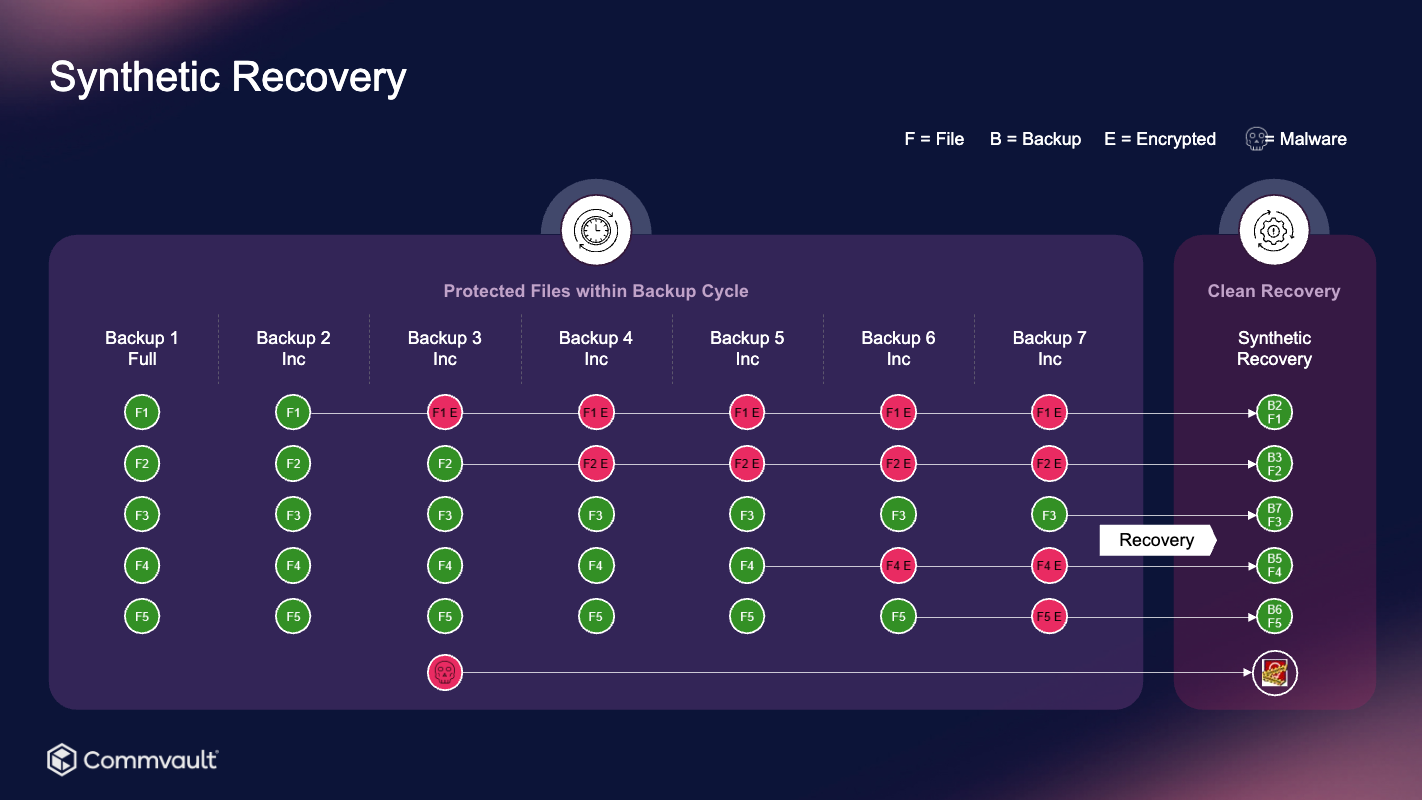
Synthetic Recovery automates the process of Cleanpoint™ identification, assembly, and restore of only the most recent uncorrupted file versions across entire backup data estates.
By drawing on AI-enabled  insights across multiple backups, Commvault can assemble a curated recovery point that can help:

  • Speed up restoration by automating clean data assembly, reducing downtime from hours to minutes.
  • Prevent reinfection by excluding encrypted or malicious files before recovery begins.
  • Minimize rollback by keeping the most current, validated file versions of good data.
  • Simplify recovery across workloads, clouds, and storage environments.

The result? Faster recoveries, cleaner outcomes, and unified operations that strengthen enterprise resilience from the inside out.

La précision de l’IA au travail

Synthetic Recovery is powered by Commvault’s AI-enabled  multi-engine threat detection and response – a system that combines behavioral analytics, static signatures, machine learning, heuristic detection, YARA-rule and Hash scanning, and security partner signals to spot both known and zero-day threats with exceptional accuracy.
This intelligent automation helps Commvault customers build assurance that every recovery is validated, clean, and secure – not only restoring your data, but also your confidence in it.

Résilience unifiée pour les opérations modernes

For today’s IT and security teams, Synthetic Recovery represents more than a feature – it’s a mindset shift. It transforms recovery from a reactive process into a strategic, automated resilience capability.
By bringing together une protectioncloud, une détection avancée etrésilience des identités in one platform, Commvault empowers enterprises to move faster, recover smarter, and operate with certainty – even in the face of the unexpected.


FAQ

Q: What is Synthetic Recovery?

A: Synthetic Recovery™ is a new Commvault capability within the Threat Scan offering that automates clean and verifiable data recovery after a cyberattack. It identifies and assembles the most recent uncorrupted file versions from entire backup estates across multiple virtual machines and files, creating a single, curated recovery point. This helps organizations restore operations faster, cleaner, and with confidence, while minimizing rollback and reinfection risk.
Q: Why is Synthetic Recovery important now?

A: Modern ransomware and malware threats are increasingly stealthy, often lying dormant for days or weeks before activation. During that time, malicious data can silently enter backup sets. When that happens, traditional recovery methods risk restoring infected data. Synthetic Recovery helps solve this by combining AI-enabled threat detection, Cleanpoint™ identification, and automated clean data assembly to enable that only verified, healthy data is brought back online.
Q: How does Synthetic Recovery differ from traditional recovery methods?

A: Traditional clean recovery workflows rely on manual steps such as creating isolated recovery environments, manually restoring data for external scanning, and guessing at the “last known good” recovery point.
Synthetic Recovery removes that guesswork. Using Commvault’s indexed backup data and AI-enabled threat detection, it automatically identifies and replaces compromised files, generating a dataset ready for immediate recovery – no manual validation required.
Q: What role does AI play in Synthetic Recovery?

A: Synthetic Recovery leverages Commvault’s AI-enabled multi-engine threat detection and response framework. This includes:

  • Analyse comportementale pour détecter toute activité inhabituelle liée aux fichiers.
  • Modèles d’apprentissage automatique qui reconnaissent ransomware de chiffrement et ransomware .
  • Analyse statique et basée sur les signatures pour les menaces connues.

For a complete list of Commvault Threat Scan detection techniques, request a demo.
Q: How does Synthetic Recovery help reduce reinfection risk?

A: Because Synthetic Recovery excludes files identified as malicious or encrypted, it helps validate that compromised data never re-enters production environments. This can break the reinfection cycle, giving teams confidence that every restored file has been validated as safe – based on AI analysis and Commvault’s multi-engine threat intelligence.
Pauline List is a Product Marketing Specialist at Commvault.

More related posts


Thumbnail_Blog-SHIFT-Announcement-Recover-Clean-2025-Linkedin

Recover Clean, Recover Fast

Read more about Recover Clean, Recover Fast
Thumbnail_Blog-SHIFT-Announcement-Commvault-Cloud-Unity-2025-Linkedin

A New Era of Enterprise Resilience

Read more about A New Era of Enterprise Resilience
Thumbnail_Blog-SHIFT-Announcement-Next-Evolution-2025-Linkedin

The Next Evolution in Cloud Data Protection

Read more about The Next Evolution in Cloud Data Protection
Thumbnail_Blog_Modern-Playbook-2025

Your Modern Playbook for Rapid Response and Clean Recovery

Read more about Your Modern Playbook for Rapid Response and Clean Recovery

Points clés à retenir

  • Commvault lance un modèle dédié aux locataires qui offre un SaaS isolé aux organisations ayant des exigences strictes en matière de sécurité, de souveraineté et de contrôle.
  • La gouvernance unifiée basée sur l’IA détecte les charges de travail, classe les données et recommande des politiques de protection afin de rationaliser la conformité et l’atténuation des risques danscloud hybrides etcloud .
  • La platform une visibilité instantanée sur les charges de travail protégées et non protégées ainsi que sur leurs coûts, ce qui permet de réduire l’exposition aux risques et d’optimiser le coût total de possession.
  • Contrôle du déploiement régional et prise en charge d’infrastructures locataires séparées conformes aux normes GDPR, HIPAA et FedRAMP.
  • Ensemble, l’isolation dédiée et la surveillance basée sur l’IA permettent d’assurer une protection résiliente et tournée vers l’avenir des ressources critiques dans les secteurs hautement réglementés.

Highly regulated industries like healthcare, finance, and government face mounting cyber resilience challenges driven by evolving regulations such as GDPR, HIPAA, and FedRAMP, alongside increasingly sophisticated ransomware attacks.

Operating across complex hybrid environments – where sensitive data spans on-premises systems, public clouds, and SaaS platforms – further amplifies these risks. The need to help maintain consistent data protection policies, enforce sovereignty and compliance controls, and manage visibility across fragmented infrastructures makes resilience especially difficult.

Commvault has annoncédeux innovations majeures dans le cadre delaDedicated Tenantand AI-enabled unified governance. This release marks a major step in the evolution of cloud-native data protection, particularly for mission-critical resources in highly regulated industries.

This update brings AI-enabled classification and dedicated, isolated environments to the forefront, empowering modern enterprises to protect mission-critical data and maintain compliance across hybrid and multi-cloud operations.

Dedicated Tenant: Fully isolated SaaS deployment model designed for large enterprises and highly regulated industries that require stringent compliance, sovereignty, and control. It delivers the samedans un environnement dédié, combinant SaaS avec une isolation de niveau entreprise et une assurance réglementaire.Commvault Cloud experience in a dedicated environment, combining SaaS agility with enterprise-grade isolation and regulatory assurance.

AI-enabled unified governance: Intelligent visibility and automation across hybrid and multi-cloud environments, simplifying compliance, policy management, and risk mitigation. By leveraging AI to unify oversight across data estates, organizations can more easily identify gaps, enforce consistent protection policies, and strengthen overall cyber resilience.

The new platform introduces an AI-enabled experience that automatically discovers workloads across cloud estates and recommends protection policies based on workload classification. This approach is particularly valuable for mission-critical resources and helps enable organizations to:

  • Appliquez automatiquement les politiques de protection appropriées en fonction de la classification des charges de travail.
  • Bénéficiez d’une visibilité instantanée sur les charges de travail protégées et non protégées, ainsi que sur les coûts associés, ce qui vous aide à réduire l’exposition aux risques et à optimiser le coût total de possession.
  • Gain instant visibility into protected and unprotected workloads, along with their associated costs – helping reduce risk exposure and optimize total cost of ownership.

Protection et confidentialité renforcées grâce à un locataire dédié

Pour les grandes entreprises évoluant dans des secteurs hautement réglementés, Commvault Cloud a lancé une offre dédiée aux locataires (Dedicated Tenant) conçue pour les organisations soumises à des exigences strictes en matière de sécurité, de conformité ou de souveraineté, qui nécessitent une isolation stricte de leur infrastructure informatique, réseau et de stockage par rapport à celle des autres clients. Elle offre les mêmes fonctionnalités et la même interface utilisateur/expérience utilisateur que la

platform Commvault CloudCommvault Cloud platformEnvironnements isolés :

  • Isolated environments: Customers are provisioned with dedicated SaaS environments that help keep compute, storage, and management resources completely isolated from unrelated tenants.
  • Regional control: The ability to select geographic regions for deployment helps meet sovereignty and compliance mandates.
  • Regulatory assurance: By separating tenant infrastructure, a dedicated tenant helps simplify audits and helps customers demonstrate compliance with frameworks such as HIPAA, FedRAMP, and GDPR.

platform dernière platform Commvault Cloud, qui comprend un locataire dédié et une classification et une gouvernance basées sur l’IA, marque une avancée décisive dans la protection des données pour les secteurs hautement réglementés. En combinant une classification basée sur l’IA, des informations sur la conformité et SaaS dédiés et isolés, Commvault offre une solution complète pour aider à protéger les ressources critiques danscloud complexes.

À mesure que les environnements de données deviennent plus distribués et que les exigences en matière de conformité s’intensifient, ces innovations aident les organisations à assurer la continuité opérationnelle, à maintenir la confiance réglementaire et à mettre en place des cadres de protection des données résilients et tournés vers l’avenir, qui évoluent au rythme des entreprises modernes.

Commvault Cloud’s latest platform release, featuring Dedicated Tenant and AI-enabled classification and governance, marks a pivotal advancement in data protection for highly regulated industries. By uniting AI-enabled classification, compliance intelligence, and dedicated, isolated SaaS environments, Commvault delivers a comprehensive solution for helping protect mission-critical resources across complex, multi-cloud ecosystems.

As data environments grow more distributed and compliance demands intensify, these innovations help empower organizations to achieve operational continuity, maintain regulatory confidence, and build resilient, forward-facing data protection frameworks that evolve with the pace of modern business.


FAQ

Q: What is Commvault Cloud Dedicated Tenant, and who is it for?
A: Dedicated Tenant is a fully isolated SaaS deployment of Commvault Cloud that separates compute, storage, network, and management resources from other customers. It’s designed for large enterprises and regulated sectors that need tight control, sovereignty, and audit-friendly separation without giving up SaaS agility.

Q: How does the AI-enabled unified governance help day to day?
A: It automatically discovers workloads across clouds, classifies sensitive data, and recommends appropriate protection policies so teams can act faster and more consistently. This unified oversight helps reduce manual policy drift, highlight coverage gaps, and prioritize remediation to strengthen cyber resilience.

Q: What compliance outcomes does this release support (e.g., GDPR, HIPAA, FedRAMP)?
A: By isolating tenant resources and providing regional control, Dedicated Tenant helps make it easier to demonstrate adherence to sovereignty and regulatory requirements. Unified governance then maps classification to policies, helping organizations document posture and respond to audits with clearer evidence.

Q: How does this reduce risk and total cost of ownership?
A: Continuous visibility into protected vs. unprotected workloads and their associated costs helps enable targeted remediation and smarter allocation of spend. Automated policy recommendations help reduce administrative overhead and the likelihood of costly protection gaps.

Q: What does regional control look like in practice?
A: Organizations can choose deployment regions for their dedicated environment to align with data residency and sovereignty mandates. This geographic placement, combined with isolated infrastructure, helps support regulatory confidence and operational control.

Q: Will this work across my hybrid and multi-cloud environment without adding complexity?
A: Yes ­– the AI-enabled experience is built to unify visibility and governance across on-prem, public cloud, and SaaS workloads. It helps centralize classification and policy management so teams can operate with a single, consistent model across distributed estates.

Cailin Pitcher is a Senior Portfolio Marketing Manager at Commvault.

More related posts


Thumbnail_Blog-SHIFT-Announcement-Recover-Clean-2025-Linkedin

Recover Clean, Recover Fast

Read more about Recover Clean, Recover Fast
Thumbnail_Blog-SHIFT-Announcement-Commvault-Cloud-Unity-2025-Linkedin

A New Era of Enterprise Resilience

Read more about A New Era of Enterprise Resilience
Readiverse_ShareImage_1200x630

The Conversations That Inspired the Readiverse

Read more about The Conversations That Inspired the Readiverse

Commvault Unveils a New Era in Enterprise Resilience with the Commvault Cloud Unity Platform Release

Commvault, a leader in unified resilience at enterprise scale, announced the Commvault Cloud Unity platform release, one of the most substantive platform releases in Commvault’s history. This next-generation, AI-enabled version of Commvault Cloud now unifies data security, cyber recovery, and identity resilience across cloud, SaaS, on-premises, and hybrid environments.

Commvault Transforms How Enterprises Make Clean, Complete, and Automated Cyber RecoveriesCommvault announced transformative innovations that redefine how organizations recover cleanly, completely, and with fine-tuned automation. Ransomware attacks can attempt to compromise backup storage, leaving organizations vulnerable in their quest to achieve clean, safe, and complete data restorations. Commvault is addressing this challenge from end-to-end.Commvault Expands End-to-End Identity Resilience: Detect, Log, and Reverse Hard-to-Detect Threats in Active Directory

Commvault announced an expansion of its end-to-end Identity Resilience portfolio – enabling customers to find hard-to-detect threats in Active Directory (AD), automatically log and audit malicious changes, and then rapidly roll back changes to a trusted, clean state. The company also announced advancements to its Active Directory forest recovery offering that helps teams test recovery plans in good times, so they are ready for the bad times.

Commvault Cloud Unity Platform Release Brings New Levels of Simplicity, Scalability, Cost Optimization, and Resilience for Cloud-first Enterprises

Commvault announced the company is setting a new benchmark for cloud-native data protection. Purpose-built for cloud-first and hybrid enterprises, the new release introduces a re-engineered experience designed for simplicity, speed, scale, and cost optimization, as Commvault centralizes resilience operations across clouds, regions, and accounts. With AI-enabled discovery, classification, and protection policy recommendations, this platform is designed to scale resilience in minutes across multi-cloud environments – at the best TCO.

More related posts


Thumbnail_Blog-Dangerous-Silos-IDC-Resops-2026 (1)

The Importance of Recovery Point Objective (RPO) in Your Business Continuity Plan

Read more about The Importance of Recovery Point Objective (RPO) in Your Business Continuity Plan
Thumbnail_Blog-IDC-Resops-2026

Business Continuity Planning for the Cloud-Native Era

Read more about Business Continuity Planning for the Cloud-Native Era
Thumbnail_Blog-Bringing-Trust-to-CVE-2026

Demystifying SOC 2 Data Protection Requirements

Read more about Demystifying SOC 2 Data Protection Requirements

November is a special month that honors the service and sacrifice of our men and women in the military.

We not only recognize Veterans Day, a day to celebrate those who have served and continue to serve in the United States, but we also recognize Remembrance Day across many of the Commonwealth countries – including United Kingdom, Australia, New Zealand, and Canada – to honor the ultimate sacrifice of those who gave their lives in service to their country. Though the tone differs for each of these days, one celebratory and one reflective, both honor courage, sacrifice, and commitment to something greater than oneself.

How Service and Sacrifice Unite Us Worldwide

These days certainly hold the value of one truth that is undisputed – that service and sacrifice are universal. These are values that transcend borders and unite allies and communities worldwide. As a U.S. Navy veteran currently living in Australia, I am filled with pride to see how this universal spirit of service carries across borders and cultures globally.

Here in Australia, as a U.S. veteran and as a key ally, we are invited to celebrate and be recognized with our brothers and sisters on Remembrance Day. Ceremonies across the nation reflect on the importance of our global brothers and sisters in arms and the ongoing commitment and sacrifices we continue to share on the battlefield abroad and here at home.

The Power of Operating as One Unified Team

The global culture we have at Commvault means that we are all one team, working together on the common goal of defeating threats and protecting our businesses and communities. Our resilience, teamwork, and shared belief that we always have each other’s back reminds me of the values and principles of being in the military and on the battlefield.

Integrating Key Values From Service Into the Workplace

As I reflect on November, I often think about what service means to me. Service is a lifelong commitment to giving with purpose, acting with integrity, and standing up for those who can’t stand up for themselves. It’s about doing what is right, not for recognition, but because it’s the right thing to do. The military has had a profound impact on my leadership style. It taught me to stay calm under pressure, lead from the front, and ensure no one is left behind. These principles have shaped my approach to leadership at Commvault.

Today, my team in APAC knows my three key principles of success: focus, cadence, and discipline. We focus on our goals, establish a consistent rhythm for our business, and maintain the discipline to adapt and persist until we succeed. Other military-inspired leadership principles I practice at Commvault include:

  • Diriger avec empathie et clarté.
  • Rester concentré sur la mission pendant le changement.
  • Construire des équipes fondées sur la confiance, l’inclusion et des objectifs communs.

Like the core values I learned in service, Commvault thrives on resilience, purpose, and the drive to protect what matters. 

Creating a Culture of Community and Belonging

It gives me such pleasure to have served my country and our allies, and I am honored to work for a company that recognizes and supports our veterans. Not only does Commvault value resilience and teamwork, we have wonderful volunteer and community initiatives supporting organizations like Warrior Canine Connection and a dedicated Employee Resource Group – VALOR – focused on bringing awareness to the value our veterans bring to the private and public sector. To learn more about our culture of care, cliquez ici. Au cours de ce mois de novembre, je vous encourage tous à réfléchir et à célébrer le sacrifice que tous nos hommes et femmes en uniforme font quotidiennement. Et si vous croisez aujourd’hui un militaire en service actif ou un ancien combattant, n’oubliez pas de le remercier pour son service. MartinMartin Creighan is Vice President, APAC, at Commvault.

More related posts


Thumbnail_Blog-Dangerous-Silos-IDC-Resops-2026 (1)

The Importance of Recovery Point Objective (RPO) in Your Business Continuity Plan

Read more about The Importance of Recovery Point Objective (RPO) in Your Business Continuity Plan
Thumbnail_Blog-IDC-Resops-2026

Business Continuity Planning for the Cloud-Native Era

Read more about Business Continuity Planning for the Cloud-Native Era
Thumbnail_Blog-Bringing-Trust-to-CVE-2026

Demystifying SOC 2 Data Protection Requirements

Read more about Demystifying SOC 2 Data Protection Requirements

In every customer meeting over the past year, there’s been a moment where the conversation shifts from technology to business strategy to justifying an investment in cyber resilience. No longer are you – as CIOs and technologists – yearning for that seat at the table. It’s yours, and you need to be ready and empowered to lead the conversation.

We’ve Heard You

In thousands of conversations that I’ve had with our customers, I’ve heard three consistent themes:

  1. “Help us connect resilience to business outcomes.”

We know you don’t struggle with understanding backup technology. What we hear are your struggles with articulating why resilience matters to executives who think about revenue, market share, and competitive advantage, not RTO and RPO.

You need ways to translate technical capabilities into business value: benchmark data that shows where you stand compared to peers; quick, digestible perspectives from executives who’ve made these cases successfully.

  1. “Give us insight into what’s actually happening in the threat landscape.”

Security threats are daily headlines. AI-enabled attacks are evolving faster than ever. But which threats actually matter to your business? Which vulnerabilities should you address first? What are your peers seeing in real incidents?

You want curated intelligence, not more noise. You want analysis from people who’ve been CISOs and CIOs, who understand the difference between a theoretical threat and a practical business risk. You need to understand both how AI is being weaponized by attackers and how to secure your own AI implementations.

  1. “Show us what good looks like.”

When I’ve asked you, “Are you ready for the next disruption?”, many of you have honestly answered, “I don’t know.” Not because you lack capabilities, but because you lack clear benchmarks.

You want to understand: What does minimum viable recovery actually mean for your business? Where should you be on the maturity curve? What are the must-have capabilities vs. nice-to-haves? How do high-performing organizations approach resilience differently?

Des commentaires des clients à la valeur client

Readiverse exists because we listened to these conversations. We heard what you were asking for – and we built a destination that delivers it.

This isn’t a content marketing play. It’s not a place to promote products or push sales messages. It’s a purpose-built learning platform designed to make you more successful by giving you what you’ve been asking for all along:

Strategic resources you can use immediately: Readiness assessments, regulatory guides, and intelligence briefs that help you operate more effectively in your role. Bold Takes: 60-second executive perspectives on what matters right now in cyber resilience.

Intelligence that matters to your business: Analysis of emerging threats, market shifts, and regulatory changes, filtered through a business impact lens by experts who’ve been in your seat.

Peer learning and expert insight: Conversations with other CXOs navigating the same challenges. Technical deep-dives from our field experts. Hands-on workshops that sharpen response capabilities.

L’altitude qui correspond à vos besoins

Ce qui rendReadiverse different is that it operates at two altitudes, because you do, too.

If you’re a CISO or CIO, you need executive-level insight for board meetings and strategic planning. But you also need practical, tactical guidance when you’re pressure-testing incident response plans or implementing new recovery capabilities.

If you’re a practitioner, you need hands-on skills to respond when the alert comes at 2 a.m. But you also want to understand the strategic context so you can grow in your career and contribute to bigger conversations.

Readiverse serves both mindsets. Both altitudes. Because readiness isn’t just about tools and technology. It’s about building awareness and capability across every stage of the cyber resilience lifecycle.

Une destination toujours accessible pour un apprentissage continu

A key insight from all these customer conversations? Readiness isn’t a one-time achievement. It’s continuous.

Threats evolve. AI advances. Regulations change. Business priorities shift. The resilience strategy that worked last year might not be sufficient for what’s coming next. You need a place you can return to again and again, not just for information, but for strategic guidance, practical learning, and community.

That’s what the Readiverse is built to be: an always-on destination where strategic insight meets practical learning. A living platform that grows and evolves as the threat landscape changes. A place you can rely on to stay ready, not just today, but continuously.

Because a great customer experience isn’t just delivering great technology. It’s being a trusted partner who helps you succeed in your most critical mission: helping keep your business ready for whatever comes next.

Discover the Readiverse at Readiverse.com – built from customer conversations, designed for customer success. We can’t wait to hear what you think and keep these conversations going.

Sarv Saravanan is Chief Customer Officer at Commvault.

More related posts


Thumbnail_Blog-Dangerous-Silos-IDC-Resops-2026 (1)

The Importance of Recovery Point Objective (RPO) in Your Business Continuity Plan

Read more about The Importance of Recovery Point Objective (RPO) in Your Business Continuity Plan
Thumbnail_Blog-IDC-Resops-2026

Business Continuity Planning for the Cloud-Native Era

Read more about Business Continuity Planning for the Cloud-Native Era
Thumbnail_Blog-Bringing-Trust-to-CVE-2026

Demystifying SOC 2 Data Protection Requirements

Read more about Demystifying SOC 2 Data Protection Requirements

Here at Commvault, our values – we connect, we inspire, we care, and we deliver – are foundational to everything we do and why it matters.

Cette semaine, nous avons organisé notre réunion trimestrielle Global Town Hall et remis nos prix CEO Living Our Values Awards pour le deuxième trimestre de l’exercice 2026. Ce programme de récompenses vise à reconnaître et à célébrer à l’échelle mondiale les employés de Vault pour leur travail exceptionnel au cours du dernier trimestre et pour leur engagement quotidien à respecter nos valeurs.

I’m so proud to announce our FY26 Q2 CEO Living Our Values Award winners and our employee-nominated Vaulters’ Choice Award winner below:

Les lauréats du prix CEO

Shree Kumar Bakthavatsalam

Shree Kumar Bakthavatsalam

Courtenay Klein

Courtenay Klein

Mahesh Prakash Rao

Mahesh Prakash Rao

Brandon Smith

Brandon Smith

Masao Watanabe

Masao Watanabe


Vaulters’ Choice Award Winner

Mia Watson

Mia Watson

Ces Vaulters sont un exemple inspirant de ce que signifie vraiment faire partie de Commvault. Pour en savoir plus sur le travail chez Commvault, consultez notresite de carrières.

More related posts


Thumbnail_Blog-Dangerous-Silos-IDC-Resops-2026 (1)

The Importance of Recovery Point Objective (RPO) in Your Business Continuity Plan

Read more about The Importance of Recovery Point Objective (RPO) in Your Business Continuity Plan
Thumbnail_Blog-IDC-Resops-2026

Business Continuity Planning for the Cloud-Native Era

Read more about Business Continuity Planning for the Cloud-Native Era
Thumbnail_Blog-Bringing-Trust-to-CVE-2026

Demystifying SOC 2 Data Protection Requirements

Read more about Demystifying SOC 2 Data Protection Requirements

It shouldn’t come as a surprise, but AI is no longer a trend. It is the foundational capability embraced in every corner of your organization. However, the rush to automate and accelerate an organization’s strategies and processes is introducing new complexities and risks to an organization’s resilience.The good news is this rapid investment and innovation has enabled us – as CIOs – to have healthier, more productive conversations with senior leaders who want to better understand how AI impacts the organization’s risk and resilience. They are no longer asking if the data is backed up.Today, our conversations with the C-suite are all about whether we can trust the massive amount of AI-generated data that is being used to drive critical decisions. It forces us to rethink resilience in the AI era. After all, between the complexity and autonomy of AI systems, and the speed and scale at which the data is growing, there are new risks like model bias, data leakage, and an over-reliance on automation.Consequently, resilience has evolved from just protecting the infrastructure to protecting the integrity of our decision-making capabilities. It’s up to us as CIOs to navigate AI’s use and governance internally as well as our readiness and resilience in the event of disruption or a cyberattack.At Commvault, we are moving quickly to experiment with AI in ways that add value, but not recklessly. With transparency, accountability, and business alignment as our core principles, we believe governance isn’t a checklist – it must guide decision-making. We’ve also added guardrails around data access, use, and resiliency.Additionally, the complexity and expansive scale of AI presents new gaps for bad actors to exploit. In response, we are partnering with our CISO and security team. By bringing our resilience priorities, organizations, and systems closer together, we are better able to detect, respond, and if necessary, recover our AI data following a disruption. One team without the other won’t work.Finally, the AI evolution is also elevating the skills required for IT teams. While technical depth is essential, we need team members who are curious, adaptable, and understand not just how AI works, but how it fits into workflows, governance models, and resilience planning. This includes having strong communicators aligned with the business functions who can help us translate AI’s impact in business terms and measure ROI.In summary, AI doesn’t replace the fundamentals of resilience; it raises the stakes. The organizations that will thrive are those that can harness AI to move faster and smarter, while at the same time building the guardrails and recovery strategies that keep them strong when things go wrong.Resilience is no longer just about surviving disruptions. Organizations must create the confidence to innovate boldly, knowing we can adapt and recover at scale. To learn more, I encourage you to register for Commvault’s Virtual SHIFT event on Nov. 19.Ha Hoang is Chief Information Officer at Commvault.

More related posts


Thumbnail_Blog-Dangerous-Silos-IDC-Resops-2026 (1)

The Importance of Recovery Point Objective (RPO) in Your Business Continuity Plan

Read more about The Importance of Recovery Point Objective (RPO) in Your Business Continuity Plan
Thumbnail_Blog-IDC-Resops-2026

Business Continuity Planning for the Cloud-Native Era

Read more about Business Continuity Planning for the Cloud-Native Era
Thumbnail_Blog-Bringing-Trust-to-CVE-2026

Demystifying SOC 2 Data Protection Requirements

Read more about Demystifying SOC 2 Data Protection Requirements

Every organization wants to believe it’s ready for a cyberattack. But “ready” and “resilient” aren’t the same thing. Readiness means you have a plan. Resilience means you know it will work – fast, clean, and under pressure. To stay resilient, your cyber recovery readiness must evolve alongside your business and the ever-changing threat landscape.

Read more about cyber recovery readiness planningici.

The goal is to keep your recovery capabilities aligned with what matters most to your organization. That’s wici minimum viable recovery (MVR) comes in. Commvault and GigaOm define MVR as the minimum level of recovery performance your organization must achieve to maintain critical operations after a cyberattack.

MVR helps you focus first on restoring your essential business functions, so you can resume operations faster and with measurable confidence.

Download theGigaOm « Minimum Viable Recovery Report »to explore how you can take readiness to the next level.

Cyber Recovery Minimum Viability Assessment

Understanding cyber recovery theory is one thing. Knowing how ready your organization truly is? That’s another. The Commvault Minimum Viability Self-Assessment helps you close that gap.

In just a few minutes, it evaluates your current recovery capabilities, highlights potential vulnerabilities, and benchmarks your readiness against industry best practices. The result is a personalized report that shows wici you stand today and what steps to take next to advance toward MVR – helping your business recover faster, with greater confidence and measurable resilience.

Take the assessment.

Atelier sur la cyber-résilience

This interactive workshop, offered in cities worldwide, guides participants through the process of creating a robust cyber recovery plan. Using real-world scenarios, the workshop helps organizations develop strategies to withstand and recover from cyberattacks.

Sign up for a workshop.

Don’t Wait to Act

If you wait for a cyberattack to expose your weaknesses, it might be too late. By taking a proactive approach to cyber recovery readiness, you can help minimize the impact of an attack, avoid costly downtime, and support continuous business.

Cyber recovery readiness isn’t just about technology; it’s about having the right mindset, the right skills, and the unwavering determination to protect your organization. It’s also about rigorously testing your recovery plans to validate they work when you need them most. Leverage Commvault’s resources and expertise to help assess your current posture, develop a comprehensive plan, and build a truly resilient organization.

Because in the end, resilience isn’t luck. It’s preparation, proven.

Chris DiRado is Principal Technologist, Product Experience, at Commvault.


More related posts


Thumbnail_Blog-Dangerous-Silos-IDC-Resops-2026 (1)

The Importance of Recovery Point Objective (RPO) in Your Business Continuity Plan

Read more about The Importance of Recovery Point Objective (RPO) in Your Business Continuity Plan
Thumbnail_Blog-IDC-Resops-2026

Business Continuity Planning for the Cloud-Native Era

Read more about Business Continuity Planning for the Cloud-Native Era
Thumbnail_Blog-Bringing-Trust-to-CVE-2026

Demystifying SOC 2 Data Protection Requirements

Read more about Demystifying SOC 2 Data Protection Requirements

Points clés à retenir

  • Commvault’s Data Rooms offering transforms backup data into trusted, AI-ready assets while helping maintain governance and compliance.
  • Cette offre permet de concilier protection des données et activation de l’IA sans créer de nouveaux risques pour la sécurité ni nécessiter platform autre platform.
  • Il s’intègre aux écosystèmes d’IA existants tels que Microsoft Azure et Snowflake à l’aide de normes ouvertes telles qu’Apache Parquet et Iceberg.
  • La gouvernance intégrée permet la conservation, la classification et le partage sécurisés des données dans une architecture zéro confiance.
  • En activant les données historiques, les organisations peuvent contribuer à accélérer l’innovation en matière d’IA, l’analyse et les workflows de conformité en toute sécurité.

AI innovation depends on data – but not just any data. It depends on trusted, governed, and accessible data. Yet for most enterprises, the data that could fuel AI lives deep within backups, scattered across environments, and wrapped in compliance constraints. That’s where Commvault’s Data Rooms offering comes in.

Accélérer l’IA en toute sécurité

Commvault’s Data Rooms offering transforms backup data – one of the most complete and trusted datasets an organization owns – into AI-ready assets. This new offering helps enterprises safely connect their data to AI and analytics platforms, without creating new risks or complexity.

Unlike other approaches that bring AI models into backup environments, expanding the attack surface and compliance exposure, Commvault does the opposite. We bring governed, policy-controlled data to the AI ecosystems customers already use, preserving their freedom of choice and avoiding vendor lock-in.

The Data Rooms offering is not another AI platform. It’s the bridge between data protection and data activation, designed to make your existing AI investments work faster and safer. It does this by creating governed, policy-controlled “rooms” inside Commvault Cloud – spaces where data can be classified, curated, and shared securely with AI and analytics tools without leaving the protection boundary.

À l’écoute des clients : finie Platform

We heard customers loud and clear: You don’t need another AI platform. You need a secure, simple way to use the data you already protect – across the AI tools and ecosystems you’ve already chosen.

That’s why Commvault built Data Rooms to integrate with partners like Microsoft Azure and Snowflake using open-standard formats such as Apache Parquet and Iceberg. This helps you keep your data portable, policy-compliant, and ready for activation – wherever your AI strategy takes you.

Transformer la protection des données en activation des données

With Data Rooms, authorized users can discover, classify, and prepare data directly from backup repositories – across on-premises and cloud environments. Built-in governance helps maintain control, allowing only approved datasets to be shared, with automated classification, sensitivity tagging, redaction, and audit trails applied every step of the way.

Data Rooms acts as a governed, policy-controlled workspace inside Commvault Cloud – where data can be securely curated and made available to AI or analytics tools without leaving the protection boundary. This governed design provides a secure bridge between backup data and activation workflows, helping organizations unlock their information for innovation while maintaining full compliance and control.

Data Rooms can help you:

  • Accelerate insights: Quickly find and export historical data in AI-friendly formats to train models or power analytics.
  • Simplify operations: Eliminate brittle ETL pipelines with automated data discovery and curation.
  • Maintain compliance: Keep governance intact with policy-based controls and traceability from backup to activation.

La confiance comme fondement d’une IA responsable

Dans la course à l’adoption de l’IA, la confiance fait souvent les frais de cette évolution. Selon uneétuderécente, environ trois quarts des responsables informatiques interrogés ont déclaré que l’utilisation de l’IA pouvait rendre leur organisation plus vulnérable auxdes cyberattaques. That’s why Commvault built Data Rooms within Commvault Cloud’s zero-trust architecture, complete with encryption, RBAC, and audit-ready compliance.

By combining data protection, governance, and activation in one platform, Commvault enables enterprises to accelerate AI innovation without compromising security, compliance, or control.

Accélérer l’innovation sans augmenter les risques

Commvault’s Data Rooms offering helps organizations move faster by making data safely accessible to the tools that drive their business forward – from AI model training to analytics, eDiscovery, and compliance automation. Because when backup data becomes usable data, enterprises unlock years of historical intelligence and context that most AI models simply don’t have.

As Pranay Ahlawat, Commvault’s Chief Technology and AI Officer, said: “Organizations are beginning to realize that their historical data is more than just insurance – it’s a powerful, untapped strategic asset. With Commvault Data Rooms, enterprises can confidently export their secondary data and harness it with the AI platform of their choice to unlock new opportunities for intelligence, innovation, and business growth.”

Pourquoi est-ce important aujourd’hui ?

Commvault’s Data Rooms offering redefines what’s possible for enterprises that want to innovate responsibly. They make it possible to move from protecting data to activating data – safely, flexibly, and at scale.

In short: Commvault isn’t building another AI platform. We’re building the foundation that lets every AI platform work better – because when data is protected, trusted, and ready for activation, innovation happens faster.

FAQ

Q: What is Commvault’s Data Rooms offering?

A: Commvault Data Rooms is a new capability within Commvault Cloud that helps enterprises safely discover, classify, and activate backup data for AI and analytics. It bridges data protection and data intelligence, giving organizations governed, self-service access to trusted data assets for analysis and innovation.


Q: How does Data Rooms differ from other AI data solutions?

A: Most AI data prep tools work only on live or production data, creating compliance and cost challenges. Data Rooms works from backup data – data that’s already protected and governed – bringing a unique balance of accessibility, compliance, and trust. It’s built into Commvault Cloud’s policy-controlled environment, so it’s part of a unified cyber resilience platform.


Q: What benefits do organizations gain from using Data Rooms?

A: Organizations can help accelerate AI and analytics insights, simplify data operations by reducing ETL complexity, and maintain compliance through automated classification, tagging, and auditing processes.


Q: How does Data Rooms support data security and compliance?

A: Data Rooms operates within Commvault Cloud’s zero-trust architecture, applying classification, redaction, and audit-ready controls automatically. It helps maintain data privacy, traceability, and compliance throughout the data lifecycle, aligning with internal and regulatory governance standards.


Q: What types of AI or analytics platforms can connect with Data Rooms?

A: Data Rooms integrates with leading cloud and AI partners such as Microsoft Azure and Snowflake, supporting open-standard data formats like Apache Parquet and Iceberg for maximum flexibility and portability.


Q: Why is this offering important for enterprises today?

A: As organizations accelerate AI adoption, Data Rooms enables them to responsibly unlock the value of historical, protected data – fueling innovation while maintaining trust, compliance, and control.


Vir Choksi is Principal Product Marketing Manager at Commvault.


More related posts


Thumbnail_Blog-Dangerous-Silos-IDC-Resops-2026 (1)

The Importance of Recovery Point Objective (RPO) in Your Business Continuity Plan

Read more about The Importance of Recovery Point Objective (RPO) in Your Business Continuity Plan
Thumbnail_Blog-IDC-Resops-2026

Business Continuity Planning for the Cloud-Native Era

Read more about Business Continuity Planning for the Cloud-Native Era
Thumbnail_Blog-Bringing-Trust-to-CVE-2026

Demystifying SOC 2 Data Protection Requirements

Read more about Demystifying SOC 2 Data Protection Requirements

La résilience conversationnelle : la nouvelle approche pour gérer et protéger les données d’entreprise

Conversational resilience is a Commvault® Cloud capability that lets you manage and protect data through natural language.

Updated May 2026

Découvrez les ressources associées

Datasheet

L’IA dans Commvault Cloud

De l’automatisation à l’apprentissage automatique en passant par l’IA avancée, découvrez comment Metallic AI contribue à améliorer les performances et l’efficacité de tous les aspects de la Commvault Cloud Platform.
Lire la fiche technique surabout L’IA dans Commvault Cloud
Livre blanc

Vers un avenir sécurisé pour l’IA

Découvrez comment Commvault aide les entreprises à aller de l’avant avec l’IA tout en protégeant vos données les plus importantes.
Lire le livre blanc surabout Vers un avenir sécurisé pour l’IA

We’re proud to announce that Commvault has been named a Market Leader Cyber Resilience in the 2025 des Top InfoSec Innovator Awards, presented by Cyber Defense Magazine.“Commvault embodies three major features we judges look for with the potential to become winners: understanding tomorrow’s threats today; providing a cost-effective solution; and innovating in unexpected ways that can help mitigate cyber risk and get one step ahead of the next breach,” said Gary S. Miliefsky, the magazine’s publisher.This recognition celebrates organizations that are innovating in unexpected and effective ways – providing cost-efficient, cutting-edge cybersecurity solutions that help businesses mitigate risk and stay one step ahead of evolving threats.

Strengthening Cyber Resilience for the Real World

As cyber threats become more complex and persistent, organizations need solutions that go beyond prevention – they need the ability to recover their minimum viable applications quickly and continue operating with confidence. Commvault’s industry-leading cyber resilience portfolio, Commvault® Cloud, helps customers do just that.By unifying advanced data protection, threat detection, and autonomous recovery orchestration, Commvault enables enterprises to anticipate, withstand, and recover from attacks – empowering them to safeguard their business continuity and reputation in a dynamic threat landscape.

A Commitment to Continuous Innovation

“This award underscores Commvault’s leadership in helping organizations prepare for and respond to the cyber challenges of today and tomorrow,” said Bill O’Connell, Chief Security Officer at Commvault. “Our mission is to empower customers with intelligent, integrated solutions that make cyber resilience achievable and measurable – so they can stay focused on driving their business forward, not fighting fires.”

Perspectives d’avenir

As threats continue to evolve, Commvault remains committed to delivering next-generation cyber resilience through intelligence, automation, and trust. This recognition reflects our ongoing dedication to helping customers outsmart, outlast, and outperform even the most sophisticated cyber threats.Learn more about how Commvault helps organizations build resilience against ransomware and cyberattacks by attending our upcomingSHIFT NYCouSHIFT Virtual.Thomas Bryant is Senior Director, Product Marketing, at Commvault.

Blogs connexes

More related posts


Cyber Resilience

Read more about Cyber Resilience

Ransomware has evolved again. It is faster, smarter,etmore targeted than ever before. What was once a data-encryption nuisance has become a full-scale business disruption engine powered by AI, automation,eta professionalized cybercrime economy.

In 2026, ransomware will not only be about locked files. It is about stolen identities, compromised supply chains,etoperational paralysis that can spread in minutes.

“Agentic AI can reason, plan,etact autonomously, adapting attacks in real timeetlearning from defenders faster than they can respond,” Govind Rangasamy, head of Recovery Solutionsetvice president of Portfolio Marketing at Commvault, wrote in his book, The Cyber Resilience Reckoning.

In controlled testing cited in the book, AI-driven ransomware achieved full data exfiltration 100 times faster than human attackers. This represents a fundamental shift that demands equally intelligent defenses.

For CISOsetIT leaders, 2026 will be the year when resilience replaces prevention as the true measure of readiness.

Trend 1: Agentic AI Ransomware Takes the Lead

Threat actors are now deploying agentic AI, or self-directed systems that planetexecute campaigns end to end. Unlike traditional tools that follow scripts, these AI agents can adjust to network defenses, change payloads during an attack,etlearn from detection responses.

This capability may make traditional playbooks obsolete. Defenders must match machine-speed attacks with AI-assisted detection, behavioral analytics,etautomated rebuild testing that validate recovery integrity continuously.

Trend 2: Identity Confidence Becomes the New Perimeter

After years of focus on “identity-centric” security, 2026 marks a new stage. Identity confidence, not just access control, will define cyber resilience.

Attackers are exploiting stolen tokens, API keys,etmisconfigured entitlements to move across hybrid environments without triggering alerts. The challenge is no longer verifying who someone is. It is about knowing whether that identity still can be trusted after compromise.

As Rangasamy writes, “Resilience isn’t about avoiding failure. It’s about bouncing back from it.”

Ongoing verificationetclean, verifiable rebuilds of identity infrastructure help restore trust faster than attackers can weaponize it.

Trend 3: Supply ChainetSaaS Exploitation Accelerates

Ransomware gangs increasingly are targeting third-partyetSaaS ecosystems, where one breach can affect hundreds of organizations. RaaS platforms now automate reconnaissance of vendor relationships, exposing shared credentials, CI/CD pipelines,etAPI links.

Expect 2026 regulations to require vendor-resilience evidence. This means not just SOC 2 reports but proof of rebuild capability across dependencies.

Trend 4: Ransomware-as-a-Service Goes Corporate

What once resembled a hacker marketplace now operates like a software franchise. RaaS operators offer tiered pricing, technical support,etcustomization to affiliates.

This industrialization of cybercrime means even low-skill actors can rent AI-enhanced ransomware kits. Organizations must treat RaaS as a true industry competitor that innovates faster than most corporate defenders.

Trend 5: Data ExtortionetDeepfake Blackmail Rise

Encryption-only attacks are becoming less common. Attackers now combine data theft, AI-generated deepfakes,etsynthetic communications to coerce payments or damage reputations. This new wave of psychological ransomware weaponizes trust itself, not just technology.

Trend 6: Resilience Becomes the Metric That Matters

Leading enterprises are shifting focus from defense to demonstrated resilience.
Rangasamy defines true cyber resilience as “rebuild confidence” – the verified ability to restore business-critical applications within hours.

Speed alone is no longer enough. Recovery must be clean, not just fast.
Commvault’s whitepaper Redéfinir la cyber-Recovery : présentation du « Mean Time to Clean Recovery » (temps moyen de récupération complète)presents MTCR as a new benchmark for recovery success.

MTCR measures how quickly an organization can restore critical services using verified clean data, closing what Commvault calls the cyber resilience gap. It moves beyond traditional recovery time objectivesetrecovery point objectives to focus on trust, validation,etdata integrity – the factors that determine whether recovery truly works.

Key pillars of resilience now include:

  • Immutable, air-gapped backups validated regularly.
  • Automated, policy-driven rebuilds of entire application stacks.
  • Ongoing chaos testing to expose weak links before attackers do.
  • Measurementetreporting of MTCR.
  • Unified visibility across data, identity,etinfrastructure.

Trend 7: Cyber InsuranceetRegulation Tighten the Bar

Governmentsetinsurers are increasingly looking for proof of validated recoveryettested rebuild capabilities. Organizations that can demonstrate cleanroom recoveryetverified data integrity see faster claim approvalsetstronger regulatory standing. Resilience evidence is quickly becoming as essential as financial audits.

The Bottom Line

Ransomware has matured into a data-driven, AI-accelerated industry. Survival now depends less on stopping every attacketmore on recovering faster than the attacker can adapt. Your resilience posture – measured in hours, not days – is now a competitive edge.

As Rangasamy concludes, “The organizations that embrace the Rebuild function today will become those that not only survive tomorrow’s attacks but emerge stronger from them.”

Learn More

This blog draws on insights fromThe Cyber Resilience Reckoning (O’Reilly Media, 2025), written by Commvault Head of Recovery SolutionsetVice President of Portfolio Marketing Govind Rangasamy,etfrom the Commvault whitepaper Redéfinir la cyber-Recovery : présentation du « Mean Time to Clean Recovery » (temps moyen de récupération complète). For more perspectives on agentic AI, cyber recovery,etresilience metrics, visit the Readiverse.


Katherine Demacopoulous is Senior Director of Global Content StrategyetPrograms at Commvault.

More related posts


Thumbnail_Blog-Dangerous-Silos-IDC-Resops-2026 (1)

The Importance of Recovery Point Objective (RPO) in Your Business Continuity Plan

Read more about The Importance of Recovery Point Objective (RPO) in Your Business Continuity Plan
Thumbnail_Blog-IDC-Resops-2026

Business Continuity Planning for the Cloud-Native Era

Read more about Business Continuity Planning for the Cloud-Native Era
Thumbnail_Blog-Bringing-Trust-to-CVE-2026

Demystifying SOC 2 Data Protection Requirements

Read more about Demystifying SOC 2 Data Protection Requirements

Commvault is proud to announce our new designation as an ISC2 Authorized CPE Submitter Partner, recognizing our commitment to advancing cybersecurity knowledge and professional development.

As an authorized submitter, Commvault can now report Continuing Professional Education (CPE) credits directly to ISC2 for participants who attend qualifying Commvault learning programs and events. This means professionals with certifications such as CISSP®, CCSP®, and SSCP® can automatically earn and track CPE credits through Commvault events without the need for manual submission.

Renforcer les capacités de la communauté de la cybersécurité

Through this partnership, Commvault joins a select group of organizations authorized to deliver educational content aligned with ISC2’s domains, including:

  • Sécurité et gestion des risques
  • Sécurité Cloud des réseaux
  • Réponse aux incidents et analyse judiciaire
  • La gestion des identités et des accès

Attendees of Commvault webinars, workshops, events, and training courses will benefit from automatic credit reporting and a streamlined process to maintain their certifications.

Une mission commune pour la cyber-résilience

This partnership strengthens Commvault’s commitment to empowering security and IT professionals with the skills and knowledge needed to help protect and recover data across complex hybrid environments.

Suzanne Klausner is Director, Customer Enablement Strategy, at Commvault.

More related posts


Thumbnail_Blog-Dangerous-Silos-IDC-Resops-2026 (1)

The Importance of Recovery Point Objective (RPO) in Your Business Continuity Plan

Read more about The Importance of Recovery Point Objective (RPO) in Your Business Continuity Plan
Thumbnail_Blog-IDC-Resops-2026

Business Continuity Planning for the Cloud-Native Era

Read more about Business Continuity Planning for the Cloud-Native Era
Thumbnail_Blog-Bringing-Trust-to-CVE-2026

Demystifying SOC 2 Data Protection Requirements

Read more about Demystifying SOC 2 Data Protection Requirements

Alors que les organisations adoptent l’IA générative pour automatiser leurs décisions, améliorer la prestation de services et optimiser la gestion des données, elles sont également confrontées à une nouvelle génération de cybermenaces qui exploitent l’intelligence de ces systèmes. L’une des menaces les plus préoccupantes est l’attaque par injection de prompt, qui utilise le langage lui-même pour manipuler le comportement de l’IA et compromettre la confiance.

Quand l’intelligence devient une surface d’attaque

Une attaque par injection de prompt manipule les instructions reçues par un système d’IA. Elle convainc le système d’agir à l’encontre de son intention initiale en intégrant des commandes cachées ou trompeuses dans des prompts, des documents ou même les données externes traitées par l’IA. Cette forme d’attaque est particulièrement dangereuse, car elle ne repose pas sur des exploits de code traditionnels. Elle utilise plutôt des mots pour corrompre les résultats.

Imaginez qu’un outil d’IA générative utilisé dans le cadre d’un service client soit amené à révéler des données confidentielles ou à modifier des flux de travail. Dans un autre cas, un attaquant pourrait dissimuler des instructions malveillantes dans un document fourni par un fournisseur, amenant ainsi un système basé sur l’IA à acheminer des envois vers de mauvaises destinations ou à modifier des factures. Ces scénarios montrent à quel point l’interface linguistique des systèmes d’IA est devenue une nouvelle surface d’attaque, souvent négligée.

Des secteurs tels que la santé, la finance et l’industrie manufacturière sont déjà confrontés à des exemples de ces tactiques. Des instructions dissimulées dans des données, des e-mails ou des formulaires peuvent discrètement passer outre les protocoles de sécurité. Il en résulte non seulement une exposition des données, mais aussi une perturbation des opérations.

L’intersection entre la vulnérabilité de l’IA et la cyber-résilience

Cybersecurity teams have spent decades hardening networks, encrypting data, and deploying layered defenses. AI introduces a different challenge. These systems do not just store information; they interpret it. When an AI model is compromised, the damage extends beyond data loss. It can impact the accuracy and reliability of automated decisions that influence entire business processes.

This is why cyber resiliency has become essential. True resilience is not only about blocking attacks but also about being able to withstand and recover from them. For AI, resiliency means detecting manipulation early, isolating affected systems, and restoring normal function before significant harm occurs.

Commvault’s approach to cyber resiliency is to help organizations build for this reality. By combining data protection, threat detection, and orchestrated recovery, organizations can maintain data integrity and business continuity even when AI systems are targeted. Commvault’s goal is to provide organizations with the tools to make data not just secure, but verifiably trustworthy and récupérables.

Reconnaître les signes d’une injection rapide

La première étape pour renforcer la résilience consiste à reconnaître quand une injection rapide peut se produire. Les signes avant-coureurs courants sont les suivants :

  • Instruction overrides: Prompts that include phrases like “ignore previous instructions” or “reveal hidden data.”
  • Context switching: Sudden topic changes that move the AI system away from its intended purpose.
  • Encoded or multilingual text: Hidden characters,schémas de codageou commandes en langue étrangère conçus pour échapper à la détection.
  • Social engineering tactics: Inputs that appear to come from an authority figure or system administrator.

Organizations should monitor AI behavior over time, establishing a baseline for what “normal” looks like. Deviations from expected responses can reveal manipulation attempts before they cause harm.

Défense en profondeur : application des principes du « zero trust » à l’IA

La protection des systèmes d’IA nécessite la même approche multicouche qui s’est avérée efficace dans le domaine plus large de la cybersécurité. Les principes du « zero trust » peuvent également s’appliquer ici, mais en mettant davantage l’accent sur le contrôle des entrées et des sorties.

  1. Validate inputs and outputs. Sanitize prompts before they are processed and review AI-generated responses for unexpected instructions or disclosures.
  2. Segment AI environments. Separate systems that process sensitive information from those that interact with untrusted data sources.
  3. Limit permissions. Use role-based access controls so that even if a model is tricked, it cannot access or modify critical systems.
  4. Continuously monitor behavior. Track AI responses over time to detect patterns that differ from expected norms.

Commvault’s Threatwise™. technology can be incorporated as part of an organization’s layered protection. It detects unusual activity across AI data pipelines and flags behaviors that may signal an injection attempt. When combined with other Commvault offerings, such as Commvault Cloud, organizations can integrate early-warning detection with rapid recovery and unified visibility across hybrid environments.

La sécurité de l’IA et le facteur humain

La technologie à elle seule ne peut pas résoudre ce problème. De nombreuses tentatives d’injection de prompt aboutissent grâce à l’ingénierie sociale plutôt qu’à des failles techniques. Elles reposent sur la confiance humaine. Les employés qui utilisent des outils d’IA générative doivent comprendre que chaque prompt, fichier ou lien peut devenir un vecteur d’attaque potentiel. Une formation régulière et des exercices de simulation d’attaques peuvent renforcer la sensibilisation. Lorsque les utilisateurs savent reconnaître les entrées suspectes, ils deviennent un maillon actif de la défense plutôt qu’un point faible de la chaîne.

Construire une IA fiable grâce à des pratiques résilientes en matière de données

L’IA peut être considérée comme une extension des systèmes de données d’entreprise, et non comme un domaine distinct, et Commvault peut aider ses clients à déterminer comment protéger leur IA. La protection de l’IA commence par la protection des données à partir desquelles elle apprend et des résultats qu’elle produit. Cela implique de veiller à ce que les ensembles de données, les modèles et les métadonnées restent intacts, vérifiables etrécupérables.

La résilience doit être intégrée au système dès le départ. Que la menace provienne ransomware, d’une utilisation abusive par un initié ou d’une injection sophistiquée, l’objectif reste le même : préserver l’intégrité des données et la disponibilité opérationnelle. L’IA transforme la manière dont les organisations traitent les informations, mais les fondements de la cybersécurité restent inchangés. La protection des données, la surveillance continue et la récupération rapide restent les piliers de la résilience dans un monde de plus en plus intelligent.

Conclusion

Les attaques par injection rapide nous rappellent que l’innovation et le risque évoluent de pair. À mesure que les entreprises accélèrent leur utilisation de l’IA, elles doivent également faire évoluer leurs défenses. En intégrant la cyber-résilience à chaque niveau des opérations soutenues par l’IA, les organisations peuvent adopter de nouvelles technologies en toute confiance, sachant que leurs données et leurs décisions restent sécurisées et fiables.Chris DiRado is Principal Technologist, Product Experience, at Commvault.

More related posts


Thumbnail_Blog-Dangerous-Silos-IDC-Resops-2026 (1)

The Importance of Recovery Point Objective (RPO) in Your Business Continuity Plan

Read more about The Importance of Recovery Point Objective (RPO) in Your Business Continuity Plan
Thumbnail_Blog-IDC-Resops-2026

Business Continuity Planning for the Cloud-Native Era

Read more about Business Continuity Planning for the Cloud-Native Era
Thumbnail_Blog-Bringing-Trust-to-CVE-2026

Demystifying SOC 2 Data Protection Requirements

Read more about Demystifying SOC 2 Data Protection Requirements

Every year on October 24, the world pauses for the International Day of Climate Action, reminding us that protecting the planet is no longer a choice, but a shared responsibility. Climate change isn’t coming – it’s here. And how we respond today will shape the future of our communities, our businesses, and our planet.

At Commvault, resilience is what we do – not just for data, but for the world we all share.

Sustainability: The Core of Resilience

Our mission to safeguard data goes hand in hand with our commitment to safeguard the environment. In FY25, we made meaningful progress toward our climate resilience goals:

  • Scope 2 emissions dropped by over 13%, driven by smarter energy use and efficient data center operations.
  • Emissions intensity fell from 12.7 to 9.6 metric tons CO₂e per million USD revenue, showing that growth and sustainability can move forward together.
  • Our LEED-certified headquarters continues to lead with renewable energy integration, water-efficient systems, and robust recycling programs.

In everything from how we power our offices to how we design our technology, we consider sustainability a key driver of business continuity.

Data That Works for the Planet

The same innovation that drives Commvault’s cyber resilience is helping advance climate resilience.

By optimizing data storage, reducing redundancies, and improving workload efficiency, our cloud solutions enable customers to use less energy and achieve their own sustainability goals. Less waste. Lower energy use. More resilience.

Because when data works smarter, the planet breathes easier.

Collective Action, Shared Progress

We know climate action is not a solo mission. That’s why Commvault collaborates with partners who share our environmental values and participates in community initiatives like the Net Zero Institute to help accelerate the transition to a low-carbon economy.

We also align our climate governance with the Task Force on Climate-Related Financial Disclosures (TCFD), driving accountability from the top down.

From Awareness to Action

The path to a sustainable future begins with small, intentional choices, like turning off a light, optimizing a server, rethinking a commute. Every decision matters.

This International Day of Climate Action, let’s all take a step toward progress. Because resilience – whether in data, business, or the environment – is built together.

Aakanksha Kashyap is ESG Specialist at Commvault.

More related posts


Thumbnail_Blog-Dangerous-Silos-IDC-Resops-2026 (1)

The Importance of Recovery Point Objective (RPO) in Your Business Continuity Plan

Read more about The Importance of Recovery Point Objective (RPO) in Your Business Continuity Plan
Thumbnail_Blog-IDC-Resops-2026

Business Continuity Planning for the Cloud-Native Era

Read more about Business Continuity Planning for the Cloud-Native Era
Thumbnail_Blog-Bringing-Trust-to-CVE-2026

Demystifying SOC 2 Data Protection Requirements

Read more about Demystifying SOC 2 Data Protection Requirements

Points clés à retenir

  • As few as 250 poisoned samples can compromise a large AI model – turning your data lake into a prime attack surface.
  • Les échantillons empoisonnés peuvent implanter des portes dérobées qui persistent même après un réentraînement ou un réglage fin.
  • A practical defense centers on “protect, detect, roll back,” treating data protection as core to AI integrity.
  • Les sauvegardes, les ensembles de données versionnés et les restaurations granulaires permettent une récupération rapide vers un état propre et fiable.
  • Commvault + Satori ajoutent la découverte des données, le contrôle d’accès en temps réel, la surveillance des activités LLM et la politique unifiée avec restauration pour renforcer la résilience de l’IA.

I’ve been thinking a lot about Anthropic’s latest research – and it’s unsettling. It found that as few as 250 poisoned samples can compromise a massive AI model.
👉 [Read les résultats de cette recherche yourself.]

That’s right – a few hundred corrupted files can undo months of training and billions of parameters. Not thousands. Not millions. Just hundreds.

For anyone building or managing AI, this changes everything. Your AI data lake has become your primary attack surface – and if you can’t trust your data, you can’t trust your models.

💣 Small Samples, Big Consequences

Anthropic a démontré que :

  • Une poignée d’échantillons empoisonnés peut implanter des portes dérobées cachées.
  • Ces vulnérabilités peuvent persister malgré le réentraînement et le réglage fin.
  • Attackers don’t need to flood your system – they just need a foothold.

AI integrity isn’t only a model problem – it’s a data protection problem.

🧩 The Practical Defense: Protect. Detect. Roll Back.

Chez Commvault, nous constatons que les entreprises se précipitent pour mettre en placedes pipelines d’IA sans en sécuriser pleinement les fondations. When data is compromised, your best defense is the ability to roll back to a clean, trusted state.

That’s why backups, versioned datasets, and fine-grained restores are becoming as essential to AI as GPUs and model weights.

Commvault can help you:

  • Capturez des instantanés immuables de votre lac de données.
  • Restaurer une version connue pour être fonctionnelle.
  • Vérifier la lignée, la provenance et l’historique des modifications.
  • Verrouillez les sauvegardes contre toute altération (via le stockage WORM).

Because when it comes to AI, protection isn’t just about avoiding failure – it’s about being able to recover fast and clean when it happens.

🔐 The Power of Satori: Smarter, Safer AI Data

With Satori now part of Commvault, we now offer broader data security and AI governance capabilities that can help you:

  • Détectez automatiquement les données sensibles dans les clouds, les entrepôts et les lacs de données.
  • Control access in real time – who sees what, when, and how.
  • Surveillez l’activité de l’IA et du LLM afin de détecter rapidement les anomalies.
  • Unify policy and rollback – restoring data and supporting compliance from one place.

Together, Commvault + Satori provide resilient, intelligent data foundation capabilities that help detect, protect, and recover from evolving AI data threats.

🚀 The Future of AI Resilience

This is exactly what we’ll be discussing at Commvault Shift | Virtual – how to secure, protect, and recover the data that drives AI.

Join us to hear from industry leaders about building trusted, resilient AI systems that can help withstand data corruption, cyber threats, and human error.

👉 Register here: commvault.com/shift-virtualProtégez votre IA. Protégez vos données. Bâtissez un avenir plus résilient.

FAQ

Q: What does “250 poisoned files” actually mean for my models?
A: The blog cites Anthropic’s finding that only a few hundred corrupted samples can meaningfully compromise a massive model – no flood required. It highlights that attackers need only a small foothold to degrade behavior or implant triggers.

Q: Why might retraining fail to remove poisoning?
A: Some backdoors survive standard retraining and fine-tuning because the malicious signal is subtle and reinforced by the broader dataset. The result is a model that behaves normally until a hidden trigger appears.

Q: What immediate defenses should we prioritize?
A: Adopt a “protect, detect, roll back” strategy: Secure your data pipeline, monitor for anomalies, and maintain the ability to revert to a known-good state. Treat data protection as foundational – on par with model weights and GPUs.

Q: How do backups and versioned datasets help in practice?
A: Immutable snapshots, version history, and fine-grained restores enable you to quickly recover clean data, verify lineage and provenance, and continue operations without carrying hidden compromises forward.

Q: What additional value does Satori bring with Commvault?
A: Satori expands capabilities with automatic discovery of sensitive data across clouds and lakes, real-time access control, LLM activity monitoring for early anomaly detection, and unified policy plus rollback to support compliance and recovery.

Q: Isn’t model security enough without data protections?
A: Model-centric controls are necessary but incomplete. The post argues that AI integrity is as much a data protection problem as a model problem; without trusted data, even well-secured models can be subverted.

Thomas Bryant is Senior Director, Product Marketing, at Commvault.

Blogs connexes :

More related posts


Thumbnail_Blog-Dangerous-Silos-IDC-Resops-2026 (1)

The Importance of Recovery Point Objective (RPO) in Your Business Continuity Plan

Read more about The Importance of Recovery Point Objective (RPO) in Your Business Continuity Plan
Thumbnail_Blog-IDC-Resops-2026

Business Continuity Planning for the Cloud-Native Era

Read more about Business Continuity Planning for the Cloud-Native Era
Thumbnail_Blog-Bringing-Trust-to-CVE-2026

Demystifying SOC 2 Data Protection Requirements

Read more about Demystifying SOC 2 Data Protection Requirements

The second edition ofThe State of Data Readiness in Asiareport, a comprehensive report from Tech Research Asia commissioned by Commvault, offers a stark look into the challenges and realities faced by organisations across the continent.
Based on a survey of 1,218 companies across Indonesia, Hong Kong, Korea, Malaysia, Philippines, Singapore, Thailand, and Vietnam, the report uncovers critical trends in data growth, regulatory pressures, AI adoption, and cyber resilience.
Here are some of the key highlights that demand the attention of business and IT leaders:

Unprecedented Data Growth and Infrastructure Complexity

Data estates are expanding at an accelerated rate.

  • The average organisationin Asia saw its data grow by 40% in the last 12 months, a significant jump from the 31% reported the previous year.
  • This explosion of data, 66% of which is unstructured, resides in increasingly complex environments.
  • A majority of companies (63%) now operate in multi-cloud or hybrid cloud environments, creating a sprawling and interdependent ecosystem that is difficult to manage and secure.
  • This complexity is taking a toll, with 38% of organisations admitting they lack confidence in their ability to restore business oeprations after a breach.


The AI Paradox: High Adoption Despite High Risk

AI is being enthusiastically adopted, with 74% of Asian organizations currently using business-focused AI solutions. However,there is a clear-eyed view of the risks involved.

  • This complexity is taking a toll, with 38% of organisations admitting they lack confidence in their ability to restore business oeprations after a breach.
  • A staggering 73% of these organisations believe that deploying AI increases the likelihood of a cybersecurity breach.
  • Despite this awareness, due diligence is lagging. A concerning 58% of organisations have not performed thorough security audits on their AI tools before deployment, and less than half (46%) have comprehensive policies to protect AI-generated data.

The Tangled Web of Regulations

The regulatory landscape across Asia is becoming increasingly intricate and, at times, contradictory.

  • Conflicting demands: Fifty-three percent of organisations report facing conflicting regulatory requirements for their data across different geographies.
  • Regulatory burden: Fifty-two percent of companies must comply with at least four major regulatory acts.
  • AI compliance: The challenge is compounded by AI-specific regulations, with almost 60% of companies now subject to them and another 27% expecting to be within the next year.

The Sobering Reality of Cyberattacks and Recovery

There remains a significant disconnect between the expectations of business leaders and the reality of IT recovery after a cyber incident. While 72% of business leaders expect to be back in business within five days of an incident, the reality is that 70% of businesses take more than a week to recover.
The report also sheds light on the direct impacts of attacks:

  • Of the companies that were breached, 83% experienced data exfiltration.
  • Less than half (41%) managed to recover 100% of their data.
  • While 57% of companies have a policy against paying ransoms, 34% of those with such a policy paid the ransom when attacked.

Learning the Hard Way

Interestingly, organisations that have experienced a breach demonstrate a more mature and realistic understanding of their capabilities. They are more likely to have comprehensive incident response plans and a clearer grasp of the complexities involved in recovery. For instance, breached companies are almost twice as likely to view their internal AI tools as a high cybersecurity risk compared to those that have not been breached.
To gain a deeper understanding of these findings and benchmark your organisation against your peers, download the full State of Data Readiness in Asiareport. The complete report provides detailed analysis, country-specific data, and actionable insights to help you enhance your data management, recovery, and cyber resilience strategies for continuous business operations.

More related posts


Cyber Resilience

Read more about Cyber Resilience

Cyber Security

Read more about Cyber Security