Skip to content

Puntos Clave

  • Streamlined process: Simplifies recovery through enhanced threat detection and validation.
  • Integrated experience: One simple process from threat identification to production recovery.
  • Readiness: Configure, plan, and test cyber recovery plans to uncover gaps.
  • Rapid detection and validation: Quickly identify clean points and validate recovery.
  • Confident recovery: Helps organizations confidently recover clean data, apps, and infrastructure.

In today’s landscape of relentless cyber threats, organizations are grappling with an unprecedented challenge: maintaining business continuity in the face of potential data loss and system compromise. The recent surge in sophisticated ransomware attacks has underscored the critical need for estrategias sólidas de ciberresilienciaque vayan más allá de los métodos tradicionales backup recuperación.Commvault Cloud Cleanroom Recoveryintroduce un enfoque innovador para este desafío. Al crear un entorno bajo demanda, seguro y aislado, las organizaciones pueden probar sus planes de recuperación, llevar a cabo investigaciones forenses exhaustivas y ejecutar recuperaciones de producción sin correr el riesgo de interrumpir aún más sus operaciones.

Cyber Recovery + análisis forense = recuperación óptima

Ransomware threats targeting backup systems have become increasingly common, highlighting the vulnerabilities in conventional recovery processes. It’s no longer sufficient to simply have a recovery plan in place; organizations must rigorously test and validate their strategies to prepare to withstand real-world cyberattacks.

Cleanroom Recovery can help organizations seeking to maintain uninterrupted operations amid disruption. Probar los planes de recuperación cibernéticaes una parte fundamental para lograr una verdadera resiliencia cibernética. Al facilitar una recuperación rápida y fiable, minimizar el tiempo de inactividad y agilizar los procesos, las pruebas desempeñan un papel vital para reforzar la continuidad del negocio.

A medida que las organizaciones siguen dando prioridad a los planes sólidos de recuperación cibernética, no se puede subestimar la importancia de realizar pruebas rigurosas. Con protocolos de prueba eficaces, las organizaciones pueden identificar vulnerabilidades y verificar que sus estrategias de recuperación sigan estando en consonancia con las amenazas cibernéticas en constante evolución. Una vez que una organización ha configurado el análisis periódico de malware de todas las copias de seguridad y ha probado sus planes, puede realizar análisis forenses para identificar la causa raíz de un ataque e investigar los sistemas afectados. Estos dos casos de uso aumentan la confianza en la ejecución de una recuperación óptima.

What’s New in Cleanroom Recovery?

Building on its foundation, the latest Cleanroom Recovery innovations are introducing significant enhancements that further strengthen cyber recovery capabilities. These advancements deliver new capabilities that help organizations protect their critical infrastructure and data.

Recent and upcoming developments have bolstered Cleanroom Recovery’s capabilities in orchestration, security, and scalability, including early access to:

  • Cleanroom creation automation: Automate cleanroom deployment, cross hypervisor recovery and threat scanning inside the cleanroom to remove manual intervention​. (Generally Available)
  • Runbook experience: Ability to create multiple runbooks for critical assets for different use cases. Runbooks provide step-by-step execution playbooks with optional manual steps.​ (Early Access)
  • Expanded workload support: You can recover Active Directory forest along with VMs and files into a cleanroom for end-to-end application validation. ​(Early Access)
  • On-premises deployment capabilities: You now can use Cleanroom Recovery to recover critical application into an isolated recovery environment in an on-premises data center using air-gapped Hyperscale X (Early Access)

These advancements illustrate a continued focus on expanding the features, capabilities, and scale of Cleanroom Recovery. This is the next phase in Cleanroom Recovery’s evolution. The solution helps provide customers with enhanced efficiency, scalability, and adaptability, with the flexibility to deploy isolated cleanroom in cloud and on-premises.

Cleanroom Recovery helps enable customers to effortlessly spin up automated cleanrooms with streamlined runbooks and features threat scanning capabilities for comprehensive threat detection and recovery.

With this new evolution, organizations will be enabled to quickly and safely test their cyber recovery plans, validate applications, and execute a confident cyber recovery. Commvault is delivering one integrated experience from identifying threats to production recovery.

Preguntas frecuentes

Q: What is Cleanroom Recovery, and why is it important?
A: Cleanroom Recovery is a secure, isolated environment that enables organizations to test recovery plans and conduct forensic analysis without risking production systems. This helps organizations maintain continuous business operations and improve cyber resilience against modern ransomware threats.

Q: How does Cleanroom Recovery enhance cyber recovery readiness?
A: By automating cleanroom creation to conduct recovery testing and enabling forensic investigation, it helps organizations validate their recovery strategies, uncover vulnerabilities, and execute faster, more confident recoveries after cyber incidents.

Q: What are the main new features in the Cleanroom Recovery release?
A: Key innovations include automated cleanroom deployment, new runbook capabilities for multiple recovery scenarios, support for Active Directory recovery, and the ability to deploy in on-premises data centers with air-gapped Hyperscale X.

Q: How does Cleanroom Recovery improve security during recovery operations?
A: It isolates the recovery environment, scans for threats pre-/post-recovery, provides controlled orchestration, and helps reduce the risk of reinfection or unauthorized access during recovery.

Q: Can Cleanroom Recovery be deployed both on-premises and in the cloud?
A: Yes, organizations now can deploy Cleanroom Recovery in both cloud and on-premises environments, providing flexibility for hybrid infrastructures and diverse security requirements.

Q: Who benefits most from Cleanroom Recovery?
A: Enterprises seeking to strengthen their cyber resilience, particularly those facing ransomware risks or complex recovery needs, gain value from its automation, scalability, and integrated testing capabilities.Toussaint Brock is a Product Marketing Manager at Commvault.



Blogs relacionados

More related posts


Thumbnail_Blog-Architect-for-tomorrow-2026

Architect for Tomorrow: Unified Data Protection as the Foundation for Resilience

Read more about Architect for Tomorrow: Unified Data Protection as the Foundation for Resilience
Thumbnail_Blog-Dangerous-Silos-IDC-Resops-2026 (1)

The Importance of Recovery Point Objective (RPO) in Your Business Continuity Plan

Read more about The Importance of Recovery Point Objective (RPO) in Your Business Continuity Plan
Thumbnail_Blog-IDC-Resops-2026

Business Continuity Planning for the Cloud-Native Era

Read more about Business Continuity Planning for the Cloud-Native Era

Puntos Clave

  • The la platform Commvault Cloud release is an AI-enabled platform that unifies data security, cyber recovery, and identity resilience across all environments – from cloud to on-premises.
  • Ayuda a eliminar los silos entre las herramientas de seguridad, identidad y recuperación, lo que permite una protección más rápida, inteligente y fiable.
  • Commvault’s de «Recovery sintética»™ uses AI to surgically remove compromised data and restore clean data quickly.
  • La resiliencia de identidad integrada detecta y revierte los cambios maliciosos en sistemas críticos como Active Directory.
  • Gracias a su inteligencia integrada, Commvault Cloud aprende Cloud de las amenazas, lo que hace que la resiliencia de la empresa sea proactiva y adaptable.

Today, we’re complace anunciar the la platform Commvault Cloud release, our next-generation, AI-enabled platform designed to unify data security, cyber recovery, and identity resilience across every environment your business runs on – cloud, SaaS, on-premises, and hybrid.

For years, IT and security teams have been fighting an uphill battle. Data is growing faster than ever, AI is generating it at lightning speed, and bad actors are taking full advantage. Meanwhile, enterprises are forced to stitch together countless security tools and recovery solutions that don’t talk to each other. The result? More silos, more risk, and slower recoveries when time matters most.

The la platform Commvault Cloud release helps change that.

This isn’t just another platform release. It’s a redefinition of what resilience means in the AI era.

Por qué hemos creado la Platform Commvault Cloud Platform

Hoy en día, todas las empresas se enfrentan a una tormenta perfecta de retos:

  • Explosive data growth fueled by AI and distributed work.
  • Disjointed tools for data protection, security, and identity management.
  • Complex environments that span cloud, SaaS, edge, and on-prem.

These are problems we’ve seen firsthand – and we knew the answer wasn’t another tool. It was a unified platform that could simplify and strengthen resilience at its core.

So, we created the la platform Commvault Cloud release: the first truly unified resilience platform that brings together data security, cyber recovery, and identity protection – all under one intelligent control plane.

“Today enterprises are facing the perfect storm: non-stop cyber threats, exacerbated by AI; attacks on identity systems that paralyze organizations; and recovery challenges that impact revenues and reputations,” said Pranay Ahlawat, Chief Technology and AI Officer at Commvault. “Commvault brought together the best engineering minds in the business and is debuting a transformative platform release that not only unifies resilience across disciplines and environments but helps drive business outcomes that can redefine new benchmarks in the industry.”

What Makes Commvault Cloud … Unified

Let’s break down what makes this next generation of Commvault Cloud so different – and so powerful.

  1. Data Security That Sees Everything

Commvault Cloud helps you stay a step ahead of risk with AI-enabled discovery, classification, and protection across all your data. It learns what’s sensitive, recommends protection policies, and enforces them automatically.

With our recent integration of Satori Cyber, Commvault Cloud now brings data and AI access governance into the fold – adding even more visibility and control over how your data is used, shared, and protected.

  1. Cyber Recovery That’s Redefined

Traditional recovery methods can take hours or days – time your business can’t afford during an attack. Commvault introduces de «Recovery sintética», an AI-enabled approach that surgically removes compromised data and helps recover everything else cleanly.

This means you’re not just restoring data – you’re restoring trust. Fast.

  1. Identity Resilience Built In

When identity systems like Active Directory go down, entire organizations can grind to a halt. Commvault Cloud’s Identity Resilience capabilities detect hidden threats in those systems and can rapidly roll back malicious changes, restoring access and productivity quickly.

Commvault makes identity protection part of your overall resilience strategy – not an afterthought.

  1. Unified Governance for a Unified World

Security, identity, and recovery teams have long operated in silos – each with their own tools, dashboards, and processes. The la platform Commvault Cloud release brings them together.

Now, you can monitor, enforce, and respond to threats across your entire ecosystem from one place. That means faster response times, cleaner recoveries, and a single version of the truth for all your resilience data.

  1. Intelligence That Gets Smarter Every Day

By combining insights from data security, identity behavior, and recovery operations, the la platform Commvault Cloud release delivers AI-enabled intelligence that helps you not just react to threats – but predict and prevent them.

This unified intelligence layer drives automation across the platform, helping enterprises achieve the cleanest, fastest, and most complete recoveries possible.

Built for Every Environment – and Every Team

One of Commvault Cloud’s biggest strengths is its flexibility. Whether your business runs entirely in the cloud, stays on-prem, or operates in a hybrid model, Commvault Cloud fits right in.

From protecting Microsoft 365 and Google Workspace to securing DevOps environments like GitHub, GitLab, and Azure DevOps, the la platform Commvault Cloud release brings resilience to the tools your teams already rely on.

We’re even extending protection to CRM systems like Salesforce and Dynamics 365 – and expanding across platforms like Atlassian, Jira, Slack, and Power Apps.

This is what we mean when we say Commvault Cloud helps deliver one of the most comprehensive SaaS protection portfolios in the industry – unified and built to grow with you.

Diseñado para la era de la IA

AI isn’t just part of Commvault Cloud – it’s at the heart of it.

From intelligent threat detection and automated policy enforcement to recovery workflows that optimize themselves, Commvault Cloud uses AI to make resilience proactive, adaptive, and continuous.

That’s what we call AI-enabled unified resilience – the ability to not just bounce back from disruption, but to get smarter every time it happens.

El futuro está unificado

The la platform Commvault Cloud release isn’t just about solving today’s problems – it’s about preparing for tomorrow’s.

By unifying data security, cyber recovery, and identity resilience under one intelligent platform, we’re giving enterprises a new way to protect what matters most – their data, their operations, and their future.

In short: Commvault Cloud simplifies resilience. And more importantly, it redefines it.

FAQs

Q: What is the la platform Commvault Cloud release?
A: The la platform Commvault Cloud release is a next-generation resilience platform that unifies data security, cyber recovery, and identity protection into a single AI-enabled solution. It allows organizations to protect, recover, and manage data across cloud, SaaS, hybrid, and on-prem environments.

Q: How does de «Recovery sintética»™ work?
A: de «Recovery sintética»™ uses AI to analyze affected systems, isolate compromised data, and restore only verified clean data. This shortens recovery time and helps organizations rebuild trust after a cyberattack faster than traditional methods.

Q: What makes the la platform Commvault Cloud release different from other resilience or backup platforms?
A: Unlike siloed tools that manage data protection, security, and identity separately, the la platform Commvault Cloud release combines them into one intelligent control plane. This unified governance enables real-time visibility, faster response, and stronger compliance across the enterprise.

Q: How does Commvault Cloud enhance identity resilience?
A: Commvault Cloud Identity Resilience actively monitors identity systems like Active Directory for malicious changes, detects potential threats, and can rapidly roll back compromised accounts or configurations – letting employees regain safe access quickly.

Q: Is the la platform Commvault Cloud release compatible with existing business tools and cloud platforms?
A: Yes. Commvault Cloud integrates with platforms like Microsoft 365, Google Workspace, Salesforce, GitHub, Jira, and more, providing broad SaaS and hybrid protection that grows with your organization’s needs.

Kristin Flandreau is Senior Director, Product & Customer Marketing, at Commvault.

More related posts


Thumbnail_Blog-SHIFT-Announcement-Recover-Clean-2025-Linkedin

Recover Clean, Recover Fast

Read more about Recover Clean, Recover Fast
Thumbnail_Blog-SHIFT-Announcement-Next-Evolution-2025-Linkedin

The Next Evolution in Cloud Data Protection

Read more about The Next Evolution in Cloud Data Protection
Readiverse_ShareImage_1200x630

The Conversations That Inspired the Readiverse

Read more about The Conversations That Inspired the Readiverse

Puntos Clave

  • Synthetic Recovery™ automates finding a clean recovery point and assembling only the most recent uncorrupted versions, enabling clean, fast restores across your backup estate.
  • Al excluir los archivos cifrados o maliciosos antes de que comience la recuperación, se ayuda a prevenir la reinfección y se minimiza la reversión innecesaria.
  • La detección de amenazas con múltiples motores y tecnología de inteligencia artificial (análisis de comportamiento, firmas, aprendizaje automático, heurística, YARA/Hash y señales de socios) permite identificar con precisión los datos válidos.
  • Este enfoque transforma la recuperación, pasando de ser una clasificación reactiva a una capacidad de resiliencia estratégica y automatizada dentro de la platform Commvault Cloud .

When cyberattacks strike, recovery confidence is everything. The ability to restore operations quickly ­– and know that the data you’re bringing back is clean – separates the resilient from the vulnerable.
With exclusive Synthetic Recovery™, Commvault ha anunciado una innovación revolucionaria as part of the Commvault Cloud Unity platform release. Enabled by AI and Commvault’s industry-leading multi-engine threat detection capability, Exploración de Amenazas, Synthetic Recovery ayuda a las organizaciones a alcanzar uno de los objetivos más difíciles de la ciberresiliencia: una recuperación limpia, rápida y completa.

La brecha de confianza en Cyber Recovery

Even the best-protected environments can harbor hidden threats. Ransomware and other malware can remain dormant for days or weeks before activating, compromising systems and even backups.
When that happens, traditional recovery approaches – manual scans, isolated recovery environments, and trial-and-error restore – can waste valuable time, drive unnecessary data rollback, and risk reintroducing malware into production systems.
Enter Synthetic Recovery, designed to close this confidence gap in la Recovery cibernética.

Datos limpios, rápidos: el poder de la recuperación sintética

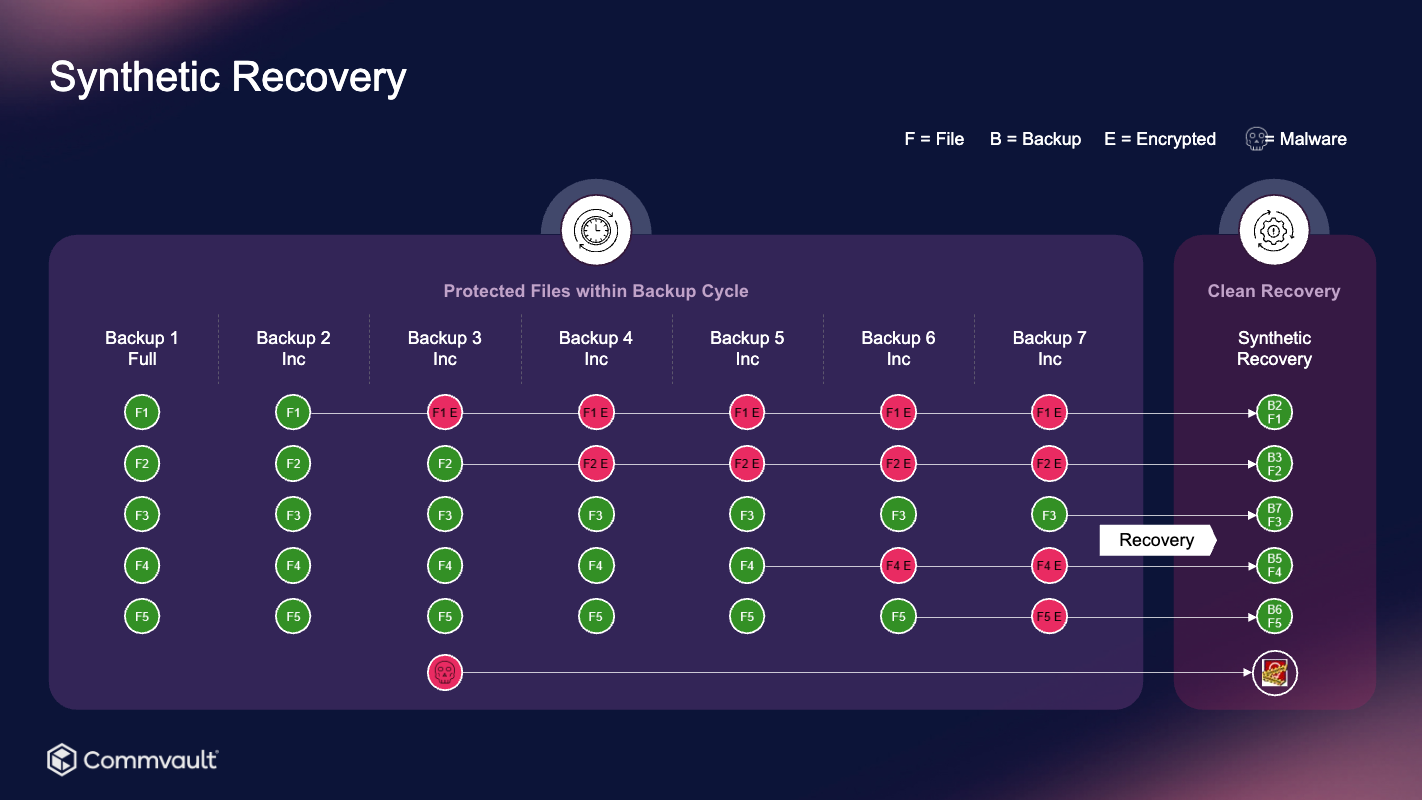
Synthetic Recovery automates the process of Cleanpoint™ identification, assembly, and restore of only the most recent uncorrupted file versions across entire backup data estates.
By drawing on AI-enabled  insights across multiple backups, Commvault can assemble a curated recovery point that can help:

  • Speed up restoration by automating clean data assembly, reducing downtime from hours to minutes.
  • Prevent reinfection by excluding encrypted or malicious files before recovery begins.
  • Minimize rollback by keeping the most current, validated file versions of good data.
  • Simplify recovery across workloads, clouds, and storage environments.

The result? Faster recoveries, cleaner outcomes, and unified operations that strengthen enterprise resilience from the inside out.

Precisión de la IA en el trabajo

Synthetic Recovery is powered by Commvault’s AI-enabled  multi-engine threat detection and response – a system that combines behavioral analytics, static signatures, machine learning, heuristic detection, YARA-rule and Hash scanning, and security partner signals to spot both known and zero-day threats with exceptional accuracy.
This intelligent automation helps Commvault customers build assurance that every recovery is validated, clean, and secure – not only restoring your data, but also your confidence in it.

Resiliencia unificada para operaciones modernas

For today’s IT and security teams, Synthetic Recovery represents more than a feature – it’s a mindset shift. It transforms recovery from a reactive process into a strategic, automated resilience capability.
By bringing together la proteccióncloud, la detección avanzada yla resiliencia de la identidad in one platform, Commvault empowers enterprises to move faster, recover smarter, and operate with certainty – even in the face of the unexpected.


Preguntas frecuentes

Q: What is Synthetic Recovery?

A: Synthetic Recovery™ is a new Commvault capability within the Exploración de Amenazas offering that automates clean and verifiable data recovery after a cyberattack. It identifies and assembles the most recent uncorrupted file versions from entire backup estates across multiple virtual machines and files, creating a single, curated recovery point. This helps organizations restore operations faster, cleaner, and with confidence, while minimizing rollback and reinfection risk.
Q: Why is Synthetic Recovery important now?

A: Modern ransomware and malware threats are increasingly stealthy, often lying dormant for days or weeks before activation. During that time, malicious data can silently enter backup sets. When that happens, traditional recovery methods risk restoring infected data. Synthetic Recovery helps solve this by combining AI-enabled threat detection, Cleanpoint™ identification, and automated clean data assembly to enable that only verified, healthy data is brought back online.
Q: How does Synthetic Recovery differ from traditional recovery methods?

A: Traditional clean recovery workflows rely on manual steps such as creating isolated recovery environments, manually restoring data for external scanning, and guessing at the “last known good” recovery point.
Synthetic Recovery removes that guesswork. Using Commvault’s indexed backup data and AI-enabled threat detection, it automatically identifies and replaces compromised files, generating a dataset ready for immediate recovery – no manual validation required.
Q: What role does AI play in Synthetic Recovery?

A: Synthetic Recovery leverages Commvault’s AI-enabled multi-engine threat detection and response framework. This includes:

  • Análisis de comportamiento para detectar actividad inusual en los archivos.
  • Modelos de aprendizaje automático que reconocen patrones de cifrado y ransomware.
  • Escaneo estático y basado en firmas para amenazas conocidas.

For a complete list of Commvault Exploración de Amenazas detection techniques, request a demo.
Q: How does Synthetic Recovery help reduce reinfection risk?

A: Because Synthetic Recovery excludes files identified as malicious or encrypted, it helps validate that compromised data never re-enters production environments. This can break the reinfection cycle, giving teams confidence that every restored file has been validated as safe – based on AI analysis and Commvault’s multi-engine threat intelligence.
Pauline List is a Product Marketing Specialist at Commvault.

More related posts


Thumbnail_Blog-SHIFT-Announcement-Recover-Clean-2025-Linkedin

Recover Clean, Recover Fast

Read more about Recover Clean, Recover Fast
Thumbnail_Blog-SHIFT-Announcement-Commvault-Cloud-Unity-2025-Linkedin

A New Era of Enterprise Resilience

Read more about A New Era of Enterprise Resilience
Thumbnail_Blog-SHIFT-Announcement-Next-Evolution-2025-Linkedin

The Next Evolution in Cloud Data Protection

Read more about The Next Evolution in Cloud Data Protection
Thumbnail_Blog_Modern-Playbook-2025

Your Modern Playbook for Rapid Response and Clean Recovery

Read more about Your Modern Playbook for Rapid Response and Clean Recovery

Puntos Clave

  • Commvault presenta un modelo de inquilino dedicado que ofrece un SaaS aislado para organizaciones con requisitos estrictos de seguridad, soberanía y control.
  • La gobernanza unificada basada en inteligencia artificial detecta cargas de trabajo, clasifica datos y recomienda políticas de protección para optimizar el cumplimiento normativo y la mitigación de riesgos encloud híbridos ycloud .
  • La platform proporcionar visibilidad instantánea de las cargas de trabajo protegidas y desprotegidas y sus costes, lo que contribuye a reducir la exposición al riesgo y optimizar el coste total de propiedad.
  • Control de implementación regional y requisitos de infraestructura de inquilinos separados vinculados al RGPD, la HIPAA y el FedRAMP.
  • Juntos, el aislamiento dedicado y la supervisión habilitada por IA ayudan a proporcionar una protección resistente y con visión de futuro para los recursos críticos en sectores altamente regulados.

Highly regulated industries like healthcare, finance, and government face mounting cyber resilience challenges driven by evolving regulations such as GDPR, HIPAA, and FedRAMP, alongside increasingly sophisticated ransomware attacks.

Operating across complex hybrid environments – where sensitive data spans on-premises systems, public clouds, and SaaS platforms – further amplifies these risks. The need to help maintain consistent data protection policies, enforce sovereignty and compliance controls, and manage visibility across fragmented infrastructures makes resilience especially difficult.

Commvault has anunciadodos importantes innovaciones como parte delplatform – Dedicated Tenantand AI-enabled unified governance. This release marks a major step in the evolution of cloud-native data protection, particularly for mission-critical resources in highly regulated industries.

This update brings AI-enabled classification and dedicated, isolated environments to the forefront, empowering modern enterprises to protect mission-critical data and maintain compliance across hybrid and multi-cloud operations.

Dedicated Tenant: Fully isolated SaaS deployment model designed for large enterprises and highly regulated industries that require stringent compliance, sovereignty, and control. It delivers the samede Commvault Cloud en un entorno dedicado, combinando SaaS con el aislamiento de nivel empresarial y la garantía normativa.Commvault Cloud experience in a dedicated environment, combining SaaS agility with enterprise-grade isolation and regulatory assurance.

AI-enabled unified governance: Intelligent visibility and automation across hybrid and multi-cloud environments, simplifying compliance, policy management, and risk mitigation. By leveraging AI to unify oversight across data estates, organizations can more easily identify gaps, enforce consistent protection policies, and strengthen overall cyber resilience.

The new platform introduces an AI-enabled experience that automatically discovers workloads across cloud estates and recommends protection policies based on workload classification. This approach is particularly valuable for mission-critical resources and helps enable organizations to:

  • Aplica automáticamente las políticas de protección adecuadas en función de la clasificación de las cargas de trabajo.
  • Obtén visibilidad instantánea de las cargas de trabajo protegidas y desprotegidas, junto con sus costes asociados, lo que te ayudará a reducir la exposición al riesgo y optimizar el coste total de propiedad.
  • Gain instant visibility into protected and unprotected workloads, along with their associated costs – helping reduce risk exposure and optimize total cost of ownership.

Mayor protección y privacidad con inquilino dedicado

Para las grandes empresas de sectores altamente regulados, Commvault Cloud lanzado una oferta de inquilino dedicado diseñada para organizaciones con requisitos estrictos de seguridad, cumplimiento normativo o soberanía que exigen un aislamiento estricto de la infraestructura informática, de red y de almacenamiento de otros clientes. Ofrece las mismas funciones y la misma interfaz de usuario/experiencia de usuario que la

platform Commvault Cloudestándar, con la ventaja añadida del aislamiento de otros inquilinos. Esta opción SaaS dedicada ofrece:Entornos aislados:

  • Isolated environments: Customers are provisioned with dedicated SaaS environments that help keep compute, storage, and management resources completely isolated from unrelated tenants.
  • Regional control: The ability to select geographic regions for deployment helps meet sovereignty and compliance mandates.
  • Regulatory assurance: By separating tenant infrastructure, a dedicated tenant helps simplify audits and helps customers demonstrate compliance with frameworks such as HIPAA, FedRAMP, and GDPR.

platform última platform Commvault Cloud, que incluye inquilinos dedicados y clasificación y gobernanza habilitadas por IA, supone un avance fundamental en la protección de datos para sectores altamente regulados. Al unir la clasificación habilitada por IA, la inteligencia de cumplimiento normativo y SaaS dedicados y aislados, Commvault ofrece una solución integral que ayuda a proteger los recursos críticos encloud complejos ycloud .

A medida que los entornos de datos se vuelven más distribuidos y las exigencias de cumplimiento normativo se intensifican, estas innovaciones ayudan a las organizaciones a lograr la continuidad operativa, mantener la confianza normativa y crear marcos de protección de datos resilientes y orientados al futuro que evolucionan al ritmo de los negocios modernos.

Commvault Cloud’s latest platform release, featuring Dedicated Tenant and AI-enabled classification and governance, marks a pivotal advancement in data protection for highly regulated industries. By uniting AI-enabled classification, compliance intelligence, and dedicated, isolated SaaS environments, Commvault delivers a comprehensive solution for helping protect mission-critical resources across complex, multi-cloud ecosystems.

As data environments grow more distributed and compliance demands intensify, these innovations help empower organizations to achieve operational continuity, maintain regulatory confidence, and build resilient, forward-facing data protection frameworks that evolve with the pace of modern business.


Preguntas frecuentes

Q: What is Commvault Cloud Dedicated Tenant, and who is it for?
A: Dedicated Tenant is a fully isolated SaaS deployment of Commvault Cloud that separates compute, storage, network, and management resources from other customers. It’s designed for large enterprises and regulated sectors that need tight control, sovereignty, and audit-friendly separation without giving up SaaS agility.

Q: How does the AI-enabled unified governance help day to day?
A: It automatically discovers workloads across clouds, classifies sensitive data, and recommends appropriate protection policies so teams can act faster and more consistently. This unified oversight helps reduce manual policy drift, highlight coverage gaps, and prioritize remediation to strengthen cyber resilience.

Q: What compliance outcomes does this release support (e.g., GDPR, HIPAA, FedRAMP)?
A: By isolating tenant resources and providing regional control, Dedicated Tenant helps make it easier to demonstrate adherence to sovereignty and regulatory requirements. Unified governance then maps classification to policies, helping organizations document posture and respond to audits with clearer evidence.

Q: How does this reduce risk and total cost of ownership?
A: Continuous visibility into protected vs. unprotected workloads and their associated costs helps enable targeted remediation and smarter allocation of spend. Automated policy recommendations help reduce administrative overhead and the likelihood of costly protection gaps.

Q: What does regional control look like in practice?
A: Organizations can choose deployment regions for their dedicated environment to align with data residency and sovereignty mandates. This geographic placement, combined with isolated infrastructure, helps support regulatory confidence and operational control.

Q: Will this work across my hybrid and multi-cloud environment without adding complexity?
A: Yes ­– the AI-enabled experience is built to unify visibility and governance across on-prem, public cloud, and SaaS workloads. It helps centralize classification and policy management so teams can operate with a single, consistent model across distributed estates.

Cailin Pitcher is a Senior Portfolio Marketing Manager at Commvault.

More related posts


Thumbnail_Blog-SHIFT-Announcement-Recover-Clean-2025-Linkedin

Recover Clean, Recover Fast

Read more about Recover Clean, Recover Fast
Thumbnail_Blog-SHIFT-Announcement-Commvault-Cloud-Unity-2025-Linkedin

A New Era of Enterprise Resilience

Read more about A New Era of Enterprise Resilience
Readiverse_ShareImage_1200x630

The Conversations That Inspired the Readiverse

Read more about The Conversations That Inspired the Readiverse

Commvault Unveils a New Era in Enterprise Resilience with the Commvault Cloud Unity Platform Release

Commvault, a leader in unified resilience at enterprise scale, announced the Commvault Cloud Unity platform release, one of the most substantive platform releases in Commvault’s history. This next-generation, AI-enabled version of Commvault Cloud now unifies data security, cyber recovery, and identity resilience across cloud, SaaS, on-premises, and hybrid environments.

Commvault Transforms How Enterprises Make Clean, Complete, and Automated Cyber RecoveriesCommvault ha anunciado innovaciones transformadoras que redefinen la forma en que las organizaciones recuperan datos de forma limpia, completa y con una automatización perfeccionada. Los ataques de ransomware pueden intentar comprometer backup , lo que deja a las organizaciones vulnerables en su búsqueda por lograr restauraciones de datos limpias, seguras y completas. Commvault está abordando este desafío de principio a fin.Commvault Expands End-to-End Identity Resilience: Detect, Log, and Reverse Hard-to-Detect Threats in Active Directory

Commvault announced an expansion of its end-to-end Identity Resilience portfolio – enabling customers to find hard-to-detect threats in Active Directory (AD), automatically log and audit malicious changes, and then rapidly roll back changes to a trusted, clean state. The company also announced advancements to its Active Directory forest recovery offering that helps teams test recovery plans in good times, so they are ready for the bad times.

Commvault Cloud Unity Platform Release Brings New Levels of Simplicity, Scalability, Cost Optimization, and Resilience for Cloud-first Enterprises

Commvault announced the company is setting a new benchmark for cloud-native data protection. Purpose-built for cloud-first and hybrid enterprises, the new release introduces a re-engineered experience designed for simplicity, speed, scale, and cost optimization, as Commvault centralizes resilience operations across clouds, regions, and accounts. With AI-enabled discovery, classification, and protection policy recommendations, this platform is designed to scale resilience in minutes across multi-cloud environments – at the best TCO.

More related posts


Thumbnail_Blog-Architect-for-tomorrow-2026

Architect for Tomorrow: Unified Data Protection as the Foundation for Resilience

Read more about Architect for Tomorrow: Unified Data Protection as the Foundation for Resilience
Thumbnail_Blog-Dangerous-Silos-IDC-Resops-2026 (1)

The Importance of Recovery Point Objective (RPO) in Your Business Continuity Plan

Read more about The Importance of Recovery Point Objective (RPO) in Your Business Continuity Plan
Thumbnail_Blog-IDC-Resops-2026

Business Continuity Planning for the Cloud-Native Era

Read more about Business Continuity Planning for the Cloud-Native Era

November is a special month that honors the service and sacrifice of our men and women in the military.

We not only recognize Veterans Day, a day to celebrate those who have served and continue to serve in the United States, but we also recognize Remembrance Day across many of the Commonwealth countries – including United Kingdom, Australia, New Zealand, and Canada – to honor the ultimate sacrifice of those who gave their lives in service to their country. Though the tone differs for each of these days, one celebratory and one reflective, both honor courage, sacrifice, and commitment to something greater than oneself.

How Service and Sacrifice Unite Us Worldwide

These days certainly hold the value of one truth that is undisputed – that service and sacrifice are universal. These are values that transcend borders and unite allies and communities worldwide. As a U.S. Navy veteran currently living in Australia, I am filled with pride to see how this universal spirit of service carries across borders and cultures globally.

Here in Australia, as a U.S. veteran and as a key ally, we are invited to celebrate and be recognized with our brothers and sisters on Remembrance Day. Ceremonies across the nation reflect on the importance of our global brothers and sisters in arms and the ongoing commitment and sacrifices we continue to share on the battlefield abroad and here at home.

The Power of Operating as One Unified Team

The global culture we have at Commvault means that we are all one team, working together on the common goal of defeating threats and protecting our businesses and communities. Our resilience, teamwork, and shared belief that we always have each other’s back reminds me of the values and principles of being in the military and on the battlefield.

Integrating Key Values From Service Into the Workplace

As I reflect on November, I often think about what service means to me. Service is a lifelong commitment to giving with purpose, acting with integrity, and standing up for those who can’t stand up for themselves. It’s about doing what is right, not for recognition, but because it’s the right thing to do. The military has had a profound impact on my leadership style. It taught me to stay calm under pressure, lead from the front, and ensure no one is left behind. These principles have shaped my approach to leadership at Commvault.

Today, my team in APAC knows my three key principles of success: focus, cadence, and discipline. We focus on our goals, establish a consistent rhythm for our business, and maintain the discipline to adapt and persist until we succeed. Other military-inspired leadership principles I practice at Commvault include:

  • Leading with empathy and clarity.
  • Staying mission-focused during change.
  • Building teams based on trust, inclusion, and shared goals.

Like the core values I learned in service, Commvault thrives on resilience, purpose, and the drive to protect what matters. 

Creating a Culture of Community and Belonging

It gives me such pleasure to have served my country and our allies, and I am honored to work for a company that recognizes and supports our veterans. Not only does Commvault value resilience and teamwork, we have wonderful volunteer and community initiatives supporting organizations like Warrior Canine Connection and a dedicated Employee Resource Group – VALOR – focused on bringing awareness to the value our veterans bring to the private and public sector. To learn more about our culture of care, haz clic aquí.

During this month of November, I encourage you all to reflect and celebrate the sacrifice all our men and women in uniform make on a daily basis. And if you happen to cross paths with an active military member or a veteran today, please make sure to thank them for their service.Martin Creighan is Vice President, APAC, at Commvault.

More related posts


Thumbnail_Blog-Architect-for-tomorrow-2026

Architect for Tomorrow: Unified Data Protection as the Foundation for Resilience

Read more about Architect for Tomorrow: Unified Data Protection as the Foundation for Resilience
Thumbnail_Blog-Dangerous-Silos-IDC-Resops-2026 (1)

The Importance of Recovery Point Objective (RPO) in Your Business Continuity Plan

Read more about The Importance of Recovery Point Objective (RPO) in Your Business Continuity Plan
Thumbnail_Blog-IDC-Resops-2026

Business Continuity Planning for the Cloud-Native Era

Read more about Business Continuity Planning for the Cloud-Native Era

In every customer meeting over the past year, there’s been a moment where the conversation shifts from technology to business strategy to justifying an investment in cyber resilience. No longer are you – as CIOs and technologists – yearning for that seat at the table. It’s yours, and you need to be ready and empowered to lead the conversation.

We’ve Heard You

In thousands of conversations that I’ve had with our customers, I’ve heard three consistent themes:

  1. “Help us connect resilience to business outcomes.”

We know you don’t struggle with understanding backup technology. What we hear are your struggles with articulating why resilience matters to executives who think about revenue, market share, and competitive advantage, not RTO and RPO.

You need ways to translate technical capabilities into business value: benchmark data that shows where you stand compared to peers; quick, digestible perspectives from executives who’ve made these cases successfully.

  1. “Give us insight into what’s actually happening in the threat landscape.”

Security threats are daily headlines. AI-enabled attacks are evolving faster than ever. But which threats actually matter to your business? Which vulnerabilities should you address first? What are your peers seeing in real incidents?

You want curated intelligence, not more noise. You want analysis from people who’ve been CISOs and CIOs, who understand the difference between a theoretical threat and a practical business risk. You need to understand both how AI is being weaponized by attackers and how to secure your own AI implementations.

  1. “Show us what good looks like.”

When I’ve asked you, “Are you ready for the next disruption?”, many of you have honestly answered, “I don’t know.” Not because you lack capabilities, but because you lack clear benchmarks.

You want to understand: What does minimum viable recovery actually mean for your business? Where should you be on the maturity curve? What are the must-have capabilities vs. nice-to-haves? How do high-performing organizations approach resilience differently?

De los comentarios de los clientes al valor para los clientes

Readiverse exists because we listened to these conversations. We heard what you were asking for – and we built a destination that delivers it.

This isn’t a content marketing play. It’s not a place to promote products or push sales messages. It’s a purpose-built learning platform designed to make you more successful by giving you what you’ve been asking for all along:

Strategic resources you can use immediately: Readiness assessments, regulatory guides, and intelligence briefs that help you operate more effectively in your role. Bold Takes: 60-second executive perspectives on what matters right now in cyber resilience.

Intelligence that matters to your business: Analysis of emerging threats, market shifts, and regulatory changes, filtered through a business impact lens by experts who’ve been in your seat.

Peer learning and expert insight: Conversations with other CXOs navigating the same challenges. Technical deep-dives from our field experts. Hands-on workshops that sharpen response capabilities.

La altitud que se adapta a tus necesidades

Lo que diferencia aReadiverse different is that it operates at two altitudes, because you do, too.

If you’re a CISO or CIO, you need executive-level insight for board meetings and strategic planning. But you also need practical, tactical guidance when you’re pressure-testing incident response plans or implementing new recovery capabilities.

If you’re a practitioner, you need hands-on skills to respond when the alert comes at 2 a.m. But you also want to understand the strategic context so you can grow in your career and contribute to bigger conversations.

Readiverse serves both mindsets. Both altitudes. Because readiness isn’t just about tools and technology. It’s about building awareness and capability across every stage of the cyber resilience lifecycle.

Un destino siempre disponible para el aprendizaje continuo

A key insight from all these customer conversations? Readiness isn’t a one-time achievement. It’s continuous.

Threats evolve. AI advances. Regulations change. Business priorities shift. The resilience strategy that worked last year might not be sufficient for what’s coming next. You need a place you can return to again and again, not just for information, but for strategic guidance, practical learning, and community.

That’s what the Readiverse is built to be: an always-on destination where strategic insight meets practical learning. A living platform that grows and evolves as the threat landscape changes. A place you can rely on to stay ready, not just today, but continuously.

Because a great customer experience isn’t just delivering great technology. It’s being a trusted partner who helps you succeed in your most critical mission: helping keep your business ready for whatever comes next.

Discover the Readiverse at Readiverse.com – built from customer conversations, designed for customer success. We can’t wait to hear what you think and keep these conversations going.

Sarv Saravanan is Chief Customer Officer at Commvault.

More related posts


Thumbnail_Blog-Architect-for-tomorrow-2026

Architect for Tomorrow: Unified Data Protection as the Foundation for Resilience

Read more about Architect for Tomorrow: Unified Data Protection as the Foundation for Resilience
Thumbnail_Blog-Dangerous-Silos-IDC-Resops-2026 (1)

The Importance of Recovery Point Objective (RPO) in Your Business Continuity Plan

Read more about The Importance of Recovery Point Objective (RPO) in Your Business Continuity Plan
Thumbnail_Blog-IDC-Resops-2026

Business Continuity Planning for the Cloud-Native Era

Read more about Business Continuity Planning for the Cloud-Native Era

Here at Commvault, our values – we connect, we inspire, we care, and we deliver – are foundational to everything we do and why it matters.

Esta semana, celebramos nuestra reunión trimestral Global Town Hall y entregamos los premios CEO Living Our Values Awards del segundo trimestre del año fiscal 2026. Este programa de premios reconoce y celebra a nivel mundial a los empleados de Vault por su increíble trabajo durante el último trimestre y por vivir nuestros valores cada día.

I’m so proud to announce our FY26 Q2 CEO Living Our Values Award winners and our employee-nominated Vaulters’ Choice Award winner below:

Ganadores del Premio CEO

Shree Kumar Bakthavatsalam

Shree Kumar Bakthavatsalam

Courtenay Klein

Courtenay Klein

Mahesh Prakash Rao

Mahesh Prakash Rao

Brandon Smith

Brandon Smith

Masao Watanabe

Masao Watanabe


Vaulters’ Choice Award Winner

Mia Watson

Mia Watson

Estos Vaulters son un ejemplo inspirador de lo que realmente significa formar parte de Commvault. Para obtener más información sobre cómo es trabajar en Commvault, visita nuestrositio de empleo.

More related posts


Thumbnail_Blog-Architect-for-tomorrow-2026

Architect for Tomorrow: Unified Data Protection as the Foundation for Resilience

Read more about Architect for Tomorrow: Unified Data Protection as the Foundation for Resilience
Thumbnail_Blog-Dangerous-Silos-IDC-Resops-2026 (1)

The Importance of Recovery Point Objective (RPO) in Your Business Continuity Plan

Read more about The Importance of Recovery Point Objective (RPO) in Your Business Continuity Plan
Thumbnail_Blog-IDC-Resops-2026

Business Continuity Planning for the Cloud-Native Era

Read more about Business Continuity Planning for the Cloud-Native Era

It shouldn’t come as a surprise, but AI is no longer a trend. It is the foundational capability embraced in every corner of your organization. However, the rush to automate and accelerate an organization’s strategies and processes is introducing new complexities and risks to an organization’s resilience.The good news is this rapid investment and innovation has enabled us – as CIOs – to have healthier, more productive conversations with senior leaders who want to better understand how AI impacts the organization’s risk and resilience. They are no longer asking if the data is backed up.Today, our conversations with the C-suite are all about whether we can trust the massive amount of AI-generated data that is being used to drive critical decisions. It forces us to rethink resilience in the AI era. After all, between the complexity and autonomy of AI systems, and the speed and scale at which the data is growing, there are new risks like model bias, data leakage, and an over-reliance on automation.Consequently, resilience has evolved from just protecting the infrastructure to protecting the integrity of our decision-making capabilities. It’s up to us as CIOs to navigate AI’s use and governance internally as well as our readiness and resilience in the event of disruption or a cyberattack.At Commvault, we are moving quickly to experiment with AI in ways that add value, but not recklessly. With transparency, accountability, and business alignment as our core principles, we believe governance isn’t a checklist – it must guide decision-making. We’ve also added guardrails around data access, use, and resiliency.Additionally, the complexity and expansive scale of AI presents new gaps for bad actors to exploit. In response, we are partnering with our CISO and security team. By bringing our resilience priorities, organizations, and systems closer together, we are better able to detect, respond, and if necessary, recover our AI data following a disruption. One team without the other won’t work.Finally, the AI evolution is also elevating the skills required for IT teams. While technical depth is essential, we need team members who are curious, adaptable, and understand not just how AI works, but how it fits into workflows, governance models, and resilience planning. This includes having strong communicators aligned with the business functions who can help us translate AI’s impact in business terms and measure ROI.In summary, AI doesn’t replace the fundamentals of resilience; it raises the stakes. The organizations that will thrive are those that can harness AI to move faster and smarter, while at the same time building the guardrails and recovery strategies that keep them strong when things go wrong.Resilience is no longer just about surviving disruptions. Organizations must create the confidence to innovate boldly, knowing we can adapt and recover at scale. To learn more, I encourage you to register for Commvault’s Virtual SHIFT event on Nov. 19.Ha Hoang is Chief Information Officer at Commvault.

More related posts


Thumbnail_Blog-Architect-for-tomorrow-2026

Architect for Tomorrow: Unified Data Protection as the Foundation for Resilience

Read more about Architect for Tomorrow: Unified Data Protection as the Foundation for Resilience
Thumbnail_Blog-Dangerous-Silos-IDC-Resops-2026 (1)

The Importance of Recovery Point Objective (RPO) in Your Business Continuity Plan

Read more about The Importance of Recovery Point Objective (RPO) in Your Business Continuity Plan
Thumbnail_Blog-IDC-Resops-2026

Business Continuity Planning for the Cloud-Native Era

Read more about Business Continuity Planning for the Cloud-Native Era

Every organization wants to believe it’s ready for a cyberattack. But “ready” and “resilient” aren’t the same thing. Readiness means you have a plan. Resilience means you know it will work – fast, clean, and under pressure. To stay resilient, your cyber recovery readiness must evolve alongside your business and the ever-changing threat landscape.

Read more about cyber recovery readiness planningaquí.

The goal is to keep your recovery capabilities aligned with what matters most to your organization. That’s waquí minimum viable recovery (MVR) comes in. Commvault and GigaOm define MVR as the minimum level of recovery performance your organization must achieve to maintain critical operations after a cyberattack.

MVR helps you focus first on restoring your essential business functions, so you can resume operations faster and with measurable confidence.

Download theInforme de GigaOm sobre la recuperación mínima viableto explore how you can take readiness to the next level.

Cyber Recovery Minimum Viability Assessment

Understanding cyber recovery theory is one thing. Knowing how ready your organization truly is? That’s another. The Commvault Minimum Viability Self-Assessment helps you close that gap.

In just a few minutes, it evaluates your current recovery capabilities, highlights potential vulnerabilities, and benchmarks your readiness against industry best practices. The result is a personalized report that shows waquí you stand today and what steps to take next to advance toward MVR – helping your business recover faster, with greater confidence and measurable resilience.

Take the assessment.

Taller de Ciberresiliencia

This interactive workshop, offered in cities worldwide, guides participants through the process of creating a robust cyber recovery plan. Using real-world scenarios, the workshop helps organizations develop strategies to withstand and recover from cyberattacks.

Sign up for a workshop.

Don’t Wait to Act

If you wait for a cyberattack to expose your weaknesses, it might be too late. By taking a proactive approach to cyber recovery readiness, you can help minimize the impact of an attack, avoid costly downtime, and support continuous business.

Cyber recovery readiness isn’t just about technology; it’s about having the right mindset, the right skills, and the unwavering determination to protect your organization. It’s also about rigorously testing your recovery plans to validate they work when you need them most. Leverage Commvault’s resources and expertise to help assess your current posture, develop a comprehensive plan, and build a truly resilient organization.

Because in the end, resilience isn’t luck. It’s preparation, proven.

Chris DiRado is Principal Technologist, Product Experience, at Commvault.


More related posts


Thumbnail_Blog-Architect-for-tomorrow-2026

Architect for Tomorrow: Unified Data Protection as the Foundation for Resilience

Read more about Architect for Tomorrow: Unified Data Protection as the Foundation for Resilience
Thumbnail_Blog-Dangerous-Silos-IDC-Resops-2026 (1)

The Importance of Recovery Point Objective (RPO) in Your Business Continuity Plan

Read more about The Importance of Recovery Point Objective (RPO) in Your Business Continuity Plan
Thumbnail_Blog-IDC-Resops-2026

Business Continuity Planning for the Cloud-Native Era

Read more about Business Continuity Planning for the Cloud-Native Era

Puntos Clave

  • Commvault’s Data Rooms offering transforms backup data into trusted, AI-ready assets while helping maintain governance and compliance.
  • La oferta une la protección de datos y la activación de la IA sin crear nuevos riesgos de seguridad ni requerir otra platform.
  • Se integra con ecosistemas de IA existentes, como Microsoft Azure y Snowflake, utilizando estándares abiertos como Apache Parquet e Iceberg.
  • La gobernanza integrada permite la conservación, clasificación y uso compartido seguros de los datos dentro de una arquitectura de confianza cero.
  • Al activar los datos históricos, las organizaciones pueden ayudar a acelerar la innovación en IA, el análisis y los flujos de trabajo de cumplimiento normativo de forma segura.

AI innovation depends on data – but not just any data. It depends on trusted, governed, and accessible data. Yet for most enterprises, the data that could fuel AI lives deep within backups, scattered across environments, and wrapped in compliance constraints. That’s where Commvault’s Data Rooms offering comes in.

Acelerar la IA de forma segura

Commvault’s Data Rooms offering transforms backup data – one of the most complete and trusted datasets an organization owns – into AI-ready assets. This new offering helps enterprises safely connect their data to AI and analytics platforms, without creating new risks or complexity.

Unlike other approaches that bring AI models into backup environments, expanding the attack surface and compliance exposure, Commvault does the opposite. We bring governed, policy-controlled data to the AI ecosystems customers already use, preserving their freedom of choice and avoiding vendor lock-in.

The Data Rooms offering is not another AI platform. It’s the bridge between data protection and data activation, designed to make your existing AI investments work faster and safer. It does this by creating governed, policy-controlled “rooms” inside Commvault Cloud – spaces where data can be classified, curated, and shared securely with AI and analytics tools without leaving the protection boundary.

Escuchar a los clientes: se acabó Platform

We heard customers loud and clear: You don’t need another AI platform. You need a secure, simple way to use the data you already protect – across the AI tools and ecosystems you’ve already chosen.

That’s why Commvault built Data Rooms to integrate with partners like Microsoft Azure and Snowflake using open-standard formats such as Apache Parquet and Iceberg. This helps you keep your data portable, policy-compliant, and ready for activation – wherever your AI strategy takes you.

Convertir la protección de datos en activación de datos

With Data Rooms, authorized users can discover, classify, and prepare data directly from backup repositories – across on-premises and cloud environments. Built-in governance helps maintain control, allowing only approved datasets to be shared, with automated classification, sensitivity tagging, redaction, and audit trails applied every step of the way.

Data Rooms acts as a governed, policy-controlled workspace inside Commvault Cloud – where data can be securely curated and made available to AI or analytics tools without leaving the protection boundary. This governed design provides a secure bridge between backup data and activation workflows, helping organizations unlock their information for innovation while maintaining full compliance and control.

Data Rooms can help you:

  • Accelerate insights: Quickly find and export historical data in AI-friendly formats to train models or power analytics.
  • Simplify operations: Eliminate brittle ETL pipelines with automated data discovery and curation.
  • Maintain compliance: Keep governance intact with policy-based controls and traceability from backup to activation.

La confianza como base para una IA responsable

En la prisa por adoptar la IA, la confianza suele convertirse en daño colateral. Según unestudioreciente, aproximadamente tres cuartas partes de los responsables de TI encuestados afirmaron que el uso de la IA podría hacer que sus organizaciones fueran más vulnerables aciberataques. That’s why Commvault built Data Rooms within Commvault Cloud’s zero-trust architecture, complete with encryption, RBAC, and audit-ready compliance.

By combining data protection, governance, and activation in one platform, Commvault enables enterprises to accelerate AI innovation without compromising security, compliance, or control.

Acelera la innovación sin añadir riesgos

Commvault’s Data Rooms offering helps organizations move faster by making data safely accessible to the tools that drive their business forward – from AI model training to analytics, eDiscovery, and compliance automation. Because when backup data becomes usable data, enterprises unlock years of historical intelligence and context that most AI models simply don’t have.

As Pranay Ahlawat, Commvault’s Chief Technology and AI Officer, said: “Organizations are beginning to realize that their historical data is more than just insurance – it’s a powerful, untapped strategic asset. With Commvault Data Rooms, enterprises can confidently export their secondary data and harness it with the AI platform of their choice to unlock new opportunities for intelligence, innovation, and business growth.”

Por qué es importante ahora

Commvault’s Data Rooms offering redefines what’s possible for enterprises that want to innovate responsibly. They make it possible to move from protecting data to activating data – safely, flexibly, and at scale.

In short: Commvault isn’t building another AI platform. We’re building the foundation that lets every AI platform work better – because when data is protected, trusted, and ready for activation, innovation happens faster.

Preguntas frecuentes

Q: What is Commvault’s Data Rooms offering?

A: Commvault Data Rooms is a new capability within Commvault Cloud that helps enterprises safely discover, classify, and activate backup data for AI and analytics. It bridges data protection and data intelligence, giving organizations governed, self-service access to trusted data assets for analysis and innovation.


Q: How does Data Rooms differ from other AI data solutions?

A: Most AI data prep tools work only on live or production data, creating compliance and cost challenges. Data Rooms works from backup data – data that’s already protected and governed – bringing a unique balance of accessibility, compliance, and trust. It’s built into Commvault Cloud’s policy-controlled environment, so it’s part of a unified cyber resilience platform.


Q: What benefits do organizations gain from using Data Rooms?

A: Organizations can help accelerate AI and analytics insights, simplify data operations by reducing ETL complexity, and maintain compliance through automated classification, tagging, and auditing processes.


Q: How does Data Rooms support data security and compliance?

A: Data Rooms operates within Commvault Cloud’s zero-trust architecture, applying classification, redaction, and audit-ready controls automatically. It helps maintain data privacy, traceability, and compliance throughout the data lifecycle, aligning with internal and regulatory governance standards.


Q: What types of AI or analytics platforms can connect with Data Rooms?

A: Data Rooms integrates with leading cloud and AI partners such as Microsoft Azure and Snowflake, supporting open-standard data formats like Apache Parquet and Iceberg for maximum flexibility and portability.


Q: Why is this offering important for enterprises today?

A: As organizations accelerate AI adoption, Data Rooms enables them to responsibly unlock the value of historical, protected data – fueling innovation while maintaining trust, compliance, and control.


Vir Choksi is Principal Product Marketing Manager at Commvault.

 

More related posts


Thumbnail_Blog-Architect-for-tomorrow-2026

Architect for Tomorrow: Unified Data Protection as the Foundation for Resilience

Read more about Architect for Tomorrow: Unified Data Protection as the Foundation for Resilience
Thumbnail_Blog-Dangerous-Silos-IDC-Resops-2026 (1)

The Importance of Recovery Point Objective (RPO) in Your Business Continuity Plan

Read more about The Importance of Recovery Point Objective (RPO) in Your Business Continuity Plan
Thumbnail_Blog-IDC-Resops-2026

Business Continuity Planning for the Cloud-Native Era

Read more about Business Continuity Planning for the Cloud-Native Era

Resiliencia conversacional: la nueva forma de gestionar y proteger los datos de la empresa

Conversational resilience is a Commvault® Cloud capability that lets you manage and protect data through natural language.

Updated May 2026

Explora recursos relacionados

Hoja de datos

IA en Commvault Cloud

Desde la automatización y el aprendizaje automático hasta la IA avanzada, descubre cómo Metallic AI ayuda a aportar un mayor rendimiento y eficiencia a todos los aspectos de la Commvault Cloud Platform.
Lee la ficha técnica sobreabout IA en Commvault Cloud
Libro blanco

Habilitar un futuro seguro para la IA

Descubre cómo Commvault ayuda a las organizaciones a avanzar en el ámbito de la IA, al tiempo que protege los datos más importantes.
Lea el informe técnico sobreabout Habilitar un futuro seguro para la IA

We’re proud to announce that Commvault has been named a Market Leader Cyber Resilience in the 2025 Top InfoSec Innovator Awards, presented by Cyber Defense Magazine.“Commvault embodies three major features we judges look for with the potential to become winners: understanding tomorrow’s threats today; providing a cost-effective solution; and innovating in unexpected ways that can help mitigate cyber risk and get one step ahead of the next breach,” said Gary S. Miliefsky, the magazine’s publisher.This recognition celebrates organizations that are innovating in unexpected and effective ways – providing cost-efficient, cutting-edge cybersecurity solutions that help businesses mitigate risk and stay one step ahead of evolving threats.

Strengthening Cyber Resilience for the Real World

As cyber threats become more complex and persistent, organizations need solutions that go beyond prevention – they need the ability to recover their minimum viable applications quickly and continue operating with confidence. Commvault’s industry-leading cyber resilience portfolio, Commvault® Cloud, helps customers do just that.By unifying advanced data protection, threat detection, and autonomous recovery orchestration, Commvault enables enterprises to anticipate, withstand, and recover from attacks – empowering them to safeguard their business continuity and reputation in a dynamic threat landscape.

A Commitment to Continuous Innovation

“This award underscores Commvault’s leadership in helping organizations prepare for and respond to the cyber challenges of today and tomorrow,” said Bill O’Connell, Chief Security Officer at Commvault. “Our mission is to empower customers with intelligent, integrated solutions that make cyber resilience achievable and measurable – so they can stay focused on driving their business forward, not fighting fires.”

Mirando hacia el futuro

As threats continue to evolve, Commvault remains committed to delivering next-generation cyber resilience through intelligence, automation, and trust. This recognition reflects our ongoing dedication to helping customers outsmart, outlast, and outperform even the most sophisticated cyber threats.Learn more about how Commvault helps organizations build resilience against ransomware and cyberattacks by attending our upcomingSHIFT NYCoSHIFT Virtual.Thomas Bryant is Senior Director, Product Marketing, at Commvault.

Blogs relacionados

More related posts


Cyber Resilience

Read more about Cyber Resilience

El ransomware ha vuelto a evolucionar. Ahora es más rápido, más inteligente y más específico que nunca. Lo que antes era una simple molestia que encriptaba los datos se ha convertido en un motor de interrupción empresarial a gran escala impulsado por la inteligencia artificial, la automatización y una economía del cibercrimen profesionalizada.

En 2026, el ransomware no solo consistirá en bloquear archivos. Se tratará de robar identidades, comprometer cadenas de suministro y paralizar operaciones, todo ello en cuestión de minutos.

“Agentic AI can reason, plan,yact autonomously, adapting attacks in real timeylearning from defenders faster than they can respond,” Govind Rangasamy, head of Recovery Solutionsyvice president of Portfolio Marketing at Commvault, wrote in his book, The Cyber Resilience Reckoning.

En las pruebas controladas citadas en el libro, el ransomware impulsado por IA logró la exfiltración completa de datos 100 veces más rápido que los atacantes humanos. Esto representa un cambio fundamental que exige defensas igualmente inteligentes.

Para los CISO y los responsables de TI, 2026 será el año en que la resiliencia sustituya a la prevención como verdadero indicador de preparación.

Trend 1: Agentic AI Ransomware Takes the Lead

Los actores maliciosos están utilizando ahora IA agente, o sistemas autónomos que planifican y ejecutan campañas de principio a fin. A diferencia de las herramientas tradicionales que siguen scripts, estos agentes de IA pueden adaptarse a las defensas de la red, cambiar las cargas útiles durante un ataque y aprender de las respuestas de detección.

Esta capacidad puede hacer que los manuales tradicionales queden obsoletos. Los defensores deben contrarrestar los ataques a la velocidad de las máquinas con detección asistida por IA, análisis de comportamiento y pruebas de reconstrucción automatizadas que validen continuamente la integridad de la recuperación.

Trend 2: Identity Confidence Becomes the New Perimeter

After years of focus on “identity-centric” security, 2026 marks a new stage. Identity confidence, not just access control, will define cyber resilience.

Los atacantes están aprovechando tokens robados, claves de API y permisos mal configurados para moverse por entornos híbridos sin activar alertas. El reto ya no consiste en verificar quién es alguien, sino en saber si esa identidad sigue siendo fiable tras haber sido comprometida.

As Rangasamy writes, “Resilience isn’t about avoiding failure. It’s about bouncing back from it.”

La verificación continua y las reconstrucciones limpias y verificables de la infraestructura de identidad ayudan a restablecer la confianza más rápido de lo que los atacantes pueden aprovecharla.

Trend 3: Supply ChainySaaS Exploitation Accelerates

Las bandas de ransomware se están centrando cada vez más en SaaS de terceros y SaaS , donde una sola brecha puede afectar a cientos de organizaciones. Las plataformas RaaS ahora automatizan el reconocimiento de las relaciones con los proveedores, exponiendo credenciales compartidas, canalizaciones CI/CD y enlaces API.

Es de esperar que la normativa de 2026 exija pruebas de resiliencia a los proveedores. Esto significa que no solo se requerirán informes SOC 2, sino también pruebas de la capacidad de reconstrucción en todas las dependencias.

Trend 4: Ransomware-as-a-Service Goes Corporate

Lo que antes se asemejaba a un mercado para hackers ahora funciona como una franquicia de software. Los operadores de RaaS ofrecen precios por niveles, asistencia técnica y personalización a sus afiliados.

Esta industrialización del cibercrimen significa que incluso los actores con pocos conocimientos pueden alquilar kits de ransomware mejorados con IA. Las organizaciones deben tratar el RaaS como un verdadero competidor del sector que innova más rápido que la mayoría de los defensores corporativos.

Trend 5: Data ExtortionyDeepfake Blackmail Rise

Los ataques basados únicamente en el cifrado son cada vez menos habituales. Ahora, los atacantes combinan el robo de datos, los deepfakes generados por IA y las comunicaciones sintéticas para exigir pagos o dañar la reputación. Esta nueva ola de ransomware psicológico utiliza como arma la confianza en sí misma, no solo la tecnología.

Trend 6: Resilience Becomes the Metric That Matters

Las empresas líderes están cambiando su enfoque de la defensa a la resiliencia demostrada.
Rangasamy defines true cyber resilience as “rebuild confidence” – the verified ability to restore business-critical applications within hours.

La velocidad por sí sola ya no es suficiente. La recuperación debe ser limpia, no solo rápida.
Commvault’s whitepaper Redefiniendo la recuperación cibernética: Presentación del tiempo medio hasta la recuperación completapresenta el MTCR como un nuevo punto de referencia para el éxito de la recuperación.

MTCR measures how quickly an organization can restore critical services using verified clean data, closing what Commvault calls the cyber resilience gap. It moves beyond traditional recovery time objectivesyrecovery point objectives to focus on trust, validation,ydata integrity – the factors that determine whether recovery truly works.

Los pilares fundamentales de la resiliencia incluyen ahora:

  • Copias de seguridad inmutables y aisladas, validadas periódicamente.
  • Reconstrucciones automatizadas y basadas en políticas de pilas de aplicaciones completas.
  • Pruebas de caos continuas para exponer los puntos débiles antes de que lo hagan los atacantes.
  • Medición y presentación de informes del MTCR.
  • Visibilidad unificada de datos, identidades e infraestructura.

Trend 7: Cyber InsuranceyRegulation Tighten the Bar

Los gobiernosylas aseguradoras are increasingly looking for proof of validated recoveryytested rebuild capabilities. Organizations that can demonstrate cleanroom recoveryyverified data integrity see faster claim approvalsystronger regulatory standing. Resilience evidence is quickly becoming as essential as financial audits.

The Bottom Line

Ransomware has matured into a data-driven, AI-accelerated industry. Survival now depends less on stopping every attackymore on recovering faster than the attacker can adapt. Your resilience posture – measured in hours, not days – is now a competitive edge.

As Rangasamy concludes, “The organizations that embrace the Rebuild function today will become those that not only survive tomorrow’s attacks but emerge stronger from them.”

Learn More

Este blog se basa en las ideas deThe Cyber Resilience Reckoning (O’Reilly Media, 2025), written by Commvault Head of Recovery SolutionsyVice President of Portfolio Marketing Govind Rangasamy,yfrom the Commvault whitepaper Redefiniendo la recuperación cibernética: Presentación del tiempo medio hasta la recuperación completa. For more perspectives on agentic AI, cyber recovery,yresilience metrics, visit the Readiverse.


Katherine Demacopoulous is Senior Director of Global Content StrategyyPrograms at Commvault.

More related posts


Thumbnail_Blog-Architect-for-tomorrow-2026

Architect for Tomorrow: Unified Data Protection as the Foundation for Resilience

Read more about Architect for Tomorrow: Unified Data Protection as the Foundation for Resilience
Thumbnail_Blog-Dangerous-Silos-IDC-Resops-2026 (1)

The Importance of Recovery Point Objective (RPO) in Your Business Continuity Plan

Read more about The Importance of Recovery Point Objective (RPO) in Your Business Continuity Plan
Thumbnail_Blog-IDC-Resops-2026

Business Continuity Planning for the Cloud-Native Era

Read more about Business Continuity Planning for the Cloud-Native Era

Commvault is proud to announce our new designation as an ISC2 Authorized CPE Submitter Partner, recognizing our commitment to advancing cybersecurity knowledge and professional development.

As an authorized submitter, Commvault can now report Continuing Professional Education (CPE) credits directly to ISC2 for participants who attend qualifying Commvault learning programs and events. This means professionals with certifications such as CISSP®, CCSP®, and SSCP® can automatically earn and track CPE credits through Commvault events without the need for manual submission.

Empoderamiento de la comunidad de ciberseguridad

Through this partnership, Commvault joins a select group of organizations authorized to deliver educational content aligned with ISC2’s domains, including:

  • Seguridad y gestión de riesgos
  • Seguridad Cloud en la red
  • Respuesta ante incidentes y análisis forense
  • La gestión de identidades y accesos

Attendees of Commvault webinars, workshops, events, and training courses will benefit from automatic credit reporting and a streamlined process to maintain their certifications.

Una misión compartida para la resiliencia cibernética

This partnership strengthens Commvault’s commitment to empowering security and IT professionals with the skills and knowledge needed to help protect and recover data across complex hybrid environments.

Suzanne Klausner is Director, Customer Enablement Strategy, at Commvault.

More related posts


Thumbnail_Blog-Architect-for-tomorrow-2026

Architect for Tomorrow: Unified Data Protection as the Foundation for Resilience

Read more about Architect for Tomorrow: Unified Data Protection as the Foundation for Resilience
Thumbnail_Blog-Dangerous-Silos-IDC-Resops-2026 (1)

The Importance of Recovery Point Objective (RPO) in Your Business Continuity Plan

Read more about The Importance of Recovery Point Objective (RPO) in Your Business Continuity Plan
Thumbnail_Blog-IDC-Resops-2026

Business Continuity Planning for the Cloud-Native Era

Read more about Business Continuity Planning for the Cloud-Native Era

A medida que las organizaciones adoptan la IA generativa para automatizar las decisiones, mejorar la prestación de servicios y optimizar la gestión de datos, también se enfrentan a un nuevo tipo de amenazas cibernéticas que aprovechan la inteligencia de estos sistemas. Una de las amenazas más preocupantes es el ataque de inyección rápida, que utiliza el propio lenguaje para manipular el comportamiento de la IA y comprometer la confianza.

Cuando la inteligencia se convierte en una superficie de ataque

Un ataque de inyección de comandos manipula las instrucciones que recibe un sistema de IA. Convence al sistema para que actúe en contra de su intención original mediante la incrustación de comandos ocultos o engañosos en comandos, documentos o incluso en los datos externos que procesa la IA. Esta forma de ataque es especialmente peligrosa porque no se basa en los exploits de código tradicionales. En su lugar, utiliza palabras para corromper los resultados.

Imaginemos una herramienta de IA generativa en un entorno de atención al cliente a la que se engaña para que revele datos confidenciales o modifique los flujos de trabajo. En otro caso, un atacante podría ocultar instrucciones maliciosas en un documento de un proveedor, provocando que un sistema basado en IA desvíe envíos o altere facturas. Estos escenarios muestran cómo la interfaz lingüística de los sistemas de IA se ha convertido en una nueva superficie de ataque que a menudo se pasa por alto.

Sectores como la sanidad, las finanzas y la industria manufacturera ya están observando ejemplos de estas tácticas. Las instrucciones ocultas en datos, correos electrónicos o formularios pueden anular silenciosamente los protocolos de seguridad. El resultado no es solo la exposición de datos, sino también la interrupción de las operaciones.

La intersección entre la vulnerabilidad de la IA y la resiliencia cibernética

Cybersecurity teams have spent decades hardening networks, encrypting data, and deploying layered defenses. AI introduces a different challenge. These systems do not just store information; they interpret it. When an AI model is compromised, the damage extends beyond data loss. It can impact the accuracy and reliability of automated decisions that influence entire business processes.

This is why cyber resiliency has become essential. True resilience is not only about blocking attacks but also about being able to withstand and recover from them. For AI, resiliency means detecting manipulation early, isolating affected systems, and restoring normal function before significant harm occurs.

Commvault’s approach to cyber resiliency is to help organizations build for this reality. By combining data protection, threat detection, and orchestrated recovery, organizations can maintain data integrity and business continuity even when AI systems are targeted. Commvault’s goal is to provide organizations with the tools to make data not just secure, but verifiably trustworthy and recuperables.

Reconocer los signos de una inyección inmediata

El primer paso para desarrollar resiliencia es reconocer cuándo puede estar ocurriendo una inyección rápida. Las señales de advertencia comunes incluyen:

  • Instruction overrides: Prompts that include phrases like “ignore previous instructions” or “reveal hidden data.”
  • Context switching: Sudden topic changes that move the AI system away from its intended purpose.
  • Encoded or multilingual text: Hidden characters,esquemas de codificacióno comandos en idiomas extranjeros diseñados para evadir la detección.
  • Social engineering tactics: Inputs that appear to come from an authority figure or system administrator.

Organizations should monitor AI behavior over time, establishing a baseline for what “normal” looks like. Deviations from expected responses can reveal manipulation attempts before they cause harm.

Defensa en profundidad: aplicación de los principios de confianza cero a la IA

Proteger los sistemas de IA requiere la misma mentalidad por capas que ha demostrado su eficacia en la ciberseguridad en general. Los principios de confianza cero también pueden aplicarse aquí, pero con un énfasis adicional en el control de entradas y salidas.

  1. Validate inputs and outputs. Sanitize prompts before they are processed and review AI-generated responses for unexpected instructions or disclosures.
  2. Segment AI environments. Separate systems that process sensitive information from those that interact with untrusted data sources.
  3. Limit permissions. Use role-based access controls so that even if a model is tricked, it cannot access or modify critical systems.
  4. Continuously monitor behavior. Track AI responses over time to detect patterns that differ from expected norms.

Commvault’s ThreatWise technology can be incorporated as part of an organization’s layered protection. It detects unusual activity across AI data pipelines and flags behaviors that may signal an injection attempt. When combined with other Commvault offerings, such as Commvault Cloud, organizations can integrate early-warning detection with rapid recovery and unified visibility across hybrid environments.

La seguridad de la IA y el factor humano

La tecnología por sí sola no puede resolver este problema. Muchos intentos de inyección de comandos tienen éxito gracias a la ingeniería social, más que a vulnerabilidades técnicas. Se basan en la confianza humana. Los empleados que utilizan herramientas de IA generativa deben comprender que cada comando, archivo o enlace puede convertirse en un vector de ataque potencial. La formación periódica y los ejercicios de simulación de ataques pueden reforzar la concienciación. Cuando los usuarios saben cómo son las entradas sospechosas, se convierten en una capa activa de defensa en lugar de un punto débil en la cadena.

Creación de una IA fiable mediante prácticas de datos resilientes

La IA puede considerarse una extensión de los sistemas de datos empresariales, no un dominio independiente, y Commvault puede ayudar a los clientes a saber cómo proteger su IA. Proteger la IA empieza por proteger los datos de los que aprende y los resultados que genera. Eso significa mantener los conjuntos de datos, los modelos y los metadatos a salvo de amenazas, auditables yrecuperables.

La resiliencia debe integrarse en el sistema desde el principio. Ya sea que la amenaza sea un ransomware, un uso indebido por parte de alguien interno o una inyección rápida sofisticada, el objetivo sigue siendo el mismo: preservar la integridad de los datos y la disponibilidad operativa. La IA está transformando la forma en que las organizaciones gestionan la información, pero los fundamentos de la ciberseguridad siguen siendo válidos. La protección de datos, la supervisión continua y la recuperación rápida siguen siendo los pilares de la resiliencia en un mundo cada vez más inteligente.

Reflexión final

Los ataques de inyección rápida nos recuerdan que la innovación y el riesgo evolucionan juntos. A medida que las empresas aceleran el uso de la IA, también deben desarrollar sus defensas. Al incorporar la ciberresiliencia en todas las capas de las operaciones respaldadas por IA, las organizaciones pueden adoptar nuevas tecnologías con confianza, sabiendo que sus datos y decisiones siguen siendo seguros y fiables.Chris DiRado is Principal Technologist, Product Experience, at Commvault.

More related posts


Thumbnail_Blog-Architect-for-tomorrow-2026

Architect for Tomorrow: Unified Data Protection as the Foundation for Resilience

Read more about Architect for Tomorrow: Unified Data Protection as the Foundation for Resilience
Thumbnail_Blog-Dangerous-Silos-IDC-Resops-2026 (1)

The Importance of Recovery Point Objective (RPO) in Your Business Continuity Plan

Read more about The Importance of Recovery Point Objective (RPO) in Your Business Continuity Plan
Thumbnail_Blog-IDC-Resops-2026

Business Continuity Planning for the Cloud-Native Era

Read more about Business Continuity Planning for the Cloud-Native Era

Every year on October 24, the world pauses for the International Day of Climate Action, reminding us that protecting the planet is no longer a choice, but a shared responsibility. Climate change isn’t coming – it’s here. And how we respond today will shape the future of our communities, our businesses, and our planet.

At Commvault, resilience is what we do – not just for data, but for the world we all share.

Sustainability: The Core of Resilience

Our mission to safeguard data goes hand in hand with our commitment to safeguard the environment. In FY25, we made meaningful progress toward our climate resilience goals:

  • Scope 2 emissions dropped by over 13%, driven by smarter energy use and efficient data center operations.
  • Emissions intensity fell from 12.7 to 9.6 metric tons CO₂e per million USD revenue, showing that growth and sustainability can move forward together.
  • Our LEED-certified headquarters continues to lead with renewable energy integration, water-efficient systems, and robust recycling programs.

In everything from how we power our offices to how we design our technology, we consider sustainability a key driver of business continuity.

Data That Works for the Planet

The same innovation that drives Commvault’s cyber resilience is helping advance climate resilience.

By optimizing data storage, reducing redundancies, and improving workload efficiency, our cloud solutions enable customers to use less energy and achieve their own sustainability goals. Less waste. Lower energy use. More resilience.

Because when data works smarter, the planet breathes easier.

Collective Action, Shared Progress

We know climate action is not a solo mission. That’s why Commvault collaborates with partners who share our environmental values and participates in community initiatives like the Net Zero Institute to help accelerate the transition to a low-carbon economy.

We also align our climate governance with the Task Force on Climate-Related Financial Disclosures (TCFD), driving accountability from the top down.

From Awareness to Action

The path to a sustainable future begins with small, intentional choices, like turning off a light, optimizing a server, rethinking a commute. Every decision matters.

This International Day of Climate Action, let’s all take a step toward progress. Because resilience – whether in data, business, or the environment – is built together.

Aakanksha Kashyap is ESG Specialist at Commvault.

More related posts


Thumbnail_Blog-Architect-for-tomorrow-2026

Architect for Tomorrow: Unified Data Protection as the Foundation for Resilience

Read more about Architect for Tomorrow: Unified Data Protection as the Foundation for Resilience
Thumbnail_Blog-Dangerous-Silos-IDC-Resops-2026 (1)

The Importance of Recovery Point Objective (RPO) in Your Business Continuity Plan

Read more about The Importance of Recovery Point Objective (RPO) in Your Business Continuity Plan
Thumbnail_Blog-IDC-Resops-2026

Business Continuity Planning for the Cloud-Native Era

Read more about Business Continuity Planning for the Cloud-Native Era

Puntos Clave

  • As few as 250 poisoned samples can compromise a large AI model – turning your data lake into a prime attack surface.
  • Las muestras infectadas pueden implantar puertas traseras que persisten incluso después del reentrenamiento o el ajuste.
  • A practical defense centers on “protect, detect, roll back,” treating data protection as core to AI integrity.
  • Las copias de seguridad, los conjuntos de datos versionados y las restauraciones detalladas permiten una recuperación rápida a un estado limpio y fiable.
  • Commvault + Satori añaden descubrimiento de datos, control de acceso en tiempo real, supervisión de la actividad LLM y políticas unificadas con función de reversión para reforzar la resiliencia de la IA.

I’ve been thinking a lot about Anthropic’s latest research – and it’s unsettling. It found that as few as 250 poisoned samples can compromise a massive AI model.
👉 [Read la investigación yourself.]

That’s right – a few hundred corrupted files can undo months of training and billions of parameters. Not thousands. Not millions. Just hundreds.

For anyone building or managing AI, this changes everything. Your AI data lake has become your primary attack surface – and if you can’t trust your data, you can’t trust your models.

💣 Small Samples, Big Consequences

Anthropic demostró que:

  • Un puñado de muestras infectadas pueden implantar puertas traseras ocultas.
  • Estas vulnerabilidades pueden persistir a pesar de la recapacitación y los ajustes.
  • Attackers don’t need to flood your system – they just need a foothold.

AI integrity isn’t only a model problem – it’s a data protection problem.

🧩 The Practical Defense: Protect. Detect. Roll Back.

En Commvault, vemos cómo las organizaciones se apresuran a crearcanales de IA sin asegurar completamente los cimientos. When data is compromised, your best defense is the ability to roll back to a clean, trusted state.

That’s why backups, versioned datasets, and fine-grained restores are becoming as essential to AI as GPUs and model weights.

Commvault can help you:

  • Captura instantáneas inmutables de tu lago de datos.
  • Restaura una versión que sepas que funciona correctamente.
  • Verifica el linaje, la procedencia y el historial de cambios.
  • Protege las copias de seguridad contra la manipulación (mediante almacenamiento WORM).

Because when it comes to AI, protection isn’t just about avoiding failure – it’s about being able to recover fast and clean when it happens.

🔐 The Power of Satori: Smarter, Safer AI Data

With Satori now part of Commvault, we now offer broader data security and AI governance capabilities that can help you:

  • Detecta automáticamente datos confidenciales en nubes, almacenes y lagos.
  • Control access in real time – who sees what, when, and how.
  • Supervisar la actividad de la IA y el LLM para detectar anomalías de forma temprana.
  • Unify policy and rollback – restoring data and supporting compliance from one place.

Together, Commvault + Satori provide resilient, intelligent data foundation capabilities that help detect, protect, and recover from evolving AI data threats.

🚀 The Future of AI Resilience

This is exactly what we’ll be discussing at Commvault Shift | Virtual – how to secure, protect, and recover the data that drives AI.

Join us to hear from industry leaders about building trusted, resilient AI systems that can help withstand data corruption, cyber threats, and human error.

👉 Register here: commvault.com/shift-virtualProtege tu IA. Protege tus datos. Construye un futuro más resiliente.

Preguntas frecuentes

Q: What does “250 poisoned files” actually mean for my models?
A: The blog cites Anthropic’s finding that only a few hundred corrupted samples can meaningfully compromise a massive model – no flood required. It highlights that attackers need only a small foothold to degrade behavior or implant triggers.

Q: Why might retraining fail to remove poisoning?
A: Some backdoors survive standard retraining and fine-tuning because the malicious signal is subtle and reinforced by the broader dataset. The result is a model that behaves normally until a hidden trigger appears.

Q: What immediate defenses should we prioritize?
A: Adopt a “protect, detect, roll back” strategy: Secure your data pipeline, monitor for anomalies, and maintain the ability to revert to a known-good state. Treat data protection as foundational – on par with model weights and GPUs.

Q: How do backups and versioned datasets help in practice?
A: Immutable snapshots, version history, and fine-grained restores enable you to quickly recover clean data, verify lineage and provenance, and continue operations without carrying hidden compromises forward.

Q: What additional value does Satori bring with Commvault?
A: Satori expands capabilities with automatic discovery of sensitive data across clouds and lakes, real-time access control, LLM activity monitoring for early anomaly detection, and unified policy plus rollback to support compliance and recovery.

Q: Isn’t model security enough without data protections?
A: Model-centric controls are necessary but incomplete. The post argues that AI integrity is as much a data protection problem as a model problem; without trusted data, even well-secured models can be subverted.

Thomas Bryant is Senior Director, Product Marketing, at Commvault.

Blogs relacionados:

More related posts


Thumbnail_Blog-Architect-for-tomorrow-2026

Architect for Tomorrow: Unified Data Protection as the Foundation for Resilience

Read more about Architect for Tomorrow: Unified Data Protection as the Foundation for Resilience
Thumbnail_Blog-Dangerous-Silos-IDC-Resops-2026 (1)

The Importance of Recovery Point Objective (RPO) in Your Business Continuity Plan

Read more about The Importance of Recovery Point Objective (RPO) in Your Business Continuity Plan
Thumbnail_Blog-IDC-Resops-2026

Business Continuity Planning for the Cloud-Native Era

Read more about Business Continuity Planning for the Cloud-Native Era