ON-DEMAND SESSION
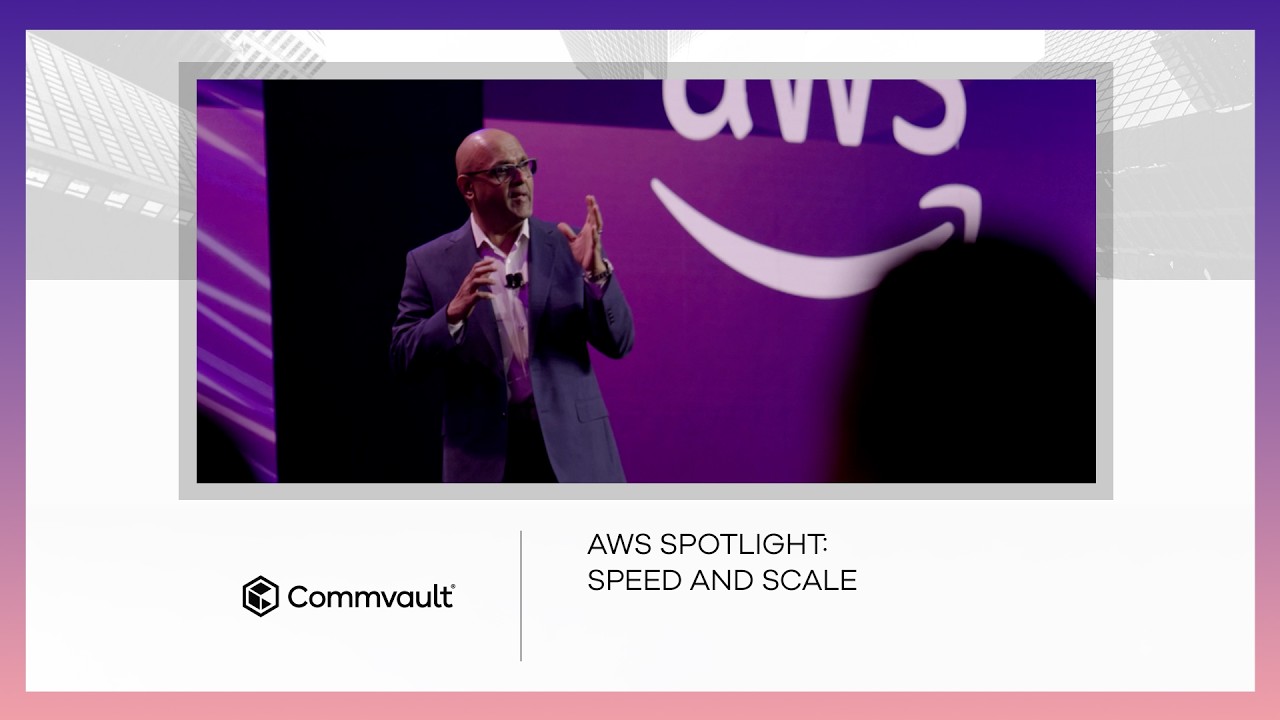
AWS Spotlight: Speed and Scale
Learn how machine-speed controls, rapid rollback, and a resilient operating model can help teams innovate faster while keeping AI-driven change reversible.
Key Takeaways
AI Moves the Bottleneck
Building accelerates with AI, shifting constraints toward governance, reviews, controls, and recovery.
Recovery Fuels Innovation
Faster recovery gives teams more room to experiment, learn, and improve.
Make Failure Reversible
Small deployments and automatic rollbacks reduce disruption when AI-driven changes go wrong.
Change the Operating Model
Redesigned ownership, reviews, and automation can increase gains beyond tools alone.
Run Controls at Speed
Embedded security and release controls must keep pace with machine-driven change.
Prove Recovery Readiness
Detection, containment, auditability, and recovery create permission to innovate safely.
About This Session
AI is accelerating development, but speed creates value only when organizations can safely reverse changes that fail. Using examples from Amazon, this session shows how agent-assisted teams can move from ideas to outcomes faster. It also explains why governance, review, and recovery become the new constraints as building itself becomes less of a bottleneck.
Recovery as Innovation Budget
Organizations that recover in minutes can experiment more than those that need weeks or months. Smaller deployment waves and automatic rollback make failure less expensive and help teams resume building sooner.
The biggest productivity gains come from changing how teams work, not simply giving them the same AI tools. Amazon teams that redesigned ownership, reviews, automation, and rollback processes achieved greater gains than teams that adopted tools without changing their operating model.
Controls at Machine Speed
Agentic change can involve code, configurations, and permissions. On-demand security testing, release-readiness checks, and continuous remediation help controls keep pace without creating a new human bottleneck.
ResOps connects fast change with coordinated recovery across applications, data, and identity. This operating model helps teams detect, contain, audit, reverse, and recover when misconfigurations, identity issues, or rogue agents disrupt the environment.
Build Trust Through Proof
In regulated environments, permission to innovate depends on proof that change is observable and recoverable. The advantage is turning intelligence into action while retaining the ability to be wrong safely.
Related Resources
ResOps for AI
Explore the operating model for durable, defensible enterprise AI.
ResOps Explained
See how teams move from backup to proven recovery readiness.
Resilience Operations
Connect posture visibility, recovery intelligence, and validated workflows.
Frequently Asked Questions
How does AI change the speed of development?
AI agents can accelerate coding and other development work. As building speeds up, governance, reviews, permissions, and recovery processes can become the new constraints that determine how quickly teams deliver outcomes.
Why is recovery speed an innovation budget?
Teams that recover in minutes can run more experiments and resume work sooner after disruption. Faster recovery reduces the cost of failure and creates more capacity for learning and innovation.
What makes AI-driven change safely reversible?
Smaller deployment waves, automatic rollbacks, rapid detection, and embedded controls help limit the blast radius. Together, they allow teams to identify failed changes and return applications and services to a working state faster.
Why must controls operate at machine speed?
Agentic systems can change code, configurations, and permissions quickly. On-demand testing, release-readiness checks, auditability, and continuous vulnerability remediation help controls keep pace without moving the bottleneck to manual review.
How does ResOps support AI innovation?
Resilience Operations connects security, infrastructure, and operations around proven recovery readiness. It helps organizations coordinate recovery across applications, data, and identity when AI-driven changes or other disruptions go wrong.
Transcript
View full transcript
Peter and Sanjay just talked about a few ways on how you can think about speed in the age of AI, and I’m going to take this thread a little further. The amount of time it’s going to take to move from an idea into something that is an outcome. What used to take maybe months is just getting done over a weekend.
And so, you know, I want to make this concrete by giving you one example from what we do in Amazon. Last year, the team that runs on Bedrock had to figure out a new way of building its inference engine. And this engine essentially serves up every model call that happens. Now, normally this exercise takes about 40 people over one year to sort of build.
However, we had just six engineers work through that problem working alongside agents. And what they were able to achieve was delivered this just within 76 days. So think about one year versus just 76 days. Now, Andy Jassy brought this up in our annual shareholder letter as well. And it wasn’t necessarily to sort of boost it, but it was a signal to say that, you know, your constraint or bottleneck has now moved from building to something else.
And so when you really think about it, it’s no longer the constraint from a building perspective. The constraint is all around the build itself. So you can think about things along the lines of reviews that you have to do from a coding perspective. You look at governance and so on. And so what I see every week within the customers that I work with, which is primarily in the financial services sector.
It’s not that AI has made this build fast. It’s just that building has stopped being that bottleneck. And like I said, it’s moved into these other risk areas. And so the organizations that I would say are pulling forward aren’t only the organizations that are building fast, but also the organizations that are building with a safety net underneath it.
And so when your builders start experimenting at scale, they start experimenting faster. They’re going to deliver faster as well. And when they deliver faster, they’re going to look at more data. They’re going to look at more services. They’re going to look at more models. And so the question isn’t necessarily, will something go wrong? The question is, how fast will I be able to start building again when something breaks?
Now again, going back to Amazon, we didn’t get fast by failing less. We did that by making failure cheap. And so our deployments run in smaller waves, and we have automatic rollbacks that go along with them. So if the data signals that something has gone in the wrong way, then our pipelines automatically start reversing themselves.
And a lot of times this happens without an individual actually looking at the alert and trying to figure out what to do with it. Now, Jeff Bezos, our founder at Amazon, calls this mechanism a two-way door. And the idea is that you should be able to walk back on a decision that you made. And so when you look at the operating model of Amazon at scale, it’s built on this notion of the door swinging both ways.
Now let’s put agents back into the equation from an AI endpoint. When we talk about agents, they write code faster. But that’s not the only thing that they do. They’re also able to look at configuration changes. They’re looking at permission changes. And sometimes they get it right and sometimes they don’t get it right. And so, when it doesn’t get it right at scale, the door you can’t walk back through is going to hit a wall, and its speed is going to hit you really, really hard.
And so the question for every one of you that’s a leader here isn’t if something is going to break. It’s how many minutes do you have? What’s that blast radius between the break and when you start building again? So think about your recovery time as your innovation budget. An organization that can recover in minutes can afford to experiment more.
Which means you can innovate more. And you can do that in days. You can do that much faster than companies that do that in weeks or months. So think about your recovery velocity as your innovation velocity as well. And here’s another example from Amazon, which we learned through some hard lessons, if you will. When agentic development was rolling out in the organization, specifically in our storage business, it was sent out to about 50 different teams.
And on average, each team was able to get about 4.5 times faster than what they used to achieve before. Now, the story here is not necessarily about the speed, but it’s actually about the spread. So the teams that were just using the tools and not doing much more beyond that were able to get minimal performance gains.
But the teams that changed how they worked, changed how they owned, changed how automation worked from a review perspective, and changed how faster rollbacks were engaged in that process were able to achieve as much as ten times more productivity. So it’s the same models, it’s the same tools. But organizationally, how they worked as a team is what made that difference.
And that’s what I truly call a metabolic rate of change. It isn’t how fast you generate ideas. I think AI has made this idea generation process very easy and, to a large extent, free. It’s how many of the changes you can observe within a week that is going to make a difference. And there are three things that I want you to think about.
One is how small is the blast radius you’re working with, how fast can you detect a problem, and then, more importantly, once you’ve detected that problem, how fast can you work on it and rewind it? Now here’s the part that I live every day in, with the banking customers that I work with.
From an agentic perspective, the problem isn’t around the models, if you will, but it’s more around the controls within the banks. Think about the approval system. Think about access from a review perspective. Think about access control. It’s designed for a world that changes on a quarterly basis. When you look at the world, changes are coming on an hourly basis.
Now, if you end up putting a human in front of every action that’s going to happen, you’re not going to achieve anything because you just moved your bottleneck. And so the controls have to run at machine speed in this world of AI, and specifically agentic AI. And that’s why at Amazon we are thinking about this differently, and we are putting the controls themselves into the agents.
So, for example, we have a security agent that runs penetration tests on demand versus just doing it on a yearly basis. We have DevOps agents that run release readiness and get your code ready before it goes into production. And then finally, we have continuous vulnerability remediation. And so every action that happens within your environment, you can explain it.
You can audit it, and you can reverse it if there is a need for it. And then Commvault comes in and closes the loop on all of it. When that fast change comes in, and let’s say that fast change actually didn’t work out, it actually went wrong. And it could go wrong from a misconfiguration standpoint. It can go wrong from an identity perspective.
Or it could just be a rogue agent that’s working in the environment. Within the Commvault approach, what will happen is you’re going to be able to rewind the application, the data, and the identity all together at once. Now, Commvault calls this particular operating model ResOps, and I think ResOps is very similar to the two-way door mechanism that I talked about earlier from an Amazon standpoint, which allows you to scale this at an enterprise level.
So I’ll talk about the last question, which has nothing to do with the product. But I feel it’s the most interesting question of all in today’s age of AI, which is, if you look at the technology era, for the most part, the scarce input has always been intelligence. And so expertise was scarce. Building complex systems that could scale was scarce.
But if models, the way and the rate at which they are changing, make this intelligence abundant, it stops being an advantage. It stops being a differentiator. So what becomes scarce? From where I see it, there are three areas where things happen from a change perspective. Number one is context. And by context I mean your data and the relationship with the business rules in your organization, so that an agent that makes a decision, its tenth decision is going to be much better than its first decision.
The second part is trust. The more you trust an agent, the more work you’re going to pass on to it. And the companies that are doing this at scale are truly having an advantage against their competitors. And number three, the one which this conference is really all about, is the ability to fail, but fail in a safe manner.
So in the regulated world, again, which is where I spend a lot of my time, the scarce resource wasn’t necessarily intelligence. It was more about permission. And permission comes from proof. And this proof is that you can detect, contain, and recover. So I’ll sharpen the overall theme for today in a simple sentence: the differentiator isn’t how fast you can turn intelligence into action. It’s how fast you can turn it into action that you can also afford to be wrong about.
With that, let me hand it over to the leaders from NVIDIA, Anthropic, Microsoft, and Databricks to discuss where the advantage really sits in this new world of AI. Is it in the data? Is it in the compute? Is it in the harness that surrounds the model, or is it the operating model that is underneath all of it?
With that, I thank you all.