AI Recovery for AI vulnerability

Recovery built for the cloud. Proven at scale. Ready for AI.
Clumio CloudRecover is recovery built for the cloud and the engineers running it. It helps recover cloud-scale data on AWS and Google Cloud fast, in place, with one policy across object stores, databases, and lakehouse tables; helps keep each vaulted backup copy immutable in a vault outside your account; and helps identify a clean recovery point before you restore. Serverless, declared in code, API-driven, and operable by AI agents.


A modeled composite organizations using Clumio CloudRecover achieved a 176% return on investment, according to a Forrester Total Economic Impact™ study.
Backup is a copy. Recovery is the business.
Code builds the cloud. AI rewrites it. Can your recovery keep up?
Replication, versioning, and snapshots let corruption and bad changes propagate, leaving no way to know which copy is safe to restore.
Tools built for the data center copy data well but recover it slowly, and snapshot sprawl makes costs grow with every copy.
Infrastructure is defined in code and changed by agents, but recovery still waits for someone to click through a console by hand.
Where CloudRecover applies
One set of policies across the cloud-native data the business and its AI run on, from the first bucket to petabytes and billions of objects.





Billions of objects. One recovery. Hours, not weeks.
Built for cloud and platform engineers, not retrofitted for them, and proven at the scale they run.
In-place rollback at cloud scale
Roll back S3, DynamoDB and Iceberg tables to a point in time, in place, from versioning, with no extra copies.
OUTCOMES: In-place recovery where supported
See Cloud Scale Rollback
Threat detection for supported backups
Clumio ThreatDetect scores supported backups for ransomware risk and shows the evidence behind each score.
OUTCOMES: Restore with receipts
See threat detection
Air-gapped, immutable protection
Immutable copies sit in an isolated vault outside the production account, helping reduce ransomware exposure.
OUTCOMES: Helps isolate copies from compromise
See air-gapped protection
Headless by design: infrastructure as code, API, and AI agents
Declare protection in Terraform or CloudFormation, drive it through the API, and let AI agents run recovery through MCP.
OUTCOMES: Recovery that fits your pipeline
See the Terraform provider
Explore all solutions
Recover the rest of the estate
CoreRecover
Integrated recovery for the hybrid enterprise: VMs, databases, files and cloud infrastructure, on one control plane.
See CoreRecoverCyberRecover
Clean, isolated recovery after cyber disruption
See CyberRecoverSaaSRecover
Recover critical SaaS and DevOps data
See SaaSRecoverAgentRecover
Full-stack AI recovery
See AgentRecoverHow does Commvault power CloudRecover?


Proven outcomes

THE CHALLENGE
Running nearly all on AWS, CAVA needed cost-effective, protected, scalable, air-gapped backup for hundreds of terabytes of restaurant and reporting data.
THE SOLUTION
Deployed across every AWS account, CloudRecover protects hundreds of terabytes without consuming CAVA's resources, and grows as the data grows.
protected across all AWS accounts
resources consumed in-account

THE CHALLENGE
A cloud-only audit platform for CPAs, with sensitive data growing 5% a month, needed to back up an entire cloud: air-gapped copies, predictable cost.
THE SOLUTION
Up and running in an afternoon with air-gapped backups. Fire drills recover a terabyte in about two hours, and the team saves a full-time employee.
to recover a terabyte
saved on backup operations

THE CHALLENGE
A fintech holding customers’ commercial loan data needed SOC 2 compliance, disaster recovery, and a backup that engineers could stand up without a project.
THE SOLUTION
CloudRecover passed a one-hour SOC 2 auditor walkthrough, took its first backup in five minutes, and cut the bill by removing orphan snapshots.
to walk auditors through it
to first backup
Frequently Asked Questions
What is CloudRecover?
CloudRecover is Commvault’s recovery solution for cloud-native data across clouds. It is a fully managed, serverless service that helps protect object storage, databases, and lakehouse tables at cloud scale; helps keep copies immutable in an isolated vault; and helps identify a clean recovery point before anything is restored.
How is CloudRecover different from native cloud backup tools?
Native replication, versioning, and snapshots create copies but were not designed for fast, reliable recovery at scale, and they can let corruption propagate. CloudRecover recovers in place across billions of objects, holds copies outside the production account, and scores supported EC2 and EBS backups when ThreatDetect is enabled to help teams assess which copies appear clean.
Does CloudRecover require any infrastructure or agents?
No. CloudRecover is serverless and agentless: no dedicated backup infrastructure to manage, with required connection resources deployed in your account, nothing to size or patch, and protection that scales as data grows.
For supported workloads, incremental-forever protection captures changes after an initial full backup, so you pay only for what you protect, at 30%+ lower backup TCO than native approaches.
Can I just use S3 Versioning to recover my objects?
Amazon S3 Versioning lets you return an object to an earlier version, but only one object at a time. Modern applications and AI workloads need that across entire buckets of millions or billions of objects, impractical by hand. CloudRecover’s in-place rollback automates it, reverting objects to a chosen version and point in time within supported service limits.
How do I know a backup is safe to restore?
Each supported backup analyzed with ThreatDetect enabled receives an assessment before you restore. ThreatDetect scores each supported backup for ransomware risk from inside the backup pipeline. It builds a baseline for each asset and correlates multiple signals, so no single metric triggers a verdict. Each backup carries a risk score, a confidence level, and a downloadable report showing which restore points appear clean.
Can we automate CloudRecover from code or AI agents?
Yes. CloudRecover is API-first, with a published Terraform provider and infrastructure-as-code modules, so teams can declare and manage protection from code. The console is an option, not a requirement.
What is the cloud shared responsibility model?
Cloud providers are responsible for the data security and reliability of their infrastructure; customers are responsible for their data and applications, including access control. That means restoring data after an overwrite, deletion, corruption, or attack is the customer’s job, whether the cause was human error, a bad code push or ransomware.
How does CloudRecover help protect my cloud data from ransomware?
Three ways. Every copy is held immutable in an air-gapped vault outside your production account, so isolation helps protect backup copies if production credentials are compromised. Supported EC2 and EBS backups can be scored for ransomware risk when ThreatDetect is enabled, so you can assess which restore points appear clean. And in-place rollback helps return billions of objects to the moment before the attack, in hours rather than weeks.
Related to CloudRecover


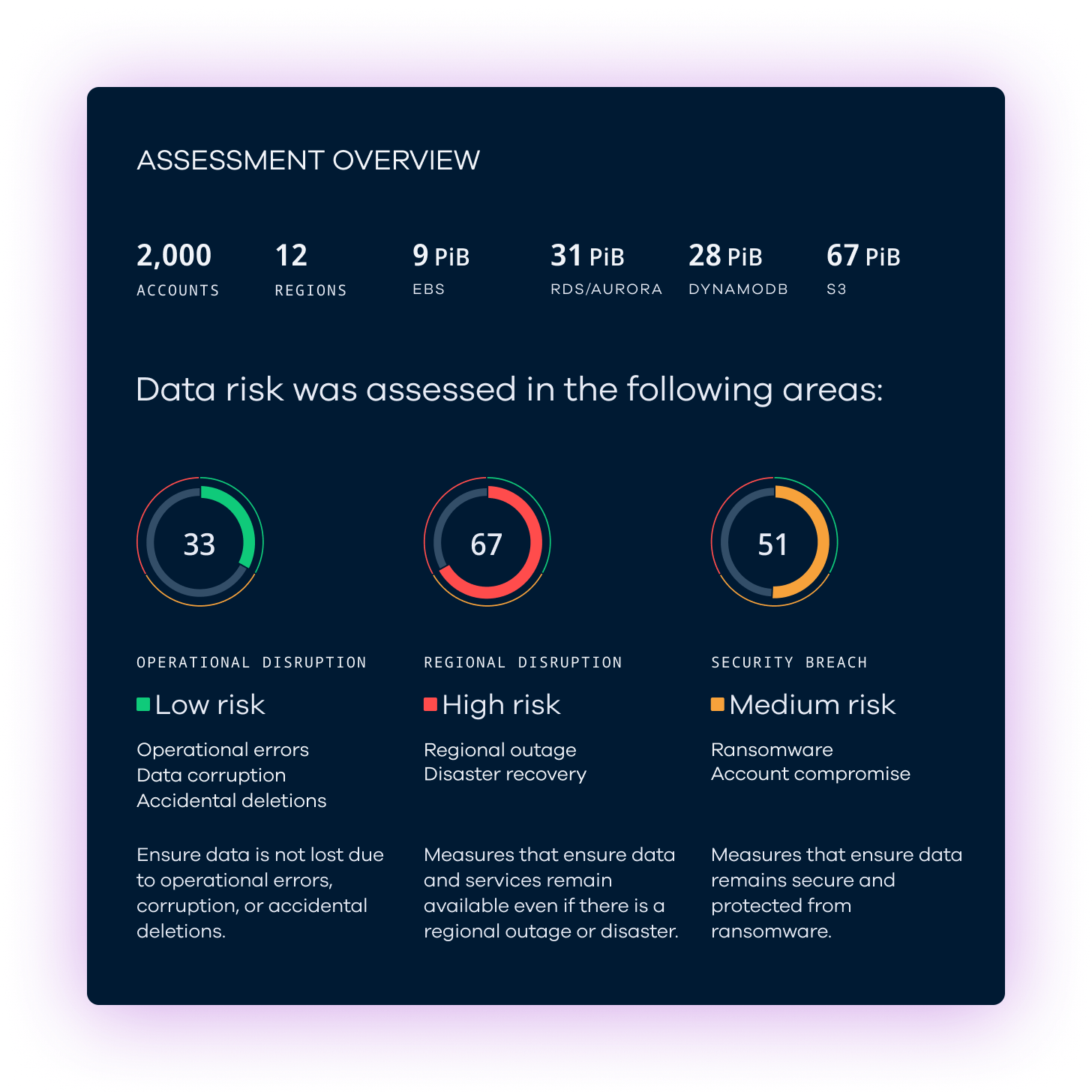
Data Risk Assessment
Are your cloud workloads at risk?
Clumio helps you find and fix data vulnerabilities before attackers do. Get a Clumio Data Risk Assessment to uncover risks in your cloud environment – and gain a roadmap to stronger resilience.