ON-DEMAND SESSION
The Machine-Speed Threat
Explore how agentic AI changes cyber risk and why governance, data controls, agent inventories, and tested recovery must evolve at machine speed.
Key Takeaways
Govern Agents at Scale
Register agents, define permitted actions, track ownership, and manage the full lifecycle.
Secure Data and Access
Control what agents can reach, which data they use, and how access is authenticated.
Build Agentic Defense
Combine skilled teams, automated guardrails, pipeline protection, and rapid response capabilities.
Know Every Connection
Inventory agents, models, APIs, code, data sources, vendors, and downstream dependencies.
Test Real Recovery
Practice disruptive scenarios to prove systems and teams can respond and recover.
Make Risk Business-Owned
Give executives and boards evidence about impact, intellectual property, and third-party exposure.
About This Session
Agentic AI can accelerate business and security, but autonomy also allows mistakes and attacks to spread at machine speed. Security leaders discuss how non-human identities, citizen development, dynamic APIs, AI pipelines, third parties, and autonomous workflows change organizational risk. The panel emphasizes governance that enables responsible adoption while protecting data, intellectual property, physical operations, and recovery capabilities.
Govern Without Blocking
Effective governance should help teams use approved tools safely instead of simply saying no. Organizations can limit initial use cases, train employees by skill level, define guardrails, and apply stronger review where experience or risk requires it.
Every agent needs an owner, an approved purpose, defined access, monitoring, and an offboarding process. AI depends on trusted data, secure access, authenticated APIs, protected code, and controlled pipelines. Weak asset inventories or unclear permissions become more dangerous when autonomous tools can act across them at speed.
Prepare for Agentic Risk
Security programs need people and technology focused on agent behavior from request through execution and returned data. Unregistered agents or activity outside their approved context should trigger containment and investigation.
Prove Resilience
Real exercises reveal what teams can see, control, detect, respond to, and recover across internal platforms and third parties. Testing turns assumptions into evidence leaders can use to understand potential impact.
Expand Board Oversight
Boards should ask how management knows controls work, how intellectual property is protected, where vendor concentration creates risk, and whether recovery capabilities match machine-speed disruption.
Related Resources
AI and Data Workload Protection
Explore how resilient data supports secure, responsible AI adoption.
Cleanroom Recovery
Learn how isolated recovery testing helps validate clean, trusted operations.
Why AI Is Breaking Your Resilience Strategy
Learn more about a new approach to help protect and recover your data.
Frequently Asked Questions
What is agentic AI risk?
Agentic AI risk arises when autonomous tools access data, call APIs, write code, or execute workflows beyond intended limits. Errors, misuse, or attacks can spread quickly without strong governance and monitoring.
How should organizations govern AI agents?
Maintain an inventory, assign ownership, register approved agents, define purpose and permissions, monitor behavior, and create processes for review, containment, and offboarding throughout each agent’s lifecycle.
Why is data governance essential for agentic AI?
Agents depend on organizational data. Accurate inventories, access controls, privacy requirements, intellectual property protections, and clear consent rules reduce the chance of inappropriate access, exposure, or reuse.
What should boards ask about AI security?
Boards should ask how management knows controls work, which intellectual property agents can access, where third-party concentration exists, and whether response and recovery capabilities have been tested.
How does recovery testing reduce AI-related risk?
Realistic exercises show what teams can observe, control, contain, and restore when an agent or connected vendor causes disruption. Testing replaces assumptions with measurable recovery evidence.
Transcript
View full transcript
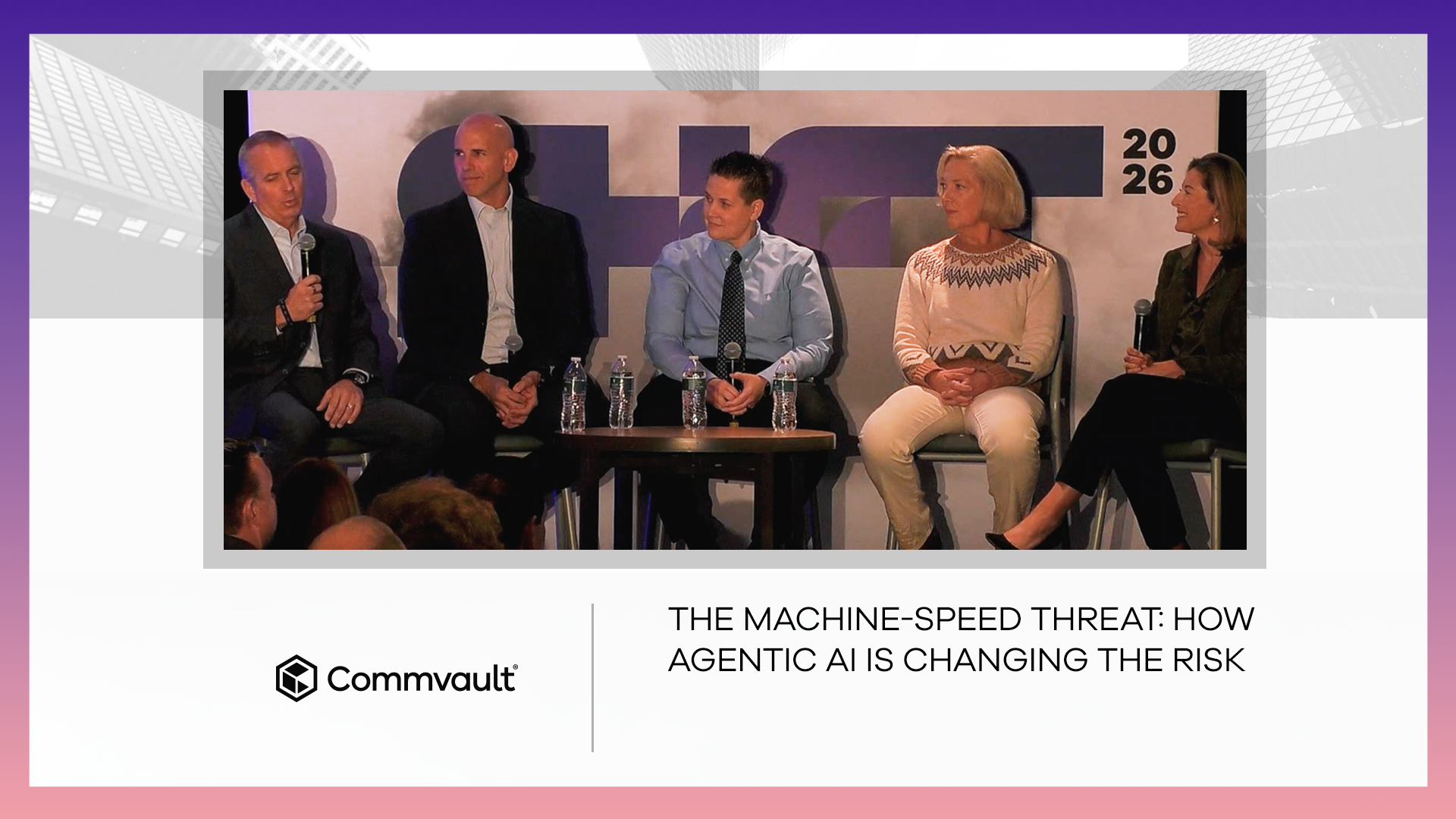
Hi, everyone. Welcome to our, really great panel. We’re going to be talking about machine speed threats and how AI is changing the landscape. And I am joined by some incredible people and experts. And I’m going to let them each introduce themselves. And then we’re going to kick it off. I’m Danielle Sheer. I’m the Chief Trust Officer at Commvault.
And, and we’re going to start with a couple of questions, and we’re going to do something that not even our marketing team who told me not to go off script as, as we actually we’re going to open up to questions from the audience. So, as we get started, I have a question in mind and we’ll pass the mic to you.
Hi. Good morning, I’m Melissa Hathaway. 35 years national security. Been doing information warfare, cyber AI. Well, all of it since early 1990s. I’m the Chair of Combat Cyber Resilience Council.
Oh, yeah. Hi. Good morning everybody. Dr. Erika Voss, Chief Security Officer for Blue Yonder, which is an AI supply chain company. I’ve been in the industry for same thing a little over 30 years. Started in physical security all the way to the cyber side now.
Hey, everybody, I’m Bill O’Connell. I’m the Chief Security Officer at Commvault.
Hi. Good morning. My name is Roland Cloutier. I am the other Chief Security Officer up here, I guess so, former Chief Security Officer for, Let’s see EMC, ADP and TikTok. ByteDance, about 35 years in the business, including military and law enforcement.
Okay, great. Perfect. So it was only six months ago that Mythos was released, and that seems kind of wild that it’s only been six months, because to me, it’s felt like six years of conversations. And the rate and pace of vulnerabilities that have been discovered and disclosed and the rate and pace of patches that we are needing to keep up with has just, is just exploded.
It was, I think, about a month ago that Microsoft, disclosed enough. CVEs that would have made it like an entire year’s worth of CVEs, right? I think it was like 1400. And teams are really struggling to keep up in this new world of rapid disclosure and in rapid patches. And there’s a lot to talk about here.
But what we want to focus on today is something that cybersecurity experts have long been trying to guard against, which is insider threats. And I think we’ve done a really great job. I think the CISOs have done a great job of educating, you know, all of the employee bases and people in general don’t click on this suspicious link.
You know, and these attacks are getting harder to spot, fake versus real. My question now is, is what happens when the insider threat isn’t a human, but it’s a non-human identity? So I got a couple of questions to kick us off in the area of each one of their expertise. And I’m going to start with Erika and Bill, okay.
As our as our current operators on the panel. So we’ll start. EriKa, my question to you is is you are an executive at a, a a supply chain company, and you have developed agents to help you move goods and products all over the world. How do you think about managing those agents? How do you think about the responsibility for what they do and checking in on them and what happens, you know, if there’s a problem?
And, Bill, the follow up question for you is going to be there are a number of third party vendors that are developing agents like Erica’s company. How do you think about defending Commvault’s and, and, and all of our systems from the explosion of agents that these third party vendors are creating in order to make, you know, work more efficient?
So I’m going to pass it to you guys to kick us off.
First of all, I feel like I got the better question. I think that’s the thing you have to recognize, it’s not so much about how much is going from a speed capability. We all want speed, whether it’s security, whether it’s technology, whether it’s resiliency, whether it’s, you know, legal, the business units, everybody wants speed.
We want to do more with less. And I think we’re excited about what agents are doing because we think it’s going to help us evolve and innovate. But there’s this element where you still have to have the governance. And I would say, I think to your point exactly, is we still struggle with governance as an industry. It’s like, oh, I want to do more with less, but but I want to also have that speed and I want to have that functionality and I want to have that capability, but I don’t really want security to come in and tell me no at the same time.
So you’ve got to find this balance where a lot of it is. I think you’ve got to put that knowledge, that know-how, in the hands of your developers, in your teams, in what we’re all talking about, the new citizen developer, which is I mean, I didn’t think in my lifetime I’d probably ever hear those words together because I was like, what?
But you have it now. You know, in some level, that’s today’s new insider is how do you address that? Is that citizen developer, and how do you make sure that he or she understands the risks, the parameters, the impacts. At the same time, you’re also addressing like, look, I’ve got to protect the company. That is what I’m here for.
I’ve got to protect the number of vendors. I mean, probably by a show of hands, the number of AI companies that are coming to you that, you know, your development team wants to adopt. I think at this point, I think I own it every single tool. And I’m like, what are we doing? Like, what are we doing a little bit here?
But it’s that governance piece I think you have to really focus on, and I think that’s how you’re going to also address your insider capabilities and how you’re going to actually, you know, look at your citizen developer is give the training, give the capabilities, give the guardrails. And I think as much as probably any security person would say, I know, at least for me, I’m more uncomfortable now than I probably have been throughout my entire career, even starting in physical security.
And that’s just my new norm that I have to be okay with, which is which is a tough challenge.
Yeah, I think that that point about the governance, I think is important. And one of the things that happened is as we were building up our own internal, you know, governance committee and our policies, we went to go hire somebody to help drive it. And in the interview process, it became really apparent, who’s somebody that is using AI and is fluent with it, because what we need is not necessarily, you know, the architects can do the architectural review of what will this do, what will this have access to.
But we also want to encourage this. And so like Erica was saying, you don’t want to be the team that says no, you want to say yes. And so here’s how you can do it. And so our governance leader, that’s helping us, it’s not just, you know, these are the rules. You have to abide by these rules, but it’s also helping.
It’s also, hey, this is a better tool for this type of activity. And here, let me help you do it this way so that the teams can see okay. We’re actually trying to encourage this. And yeah I think there’s just to the point about how many options there are. You know, we we’ve kind of had to say, hey, let’s limit it because there’s too many things to try.
So let’s try a few. Let’s get good at it. And let’s put, you know, all that work and time and effort into making sure that it’s controlled. And we have, you know, what we expect as the security team. But we can’t do every single thing because every time we look at something new, we have to start from, you know, all those basics again.
But it’s evolving so quickly. So it’s really just a matter of, you know, trying to be supportive, using this as much as we can across the organization in with the default being as long as it’s safe. Yeah.
I mean, one of the things that you hear very clearly from your answers is how much you want to be encouraging and enabling the business to take advantage of this awesome new technology and these awesome new options, but also have a little bit of respect for the fact that somebody needs to make sure it doesn’t create more issues and, and vulnerabilities and, and security risks, which, you know, there’s a tension there that’s, that’s getting harder and harder.
Roland. How does the role of the CISO change? How does the program change who’s responsible when an agent not only kind of mucks with the data, but creates digital and even physical risk inside of a company or to people?
Yeah, it’s a complex question. And I, you know, I’ll break down this way. First of all, the business is responsible. So a lot of the times we think it’s an individual, a person, you know, a group, you know, the CIO, the whoever. The reality is the business has to make decisions. Both these practitioners are spot on when they say we have to implement capabilities that allow us to manage it at speed in, in the context that we use it in the business.
But our organizations are going to have to change, right? We’re not we’re not going. I mean, if I’m a sitting CISO and I think I’m going to have a risk and compliance group with 50 people next year, I probably shouldn’t be in this job. Right. Or if I’m thinking about, you know, I’ll add a security team.
No, I need, like, an agentic team, right? I need an agentic defense team. And so we have this incredible opportunity to rethink how we deliver security risk and privacy enforcement services. Number one. Number two is we’ve got to finish some basics. I mean, the you know, there’s five important things. And almost all of them, none of them have changed.
If you can’t solve it you can’t manage your environment. Second is data. Our AI uses all of our data, whether it’s, in context of the business process, developing new capabilities, whatever it may be, if we don’t have capabilities set around data defense and access assurance, there is there’s no way that we’re going to be successful with the quality and trust and safety of the AI that we’re providing to our customers.
The third is around AI. I’m sorry, not AI APIs, API in code, and I use those two things as a combination. If you if you think around, where we’ve kind of done this SDLC and we’ll do by design and check code at the end, we’re never going to get to a zero defect environment if that’s the way we’re doing it.
No. By the way, every for every one API, we now have 400 APIs based on the way that our architecture now works, and we’re creating them dynamically on the fly. And, you know, ask any system in the room, do you guys know how many APIs you have, what can access them, what data should be going over them and how they authenticate and what their token use in management is?
I’m going to plead the fifth.
Okay. Right. Like it’s the real thing.
It’s a problem. So and the last one is pipeline defense. That’s new to us AI pipeline defense is very different. The air is different. So we have to get really good at that. And there’s a there’s a weird, weird fifth out there that is really around guardrails. And that’s what we’re not talking about. I don’t think a lot of our organizations will change to ensure that, listen, if that isn’t a registered agent and it’s not operating in the context and accessing the context of the data that you should be killing, you know, kill it, well, we’ll move on.
But if it’s registered and it’s and it’s doing what it’s supposed to be doing, it’s registered as an employee, so to speak. So we talk about human capital management. How about agent capital management. Right. So we have to start as security risk and provider and privacy executives. We have to think of that way. And I think the last goes to the convergence thing you were hinting at.
I think there’s a there’s an aspect of this stuff turns real, real fast. Melissa and I were talking about the attacks four weeks ago, five weeks ago on NATO bases around refrigeration. And then we saw what happened in Europe last week. And now, people are being told to prepare for 90 days of outages like that. That’s real deal.
So as security experts becoming resiliency experts, becoming trust assurance and business resiliency experts, we have to think about our programs and how the defense ability and our response goes from not just technology and the digital ecosystems we serve, but it also has to flip into this side of how do we understand the physical realm by which it can be impacted, both on a go to market and customer side that we deliver to market, but as well as our people where they travel around the world and how do we make them safe?
So a little more complex.
You said these words that I thought were like, fascinating. And I saw some people scribbling it down, a defense team. Can you talk a little bit more about what a defense team looks like? Is it something that you buy from another company? Is it something that’s proprietary and a CISO creates themselves? How are you thinking about agentic defense teams.
Not being a sitting CISO was really awesome. You get a lot of head space and time to actually call and talk to, you know, people developing these technologies. And so I’ve been out there searching, you know, who is creating these, these guardrails that we can use to deploy. And there’s a there’s a handful of companies out there that are really focused in defense, understanding from the time that human asking to asset to go do something all the way to the end and it brings the data back, is a valid is it appropriate for the type of agent.
It is all the way to the life and death of an agent. Right. How are we managing those things? So I think it is a specialty and there’ll be technology applied to it. Right now. We have to get our practitioners to a spot where they understand not just how it’s operating today, but what that future is going to look like, how 90% of our security efforts are going to be around agentic, agent use, but also how business workflows.
You know, hey, business, can you tell me exactly how the business works and where you go inside and outside your business ecosystem? And now we’re going to have it done agentically. We really have to flip how we’re our training, our team.
So it’s going to be technology and teams.
So let’s follow up on guardrails. One of the things Melissa didn’t say when she introduced herself is that she was the top cybersecurity expert for two US presidents. And, one of the things that she wrote about, maybe it was more than ten years ago, but I think about it all the time, is that we really needed guardrails and oversight for the release of software.
We created it for the release of food, the release of medicine for wiring our homes with electricity. But where have the guardrails and oversight been for the release of software? We there was a there’s a famous saying ship then fix right. Like let it be released and let the wild figure out what’s wrong with it. It turns out that’s pretty problematic.
So my question to you, Melissa, is can this be regulated? Can governments in the world, how do they catch up to this? How do they even manage to understand the technology in a way where maybe we can get this right at the outset? And, what kind of policy or regulatory or just safety concerns do you think, lawmakers all over the world can play here or should play here?
Okay. That’s going to be a long answer. But, so the industry we’ve allowed for the last, you know, 30 plus 40 years field it fast and fix it later. And we allowed Microsoft to set that standard, unfortunately. And as Danielle said in the beginning, Microsoft released 400 patches last Tuesday. That was all the entire accumulation of all of last year.
They did in one month. And so the up tempo of our technologists and our operations and our companies is is unsustainable. I can’t deal with 1400 from Microsoft and 400 from Cisco. And pick your amount from Oracle and you know, and all of the different things. So we’ve allowed this industry a by really for a long time.
They’re not delivering us a good product is shrink wrapped with the vulnerabilities baked in. And they’re going to field it fast and fix it later and fix it over time. And they actually never fix it. So are we going to get ahead of this for AI? Unfortunately, no, because we were making actually a bigger mistake with AI. It’s actually going what I would say from months to minutes.
And the life cycle of these technologies and it’s every day is, is another evolution of a chat or a, you know, of any of the different products that we’ve got. And we’re allowing vibe code, which isn’t exactly good code, and we’re not actually checking those things or allowing people who have never done any software to do the vibe code.
And it’s going into your refrigerator, it’s going into your doorbell, and it’s going into all of these different things. So. So what’s going on from a regulatory perspective? Well, we already have regulation. The Europeans of course, were the first to regulate. They always are not to offend any European in the room. But this is how we put guardrails in.
It’s how they put guardrails on American companies. And so but they have taken it from a social perspective of your AI cannot introduce bias. It can’t decide whether you’re going to I’m going to get hired or fired or whether or not you’re going to get health care or your pension or all of those different things.
And we in the United States have actually followed that. We have it in Illinois and California and other things. We brought these social guardrails in that these that bias cannot be introduced by the models. But what we’re not really thinking about is the data governance piece. And there’s going to be other regulation that’s going to start to apply.
And we the United States are kind of allergic to regulation. So it’s not going to come from us. And the data governance is going to be that, you know, did the model are you actually following GDPR or any data protection privacy laws? Has your company actually thought about protecting your intellectual property? And what access in that data governance?
And the answer to that is no. And I can guarantee you there’s going to be the lawsuits are going to start coming for that. You violated GDPR, you violated California Privacy Protection Act, you violated the Illinois Act. And the companies, because they’re allowing agents to access all of this data, public nonpublic information and proprietary information. And there’s going to be this problem.
And the boards and management better get their head around the data governance piece, because those laws are serious. You know, like as far as the violation per record, now you got to get into the next thing of thinking about regulation. And it’s about I’m having a conversation and she’s my non-human identity right now. It’s my it’s my chat bot or whatever.
Is that a bidirectional consent? And are you allowed to record that conversation and use it for future. Because that’s surveillance law that is illegal in the majority of the world. And but I can guarantee you that meta is already doing that and using it to profile you and illegally collecting that data. And there are already lawsuits here in the United States on that.
So have you thought about consent? And so our general counsels all need to start thinking about consent. And then I think the next area you have to think about is what the Anthropic issues are. A Department of Defense says we’re going to use this to rendition a leader out of Venezuela. We’re going to use this for bombing in Iran.
Israel is using it for bombing in Iran and elsewhere. And are we really allowed to use these commercial products as weapons? And, and so it comes under export control, and there’s a whole discussion about export control and who we’re going to allow these products to be interfacing with. So then how do we think about safety. Well, the UK has a UK AI safety Institute where they’re actually looking at all of these different models.
And I think that’s important. And I would we would need to create a center of excellence. We don’t need one in the US, we don’t need one in the UK and one in China and one elsewhere. We need to actually all chips in and say, this is the place that we’re all going to put our models in so we don’t spend, you know, twice or three times, and we have some trusted element.
We need to think about how the penetration tools are being used along with the AI. And like there’s about 5 or 6 different pen testing tools that were weaponized by AI and by the Chinese malicious actors in the last three weeks that that for took down all the banks in Korea, 400 companies in Japan.
Japan declared a national emergency. A lot of banks in India, just last week. And so we have to be thinking about AI plus pen testing tool. Commercially available pen testing tool is you got a problem in seconds, not minutes and not days. And so we have to start thinking about what would be that dynamic defense that we could actually incorporate to protect ourselves.
I think that we also have to look at, you know, France attributed to Iran, but I would bet my entire paycheck on it was Russia is using basically the operational technology vulnerabilities that were used to move the actual temperature gauges of this, you know, end of life, you know, temperature gauge in the refrigerators and then the blood banks.
Not a lot of people know that. The blood banks also had the blood moved up in plasma, moved up to boiling levels. Okay. So I now have a food problem. It was six U.S. bases here in CONUS, continental United States, and it was in almost all the refrigerators across Europe. I have a food problem now because I can’t have frozen food.
And it’s all it’s all gone. It’s destroyed. That’s a different operational problem for you if you you’re Safeway or Kroger or A and P, I’m not sure where you’re from in the world, but those are problems. And now I’ve got a problem because it’s going after the exact same technology of my blood banks. If I’m Russia and I’m going to start to do disruption, and I really want to put you on your heels because I don’t want you to send any more money, weapons, anything to Ukraine, I’m going to start taking out your food and your blood supplies, and the population will be paralyzed.
I don’t think there’s going to be international regulation on this. I think that we’re going to have a very bad day, and it’s going to escalate things and divide more people in camps.
So to follow up, I mean, that is just remarkable. It’s a remarkable amount of information. It’s a marked amount of thought. You know, it really is. And so I’m going to ask you what is going to sound like a simple question. But it’s not, which is everything you just discussed eventually trickles down and affects a person.
It affects the family. It affects the consumer, it affects a kid. What sorts of questions should we be asking? All of us as as users of this technology and in some cases, involuntarily involuntary users. What’s question should we be asking?
I think that we need to be looking at this maybe from multiple different perspectives. I think when I talk to companies that they don’t really understand what AI is. So I’ve been thinking about we’re going into a presidential election. Mr. President or Madam President or whatever, president elect, whatever’s going on. How do you think about this? Well, there are 2 million LLMs and growing every day.
Here’s what a harness does. Here’s how you think about the agent and agentic environment and everything. Here’s how we be thinking about. I have a 1 to 20, you know, agent environment and everything. And I look at this as an HR problem. Honestly, is like, is it like, when did I hire said agent? Did it do it was supposed to do.
Which gets to Erica’s, like, special, you know, specialty of when do I detect that it didn’t do what it was supposed to do and when do I fire it? If you’re an HR executive or you’re a technology, you have a seven year database of 1 to 1 billion agents, really of per person, like I’m going to on board and off board an agent and maybe a week that think of that, think of that database that’s really huge.
And I don’t know any company is really talking about that and everything as a mom and, you know, and as a, as a, as a person, I think about it was really scary. Somebody it was the time. Interviewer. She’s like, my kids have like got these agents and they’ve given them all the passwords and everything. You might want to think twice about that, because agent could then go into the bank account and potentially drain your bank account and move it to some other place.
And so you have to start to think about what do I trust and what do I don’t trust? Why am I using this thing for efficiency? I want it to organize my calendar. I don’t want it to be touching my bank account. If my children, I still need my children to be able to do reasoning, analytic reasoning do not trust the agent is going to bring you back the right answer because it doesn’t actually know Shakespeare and that this was, you know, this battle or whatever and put it into a cultural context.
So I think that we really is I think if I were in, I were advising again, we need almost like the, the 50 ways of the three minute cartoon of which Schoolhouse Rock, you know, Conjunction Junction. I bet everybody in this room can sing those songs still. And so, you know, what’s an LLM and what’s a harness and, you know, and how should I be thinking about an agent?
That would be my first story. And then how do I think about should I ever give an agent and access to my bank account? Well probably not. Can I use an agent to do my book? My travel? Well, maybe. So, you know, and then and things like that, I, I don’t know, that’s a long answer, but it’s a you got to think about it as it’s right now we’re in the baby.
We’re in the baby stages of a of a of a of the next revolution of technology and evolution of our, of our, of our lives. But we need to be very delicate in how we embed it in our businesses, our personal lives and in our countries.
And we have to be having conversations like this so that people can understand and wrap their heads around just how massive the questions and the challenges are. Erica, I’m going to continue with this question, which is what should X be asking? And I asked her, what should you know, a regular human or a consumer, a family be asking for you?
I’d like to ask what should the CEO be asking? What should the executive team be asking you? I want to flip it from I want to do everything I can to enable you to, you know, deploy AI and deploy agents to. Hey, guys, this is what you should be asking me.
I think it’s a great question. It’s one, actually, that we just recently had, even as an executive team is what do we want our agent to solve for, which is a lot of it’s a lot of like what you’re saying, what is my defense in depth? And I would challenge everybody in this room. We all grew up learning the defense in depth plan or eating the elephant.
One bite at the time. Go to go to your LLM or go to your agent and say build me an AI defense in depth plan. It’s very different. It’s a very different view. It’s a very scary view to and so we did that basically as a company exercise from a tabletop with our executives and said, hey, here’s what I’m concerned about.
I grew up wanting to protect the perimeter layer of the application layer. Here’s my defense in depth. Here’s the things I care about. Now I’m asking the question. That’s great. We’re an AI supply chain company. Our job is to protect the supply chain. I probably cry every day about it a little bit because of the refrigerators, the freezers, all these things.
But the thing that it doesn’t get asked with our executive team that I keep pushing on is what’s just the basic inventory. We all still struggles in industry with CMDB, we still struggle patching, and now it’s like, cool, I’ve got to worry about the, you know, the the cloud team or the, you know, the developer team that is like, oh, I’ve, I’ve built this other agent.
It doesn’t connect to anything. Erica, don’t you don’t need to worry about it. And it’s like, but wait, it’s connected to Snowflake on the back end. Like some of these things, that conversation you have to have is what is that inventory of agents. And when you actually ask the CEO, do you know how many agents we have? The answer is very clear.
Yeah, I have you. And I’m like Do you, do you. Because average CSO now is 19 months in role I mean because we’re finding you’re having to do more with less. You’re getting a little bit more stressed. You have to live in this uncomfortable gray. And so I think that would be my challenge for you to do is when you talk to your CEO or when you ask those questions, to start with the basics.
Do you have good inventory? Do you know what your agents are doing? Do you know what your models are connecting to from a data perspective? Do you understand agentic defense? I’m talking about agentic defense. And everyone’s like, yeah, this is great, let’s go. And I was like, hold on. It’s just another emerging tech. What’s our plan to address emerging tech?
That’s because it’s AI right now. But what happened to quantum when that comes what happens after that? This is just another technology for me. And so I think you’ve got to ground it back to the basics of what are the things you care about as a company versus, you know, your executive team and then teach them to understand the questions we are challenged to ask.
So it’s not about unlocking the business. That’s always going to be our problem. We all have to unlock the business and enable them to go faster and do more. But if you don’t understand what your agents or your models are even doing, well, how do you think you’re ever going to get your arms around anything?
And everybody who uses an agent or wants to use it has to be responsible to ask those questions. They just can’t, you know, take a loaded gun. They have to know how to use it, and they have to know how to fix it. And Bill, same question, but from the perspective of a customer. So you talk to customers all the time.
It’s becoming more and more the norm that before a customer buys an expensive piece of enterprise software, they want to talk to the CISO. They want to put a face to a name. What kinds of questions should customers be asking companies who are deploying AI agents of you?
I think for my role, there’s a couple of things that I get asked a lot. How are we using AI ourselves and a lot of the heavily regulated entities that are our customers want to make sure that we are not one of those use cases that you see in the news about where AI has gone rogue and something bad happens.
Then also, you know, I get asked, are we using it in the positive way that, hey, you’re a company that is on the leading edge of technology, so I want to see you using AI. So it’s funny to see that spectrum and then also within the product itself. So you know, what functionality is there for me to use your product.
And what AI can I use to help accelerate what I do when I need to do recovery? And then also what AI tools, you know, can you give me that I can plug into and I can do my own stuff with yours. So it’s really fascinating to see all these different dimensions. One of the things that I found interesting when we were doing the TIME CISO of the Year and got to talk to these amazing CISOs as part of the kind of review process.
And one of them was explaining that one thing that they did because we keep saying about like, oh, you know, vibe coding and any user, they can build an agent, but should they and do they do it right? And I agree, as Erica laid out, all of those fundamental IT housekeeping things need to be in place about do I know where my stuff is?
Do I know where my sensitive data is? Do I know who has access to what and when? You don’t have that clean, but you try to put this, you know, kind of supercharged tool on top of it. It’s going to exacerbate the issue. So the so from the governance piece, the other thing that that this CSO is explaining is they’ve looked at all their people and said, hey, just let’s simply put everybody through some AI, you know, understanding.
So we can see on a level one, two, 3 or 4 what’s their maturity with using AI. And if you’re at a level one, there’s only certain things that you can do. If you’re at a level two, there’s more things that you could do all the way up. So when somebody in the organization demonstrates that they know how to do this, well, they know how to do this right, and they’re building some agent in the right way, then, yes, they have the capability to do that.
But I just like that approach to say, okay, all people in the organization are not, you know, don’t have the same skill set. So that helps us go faster. If instead of treating everybody as, oh, it has to go through this big, big, cumbersome review, maybe many of them do, but not all, and maybe some people have demonstrated that they’re good at managing an agent, or they’re good at at allowing some vibe coding and then checking it.
And so you don’t need that same heavy scrutiny with them. You still have some and you still have guardrails and controls, but they’ve demonstrated that they know how to do it with as little effort, so you can give them less friction. Whereas people over here that have demonstrated they can’t yeah, it’s a heavier process. It’s a slower review.
You need to double check all their work. And so I like that thinking about yeah. You know, how do I make sure that I tackle it from the people side as well.
Yeah. And so Roland, from the board perspective, what should the directors be asking. And you know, directors are not necessarily cybersecurity experts. They’re not even necessarily technologists. So what’s their responsibility? To provide good governance and oversight? And how do they do it? What are the questions they should be asking now?
Broad question. It’s actually funny. We were talking about this this morning. I’m going to try to answer this not from a CSO perspective, because I think it’s really important that people understand the board’s accountability. And a lot of people don’t get this. But the board’s accountability isn’t. To run the business is to protect the shareholders. I mean, at the end of the day, they’re they’re they’re so focused when they’re asking us you questions in a meeting, it is it is because they want to make sure we’re doing the right thing for the shareholders.
So I think, if you take that step back, one of the one of the first things that they should be asking is how do you know? Right. It’s my favorite board question when I get up there and I’m pontificating about all the security stuff we’re doing and, you know, plans for the future, and they’re like, how do you know it works?
How do you know you have everything? I think boards have to ask about transparency and ability to impact change within the environment as an executive and completeness of what we’re committing to. And they don’t ask that enough. So I think that’s number one when it comes to AI. I think a lot of people forget about the intellectual property.
That is the business that sits within the data, the the thing that makes us a special company, the from the code that does to the secret sauce of Campbell’s. I don’t know. But the point is, when we open up our data and automation and capabilities to AI architecture and agents doing tasks on behalf of whatever the question is, what is the impact to the intellectual property and the long the long stream residual revenue that comes from, you know, what has built the company.
And so if people aren’t thinking about that, if they’re not asking that question, they’re running. Yes, we’re we’re protecting X, Y and Z. We’re we have agents, we test the code. We’re making sure vulnerabilities. That’s great. But at the end of the day, if that’s coming out into foundational models, if that’s going out into unprotected things that are not protected legally as confidential information, it’s gone.
And so now your competitor or the people that are building the models for you in the market, or people that are using their models that now can compete against you because you train them. So boards should be asking those questions. And I’m a big believer in resiliency. One of the reasons I’m here, I think our jobs should be no longer just chief security officers should be chief trust security and resiliency officers.
I think the understanding of the end to end value chain of the organization and the implications that whether it’s a rogue agent, it’s it’s malicious or non malicious negative impact code, you know within your environment. I mean think about your infrastructure as code. Your agents are code your everything you’re doing. And it’s done at machine speed. So maybe you had 40 repos before.
Now you’re going to have 404,000 repos. Your code percentage is going to go up by the X. And we only used to check code I don’t know, 20% of it. Maybe, you know, really mature companies, maybe 60% of their code. And now you’re you have so much code because everything is being done in code, even down to HR functions and finance functions.
Using agent technology. You have to check all that. So one of the things that I think boards should be talking about is how are we ensuring the sanctity of the code base that is our digital business today. And and that’s about as technical as they should get, I think.
Yeah, I think that’s great. And you know, the requirement, the standard isn’t to get it right. I think the requirement, the standard is to try. So asking those questions and making sure people are thinking through them and having conversations like this is is what the goal is. The goal is to try really, really hard to get it right.
I’m going to open it up to questions in the audience who’s got one? And if you do, just stand up so we can see you.
And if it’s hard, ask Melissa, please.
Bob Haynes, I have a question around for reviewing the AMA. So you have a lot of systems using Salesforce, all these systems using the Gypsy data and you have your own internal AI. How do you how do you look at that? And there’s a when there’s a threat or into your system. How do you look at that as a board and talk about that and identify responsibility into what happened?
Okay, I’m going to repeat the question because this is being videoed. It’s a great question. There are a lot of different third party systems inside of a company. You know, you could have Commvault, you could have Salesforce, you could have NetSuite, you could have Workday when there is, a breach or some attack that’s happened.
How do you discuss this with the board? How do you how are you transparent with the board? How do you explain it to them? How do you figure it out yourself? So let’s let’s go one by one. We’ll start with Roland.
And I’d love to start, start this one because I just went through an exercise like this. So it’s it’s it’s, it’s kind of a bit of a radical way of thinking, but think about our jobs as practitioners. And, you know, we have to have visibility. We have to implement controls. We have to have the ability to respond, and we have to have the ability to recover within that stack.
Now, go through your digital ecosystem, draw lines and say, within these lines, I can see I can implement controls I can detect and I can respond, next line out, I can see, I can see the controls, but I don’t manage them. When you go to the next line, it’s kind of like a reverse bullseye, if you will. And then each one of those things, what we’re going to do is we’re going to educate the board on who our third parties are, what portions of the business they impact, and what we can or cannot do either as operationally, contractually.
And then we spell out the risks there we don’t have to solve forever. Well, I guess they’re going to make us solve for it. But we don’t we don’t have to solve for every risk. But what we have to do is understand what the risks are, what our capabilities are around that, that entire spectrum of our digital and business ecosystem.
And then the board can have a conversation. But that’s what we need to bring to the board.
And also just run it in reverse. Right. So I like to, you know, the with the tabletops that we do and the exercises that we do, I like to try to think about, okay, what’s what’s the bad thing that could happen. And you know, to, as Roland was mentioning, you know, would I be what would I know and what would I not be able to tell?
So you can see and also, you know, the whole point from this morning about practicing, I, I really love the concept that you’re not going to figure it out in real time if you’ve ever, anybody in the room has ever had to do that, it’s not fun. So what are those things that you can test and practice in advance in the real world?
Not the paperwork exercise, but really, you know, bringing a system down and seeing how long does it take you to bring it back. And then you can have much more confidence knowing, okay, we thought it would take us two hours, but we actually did it and took eight, right. So now what does that mean for that scenario? That’s that’s a longer term, that’s much more impact etc..
So you know that would be my kind of piece here is only through really testing and and putting your team through that. Would you be able to know. And then also that also helps if you’re, if you are a security person or you’re, you know, you’re running resilience, to get the right attention that, you know, communicating to the board or to the leadership of the company, you know, if this were to happen, it would take us this much time or we would have this much impact.
I think that conversation, you know, again, to the point of the proof, you would have that practice, you would have that proof to kind of advocate for yourself.
I think the thing I would add is very traditional supply chain. It’s not just about third parties. You’ve got to think fourth party, fifth party. You’re going to have to go deeper. And I think that’s the area I, I unfortunately will pick on Salesforce a little bit. They’re a great company that is acquiring everybody left and right. So that’s great.
If Salesforce has a marketing incident with their vendor and we all probably got the notice of like, oh, like we bought this company or, you know, we we outsourced our, our, you know, capabilities to this thing. But who do they outsource to that offshore company that’s in the Philippines or Vietnam or India?
I mean, you’ve got to start mapping that. And I, I would challenge and this is a thing that I, I kind of do with our, our executive team, which is or even our board, which is kind of fun, is we had our first hiccup with supply chain. It was COVID. You couldn’t get toilet paper. I mean, think about that.
That’s just a basic good. But what about the truck to the pallet that has all that toilet paper on it? It’s the same thing with third parties. You got to go third party. Fourth party, fifth party. I need the truck, I need the pallet, I need the container. I need the Maersk ship to get it from A to Z.
If you’re not going that deep into your supply chain and looking at your vendor dependency, I mean, that’s if you were to ask me, what’s the thing I worry about the most? It’s not about AI and all the technology. It’s my vendor dependency still. And that’s a core thing we haven’t solved as an industry. It’s I’m just going to introduce, like we’ve all said, I’m just going to bring more AI vendors to the table to solve my problem.
Awesome. That’s great. But it’s still a problem. So that’s what I would say. Go, go deeper in your supply chain of your actual vendors.
Yeah, I’m going to build on that. And I think that you, you have to really understand your that dependency. But where’s your concentration of risk if, if as Azure goes down you’re down. If this company, you know Salesforce has another bad day or Oracle has another bad day, it’s a one to many because Russia or China has found them to be the easy access point into your organization.
Do they have effective controls in place? So I’m going to put like you know my my a government hat on. So this is where the Europeans have been I think somewhat helpful. You’re liable as a government as a director under multiple of their laws. You’re like you go, you’re going to get fined and you’re going to potentially, you know, be incarcerated.
There’s two that are really important. One is the Network Information Security Directive, which is for all critical infrastructures. And it applies to every company in this room. And they basically article 20 is all about governance, not about the technology, but governance. And you as a director, are you asking the right questions? Do you know when you get a bullshit answer versus a correct answer?
And they give you the top 20 questions that you better be able to say, yes, I have validated the controls that management told me about or had an outside auditor, etc. and then the second would be the Digital Operational Resilience Act. Is your IT vendor actually implementing the controls? Because I have to attest to the controls of all of those third, fourth, fifth parties, because they are integrated in my business and I don’t know many companies that are actually doing that responsible good governance or directors who can answer those questions.
So it goes to the visibility and each of the things that we all said.
Great question.
Yeah, yeah, it was a great question. We time flies when you hang out with this crew and we are at time. Please join me in thanking them for their time.
And not just that, but, what they have chosen to do for a living has been remarkably important for a long time, but now it is important in a way that everybody can realize. So thank you guys so much. It feels sometimes that there are fewer and fewer guardians at the gate, and it’s going to affect all of us.
So thank you so much for the time.