ON-DEMAND SESSION
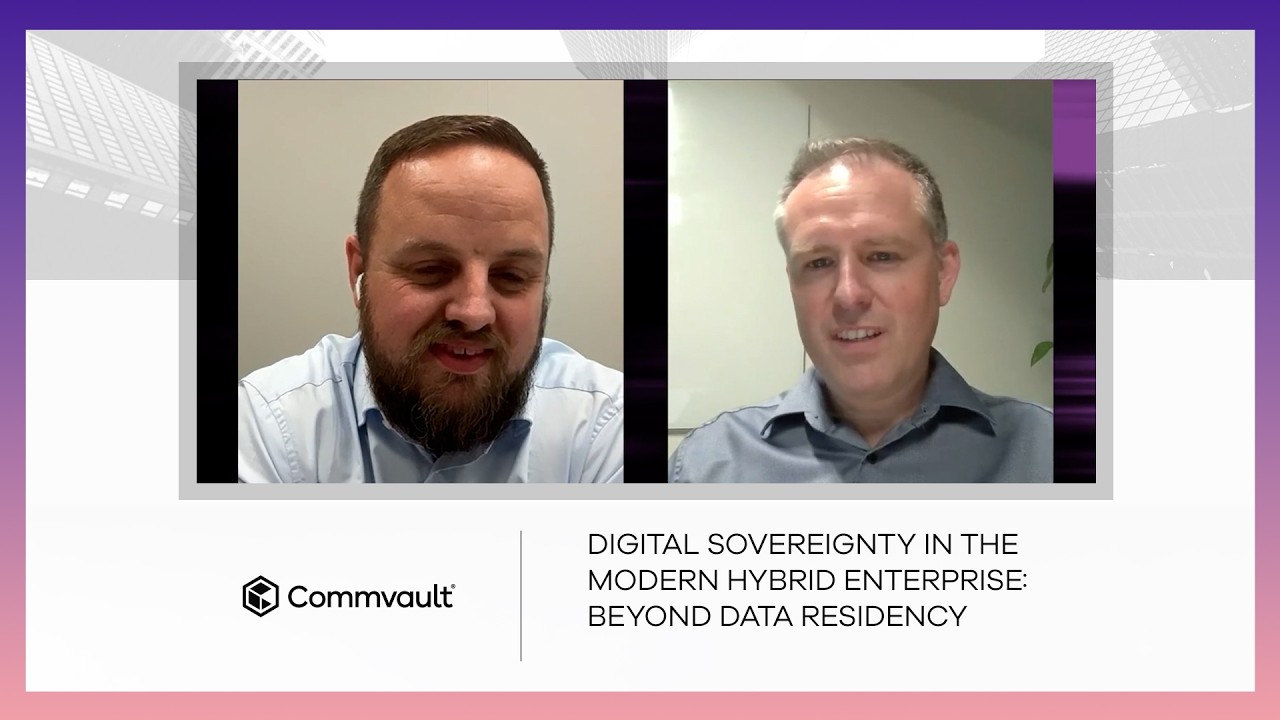
Digital Sovereignty in the Modern Hybrid Enterprise: Beyond Data Residency
Digital sovereignty is becoming a strategic priority. Learn how organizations can match sovereignty controls to workload risk while maintaining hybrid-cloud flexibility, resilience, and innovation.
Sovereignty Fundamentals
Sovereignty is Strategic
Regulation, geopolitics, and cyber threats make sovereignty an executive priority.
Use a Risk-Based Model
Not every workload needs the highest sovereignty level or the same controls.
Balance Hybrid Adoption
Combine public cloud, private cloud, and on-premises environments where requirements demand.
Prove Recovery Readiness
Demonstrate operational control, access governance, and recovery under pressure.
Plan for Change
Build cross-functional practices that keep pace with regulation and technology.
Protect Critical Workloads
Classify applications and place each workload in its right landing zone.
About this session
Digital sovereignty is more than data residency. The conversation is shifting from where data lives to who controls, operates, and can legally access the complete estate. Regulation, geopolitical tension, cyber threats, and cloud governance are making sovereignty a board-level business concern.
A Spectrum of Control
Sovereignty includes data locality, technological control, operational control, and jurisdictional control. Organizations need the level that matches each workload, rather than applying maximum controls everywhere.
Hybrid adoption remains the pragmatic path for many enterprises. Public cloud, private cloud, trusted cloud, and on-premises environments can coexist when workload sensitivity and business continuity objectives guide placement.
From Policy to Proof
Compliance claims must be supported with evidence: access logs, operational controls, recovery capabilities, and a repeatable process that works under pressure.
Sovereignty programs should begin with understanding risk. Teams need to scope applications, untangle dependencies, define ideal states, and build a roadmap in practical waves.
Prepare for the Future
Identity, AI-enabled threats, shifting requirements, and recovery at scale will shape sovereignty programs over the next three years.
Related resources
Digital Sovereignty Policy
A practitioner framework for implementing digital sovereignty strategy.
Unified Cloud Protection
Protect workloads across on-premises, hybrid, and multi-cloud environments.
Resilience Operations
Operationalize measurable recovery readiness across critical services.
Frequently Asked Questions
What is digital sovereignty?
Digital sovereignty is control over where data lives, who accesses it, how systems are operated, and which jurisdictions govern them. Data locality alone is not enough for a complete sovereignty posture.
Why is sovereignty a strategic priority?
Regulation, geopolitical tension, cyber threats, and executive accountability are moving sovereignty beyond a compliance checkbox. Organizations increasingly need to demonstrate control and recoverability across complex hybrid environments.
Do all workloads need maximum sovereignty?
No. A risk-based approach matches sovereignty controls to workload sensitivity, application exposure, industry requirements, and business continuity objectives. Applying the highest level everywhere can add unnecessary cost and complexity.
How should organizations build a sovereignty strategy?
Organizations should scope and classify workloads, analyze dependencies, define target states, and build an implementation roadmap in waves. Each wave should be validated against business value and risk reduction before scaling.
What will challenge sovereignty programs next?
Shifting regulations, rapidly changing technology, identity complexity, AI-enabled threats, and the need to recover at greater speed and scale will challenge organizations over the next three years.
Transcript
View full transcript
Hello. My name is Trevor Renner, and I am a Solutions Director here at Commvault. And today I’m joined by Guardian. Can you start by introducing yourself? What is your current role? How does the topic of digital sovereignty connect to your day to day, operations and responsibilities?
So, Hi. I’m Rose. I’m responsible for private cloud and cyber recovery. CETA is a Belgian, family-owned company founded in 1992. So, we were around for a bit already. Our top line revenue was roughly 1.4 billion. And you can see us as a full one stop shop for it.
We, we go from application development to quality engineering data and AI to digital workplace delivery, cyber security and ultimately, hybrid cloud solutions on advisory services. We operate their own data centers in the Belgium and the Netherlands, and we’re actually currently building a state of the art new one in, in Belgium to service our most critical, customers and the critical industries, which we’re going to cover, a bit more in detail today.
Our, historical playing field is, of course, the Belgium and the Netherlands and Luxembourg. But we grew into European players over the years. And recently, with the acquisition of CTG in the US in 2025, we became a global player today with roughly 9000 employees. And we are active in 17 countries.
And, in those countries, we are not actively I go into markets and all of them, but for example, in Romania and Greece, we are doing shore and in Colombia, and yet we’re doing offshore, which gives us flexibility in, in utilizing the right skills. The right price points depend on the sovereignty needs of our customers.
And since we have been partnering with Commvault since 2012 already and, it’s a design from my personal hands, when I still was, architects and the manager of the banking and switch team. So, good things with Commvault. But that aspect where the disconnects with sovereignty, I’m responsible for Private cloud. So, I try to translate, the abstract sovereignty requirements into a more practical operating model, and services and solutions that meet Ireland’s.
So hefty. When did this topic first land on your desk as a business conversation and the board level discussion, rather than a compliance topic?
Yeah. Basically, that’s what the conversation shifted from where my data list to who actually controls my complete estate. Who operates my estate with all EU regulations, like. Yeah. And then as to the, and, have the evolving, cloud governance discussions that are now ongoing and actually are acting as a catalyst, for that discussion, we see that, that that is kind of driving, the discussion towards a more, more level, discussion specifically with the recent geopolitical tensions rising and the EU cloud and AI Development Act on the horizon.
This discussion significantly shifts from, is just a compliance checkbox, to experience, topic, making it a bottom discussion rather than 90 minutes of trying to fix a problem.
When you look at the market signals that we’re seeing, specifically Gartner, they indicate that about 75% of the organizations by 2030 will have a certain sovereign strategy already developed. And then on top of it, there is an expectation that the EU cloud spend by 2030 is going to hit roughly 170 billion. So, I think an important question needs to be addressed.
Do you really see this as a temporary, something or temporary trend, or is this something that you believe is going to become more like a permanent strategy or a permanent priority for organizations moving forward?
I really think that’s not just a trend that’s more like an ADF. That’s that that’s shifted towards a strategic, priority, specifically in Europe. With the evolving legislation like data, bringing digital sovereignty, more like a compulsory, thing to, to look out for. So besides looking at data locality, we need to look at how, how do we cope with technical sovereignty, how do we cope with operational sovereignty and jurisdictional sovereignty?
So, for me, it’s becoming mainstream in discussion. And I see this every day with the customers we talk with.
I like the fact that you talked about the definitions of technological and operational sovereignty. Maybe for the audience, can you maybe just give your definition on how you define sovereignty internally at sea to and how does it really match with what you’re hearing from customers and what is being defined as part of the regulation?
So second, we’ve always been talking with our customers about it. Right cloud. So, and now it’s time to create the right mix for a cloud user for, I guess, a mix of states. That conversation actually doesn’t change too much. It just shifts. And how we tell it’s, it’s shifted from right clouds to, to the 50 Shades of Sovereignty narrative that we follow it and say, okay, where do we see that?
It’s putting tension on Hyperscalers and say, cloud offering, where Hyperscalers are trying to lobby, to stay in the space where they will eventually remain in compliance with sovereign law within, within Europe. And we as, service providers, seek, for that matter; we already invested heavily in some sovereign technologies in our stack, but not necessarily provide a guard or three compliances today.
But we’re on the journey to do that with our Belgian critical cloud initiative, for example, which targets, public sector financial sector of defense, space and utilities, which are the definition of critical industries. So, we help navigate our customers through regulatory complexities. And that actually then goes out, out into making smart choices in the full spectrum of sovereign cloud offerings that are out there.
And that actually reflects back to the right clouds, that we actually started out with, to start with. So, from saying as you, sovereignty is not binary. It’s not something you need to achieve at the highest sovereignty level as a goal. As such, you just need to make sure that those workloads that require sovereignty get to the point that they are compliant or what the regulatory body needs, or you as a company are accepting, as a risk if something happens in, geopolitics or tightening constraints, at a certain point, monetary success and the challenge is choosing the right one, where it matters most.
Depends on your sensitivity of data to get the quality of application exposure for your particular industry and your business continuity objectives.
So, tell us about the moment that your organization realized that it stopped being theoretical. When did it become a practical conversation?
I don’t think it’s like a singular event. It’s rather like a version of regulatory pressure, specifically in Europe, cyber threats that we now see with frontier AI, being much more, available and therefore posing a risk for, for cyber security postures. And it’s becoming an executive accountability. And that’s reflecting back to the regulatory, pressure.
So simply put, when the organizations need to demonstrate resilience, it’s not simply declaring compliance based on the model and then having somebody sign off a paper or putting a checkbox on a tabletop test. But, really, claiming recovery capabilities, and, and the business continuity plan, you need to prove that you actually can do it, and not just by by doing, like I said, a tabletop test, which is, is is the standard for the last few years for the majority of the, with the customers out there.
So,
The sovereignty team brought everything together in kind of a perfect storm for a service provider as they go. We provide technologies to help with recovering, if there is a need for. And we can sit from the very basic back about recovery capabilities up to a full cyber vault and, isolate, like all the environments, which helps us a lot in answering those questions of our customers.
So, we have a lot of experience in providing managed backup services, where we are ideally positioned to benefit from the market needs that currently arise, but particularly in regulated industries. So, we need to see the significant shift in what we actually need. So, I see a lot of questions revolving out. I did the basics.
Now I need a cyber force. Am I the cyber? But now I need to compulsory, prove that I can actually do a recovery when, when we’re under pressure. So, therefore you need it, and I agree. And that also loops back into some of the, the awareness that we did, with customers, so, so providing general advisory services on business continuity as a process and then link it into cyber, cyber recovery and, explaining how a cyber emergency response time process actually looks like in practice, something that we do.
Right, only with customers.
What do you feel that customers can benefit from the guidance and assistance that you, as an organization, can provide?
All our customers engage; catchments are pivoting around our journey to cyber recovery. It’s a framework we use to engage customers. At any maturity level that they may be at, some customers need to have some awareness, from the executive layer, maybe not.
Not so much the technical or vice versa. Others need help with the BCM part. And others even need to have a solution put in place because they have matured enough that they already have the inputs that we need. So, what we usually try to do with that journey is trying to avoid that. It starts revolving around putting in a technology or a solution early in the conversation, because that’s usually how they get to the service provider and say, okay, you meet your partner; it converts.
So please bring me a solution with a cyber fault. And here, hey, implementation to fix my problem. I have regulations and compliance. That’s the wrong question. You need you need to go to the, through the steps to make sure that you actually are able to provide a solution which fits, to your particular needs.
And that’s what you need to understand. First, you need to scope; you need to analyze. Maybe you need to look at your ideal states and untangle the applications’ entanglements. And to make your strategies solid enough so that I can implement it in a way that doesn’t affect your bottom line too much because it’s not that’s, that cheap to implement such a strategy.
And that actually revolves then into a roadmap, where we start planning into waves and the soft implement thing, and then we get through it again once we validated the first wave, actually provided the, the right output for the business. So, the real business value and that’s not only tactical but also proven to the business that we achieved, of mitigating key risk, on the list and then we iterate.
So typically, such a, framework is, is looped through once to get the big roadmap and get everybody aligned. And then we go in execution mode. And if we, we look at a financial customer for example, that’s, that’s usually a track of 2 to 3 years, to get from, from conceptual phase to full implementation and, and run.
Yeah, you already referred to Qatar or the cloud an E in development Act. Here in Europe. And it’s a regulation that is currently still not in effect. Today. What do you think is going to be the hardest proof to provide and deliver, to explain to the customers board, potentially even your own board of directors or even an auditor that you’re doing the right thing.
So, I think it starts with the fact that sovereignty means something else for everybody and depends on how you look at it and what you need to prove. And at the bottom line, it’s about risk mitigation. It’s no, no longer sufficient to only look at terror data locality of what you did, from a security perspective.
And then these the problem bits, but it doesn’t provide you with the compliance, evidence that you need to face a challenge moving forward. So, if you look at it, from a few businesses, that’s from the sovereignty framework. Then for operational reasons, I think that the challenge there is that’s, how do you prove it’s, and it’s easy if you’re in your company.
You have EU citizens working on your services. You’re a legal entity in the EU, so that’s easy to prove. But yeah, still, you need to, to provide collateral to, to another tax. So you need to provide adequate access logs that are coherent across tax. You need to be able to prove that data access has not been granted, for example, in Irish, inadvertently, to say so, but but you need to provide the proof.
It’s no longer sufficient that you say, we are we are European citizens from an EU country, working on an EU stack for an EU,
company, and then vice versa. And that’s what a lot of them, like isolationists, around Europe. But what about international distance. And there was a similar dynamic there from a technology point of view. It’s more like, how do you put in the plumbing around teleport and compliance?
It’s more like gathering the bombs, the edge bombs, and making sure that we can prove that the long, continuous, what matters. Can we have the content, the CM, continuous compliance, and management framework, which we use for that? But I think it’s quite a bit of, of plumbing, but obviously to get all those data points, approvals and whatnot, visible in, in an environment.
And that comes with technology. For example, if you use AI, okay, there are controls on it, and that comes with an additional burden that’s below its surface. But you need to be able to prove that. Curious. I don’t listen to operations, for example, jurisdictional. Yeah. Basically, it’s a complex structure. So, we do see some, like see that start simple.
We are a Belgian company with a family-owned structure. There’s no foreign capital there. But for other companies, it’s more complex. There might be financial capital in there. So, the majority stake also might be European, or they might not be, depending on the beneficiaries. Vice versa for a company in the US, for example.
Yeah. Do you really trust you for a Chinese company for that matter? So how is that reality resonating for you? And it’s already too complex. So that’s roughly how we look at it.
So, one thing that you called off and it’s just maybe a good nice. No, in France there is something called second cloud and second cloud defines the maximum percentage of an organization that can be owned by a non-France entity or individual. So that’s not something that C is going to have a problem with because your, your family owns now everything is hiring today.
So do you think that managing these, these principles and requirements across these different environments being, you know, public cloud or trusted cloud of private clouds and on prem is going to be harder than basically the requirement itself.
I think multi-cloud environments require a holistic view on the complete environment. So, the challenge there is getting to consolidate all those data points. Which is an additional burden on it teams, especially service providers, which we sell compliance to today. And we no longer only sell technology solutions, or advisory services. Secondly, guarantee and force you to look for technical logical alternatives.
They might not exist yet, or they are not fit for use in enterprise situations. So that also puts some pressure on us, this list with the residual risk. When forced to remain in compliance, for a little long, then the regulator actually would like to, like to adapt to be, if anything, it starts triggering innovation.
So, for example, we are moving to work on vault, Hill Shield. So, for our environments, which is a guard of two compliant environments. But at this point in time kind of is out of reach, that’s not the solution. So, what are we going to do, to solve that for those customers that are consuming compliance cloud services from, from city account for the time being.
We’re still going to work with consoles. But the approach there is that we’re going to try and mitigate, as much as possible, the risks that reflect the kind of framework, but as rules get formalized down the line, it’s not today, but it’s going to be tomorrow. Then that will become an issue and then we will need to look how that we will be able to cope with that, or we will need to get to a point that’s, the best of breed products achieve the stamp from the European Commission based on the rule sets.
Do you believe in taking all of this into account. And do you see organizations consuming technology in the future. Will they lock themselves into a certain sovereign silo. Or will that still be like a hybrid adoption approach like we’ve seen in security? Sometimes it’s okay to accept the risk that they still benefit from hybrid adoption across, you know, the regular Azure platform, your private cloud, on premises, etc.
Or will they say, you know, I need to be at the utmost level. I will consume everything directly from the private cloud.
It’s very enticing. I have to say. I just go for a side of the price and sovereignty, because I know of compliance. But I don’t believe in that model. I think that, looking at, the right cloud, we already discussed, analysis, like, to 50 shades and selecting for your particular workloads, the right landing zone.
So, it’s a hybrid adoption for sure, in my opinion. Not all workloads require the same degree of sovereignty. And today, sovereignty still comes with a premium. So, it’s also a financial driver here to not just go all in on a silo, which provides you with the ISO ready, degree out there. Therefore, a risk-based categorization of your business applications, will will define where your workloads should set a functional level and that kind of low band, the choice of cloud, looking at that, there will be a need for guidance for customers, to, to understand because every the everybody puts sovereign stamp on their cards.
And the only question is, is it really the level or the shades of sovereignty that the customer needs for this particular application? Yes or no. And there’s guidance in a term. So, on another level and such an application architecture will also be built, with much more consideration for portability, I assume. And secondly, that are not in scope, strictly speaking, from a regulation point of view, they will become in scope down the line.
I really believe that the architect, he is architecting the replatforming or even retiring or full applications makes sense ahead of, that curve coming.
First of all, great that you talk about refactoring and replatforming and basically adopting new applications or structures and structures. And one of the following questions that I have is when an organization needs to move forward towards creativity through sovereignty or a higher level. Do you think that it comes at the expense of innovation, or can they still innovate in the same space or at the same time?
Yeah. Speeds as well as still retain full control throughout the entire cycle.
some companies, due to the imminent regulatory pressure, and they will see some slowdown in innovation. Because the ecosystem maturity is just not there yet. But there’s a lot of sense of urgency. Yeah. That that fails innovation to kind of, bridge that gap, that that’s currently seen. So, I’m quite confident that the industry will catch up quickly, because it’s a full continent that’s kind of forced, to become compliant, basically.
So that puts the wheels in motion quickly. In the meantime, the pragmatic approach is, is what we advise. And that’s also, a common place, for some time, I think, they always say necessity is the mother of invention or dare I say, innovation in this case, even.
So, three years from now, what will be the biggest challenge to overcome?
Let me think. I think it will be a fact that requirements keep shifting at an increasing pace. Just like technology advancements. Keep shifting, almost on a day-to-day basis right now, if you look at that, what happens in, in the AI space, and then building a cross-functional practice that keeps the pace of this innovation, I think that’s going to be key.
To overcome those challenges. If I needed to name two, two challenges to overcome, that would be one. So, from my point of view, then it would be identity. So, trying to get rid of those closed standards is tricky, at least not in a real scenario, too. Like although like an identity and an honorary and then bolt on the application again without breaking things.
I’ll bring in another identity, an application for which you don’t need to, yeah. Wiring those new identities and existing, access and permission scheme. And then the second, challenge. The thing is what I think of it itself, as I mentioned before, I threaten, and they are threatening the, the pyramid today, and, the text, response capabilities.
But, if they are getting hit faster, then we will need to be able to faster. And the more and the larger scale, start doing process recovery activities, which are complex, to put in place. So, we will also need, first, the AI capabilities in the future to keep pace with those AI trends that are currently more focused on, holding, circumventing the security measures that companies put in place.
So that’s the two challenges I think that we should overcome, specifically in the short term.
Yeah. Well, I think first of all, thank you for your insights. It was really beneficial to see and get your view on it. I can imagine that you might still have a question for me as well. So, I do want to give you the opportunity to ask for it.
Yeah. Thank you. Reuben. So, I actually have one, so I would slightly like to challenge the market a bit on the assumption that every organization needs to have the highest sovereignty level. So, I was wondering, what is your personal and common stake in this?
Well, first of all, it’s a good question, and we already partially answered it. So, you talk about 50 Shades of sovereignty on the single side. We see something similar. The only difference is that we call it the spectrum. So, a spectrum of degrees of sovereignty, where we recognize as a global company sovereignty is something that lives everywhere, not only in the Netherlands or a bunch of, but in Europe, but also in Canada and then other, other geographies around the world.
So, we start with data residency being, you know, the foundational approach about, you know, I know where my data is, but it’s still being managed by an American company or is accessible. We might debate if that is sovereign, that we can, I think, agree to that. Just like, you know, the foundation of where everything starts. And then from that perspective, we also look into regional sovereignty.
We investigate national sovereignty, where we really want to rely on our service providers. To your point, the sake of being a family-owned organization. That actually puts a lot of checkboxes there. So, for the sovereign conversation on the Commvault side, we really want to put our service provider front and center in that strategy. And then of course, we always have to recognize that certain organizations have more strict requirements.
We talked about private, sovereign, lots of private sovereign environments, which is basically a little bit going back into the possible dark side deployments and where the customer operates and manages everything themselves, or they appoint an operating partner. So, from that perspective, we have those different degrees of sovereignty, which aligns with basically your 50 shades of, gray or 50 shades of sovereignty, principle.
And on top of it, and we’ve talked about it as well, is, there is a premium, and you might not want to pay the premium for everything. So, we strongly believe that organizations eventually will develop a practice that will define minimum viable sovereignty, requirements that route mapping to where the data can live.
So, thank you for your insight. And thank you for the opportunity to have this chat with you.
You’re welcome. It was really helpful. Thank you for your time.