ON-DEMAND SESSION
The Long View
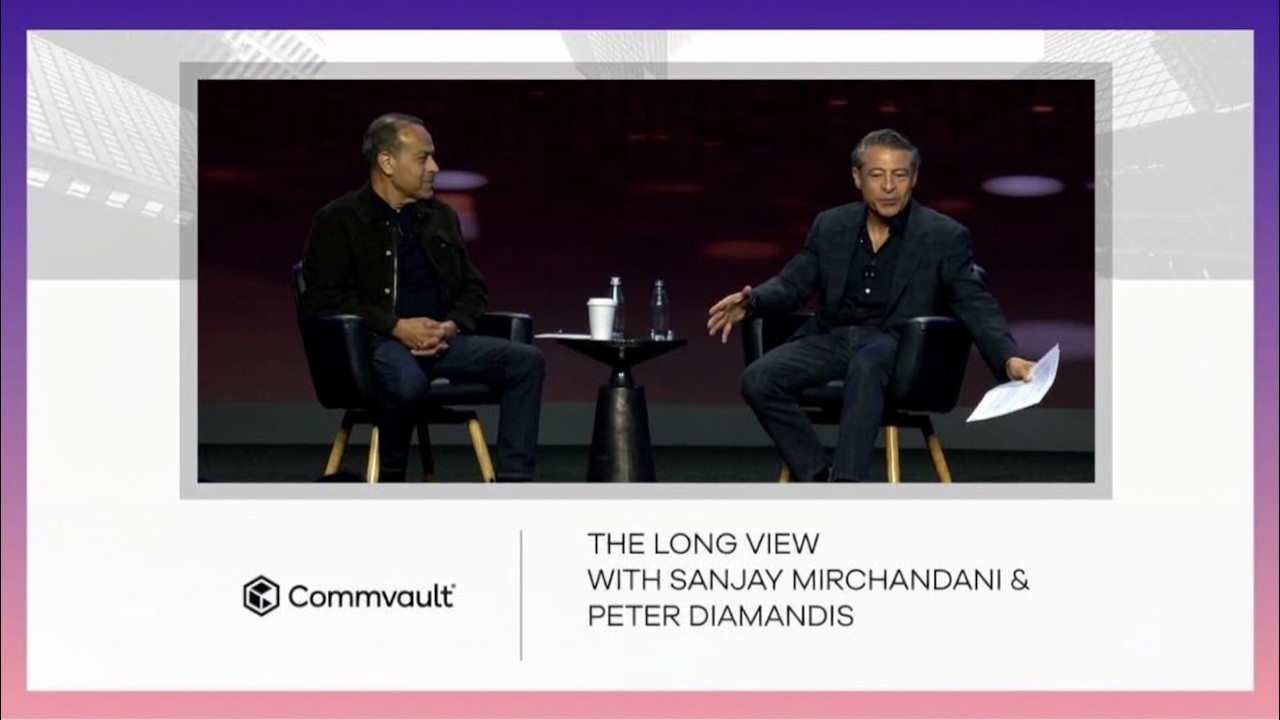
Sanjay Mirchandani and Peter Diamandis explore how AI, rapid recovery, defensive co-scaling, and faster learning can help businesses adapt and reinvent.
Key Takeaways
Resilience Creates Advantage
Adapt, recover, and reinvent faster as AI changes traditional sources of differentiation.
Use AI to Defend
Advanced models can analyze code, identify weaknesses, and support rapid recovery.
Build Faster Learning Loops
Rapid iteration helps organizations improve operations and keep pace with change.
Design for Rapid Recovery
Accept disruption as inevitable and build systems that can reboot and recover quickly.
Reinvent at the Edge
Test new digital workflows separately before moving successful models into core operations.
Keep Humans in Control
Human judgment, taste, governance, and oversight remain essential as AI adoption grows.
About This Session
AI is reshaping the advantages businesses spent years building, from intellectual property and data to brand and supply chains. Commvault CEO Sanjay Mirchandani and entrepreneur Peter Diamandis discuss why resilience, rapid recovery, and reinvention can become durable sources of advantage as advanced AI capabilities become broadly available.
Resilience as an Advantage
Organizations can compete by adapting and recovering faster than their peers. Peter argues that optimism and problem-solving matter because AI and other exponential technologies are expanding humanity’s ability to address complex challenges.
As AI makes expertise more abundant, an organization’s speed of reinvention becomes a critical source of differentiation. Defensive co-scaling uses advanced AI to find weaknesses, improve code, and strengthen the ability to recover rapidly.
Build Rapid Learning Loops
Companies need to retrain people, rethink operations, and iterate continuously. Faster learning loops help teams test new approaches, improve workflows, and respond as technology changes.
Rapid recovery should be designed into systems because preventing every failure is impractical. Teams can validate digital workflows at the edge before replacing slower processes in the core business.
Reinvent With Guardrails
Governance and human oversight remain essential as organizations adopt AI and pair experimentation with continuous discovery and recovery.
Related Resources
AI Resilience
Protect AI data and infrastructure against emerging threats.
AI Recovery
See how clean recovery supports resilience for AI workloads.
How Can Generative AI Be Used in Cybersecurity and Cyber Resilience?
Learn why rapid recovery supports innovation and business velocity.
Frequently Asked Questions
Why can resilience become a competitive advantage?
As AI makes code, expertise, and capabilities more accessible, traditional advantages may become easier to reproduce. Organizations can differentiate through how quickly they adapt, recover, learn, and reinvent their operations.
What is defensive co-scaling?
Defensive co-scaling means using advanced AI models to review code, identify weaknesses, strengthen defenses, and support rapid recovery. It applies AI capabilities to help defenders keep pace with AI-enabled threats.
What is a company’s metabolic rate?
A company’s metabolic rate is the speed at which it can learn, innovate, and reinvent itself. Faster learning loops and workflow experimentation help organizations respond to changing technology and competitive pressure.
Why should systems be designed for rapid recovery?
Preventing every failure is unrealistic. Systems designed to reboot or recover from a known-good state can reduce disruption and help organizations resume operations faster after cyber incidents or technology failures.
What role do humans play in AI-driven operations?
Humans continue to provide judgment, taste, accountability, governance, and oversight. Organizations need clear guardrails and decision rights as they move more workflows to AI-supported digital operations.
Transcript
See full transcript
Welcome back. How’s everybody doing today? Day two is always rougher.
Not too many empty seats. I’m going to take it as we had a good evening. Okay, so yesterday we talked a lot about resilience. And we talked about protecting the business, recovering faster, being ready for whatever comes next.
Today we’re going to turn up the volume a little bit. And we’re going to have a chance to get in the room with experts. You’re going to see things. You’re going to feel things and you’re going to ask them your toughest questions. See our AI Recovery in action. Everything we talk about, you’re going to be able to see it. Get your hands on it.
But first I want to step back. Because AI isn’t simply changing technology. It’s changing the durable advantage you’ve built for your businesses over the years. Your brand, your intellectual property, your supply chain, or your data. And these advantages that were once very hard to build and replicate, in the AI era I’m not sure we could say that anymore. Not without some good thought.
And so in the AI era, I believe that resilience will become your new competitive advantage and to enable you to adapt faster, recover faster, and reinvent faster than anyone else. And I can’t think of a better person to explore what that means than our next guest.
Named by Fortune, one of the World’s 50 Greatest Leaders, Peter Diamandis is Founder and Executive chairman of XPRIZE Foundation and the Executive Founder of Singularity University.
Along the way, Peter’s also started more than 25 companies in the health tech space, venture capital and education, and co-founded two venture funds, Bold Capital Partners and Exponential Ventures. At the moment when AI is changing how we lead and protect what matters most. There’s no one I’d rather speak with. Please join me in welcoming Peter on stage.
Welcome, please. Thank you. Thank you. Good morning everybody.
Bright and early.
We’re gonna have some fun.
Absolutely.
They gave me cards. They think I’m going to read. Okay. All right, so, let me try one of these. So, Peter, so much of the news, about AI tends to be ominous.
Yeah, right.
New threats, agents attacking agents, bigger blast radius. Name it. You’ve been a little optimistic about all this.
I have been.
Why?
So, first of all, I have to remember that the news media and all media have one business model delivering your eyes to their advertisers. And so if it bleeds, it leads. Negative news sells far better than anything else. And the challenge is that they’re not ever delivering all of the good things that are going on. You know, AI today and all the exponential technologies that wrap around it from robotics, sensors, networks and so forth are giving us godlike capabilities.
You know, we’re omniscient, we’re omnipotent, we’re omnipresent. The entire planet, I wrote a book back in 2012 called Abundance: The Future Is Better Than You Think. Ray Kurzweil was my mentor. We spent a lot of time on this looking that technology is the only thing that takes what was scarce and makes it abundant for humanity.
And we’re seeing this across the board. We’re uplifting every man, woman, and child on the planet. So, you know, for me, what is being enabled is the complete reinvention of healthcare. I spent half my life in longevity, I think that we’re on the verge of what’s called longevity escape velocity. This is the ability to add 30, 40, 50 healthy years on your life.
And what’s more important than that? I’m focused on reinvention, reinventing education next, and so forth. But at the end of the day, what we humans do best is we find and we solve problems. And that’s what AI is enabling us to do to detect problems and solve them. We also have another attribute which is we tend to see problems way in the future.
We bring them all the way to today and we freak out. But we forget that between now and the intercepting that problem. People start working on it, you know, capitalism, entrepreneurship starts attacking it. And new technologies are coming online and inevitably we solve the problems. And for me, the more entrepreneurs in the world, the more people solving problems. And the world is getting better at a measurable rate.
So you’re still optimistic?
I’m still optimistic. Okay. Excited. I mean, this is the most insane time. We’re living in the singularity right now. I mean, I hope you realize this magical moment. Right now, Ray called it, in the late 2020s, we’d hit AGI. He called singularity 2045, I think, where it’s a smooth curve and we’re in the middle of it today.
Sure, sure.
So I’m going to I’m going to focus on what we spent yesterday about and today which is until today when you think of cyberattacks and attackers, they’ve historically had the advantage. And I’m often quoted saying, you know, we have to be right 100% of the time. They have to be right. One.
Yeah, exactly.
And at least in the near term, you believe in, what I’ve read, that we have a level playing field.
We have an advantage. Playing field even.
Okay. Even better. Okay.
Yeah. I mean, so first of all, the rate of exploitation is increased. The numbers are pretty dramatic in that regard. But what we have to our advantage is defensive co-scaling. It’s the only thing that is critically important. And today, the, you know, the frontier Labs, at least by my analysis, we saw 3.1 that came out that closed the gap somewhat.
But we’re in a situation where we have in the Frontier labs, the US Frontier Labs, we have a 4 to 5 month advantage over the open source models. And we’ve been holding that for a relative period of time. And the people I speak to believe we’re going to continue to hold that advantage. So getting access through, you know, trusted partner programs to these frontier models and then being smart about how you’re using this AI to protect yourself and for rapid recovery, is the game. Now, the institution, the organization, the company needs to sort of, say, re-evolve itself to take advantage of what we have.
Right? You can’t do things the way we used to.
Right. And that was sort of my opening comment as well, which is the bigger question, is AI’s making code, expertise, capability, speed available to everyone. And if everyone has access to similar AI capabilities, where does an enterprise competitive advantage come from and stay?
Well, it’s going to come again. I don’t think that the black hats have advantage, have access to the level of frontier labs that you do, that some hopefully many of you do here. So there is that advantage. I think the other advantage is going to need to come from the people in your organization. You know, I was having a conversation with Eric Schmidt on my moonshots podcast about this, and he said, the single most important thing right now is what he calls learning loops, very rapidly iterating and reinventing how your operations are being run.
So I think in retraining the humans in building out defensive co-scaling with the best frontier models, looking retrospectively to repair what exists from, God knows, 60 years of human error injection and planning for rapid recovery which is your business, I think is critically important.
I’ll give you a very quick example. I used to run an asteroid mining company. Crazy story. We had two launch failures, and the company didn’t make it, but we were building deep space spacecraft that would be in space for many months as they were going to prospect asteroids. And the biggest problem there was cosmic rays and single event upsets of the software. We had two choices.
Either we like, coat the damn thing in lead and try and protect against it, which was expensive and impractical. Or we set up a system where it had very rapid reboot. We knew we were going to be hit by cosmic rays, and we set it up so it could reboot rapidly and do very rapid recovery. And that’s ultimately the only thing that can really work.
I’m going to just step for a second, go back to co-scale. Yeah. Could you share a little bit about your thoughts on what that is? I’m not sure. Everybody here knows.
Well, defensive co-scaling means using the most advanced models and utilizing them to basically review your code base. And basically what ExploitBench has given us to identify the challenges that you have inherent, like what OpenAI did with PHP. Fixing those critically, but also standing up the ability to rapidly recover on your systems.
It’s using the highest level AI as the white hat to defend against the black hat. It’s the only thing that is going to give us the level of security. Yeah, yeah.
So, that’s a nice transition to what you call the metabolic rate.
The metabolic rate of a company. Yeah. And the speed at which an enterprise adapts. So we believe recovery is one of those critical advantages and pivots. What other examples or changes can you share with the attendees on what that means?
Yeah. So the metabolic rate of your company is how rapidly are you able and willing to reinvent yourself? It’s a fundamental importance. The only moat, and we can talk about moats as well, that you have, is how rapidly you’re reinventing yourself against the competition. So as a leader in your company, one of my favorite sayings is that day before something is truly a breakthrough, it’s a crazy idea.
If it wasn’t a crazy idea yesterday, it would not be a breakthrough today. It would be a planned incremental improvement. So where inside your organization are you trying and iterating on crazy ideas? This is what Astro Teller at Google and the Moonshots Factory talks about often. So, companies that have traditional workflows are going to have to basically build at the edge with full agentic workflows where you take a series of your normal workflows and tasks and so forth that you duplicate.
You duplicate them digitally on the edge of the organization. You make sure they’re working. You retire those workflows in the main corporate, and you move over workflow after workflow after workflow. And that’s the way you speed up your processes, making sure you have the proper, governance structure in there, the right humans in the loop. Humans, by the way, we’re talking about this backstage are still the weak point in the system.
And that’s really tough right? What we saw with Binance, a guy with a laptop. How many, six billion was it? That’s what they said. Crazy. Yeah. So that’s a whole other set of defensive co-scaling. How do you make sure we’ve got the right protections supporting you?
Yesterday we talked at length about continuous discovery, continuous detection, continuous recovery.
That’s defensive.
And that’s where we need to sort of get to. And you believe based on you giving the example of processes and how companies need to evolve that AI at its full might is going to really be is that going to be a crazy idea? Or is it going to be a breakthrough idea?
I think it’s going to be a baseline idea. I think ultimately, every company may not be the most popular thing, is going to migrate a significant amount of its operations over to a digital edge. The size of companies will probably reduce in size as that occurs. Humans are still going to be in the loop to provide judgment, to provide taste, to provide oversight.
And companies will also spark hundreds of spin out companies. Right. So I’m not worried about the job market right now. I am thinking that companies are going to have to transition to, again, a new metabolism, a new speed. You know what Eric Schmidt called learning loops? How rapidly are you able to learn and innovate? And one of the challenges, if I could, is the whole concept of immune systems.
Every company, if you’re trying to do something radically different inside your company, there’s an immune system that will kill that effort to do something radically different. I’ve had that in companies of 50 people I’ve run, and 100 people have run, isn’t just large companies. So the only way that you truly innovate in sort of like a moonshot factory mindset is the CEO puts a small team on the side and says, I want you to do things that are crazy and 10x bigger.
The main company you stay, you generate the profit, you do what you do. So when Steve Jobs started the Mac, he put a team with him in a building far from Apple headquarters, flew a pirate flag over it and said leave us alone. But when the product was then developed, moved it back into the mothership, right.
Same thing with Lockheed Skunkworks and such.
Sure, sure. Yeah, we’ve seen that happen. So, one final question. Yeah. If AI gives us all access to capabilities that were once scarce.
Say again.
If AI gives us all access to capabilities that were once scarce, what qualities are going to matter most to thrive in this in the future?
So I think, again, it’s the speed at which your company can innovate is probably the single greatest defense you have. If you’re ossified and you’re not changing and you’re scared about protecting what you’ve had, that’s not going to last. AI is able to, if you ask yourself. Okay, our core products and so forth, could a small team with the highest level AI reproduce what we currently are doing?
If the answer is yes, you’re in trouble. And unfortunately, increasingly, we’re investing $2.5 billion a day in AI. We’ve seen task lengths go from a few hours to 17 hours. Over the last 18 months, we’ve seen the speed at which Anthropic is moving, you know, go 1.9x faster than it was just, you know, six months ago.
And we’re seeing, we’re in the midst of RSI. We’re here at 90% of Anthropic’s code, soon 100%, and I don’t think we’ve actually seen the hard takeoff yet that we probably will see.
Incredible. You know, I want to say thank you on behalf of all of us, your optimism, your energy is amazing.
And I just want to I want to end with that. I want to remind us that these tools are giving us the ability to solve humanity’s greatest problems. We’re heading towards this world of abundance, and that’s my mission. You know two things. One, to minimize fear. Fear is a terrible place to face the future from. It puts you back on your haunches. You’re not absorbing information.
And the second thing is we have the ability to provide every man, woman, and child on this planet all the food, water, energy, healthcare, education that they want. And that’s a world that is safer. That’s a world that’s more peaceful at the end of the day.
Do we have challenges to navigate? 100%. But I have great faith in humanity.
Wonderful. Well, thank you for joining us.
Thank you, Sanjay.
Thank you.