Protected Unified AI Data Resilience
Commvault Cloud helps deliver end-to-end resilience for enterprise AI stacks — helping protect data lakes, vector databases, models, and supported compute environments against data poisoning, adversarial prompts, and runtime attacks. It provides AI-enabled threat detection, composite cleanpoint-based recovery, and governed data access controls so organizations can scale AI adoption while helping reduce unmanaged data security risk.
-

100,000+ customers worldwide
-

15x Leader in Gartner Magic Quadrant
-

SOC 2, ISO, FedRAMP Class D (High) Certified

01 Executive summary
Agentic AI raises new risk
Enterprise AI adoption is accelerating — and so is the attack surface. Data poisoning can corrupt model outputs before anyone notices. Adversarial prompts can exploit agent access at runtime. MCP connectors expand agentic reach across systems that may not have been built with security boundaries in mind. Sensitive training data can fall outside existing governance once it enters AI pipelines or analytics platforms.
Commvault Cloud helps address these failure modes with protection across the supported AI data, models, compute, and agentic workflows. It combines AI-enabled threat detection, composite cleanpoint-based recovery, governed data rooms for protected data activation, and MCP Server integration for controlled agentic access — all within a unified policy framework designed to support NIST AI Risk Management Framework alignment.
This whitepaper provides the architectural and operational approach enterprises need to scale AI confidently without sacrificing resilience or governance.
02 the challenge
AI expands the blast radius
AI changes how attacks land and how recovery works. Organizations need AI-enabled resilience, governance, and clean recovery across hybrid AI stacks.

Runtime attacks break trust
When adversarial prompts, runtime attacks, or hallucinations alter AI outputs, organizations can’t tell what changed or when. Production integrity requires controls that monitor and verify AI interactions before compromise compounds.

Poisoned data corrupts models
When training data or models are compromised, issues often go undetected until outputs begin to drift. Preventing this requires validation, versioning, and the ability to roll back to trusted states.

Agentic supply chain exposure
MCP connectors and AI agents expand access paths faster than security teams can map them. Without governed integrations, least-privilege controls, and audit trails across orchestrations, each new agent can create additional unmanaged access risk.

Sensitive data escapes governance
Once sensitive data enters AI systems, analytics platforms, or SaaS applications, governance can become harder to maintain. Maintaining control requires policy-based access, time-bound sharing, and consistent enforcement across environments.

Hybrid sprawl kills visibility
Data, models, and vector stores are distributed across clouds and platforms, creating fragmented visibility. Without unified governance and oversight, organizations lack confidence in what can be trusted.

Clean recovery is too slow
After a compromise, it is often unclear what changed and what remains trustworthy. Recovery efforts are delayed without verified clean recovery points and automated workflows.
03 the solution
Unify resilience across supported AI workflows
Commvault Cloud Unity helps protect AI data, models, and pipelines end-to-end—so you can help detect potential compromise, govern access, and support faster clean recovery workflows.

End-to-end supported stack protection, scaled
Help protect data lakes, vector stores, models, and compute across hybrid environments with policy controls, versioning, and rollback to trusted recovery points.

AI-enabled detection and clean recovery
Help detect anomalies and malware in backups, identify trusted recovery points, and automate synthetic recovery to support faster, cleaner recovery while helping reduce reinfection risk.

Governed AI extensions, integrated
Use Data Activate and MCP Server to connect AI ecosystems with least privilege, audit trails, and time-bound sharing while helping reduce operational silos.
04 Technical Architecture
Commvault Cloud unifies protection, detection, recovery, and governed AI extensions—connecting AI data, models, and pipelines with AI-enabled resilience across supported hybrid environments.
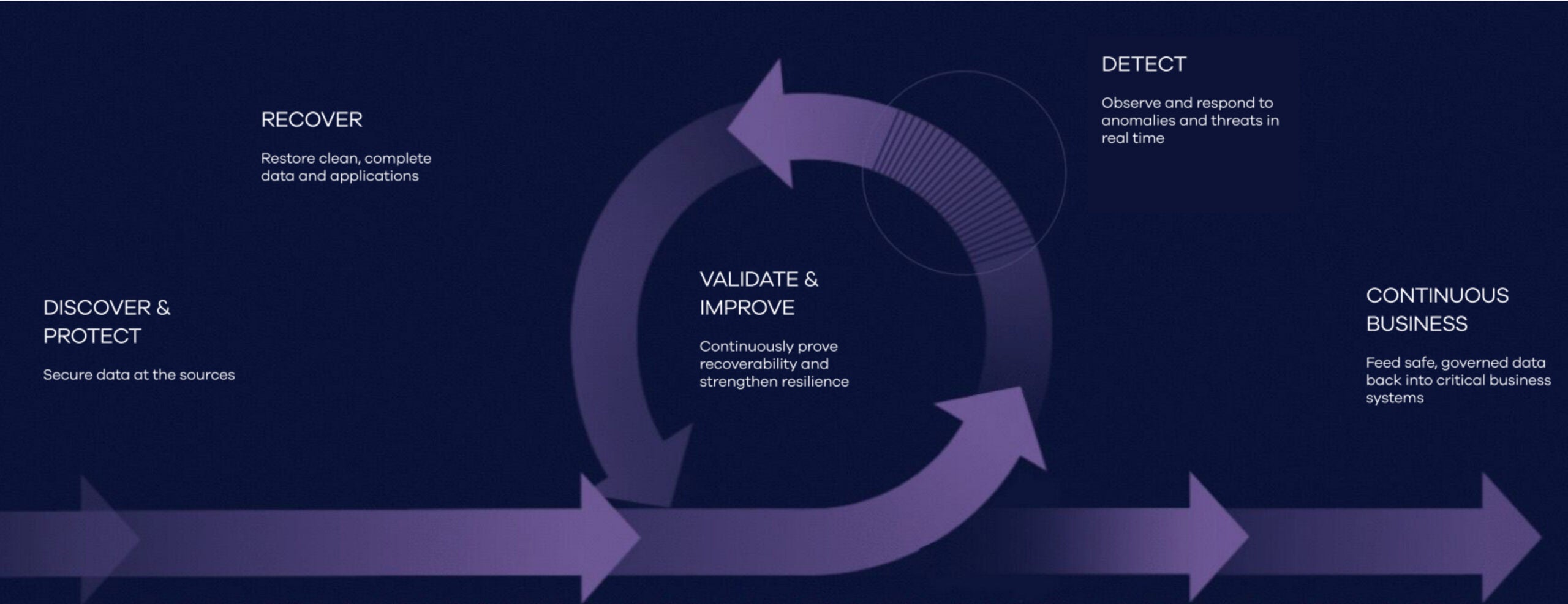
Data Security
AI-enabled threat and anomaly detection across environments
Threat scanning and threat hunting for protected data
Composite cleanpoints and synthetic recovery to support verified restore
Role-based access controls with auditability for actions and APIs
Policy-based control for sensitive data access across AI workflows
Platform
End-to-end AI workload protection for data, vector stores, models, and compute
MCP Server integration for agentic automation via approved APIs
Data Activate for governed data activation to enterprise data lakes
Active Insights for AI-enabled workflows: resilience insights, policy recommendations, recovery guidance
Unified visibility across supported hybrid AI stacks through a common control plane
05 the benefits

Help protect supported AI workflows
Backup and recovery for data lakes, vector retrieval systems, unified data & AI platforms, and supported compute & DevOps—across hybrid environments with consistent policy controls.

Support trusted recovery points
Rebuild recovery points using AI-enabled composite cleanpoints and automated recovery—helping teams return AI workloads to trusted recovery points with less rework.

Help surface AI-era threat signals
Use AI-enabled threat scanning and anomaly detection to spot unusual patterns, encryption signals, and access anomalies—helping identify potentially compromised data before recovery begins.

Operationalize resilience with agents
Enable an agentic automation foundation with Arlie Active Insights — to recommend protections, surface insights, and guide clean recovery actions.

Connect agents via MCP Server
Integrate intelligent agentic workflows using open standards like MCP, orchestrating approved actions through APIs across hybrid environments through existing control plane.

Govern sensitive data access
Use Data Activate plus sensitive data discovery & classification and policy-based controls to help govern access across AI and analytics workflows—supporting compliance, auditability, and integrity objectives.
06 Compliance & Certifications

SOC 2 Type II
Third-party audit of Commvault Cloud controls for security, availability, and confidentiality.

ISO/IEC 27001:2013
ISMS certification supporting Commvault Cloud data security governance and risk management.
FedRAMP Class D (High) Certified
(Commvault Cloud for Government) — Authorized cloud service for U.S. federal high-impact workloads.
FIPS 140-2 validated crypto module
(Commvault Crypto Library) — Validated cryptography module for approved encryption use.
GovRAMP High Authorized
(Commvault Cloud for Government) — U.S. State/local public-sector authorization alignment.
07 Conclusion
AI introduces attack surfaces that traditional resilience approaches may not fully address, including data poisoning, adversarial prompts, agentic supply chain exposure, and runtime integrity failures. Commvault provides unified protection, detection, governed access, and clean recovery capabilities designed to help organizations adopt AI at scale, support containment and help restore trust after compromise.

Responsible AI, Built In
Scale AI with reliability, transparency, and human oversight—designed to support NIST AI RMF alignment and help teams maintain control, privacy, and security.
Read now
Support Governed Agentic Automation
Use Commvault’s MCP server to connect trusted automation to resilience operations—while helping preserve governance, RBAC controls, and auditability across supported hybrid environments.
Read the docs
08 FAQ
Frequently Asked Questions
What does “protect AI platforms” mean?
Commvault doesn’t replace enterprise AI platforms — it helps protect the data, models, configurations and software workloads those platforms depend on. When adversarial prompts, data poisoning, or runtime corruption occur, Commvault helps detect, contain, and recover the supported AI stack to trusted recovery points.
What AI stack is protected?
Commvault Cloud Unity helps protect supported AI application environments, including: data pipelines, data lakes and distributed file systems, search and vector retrieval systems, models, and supporting compute/DevOps environments—across on-prem, cloud, and edge with unified policy controls.
How does clean recovery work?
When compromise occurs, Commvault uses AI-enabled composite cleanpoints and Synthetic Recovery to analyze multiple backup versions, help identify cleaner recovery points and assemble a curated recovery point—helping reduce reinfection risk and minimize data reversion.
How does AI governance apply?
Governance applies through policy-based controls and protected data extensibility. Data Activate creates a governed workspace to prepare and share data using encryption, role-based access, immutability, and time-bound sharing—supporting compliance-oriented AI and analytics access.
How do MCP and agents help?
MCP Server and the Agent Library enable AI-enabled automation through approved APIs, aligned to existing identity and RBAC permissions. Agents recommend protection strategies, assist recovery point selection, and guide restoration—while helping preserve governance, auditability, and human oversight.
Who uses this platform?
CIOs, CISOs, and Heads of Data/AI Strategy use it to unify resilience and governance. SecOps gains AI-enabled threat and anomaly signals; ITOps gets clean recovery automation; data and AI teams extend trusted data via Data Activate and integrations.
Explore related resources
Explore more Microsoft 365 and cloud data protection content.

Help Protect and Leverage AI with Commvault
The 6 Most Important Considerations for Developing Your AI Strategy