Clumio Cloud Recover Capability
Built for Cloud Developers
Protection declared in code. Recovery an agent can run.

See it work
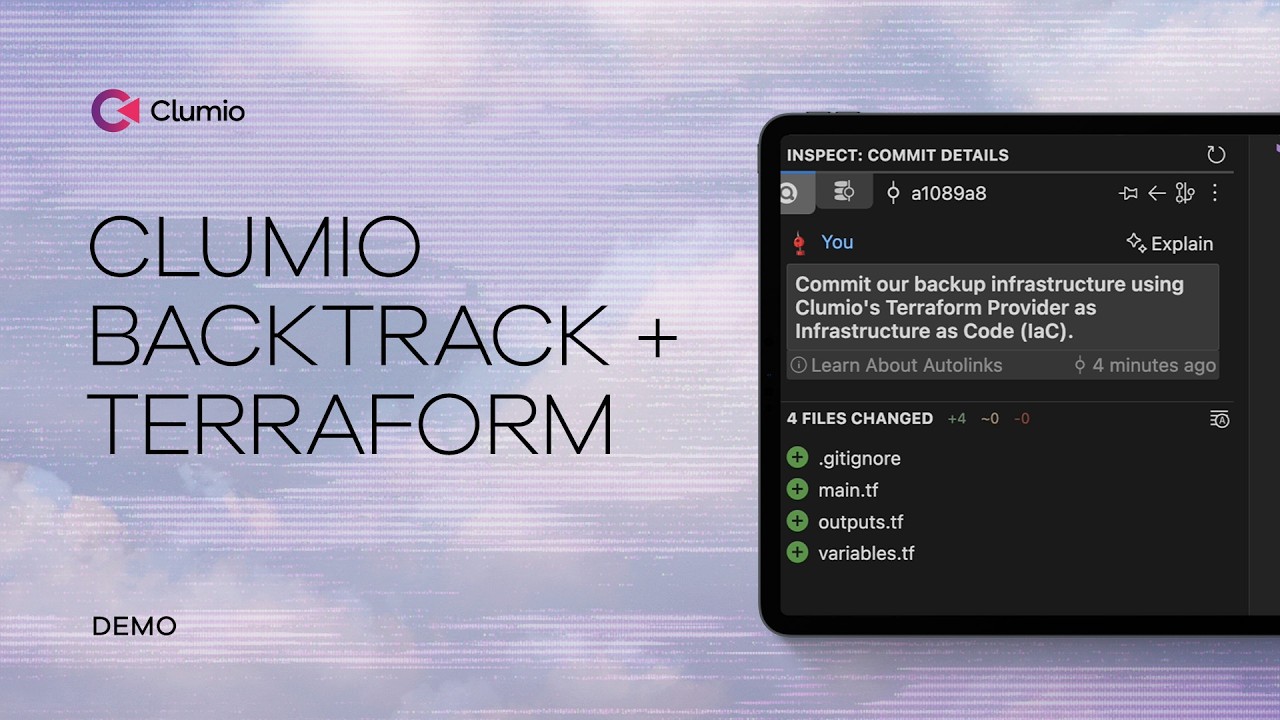
From Terraform plan to recovery
Watch protection declared in code, a restore triggered by API, and an agent running recovery through MCP.
Why it matters
Capability Benefits
Recovery designed to work the way cloud and platform engineers already work.

Protection lives next to the infrastructure
An official Terraform provider and CloudFormation templates; policies in version control, reviewed like code.

Every workflow without a console
A public REST API for protection and recovery; the console is an option, never a requirement.

Recovery your agents can run
A native MCP server lets agents interact with recovery operations through a standard interface.

Fits the CI/CD you already have
Trigger restores from a pipeline or runbook and poll the task until it completes.

Help protect new resources automatically
Policy-driven protection follows accounts and resources as they appear, with no ticket.

Nothing to deploy or patch
Serverless and agentless, so you adopt it like any cloud service, through AWS Marketplace.
Analyst report
Architecting Cloud Data Resilience
MIT Technology Review Insights on why cloud data needs cloud-native backup, air-gapping and immutability.

How it works
Capability Features
Official Terraform provider
Declare policies, protection groups and connections as code, in the registry today.
Public REST API
Protection, restore and task endpoints for every supported workload, documented.
MCP server for AI agents
A standardized interface designed so agents can interact with recovery operations.

Related to this capability
ai recovery Solution
Clumio CloudRecover
Recovery built for the cloud. Proven at scale. Ready for AI.

In-place rollback at cloud scale
Designed to return billions of objects to a point in time, before the damage, with no extra copies.
Learn more
Threat and ransomware detection
One verdict on every backup, with the evidence behind it.
Learn more
Air-gapped, immutable protection
Every copy isolated, immutable, and outside your account’s reach.
Learn moreUser documentation
Recovery in your pipeline
Terraform onboarding, API tokens, and the REST reference for scripting protection and recovery.

Our Reach
Supporting more than 100,000 companies
Trusted by teams that automate everything, including recovery.






“We are saving at least one full-time employee by using Clumio. ”

“Clumio does not consume any resources, and it does not affect our infrastructure. Yet it grows as much as we need it to. As much as our data grows, Clumio will serve that purpose. ”
Frequently Asked Questions
Can we automate CloudRecover from code or AI agents?
Yes. CloudRecover is API-first, with an official Terraform provider for infrastructure as code and support for the Model Context Protocol designed so AI agents can interact with recovery operations through a standardized interface. The console is an option, not a requirement.
Do we ever need to open the console?
Not to protect or recover. Policies, protection groups and account connections can be declared in Terraform or CloudFormation; backups and restores can be driven through the REST API and tracked as tasks. The console remains available for teams that prefer it.
What can an AI agent do through the MCP server?
The MCP server gives agents a standardized, interface to recovery operations, so recovery can be incorporated into agent-driven workflows alongside the APIs, infrastructure as code and pipelines teams already use. MCP support is generally available in December 2026.
Which infrastructure-as-code tools are supported?
An official Terraform provider is published in the Terraform Registry (Commvault is a HashiCorp Select partner), and CloudFormation templates are provided for account onboarding, including AWS Organizations deployments across accounts and regions.
Is the API documented?
Yes. The REST API reference is public at developers.clumio.com and covers protection, restore and task operations for supported workloads, with examples. Some features are available through the API only on request; the documentation says which.
Data Risk Assessment
Are your cloud workloads at risk?
CloudRecover helps you find and fix data vulnerabilities before attackers do. Get a CloudRecover Data Risk Assessment to uncover risks in your cloud environment and gain a roadmap to stronger resilience.
