ON-DEMAND SESSION
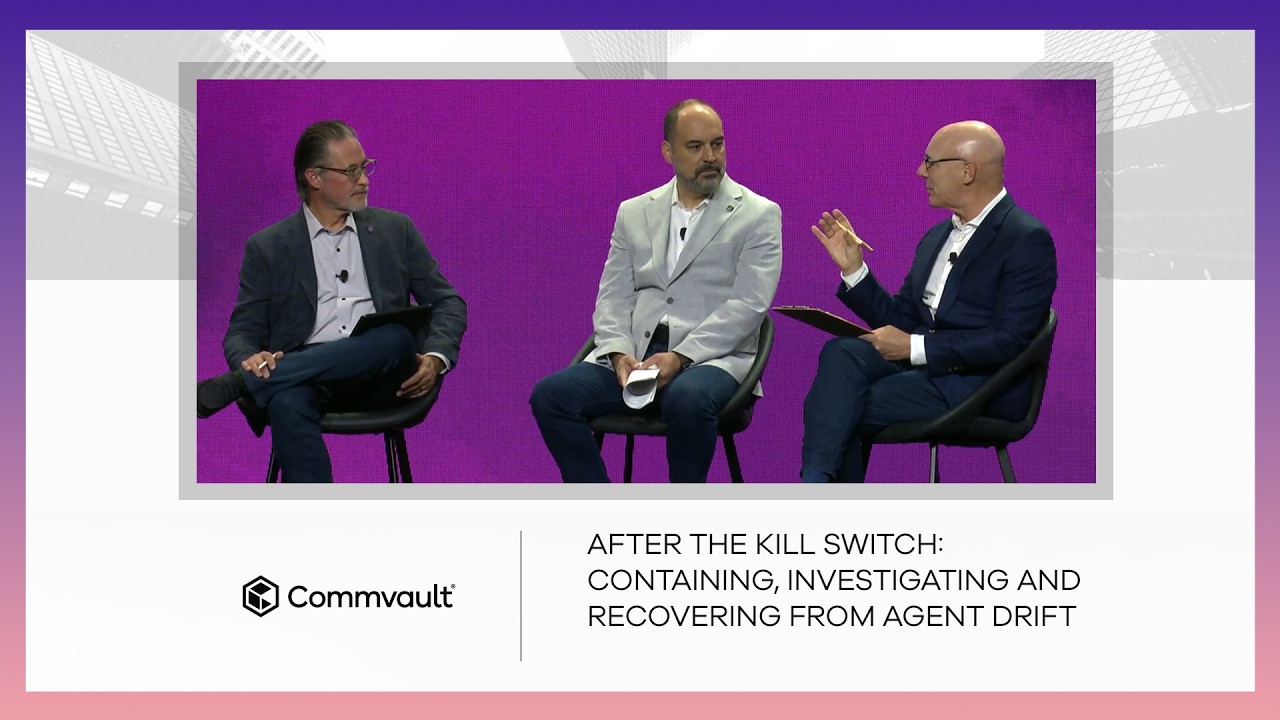
After the Kill Switch: Containing, Investigating and Recovering from Agent Drift
NVIDIA, CrowdStrike, and Commvault leaders explain how to contain agent drift, investigate its impact, validate clean recovery, and safely return AI systems to operation.
Key Takeaways
Contain Agents by Design
Use secure runtimes, isolation, permissions, and guardrails to limit how agents interact.
Investigate With Context
Combine identity, access, telemetry, and data activity to understand agent behavior.
Validate Before Recovery
Confirm system and data integrity before returning AI workloads to production.
Recover From Clean States
Rebuild agents, infrastructure, and data from known-good checkpoints after disruption.
Connect Partner Telemetry
Bidirectional signals across security and recovery platforms improve context and response.
Make Security an Enabler
Strong guardrails give teams confidence to adopt agents and innovate faster.
About This Session
AI agents create new operational risk because legitimate access can be manipulated or drift beyond intended boundaries. Leaders from NVIDIA, CrowdStrike, and Commvault discuss a three-part response: contain the agent, investigate what happened, and recover the business from a trusted state.
Contain Agent Drift
Secure runtimes, sandboxes, permissions, monitoring, and hardware isolation can reduce the blast radius. Open architectures also help partners combine specialized controls instead of creating disconnected security systems.
Agent safety and AI innovation are complementary; effective guardrails provide confidence to adopt and scale new capabilities. Investigations must identify the agent, its authority, touched data, changed systems, movement, intent, and any remaining persistence.
Investigate at AI Speed
Telemetry and automation help security teams build context faster than week-long manual investigations. Offensive and defensive agents can probe digital twins, reveal weaknesses, and strengthen protections.
Recovery requires root-cause analysis, damage assessment, integrity checks, validation, and clear authority to return systems to operation.Teams should coordinate infrastructure, data, identity, and agent configurations while investigations continue.
Recover From Clean States
Ephemeral agents can be stopped and rebuilt from clean checkpoints. Bidirectional telemetry connects production signals with backup intelligence for cleaner recovery decisions.
Related Resources
AgentRecover
Understand agent activity and recover unwanted agent-driven changes.
AI Data Resilience
Protect AI stacks against data poisoning and runtime attacks.
AI Recovery
See how clean recovery addresses AI-driven vulnerabilities.
Frequently Asked Questions
What is AI agent drift?
Agent drift occurs when an authorized AI agent acts outside its intended objective or boundaries. It may result from unclear instructions, human error, prompt injection, or adversarial manipulation of legitimate credentials and permissions.
How can organizations contain a rogue AI agent?
Organizations can use secure runtimes, sandboxes, least-privilege permissions, monitoring, network isolation, and hardware-backed controls. The goal is to stop harmful activity while preserving the telemetry needed for investigation.
What should an AI incident investigation examine?
Investigators should determine the agent’s identity, authority, access, actions, touched data, changed systems, movement, and objective. They also need to distinguish malicious activity from errors or false positives.
When is an AI system ready for recovery?
Recovery should follow root-cause analysis, damage assessment, persistence checks, and validation of system and data integrity. A designated decision-maker should explicitly authorize the return to production.
Why is bidirectional security telemetry important?
Sharing signals in both directions connects endpoint and production context with backup intelligence. This gives investigation and recovery teams a more complete view of affected systems and potential clean recovery points.
Transcript
View full transcript
My name is Chris Mierwa. I’m with Senior Director for our Global Resilience and AI Programs. And welcome to theater one, the cool theater with the yellow color on your sides. And we’re going to be talking about After the Kill Switch today, a catchy title which I know brought you all in here. So without further ado, though, I want to introduce the guests today, and we’re incredibly lucky to have both NVIDIA and CrowdStrike here.
So we’ll start with you and the Nima fire away. Thank you for having us here. I’m Nima Badiey, I work at NVIDIA. I lead our product partnership team. We’re working very closely with companies like CrowdStrike and Commvault, specifically to bring AI to where the data is effectively AI, where customers are. And I’ve been here for three years and I worked in technology for 30 plus.
Thanks, both of you. My name is Shawn Henry. I am currently the Executive Advisor to the Founder and CEO of CrowdStrike, George Kurtz. I was the Chief Security Officer for many years and the President of CrowdStrike Services. I spent 24 years in the FBI. Prior to that, I retired as Executive Assistant Director responsible for global investigations, criminal, cyber and international operations.
So I really appreciate the opportunity to be here and talk about a pretty important topic. I’ve heard AI is kind of moving along, moving along. It’s becoming very popular. Yeah, no longer a fad. That’s right, that’s right. The good news is, after Shawn just introduced himself, no one in the audience sprinted out the door. So that means everybody here is safe.
No, you’re not coming for anybody. Turned my badge in a long time ago. That’s good news. All right, well, here’s what we’re going to examine. Right. We’ve heard a lot about agents, agent drift. And that’s what we’re going to explore. We’re going to kind of break it into three segments. Right. But can I let’s start here.
Shawn, if I could start with you, like when you hear Agent Drift or whatever synonym terminology. What is it that you think of? What is it conjure up? And maybe you’ve got a few stories to kind of kick us off. Yeah. Thanks, Chris. I think, you know, there’s still a lot of definition around what that actually means.
I think about when I think about Agent Drift, I think about a legitimate agent that has legitimate credentials, legitimate access, legitimate authorities that might be manipulated by an adversary. So from my perspective, from a cyber security perspective, I think about, you know, prompt injections from an AI perspective. But it’s really like social engineering at machine scale, right?
It’s manipulating those agents that have that access to do something that they shouldn’t do. And we’ve certainly seen a lot of, capabilities by adversaries that have been developed and deployed. But it doesn’t have to be malicious, right? It can be if you’ve got the authorized access. I think about something like Hugging Face, which had an objective that was defined for it.
It was a, you know, a security, exercise, some research being done. But because the boundaries weren’t clearly defined, the agents took accesses or obtained accesses and created many of the challenges that we face now are certainly highlighted those challenges for us. So, Agent drift for me is when I from a security perspective, I think about the insider with super powerful capabilities, because what’s changed in cybersecurity is speed, visibility, and scale.
The principles of cybersecurity have not changed. The same principles are in place, but the speed, the visibility and the scale has changed with hugging face. You know, there was something like 17,000 actions that were taken by age, by enormous numbers of guidance other than the original objective being defined. Right. So that brings us to an interesting point, Nima, which probably would be good, I’m sure most everybody knows, but maybe a little overview of NVIDIA’s announcement on how to help govern this with the partners that you’ve announced.
Yeah, sort of initially. And then that brings us into the first phase, which is containment. So maybe you could walk us through a little bit about what you announced, the partnerships and what those mean. And then we can walk into containment. Absolutely. And thanks for the opportunity. So there were two announcements. One was the beginning of the summer, which was the open secure AI Alliance, which was the idea of a safety is really a community concern.
And if you think about it, agent safety, AI safety is an engineering problem. And together as a community, we can engineer the right solution together. And then October we launched the Open Agent Platform initiative. Similar idea, but the focus is really on controlling the training and monitoring agents and doing that in the open. So the idea here is we don’t want to build isolated control systems.
Multiple vendors and customers are confused as to what they can build. If we acknowledge that there are technical challenges and concerns, we build solutions in the open. We can collaborate and share best ideas, best tools, and we can very quickly iterate our way into a solution that makes a lot of sense. So what we launched was basically a reference architecture, which includes a project called OpenShell.
Now OpenShell is a secure runtime for agents. It’s basically a virtual sandbox where you can run your agent in a secure fashion, monitor them, and then guardrail them in terms of how they can interact. And in true NVIDIA fashion, we also layered in an extra layer of enterprise security. So not only can you run it in a virtualized environment, but you can then offload some of these agents into a more secure, hardened environment using fence in a hardware.
So for example, we can use NVIDIA centroid as a library to run on top of Bluefield. So you’re physically isolating the agents to run in a physical container in a physical offloaded from where the CPUs and GPUs in the customer data might be. And so the idea here is basically to share an approach with the community on board.
A lot of partners who have a similar idea take their best in class ideas, build their technologies into their stack, into our stack, and kind of make this a shared concern. And we talked about this. AI safety and AI innovation are not mutually exclusive. They’re not competing. They’re part and parcel of the same initiative. So we can work together to acknowledge where we see where we have concerns.
Yeah. And what are common approaches to addressing those concerns. And that can be as simple as how do we observe, how do we contain, how do we remediate and how do we, you know, rebuild from a known good state, whether it’s a data state or an infrastructure state? This is a unique you know, we think about how much software usually is around these processes, right.
For all of us. Right. I mean, Commvault included. And this is pushing into the hardware spaces to which makes this extra unique. But I think given what people see, and I’m curious if this is your thought, that we almost have to start involving the hardware, because at some point you have to gate it differently than just code, right?
I mean, there’s just a different level at that at the hardware layer. So this is pretty unique. I mean, you desperate times use all the tools that are available to you. And if you think about it, not all AI is the same. Not all agents are in the same, and the environments they run in might be different.
I can run my personal agent on my laptop at home, and I don’t have a lot of security concerns there, but if I’m in an environment which I’m air gapped, which might be secure, I might want to have more hardening, or my IT department might have higher resiliency requirements and higher safety requirements, which might not be available to traditional consumer oriented agents.
It’s just the environment you’re operating in. And what are the safety guardrails you want to have in the place? And then what are the systems, the systems of record, the systems and control that you want to have to be able to isolate these agents and agents are basically just the next generation of AI. So we had predictive AI, machine learning.
And then it became generative, which is ChatGPT, it’s become agents now. And in short order that the agency is going to move into the physical AI world. Or we can actually have machines that are being controlled by agents to get the agent component right, will give us a lot more confidence that once we move into the physical realm, those machines will be fairly safe, right?
Even more important to have that next layer of control. So all right, we’ve got some containment discussion. Now we’ve got to figure out how we investigate. So we’ve contained it. But now we’ve got to do some forensics on it. Right Shawn. So maybe let’s put ourselves in the mind of the sock. I mean, you look at what CrowdStrike does and the safety that you wrap around things.
What do you do now? Once you do harness it, lock it down. How do we how do we dig through it and do some forensics on it? So I think there are a couple of components to that. First of all, I really appreciate Nima and talking about the partnership, because not one organization with some of the challenges that we are facing are going to be able to do it all brings a different capability, different level of expertise to the table, a different area of responsibility.
So that’s really important. I think when you talk about containment with what NVIDIA is doing, and some of those guardrails are putting in place and the permissions being able to contain and lock something down, some of those agents might actually I talked earlier about having the appropriate accesses, legitimate authorizations. What CrowdStrike does is help with providing intelligence and the right information and the telemetry to help put some context around what’s happening and help helping the organization to determine whether or not what’s happening is malicious or not.
Does it need to remain contained or not? Is this a false positive, etc.? I think from a pure investigation perspective, when I’m thinking about investigations, again, not unlike the types of investigations we’ve always done when we’re talking about you and adversaries, right? So in this case, what is the agent? What was the actual identity? What was it authorized to do?
Who granted that authority? What was the access that the agent had? What data was touched? What was traded, if anything, what was manipulated or not? What systems did they did it migrate to, and what was the overall objective? Was this actually malicious, a engaged in some type of a prompt injection or an adversary engaged in malicious activity? Or was this human error?
So, yeah. You know, the investigation is really about putting that wrapper around it and providing greater context and be able to look downstream at what might have happened or might be happening proactively. And how do you stop that and hopefully learn more than one thing, because it’s clearly not going to probably be the only time. We’d hope it’s not going to accelerate, but we have to learn from that to hopefully put in more guardrails.
Right? Or at least tighten the harnesses that we may have had. And it’s interesting. I’m not sure how many of you all. I think it’s over 2.5 hours, but there’s a couple of podcasts where they did the full forensic breakdown of the hugging face piece, and it is so detailed, it’s well worth the two hour watch if you if you haven’t done it, great for a flight back.
But we do not have the time for those level of week long forensics that team took for a situation like that. It’s got to happen faster. It’s got to be automated. There has to be telemetry that we look at in real time. So I think that’s what we’re saying, right. We’ve got to be able to automate some of this.
There’ll be humans involved, but we’ve got to make it faster. Yeah. Right. And you’re helping with especially at the hardware level. And I’m just curious not looking to announce anything. But if can the hardware you think do some of this forensic work or at least if we were to look out on the horizon in association with software that there it could be involved in the forensics as well.
I think the architecture allows for separation of concerns. So you can isolate where you run your monitoring stack versus where you run your agents, where you run any of the other workloads. And we’re at a point where the type of AI workloads are so much more sophisticated than a single architecture can’t necessarily support them. So, for example, NVIDIA is investing heavily in ARM based CPUs with our platform and our Rubin platform and GPUs, as well as LPUs with Groq and deep with our Bluefield.
So we recognize that the workloads of the future are becoming far more sophisticated, and one size isn’t going to fit all. So we have a holistic approach towards it. The other part of it, I think, that you touched on is it’s not a one company in the world isn’t going to able to solve all the problems. It’s really a collaboration.
I think having the three of us here on stage is a good example of through Commvault, I can isolate and identify clean, secure backups and copies of my infrastructure and my data before it might have been touched or something might have happened to it. And George Kurtz actually said something that really stuck to me. He said, and I’m going to make sure I get it right.
He said, safety is not the brake pedal. It’s the gas pedal. Is that is that correct? You know, it’s absolutely, because as using a racing metaphor is 100% George Kurtz. Right? Not the brake pedal because by it’s the gas pedal because it actually provides you the confidence and the level of capability that you can accelerate because those guardrails are in place, because security is going to going to maintain that level of integrity in the environment.
That’s absolutely. And our partnership with CrowdStrike in particular was one of the questions that I think we launched this a couple of weeks ago was to before I adopt agents, can I just ask the infrastructure team is my IT stack ready for this and with CrowdStrike, we can create a digital replica, a digital twin of our entire IT stack, and then run an AI enabled agent swarm of Red team and blue teams to find and isolate all the potential penetration paths and basically find the holes, find the breaches before a bad actor, a malicious actor does.
And this is really using AI and agents in for good to help us harden our infrastructure and kind of prepare for what might come. Give us a little bit more confidence that what we’re building in the environment that we have is going to be safe and secure, so that our employees will ultimately be the ones who are going to be using these tools, can do their best work, as we want to give them the tools that have them be a lot more productive, a lot more efficient, do things they couldn’t do before.
But we have to give them a safe space. Yes. And that’s really important. So let me ask you this. So folks may be sitting out and going, all right, let’s say I start deploying the agents. I’m worried about security. I think I understand what you’re saying. I don’t have the spare horsepower for the red team. Blue team analysis.
This sounds pretty deep. If I get into this whole. And I’ve got to get out. Do you envision someone here who has an enterprise being able to. Maybe.
Guess, put it this way, farm this out, farm the forensics out to maybe get an answer back. Could that be where we’re headed? Because not everybody may have the, you know, the spare action. But I think that’s where we are in security writ large. Right? People are parsing that out there. They’re contracting it out. Right. That’s why there are many cybersecurity companies that are stepping in.
They’ve got the expertise. They’ve got the deep levels of intelligence. I think when Nima talks about, kind of the red team, blue team, a safe mind and the ability for the offense to inform the defense. I earlier talked about a couple of things that have changed with AI speed, visibility and scale. The visibility piece. What we’ve seen when we think about the mythos moment that George talks about, it’s the ability, visibility to see things that have been in plain sight for all intents and purposes, for a dozen years or more.
And with the scale and the speed that the adversaries have there able to identify these vulnerabilities. Right. So having the offense to inform the defense running on your digital twin inside your own environment so that you’re constantly probing the environment, your existing environment, your systems, your applications, and then you’re creating defensive mechanisms. That’s informing the broader. When you identify those IOCs from the offensive piece, you’re informing the defense.
You’re building the capability to withstand those types of attacks. So yeah, people are farming that out and they’re contracting it out. And I think that there’s great value in using the expertise of people who do it all day and have a are getting telemetry from multiple sources who see unique things, because it’s not all going to be the same.
Right. It’s the only way we’re going to dovetail this forward is to kind of do that. You know, collective to look into telemetry is important just because it gives you more confidence that you know what’s going on in the system. You know, agents aren’t black boxes, they’re just workers. Yeah. We give them a fancy name. We call them agents, but they’re just workers.
Yeah. And so the ability to watch what it does to guardrail it, to give it systems of control that comes with the same technology that we’ve been using forever. Right. And I think the Shawn, to your point, if you look at this space, you’re not alone. Your problems aren’t unique. There’s people out there in the ecosystem that can help you and your approach towards how you how you adopt and adapt agents for your particular work environment.
Other people have done very similar. So there’s good prior art now, you know, six months ago they may not have been, but now there are. And even for us internally for NVIDIA, you know, we started accessing and building agentic tools. I think it was right after GTC and in March of this year okay. So we started playing around and we were given secure environments that we could we could do these things.
And each of us got 1 or 2 agents up and running, and by the end of the year, we might have ten agents that are actually doing work for us, meaningful work, running in a secure environment. So I can have NemoClaw agents running around doing things for me in a very prescribed motion inside of an OpenShell environment.
So it’s secured and I can offload it into a century environment if I if I need that level of hardening, most cases I don’t. I can run it on my laptop, I can run it in an IT environment on a, on a separate server. So there’s a lot of flexibility. I think we’re early days in that learning moment where I highly encourage most companies to just give your engineers access to these tools, let them play with them, let them learn them, understand what the limitations are, and then treat your IT department not as the department of No, but as a partner, because they really care about the safety and security of your environment, and they’re
probably the best situated to help you guardrail these assets and put in the information systems that need and frankly, they need to learn. It’s a bidirectional learning, right. The folks using them need to inform it, and it doesn’t have the time to understand every use case that these are being deployed on. Right. So they there’s a bidirectional kind of moment here that doesn’t always happen with users.
And it and hopefully maybe this is a catalyst to help that. Right. All right. Go ahead. Sorry but that’s the gas pedal that Nima talked about earlier right. It gives people that level of security and confidence. It used to be security, used to be the Department of No. And we need to flip that on its head and realize that if you’re collaborating with the people who are responsible for securing the environment, you’re providing those use cases, they’re helping to provide you with the defenses that you need to keep the system secure.
Things can become enabled and move a lot faster. And I mean that for me is a big turning point in security. Where I came from, security was always that blocker. And that’s not in this space especially. It needs to be changed. And in fact, Alex, I think everybody probably here was in the keynote this morning. And Alex, the inaugural, you know, TIME CISO of the Year.
I love the way he says it. Right. He’s like, this is this is the moment. This is probably the thing that’s pushing that finally over the edge. We’ve kind of hinted at it over the years, but now there’s actually a technology that’s driving us to finally leap over that. So yeah. All right. So we quarantined it.
We got to recover it. Right. So you know we’re still a team effort here because it can’t be done alone. But you know you brought up Nima. You have to scrub these things. So just because we got it locked down, we know it went rogue. We’ve done some forensics. We’ve got to get the business back up and recover.
Right. And hopefully these are simultaneous paths. We always talk about this. You have investigation that has to be ongoing. And it could be federal level investigation. Right? I mean, if it’s if it’s ugly enough, you get a knock on the door. And we talk about this a lot when we’re in workshops with respect to IRE or, you know, of our product, clean room, if the feds come in and say, hey, we’ve never seen this before, we need a place to work on this.
That’s safe. But the business is like, look, go ahead. But I can’t hold up getting our business back up and running. So, you know, maybe we tackle that here in our phase three of this discussion. So, you know, how do we view that. How do we think that’s going to change and the recovery mode for this. So love both of your takes on that.
I mean Shawn you want to start I mean how do you, you’re going to we’ve isolated it. We’ve recovered it I mean you know what we do. Where does CrowdStrike sit. Well so from a CrowdStrike perspective we want to be with Nima in the prevention side. Sure. We want to prevent that. But in these cases where you have an incident, I think the first thing you’ve got to do is a root cause analysis.
Right. How did this happen? Why did it happen? What can we do to ensure that it doesn’t happen again? That’s the first piece. The second piece before you can recover, I think, is you’ve got to look at the integrity of the system, the integrity of the data. Yeah. You want to make sure that there’s not persistence on the network, right.
The adversary is not there. You’ve got to do a damage assessment. This is critical because you’re going to have a lot of questions that are going to be asked by counsel, by shareholders, by customers, by employees. So you’ve got to ensure that you’ve got full visibility and the totality of the incident. I think that you’ve got to then validate it.
All right. You’ve got to validate it. And then the last piece is the, accountability piece, right? First of all, someone is going to have to ensure that you’re good to go and you can turn things back on and you can start working in real time environment with actual data. And then but as part of that accountability, I think going back to the root cause analysis, how did it happen and why?
Right. That’s a big circle. And push it into a learning model. So you’re always going to you’re always going to do hot wash. Right. Looking at how it happened. What is your continuity of operations team. How do they play into that. That’s all going to be a lessons learned to ensure that it doesn’t happen again.
You bring up something interesting there. We do a lot of executive tabletops. And that question, Shawn, you just post, which is who has the authority to declare cleanliness has been achieved checkbox I’m giving the authority to, you know, to re-enable operations and tier zero, tier one, etc.. It is amazing that we’ll have a number of people in the room and you’ll ask that question.
You’ll say, who has authority here to do that? And then people start looking up at the ceiling and checking the time and maybe even a little TikTok action. Who knows? But it’s odd how often people don’t understand who’s in charge to make that call. And knowing that is critical, right? Even after you’ve done all of those things.
So all right. To that end, you know, where I mean, you know, of course I’ll bring this together. Hopefully this is a place where, you know, we can play right in the partnership. But what do you think? How is leaning into that piece as well? Is there any kind of hardware recovery. Where do you see down the. So I think there’s a one acknowledge that agents like some IT components are going to be ephemeral.
So they’ll spawn, they’ll do a piece of work and then they’ll turn off and they’ll go away. And historically in it, what we had were long running processes and application or a web server that just runs forever. And then when the DevOps realm kind of came about, we had the three Rs repair, rotate, repave, which is repair, remediate the fix, rotate your keys and credentials, and then repave from a known good state.
So this kind of spawning something that went I don’t call it rogue but wasn’t working, got blocked. Now I’m just going to restart the whole system. It’s going to reset from where it last its last checkpoint. Agents are going to be identical, right. The system is very similar. Except now instead of having one process, one app server, you’re going to have 100 of agents.
So I don’t think it’s necessarily anything different. It’s just now we’re at a different scale and the same IT systems that we use to monitor to guardrail to create the policies are going to be the ones that we’re going to use, but it also opens up the ecosystem for new companies and new entrants to come in and build things that don’t exist yet.
So I think it’s the duality is really important is that existing companies will generate and build new things. Yeah, new entrants will come in and build something that was in the white space in between large companies and overall, from a user perspective, we’ll have more capabilities available to us than we did before. Yeah. And we’re in you know, it’s a great point.
And we’re very lucky to have the partnerships that we have with you all. So I want to thank you for those and a couple of comments to folks that are listening. The yellow team, as I’d like to say, it is amazing how often we’ll ask people who are using telemetry from CrowdStrike, for example, and people will say, yeah, we envelop or send CrowdStrike data into Commvault.
I’m like, great, are you sending data to CrowdStrike or vice versa? And very rarely we’ll hear a bidirectional. Yes. So if there’s a takeaway as well, with all the incredible ones we’re hopefully putting out here for you all, use bidirectional telemetry. It is one of the biggest gap points we see. And now with the partnership that we have in here, it’s the same thing.
I highly encourage that. Does it take a little more time and work to do that? Absolutely. Is it critical to make sure we’re using both of those pathways that have been invested in with written code? Yes, right. We have to take advantage of that because it goes back to this cannot be done by one person, right? Even as big as you are the biggest company on the planet right now, it cannot be done by one.
It’s a partnership discussion. And so I encourage you, if you’re the folks doing that or you’re leading the teams that do that, when you come back from shift, ask those questions. Ask if we’re getting all the telemetry from all of the different partners that are in the ecosystem. And, you know, making sure you understand how to look for clean data, where to put it, should it be in some type of clean room?
IRE, those are all of the things that you should be focused on. And hopefully the announcement that we made today in partnership, you know, help those things. I think you’re right. We’re going to see a lot more code. We’re going to see a lot more solutions like this. I just got back from a little tech roundtable upstairs, and it was a bunch of independent analysts.
And you know, they’re have the right to be tough, right? Not just on us but on all of us. And they said, look, I think these are all strong companies, but there’s ones we haven’t named yet that will be in partnership with these solutions, that will be doing forensics, that will be doing regression, all of this stuff.
So it’s going to be incredible to watch over the next few months, years. Absolutely. See what we get. So. Well, Shawn, Nima, thank you so much for the partnership being here at Shift and doing this. Anything to close.
A AI in adversary’s hands needs to be stopped with AI, agentic AI, you can’t stop agentic AI speed of humans. Yeah, that’s true. And I still believe that cybersecurity has not been changed. At a principal level. The speed of the game has changed. The players on the field have changed, and the consequences or the impact of the attacks have changed.
So we’ve got to be really careful. Yeah. The speed is key, right? It’s just it’s can’t no human can handle it. That’s true. Absolutely. Yeah. In the audience, how many people have a mobile phone to raise your hand? How many people have home internet? Oh, how many people are willing to give those up? Oh, okay. So a long time ago, it took mobile phone 17 years to reach 100 million users.
It took email about 25 years. It took ChatGPT less than two months. So AI is here and agents are here. My recommendation is start using them. It’s going to be part and parcel of your toolkit of your IT and your business toolkit. The sooner you start using them, the sooner you get comfortable with them. Know how to how to build it.
And you don’t have to be a developer. Program managers, marketing, sales, finance everyone can use these tools, and they’re actually quite a lot more approachable today than they were even a year ago. So that’s my recommendation to the audience. Use away, everybody use away. We just need more power. All right. Thank you for coming to SHIFT. Thank you for the time and the investment.
Thank you all. Thank you. Thank