Key Takeaways
- Multi-cloud growth can create a resilience gap. As resources multiply across accounts, regions, and cloud providers, maintaining visibility and consistent protection becomes increasingly difficult.
- Continuous discovery helps reduce protection blind spots. Commvault automatically discovers workloads across AWS, Azure, and Google Cloud Platform (GCP), giving teams a centralized view of protected, partially protected, and unprotected resources.
- Protection Groups turn policies into scalable protection. Teams can define protection rules based on attributes such as tags, regions, accounts, and workload types, allowing newly discovered resources to inherit the appropriate protection automatically.
- Auto-scaling eliminates the need for persistent backup compute. Commvault provisions infrastructure when backup or restore jobs run, scales capacity to workload demand, and decommissions resources when jobs finish.
- The result is a more adaptive backup model. Combining discovery, policy-driven protection, and autoscaling helps reduce configuration drift, administrative effort, and unnecessary infrastructure costs while keeping protection aligned with rapidly changing cloud environments.
Most enterprises abandoned the goal of a single, consolidated IT environment some time ago. Infrastructure now routinely spans multiple cloud providers, several regions, and dozens of accounts, each owned by a different team. This autonomy accelerates delivery, but it also introduces significant challenges for the teams accountable for ensuring that every workload remains protected.
The underlying issue is straightforward: Infrastructure scales effortlessly, while data protection does not. New resources are created continuously, configurations drift over time, and visibility across accounts diminishes. The gap between what exists in the cloud and what is genuinely protected continues to widen. And at enterprise scale, that gap is a material risk.
What Is the Multi-Cloud Resilience Gap?
As organizations rapidly expand workloads across AWS, Azure, and GCP, operational complexity often outpaces their ability to maintain consistent visibility, governance, and recovery preparedness. Commvault defines this challenge as the multi-cloud resilience gap.
To address it, Commvault® Cloud now supports Discovery, Auto-scale, and protection groups, helping teams automatically identify cloud resources, adapt protection as environments evolve, and enforce consistent data protection policies across dynamic multi-cloud estates.
The Hidden Pain Points of Enterprise Multi-Cloud Data Protection
Backup teams operating at scale consistently identify the same three pain points.
1. Lack of Centralized Visibility Across Cloud Accounts
Administrators and security teams seldom have a centralized view of every cloud asset. The most critical workloads – those that an organization cannot afford to lose – are distributed across accounts without clear oversight. Organizations cannot protect what they cannot see, and they certainly cannot demonstrate compliance for it.
2. Unsustainable Manual Onboarding and Configuration Drift
Onboarding accounts manually, discovering assets, and configuring backup policies individually is not sustainable in a dynamic environment. Teams are forced either to rely on individual application owners to follow best practices or to impose standardized processes that fail to accommodate how cloud environments actually operate.
3. High Costs from Idle, Pre-Provisioned Backup Infrastructure
Traditional backup depends on pre-provisioned infrastructure, which presents an unavoidable trade-off. Provisioning for peak demand results in ongoing costs for idle compute throughout most of the operating cycle, while provisioning conservatively introduces performance bottlenecks when demand spikes. In either case, persistent infrastructure continues to incur costs even when no jobs are running. Across a large cloud estate, these inefficiencies accumulate rapidly.
Compounding all three challenges are threats that often go undetected: ransomware that can remain dormant in an environment for weeks before discovery, over-permissioned access, and unclassified sensitive data that quietly expands the attack surface.
A Policy-Driven Approach to Multi-Cloud Protection
Commvault is a cloud-native capability that automates the discovery, onboarding, and protection of workloads across AWS, Azure, and GCP, while dynamically scaling backup infrastructure to match demand. Rather than relying on pre-provisioned, persistent compute, it provisions resources on demand when a backup or restore job runs and decommissions them automatically once the job completes.
The solution is built around a policy-driven model in which teams define rules named as “protection group” once, and the system helps enforce them consistently across the environment. By continuously discovering assets, organizing them into protection groups, and applying predefined backup plans, auto-scale helps maintain a real-time, organization-wide view of what is protected and what is not – without the manual configuration that traditional backup approaches require.
This helps deliver consistent protection that keeps pace with the cloud, lower infrastructure costs, and reduced operational overhead.
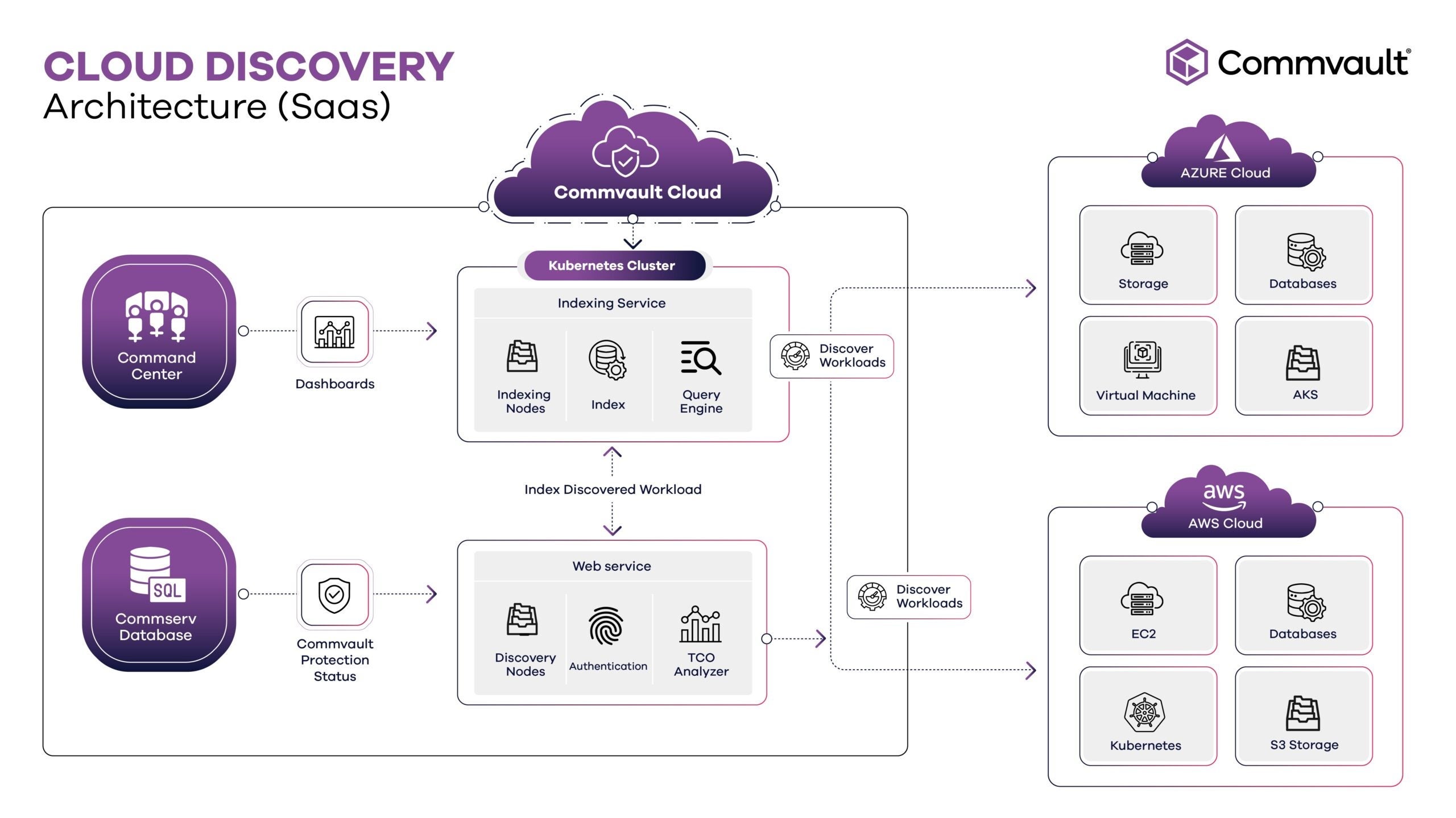
Fig: Commvault’s Cloud Discovery Architecture for Multi-Cloud Backup Visibility
1. Automated Discovery Across AWS, Azure, and GCP
The process begins with discovery. By connecting securely to AWS, Azure, and GCP, Auto-scale automatically identifies compute instances, object storage such as S3, managed databases including RDS, Redshift, and DynamoDB, and other critical workloads. This helps reduce manual tracking and spreadsheets in favor of a real-time inventory of the environment.
2. Organization-Level Onboarding Under One Control Plane
From discovery, the solution moves to onboarding at the organization level. Rather than configuring backup on an account-by-account basis, teams connect entire cloud environments at once, define scope using tags, regions, or policies, and consolidate multiple accounts under a single control plane. The result is a unified view and consistent governance across the organization, supported by clear status indicators that immediately surface assets classified as “not protected” or “partially protected.”
3. Translating Discovery into Protection Through Intelligent Grouping
Identifying assets is only the first step. With protection groups, administrators can define rules based on attributes such as tags, regions, accounts, or workload types to determine which resources should be protected.
As new assets are discovered, Auto-scale automatically identifies and associates eligible resources with the appropriate protection groups, helping verify that they inherit the correct backup plans and protection policies without requiring manual intervention.
This is where the “define rules, not configurations” approach delivers value. Instead of managing protection settings for individual assets, teams establish policy-driven criteria once and allow the system to apply them automatically at scale. The result helps provide more consistent protection coverage, reduced administrative overhead, and less risk of configuration drift as cloud environments evolve.
The Commvault Auto-scaling Workflow: Provision, Execute, and Decommission
Traditional backup systems rely on fixed compute infrastructure that continues running even when idle. Commvault replaces this with an on-demand model that provisions compute only when backup or restore jobs begin.
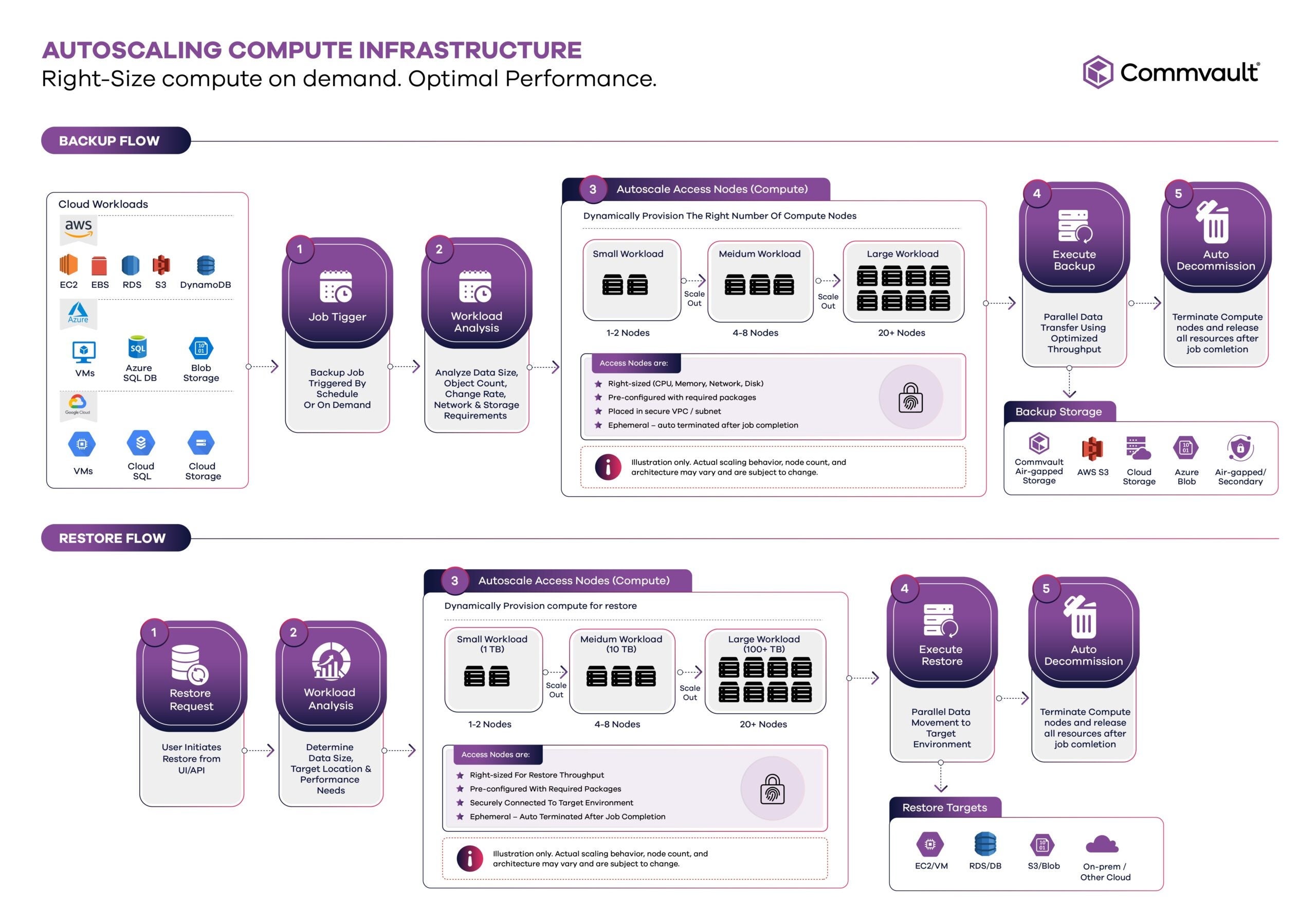
Fig: How Commvault Auto-Scaling works
The system helps evaluate workload size and complexity, allocate the required compute capacity dynamically, and scale resources accordingly. Large workloads can provision multiple nodes in parallel, while smaller workloads consume fewer resources. Once the job completes, all compute is automatically decommissioned – enabling the infrastructure to match demand without incurring unnecessary idle costs.
A Single Provisioning Engine
Administrators configure virtual machine size, region, networking, tags, and access controls once through a centralized Scale Config wizard, with native support for Azure, GCP, and AWS environments.
Operational Conveniences That Compound
Several features help reduce operational complexity – automated node registration, policy-driven scaling, automatic reclamation of idle resources, and integrated debug log streaming that simplifies monitoring and troubleshooting during scaling events.
The Operational Benefits of Dynamic Multi-Cloud Backup Scaling
By combining continuous discovery, policy-driven protection, and autoscaling infrastructure within a single framework, Commvault helps deliver measurable operational and business impact. The result is not just more efficient backup operations, but a model that scales consistently across complex multi-cloud environments while helping reduce administrative overhead and unnecessary infrastructure costs. The business value is realized in three key areas.
1. Cost Efficiency: Pay Only for What Runs
Auto-scale helps right-size compute for each workload and eliminate persistent infrastructure, so that organizations pay only for the resources used during active jobs. Idle and orphaned compute is automatically removed.
2. Operational Simplicity: Less Maintenance, More Strategic Focus
Policy-driven autoscaling helps eliminate the need to manually estimate infrastructure requirements, manage systems across accounts, or continuously adjust configurations, allowing teams to focus on governance and strategy.
3. Enterprise Scale and Security: Consistent Protection Everywhere
With centralized visibility and policy-based controls, organizations can apply consistent protection across backup, restore, and threat workflows while maintaining isolated, resilient recovery environments.
From Reactive to Adaptive Backup
As cloud environments scale, the traditional approach-manual processes, static infrastructure, and fragmented visibility-is no longer viable. Commvault shifts backup from a reactive to an adaptive model: It helps automate routine work, scale infrastructure dynamically, and unify operations within a single policy-driven framework.
Cloud environments are evolving rapidly, and backup strategies should evolve at the same pace. The relevant question is whether the current approach is genuinely built for the scale and complexity the organization operates at today, or whether it is quietly constraining the business.
FAQs
Q: What is the multi-cloud resilience gap?
A: The multi-cloud resilience gap is the challenge that emerges when cloud environments grow faster than an organization’s ability to maintain consistent visibility, governance, and recovery preparedness across them.
Q: How does Commvault improve visibility across multi-cloud environments?
A: Commvault continuously discovers cloud resources across AWS, Azure, and GCP and brings them into a centralized view. This helps teams identify resources that are protected, partially protected, or not protected without relying on manual inventories or spreadsheets.
Q: What are protection groups?
A: Protection groups allow administrators to define rules based on attributes such as tags, regions, accounts, or workload types. Eligible resources then can be associated with the appropriate groups, and inherit predefined backup plans and protection policies.
Q: How does Commvault Auto-scale work?
A: When a backup or restore job begins, Commvault helps evaluate the workload and dynamically provision the compute capacity needed to execute it. It can help scale the number of resources according to demand and automatically decommission that compute when the job completes.
Q: How can auto-scaling help reduce cloud backup costs?
A: Instead of maintaining pre-provisioned compute that continues generating costs while idle, Auto-scale helps provision resources on demand and remove them when they are no longer needed. This better aligns infrastructure consumption with active backup and restore workloads.
Q: Does Commvault support AWS, Microsoft Azure, and GCP?
A: Yes. Commvault enables discovery, onboarding, protection, and auto-scaling capabilities across AWS, Azure, and GCP.
Q: How does Commvault help reduce manual backup administration?
A: Commvault helps combine organization-level onboarding, automated discovery, protection groups, policy-driven protection, automated node registration, autoscaling, and reclamation of idle resources. This helps shift administrators away from configuring and maintaining protection resource by resource.
Chandresh Sharmais Principal Engineering Manager at Commvault.