Artificial intelligence is redefining what’s possible for modern enterprises: accelerating innovation, sharpening decision-making, and unlocking new efficiencies at scale. Behind every AI-driven insight lies a physical reality—one powered by energy, infrastructure, and data.
As AI adoption grows, so does the need to efficiently manage and protect data at scale.
The future of AI will not be defined by intelligence alone, but by how responsibly that intelligence is built and sustained.
Three Key Levers of Environmental Impact
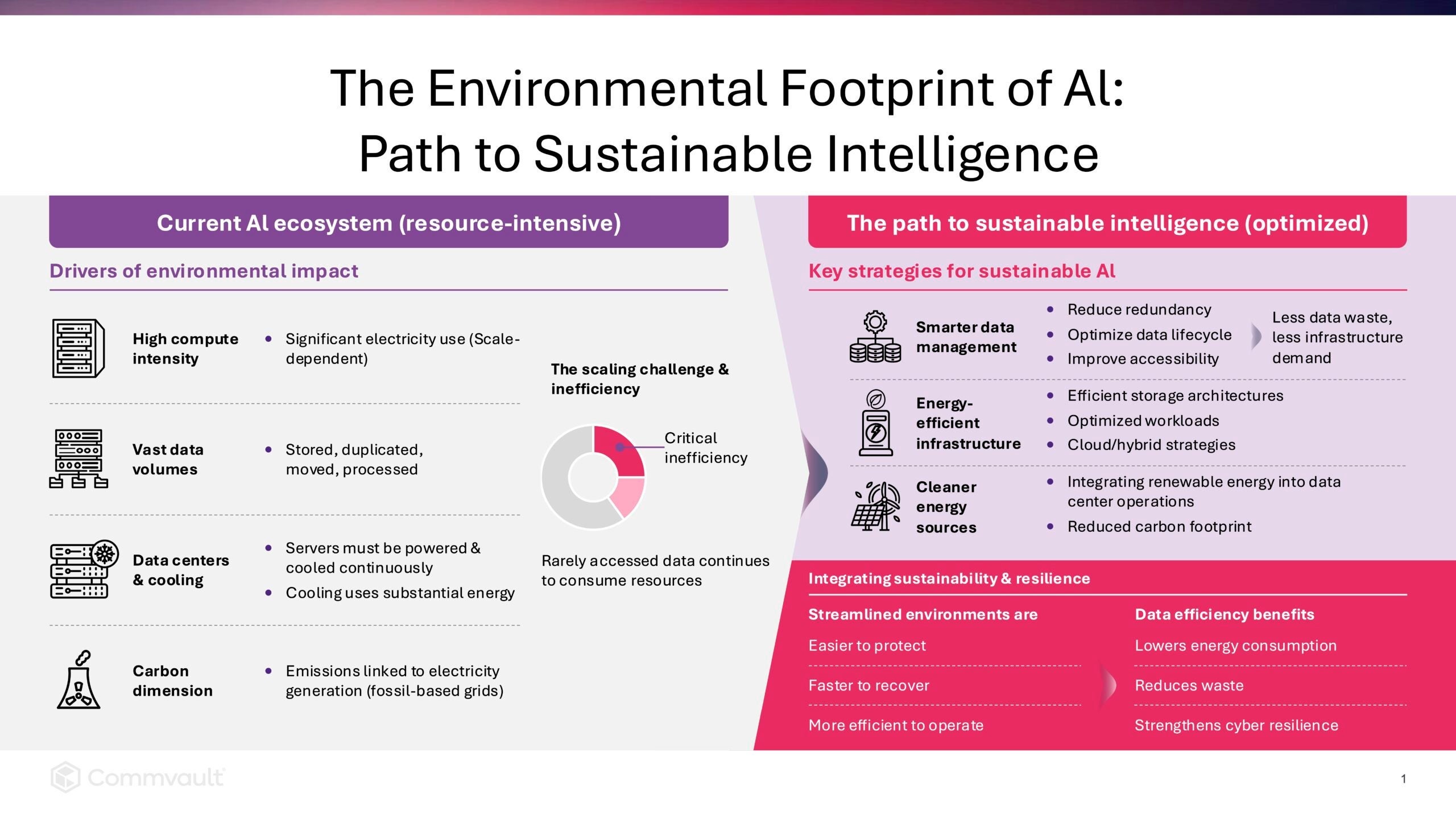
The environmental impact of AI is rooted in the compute infrastructure that powers it. Training and running AI models requires high-performance systems that consume electricity. But compute intensity is only part of the story.
AI depends on vast amounts of data—stored, moved, and processed across systems, each contributing to resource use.
All of this is supported by data centers, where servers must be powered and cooled. Cooling systems can represent a meaningful portion of energy use, making data infrastructure design a critical factor in AI sustainability.
Finally, the environmental impact of AI is influenced by how electricity is generated: the same workload can result in very different carbon emissions depending on the energy source.
Curb Inefficiency, Not Innovation
AI is scaling rapidly as organizations deploy it across functions, generate more data, and expand infrastructure to keep pace. A key inefficiency often goes unnoticed: half of enterprise data is never accessed after being stored.1 Companies pay to store it without realizing value from it. This is where the environmental footprint of AI can expand—not through innovation, but through inefficiency.
Addressing this starts with better visibility and control over data.
Smarter Data: A Powerful Sustainability Lever
Because AI leverages large datasets, organizations can help reduce environmental impact by addressing inefficient data practices that create unnecessary workloads.
Commvault solutions offer several features that help enterprises efficiently manage and leverage data:
- Deduplication to remove redundant data
- Tiering to align storage and processing with access needs
- Compression to reduce storage requirements
Intentional data management helps improve efficiency and reduce resource use.
Sustainability and Resilience: Two Sides of the Same Strategy
Data environments filled with redundant and unorganized data are not only energy-intensive, they are also harder to secure, govern, and recover. Complexity increases risk and complicates business continuity plans.
By helping organizations manage, protect, and leverage their data, Commvault supports systems that are both resilient and sustainable. Smarter data management can help reduce waste, improve efficiency, and strengthen cyber resilience.
The Path Forward
The future of AI will be shaped by the choices organizations make today. Leaders in this space will:
- Treat data as a strategic asset—not just a growing volume
- Design AI systems with efficiency and lifecycle management in mind
- Integrate resilience into every layer of their operations
With smarter data management, optimized infrastructure, and responsible design, organizations can reduce the environmental impact of AI—while unlocking its full potential.
Less waste. More resilience.
Aakanksha Kashyap is ESG Specialist at Commvault.