Conversational Resilience: The New Way to Manage and Protect Enterprise Data
Conversational resilience is a Commvault® Cloud capability that lets you manage and protect data through natural language.
Updated May 2026
Key Takeaways
AI-enabled conversational resilience transforms data protection by helping enable secure, governed, natural-language control of workloads – directly within the tools enterprise teams already use.
-
Natural-language data protection via AI assistants (ChatGPT, Claude) in Commvault® Cloud.
-
Governed, auditable AI-enabled actions aligned with enterprise Responsible AI principles and the NIST AI Risk Management Framework.
-
Direct invocation of protection workflows within application and DevOps environments.
-
Decentralized execution with centralized oversight, compliance, and cost control.
-
Streamlined protection of cloud-native workloads with minimal operational change.
Your global enterprise operates across on-premises data centers and multiple cloud environments, creating a complex data protection landscape. You manage hundreds of policies, storage locations, identity integrations, and compliance requirements.
When a security incident occurs – or an audit requires proof of recoverability – you likely must navigate multiple consoles, review logs, confirm configurations, and execute recovery workflows under tight deadlines. At the same time, business stakeholders look to you for clear answers about risk exposure and recovery posture.
Even routine tasks, such as validating backup coverage or running recovery tests, typically demand specialized knowledge and manual effort. This complexity can slow your response time, increases the risk of human error, and creates friction between security, infrastructure, and compliance teams.
Conversational resilience is a capability in Commvault Cloud that replaces console-hopping and manual workflows with natural language – so your team can ask questions about risk posture, validate backup coverage, and initiate recoveries directly. The result: less manual effort and faster response times, even across complex, multi-team environments.
The average cost of downtime per minute turns operational friction during recovery into more than an inconvenience; it becomes a measurable business risk.
What is Conversational Resilience?
Data protection has long relied on specialists navigating complex consoles, scripts, and workflows. Conversational resilience introduces a new interface: natural language.
With conversational resilience, you interact with Commvault® Cloud through supported generative AI assistants such as Anthropic’s Claude or OpenAI’s ChatGPT Enterprise. Instead of switching dashboards or writing API calls, you can issue requests like, “Check my backup status” or “Set up protection for Docusign.”
This capability is built on Commvault’s Model Context Protocol (MCP) server. MCP securely translates natural language intent into validated, policy-driven actions inside Commvault Cloud. Rather than a standalone chatbot layered onto the platform, this is a standards-based integration built to work within your existing enterprise controls.
How Does Conversational Resilience Work?
Conversational resilience connects AI assistants to Commvault Cloud through tMCP, an open standard introduced by Anthropic for secure system-to-system interaction.
When you submit a request through a supported assistant, it’s routed through Commvault’s MCP server. MCP authenticates your identity, validates permissions using role-based access controls (RBAC), and executes authorized API calls. Every action is logged for auditing – with authentication, encryption, and policy enforcement built directly into the conversational workflow.
Because MCP is standards-based, it is designed to interoperate with assistants that support the protocol. Commvault has validated integration with Claude and plans to expand support over time.
MCP also enables integration across a broader AI ecosystem – supporting orchestrated recovery tasks, workflow automation, and connections to IT service platforms – while maintaining centralized governance.
Why Does Conversational Resilience Matter?
Cyber resilience operations are growing more complex. Multi-cloud architectures, SaaS expansion, and evolving cyber threats demand speed and precision – often from lean teams.
Conversational resilience helps reduce friction between intent and action. You describe what you want to accomplish in plain language, and authorized actions help execute within defined controls. That helps accelerate workflows, reduce manual steps, and support faster response to incidents or policy changes.
It also helps broaden operational accessibility. Teams can complete guided tasks without deep console expertise, while administrators retain full control through RBAC and audit logging.
Most importantly, it helps preserve governance. Every request is authenticated, authorized, and recorded. The conversational interface helps extend enterprise safeguards into AI-enabled workflows rather than bypassing them.
As AI becomes embedded across IT environments, resilience platforms must integrate securely. Conversational resilience helps align cyber operations with that shift.
Key Capabilities
-
Natural language interaction with Commvault Cloud
Users can check backup status, initiate recoveries, and configure protection using plain language through supported AI assistants, helping teams move faster. -
Standards-based integration via MCP
Conversational resilience connects AI assistants to Commvault Cloud through MCP, an open standard for secure system interaction that aligns with enterprise architecture and integration requirements. -
Enforcement of authentication, encryption, and RBAC
Every conversational request is authenticated, encrypted, and validated against RBACs, preserving established security policies within AI-enabled workflows. -
Policy-driven API execution within defined permissions
Natural language input is translated into authorized API calls that operate strictly within assigned roles and policies, reduce the risk of misconfiguration or unauthorized changes. -
Full audit logging of conversational actions
All requests and resulting actions are recorded through established audit mechanisms, providing traceability for compliance reviews and investigations. -
Extensible integration across supported AI assistants and IT platforms
The MCP framework is designed to interoperate with compatible AI assistants and enterprise systems, helping support workflow orchestration while maintaining centralized governance.
Seamless Integrations
Work with AI assistants and IT platforms you already use – with more integrations on the way.
-

Claude (Anthropic)
-

ChatGPT Enterprise (OpenAI)
-

Docusign
-

ServiceNow
-
Commvault MCP Server (GitHub –open source)
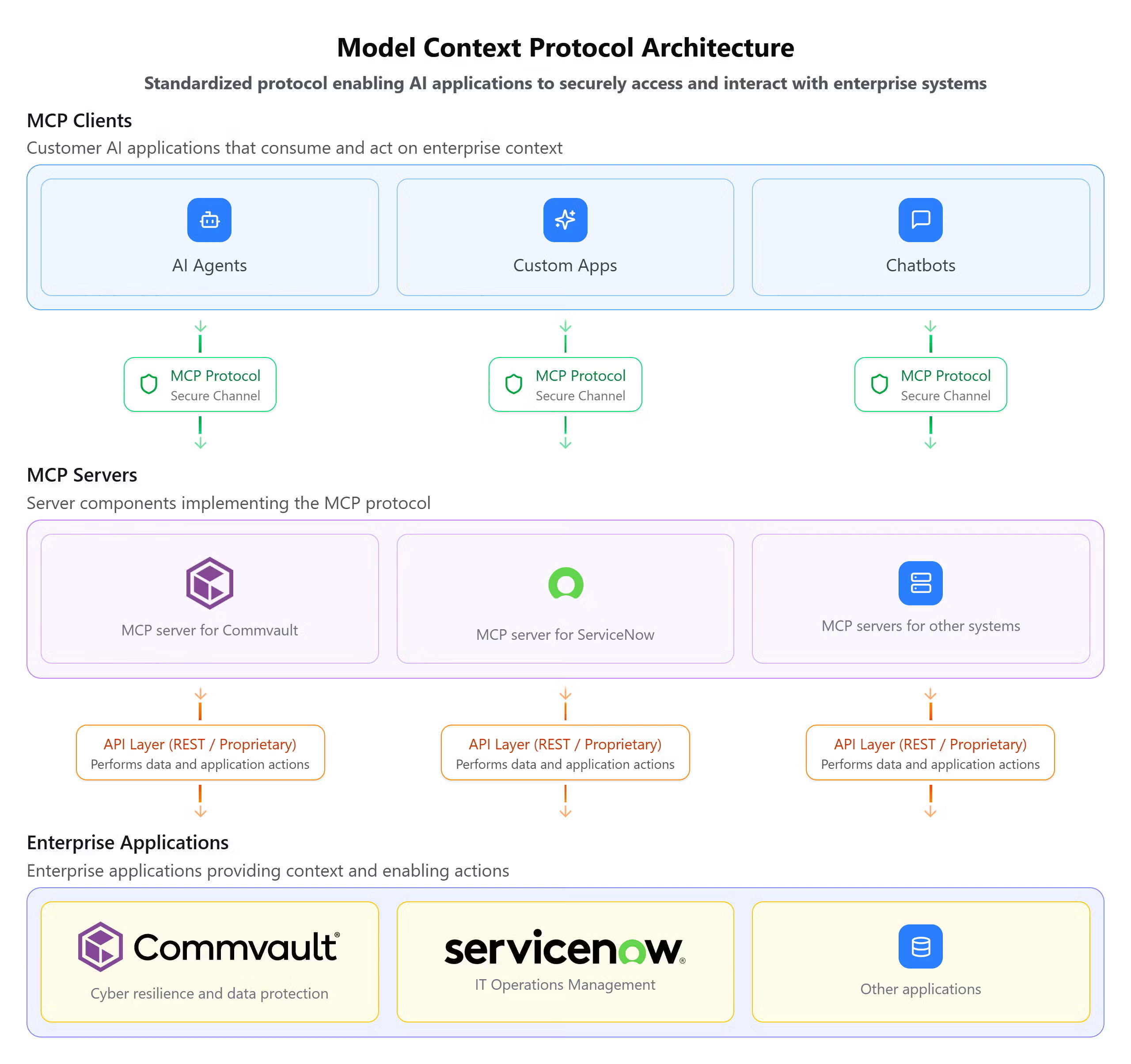
How do AI clients connect?
-
How do AI clients initiate requests?
AI assistants, applications, and conversational interfaces connect through the MCP to securely request enterprise context and trigger approved actions. -
How is the MCP channel secured?
Each client communicates through an encrypted MCP channel that helps authenticates requests, enforce policies, and protect sensitive enterprise data in transit. -
How do MCP Servers translate requests?
MCP servers (such as Commvault’s and other compatible systems) interpret requests, apply governance rules, and translate natural language prompts into structured system operations. -
How does the API layer execute tasks?
Standard REST or proprietary APIs perform underlying data queries and application actions, helping verify accuracy, consistency, and controlled execution. -
How do enterprise platforms deliver results?
Enterprise platforms such as Commvault and ServiceNow provide contextual data, execute workflows, and return results to users through a unified, conversational experience.
To see how these elements connect, review the architecture diagram below. It illustrates how AI clients securely access and interact with enterprise systems.
Is conversational data protection for my team?
Conversational resilience is built for both specialists and non-specialists who need to act quickly on data protection.
For security and backup administrators, it helps accelerate incident response by reducing manual steps and enabling faster validation, investigation, and recovery through natural language.
For IT leaders, application owners, and compliance stakeholders, it helps provide clear visibility into protection status and risk posture – without requiring deep expertise in backup systems or multiple consoles.
This shared interface helps teams align faster, respond with confidence, and operate within established governance controls.
Conversational Resilience helps reduce the gap between knowing there’s a problem and doing something about it. Replacing console-hopping and manual workflows with governed natural-language interactions can help security and operations teams validate coverage, initiate recovery, and respond to incidents in fewer steps – without increasing risk or stepping outside established access controls. For enterprises managing complex, multi-cloud environments with lean teams, that speed is measurable.
Frequently Asked Questions
What is conversational resilience?
Conversational resilience is a Commvault Cloud capability that helps allow teams to interact with their backup and recovery environments using natural-language prompts through enterprise AI assistants such as ChatGPT Enterprise and Claude. It simplifies operations, helping users perform protection and recovery tasks through intuitive, plain-language interactions – without navigating multiple consoles or requiring deep platform expertise.
What are “agentic operations”?
Agentic operations go beyond basic chat, helping enable AI assistants to act on behalf of authorized users within defined governance boundaries. In Commvault Cloud, these operations are built on the MCP server, allowing recovery and protection workflows to be automated within policy-controlled, role-based, and auditable processes.
How does the MCP work?
MCP acts as a bridge between generative AI assistants and Commvault Cloud. It helps convert natural-language requests into authenticated API calls that run within existing enterprise policies. MCP actions pass through standard REST APIs – so RBAC, authentication, and event logging apply automatically.
How are operations kept governed and transparent?
MCP is designed for policy-controlled automation. Tasks initiated through conversational or agentic workflows are logged and subject to RBAC permissions. These capabilities are aligned with the NIST AI Risk Management Framework (AMF 1.0) and Commvault’s Responsible AI principles to help customers maintain oversight and accountability.
How do conversational and agentic resilience differ?
Conversational resilience allows users to request information or start protection and recovery tasks using natural language. Agentic resilience builds that capability by allowing AI assistants, under customer-defined policies, to carry out approved actions with full visibility and audit trails.
What workloads and systems are currently supported?
Conversational resilience currently supports backup and recovery workflows for Docusign, with additional workloads on the roadmap. Through MCP, it also integrates with IT service platforms such as ServiceNow, helping enable users to create and update incidents for backup jobs directly through conversation.
Explore related resources

See Conversational Resilience in Action

AI In Commvault Cloud