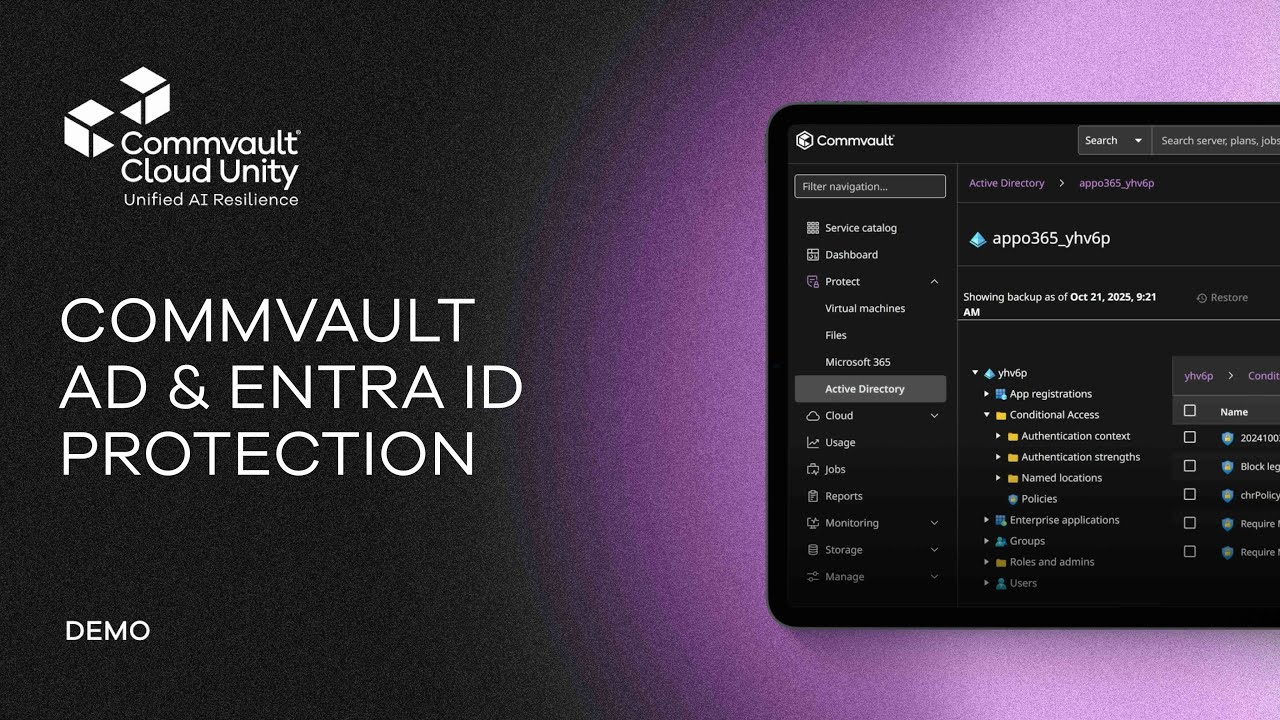
See Identity Resilience in Action
Active Directory and Entra ID are the foundation of enterprise access — and the #1 target for attackers. This demo shows how Commvault helps you assess risk, detect and contain threats in real time, and recover your identity environment completely and cleanly.
- 5 min 20 sec
- Updated Jan 2026
Key Takeaways
- Proactively reduce your attack surface. Commvault’s AD vulnerability assessments scan for misconfigurations and exposed credentials — like accounts with non-expiring passwords — before attackers can exploit them.
- Detect and contain threats the moment they occur. Real-time AD auditing captures every change, flags suspicious activity such as unauthorized privilege escalation, and enables one-click rollback of malicious changes — without leaving the same console.
- Recover your entire identity environment with confidence. Commvault automates full Active Directory Forest recovery through intuitive runbooks, visual topology views, and clean-VM rebuilds — dramatically reducing downtime and business disruption.
- Manage hybrid identity from a single control plane. Unified coverage across on-premises Active Directory and cloud-based Entra ID simplifies operations, reduces tool sprawl, and gives security leadership assurance across the full hybrid environmen
About This Video
Identity systems are the keys to your enterprise — controlling access to every application, system, and data source your business depends on. When Active Directory or Entra ID is compromised, operations can stop within minutes. AD outages alone cost organizations an average of $730,000 per hour.
This demo walks through Commvault’s end-to-end approach to identity resilience: how to assess AD vulnerabilities before attackers exploit them, audit and roll back malicious changes in real time, and execute automated forest recovery that brings your environment back to a known-clean state.
Whether you’re an Active Directory architect responsible for day-to-day identity operations or a CISO building your cyber resilience posture, this demonstration shows how Commvault helps you stay in control of your most critical systems — across both on-premises AD and cloud-based Entra ID.
Related Videos



Related Resources
How Do You Protect and Recover Active Directory After a Cyberattack?
Commvault® Cloud Backup and Recovery for Active Directory
Explore Solutions
Identity resilience is one part of a comprehensive cyber resilience strategy. Explore how Commvault protects and recovers across your entire environment.
Identity Resilience
Govern Access Across Identities and AI Models
Access governance starts with identity. See how Commvault connects data security with identity resilience to enforce consistent least-privilege access across human users, service accounts, and AI models — from a single control plane.
Cyber Resilience
Protect and Recover with Confidence
Commvault’s cyber resilience platform integrates data protection, threat detection, and recovery operations into one unified solution — built for the threats enterprises face today.
Identity Resilience for Active Directory
Resilience for Your Most Critical Identity Systems
Full forest recovery, granular GPO rollback, visual topology views, and runbook automation — purpose-built to protect and recover Active Directory at enterprise scale.
Frequently Asked Questions
What is identity resilience?
Identity resilience is an organization’s ability to protect, monitor, and fully recover its identity provider — such as Active Directory or Entra ID — in the face of cyberattacks, misconfigurations, or accidental deletion. It helps identity services to remain available and trustworthy, even after a serious security incident.
Why is Active Directory a primary target for attackers?
Active Directory controls authentication and access across an organization’s entire environment — every user, application, and system. Compromising AD gives attackers the ability to move laterally, escalate privileges, and deploy ransomware at scale. Eighty percent of breaches involve compromised identities, making AD resilience a foundational security requirement.
How does Commvault detect unauthorized changes to Active Directory?
Commvault’s AD change auditing captures all changes made to the directory in real time — including user and group modifications, login events, and changes to Group Policy Objects. When suspicious activity is detected, such as a backdoor account being added to domain admins, security teams can filter the activity feed and roll back malicious changes from the same view.
What does Active Directory Forest Recovery involve?
A full Active Directory Forest recovery can require 50 to 100 individual steps depending on the number of domains and domain controllers. Commvault automates this process using visual topology views that show the full AD Forest structure, intuitive runbooks that orchestrate every recovery step, and clean-VM rebuilds that stand up domain controllers on newly created systems for faster, cleaner outcomes.
Does Commvault support both Active Directory and Entra ID?
Yes. Commvault’s unified control plane delivers protection and recovery across both Active Directory and Microsoft Entra ID — as well as Okta. This hybrid coverage eliminates the need for separate tools and gives teams a single view of their entire identity environment.
Transcript
View transcript
Transcript
Chapter 1: Rising Threats to Identity Systems Cyberattacks targeting identity systems are rising fast. Active Directory and Entra ID serve as the core of user access, application availability, and business continuity — making them prime targets for attackers. Throughout this demo, we’ll highlight how Commvault’s capabilities address the unique needs of technology and security leaders through proactive risk assessment, real-time threat detection and response, automated clean recovery, and unified management. Commvault provides identity resilience, protecting Active Directory and Entra ID from attacks, misconfigurations, and compromise. Our unified control plane helps enable you to assess risk, identify malicious activity, and recover cleanly — all from one platform. Every strong defense starts with visibility. Our AD vulnerability assessments conduct a comprehensive identity posture scan, identifying misconfigurations and exposures that attackers might exploit. This helps enable you to proactively reduce risk and support compliance. It’s a way to catch issues before they turn into incidents. The overall score indicates the level of risk based on the number and severity of indicators of exposure identified. Let’s look at one example: accounts with passwords that never expire. These credentials provide ideal opportunities for attackers. Each indicator has a severity rating and outlines the potential impact if it is exploited. Additionally, Commvault specifies the steps needed to remediate each vulnerability — including all users whose passwords are set to never expire. Assessments give you the map. But the moment an attacker acts, you need to know fast. Commvault’s rapid AD auditing provides visibility into change, alerting you to suspicious activity as it happens. All changes made to Active Directory are recorded with essential details. Both successful and failed logins are also captured, providing a complete picture of user activity. Here, we see a sequence of suspicious AD events: a backdoor account created using a compromised user account, added to domain admins, and a malicious Group Policy Object created and linked to the domain head — designed to deploy ransomware. Once you identify the suspicious activity, you can easily filter the activity feed to find all other changes made by the compromised account. Commvault AD auditing not only detects changes — it enables you to rapidly contain them. From the same view, you can roll back the malicious GPO link, restoring the environment to a known-good state.
Chapter 2: Proactive Risk Assessment and Threat Detection Reversing the attack chain with one action helps minimize downtime, limit the blast radius of attacks, and maintain trust in your environment. Your rollback halts the attack — but how do you prevent it from happening again? Let’s revisit our assessment results. The same compromised account appears in our results. The account had a stale password that was set to never expire. The assessment highlights other accounts with the same vulnerability. By removing non-expiring credentials and strengthening password policies, you close one of the most common attacker entry points. Even with strong defenses, no organization is immune to compromise. Commvault Forest Recovery automates one of the most complex processes in IT: rebuilding an entire Active Directory Forest after ransomware or corruption. Commvault’s visual view of the AD Forest displays the topology of domains and domain controllers and highlights the key roles each DC holds. A forest recovery may involve 50 to 100 steps or more, depending on the number of domains and DCs. Using intuitive runbooks, Commvault orchestrates every step. We take recovery further with Recovery AD to clean VM, which allows rebuilding domain controllers on newly created systems — enabling faster, cleaner recoveries and less business disruption. Modern enterprises operate hybrid environments with identities spanning on-premises AD and cloud-based Entra ID. Commvault’s unified control plane provides assessment, auditing, detection, and recovery across both platforms. This simplifies operations, reduces tool sprawl, and assures leadership that hybrid identity resilience is truly unified. Commvault delivers a comprehensive approach to identity resilience — helping you proactively assess risks, detect and contain threats quickly, and recover your Active Directory and Entra ID environments with confidence. With Commvault, you’re not just backing up data. You’re protecting the foundation of your business.